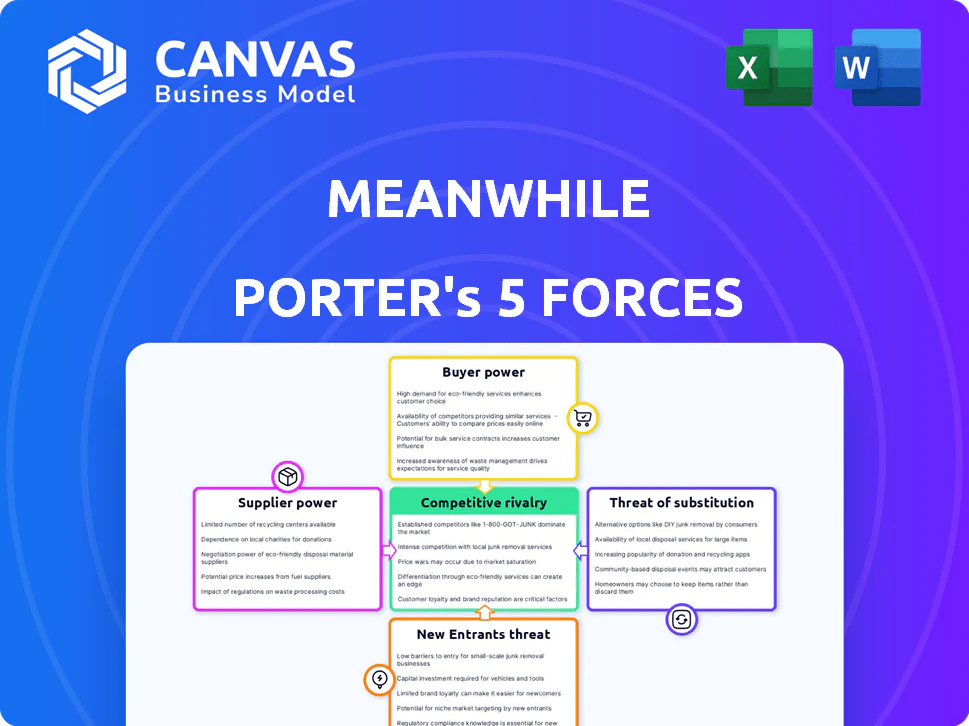
MEANWHILE PORTER'S FIVE FORCES TEMPLATE RESEARCH
What is included in the product
 Detailed Word Document
Analyzes Meanwhile's competitive position by assessing industry forces and potential impacts.

 Customizable Excel Spreadsheet
Unlock immediate strategic insights with interactive force pressure sliders—for optimal market navigation.
Full Version Awaits
Meanwhile Porter's Five Forces Analysis
This preview showcases the complete Porter's Five Forces analysis. You're seeing the exact, fully formatted document. After purchasing, you'll instantly receive this same professional analysis. It's ready for immediate download and use. No hidden content or edits are needed.

Porter's Five Forces Analysis Template

From Overview to Strategy Blueprint
Meanwhile's industry landscape is shaped by powerful forces: competitive rivalry, supplier power, and the threat of substitutes. Buyer power and the threat of new entrants also significantly impact its strategic position. Understanding these forces is crucial for effective decision-making. This brief snapshot only scratches the surface. Unlock the full Porter's Five Forces Analysis to explore Meanwhile’s competitive dynamics, market pressures, and strategic advantages in detail.
Suppliers Bargaining Power

Availability of Bitcoin
The bargaining power of Bitcoin suppliers hinges on its availability to Meanwhile. Bitcoin's liquidity, while improved, can still pose challenges, especially during high-demand periods. In 2024, Bitcoin's price volatility saw significant swings, with daily fluctuations sometimes exceeding 5%. Securing reserves could be costly.
Custodial Services
Custodial services are crucial for Bitcoin reserves, influencing supplier power. Reputable custodians with strong security and competitive fees have more power. Availability of alternative providers affects this power dynamic. In 2024, the market saw various custodians, like Coinbase Custody, managing billions in assets.

Regulatory Compliance Providers
Regulatory compliance providers, supplying crucial legal and regulatory expertise for insurance and cryptocurrency, hold significant bargaining power. Their specialized knowledge is vital for navigating complex landscapes. Demand for these services is high, especially in the evolving crypto space. For example, the global regtech market was valued at $12.3 billion in 2023, showing considerable growth.

Technology and Security Providers
For Bitcoin-denominated insurance, suppliers of technology and security hold significant bargaining power. The reliability and security of the technology infrastructure are crucial, given the sensitivity of financial transactions. Switching costs are high due to the need for specialized expertise and integration. The global cybersecurity market is projected to reach $345.7 billion in 2024, emphasizing the importance of robust security.
- High switching costs increase supplier power.
- Dependence on security protocols strengthens supplier leverage.
- The market size in 2024 for cybersecurity is $345.7B.
Data and Analytics Providers
Data and analytics providers significantly influence the insurance industry's efficiency. Suppliers of underwriting, risk assessment, and policy management tools hold considerable power. This is due to the uniqueness and accuracy of the data and insights they offer, which are crucial for insurers. For instance, in 2024, the global market for insurance analytics is estimated at $8.5 billion, showcasing the sector's dependence on these providers.
- Market Growth: The insurance analytics market is projected to reach $16.2 billion by 2029, growing at a CAGR of 13.7%.
- Data Accuracy: High-quality data providers can reduce claims processing time by up to 20%.
- Provider Concentration: The top 5 data analytics firms control about 60% of the market.
- Technological Advancements: The adoption of AI and machine learning has increased the demand for specialized data providers.
Bitcoin's Supplier Power: Liquidity, Custody, and Tech
Suppliers' power in Bitcoin hinges on liquidity and volatility. Custodial services impact power, with secure providers favored. Regulatory and tech suppliers hold sway due to specialized expertise. Cybersecurity market reached $345.7B in 2024.
| Aspect | Impact | Data (2024) |
|---|---|---|
| Bitcoin Liquidity | Affects supplier power | Daily price swings up to 5% |
| Custodial Services | Influence on power dynamics | Coinbase Custody manages billions |
| RegTech Market | Supplier bargaining power | Global market valued at $12.3B in 2023 |
Customers Bargaining Power

Customer Awareness and Understanding
Customer awareness significantly influences their bargaining power. In life insurance, a lack of understanding can empower customers, requiring more education and assurance. Bitcoin's complexity also increases customer bargaining power due to the need for detailed explanations. For example, in 2024, only 14% of Americans fully understood Bitcoin. This lack of knowledge makes them more reliant on advisors, thus increasing their bargaining power.
Availability of Alternative Financial Products
Customers possess significant bargaining power due to the availability of alternative financial products. Instead of Bitcoin-denominated life insurance, they can choose traditional life insurance, other crypto investments, or a mix. The ease of switching to these substitutes strengthens their position. For example, in 2024, traditional life insurance sales reached $1.2 trillion, showing a strong alternative market.

Switching Costs for Customers
Switching costs significantly influence customer power. If it's easy for customers to switch, their power increases. Conversely, high switching costs reduce customer influence. For instance, the average surrender charge for a life insurance policy in 2024 was around 7%, which can discourage switching. Meanwhile, policies might offer lower fees, making switching more appealing, but consider tax implications.

Price Sensitivity of Customers
Customer price sensitivity significantly impacts Meanwhile's market position. The sensitivity level depends on factors like policy premiums and payout expectations. Given the product's innovative nature, customers might have diverse price sensitivities. Understanding these sensitivities is crucial for setting competitive premiums and attracting customers. Failing to do so could lead to a loss of market share.
- According to a 2024 study, 35% of insurance customers are highly price-sensitive.
- Premiums have increased by an average of 10% in 2024 across the insurance sector.
- Customer satisfaction with insurance pricing is at a record low, with only 40% satisfied in 2024.
Customer Concentration
Customer concentration impacts bargaining power. If customers are concentrated, they hold more sway. Think large institutional investors in financial markets. Individual policyholders typically have less power. In the insurance industry, customer concentration can vary. Some companies have a few large clients, others a multitude of smaller ones.
- Example: In 2024, institutional investors managed around $50 trillion in assets, highlighting their significant market influence.
- Impact: High customer concentration can lead to lower prices and reduced profitability for companies.
- Strategy: Companies should diversify their customer base to mitigate this risk.
- Consideration: Customer concentration is a key factor in assessing market competitiveness.
Customer Power in Financial Services: Key Factors
Customer bargaining power in financial services hinges on awareness, alternatives, and switching costs. Limited understanding, like the 14% of Americans fully understanding Bitcoin in 2024, boosts customer power. Easy switching to substitutes, such as the $1.2 trillion in traditional life insurance sales in 2024, also empowers customers.
Price sensitivity, with 35% of insurance customers being highly sensitive in 2024, is another key factor. Customer concentration, as seen with institutional investors managing around $50 trillion in assets in 2024, also influences power dynamics. Companies must understand these factors to remain competitive.
| Factor | Impact | 2024 Data |
|---|---|---|
| Awareness | Higher power with less understanding | 14% fully understood Bitcoin |
| Alternatives | Power increases with more options | $1.2T traditional life insurance sales |
| Price Sensitivity | Influences premium decisions | 35% of customers highly price-sensitive |
Rivalry Among Competitors

Traditional Life Insurance Companies
Traditional life insurance companies present strong competition. These firms boast robust brand recognition and vast customer bases. They also bring extensive experience in risk assessment. In 2024, these companies held a significant share of the life insurance market, with some controlling over 10% of total premiums.
Other Cryptocurrency-Related Financial Products
Competition in crypto extends beyond direct rivals. Crypto lending platforms, like BlockFi (though now bankrupt) and others, vie for investor capital. Yield farming and other investment vehicles also attract funds. In 2024, the total value locked (TVL) in DeFi, a measure of assets in these platforms, fluctuated, but remained substantial, indicating ongoing rivalry.

Emerging Bitcoin-Denominated Financial Services
Competitive rivalry intensifies as more firms offer Bitcoin-denominated financial services. The expansion of crypto-financial services attracts direct competitors. In 2024, companies like Unchained Capital provided Bitcoin-backed loans. The market's growth may lead to more Bitcoin-based insurance products.

Fintech Companies
Fintech companies pose a significant competitive threat to Meanwhile. These agile firms can rapidly develop innovative solutions that compete with Meanwhile's offerings, even indirectly. Their ability to quickly adapt to market trends gives them an edge. The global fintech market was valued at $112.5 billion in 2020 and is projected to reach $324 billion by 2026. This rapid growth underscores the intensity of competition.
- Increased competition from digital platforms.
- Potential for disruption from new technologies.
- Need for continuous innovation to stay relevant.
- Risk of price wars and margin pressure.
Lack of Direct Competitors (Currently)
Presently, the competitive landscape for Bitcoin-denominated life insurance is relatively sparse, suggesting a low intensity of rivalry. This lack of direct competitors could provide a unique market position. However, the absence of immediate rivals doesn't guarantee sustained dominance; market dynamics are always evolving.
- Market analysis in 2024 shows a nascent stage for Bitcoin-based insurance.
- Specific data on the number of firms offering this service is limited.
- The potential for new entrants is high, changing the competitive balance.
- Competition is likely to intensify as demand and awareness increase.
Bitcoin Life Insurance: Market Rivalry Analysis
Competitive rivalry reflects the intensity of competition within the Bitcoin-denominated life insurance market. Traditional insurers and fintech firms present significant challenges, intensifying the need for innovation and strategic adaptability. The nascent market stage currently indicates low rivalry, yet this could change rapidly.
| Competitive Factor | Impact | 2024 Data |
|---|---|---|
| Traditional Insurers | High, due to established presence | Control over 10% of life insurance premiums. |
| Fintech Companies | High, for innovative solutions | Fintech market projected to reach $324B by 2026. |
| Bitcoin-based Firms | Low, but growing | Limited data on the number of firms. |
Original: $10.00
-65%$10.00
$3.50MEANWHILE PORTER'S FIVE FORCES TEMPLATE RESEARCH
What is included in the product
Detailed Word Document
Analyzes Meanwhile's competitive position by assessing industry forces and potential impacts.
Customizable Excel Spreadsheet
Unlock immediate strategic insights with interactive force pressure sliders—for optimal market navigation.
Full Version Awaits
Meanwhile Porter's Five Forces Analysis
This preview showcases the complete Porter's Five Forces analysis. You're seeing the exact, fully formatted document. After purchasing, you'll instantly receive this same professional analysis. It's ready for immediate download and use. No hidden content or edits are needed.
Porter's Five Forces Analysis Template
From Overview to Strategy Blueprint
Meanwhile's industry landscape is shaped by powerful forces: competitive rivalry, supplier power, and the threat of substitutes. Buyer power and the threat of new entrants also significantly impact its strategic position. Understanding these forces is crucial for effective decision-making. This brief snapshot only scratches the surface. Unlock the full Porter's Five Forces Analysis to explore Meanwhile’s competitive dynamics, market pressures, and strategic advantages in detail.
Suppliers Bargaining Power
Availability of Bitcoin
The bargaining power of Bitcoin suppliers hinges on its availability to Meanwhile. Bitcoin's liquidity, while improved, can still pose challenges, especially during high-demand periods. In 2024, Bitcoin's price volatility saw significant swings, with daily fluctuations sometimes exceeding 5%. Securing reserves could be costly.
Custodial Services
Custodial services are crucial for Bitcoin reserves, influencing supplier power. Reputable custodians with strong security and competitive fees have more power. Availability of alternative providers affects this power dynamic. In 2024, the market saw various custodians, like Coinbase Custody, managing billions in assets.
Regulatory Compliance Providers
Regulatory compliance providers, supplying crucial legal and regulatory expertise for insurance and cryptocurrency, hold significant bargaining power. Their specialized knowledge is vital for navigating complex landscapes. Demand for these services is high, especially in the evolving crypto space. For example, the global regtech market was valued at $12.3 billion in 2023, showing considerable growth.
Technology and Security Providers
For Bitcoin-denominated insurance, suppliers of technology and security hold significant bargaining power. The reliability and security of the technology infrastructure are crucial, given the sensitivity of financial transactions. Switching costs are high due to the need for specialized expertise and integration. The global cybersecurity market is projected to reach $345.7 billion in 2024, emphasizing the importance of robust security.
- High switching costs increase supplier power.
- Dependence on security protocols strengthens supplier leverage.
- The market size in 2024 for cybersecurity is $345.7B.
Data and Analytics Providers
Data and analytics providers significantly influence the insurance industry's efficiency. Suppliers of underwriting, risk assessment, and policy management tools hold considerable power. This is due to the uniqueness and accuracy of the data and insights they offer, which are crucial for insurers. For instance, in 2024, the global market for insurance analytics is estimated at $8.5 billion, showcasing the sector's dependence on these providers.
- Market Growth: The insurance analytics market is projected to reach $16.2 billion by 2029, growing at a CAGR of 13.7%.
- Data Accuracy: High-quality data providers can reduce claims processing time by up to 20%.
- Provider Concentration: The top 5 data analytics firms control about 60% of the market.
- Technological Advancements: The adoption of AI and machine learning has increased the demand for specialized data providers.
Bitcoin's Supplier Power: Liquidity, Custody, and Tech
Suppliers' power in Bitcoin hinges on liquidity and volatility. Custodial services impact power, with secure providers favored. Regulatory and tech suppliers hold sway due to specialized expertise. Cybersecurity market reached $345.7B in 2024.
| Aspect | Impact | Data (2024) |
|---|---|---|
| Bitcoin Liquidity | Affects supplier power | Daily price swings up to 5% |
| Custodial Services | Influence on power dynamics | Coinbase Custody manages billions |
| RegTech Market | Supplier bargaining power | Global market valued at $12.3B in 2023 |
Customers Bargaining Power
Customer Awareness and Understanding
Customer awareness significantly influences their bargaining power. In life insurance, a lack of understanding can empower customers, requiring more education and assurance. Bitcoin's complexity also increases customer bargaining power due to the need for detailed explanations. For example, in 2024, only 14% of Americans fully understood Bitcoin. This lack of knowledge makes them more reliant on advisors, thus increasing their bargaining power.
Availability of Alternative Financial Products
Customers possess significant bargaining power due to the availability of alternative financial products. Instead of Bitcoin-denominated life insurance, they can choose traditional life insurance, other crypto investments, or a mix. The ease of switching to these substitutes strengthens their position. For example, in 2024, traditional life insurance sales reached $1.2 trillion, showing a strong alternative market.
Switching Costs for Customers
Switching costs significantly influence customer power. If it's easy for customers to switch, their power increases. Conversely, high switching costs reduce customer influence. For instance, the average surrender charge for a life insurance policy in 2024 was around 7%, which can discourage switching. Meanwhile, policies might offer lower fees, making switching more appealing, but consider tax implications.
Price Sensitivity of Customers
Customer price sensitivity significantly impacts Meanwhile's market position. The sensitivity level depends on factors like policy premiums and payout expectations. Given the product's innovative nature, customers might have diverse price sensitivities. Understanding these sensitivities is crucial for setting competitive premiums and attracting customers. Failing to do so could lead to a loss of market share.
- According to a 2024 study, 35% of insurance customers are highly price-sensitive.
- Premiums have increased by an average of 10% in 2024 across the insurance sector.
- Customer satisfaction with insurance pricing is at a record low, with only 40% satisfied in 2024.
Customer Concentration
Customer concentration impacts bargaining power. If customers are concentrated, they hold more sway. Think large institutional investors in financial markets. Individual policyholders typically have less power. In the insurance industry, customer concentration can vary. Some companies have a few large clients, others a multitude of smaller ones.
- Example: In 2024, institutional investors managed around $50 trillion in assets, highlighting their significant market influence.
- Impact: High customer concentration can lead to lower prices and reduced profitability for companies.
- Strategy: Companies should diversify their customer base to mitigate this risk.
- Consideration: Customer concentration is a key factor in assessing market competitiveness.
Customer Power in Financial Services: Key Factors
Customer bargaining power in financial services hinges on awareness, alternatives, and switching costs. Limited understanding, like the 14% of Americans fully understanding Bitcoin in 2024, boosts customer power. Easy switching to substitutes, such as the $1.2 trillion in traditional life insurance sales in 2024, also empowers customers.
Price sensitivity, with 35% of insurance customers being highly sensitive in 2024, is another key factor. Customer concentration, as seen with institutional investors managing around $50 trillion in assets in 2024, also influences power dynamics. Companies must understand these factors to remain competitive.
| Factor | Impact | 2024 Data |
|---|---|---|
| Awareness | Higher power with less understanding | 14% fully understood Bitcoin |
| Alternatives | Power increases with more options | $1.2T traditional life insurance sales |
| Price Sensitivity | Influences premium decisions | 35% of customers highly price-sensitive |
Rivalry Among Competitors
Traditional Life Insurance Companies
Traditional life insurance companies present strong competition. These firms boast robust brand recognition and vast customer bases. They also bring extensive experience in risk assessment. In 2024, these companies held a significant share of the life insurance market, with some controlling over 10% of total premiums.
Other Cryptocurrency-Related Financial Products
Competition in crypto extends beyond direct rivals. Crypto lending platforms, like BlockFi (though now bankrupt) and others, vie for investor capital. Yield farming and other investment vehicles also attract funds. In 2024, the total value locked (TVL) in DeFi, a measure of assets in these platforms, fluctuated, but remained substantial, indicating ongoing rivalry.
Emerging Bitcoin-Denominated Financial Services
Competitive rivalry intensifies as more firms offer Bitcoin-denominated financial services. The expansion of crypto-financial services attracts direct competitors. In 2024, companies like Unchained Capital provided Bitcoin-backed loans. The market's growth may lead to more Bitcoin-based insurance products.
Fintech Companies
Fintech companies pose a significant competitive threat to Meanwhile. These agile firms can rapidly develop innovative solutions that compete with Meanwhile's offerings, even indirectly. Their ability to quickly adapt to market trends gives them an edge. The global fintech market was valued at $112.5 billion in 2020 and is projected to reach $324 billion by 2026. This rapid growth underscores the intensity of competition.
- Increased competition from digital platforms.
- Potential for disruption from new technologies.
- Need for continuous innovation to stay relevant.
- Risk of price wars and margin pressure.
Lack of Direct Competitors (Currently)
Presently, the competitive landscape for Bitcoin-denominated life insurance is relatively sparse, suggesting a low intensity of rivalry. This lack of direct competitors could provide a unique market position. However, the absence of immediate rivals doesn't guarantee sustained dominance; market dynamics are always evolving.
- Market analysis in 2024 shows a nascent stage for Bitcoin-based insurance.
- Specific data on the number of firms offering this service is limited.
- The potential for new entrants is high, changing the competitive balance.
- Competition is likely to intensify as demand and awareness increase.
Bitcoin Life Insurance: Market Rivalry Analysis
Competitive rivalry reflects the intensity of competition within the Bitcoin-denominated life insurance market. Traditional insurers and fintech firms present significant challenges, intensifying the need for innovation and strategic adaptability. The nascent market stage currently indicates low rivalry, yet this could change rapidly.
| Competitive Factor | Impact | 2024 Data |
|---|---|---|
| Traditional Insurers | High, due to established presence | Control over 10% of life insurance premiums. |
| Fintech Companies | High, for innovative solutions | Fintech market projected to reach $324B by 2026. |
| Bitcoin-based Firms | Low, but growing | Limited data on the number of firms. |
Product Information
Product Information
Shipping & Returns
Shipping & Returns
Description
What is included in the product
Detailed Word Document
Analyzes Meanwhile's competitive position by assessing industry forces and potential impacts.
Customizable Excel Spreadsheet
Unlock immediate strategic insights with interactive force pressure sliders—for optimal market navigation.
Full Version Awaits
Meanwhile Porter's Five Forces Analysis
This preview showcases the complete Porter's Five Forces analysis. You're seeing the exact, fully formatted document. After purchasing, you'll instantly receive this same professional analysis. It's ready for immediate download and use. No hidden content or edits are needed.
Porter's Five Forces Analysis Template
From Overview to Strategy Blueprint
Meanwhile's industry landscape is shaped by powerful forces: competitive rivalry, supplier power, and the threat of substitutes. Buyer power and the threat of new entrants also significantly impact its strategic position. Understanding these forces is crucial for effective decision-making. This brief snapshot only scratches the surface. Unlock the full Porter's Five Forces Analysis to explore Meanwhile’s competitive dynamics, market pressures, and strategic advantages in detail.
Suppliers Bargaining Power
Availability of Bitcoin
The bargaining power of Bitcoin suppliers hinges on its availability to Meanwhile. Bitcoin's liquidity, while improved, can still pose challenges, especially during high-demand periods. In 2024, Bitcoin's price volatility saw significant swings, with daily fluctuations sometimes exceeding 5%. Securing reserves could be costly.
Custodial Services
Custodial services are crucial for Bitcoin reserves, influencing supplier power. Reputable custodians with strong security and competitive fees have more power. Availability of alternative providers affects this power dynamic. In 2024, the market saw various custodians, like Coinbase Custody, managing billions in assets.
Regulatory Compliance Providers
Regulatory compliance providers, supplying crucial legal and regulatory expertise for insurance and cryptocurrency, hold significant bargaining power. Their specialized knowledge is vital for navigating complex landscapes. Demand for these services is high, especially in the evolving crypto space. For example, the global regtech market was valued at $12.3 billion in 2023, showing considerable growth.
Technology and Security Providers
For Bitcoin-denominated insurance, suppliers of technology and security hold significant bargaining power. The reliability and security of the technology infrastructure are crucial, given the sensitivity of financial transactions. Switching costs are high due to the need for specialized expertise and integration. The global cybersecurity market is projected to reach $345.7 billion in 2024, emphasizing the importance of robust security.
- High switching costs increase supplier power.
- Dependence on security protocols strengthens supplier leverage.
- The market size in 2024 for cybersecurity is $345.7B.
Data and Analytics Providers
Data and analytics providers significantly influence the insurance industry's efficiency. Suppliers of underwriting, risk assessment, and policy management tools hold considerable power. This is due to the uniqueness and accuracy of the data and insights they offer, which are crucial for insurers. For instance, in 2024, the global market for insurance analytics is estimated at $8.5 billion, showcasing the sector's dependence on these providers.
- Market Growth: The insurance analytics market is projected to reach $16.2 billion by 2029, growing at a CAGR of 13.7%.
- Data Accuracy: High-quality data providers can reduce claims processing time by up to 20%.
- Provider Concentration: The top 5 data analytics firms control about 60% of the market.
- Technological Advancements: The adoption of AI and machine learning has increased the demand for specialized data providers.
Bitcoin's Supplier Power: Liquidity, Custody, and Tech
Suppliers' power in Bitcoin hinges on liquidity and volatility. Custodial services impact power, with secure providers favored. Regulatory and tech suppliers hold sway due to specialized expertise. Cybersecurity market reached $345.7B in 2024.
| Aspect | Impact | Data (2024) |
|---|---|---|
| Bitcoin Liquidity | Affects supplier power | Daily price swings up to 5% |
| Custodial Services | Influence on power dynamics | Coinbase Custody manages billions |
| RegTech Market | Supplier bargaining power | Global market valued at $12.3B in 2023 |
Customers Bargaining Power
Customer Awareness and Understanding
Customer awareness significantly influences their bargaining power. In life insurance, a lack of understanding can empower customers, requiring more education and assurance. Bitcoin's complexity also increases customer bargaining power due to the need for detailed explanations. For example, in 2024, only 14% of Americans fully understood Bitcoin. This lack of knowledge makes them more reliant on advisors, thus increasing their bargaining power.
Availability of Alternative Financial Products
Customers possess significant bargaining power due to the availability of alternative financial products. Instead of Bitcoin-denominated life insurance, they can choose traditional life insurance, other crypto investments, or a mix. The ease of switching to these substitutes strengthens their position. For example, in 2024, traditional life insurance sales reached $1.2 trillion, showing a strong alternative market.
Switching Costs for Customers
Switching costs significantly influence customer power. If it's easy for customers to switch, their power increases. Conversely, high switching costs reduce customer influence. For instance, the average surrender charge for a life insurance policy in 2024 was around 7%, which can discourage switching. Meanwhile, policies might offer lower fees, making switching more appealing, but consider tax implications.
Price Sensitivity of Customers
Customer price sensitivity significantly impacts Meanwhile's market position. The sensitivity level depends on factors like policy premiums and payout expectations. Given the product's innovative nature, customers might have diverse price sensitivities. Understanding these sensitivities is crucial for setting competitive premiums and attracting customers. Failing to do so could lead to a loss of market share.
- According to a 2024 study, 35% of insurance customers are highly price-sensitive.
- Premiums have increased by an average of 10% in 2024 across the insurance sector.
- Customer satisfaction with insurance pricing is at a record low, with only 40% satisfied in 2024.
Customer Concentration
Customer concentration impacts bargaining power. If customers are concentrated, they hold more sway. Think large institutional investors in financial markets. Individual policyholders typically have less power. In the insurance industry, customer concentration can vary. Some companies have a few large clients, others a multitude of smaller ones.
- Example: In 2024, institutional investors managed around $50 trillion in assets, highlighting their significant market influence.
- Impact: High customer concentration can lead to lower prices and reduced profitability for companies.
- Strategy: Companies should diversify their customer base to mitigate this risk.
- Consideration: Customer concentration is a key factor in assessing market competitiveness.
Customer Power in Financial Services: Key Factors
Customer bargaining power in financial services hinges on awareness, alternatives, and switching costs. Limited understanding, like the 14% of Americans fully understanding Bitcoin in 2024, boosts customer power. Easy switching to substitutes, such as the $1.2 trillion in traditional life insurance sales in 2024, also empowers customers.
Price sensitivity, with 35% of insurance customers being highly sensitive in 2024, is another key factor. Customer concentration, as seen with institutional investors managing around $50 trillion in assets in 2024, also influences power dynamics. Companies must understand these factors to remain competitive.
| Factor | Impact | 2024 Data |
|---|---|---|
| Awareness | Higher power with less understanding | 14% fully understood Bitcoin |
| Alternatives | Power increases with more options | $1.2T traditional life insurance sales |
| Price Sensitivity | Influences premium decisions | 35% of customers highly price-sensitive |
Rivalry Among Competitors
Traditional Life Insurance Companies
Traditional life insurance companies present strong competition. These firms boast robust brand recognition and vast customer bases. They also bring extensive experience in risk assessment. In 2024, these companies held a significant share of the life insurance market, with some controlling over 10% of total premiums.
Other Cryptocurrency-Related Financial Products
Competition in crypto extends beyond direct rivals. Crypto lending platforms, like BlockFi (though now bankrupt) and others, vie for investor capital. Yield farming and other investment vehicles also attract funds. In 2024, the total value locked (TVL) in DeFi, a measure of assets in these platforms, fluctuated, but remained substantial, indicating ongoing rivalry.
Emerging Bitcoin-Denominated Financial Services
Competitive rivalry intensifies as more firms offer Bitcoin-denominated financial services. The expansion of crypto-financial services attracts direct competitors. In 2024, companies like Unchained Capital provided Bitcoin-backed loans. The market's growth may lead to more Bitcoin-based insurance products.
Fintech Companies
Fintech companies pose a significant competitive threat to Meanwhile. These agile firms can rapidly develop innovative solutions that compete with Meanwhile's offerings, even indirectly. Their ability to quickly adapt to market trends gives them an edge. The global fintech market was valued at $112.5 billion in 2020 and is projected to reach $324 billion by 2026. This rapid growth underscores the intensity of competition.
- Increased competition from digital platforms.
- Potential for disruption from new technologies.
- Need for continuous innovation to stay relevant.
- Risk of price wars and margin pressure.
Lack of Direct Competitors (Currently)
Presently, the competitive landscape for Bitcoin-denominated life insurance is relatively sparse, suggesting a low intensity of rivalry. This lack of direct competitors could provide a unique market position. However, the absence of immediate rivals doesn't guarantee sustained dominance; market dynamics are always evolving.
- Market analysis in 2024 shows a nascent stage for Bitcoin-based insurance.
- Specific data on the number of firms offering this service is limited.
- The potential for new entrants is high, changing the competitive balance.
- Competition is likely to intensify as demand and awareness increase.
Bitcoin Life Insurance: Market Rivalry Analysis
Competitive rivalry reflects the intensity of competition within the Bitcoin-denominated life insurance market. Traditional insurers and fintech firms present significant challenges, intensifying the need for innovation and strategic adaptability. The nascent market stage currently indicates low rivalry, yet this could change rapidly.
| Competitive Factor | Impact | 2024 Data |
|---|---|---|
| Traditional Insurers | High, due to established presence | Control over 10% of life insurance premiums. |
| Fintech Companies | High, for innovative solutions | Fintech market projected to reach $324B by 2026. |
| Bitcoin-based Firms | Low, but growing | Limited data on the number of firms. |











