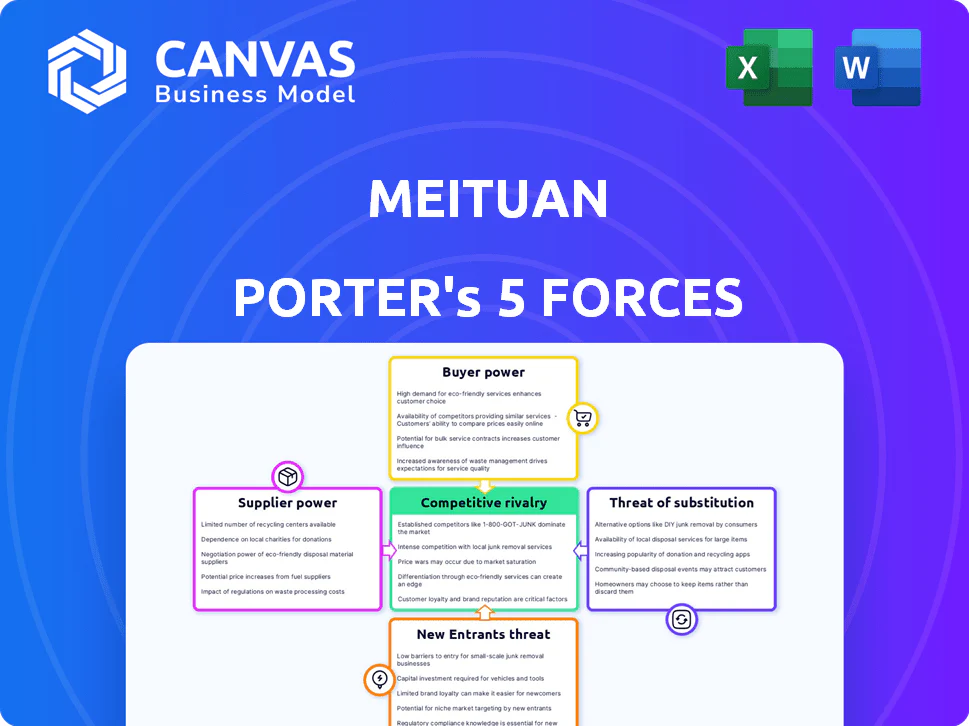
MEITUAN PORTER'S FIVE FORCES TEMPLATE RESEARCH

From Overview to Strategy Blueprint
Meituan faces intense rivalry across food delivery, travel, and local services with high buyer expectations and thin margins, while platform scale, data advantages, and supplier networks moderate supplier and entrant threats.
This brief snapshot only scratches the surface. Unlock the full Porter's Five Forces Analysis to explore Meituan's competitive dynamics, market pressures, and strategic advantages in detail.
Suppliers Bargaining Power

Merchant Dependency and Fragmentation
Meituan's supplier base-over 6 million merchant partners by FY2025-are mainly small-to-medium restaurants and local service providers with limited bargaining power, so Meituan sets commission rates (avg. take rate ~12% in 2025) and contract terms.
The merchant fragmentation and reliance on Meituan for digital orders mean no single partner can destabilize Meituan's platform or supply chain.
Labor Market Dynamics for Delivery Riders
Meituan's vast fleet of ~6.8 million delivery riders (2025 company disclosure) gives individual couriers low bargaining power, yet social pressure rose after 2025-2026 rules expanding pension, unemployment, and minimum-wage coverage, forcing Meituan to raise rider costs by an estimated RMB 12-18 billion in FY2025.

Cloud Infrastructure and Tech Providers
Suppliers of cloud and data-center services hold moderate power: Meituan's real-time dispatch needs require advanced infrastructure, so switching costs for large-scale operations exceed $100M+ (estimated migration CAPEX/OPEX). Meituan offsets this by multi-cloud sourcing and negotiating volume discounts-its 2025 domestic cloud spend reported ~RMB 2.4B, enabling favorable pricing with China tech giants.

Brand Power of National Chains
Large national restaurant chains and international hotel groups wield higher bargaining power than independents, securing commission cuts as their listings drove about 28% of Meituan's takeaway GMV in 2025 and boosted platform credibility.
Meituan conceded margin reductions-reported as ~1.2 percentage points on average-to retain high-volume anchors and prevent exclusivity with competitors, shifting ~15% of marketing spend to these partners.
- Anchor merchants ≈28% takeaway GMV (2025)
- Average commission concession ≈1.2 pp
- ~15% marketing spend targeted to retain anchors
Payment Processing and Financial Gateways
Meituan relies heavily on dominant payment rails-WeChat Pay and Alipay handle ~90% of mobile payments in China (2025 est.), creating concentrated supplier power for transaction settlement.
Despite Meituan Pay rollout, over 80% of its orders still use third-party wallets in 2025, forcing Meituan to accept prevailing fees (~0.5-1.0% per txn) and platform data-sharing terms.
- ~90% mobile-pay market share: WeChat/Alipay (2025)
- Meituan orders using third-party wallets: >80% (2025)
- Typical transaction fees: 0.5-1.0% per transaction
- Supplier concentration raises bargaining power and data constraints
Meituan: Fragmented suppliers, rising rider costs (RMB12-18B), heavy WeChat/Alipay wallet reliance
Suppliers have limited aggregate power: 6M+ merchant partners and ~6.8M riders (FY2025) fragment bargaining, while anchors (≈28% takeaway GMV) extract concessions (~1.2 pp avg). Meituan faced rider cost increases of RMB12-18B in FY2025; cloud spend ~RMB2.4B; >80% orders use third‑party wallets; WeChat/Alipay ~90% share.
| Metric | 2025 |
|---|---|
| Merchant partners | 6M+ |
| Delivery riders | 6.8M |
| Anchor GMV share | 28% |
| Rider cost impact | RMB12-18B |
| Cloud spend | RMB2.4B |
| Third‑party wallet use | >80% |
| WeChat/Alipay share | ~90% |
What is included in the product
 Detailed Word Document
Tailored Porter's Five Forces assessment for Meituan that uncovers competitive intensity, buyer and supplier power, entry barriers, and substitution risks, highlighting disruptive threats and strategic levers to defend market share.

 Customizable Excel Spreadsheet
A one-sheet Meituan Porter's Five Forces snapshot-translate competitive intensity into clear actions, adjustable force levels and a radar chart for board-ready slides that non-finance teams can update without macros.
Customers Bargaining Power

Low Switching Costs for Consumers
Low switching costs: the average Chinese consumer carries 5+ apps and can swap between Meituan, Ele.me, and Douyin in seconds, so Meituan reinvested heavily-¥28.4 billion in 2025 on marketing and subsidies and expanded Meituan Select to cut churn; price remains king, with 72% of local-service users in 2025 citing cost as their top decision factor.
Information Transparency and Price Comparison
Meituan's transparency tools show real-time reviews and price rankings, letting users pick top-value options; in 2025 Meituan reported 730 million annual transacting users, magnifying this effect.
Near-"perfect information" forces merchants to cut prices to win visibility, squeezing Meituan's take-rate-commission fell to about 3.8% in FY2025.
Consumers act collectively: categories with low satisfaction lose order share quickly, reflected in Meituan's 12% year-over-year churn in low-rated restaurants in 2025.

High Sensitivity to Service Fees
Meituan's customers show high sensitivity to service fees: when Meituan raised delivery fees and trimmed member discounts in 2025, daily active users dipped 2.8% month-over-month and order frequency fell 4.1% in Q3 2025, per company filings.
In the 2025-2026 value-conscious climate, households cut discretionary delivery use; average ticket self-pickup rates rose to 27% in 2025 from 22% in 2023, signaling resistance to passing on cost inflation.
Users explicitly trade convenience for savings: surveys in late 2025 found 46% of urban users would pick up orders to avoid a delivery premium, constraining Meituan's ability to raise prices without losing volume.

Membership Program Lock-in
Meituan's Meituan Membership cuts buyer power by charging RMB 9-19/month (2025), offering exclusive coupons and free delivery so members treat the fee as sunk cost and avoid rivals; management reported a 12% lower churn among premium users in FY2025 and membership ARPU rose to RMB 42.7.
- RMB 9-19/month fee
- Membership ARPU RMB 42.7 (2025)
- 12% lower churn in premium cohort (FY2025)
Influence of Social Commerce and Recommendations
Modern consumers, driven by social proof and short-video trends, shift power to platforms blending entertainment and commerce; Meituan reported 740 million annual transacting users in 2025, so trending content directly moves volume and GMV.
If a service isn't viral or highly rated, buyers abandon it fast, forcing Meituan to spend on content-Meituan's marketing & promotion expenses rose to RMB 38.6 billion in FY2025 to bolster its content ecosystem.
The buyer's power shows in ratings and reviews: top-rated merchants capture disproportionate orders, so user ratings effectively decide which merchants thrive on Meituan's platform.
- 740m transacting users (2025)
- RMB 38.6bn marketing & promotion spend (FY2025)
- Short-video/social referrals drive disproportionate GMV
Meituan squeezed by buyer power: 3.8% take‑rate, heavy marketing & subsidies
Buyers hold strong leverage: low switching costs, near-perfect information, and social referral power pressured Meituan's FY2025 take-rate to ~3.8% while marketing rose to RMB 38.6bn and subsidies to RMB 28.4bn; 740m transacting users and membership ARPU RMB 42.7 (RMB 9-19/month fee) dampen churn but limit price hikes.
| Metric | 2025 |
|---|---|
| Transacting users | 740m |
| Take-rate | 3.8% |
| Marketing & promotion | RMB 38.6bn |
| Subsidies/marketing reinvest | RMB 28.4bn |
| Membership ARPU | RMB 42.7 |
Preview Before You Purchase
Meituan Porter's Five Forces Analysis
This preview shows the exact Meituan Porter's Five Forces analysis you'll receive immediately after purchase-no placeholders or mockups.
You're looking at the final, professionally formatted document; once you buy, you'll get instant access to this same file, ready for use.

MEITUAN PORTER'S FIVE FORCES TEMPLATE RESEARCH
From Overview to Strategy Blueprint
Meituan faces intense rivalry across food delivery, travel, and local services with high buyer expectations and thin margins, while platform scale, data advantages, and supplier networks moderate supplier and entrant threats.
This brief snapshot only scratches the surface. Unlock the full Porter's Five Forces Analysis to explore Meituan's competitive dynamics, market pressures, and strategic advantages in detail.
Suppliers Bargaining Power
Merchant Dependency and Fragmentation
Meituan's supplier base-over 6 million merchant partners by FY2025-are mainly small-to-medium restaurants and local service providers with limited bargaining power, so Meituan sets commission rates (avg. take rate ~12% in 2025) and contract terms.
The merchant fragmentation and reliance on Meituan for digital orders mean no single partner can destabilize Meituan's platform or supply chain.
Labor Market Dynamics for Delivery Riders
Meituan's vast fleet of ~6.8 million delivery riders (2025 company disclosure) gives individual couriers low bargaining power, yet social pressure rose after 2025-2026 rules expanding pension, unemployment, and minimum-wage coverage, forcing Meituan to raise rider costs by an estimated RMB 12-18 billion in FY2025.
Cloud Infrastructure and Tech Providers
Suppliers of cloud and data-center services hold moderate power: Meituan's real-time dispatch needs require advanced infrastructure, so switching costs for large-scale operations exceed $100M+ (estimated migration CAPEX/OPEX). Meituan offsets this by multi-cloud sourcing and negotiating volume discounts-its 2025 domestic cloud spend reported ~RMB 2.4B, enabling favorable pricing with China tech giants.
Brand Power of National Chains
Large national restaurant chains and international hotel groups wield higher bargaining power than independents, securing commission cuts as their listings drove about 28% of Meituan's takeaway GMV in 2025 and boosted platform credibility.
Meituan conceded margin reductions-reported as ~1.2 percentage points on average-to retain high-volume anchors and prevent exclusivity with competitors, shifting ~15% of marketing spend to these partners.
- Anchor merchants ≈28% takeaway GMV (2025)
- Average commission concession ≈1.2 pp
- ~15% marketing spend targeted to retain anchors
Payment Processing and Financial Gateways
Meituan relies heavily on dominant payment rails-WeChat Pay and Alipay handle ~90% of mobile payments in China (2025 est.), creating concentrated supplier power for transaction settlement.
Despite Meituan Pay rollout, over 80% of its orders still use third-party wallets in 2025, forcing Meituan to accept prevailing fees (~0.5-1.0% per txn) and platform data-sharing terms.
- ~90% mobile-pay market share: WeChat/Alipay (2025)
- Meituan orders using third-party wallets: >80% (2025)
- Typical transaction fees: 0.5-1.0% per transaction
- Supplier concentration raises bargaining power and data constraints
Meituan: Fragmented suppliers, rising rider costs (RMB12-18B), heavy WeChat/Alipay wallet reliance
Suppliers have limited aggregate power: 6M+ merchant partners and ~6.8M riders (FY2025) fragment bargaining, while anchors (≈28% takeaway GMV) extract concessions (~1.2 pp avg). Meituan faced rider cost increases of RMB12-18B in FY2025; cloud spend ~RMB2.4B; >80% orders use third‑party wallets; WeChat/Alipay ~90% share.
| Metric | 2025 |
|---|---|
| Merchant partners | 6M+ |
| Delivery riders | 6.8M |
| Anchor GMV share | 28% |
| Rider cost impact | RMB12-18B |
| Cloud spend | RMB2.4B |
| Third‑party wallet use | >80% |
| WeChat/Alipay share | ~90% |
What is included in the product
Detailed Word Document
Tailored Porter's Five Forces assessment for Meituan that uncovers competitive intensity, buyer and supplier power, entry barriers, and substitution risks, highlighting disruptive threats and strategic levers to defend market share.
Customizable Excel Spreadsheet
A one-sheet Meituan Porter's Five Forces snapshot-translate competitive intensity into clear actions, adjustable force levels and a radar chart for board-ready slides that non-finance teams can update without macros.
Customers Bargaining Power
Low Switching Costs for Consumers
Low switching costs: the average Chinese consumer carries 5+ apps and can swap between Meituan, Ele.me, and Douyin in seconds, so Meituan reinvested heavily-¥28.4 billion in 2025 on marketing and subsidies and expanded Meituan Select to cut churn; price remains king, with 72% of local-service users in 2025 citing cost as their top decision factor.
Information Transparency and Price Comparison
Meituan's transparency tools show real-time reviews and price rankings, letting users pick top-value options; in 2025 Meituan reported 730 million annual transacting users, magnifying this effect.
Near-"perfect information" forces merchants to cut prices to win visibility, squeezing Meituan's take-rate-commission fell to about 3.8% in FY2025.
Consumers act collectively: categories with low satisfaction lose order share quickly, reflected in Meituan's 12% year-over-year churn in low-rated restaurants in 2025.
High Sensitivity to Service Fees
Meituan's customers show high sensitivity to service fees: when Meituan raised delivery fees and trimmed member discounts in 2025, daily active users dipped 2.8% month-over-month and order frequency fell 4.1% in Q3 2025, per company filings.
In the 2025-2026 value-conscious climate, households cut discretionary delivery use; average ticket self-pickup rates rose to 27% in 2025 from 22% in 2023, signaling resistance to passing on cost inflation.
Users explicitly trade convenience for savings: surveys in late 2025 found 46% of urban users would pick up orders to avoid a delivery premium, constraining Meituan's ability to raise prices without losing volume.
Membership Program Lock-in
Meituan's Meituan Membership cuts buyer power by charging RMB 9-19/month (2025), offering exclusive coupons and free delivery so members treat the fee as sunk cost and avoid rivals; management reported a 12% lower churn among premium users in FY2025 and membership ARPU rose to RMB 42.7.
- RMB 9-19/month fee
- Membership ARPU RMB 42.7 (2025)
- 12% lower churn in premium cohort (FY2025)
Influence of Social Commerce and Recommendations
Modern consumers, driven by social proof and short-video trends, shift power to platforms blending entertainment and commerce; Meituan reported 740 million annual transacting users in 2025, so trending content directly moves volume and GMV.
If a service isn't viral or highly rated, buyers abandon it fast, forcing Meituan to spend on content-Meituan's marketing & promotion expenses rose to RMB 38.6 billion in FY2025 to bolster its content ecosystem.
The buyer's power shows in ratings and reviews: top-rated merchants capture disproportionate orders, so user ratings effectively decide which merchants thrive on Meituan's platform.
- 740m transacting users (2025)
- RMB 38.6bn marketing & promotion spend (FY2025)
- Short-video/social referrals drive disproportionate GMV
Meituan squeezed by buyer power: 3.8% take‑rate, heavy marketing & subsidies
Buyers hold strong leverage: low switching costs, near-perfect information, and social referral power pressured Meituan's FY2025 take-rate to ~3.8% while marketing rose to RMB 38.6bn and subsidies to RMB 28.4bn; 740m transacting users and membership ARPU RMB 42.7 (RMB 9-19/month fee) dampen churn but limit price hikes.
| Metric | 2025 |
|---|---|
| Transacting users | 740m |
| Take-rate | 3.8% |
| Marketing & promotion | RMB 38.6bn |
| Subsidies/marketing reinvest | RMB 28.4bn |
| Membership ARPU | RMB 42.7 |
Preview Before You Purchase
Meituan Porter's Five Forces Analysis
This preview shows the exact Meituan Porter's Five Forces analysis you'll receive immediately after purchase-no placeholders or mockups.
You're looking at the final, professionally formatted document; once you buy, you'll get instant access to this same file, ready for use.
Product Information
Product Information
Shipping & Returns
Shipping & Returns
Description
From Overview to Strategy Blueprint
Meituan faces intense rivalry across food delivery, travel, and local services with high buyer expectations and thin margins, while platform scale, data advantages, and supplier networks moderate supplier and entrant threats.
This brief snapshot only scratches the surface. Unlock the full Porter's Five Forces Analysis to explore Meituan's competitive dynamics, market pressures, and strategic advantages in detail.
Suppliers Bargaining Power
Merchant Dependency and Fragmentation
Meituan's supplier base-over 6 million merchant partners by FY2025-are mainly small-to-medium restaurants and local service providers with limited bargaining power, so Meituan sets commission rates (avg. take rate ~12% in 2025) and contract terms.
The merchant fragmentation and reliance on Meituan for digital orders mean no single partner can destabilize Meituan's platform or supply chain.
Labor Market Dynamics for Delivery Riders
Meituan's vast fleet of ~6.8 million delivery riders (2025 company disclosure) gives individual couriers low bargaining power, yet social pressure rose after 2025-2026 rules expanding pension, unemployment, and minimum-wage coverage, forcing Meituan to raise rider costs by an estimated RMB 12-18 billion in FY2025.
Cloud Infrastructure and Tech Providers
Suppliers of cloud and data-center services hold moderate power: Meituan's real-time dispatch needs require advanced infrastructure, so switching costs for large-scale operations exceed $100M+ (estimated migration CAPEX/OPEX). Meituan offsets this by multi-cloud sourcing and negotiating volume discounts-its 2025 domestic cloud spend reported ~RMB 2.4B, enabling favorable pricing with China tech giants.
Brand Power of National Chains
Large national restaurant chains and international hotel groups wield higher bargaining power than independents, securing commission cuts as their listings drove about 28% of Meituan's takeaway GMV in 2025 and boosted platform credibility.
Meituan conceded margin reductions-reported as ~1.2 percentage points on average-to retain high-volume anchors and prevent exclusivity with competitors, shifting ~15% of marketing spend to these partners.
- Anchor merchants ≈28% takeaway GMV (2025)
- Average commission concession ≈1.2 pp
- ~15% marketing spend targeted to retain anchors
Payment Processing and Financial Gateways
Meituan relies heavily on dominant payment rails-WeChat Pay and Alipay handle ~90% of mobile payments in China (2025 est.), creating concentrated supplier power for transaction settlement.
Despite Meituan Pay rollout, over 80% of its orders still use third-party wallets in 2025, forcing Meituan to accept prevailing fees (~0.5-1.0% per txn) and platform data-sharing terms.
- ~90% mobile-pay market share: WeChat/Alipay (2025)
- Meituan orders using third-party wallets: >80% (2025)
- Typical transaction fees: 0.5-1.0% per transaction
- Supplier concentration raises bargaining power and data constraints
Meituan: Fragmented suppliers, rising rider costs (RMB12-18B), heavy WeChat/Alipay wallet reliance
Suppliers have limited aggregate power: 6M+ merchant partners and ~6.8M riders (FY2025) fragment bargaining, while anchors (≈28% takeaway GMV) extract concessions (~1.2 pp avg). Meituan faced rider cost increases of RMB12-18B in FY2025; cloud spend ~RMB2.4B; >80% orders use third‑party wallets; WeChat/Alipay ~90% share.
| Metric | 2025 |
|---|---|
| Merchant partners | 6M+ |
| Delivery riders | 6.8M |
| Anchor GMV share | 28% |
| Rider cost impact | RMB12-18B |
| Cloud spend | RMB2.4B |
| Third‑party wallet use | >80% |
| WeChat/Alipay share | ~90% |
What is included in the product
Detailed Word Document
Tailored Porter's Five Forces assessment for Meituan that uncovers competitive intensity, buyer and supplier power, entry barriers, and substitution risks, highlighting disruptive threats and strategic levers to defend market share.
Customizable Excel Spreadsheet
A one-sheet Meituan Porter's Five Forces snapshot-translate competitive intensity into clear actions, adjustable force levels and a radar chart for board-ready slides that non-finance teams can update without macros.
Customers Bargaining Power
Low Switching Costs for Consumers
Low switching costs: the average Chinese consumer carries 5+ apps and can swap between Meituan, Ele.me, and Douyin in seconds, so Meituan reinvested heavily-¥28.4 billion in 2025 on marketing and subsidies and expanded Meituan Select to cut churn; price remains king, with 72% of local-service users in 2025 citing cost as their top decision factor.
Information Transparency and Price Comparison
Meituan's transparency tools show real-time reviews and price rankings, letting users pick top-value options; in 2025 Meituan reported 730 million annual transacting users, magnifying this effect.
Near-"perfect information" forces merchants to cut prices to win visibility, squeezing Meituan's take-rate-commission fell to about 3.8% in FY2025.
Consumers act collectively: categories with low satisfaction lose order share quickly, reflected in Meituan's 12% year-over-year churn in low-rated restaurants in 2025.
High Sensitivity to Service Fees
Meituan's customers show high sensitivity to service fees: when Meituan raised delivery fees and trimmed member discounts in 2025, daily active users dipped 2.8% month-over-month and order frequency fell 4.1% in Q3 2025, per company filings.
In the 2025-2026 value-conscious climate, households cut discretionary delivery use; average ticket self-pickup rates rose to 27% in 2025 from 22% in 2023, signaling resistance to passing on cost inflation.
Users explicitly trade convenience for savings: surveys in late 2025 found 46% of urban users would pick up orders to avoid a delivery premium, constraining Meituan's ability to raise prices without losing volume.
Membership Program Lock-in
Meituan's Meituan Membership cuts buyer power by charging RMB 9-19/month (2025), offering exclusive coupons and free delivery so members treat the fee as sunk cost and avoid rivals; management reported a 12% lower churn among premium users in FY2025 and membership ARPU rose to RMB 42.7.
- RMB 9-19/month fee
- Membership ARPU RMB 42.7 (2025)
- 12% lower churn in premium cohort (FY2025)
Influence of Social Commerce and Recommendations
Modern consumers, driven by social proof and short-video trends, shift power to platforms blending entertainment and commerce; Meituan reported 740 million annual transacting users in 2025, so trending content directly moves volume and GMV.
If a service isn't viral or highly rated, buyers abandon it fast, forcing Meituan to spend on content-Meituan's marketing & promotion expenses rose to RMB 38.6 billion in FY2025 to bolster its content ecosystem.
The buyer's power shows in ratings and reviews: top-rated merchants capture disproportionate orders, so user ratings effectively decide which merchants thrive on Meituan's platform.
- 740m transacting users (2025)
- RMB 38.6bn marketing & promotion spend (FY2025)
- Short-video/social referrals drive disproportionate GMV
Meituan squeezed by buyer power: 3.8% take‑rate, heavy marketing & subsidies
Buyers hold strong leverage: low switching costs, near-perfect information, and social referral power pressured Meituan's FY2025 take-rate to ~3.8% while marketing rose to RMB 38.6bn and subsidies to RMB 28.4bn; 740m transacting users and membership ARPU RMB 42.7 (RMB 9-19/month fee) dampen churn but limit price hikes.
| Metric | 2025 |
|---|---|
| Transacting users | 740m |
| Take-rate | 3.8% |
| Marketing & promotion | RMB 38.6bn |
| Subsidies/marketing reinvest | RMB 28.4bn |
| Membership ARPU | RMB 42.7 |
Preview Before You Purchase
Meituan Porter's Five Forces Analysis
This preview shows the exact Meituan Porter's Five Forces analysis you'll receive immediately after purchase-no placeholders or mockups.
You're looking at the final, professionally formatted document; once you buy, you'll get instant access to this same file, ready for use.











