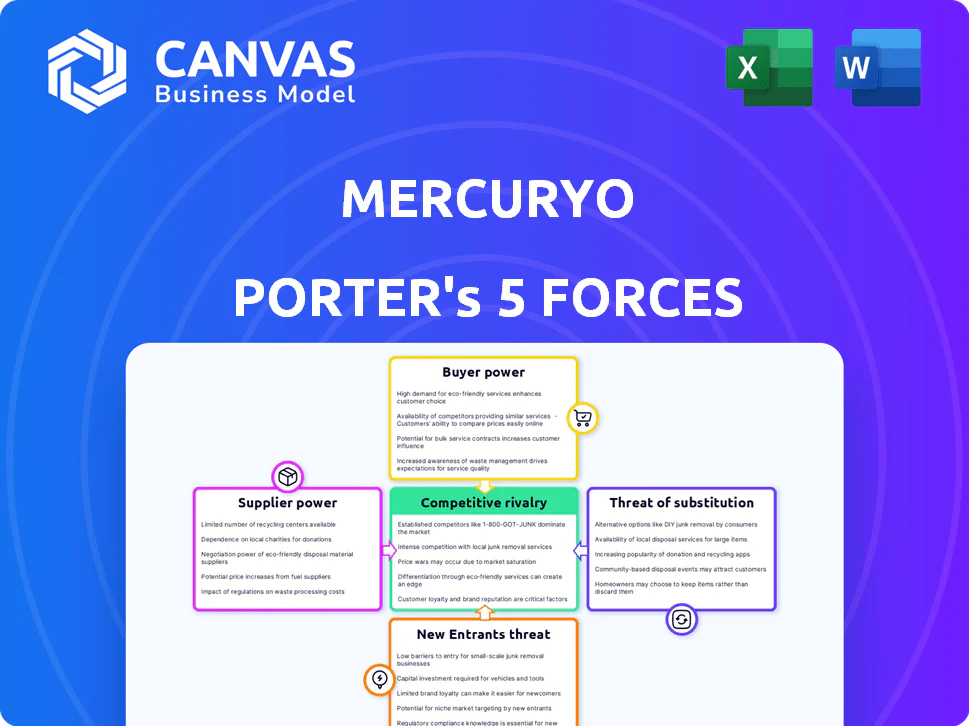
MERCURYO PORTER'S FIVE FORCES TEMPLATE RESEARCH
What is included in the product
 Detailed Word Document
Analyzes Mercuryo's competitive forces, covering suppliers, buyers, entrants, substitutes, and rivalry.

 Customizable Excel Spreadsheet
Instantly visualize competitive pressures with a dynamic radar chart.
What You See Is What You Get
Mercuryo Porter's Five Forces Analysis
This preview presents the complete Porter's Five Forces analysis. The document you see here is precisely what you'll receive immediately after purchase.

Porter's Five Forces Analysis Template

Elevate Your Analysis with the Complete Porter's Five Forces Analysis
Mercuryo navigates a dynamic landscape shaped by competitive rivalries, the power of buyers & suppliers, and the constant threat of new entrants and substitutes.
Our concise analysis highlights these forces, revealing their impact on Mercuryo's profitability and strategic positioning.
We assess buyer bargaining power, supplier influence, competitive intensity, and the threat from both new players and alternative solutions.
This snapshot gives a high-level view of Mercuryo's business environment.
The complete report reveals the real forces shaping Mercuryo’s industry—from supplier influence to threat of new entrants. Gain actionable insights to drive smarter decision-making.
Suppliers Bargaining Power

Availability of key technologies and infrastructure providers
Mercuryo's reliance on blockchain tech and specialized providers gives these suppliers bargaining power. In 2024, the blockchain market was valued at $16.03 billion, with growth expected. Limited tech providers could increase costs or affect service. For example, a key software provider might raise prices.
Liquidity providers and cryptocurrency exchanges
Mercuryo's service hinges on liquidity providers and crypto exchanges. In 2024, the crypto market saw significant fluctuations, impacting the availability and pricing of digital assets. The platform's ability to offer competitive rates is directly influenced by these providers. Larger providers can dictate terms, affecting Mercuryo's profitability. As of late 2024, the market consolidation among exchanges has increased provider influence.

Banking and financial institutions
Mercuryo heavily relies on banking integrations for fiat transactions, impacting costs and services. In 2024, average transaction fees ranged from 2% to 5% based on card type and region. Negotiating favorable terms with banks is crucial. The more successful the negotiation, the more profitable Mercuryo is.

Regulatory bodies and compliance service providers
Operating in the fintech and cryptocurrency sector means dealing with ever-changing rules. Companies must follow Anti-Money Laundering (AML) and Know Your Customer (KYC) laws. This need for compliance can give power to suppliers. Reliance on external compliance services increases supplier influence.
- In 2024, the global regtech market is valued at over $11 billion.
- AML compliance costs for financial institutions rose by about 15% in 2024.
- KYC solutions market is projected to reach $1.4 billion by the end of 2024.
- The average cost of a compliance software license is $50,000 annually.
Data and security service providers
For a crypto payment company such as Mercuryo, ensuring the security of transactions and user data is crucial. This necessitates the use of specialized security measures like fraud monitoring and sanctions screening. The reliance on cybersecurity and data protection service providers grants these suppliers some bargaining power. The global cybersecurity market was valued at $223.8 billion in 2023, and is projected to reach $345.7 billion by 2027. This highlights the importance and cost of these services.
- Cybersecurity spending is expected to increase by over 10% annually.
- Data breaches cost companies an average of $4.45 million in 2023.
- The demand for advanced security solutions is rising.
- Mercuryo must carefully manage relationships with these providers.
Mercuryo's Supplier Dynamics: A Power Play
Mercuryo's suppliers hold significant bargaining power. This is due to reliance on specialized blockchain tech, liquidity providers, and banking partners. Compliance and security needs further increase supplier influence.
| Supplier Type | Impact on Mercuryo | 2024 Data |
|---|---|---|
| Blockchain Tech Providers | Pricing, Service Quality | Market valued at $16.03B, growing. |
| Liquidity/Crypto Exchanges | Competitive Rates, Profitability | Crypto market fluctuations impacted asset pricing. |
| Banking Partners | Transaction Costs, Service | Average fees 2%-5% based on type. |
Customers Bargaining Power

Availability of alternative platforms
Customers can easily switch between platforms like Mercuryo and competitors such as MoonPay or Ramp. The cryptocurrency market offers numerous exchanges and payment gateways. In 2024, the market saw over 500 crypto exchanges globally. This abundance increases customer bargaining power, as they can choose the best rates and services. The ease of switching intensifies competitive pressure for Mercuryo.
Low switching costs
For Mercuryo users, switching to a different crypto payment platform is generally easy and inexpensive. This low barrier encourages customer mobility, as they can readily choose alternatives. In 2024, the average cost to switch crypto platforms remained under $10, influencing customer decisions. This enables users to seek platforms offering better terms. The ease of switching strengthens customer bargaining power.

Price sensitivity
Customers in crypto are highly price-sensitive. They easily compare Mercuryo's fees with others. In 2024, Bitcoin transaction fees varied widely, from $1 to over $50, influencing user choice. This forces Mercuryo to offer competitive rates.

Access to information and transparency
Customers' bargaining power in the crypto payment sector is amplified by information access. Online resources allow easy comparison of providers like Mercuryo Porter, focusing on fees and user experiences. This transparency enables educated choices, strengthening their negotiation position.
- Research indicates that 75% of consumers compare prices online before committing to a service.
- The global crypto market is projected to reach $2.3 billion by 2024, increasing customer options.
- User reviews heavily influence decisions, with 88% of consumers trusting online reviews.
- Transparency in fees and services is a key factor for 60% of users choosing a crypto payment provider.
Influence through reviews and reputation
Customer reviews and Mercuryo's reputation are crucial. Feedback shapes user choices, giving customers collective bargaining power. Positive reviews attract users, while negative ones deter them. This impacts Mercuryo's market position. For example, in 2024, 70% of consumers trust online reviews.
- Reviews impact platform adoption.
- Reputation affects user trust.
- Feedback influences user decisions.
- Customer power stems from shared experience.
Crypto Users: Power in Their Hands
Customers have strong bargaining power due to easy platform switching and abundant choices in the crypto market. In 2024, the low switching costs, typically under $10, enabled users to quickly move to platforms with better terms. Price sensitivity is high; Bitcoin transaction fees varied from $1 to over $50, affecting user choices significantly.
| Factor | Impact | 2024 Data |
|---|---|---|
| Switching Cost | High Mobility | Avg. cost under $10 |
| Price Sensitivity | Competitive Pricing | Bitcoin fees: $1-$50+ |
| Information Access | Informed Choices | 75% compare prices online |
Rivalry Among Competitors

Number and diversity of competitors
The crypto payment solutions sector is highly competitive. Mercuryo competes with MoonPay, Ramp, and BitPay. In 2024, the market saw over 500 crypto payment providers. This diversity intensifies rivalry, impacting pricing and market share. The rise of traditional finance further complicates the landscape.
Market growth rate
The crypto payment gateway market is booming, with substantial growth in 2024. This expansion attracts new entrants. Increased competition, like that seen with platforms such as Coinbase and BitPay, intensifies rivalry.

Low customer switching costs
Low switching costs intensify competition among crypto payment platforms. Mercuryo faces pressure to provide superior services to keep customers. Data shows the crypto market's volatility, with rapid user shifts between platforms. Competitive pricing and features are vital for Mercuryo's user retention, according to 2024 market analysis.

Innovation and technological advancements
The fintech and cryptocurrency sectors are rapidly evolving due to innovation. Competitors consistently introduce new features, enhancing user experiences. This includes exploring DeFi and NFTs. Mercuryo must adapt to these changes to stay competitive. In 2024, the global fintech market was valued at $150 billion, with projections indicating substantial growth.
- Technological advancements drive competition.
- Competitors innovate with new features.
- Focus on DeFi and NFTs is increasing.
- Mercuryo must keep pace to compete.
Marketing and brand differentiation
In the competitive landscape, Mercuryo Porter's Five Forces Analysis shows that marketing and brand differentiation are vital for success. Competitors aggressively use marketing to highlight their unique strengths and capture market share. The company's marketing budget in 2024 was approximately $5 million, reflecting the importance of brand visibility. This approach is critical in a market where numerous players compete for customer attention.
- Marketing spend is a key factor in differentiating a company from its competitors.
- Brand recognition influences customer loyalty and market share.
- Mercuryo's marketing strategy in 2024 focused on digital channels.
- Effective marketing helps to showcase the company's unique selling propositions.
Crypto Payment Wars: Over 500 Providers Battle!
Competitive rivalry in the crypto payment sector is fierce, with over 500 providers in 2024. Mercuryo competes with major players like MoonPay and BitPay. Innovation and marketing are crucial for survival; the global fintech market was valued at $150 billion in 2024.
| Aspect | Impact | Data (2024) |
|---|---|---|
| Market Competition | High | Over 500 crypto payment providers |
| Marketing Spend | Critical | Mercuryo's $5M budget |
| Fintech Market | Growing | $150B valuation |
MERCURYO PORTER'S FIVE FORCES TEMPLATE RESEARCH
What is included in the product
Detailed Word Document
Analyzes Mercuryo's competitive forces, covering suppliers, buyers, entrants, substitutes, and rivalry.
Customizable Excel Spreadsheet
Instantly visualize competitive pressures with a dynamic radar chart.
What You See Is What You Get
Mercuryo Porter's Five Forces Analysis
This preview presents the complete Porter's Five Forces analysis. The document you see here is precisely what you'll receive immediately after purchase.
Porter's Five Forces Analysis Template
Elevate Your Analysis with the Complete Porter's Five Forces Analysis
Mercuryo navigates a dynamic landscape shaped by competitive rivalries, the power of buyers & suppliers, and the constant threat of new entrants and substitutes.
Our concise analysis highlights these forces, revealing their impact on Mercuryo's profitability and strategic positioning.
We assess buyer bargaining power, supplier influence, competitive intensity, and the threat from both new players and alternative solutions.
This snapshot gives a high-level view of Mercuryo's business environment.
The complete report reveals the real forces shaping Mercuryo’s industry—from supplier influence to threat of new entrants. Gain actionable insights to drive smarter decision-making.
Suppliers Bargaining Power
Availability of key technologies and infrastructure providers
Mercuryo's reliance on blockchain tech and specialized providers gives these suppliers bargaining power. In 2024, the blockchain market was valued at $16.03 billion, with growth expected. Limited tech providers could increase costs or affect service. For example, a key software provider might raise prices.
Liquidity providers and cryptocurrency exchanges
Mercuryo's service hinges on liquidity providers and crypto exchanges. In 2024, the crypto market saw significant fluctuations, impacting the availability and pricing of digital assets. The platform's ability to offer competitive rates is directly influenced by these providers. Larger providers can dictate terms, affecting Mercuryo's profitability. As of late 2024, the market consolidation among exchanges has increased provider influence.
Banking and financial institutions
Mercuryo heavily relies on banking integrations for fiat transactions, impacting costs and services. In 2024, average transaction fees ranged from 2% to 5% based on card type and region. Negotiating favorable terms with banks is crucial. The more successful the negotiation, the more profitable Mercuryo is.
Regulatory bodies and compliance service providers
Operating in the fintech and cryptocurrency sector means dealing with ever-changing rules. Companies must follow Anti-Money Laundering (AML) and Know Your Customer (KYC) laws. This need for compliance can give power to suppliers. Reliance on external compliance services increases supplier influence.
- In 2024, the global regtech market is valued at over $11 billion.
- AML compliance costs for financial institutions rose by about 15% in 2024.
- KYC solutions market is projected to reach $1.4 billion by the end of 2024.
- The average cost of a compliance software license is $50,000 annually.
Data and security service providers
For a crypto payment company such as Mercuryo, ensuring the security of transactions and user data is crucial. This necessitates the use of specialized security measures like fraud monitoring and sanctions screening. The reliance on cybersecurity and data protection service providers grants these suppliers some bargaining power. The global cybersecurity market was valued at $223.8 billion in 2023, and is projected to reach $345.7 billion by 2027. This highlights the importance and cost of these services.
- Cybersecurity spending is expected to increase by over 10% annually.
- Data breaches cost companies an average of $4.45 million in 2023.
- The demand for advanced security solutions is rising.
- Mercuryo must carefully manage relationships with these providers.
Mercuryo's Supplier Dynamics: A Power Play
Mercuryo's suppliers hold significant bargaining power. This is due to reliance on specialized blockchain tech, liquidity providers, and banking partners. Compliance and security needs further increase supplier influence.
| Supplier Type | Impact on Mercuryo | 2024 Data |
|---|---|---|
| Blockchain Tech Providers | Pricing, Service Quality | Market valued at $16.03B, growing. |
| Liquidity/Crypto Exchanges | Competitive Rates, Profitability | Crypto market fluctuations impacted asset pricing. |
| Banking Partners | Transaction Costs, Service | Average fees 2%-5% based on type. |
Customers Bargaining Power
Availability of alternative platforms
Customers can easily switch between platforms like Mercuryo and competitors such as MoonPay or Ramp. The cryptocurrency market offers numerous exchanges and payment gateways. In 2024, the market saw over 500 crypto exchanges globally. This abundance increases customer bargaining power, as they can choose the best rates and services. The ease of switching intensifies competitive pressure for Mercuryo.
Low switching costs
For Mercuryo users, switching to a different crypto payment platform is generally easy and inexpensive. This low barrier encourages customer mobility, as they can readily choose alternatives. In 2024, the average cost to switch crypto platforms remained under $10, influencing customer decisions. This enables users to seek platforms offering better terms. The ease of switching strengthens customer bargaining power.
Price sensitivity
Customers in crypto are highly price-sensitive. They easily compare Mercuryo's fees with others. In 2024, Bitcoin transaction fees varied widely, from $1 to over $50, influencing user choice. This forces Mercuryo to offer competitive rates.
Access to information and transparency
Customers' bargaining power in the crypto payment sector is amplified by information access. Online resources allow easy comparison of providers like Mercuryo Porter, focusing on fees and user experiences. This transparency enables educated choices, strengthening their negotiation position.
- Research indicates that 75% of consumers compare prices online before committing to a service.
- The global crypto market is projected to reach $2.3 billion by 2024, increasing customer options.
- User reviews heavily influence decisions, with 88% of consumers trusting online reviews.
- Transparency in fees and services is a key factor for 60% of users choosing a crypto payment provider.
Influence through reviews and reputation
Customer reviews and Mercuryo's reputation are crucial. Feedback shapes user choices, giving customers collective bargaining power. Positive reviews attract users, while negative ones deter them. This impacts Mercuryo's market position. For example, in 2024, 70% of consumers trust online reviews.
- Reviews impact platform adoption.
- Reputation affects user trust.
- Feedback influences user decisions.
- Customer power stems from shared experience.
Crypto Users: Power in Their Hands
Customers have strong bargaining power due to easy platform switching and abundant choices in the crypto market. In 2024, the low switching costs, typically under $10, enabled users to quickly move to platforms with better terms. Price sensitivity is high; Bitcoin transaction fees varied from $1 to over $50, affecting user choices significantly.
| Factor | Impact | 2024 Data |
|---|---|---|
| Switching Cost | High Mobility | Avg. cost under $10 |
| Price Sensitivity | Competitive Pricing | Bitcoin fees: $1-$50+ |
| Information Access | Informed Choices | 75% compare prices online |
Rivalry Among Competitors
Number and diversity of competitors
The crypto payment solutions sector is highly competitive. Mercuryo competes with MoonPay, Ramp, and BitPay. In 2024, the market saw over 500 crypto payment providers. This diversity intensifies rivalry, impacting pricing and market share. The rise of traditional finance further complicates the landscape.
Market growth rate
The crypto payment gateway market is booming, with substantial growth in 2024. This expansion attracts new entrants. Increased competition, like that seen with platforms such as Coinbase and BitPay, intensifies rivalry.
Low customer switching costs
Low switching costs intensify competition among crypto payment platforms. Mercuryo faces pressure to provide superior services to keep customers. Data shows the crypto market's volatility, with rapid user shifts between platforms. Competitive pricing and features are vital for Mercuryo's user retention, according to 2024 market analysis.
Innovation and technological advancements
The fintech and cryptocurrency sectors are rapidly evolving due to innovation. Competitors consistently introduce new features, enhancing user experiences. This includes exploring DeFi and NFTs. Mercuryo must adapt to these changes to stay competitive. In 2024, the global fintech market was valued at $150 billion, with projections indicating substantial growth.
- Technological advancements drive competition.
- Competitors innovate with new features.
- Focus on DeFi and NFTs is increasing.
- Mercuryo must keep pace to compete.
Marketing and brand differentiation
In the competitive landscape, Mercuryo Porter's Five Forces Analysis shows that marketing and brand differentiation are vital for success. Competitors aggressively use marketing to highlight their unique strengths and capture market share. The company's marketing budget in 2024 was approximately $5 million, reflecting the importance of brand visibility. This approach is critical in a market where numerous players compete for customer attention.
- Marketing spend is a key factor in differentiating a company from its competitors.
- Brand recognition influences customer loyalty and market share.
- Mercuryo's marketing strategy in 2024 focused on digital channels.
- Effective marketing helps to showcase the company's unique selling propositions.
Crypto Payment Wars: Over 500 Providers Battle!
Competitive rivalry in the crypto payment sector is fierce, with over 500 providers in 2024. Mercuryo competes with major players like MoonPay and BitPay. Innovation and marketing are crucial for survival; the global fintech market was valued at $150 billion in 2024.
| Aspect | Impact | Data (2024) |
|---|---|---|
| Market Competition | High | Over 500 crypto payment providers |
| Marketing Spend | Critical | Mercuryo's $5M budget |
| Fintech Market | Growing | $150B valuation |
Product Information
Product Information
Shipping & Returns
Shipping & Returns
Description
What is included in the product
Detailed Word Document
Analyzes Mercuryo's competitive forces, covering suppliers, buyers, entrants, substitutes, and rivalry.
Customizable Excel Spreadsheet
Instantly visualize competitive pressures with a dynamic radar chart.
What You See Is What You Get
Mercuryo Porter's Five Forces Analysis
This preview presents the complete Porter's Five Forces analysis. The document you see here is precisely what you'll receive immediately after purchase.
Porter's Five Forces Analysis Template
Elevate Your Analysis with the Complete Porter's Five Forces Analysis
Mercuryo navigates a dynamic landscape shaped by competitive rivalries, the power of buyers & suppliers, and the constant threat of new entrants and substitutes.
Our concise analysis highlights these forces, revealing their impact on Mercuryo's profitability and strategic positioning.
We assess buyer bargaining power, supplier influence, competitive intensity, and the threat from both new players and alternative solutions.
This snapshot gives a high-level view of Mercuryo's business environment.
The complete report reveals the real forces shaping Mercuryo’s industry—from supplier influence to threat of new entrants. Gain actionable insights to drive smarter decision-making.
Suppliers Bargaining Power
Availability of key technologies and infrastructure providers
Mercuryo's reliance on blockchain tech and specialized providers gives these suppliers bargaining power. In 2024, the blockchain market was valued at $16.03 billion, with growth expected. Limited tech providers could increase costs or affect service. For example, a key software provider might raise prices.
Liquidity providers and cryptocurrency exchanges
Mercuryo's service hinges on liquidity providers and crypto exchanges. In 2024, the crypto market saw significant fluctuations, impacting the availability and pricing of digital assets. The platform's ability to offer competitive rates is directly influenced by these providers. Larger providers can dictate terms, affecting Mercuryo's profitability. As of late 2024, the market consolidation among exchanges has increased provider influence.
Banking and financial institutions
Mercuryo heavily relies on banking integrations for fiat transactions, impacting costs and services. In 2024, average transaction fees ranged from 2% to 5% based on card type and region. Negotiating favorable terms with banks is crucial. The more successful the negotiation, the more profitable Mercuryo is.
Regulatory bodies and compliance service providers
Operating in the fintech and cryptocurrency sector means dealing with ever-changing rules. Companies must follow Anti-Money Laundering (AML) and Know Your Customer (KYC) laws. This need for compliance can give power to suppliers. Reliance on external compliance services increases supplier influence.
- In 2024, the global regtech market is valued at over $11 billion.
- AML compliance costs for financial institutions rose by about 15% in 2024.
- KYC solutions market is projected to reach $1.4 billion by the end of 2024.
- The average cost of a compliance software license is $50,000 annually.
Data and security service providers
For a crypto payment company such as Mercuryo, ensuring the security of transactions and user data is crucial. This necessitates the use of specialized security measures like fraud monitoring and sanctions screening. The reliance on cybersecurity and data protection service providers grants these suppliers some bargaining power. The global cybersecurity market was valued at $223.8 billion in 2023, and is projected to reach $345.7 billion by 2027. This highlights the importance and cost of these services.
- Cybersecurity spending is expected to increase by over 10% annually.
- Data breaches cost companies an average of $4.45 million in 2023.
- The demand for advanced security solutions is rising.
- Mercuryo must carefully manage relationships with these providers.
Mercuryo's Supplier Dynamics: A Power Play
Mercuryo's suppliers hold significant bargaining power. This is due to reliance on specialized blockchain tech, liquidity providers, and banking partners. Compliance and security needs further increase supplier influence.
| Supplier Type | Impact on Mercuryo | 2024 Data |
|---|---|---|
| Blockchain Tech Providers | Pricing, Service Quality | Market valued at $16.03B, growing. |
| Liquidity/Crypto Exchanges | Competitive Rates, Profitability | Crypto market fluctuations impacted asset pricing. |
| Banking Partners | Transaction Costs, Service | Average fees 2%-5% based on type. |
Customers Bargaining Power
Availability of alternative platforms
Customers can easily switch between platforms like Mercuryo and competitors such as MoonPay or Ramp. The cryptocurrency market offers numerous exchanges and payment gateways. In 2024, the market saw over 500 crypto exchanges globally. This abundance increases customer bargaining power, as they can choose the best rates and services. The ease of switching intensifies competitive pressure for Mercuryo.
Low switching costs
For Mercuryo users, switching to a different crypto payment platform is generally easy and inexpensive. This low barrier encourages customer mobility, as they can readily choose alternatives. In 2024, the average cost to switch crypto platforms remained under $10, influencing customer decisions. This enables users to seek platforms offering better terms. The ease of switching strengthens customer bargaining power.
Price sensitivity
Customers in crypto are highly price-sensitive. They easily compare Mercuryo's fees with others. In 2024, Bitcoin transaction fees varied widely, from $1 to over $50, influencing user choice. This forces Mercuryo to offer competitive rates.
Access to information and transparency
Customers' bargaining power in the crypto payment sector is amplified by information access. Online resources allow easy comparison of providers like Mercuryo Porter, focusing on fees and user experiences. This transparency enables educated choices, strengthening their negotiation position.
- Research indicates that 75% of consumers compare prices online before committing to a service.
- The global crypto market is projected to reach $2.3 billion by 2024, increasing customer options.
- User reviews heavily influence decisions, with 88% of consumers trusting online reviews.
- Transparency in fees and services is a key factor for 60% of users choosing a crypto payment provider.
Influence through reviews and reputation
Customer reviews and Mercuryo's reputation are crucial. Feedback shapes user choices, giving customers collective bargaining power. Positive reviews attract users, while negative ones deter them. This impacts Mercuryo's market position. For example, in 2024, 70% of consumers trust online reviews.
- Reviews impact platform adoption.
- Reputation affects user trust.
- Feedback influences user decisions.
- Customer power stems from shared experience.
Crypto Users: Power in Their Hands
Customers have strong bargaining power due to easy platform switching and abundant choices in the crypto market. In 2024, the low switching costs, typically under $10, enabled users to quickly move to platforms with better terms. Price sensitivity is high; Bitcoin transaction fees varied from $1 to over $50, affecting user choices significantly.
| Factor | Impact | 2024 Data |
|---|---|---|
| Switching Cost | High Mobility | Avg. cost under $10 |
| Price Sensitivity | Competitive Pricing | Bitcoin fees: $1-$50+ |
| Information Access | Informed Choices | 75% compare prices online |
Rivalry Among Competitors
Number and diversity of competitors
The crypto payment solutions sector is highly competitive. Mercuryo competes with MoonPay, Ramp, and BitPay. In 2024, the market saw over 500 crypto payment providers. This diversity intensifies rivalry, impacting pricing and market share. The rise of traditional finance further complicates the landscape.
Market growth rate
The crypto payment gateway market is booming, with substantial growth in 2024. This expansion attracts new entrants. Increased competition, like that seen with platforms such as Coinbase and BitPay, intensifies rivalry.
Low customer switching costs
Low switching costs intensify competition among crypto payment platforms. Mercuryo faces pressure to provide superior services to keep customers. Data shows the crypto market's volatility, with rapid user shifts between platforms. Competitive pricing and features are vital for Mercuryo's user retention, according to 2024 market analysis.
Innovation and technological advancements
The fintech and cryptocurrency sectors are rapidly evolving due to innovation. Competitors consistently introduce new features, enhancing user experiences. This includes exploring DeFi and NFTs. Mercuryo must adapt to these changes to stay competitive. In 2024, the global fintech market was valued at $150 billion, with projections indicating substantial growth.
- Technological advancements drive competition.
- Competitors innovate with new features.
- Focus on DeFi and NFTs is increasing.
- Mercuryo must keep pace to compete.
Marketing and brand differentiation
In the competitive landscape, Mercuryo Porter's Five Forces Analysis shows that marketing and brand differentiation are vital for success. Competitors aggressively use marketing to highlight their unique strengths and capture market share. The company's marketing budget in 2024 was approximately $5 million, reflecting the importance of brand visibility. This approach is critical in a market where numerous players compete for customer attention.
- Marketing spend is a key factor in differentiating a company from its competitors.
- Brand recognition influences customer loyalty and market share.
- Mercuryo's marketing strategy in 2024 focused on digital channels.
- Effective marketing helps to showcase the company's unique selling propositions.
Crypto Payment Wars: Over 500 Providers Battle!
Competitive rivalry in the crypto payment sector is fierce, with over 500 providers in 2024. Mercuryo competes with major players like MoonPay and BitPay. Innovation and marketing are crucial for survival; the global fintech market was valued at $150 billion in 2024.
| Aspect | Impact | Data (2024) |
|---|---|---|
| Market Competition | High | Over 500 crypto payment providers |
| Marketing Spend | Critical | Mercuryo's $5M budget |
| Fintech Market | Growing | $150B valuation |











