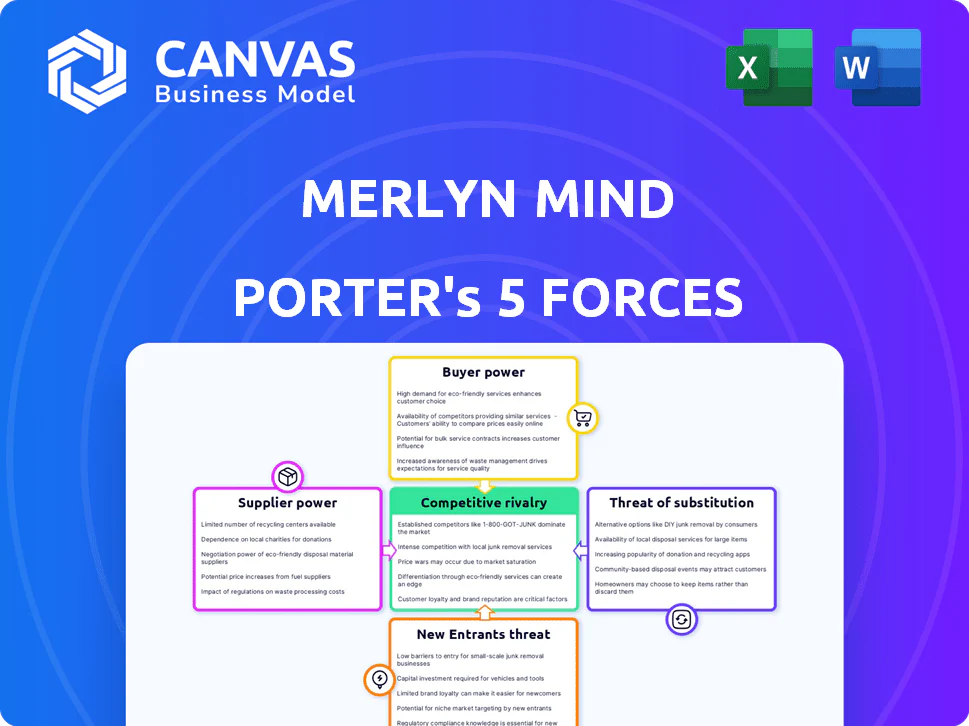
MERLYN MIND PORTER'S FIVE FORCES TEMPLATE RESEARCH
What is included in the product
 Detailed Word Document
Analyzes the competitive forces shaping Merlyn Mind's position, including risks and market dynamics.

 Customizable Excel Spreadsheet
Customize Porter's Five Forces pressure levels to account for shifting market dynamics.
What You See Is What You Get
Merlyn Mind Porter's Five Forces Analysis
The Merlyn Mind Porter's Five Forces analysis you're previewing is the complete document. It assesses industry rivalry, supplier power, buyer power, threat of substitutes, and threat of new entrants. This is the same comprehensive analysis you will download after purchasing. It is fully formatted and ready for immediate use.

Porter's Five Forces Analysis Template

A Must-Have Tool for Decision-Makers
Merlyn Mind faces moderate rivalry, with established EdTech players vying for market share. Buyer power is significant, as schools and institutions have options. Supplier power is relatively low due to diverse technology vendors. The threat of new entrants is moderate, given high R&D and regulatory hurdles. Substitutes, like in-house solutions, pose a moderate threat.
This preview is just the beginning. The full analysis provides a complete strategic snapshot with force-by-force ratings, visuals, and business implications tailored to Merlyn Mind.
Suppliers Bargaining Power

Reliance on Core AI Technology Providers
Merlyn Mind's dependence on core AI tech providers, such as those offering foundational models, is a key factor. If these suppliers, like OpenAI or Google, possess specialized tech or limited alternatives, their bargaining power grows. This could elevate Merlyn Mind's operational costs, especially if AI model prices increase, impacting profitability.
Availability of Education-Specific Data
Merlyn Mind's AI relies on ethically sourced educational data. The bargaining power of data suppliers, like educational institutions, is high if the data is scarce or proprietary. In 2024, the market for educational AI solutions was valued at approximately $1.8 billion, illustrating the value of the underlying data. Limited data access can raise costs and affect AI development.

Hardware Component Suppliers
Merlyn Mind relies on hardware component suppliers for its Symphony Classroom. The bargaining power of these suppliers depends on component uniqueness and alternatives. In 2024, the global semiconductor market, a key component, saw a revenue of $526.8 billion. The more unique the component, the higher the supplier's power, affecting Merlyn Mind's costs.

Talent Pool for AI Development
The bargaining power of suppliers in the context of Merlyn Mind's AI development hinges significantly on the talent pool of AI researchers and developers. A scarcity of skilled AI professionals elevates their bargaining power, potentially increasing labor costs for Merlyn Mind. This dynamic can influence project budgets and timelines, impacting profitability. Competition for top AI talent is fierce, especially in specialized areas like machine learning and natural language processing.
- The global AI market size was valued at USD 196.63 billion in 2023.
- The demand for AI specialists is projected to grow significantly.
- High salaries and benefits packages are common to attract talent.
- Companies compete to secure skilled AI personnel.
Integration Partners
Merlyn Mind's integration with educational platforms places it in a relationship where the platform suppliers wield considerable bargaining power. These suppliers, like Google Classroom or Canvas, control significant market share within the educational technology space. Their importance to Merlyn Mind's service delivery gives them leverage in pricing and terms. The more essential the integration, the stronger the supplier's position becomes.
- Market concentration: The top 3 LMS providers control over 60% of the market share.
- Switching costs: High switching costs for Merlyn Mind if it needs to change platforms.
- Integration complexity: Complex integrations can increase dependency on specific suppliers.
- Platform's brand: The platform's brand recognition could influence Merlyn Mind's market access.
Supplier Power Dynamics: A Deep Dive
Merlyn Mind faces supplier bargaining power across various fronts, including AI tech providers and educational data sources. The scarcity of AI talent also elevates supplier power, driving up labor costs. Integration with dominant educational platforms further strengthens supplier leverage, impacting pricing and terms.
| Supplier Type | Impact on Merlyn Mind | 2024 Data Highlights |
|---|---|---|
| AI Model Providers | Increased operational costs | Global AI market: $250 billion |
| Educational Data Suppliers | Higher data acquisition costs | EdTech market: $2.2 billion |
| AI Talent | Elevated labor costs | AI specialist demand increase: 20% |
Customers Bargaining Power

Fragmented Customer Base
Merlyn Mind primarily serves educational institutions, a customer base that can be fragmented. Individual schools or small districts might have less bargaining power. However, larger districts or collaborative groups of schools can negotiate more favorable terms, potentially influencing pricing and product features. For example, in 2024, districts with over 50,000 students represent a significant market segment.
Availability of Alternative Solutions
Customers of Merlyn Mind Porter have access to numerous ed-tech tools and AI solutions. The availability of these alternatives significantly boosts customer bargaining power. Switching costs are low, further strengthening their ability to negotiate favorable terms. For example, the global ed-tech market was valued at $158.8 billion in 2023, with continued growth projected for 2024.

Importance of AI in Education Budgets
The perceived value of AI in education significantly impacts customer bargaining power. If institutions view AI as essential, they might accept higher prices. However, budget limitations can heighten price sensitivity. For instance, in 2024, U.S. K-12 schools spent $20.6 billion on technology, a key area for AI adoption.

Implementation and Integration Costs
The expenses and intricacy involved in integrating Merlyn Mind's offerings into a school's current setup can sway customer negotiation leverage. Schools with limited resources may face challenges in affording or managing complex integrations. This might restrict their ability to bargain effectively for better terms or pricing. The bargaining power of customers is influenced by these costs.
- Implementation costs can vary, with some schools spending tens of thousands of dollars on initial setup.
- Integration complexity often leads to longer implementation timelines, sometimes extending over several months.
- The need for specialized IT support adds to the overall costs, potentially increasing the financial burden.
- Schools with less technical expertise might find themselves more reliant on Merlyn Mind's services, reducing their bargaining power.
Customer Knowledge and Experience with AI
As educators gain expertise in AI, their ability to negotiate for better terms and pricing rises. This heightened knowledge allows them to assess AI solutions more critically. This shift towards informed decision-making can significantly influence the market dynamics for educational AI tools. For example, in 2024, the adoption rate of AI in education has increased by 40%.
- Increased adoption of AI in education by 40% in 2024.
- Educators' rising demand for tailored AI solutions.
- Greater ability to negotiate and compare AI offerings.
- Potential for price sensitivity and value-based purchasing.
Ed-Tech: Who Holds the Power?
Customer bargaining power in the ed-tech market varies. Large districts and groups have more leverage than smaller ones. The availability of many alternative AI tools and low switching costs boosts customer power. Perceived value and budget limitations influence negotiation.
| Factor | Impact | Example (2024) |
|---|---|---|
| District Size | Larger districts have more power. | Districts >50k students: significant market. |
| Alternatives | Availability increases power. | Ed-tech market value: $158.8B (2023). |
| Perceived Value | Essential AI reduces power. | US K-12 tech spending: $20.6B. |
Rivalry Among Competitors

Presence of Established EdTech Companies
Merlyn Mind faces intense competition from established edtech giants. These companies, such as Google and Microsoft, already have strong school ties. In 2024, the global edtech market was valued at over $120 billion, showing the scale of competition. Their extensive product offerings make it challenging for newcomers.
Emergence of Other AI-Focused EdTech Startups
The education AI market is heating up, drawing in fresh startups. These newcomers intensify competition, potentially disrupting established players like Merlyn Mind. For example, in 2024, over $2 billion was invested in EdTech, signaling strong interest. New entrants could introduce innovative AI-driven learning tools, challenging existing market dynamics.

Availability of General-Purpose AI Tools
General-purpose AI tools pose indirect competition to Merlyn Mind. These tools, adaptable for some educational uses, challenge Merlyn Mind's market position. In 2024, the global AI in education market was valued at $1.36 billion. Merlyn Mind distinguishes itself by focusing on education-specific AI solutions.

Pace of AI Development
The fast evolution of AI creates intense competition, as rivals can swiftly introduce new features. This demands constant innovation from Merlyn Mind to stay ahead. For example, the AI market's growth rate in 2024 was approximately 20%, highlighting the need for rapid adaptation. This pace challenges Merlyn Mind to maintain its market position.
- The AI market's projected value is expected to reach $200 billion by the end of 2024.
- New AI startups are emerging monthly, increasing competitive pressure.
- The average time to develop and launch an AI feature is now under six months.
- Merlyn Mind must invest heavily in R&D to compete effectively.
Differentiation and Unique Value Proposition
Merlyn Mind distinguishes itself through its specialized AI designed for education, setting it apart in a competitive landscape. Its integration capabilities further enhance its unique value proposition, making it a more comprehensive solution. This focus allows Merlyn Mind to cater specifically to educators' needs, potentially increasing market share. This targeted approach differs from general-purpose AI tools.
- Focus on education-specific AI.
- Integration capabilities within educational platforms.
- Potential for increased market share.
- Differentiation from general AI tools.
EdTech's $120B+ Battleground: AI's Rapid Rise
Merlyn Mind faces fierce competition from established and emerging edtech players, intensifying rivalry. The EdTech market's value exceeded $120 billion in 2024, indicating substantial competitive pressure. Rapid AI advancements require continuous innovation to maintain a market edge.
| Aspect | Details |
|---|---|
| Market Value (2024) | EdTech: $120B+; AI in Education: $1.36B |
| Growth Rate (2024) | AI Market: ~20% |
| Investment (2024) | EdTech: Over $2B |
Original: $10.00
-65%$10.00
$3.50MERLYN MIND PORTER'S FIVE FORCES TEMPLATE RESEARCH
What is included in the product
Detailed Word Document
Analyzes the competitive forces shaping Merlyn Mind's position, including risks and market dynamics.
Customizable Excel Spreadsheet
Customize Porter's Five Forces pressure levels to account for shifting market dynamics.
What You See Is What You Get
Merlyn Mind Porter's Five Forces Analysis
The Merlyn Mind Porter's Five Forces analysis you're previewing is the complete document. It assesses industry rivalry, supplier power, buyer power, threat of substitutes, and threat of new entrants. This is the same comprehensive analysis you will download after purchasing. It is fully formatted and ready for immediate use.
Porter's Five Forces Analysis Template
A Must-Have Tool for Decision-Makers
Merlyn Mind faces moderate rivalry, with established EdTech players vying for market share. Buyer power is significant, as schools and institutions have options. Supplier power is relatively low due to diverse technology vendors. The threat of new entrants is moderate, given high R&D and regulatory hurdles. Substitutes, like in-house solutions, pose a moderate threat.
This preview is just the beginning. The full analysis provides a complete strategic snapshot with force-by-force ratings, visuals, and business implications tailored to Merlyn Mind.
Suppliers Bargaining Power
Reliance on Core AI Technology Providers
Merlyn Mind's dependence on core AI tech providers, such as those offering foundational models, is a key factor. If these suppliers, like OpenAI or Google, possess specialized tech or limited alternatives, their bargaining power grows. This could elevate Merlyn Mind's operational costs, especially if AI model prices increase, impacting profitability.
Availability of Education-Specific Data
Merlyn Mind's AI relies on ethically sourced educational data. The bargaining power of data suppliers, like educational institutions, is high if the data is scarce or proprietary. In 2024, the market for educational AI solutions was valued at approximately $1.8 billion, illustrating the value of the underlying data. Limited data access can raise costs and affect AI development.
Hardware Component Suppliers
Merlyn Mind relies on hardware component suppliers for its Symphony Classroom. The bargaining power of these suppliers depends on component uniqueness and alternatives. In 2024, the global semiconductor market, a key component, saw a revenue of $526.8 billion. The more unique the component, the higher the supplier's power, affecting Merlyn Mind's costs.
Talent Pool for AI Development
The bargaining power of suppliers in the context of Merlyn Mind's AI development hinges significantly on the talent pool of AI researchers and developers. A scarcity of skilled AI professionals elevates their bargaining power, potentially increasing labor costs for Merlyn Mind. This dynamic can influence project budgets and timelines, impacting profitability. Competition for top AI talent is fierce, especially in specialized areas like machine learning and natural language processing.
- The global AI market size was valued at USD 196.63 billion in 2023.
- The demand for AI specialists is projected to grow significantly.
- High salaries and benefits packages are common to attract talent.
- Companies compete to secure skilled AI personnel.
Integration Partners
Merlyn Mind's integration with educational platforms places it in a relationship where the platform suppliers wield considerable bargaining power. These suppliers, like Google Classroom or Canvas, control significant market share within the educational technology space. Their importance to Merlyn Mind's service delivery gives them leverage in pricing and terms. The more essential the integration, the stronger the supplier's position becomes.
- Market concentration: The top 3 LMS providers control over 60% of the market share.
- Switching costs: High switching costs for Merlyn Mind if it needs to change platforms.
- Integration complexity: Complex integrations can increase dependency on specific suppliers.
- Platform's brand: The platform's brand recognition could influence Merlyn Mind's market access.
Supplier Power Dynamics: A Deep Dive
Merlyn Mind faces supplier bargaining power across various fronts, including AI tech providers and educational data sources. The scarcity of AI talent also elevates supplier power, driving up labor costs. Integration with dominant educational platforms further strengthens supplier leverage, impacting pricing and terms.
| Supplier Type | Impact on Merlyn Mind | 2024 Data Highlights |
|---|---|---|
| AI Model Providers | Increased operational costs | Global AI market: $250 billion |
| Educational Data Suppliers | Higher data acquisition costs | EdTech market: $2.2 billion |
| AI Talent | Elevated labor costs | AI specialist demand increase: 20% |
Customers Bargaining Power
Fragmented Customer Base
Merlyn Mind primarily serves educational institutions, a customer base that can be fragmented. Individual schools or small districts might have less bargaining power. However, larger districts or collaborative groups of schools can negotiate more favorable terms, potentially influencing pricing and product features. For example, in 2024, districts with over 50,000 students represent a significant market segment.
Availability of Alternative Solutions
Customers of Merlyn Mind Porter have access to numerous ed-tech tools and AI solutions. The availability of these alternatives significantly boosts customer bargaining power. Switching costs are low, further strengthening their ability to negotiate favorable terms. For example, the global ed-tech market was valued at $158.8 billion in 2023, with continued growth projected for 2024.
Importance of AI in Education Budgets
The perceived value of AI in education significantly impacts customer bargaining power. If institutions view AI as essential, they might accept higher prices. However, budget limitations can heighten price sensitivity. For instance, in 2024, U.S. K-12 schools spent $20.6 billion on technology, a key area for AI adoption.
Implementation and Integration Costs
The expenses and intricacy involved in integrating Merlyn Mind's offerings into a school's current setup can sway customer negotiation leverage. Schools with limited resources may face challenges in affording or managing complex integrations. This might restrict their ability to bargain effectively for better terms or pricing. The bargaining power of customers is influenced by these costs.
- Implementation costs can vary, with some schools spending tens of thousands of dollars on initial setup.
- Integration complexity often leads to longer implementation timelines, sometimes extending over several months.
- The need for specialized IT support adds to the overall costs, potentially increasing the financial burden.
- Schools with less technical expertise might find themselves more reliant on Merlyn Mind's services, reducing their bargaining power.
Customer Knowledge and Experience with AI
As educators gain expertise in AI, their ability to negotiate for better terms and pricing rises. This heightened knowledge allows them to assess AI solutions more critically. This shift towards informed decision-making can significantly influence the market dynamics for educational AI tools. For example, in 2024, the adoption rate of AI in education has increased by 40%.
- Increased adoption of AI in education by 40% in 2024.
- Educators' rising demand for tailored AI solutions.
- Greater ability to negotiate and compare AI offerings.
- Potential for price sensitivity and value-based purchasing.
Ed-Tech: Who Holds the Power?
Customer bargaining power in the ed-tech market varies. Large districts and groups have more leverage than smaller ones. The availability of many alternative AI tools and low switching costs boosts customer power. Perceived value and budget limitations influence negotiation.
| Factor | Impact | Example (2024) |
|---|---|---|
| District Size | Larger districts have more power. | Districts >50k students: significant market. |
| Alternatives | Availability increases power. | Ed-tech market value: $158.8B (2023). |
| Perceived Value | Essential AI reduces power. | US K-12 tech spending: $20.6B. |
Rivalry Among Competitors
Presence of Established EdTech Companies
Merlyn Mind faces intense competition from established edtech giants. These companies, such as Google and Microsoft, already have strong school ties. In 2024, the global edtech market was valued at over $120 billion, showing the scale of competition. Their extensive product offerings make it challenging for newcomers.
Emergence of Other AI-Focused EdTech Startups
The education AI market is heating up, drawing in fresh startups. These newcomers intensify competition, potentially disrupting established players like Merlyn Mind. For example, in 2024, over $2 billion was invested in EdTech, signaling strong interest. New entrants could introduce innovative AI-driven learning tools, challenging existing market dynamics.
Availability of General-Purpose AI Tools
General-purpose AI tools pose indirect competition to Merlyn Mind. These tools, adaptable for some educational uses, challenge Merlyn Mind's market position. In 2024, the global AI in education market was valued at $1.36 billion. Merlyn Mind distinguishes itself by focusing on education-specific AI solutions.
Pace of AI Development
The fast evolution of AI creates intense competition, as rivals can swiftly introduce new features. This demands constant innovation from Merlyn Mind to stay ahead. For example, the AI market's growth rate in 2024 was approximately 20%, highlighting the need for rapid adaptation. This pace challenges Merlyn Mind to maintain its market position.
- The AI market's projected value is expected to reach $200 billion by the end of 2024.
- New AI startups are emerging monthly, increasing competitive pressure.
- The average time to develop and launch an AI feature is now under six months.
- Merlyn Mind must invest heavily in R&D to compete effectively.
Differentiation and Unique Value Proposition
Merlyn Mind distinguishes itself through its specialized AI designed for education, setting it apart in a competitive landscape. Its integration capabilities further enhance its unique value proposition, making it a more comprehensive solution. This focus allows Merlyn Mind to cater specifically to educators' needs, potentially increasing market share. This targeted approach differs from general-purpose AI tools.
- Focus on education-specific AI.
- Integration capabilities within educational platforms.
- Potential for increased market share.
- Differentiation from general AI tools.
EdTech's $120B+ Battleground: AI's Rapid Rise
Merlyn Mind faces fierce competition from established and emerging edtech players, intensifying rivalry. The EdTech market's value exceeded $120 billion in 2024, indicating substantial competitive pressure. Rapid AI advancements require continuous innovation to maintain a market edge.
| Aspect | Details |
|---|---|
| Market Value (2024) | EdTech: $120B+; AI in Education: $1.36B |
| Growth Rate (2024) | AI Market: ~20% |
| Investment (2024) | EdTech: Over $2B |
Product Information
Product Information
Shipping & Returns
Shipping & Returns
Description
What is included in the product
Detailed Word Document
Analyzes the competitive forces shaping Merlyn Mind's position, including risks and market dynamics.
Customizable Excel Spreadsheet
Customize Porter's Five Forces pressure levels to account for shifting market dynamics.
What You See Is What You Get
Merlyn Mind Porter's Five Forces Analysis
The Merlyn Mind Porter's Five Forces analysis you're previewing is the complete document. It assesses industry rivalry, supplier power, buyer power, threat of substitutes, and threat of new entrants. This is the same comprehensive analysis you will download after purchasing. It is fully formatted and ready for immediate use.
Porter's Five Forces Analysis Template
A Must-Have Tool for Decision-Makers
Merlyn Mind faces moderate rivalry, with established EdTech players vying for market share. Buyer power is significant, as schools and institutions have options. Supplier power is relatively low due to diverse technology vendors. The threat of new entrants is moderate, given high R&D and regulatory hurdles. Substitutes, like in-house solutions, pose a moderate threat.
This preview is just the beginning. The full analysis provides a complete strategic snapshot with force-by-force ratings, visuals, and business implications tailored to Merlyn Mind.
Suppliers Bargaining Power
Reliance on Core AI Technology Providers
Merlyn Mind's dependence on core AI tech providers, such as those offering foundational models, is a key factor. If these suppliers, like OpenAI or Google, possess specialized tech or limited alternatives, their bargaining power grows. This could elevate Merlyn Mind's operational costs, especially if AI model prices increase, impacting profitability.
Availability of Education-Specific Data
Merlyn Mind's AI relies on ethically sourced educational data. The bargaining power of data suppliers, like educational institutions, is high if the data is scarce or proprietary. In 2024, the market for educational AI solutions was valued at approximately $1.8 billion, illustrating the value of the underlying data. Limited data access can raise costs and affect AI development.
Hardware Component Suppliers
Merlyn Mind relies on hardware component suppliers for its Symphony Classroom. The bargaining power of these suppliers depends on component uniqueness and alternatives. In 2024, the global semiconductor market, a key component, saw a revenue of $526.8 billion. The more unique the component, the higher the supplier's power, affecting Merlyn Mind's costs.
Talent Pool for AI Development
The bargaining power of suppliers in the context of Merlyn Mind's AI development hinges significantly on the talent pool of AI researchers and developers. A scarcity of skilled AI professionals elevates their bargaining power, potentially increasing labor costs for Merlyn Mind. This dynamic can influence project budgets and timelines, impacting profitability. Competition for top AI talent is fierce, especially in specialized areas like machine learning and natural language processing.
- The global AI market size was valued at USD 196.63 billion in 2023.
- The demand for AI specialists is projected to grow significantly.
- High salaries and benefits packages are common to attract talent.
- Companies compete to secure skilled AI personnel.
Integration Partners
Merlyn Mind's integration with educational platforms places it in a relationship where the platform suppliers wield considerable bargaining power. These suppliers, like Google Classroom or Canvas, control significant market share within the educational technology space. Their importance to Merlyn Mind's service delivery gives them leverage in pricing and terms. The more essential the integration, the stronger the supplier's position becomes.
- Market concentration: The top 3 LMS providers control over 60% of the market share.
- Switching costs: High switching costs for Merlyn Mind if it needs to change platforms.
- Integration complexity: Complex integrations can increase dependency on specific suppliers.
- Platform's brand: The platform's brand recognition could influence Merlyn Mind's market access.
Supplier Power Dynamics: A Deep Dive
Merlyn Mind faces supplier bargaining power across various fronts, including AI tech providers and educational data sources. The scarcity of AI talent also elevates supplier power, driving up labor costs. Integration with dominant educational platforms further strengthens supplier leverage, impacting pricing and terms.
| Supplier Type | Impact on Merlyn Mind | 2024 Data Highlights |
|---|---|---|
| AI Model Providers | Increased operational costs | Global AI market: $250 billion |
| Educational Data Suppliers | Higher data acquisition costs | EdTech market: $2.2 billion |
| AI Talent | Elevated labor costs | AI specialist demand increase: 20% |
Customers Bargaining Power
Fragmented Customer Base
Merlyn Mind primarily serves educational institutions, a customer base that can be fragmented. Individual schools or small districts might have less bargaining power. However, larger districts or collaborative groups of schools can negotiate more favorable terms, potentially influencing pricing and product features. For example, in 2024, districts with over 50,000 students represent a significant market segment.
Availability of Alternative Solutions
Customers of Merlyn Mind Porter have access to numerous ed-tech tools and AI solutions. The availability of these alternatives significantly boosts customer bargaining power. Switching costs are low, further strengthening their ability to negotiate favorable terms. For example, the global ed-tech market was valued at $158.8 billion in 2023, with continued growth projected for 2024.
Importance of AI in Education Budgets
The perceived value of AI in education significantly impacts customer bargaining power. If institutions view AI as essential, they might accept higher prices. However, budget limitations can heighten price sensitivity. For instance, in 2024, U.S. K-12 schools spent $20.6 billion on technology, a key area for AI adoption.
Implementation and Integration Costs
The expenses and intricacy involved in integrating Merlyn Mind's offerings into a school's current setup can sway customer negotiation leverage. Schools with limited resources may face challenges in affording or managing complex integrations. This might restrict their ability to bargain effectively for better terms or pricing. The bargaining power of customers is influenced by these costs.
- Implementation costs can vary, with some schools spending tens of thousands of dollars on initial setup.
- Integration complexity often leads to longer implementation timelines, sometimes extending over several months.
- The need for specialized IT support adds to the overall costs, potentially increasing the financial burden.
- Schools with less technical expertise might find themselves more reliant on Merlyn Mind's services, reducing their bargaining power.
Customer Knowledge and Experience with AI
As educators gain expertise in AI, their ability to negotiate for better terms and pricing rises. This heightened knowledge allows them to assess AI solutions more critically. This shift towards informed decision-making can significantly influence the market dynamics for educational AI tools. For example, in 2024, the adoption rate of AI in education has increased by 40%.
- Increased adoption of AI in education by 40% in 2024.
- Educators' rising demand for tailored AI solutions.
- Greater ability to negotiate and compare AI offerings.
- Potential for price sensitivity and value-based purchasing.
Ed-Tech: Who Holds the Power?
Customer bargaining power in the ed-tech market varies. Large districts and groups have more leverage than smaller ones. The availability of many alternative AI tools and low switching costs boosts customer power. Perceived value and budget limitations influence negotiation.
| Factor | Impact | Example (2024) |
|---|---|---|
| District Size | Larger districts have more power. | Districts >50k students: significant market. |
| Alternatives | Availability increases power. | Ed-tech market value: $158.8B (2023). |
| Perceived Value | Essential AI reduces power. | US K-12 tech spending: $20.6B. |
Rivalry Among Competitors
Presence of Established EdTech Companies
Merlyn Mind faces intense competition from established edtech giants. These companies, such as Google and Microsoft, already have strong school ties. In 2024, the global edtech market was valued at over $120 billion, showing the scale of competition. Their extensive product offerings make it challenging for newcomers.
Emergence of Other AI-Focused EdTech Startups
The education AI market is heating up, drawing in fresh startups. These newcomers intensify competition, potentially disrupting established players like Merlyn Mind. For example, in 2024, over $2 billion was invested in EdTech, signaling strong interest. New entrants could introduce innovative AI-driven learning tools, challenging existing market dynamics.
Availability of General-Purpose AI Tools
General-purpose AI tools pose indirect competition to Merlyn Mind. These tools, adaptable for some educational uses, challenge Merlyn Mind's market position. In 2024, the global AI in education market was valued at $1.36 billion. Merlyn Mind distinguishes itself by focusing on education-specific AI solutions.
Pace of AI Development
The fast evolution of AI creates intense competition, as rivals can swiftly introduce new features. This demands constant innovation from Merlyn Mind to stay ahead. For example, the AI market's growth rate in 2024 was approximately 20%, highlighting the need for rapid adaptation. This pace challenges Merlyn Mind to maintain its market position.
- The AI market's projected value is expected to reach $200 billion by the end of 2024.
- New AI startups are emerging monthly, increasing competitive pressure.
- The average time to develop and launch an AI feature is now under six months.
- Merlyn Mind must invest heavily in R&D to compete effectively.
Differentiation and Unique Value Proposition
Merlyn Mind distinguishes itself through its specialized AI designed for education, setting it apart in a competitive landscape. Its integration capabilities further enhance its unique value proposition, making it a more comprehensive solution. This focus allows Merlyn Mind to cater specifically to educators' needs, potentially increasing market share. This targeted approach differs from general-purpose AI tools.
- Focus on education-specific AI.
- Integration capabilities within educational platforms.
- Potential for increased market share.
- Differentiation from general AI tools.
EdTech's $120B+ Battleground: AI's Rapid Rise
Merlyn Mind faces fierce competition from established and emerging edtech players, intensifying rivalry. The EdTech market's value exceeded $120 billion in 2024, indicating substantial competitive pressure. Rapid AI advancements require continuous innovation to maintain a market edge.
| Aspect | Details |
|---|---|
| Market Value (2024) | EdTech: $120B+; AI in Education: $1.36B |
| Growth Rate (2024) | AI Market: ~20% |
| Investment (2024) | EdTech: Over $2B |











