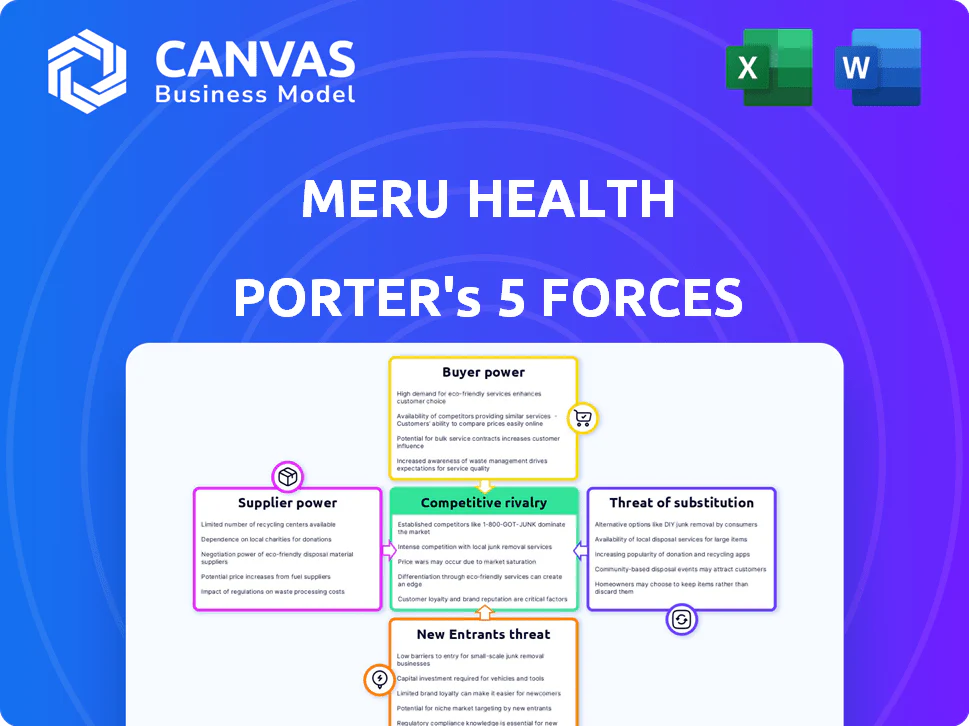
MERU HEALTH PORTER'S FIVE FORCES TEMPLATE RESEARCH
What is included in the product
 Detailed Word Document
Evaluates control held by suppliers and buyers, and their influence on pricing and profitability.

 Customizable Excel Spreadsheet
Tailor the Porter's Five Forces with notes for Meru Health's specific competitive analysis.
What You See Is What You Get
Meru Health Porter's Five Forces Analysis
This preview shows the exact document you'll receive immediately after purchase—no surprises, no placeholders. It provides a complete Porter's Five Forces analysis of Meru Health. You'll find detailed insights into competitive rivalry, supplier power, and more. The file is professionally formatted and ready for your immediate use. This means no extra work is needed from your side.

Porter's Five Forces Analysis Template

Don't Miss the Bigger Picture
Meru Health operates in a dynamic mental healthcare market. Its success hinges on navigating competitive forces like the intensity of rivalry among other digital health platforms. Buyer power is moderated by the fragmented nature of the customer base but influenced by insurance negotiations. Substitute threats include traditional therapy and wellness apps. New entrants face barriers such as regulatory hurdles and established brand recognition. Suppliers have moderate influence over costs and innovation.
Our full Porter's Five Forces report goes deeper—offering a data-driven framework to understand Meru Health's real business risks and market opportunities.
Suppliers Bargaining Power

Availability of Qualified Therapists
Meru Health's reliance on licensed therapists gives these suppliers some bargaining power. The demand for mental health professionals is high, with a 2024 shortage reported in many areas. This scarcity can drive up costs for Meru Health. Furthermore, the competition among telehealth providers for therapists may intensify this pressure, impacting Meru Health's operational expenses.
Technology and Platform Providers
Meru Health depends on digital platforms and technology. Suppliers like software developers and hosting services might have power, particularly if their services are specialized or switching is costly. In 2024, the global cloud computing market, a key technology provider, was valued at over $600 billion, indicating the scale of these suppliers. High switching costs, due to data migration complexities, can further strengthen their position.

Biofeedback Device Manufacturers
Meru Health's use of biofeedback devices introduces supplier bargaining power. If the devices are unique or essential, manufacturers gain leverage. In 2024, the biofeedback market was valued at $2.5 billion. This could affect Meru Health's costs.

Content and Curriculum Developers
Meru Health's success hinges on its content and curriculum, making developers and licensors of therapeutic materials potential influencers. If these suppliers possess unique, highly sought-after content, their bargaining power increases. Consider that the global e-learning market was valued at $325 billion in 2023, showing the value of specialized content. Meru Health must manage these supplier relationships effectively to maintain program quality and control costs.
- Content quality directly impacts program effectiveness.
- Proprietary content gives suppliers leverage.
- The e-learning market's value highlights content importance.
- Meru Health needs to negotiate favorable terms.
Data Analytics and Security Providers
Data analytics and security providers wield substantial bargaining power due to the sensitive nature of mental health data. This is crucial for a company like Meru Health. The need for HIPAA compliance and robust data protection elevates their importance. Their specialized expertise and the critical nature of their services also strengthen their position. The global cybersecurity market is projected to reach $345.4 billion in 2024.
- High demand for cybersecurity services.
- Specialized expertise in healthcare data security.
- Compliance requirements increase supplier leverage.
- Market growth in cybersecurity.
Supplier Power Dynamics at Play
Meru Health faces supplier power from therapists due to shortages, impacting costs. Tech suppliers like cloud services also have leverage; the 2024 cloud market exceeded $600B. Biofeedback device makers and content providers also exert influence.
| Supplier Type | Bargaining Power Factor | 2024 Market Data |
|---|---|---|
| Therapists | High demand, shortage | Mental health professional shortage reported in many areas |
| Tech Providers | Specialized services, high switching costs | Global cloud computing market: over $600 billion |
| Biofeedback Device Makers | Uniqueness, essentiality | Biofeedback market value: $2.5 billion |
Customers Bargaining Power

Employer and Payer Clients
Meru Health's reliance on employer and payer clients gives these entities strong bargaining power. They control access to a large user base. In 2024, employer-sponsored healthcare covered around 157 million Americans, and payers manage substantial budgets for mental health services. This allows them to negotiate prices and service terms.
Individual Users
Individual users of Meru Health exert influence through their program engagement and feedback. Their satisfaction is vital; it shapes Meru Health's reputation. Positive user experiences are essential for maintaining and growing partnerships, which is a key revenue driver. In 2024, Meru Health's user satisfaction scores directly influenced contract renewals, impacting the company's financial performance.

Awareness and Alternatives
Customers now have more mental health options, thanks to digital resources and traditional services. This increased awareness and availability of diverse solutions give customers more power. For instance, in 2024, telehealth use surged, with 52% of U.S. adults using it. This means customers can shop around for the best fit.

Clinical Outcomes and Effectiveness
Customers and payers increasingly scrutinize digital health solutions based on clinical outcomes. Meru Health's ability to prove its effectiveness directly impacts its market position and customer adoption rates. Strong clinical results lead to higher perceived value and willingness to pay for the service. This focus on outcomes is a key aspect of customer bargaining power.
- In 2024, value-based care models grew, with 48% of healthcare payments tied to outcomes.
- Digital mental health adoption increased by 25% in 2024, driven by outcome data.
- Meru Health's demonstrated efficacy directly influences its pricing power.
- Payers increasingly demand data on ROI and clinical improvements.
Pricing Models
Meru Health's pricing models, including fees-at-risk, give customers, like large payers and employers, leverage. This allows for negotiation based on the program's perceived value and outcomes. For example, in 2024, value-based care models, which include risk-sharing, covered approximately 40% of U.S. healthcare spending. The ability to negotiate is crucial for cost control.
- Negotiation power stems from alternative mental health solutions available.
- Pricing is also influenced by the outcomes and value demonstrated by Meru Health's programs.
- Customers are often large payers or employers with significant bargaining power.
Customer Power Dynamics in Mental Healthcare
Meru Health's customers, including employers and payers, hold significant bargaining power, impacting pricing and service terms. This is due to the availability of alternative mental health solutions. Value-based care models, covering around 40% of U.S. healthcare spending in 2024, give customers leverage. This is because they focus on outcomes.
| Aspect | Impact | 2024 Data |
|---|---|---|
| Customer Type | Large Payers/Employers | 157M Americans covered by employer-sponsored healthcare |
| Negotiation | Pricing & Service Terms | 40% U.S. healthcare spending tied to value-based care. |
| Outcome Focus | Value & Adoption | Digital mental health adoption increased by 25%. |
Rivalry Among Competitors

Large Number of Competitors
The digital mental health market is highly competitive, featuring numerous players vying for market share. This includes established giants and emerging startups, all striving to attract users and providers. In 2024, over 2,000 digital mental health companies operated globally. This intense competition puts pressure on pricing and innovation.
Diverse Offerings
Meru Health faces intense rivalry due to competitors' diverse offerings. They provide teletherapy, coaching, and apps, catering to varied mental health needs. This means Meru Health competes broadly, not just with program peers. The mental health market is valued at billions, with digital health growing; in 2024, the global market reached $400 billion.

Funding and Investment
The digital mental health market is highly competitive, with many companies securing significant funding. In 2024, companies like Lyra Health and Headspace raised substantial capital, fueling rapid growth and innovation. This influx of investment allows these firms to aggressively pursue market share through enhanced technology, marketing, and geographical expansion. This financial backing intensifies rivalry, as companies vie for user acquisition and market dominance.

Differentiation and Specialization
Competitive rivalry in the mental health space sees firms like Meru Health facing specialized competitors. While Meru Health offers a broad lifestyle medicine approach, it competes with those focused on specific conditions. For example, Talkspace reported revenue of $78.7 million in 2023, highlighting the market's segmentation. This differentiation impacts market share and pricing strategies.
- Specialization allows competitors to target specific needs, potentially attracting a focused customer base.
- Meru Health's comprehensive approach may appeal to a broader audience but requires effective marketing.
- The market's fragmentation creates diverse competitive dynamics.
- Pricing strategies are affected by specialization and the perceived value of services.
Partnerships and Market Access
Competitive rivalry in the mental health space is fierce, with companies like Meru Health vying for strategic partnerships. Competitors aggressively pursue collaborations with employers, insurance providers, and healthcare networks to broaden their market reach. These partnerships are crucial for expanding access to care and directly impact revenue streams. Securing and maintaining these alliances is a core battleground for companies aiming to gain a competitive edge.
- In 2024, the digital mental health market is estimated to be worth over $7 billion, highlighting the stakes.
- Partnerships can lead to significant revenue growth; for example, partnerships with large employers can increase patient volume by 20-30%.
- The ability to integrate with existing healthcare systems is a crucial factor in securing these partnerships.
- Companies that fail to secure these partnerships face a high risk of market share erosion.
Digital Mental Health: A $7 Billion Battleground
Competitive rivalry is high in the digital mental health market. Numerous companies compete, fueled by significant funding, such as Lyra Health and Headspace. These firms pursue market share through tech, marketing, and partnerships. In 2024, the digital mental health market was valued at over $7 billion.
| Aspect | Details | Impact |
|---|---|---|
| Market Growth (2024) | Digital mental health market value | Over $7 billion |
| Key Players | Lyra Health, Headspace | Drive innovation and competition |
| Partnerships | With employers, insurers | Expand market reach |
Original: $10.00
-65%$10.00
$3.50MERU HEALTH PORTER'S FIVE FORCES TEMPLATE RESEARCH
What is included in the product
Detailed Word Document
Evaluates control held by suppliers and buyers, and their influence on pricing and profitability.
Customizable Excel Spreadsheet
Tailor the Porter's Five Forces with notes for Meru Health's specific competitive analysis.
What You See Is What You Get
Meru Health Porter's Five Forces Analysis
This preview shows the exact document you'll receive immediately after purchase—no surprises, no placeholders. It provides a complete Porter's Five Forces analysis of Meru Health. You'll find detailed insights into competitive rivalry, supplier power, and more. The file is professionally formatted and ready for your immediate use. This means no extra work is needed from your side.
Porter's Five Forces Analysis Template
Don't Miss the Bigger Picture
Meru Health operates in a dynamic mental healthcare market. Its success hinges on navigating competitive forces like the intensity of rivalry among other digital health platforms. Buyer power is moderated by the fragmented nature of the customer base but influenced by insurance negotiations. Substitute threats include traditional therapy and wellness apps. New entrants face barriers such as regulatory hurdles and established brand recognition. Suppliers have moderate influence over costs and innovation.
Our full Porter's Five Forces report goes deeper—offering a data-driven framework to understand Meru Health's real business risks and market opportunities.
Suppliers Bargaining Power
Availability of Qualified Therapists
Meru Health's reliance on licensed therapists gives these suppliers some bargaining power. The demand for mental health professionals is high, with a 2024 shortage reported in many areas. This scarcity can drive up costs for Meru Health. Furthermore, the competition among telehealth providers for therapists may intensify this pressure, impacting Meru Health's operational expenses.
Technology and Platform Providers
Meru Health depends on digital platforms and technology. Suppliers like software developers and hosting services might have power, particularly if their services are specialized or switching is costly. In 2024, the global cloud computing market, a key technology provider, was valued at over $600 billion, indicating the scale of these suppliers. High switching costs, due to data migration complexities, can further strengthen their position.
Biofeedback Device Manufacturers
Meru Health's use of biofeedback devices introduces supplier bargaining power. If the devices are unique or essential, manufacturers gain leverage. In 2024, the biofeedback market was valued at $2.5 billion. This could affect Meru Health's costs.
Content and Curriculum Developers
Meru Health's success hinges on its content and curriculum, making developers and licensors of therapeutic materials potential influencers. If these suppliers possess unique, highly sought-after content, their bargaining power increases. Consider that the global e-learning market was valued at $325 billion in 2023, showing the value of specialized content. Meru Health must manage these supplier relationships effectively to maintain program quality and control costs.
- Content quality directly impacts program effectiveness.
- Proprietary content gives suppliers leverage.
- The e-learning market's value highlights content importance.
- Meru Health needs to negotiate favorable terms.
Data Analytics and Security Providers
Data analytics and security providers wield substantial bargaining power due to the sensitive nature of mental health data. This is crucial for a company like Meru Health. The need for HIPAA compliance and robust data protection elevates their importance. Their specialized expertise and the critical nature of their services also strengthen their position. The global cybersecurity market is projected to reach $345.4 billion in 2024.
- High demand for cybersecurity services.
- Specialized expertise in healthcare data security.
- Compliance requirements increase supplier leverage.
- Market growth in cybersecurity.
Supplier Power Dynamics at Play
Meru Health faces supplier power from therapists due to shortages, impacting costs. Tech suppliers like cloud services also have leverage; the 2024 cloud market exceeded $600B. Biofeedback device makers and content providers also exert influence.
| Supplier Type | Bargaining Power Factor | 2024 Market Data |
|---|---|---|
| Therapists | High demand, shortage | Mental health professional shortage reported in many areas |
| Tech Providers | Specialized services, high switching costs | Global cloud computing market: over $600 billion |
| Biofeedback Device Makers | Uniqueness, essentiality | Biofeedback market value: $2.5 billion |
Customers Bargaining Power
Employer and Payer Clients
Meru Health's reliance on employer and payer clients gives these entities strong bargaining power. They control access to a large user base. In 2024, employer-sponsored healthcare covered around 157 million Americans, and payers manage substantial budgets for mental health services. This allows them to negotiate prices and service terms.
Individual Users
Individual users of Meru Health exert influence through their program engagement and feedback. Their satisfaction is vital; it shapes Meru Health's reputation. Positive user experiences are essential for maintaining and growing partnerships, which is a key revenue driver. In 2024, Meru Health's user satisfaction scores directly influenced contract renewals, impacting the company's financial performance.
Awareness and Alternatives
Customers now have more mental health options, thanks to digital resources and traditional services. This increased awareness and availability of diverse solutions give customers more power. For instance, in 2024, telehealth use surged, with 52% of U.S. adults using it. This means customers can shop around for the best fit.
Clinical Outcomes and Effectiveness
Customers and payers increasingly scrutinize digital health solutions based on clinical outcomes. Meru Health's ability to prove its effectiveness directly impacts its market position and customer adoption rates. Strong clinical results lead to higher perceived value and willingness to pay for the service. This focus on outcomes is a key aspect of customer bargaining power.
- In 2024, value-based care models grew, with 48% of healthcare payments tied to outcomes.
- Digital mental health adoption increased by 25% in 2024, driven by outcome data.
- Meru Health's demonstrated efficacy directly influences its pricing power.
- Payers increasingly demand data on ROI and clinical improvements.
Pricing Models
Meru Health's pricing models, including fees-at-risk, give customers, like large payers and employers, leverage. This allows for negotiation based on the program's perceived value and outcomes. For example, in 2024, value-based care models, which include risk-sharing, covered approximately 40% of U.S. healthcare spending. The ability to negotiate is crucial for cost control.
- Negotiation power stems from alternative mental health solutions available.
- Pricing is also influenced by the outcomes and value demonstrated by Meru Health's programs.
- Customers are often large payers or employers with significant bargaining power.
Customer Power Dynamics in Mental Healthcare
Meru Health's customers, including employers and payers, hold significant bargaining power, impacting pricing and service terms. This is due to the availability of alternative mental health solutions. Value-based care models, covering around 40% of U.S. healthcare spending in 2024, give customers leverage. This is because they focus on outcomes.
| Aspect | Impact | 2024 Data |
|---|---|---|
| Customer Type | Large Payers/Employers | 157M Americans covered by employer-sponsored healthcare |
| Negotiation | Pricing & Service Terms | 40% U.S. healthcare spending tied to value-based care. |
| Outcome Focus | Value & Adoption | Digital mental health adoption increased by 25%. |
Rivalry Among Competitors
Large Number of Competitors
The digital mental health market is highly competitive, featuring numerous players vying for market share. This includes established giants and emerging startups, all striving to attract users and providers. In 2024, over 2,000 digital mental health companies operated globally. This intense competition puts pressure on pricing and innovation.
Diverse Offerings
Meru Health faces intense rivalry due to competitors' diverse offerings. They provide teletherapy, coaching, and apps, catering to varied mental health needs. This means Meru Health competes broadly, not just with program peers. The mental health market is valued at billions, with digital health growing; in 2024, the global market reached $400 billion.
Funding and Investment
The digital mental health market is highly competitive, with many companies securing significant funding. In 2024, companies like Lyra Health and Headspace raised substantial capital, fueling rapid growth and innovation. This influx of investment allows these firms to aggressively pursue market share through enhanced technology, marketing, and geographical expansion. This financial backing intensifies rivalry, as companies vie for user acquisition and market dominance.
Differentiation and Specialization
Competitive rivalry in the mental health space sees firms like Meru Health facing specialized competitors. While Meru Health offers a broad lifestyle medicine approach, it competes with those focused on specific conditions. For example, Talkspace reported revenue of $78.7 million in 2023, highlighting the market's segmentation. This differentiation impacts market share and pricing strategies.
- Specialization allows competitors to target specific needs, potentially attracting a focused customer base.
- Meru Health's comprehensive approach may appeal to a broader audience but requires effective marketing.
- The market's fragmentation creates diverse competitive dynamics.
- Pricing strategies are affected by specialization and the perceived value of services.
Partnerships and Market Access
Competitive rivalry in the mental health space is fierce, with companies like Meru Health vying for strategic partnerships. Competitors aggressively pursue collaborations with employers, insurance providers, and healthcare networks to broaden their market reach. These partnerships are crucial for expanding access to care and directly impact revenue streams. Securing and maintaining these alliances is a core battleground for companies aiming to gain a competitive edge.
- In 2024, the digital mental health market is estimated to be worth over $7 billion, highlighting the stakes.
- Partnerships can lead to significant revenue growth; for example, partnerships with large employers can increase patient volume by 20-30%.
- The ability to integrate with existing healthcare systems is a crucial factor in securing these partnerships.
- Companies that fail to secure these partnerships face a high risk of market share erosion.
Digital Mental Health: A $7 Billion Battleground
Competitive rivalry is high in the digital mental health market. Numerous companies compete, fueled by significant funding, such as Lyra Health and Headspace. These firms pursue market share through tech, marketing, and partnerships. In 2024, the digital mental health market was valued at over $7 billion.
| Aspect | Details | Impact |
|---|---|---|
| Market Growth (2024) | Digital mental health market value | Over $7 billion |
| Key Players | Lyra Health, Headspace | Drive innovation and competition |
| Partnerships | With employers, insurers | Expand market reach |
Product Information
Product Information
Shipping & Returns
Shipping & Returns
Description
What is included in the product
Detailed Word Document
Evaluates control held by suppliers and buyers, and their influence on pricing and profitability.
Customizable Excel Spreadsheet
Tailor the Porter's Five Forces with notes for Meru Health's specific competitive analysis.
What You See Is What You Get
Meru Health Porter's Five Forces Analysis
This preview shows the exact document you'll receive immediately after purchase—no surprises, no placeholders. It provides a complete Porter's Five Forces analysis of Meru Health. You'll find detailed insights into competitive rivalry, supplier power, and more. The file is professionally formatted and ready for your immediate use. This means no extra work is needed from your side.
Porter's Five Forces Analysis Template
Don't Miss the Bigger Picture
Meru Health operates in a dynamic mental healthcare market. Its success hinges on navigating competitive forces like the intensity of rivalry among other digital health platforms. Buyer power is moderated by the fragmented nature of the customer base but influenced by insurance negotiations. Substitute threats include traditional therapy and wellness apps. New entrants face barriers such as regulatory hurdles and established brand recognition. Suppliers have moderate influence over costs and innovation.
Our full Porter's Five Forces report goes deeper—offering a data-driven framework to understand Meru Health's real business risks and market opportunities.
Suppliers Bargaining Power
Availability of Qualified Therapists
Meru Health's reliance on licensed therapists gives these suppliers some bargaining power. The demand for mental health professionals is high, with a 2024 shortage reported in many areas. This scarcity can drive up costs for Meru Health. Furthermore, the competition among telehealth providers for therapists may intensify this pressure, impacting Meru Health's operational expenses.
Technology and Platform Providers
Meru Health depends on digital platforms and technology. Suppliers like software developers and hosting services might have power, particularly if their services are specialized or switching is costly. In 2024, the global cloud computing market, a key technology provider, was valued at over $600 billion, indicating the scale of these suppliers. High switching costs, due to data migration complexities, can further strengthen their position.
Biofeedback Device Manufacturers
Meru Health's use of biofeedback devices introduces supplier bargaining power. If the devices are unique or essential, manufacturers gain leverage. In 2024, the biofeedback market was valued at $2.5 billion. This could affect Meru Health's costs.
Content and Curriculum Developers
Meru Health's success hinges on its content and curriculum, making developers and licensors of therapeutic materials potential influencers. If these suppliers possess unique, highly sought-after content, their bargaining power increases. Consider that the global e-learning market was valued at $325 billion in 2023, showing the value of specialized content. Meru Health must manage these supplier relationships effectively to maintain program quality and control costs.
- Content quality directly impacts program effectiveness.
- Proprietary content gives suppliers leverage.
- The e-learning market's value highlights content importance.
- Meru Health needs to negotiate favorable terms.
Data Analytics and Security Providers
Data analytics and security providers wield substantial bargaining power due to the sensitive nature of mental health data. This is crucial for a company like Meru Health. The need for HIPAA compliance and robust data protection elevates their importance. Their specialized expertise and the critical nature of their services also strengthen their position. The global cybersecurity market is projected to reach $345.4 billion in 2024.
- High demand for cybersecurity services.
- Specialized expertise in healthcare data security.
- Compliance requirements increase supplier leverage.
- Market growth in cybersecurity.
Supplier Power Dynamics at Play
Meru Health faces supplier power from therapists due to shortages, impacting costs. Tech suppliers like cloud services also have leverage; the 2024 cloud market exceeded $600B. Biofeedback device makers and content providers also exert influence.
| Supplier Type | Bargaining Power Factor | 2024 Market Data |
|---|---|---|
| Therapists | High demand, shortage | Mental health professional shortage reported in many areas |
| Tech Providers | Specialized services, high switching costs | Global cloud computing market: over $600 billion |
| Biofeedback Device Makers | Uniqueness, essentiality | Biofeedback market value: $2.5 billion |
Customers Bargaining Power
Employer and Payer Clients
Meru Health's reliance on employer and payer clients gives these entities strong bargaining power. They control access to a large user base. In 2024, employer-sponsored healthcare covered around 157 million Americans, and payers manage substantial budgets for mental health services. This allows them to negotiate prices and service terms.
Individual Users
Individual users of Meru Health exert influence through their program engagement and feedback. Their satisfaction is vital; it shapes Meru Health's reputation. Positive user experiences are essential for maintaining and growing partnerships, which is a key revenue driver. In 2024, Meru Health's user satisfaction scores directly influenced contract renewals, impacting the company's financial performance.
Awareness and Alternatives
Customers now have more mental health options, thanks to digital resources and traditional services. This increased awareness and availability of diverse solutions give customers more power. For instance, in 2024, telehealth use surged, with 52% of U.S. adults using it. This means customers can shop around for the best fit.
Clinical Outcomes and Effectiveness
Customers and payers increasingly scrutinize digital health solutions based on clinical outcomes. Meru Health's ability to prove its effectiveness directly impacts its market position and customer adoption rates. Strong clinical results lead to higher perceived value and willingness to pay for the service. This focus on outcomes is a key aspect of customer bargaining power.
- In 2024, value-based care models grew, with 48% of healthcare payments tied to outcomes.
- Digital mental health adoption increased by 25% in 2024, driven by outcome data.
- Meru Health's demonstrated efficacy directly influences its pricing power.
- Payers increasingly demand data on ROI and clinical improvements.
Pricing Models
Meru Health's pricing models, including fees-at-risk, give customers, like large payers and employers, leverage. This allows for negotiation based on the program's perceived value and outcomes. For example, in 2024, value-based care models, which include risk-sharing, covered approximately 40% of U.S. healthcare spending. The ability to negotiate is crucial for cost control.
- Negotiation power stems from alternative mental health solutions available.
- Pricing is also influenced by the outcomes and value demonstrated by Meru Health's programs.
- Customers are often large payers or employers with significant bargaining power.
Customer Power Dynamics in Mental Healthcare
Meru Health's customers, including employers and payers, hold significant bargaining power, impacting pricing and service terms. This is due to the availability of alternative mental health solutions. Value-based care models, covering around 40% of U.S. healthcare spending in 2024, give customers leverage. This is because they focus on outcomes.
| Aspect | Impact | 2024 Data |
|---|---|---|
| Customer Type | Large Payers/Employers | 157M Americans covered by employer-sponsored healthcare |
| Negotiation | Pricing & Service Terms | 40% U.S. healthcare spending tied to value-based care. |
| Outcome Focus | Value & Adoption | Digital mental health adoption increased by 25%. |
Rivalry Among Competitors
Large Number of Competitors
The digital mental health market is highly competitive, featuring numerous players vying for market share. This includes established giants and emerging startups, all striving to attract users and providers. In 2024, over 2,000 digital mental health companies operated globally. This intense competition puts pressure on pricing and innovation.
Diverse Offerings
Meru Health faces intense rivalry due to competitors' diverse offerings. They provide teletherapy, coaching, and apps, catering to varied mental health needs. This means Meru Health competes broadly, not just with program peers. The mental health market is valued at billions, with digital health growing; in 2024, the global market reached $400 billion.
Funding and Investment
The digital mental health market is highly competitive, with many companies securing significant funding. In 2024, companies like Lyra Health and Headspace raised substantial capital, fueling rapid growth and innovation. This influx of investment allows these firms to aggressively pursue market share through enhanced technology, marketing, and geographical expansion. This financial backing intensifies rivalry, as companies vie for user acquisition and market dominance.
Differentiation and Specialization
Competitive rivalry in the mental health space sees firms like Meru Health facing specialized competitors. While Meru Health offers a broad lifestyle medicine approach, it competes with those focused on specific conditions. For example, Talkspace reported revenue of $78.7 million in 2023, highlighting the market's segmentation. This differentiation impacts market share and pricing strategies.
- Specialization allows competitors to target specific needs, potentially attracting a focused customer base.
- Meru Health's comprehensive approach may appeal to a broader audience but requires effective marketing.
- The market's fragmentation creates diverse competitive dynamics.
- Pricing strategies are affected by specialization and the perceived value of services.
Partnerships and Market Access
Competitive rivalry in the mental health space is fierce, with companies like Meru Health vying for strategic partnerships. Competitors aggressively pursue collaborations with employers, insurance providers, and healthcare networks to broaden their market reach. These partnerships are crucial for expanding access to care and directly impact revenue streams. Securing and maintaining these alliances is a core battleground for companies aiming to gain a competitive edge.
- In 2024, the digital mental health market is estimated to be worth over $7 billion, highlighting the stakes.
- Partnerships can lead to significant revenue growth; for example, partnerships with large employers can increase patient volume by 20-30%.
- The ability to integrate with existing healthcare systems is a crucial factor in securing these partnerships.
- Companies that fail to secure these partnerships face a high risk of market share erosion.
Digital Mental Health: A $7 Billion Battleground
Competitive rivalry is high in the digital mental health market. Numerous companies compete, fueled by significant funding, such as Lyra Health and Headspace. These firms pursue market share through tech, marketing, and partnerships. In 2024, the digital mental health market was valued at over $7 billion.
| Aspect | Details | Impact |
|---|---|---|
| Market Growth (2024) | Digital mental health market value | Over $7 billion |
| Key Players | Lyra Health, Headspace | Drive innovation and competition |
| Partnerships | With employers, insurers | Expand market reach |











