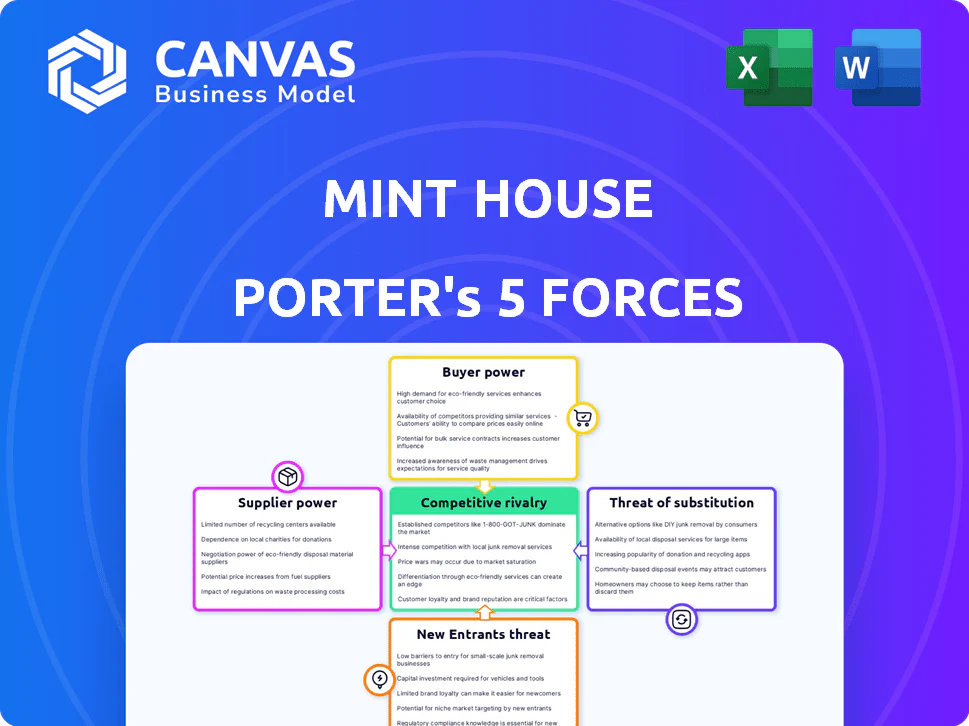
MINT HOUSE PORTER'S FIVE FORCES TEMPLATE RESEARCH
What is included in the product
 Detailed Word Document
Analyzes competitive forces, substitutes, and threats within Mint House's market position.

 Customizable Excel Spreadsheet
Customize pressure levels based on new data or evolving market trends.
Full Version Awaits
Mint House Porter's Five Forces Analysis
This is the complete, ready-to-use analysis file. The Mint House Porter's Five Forces you're previewing is what you get—professionally formatted and ready for your needs.

Porter's Five Forces Analysis Template

Don't Miss the Bigger Picture
Mint House operates in a competitive short-term rental market, facing pressure from established hotels, online travel agencies (OTAs), and other short-term rental platforms. Buyer power is moderate, as consumers have numerous accommodation options. The threat of new entrants is significant, fueled by low barriers to entry. Substitute products, like traditional hotels and extended-stay options, pose a moderate threat. Suppliers, including property owners and management companies, exert some influence.
This brief snapshot only scratches the surface. Unlock the full Porter's Five Forces Analysis to explore Mint House’s competitive dynamics, market pressures, and strategic advantages in detail.
Suppliers Bargaining Power

Dependence on Property Owners
Mint House's asset-light strategy hinges on collaborations with multifamily property owners. This reliance potentially grants property owners negotiating power, especially concerning revenue splits and management deals. In 2024, real estate firms saw an average 4.3% increase in multifamily property values. This could lead to owners seeking better terms. The firm's success depends heavily on these partnerships.
Technology Providers
Mint House's tech-driven model means it depends on suppliers for digital check-ins and keyless entry. The power of these suppliers hinges on tech uniqueness and availability. In 2024, the hospitality tech market was valued at $24.8 billion. This suggests a competitive landscape for these services.

Service Providers
Mint House relies on external service providers like cleaning and maintenance. The bargaining power of these providers varies with market concentration and service differentiation. In 2024, the U.S. cleaning services market was worth over $100 billion. Highly specialized or differentiated services might command higher prices due to limited supply. This can squeeze Mint House's margins.

Amenity and Furnishing Suppliers
Mint House's operational costs are significantly affected by the bargaining power of amenity and furnishing suppliers. The cost of furniture, kitchen supplies, and other apartment amenities directly impacts profitability. Suppliers' pricing strategies, availability, and quality control are crucial. Mint House must carefully manage these supplier relationships to control expenses and maintain service quality.
- In 2024, the global furniture market was valued at approximately $650 billion.
- The cost of kitchen supplies can vary widely, impacting operational budgets.
- Supplier negotiations are key to mitigating cost increases.
- Quality control ensures guest satisfaction and reduces replacement costs.
Geographic Concentration of Suppliers
The bargaining power of suppliers, like property owners or service providers, can be significantly impacted by their geographic concentration. If Mint House operates in areas with few willing partners, these suppliers gain increased leverage. This limited competition allows suppliers to potentially dictate terms, affecting Mint House's operational costs. For instance, in 2024, markets like Aspen or Nantucket, with limited lodging options, might see higher supplier power. This dynamic underscores the importance of diversification.
- Supplier concentration directly impacts Mint House's operational costs.
- Limited competition among suppliers increases their bargaining power.
- Geographic location plays a key role in supplier dynamics.
- Areas with fewer lodging alternatives give suppliers leverage.
Supplier Power Dynamics at Play
Mint House faces supplier bargaining power across several areas. Property owners, tech providers, and service providers can influence costs. The furniture market was about $650 billion in 2024. Geographic concentration also affects supplier leverage.
| Supplier Type | Impact on Mint House | 2024 Market Data |
|---|---|---|
| Property Owners | Revenue splits, management deals | Multifamily property values increased 4.3% |
| Tech Suppliers | Digital check-ins, keyless entry costs | Hospitality tech market: $24.8 billion |
| Service Providers | Cleaning, maintenance costs | U.S. cleaning services market: $100B+ |
Customers Bargaining Power

Diverse Customer Base
Mint House's customer base includes corporate and leisure travelers, which can balance customer power. However, large corporate clients, particularly those with extended stays, might negotiate better rates. In 2024, corporate travel spending is projected to reach $1.5 trillion globally, so large clients could have more influence. This dynamic shapes Mint House's pricing strategies.
Availability of Alternatives
Customers of Mint House possess considerable bargaining power due to the availability of numerous alternatives. They can choose from hotels, other serviced apartments, and platforms like Airbnb. The U.S. hotel industry generated over $167 billion in revenue in 2023, indicating robust competition. This readily available choice makes customers less reliant on Mint House. The ability to easily switch accommodations strengthens their negotiating position.

Price Sensitivity
Customers, particularly leisure travelers and those booking extended stays, often show price sensitivity. This sensitivity forces Mint House to provide competitive pricing, thus amplifying customer bargaining power. In 2024, the average daily rate (ADR) for luxury hotels, a segment Mint House competes in, was around $400. Price-conscious guests might opt for cheaper alternatives. This dynamic gives customers significant leverage in negotiations.

Access to Information
Customers in the hospitality sector wield significant bargaining power, fueled by readily available information. Online travel agencies (OTAs) and platforms like Booking.com and TripAdvisor offer comprehensive pricing, amenity details, and guest reviews, fostering transparency. This allows customers to compare options and negotiate better deals, influencing Mint House's pricing strategy. In 2024, 60% of hotel bookings were made online, underscoring this shift.
- Booking.com processed $91.5 billion in gross travel bookings in 2024.
- TripAdvisor had 438 million average monthly users in 2024.
- Customer reviews significantly impact booking decisions, with 79% of travelers reading reviews before booking.
Length of Stay
Mint House's customer bargaining power varies with the length of stay. Customers booking longer stays, like those for a month, often wield more influence. This is because their booking volume is higher and they represent a chance for repeat business, giving them leverage to negotiate rates. In 2024, extended-stay hotels saw an average occupancy rate of around 78.9%, slightly higher than traditional hotels, indicating the importance of these guests.
- Extended stays offer higher revenue per booking.
- Repeat business is critical for sustained revenue.
- Long-term bookings can fill vacancies.
- Negotiation is key for extended stays.
Customer Power: A Bargaining Battle
Mint House faces substantial customer bargaining power due to ample alternatives and price sensitivity. Corporate clients and those booking extended stays can negotiate lower rates. Online platforms enhance customer leverage through price transparency and reviews.
| Factor | Impact | Data (2024) |
|---|---|---|
| Alternatives | High | U.S. hotel revenue: $167B |
| Price Sensitivity | High | Luxury ADR: ~$400 |
| Information | High | Online Bookings: 60% |
Rivalry Among Competitors

Numerous Competitors
The hospitality sector faces intense competition, especially in serviced apartments and extended stays. Major hotel chains, like Marriott and Hilton, compete with independent operators. In 2024, the global hotel market was valued at over $700 billion, showing the scale of competition. This rivalry pressures pricing and innovation.
Differentiation
Mint House sets itself apart with tech-driven, apartment-like stays plus hotel services. The ease with which rivals can copy this impacts competition. In 2024, the extended-stay lodging market, where Mint House plays, saw revenue of approximately $35 billion. The more unique Mint House is, the less fierce the rivalry. Competitors like Sonder are also aiming for a similar model.

Market Growth
The apartment hotel and serviced apartment sector is expanding. This growth can fuel competition, drawing in new rivals and heightening the intensity of competition. For instance, the U.S. hotel industry's revenue in 2024 is predicted to be around $200 billion, with a portion of that coming from apartment hotels, indicating a vibrant market. Increased competition might lead to price wars or innovation battles.

Acquisitions and Consolidation
Acquisitions and consolidation are reshaping the competitive landscape within residential hospitality. Mint House's acquisition of Locale is a prime example of this trend. This consolidation can lead to fewer, but larger, competitors. The aim is to create more comprehensive offerings.
- In 2024, the hospitality industry saw a 15% increase in mergers and acquisitions.
- Mint House acquired Locale in Q2 2024, expanding its portfolio.
- Consolidation often results in increased market share for the acquiring entities.
- This trend also encourages specialized services, such as extended-stay options.
Target Market Overlap
Mint House faces intense competition due to its target market overlap with hotels and short-term rentals. Both corporate and leisure travelers are sought after, intensifying the rivalry. This shared focus forces Mint House to differentiate through unique offerings. Competitors include established hotel chains and platforms like Airbnb.
- In 2024, the U.S. hotel industry's revenue reached approximately $200 billion.
- Airbnb's revenue in 2024 was about $9.9 billion.
- Corporate travel spending is expected to increase.
- Leisure travel demand remains strong.
Extended-Stay Lodging: A $35 Billion Market in 2024
Competition in Mint House's sector is fierce, with hotels and short-term rentals vying for customers. The extended-stay lodging market generated roughly $35 billion in 2024. Acquisitions are reshaping the market, with a 15% rise in mergers and acquisitions in the hospitality industry in 2024.
| Aspect | Details | 2024 Data |
|---|---|---|
| Market Size | Global Hotel Market | $700B+ |
| Competition | Rivalry Intensity | High |
| M&A Activity | Hospitality Industry | 15% increase |
MINT HOUSE PORTER'S FIVE FORCES TEMPLATE RESEARCH
What is included in the product
Detailed Word Document
Analyzes competitive forces, substitutes, and threats within Mint House's market position.
Customizable Excel Spreadsheet
Customize pressure levels based on new data or evolving market trends.
Full Version Awaits
Mint House Porter's Five Forces Analysis
This is the complete, ready-to-use analysis file. The Mint House Porter's Five Forces you're previewing is what you get—professionally formatted and ready for your needs.
Porter's Five Forces Analysis Template
Don't Miss the Bigger Picture
Mint House operates in a competitive short-term rental market, facing pressure from established hotels, online travel agencies (OTAs), and other short-term rental platforms. Buyer power is moderate, as consumers have numerous accommodation options. The threat of new entrants is significant, fueled by low barriers to entry. Substitute products, like traditional hotels and extended-stay options, pose a moderate threat. Suppliers, including property owners and management companies, exert some influence.
This brief snapshot only scratches the surface. Unlock the full Porter's Five Forces Analysis to explore Mint House’s competitive dynamics, market pressures, and strategic advantages in detail.
Suppliers Bargaining Power
Dependence on Property Owners
Mint House's asset-light strategy hinges on collaborations with multifamily property owners. This reliance potentially grants property owners negotiating power, especially concerning revenue splits and management deals. In 2024, real estate firms saw an average 4.3% increase in multifamily property values. This could lead to owners seeking better terms. The firm's success depends heavily on these partnerships.
Technology Providers
Mint House's tech-driven model means it depends on suppliers for digital check-ins and keyless entry. The power of these suppliers hinges on tech uniqueness and availability. In 2024, the hospitality tech market was valued at $24.8 billion. This suggests a competitive landscape for these services.
Service Providers
Mint House relies on external service providers like cleaning and maintenance. The bargaining power of these providers varies with market concentration and service differentiation. In 2024, the U.S. cleaning services market was worth over $100 billion. Highly specialized or differentiated services might command higher prices due to limited supply. This can squeeze Mint House's margins.
Amenity and Furnishing Suppliers
Mint House's operational costs are significantly affected by the bargaining power of amenity and furnishing suppliers. The cost of furniture, kitchen supplies, and other apartment amenities directly impacts profitability. Suppliers' pricing strategies, availability, and quality control are crucial. Mint House must carefully manage these supplier relationships to control expenses and maintain service quality.
- In 2024, the global furniture market was valued at approximately $650 billion.
- The cost of kitchen supplies can vary widely, impacting operational budgets.
- Supplier negotiations are key to mitigating cost increases.
- Quality control ensures guest satisfaction and reduces replacement costs.
Geographic Concentration of Suppliers
The bargaining power of suppliers, like property owners or service providers, can be significantly impacted by their geographic concentration. If Mint House operates in areas with few willing partners, these suppliers gain increased leverage. This limited competition allows suppliers to potentially dictate terms, affecting Mint House's operational costs. For instance, in 2024, markets like Aspen or Nantucket, with limited lodging options, might see higher supplier power. This dynamic underscores the importance of diversification.
- Supplier concentration directly impacts Mint House's operational costs.
- Limited competition among suppliers increases their bargaining power.
- Geographic location plays a key role in supplier dynamics.
- Areas with fewer lodging alternatives give suppliers leverage.
Supplier Power Dynamics at Play
Mint House faces supplier bargaining power across several areas. Property owners, tech providers, and service providers can influence costs. The furniture market was about $650 billion in 2024. Geographic concentration also affects supplier leverage.
| Supplier Type | Impact on Mint House | 2024 Market Data |
|---|---|---|
| Property Owners | Revenue splits, management deals | Multifamily property values increased 4.3% |
| Tech Suppliers | Digital check-ins, keyless entry costs | Hospitality tech market: $24.8 billion |
| Service Providers | Cleaning, maintenance costs | U.S. cleaning services market: $100B+ |
Customers Bargaining Power
Diverse Customer Base
Mint House's customer base includes corporate and leisure travelers, which can balance customer power. However, large corporate clients, particularly those with extended stays, might negotiate better rates. In 2024, corporate travel spending is projected to reach $1.5 trillion globally, so large clients could have more influence. This dynamic shapes Mint House's pricing strategies.
Availability of Alternatives
Customers of Mint House possess considerable bargaining power due to the availability of numerous alternatives. They can choose from hotels, other serviced apartments, and platforms like Airbnb. The U.S. hotel industry generated over $167 billion in revenue in 2023, indicating robust competition. This readily available choice makes customers less reliant on Mint House. The ability to easily switch accommodations strengthens their negotiating position.
Price Sensitivity
Customers, particularly leisure travelers and those booking extended stays, often show price sensitivity. This sensitivity forces Mint House to provide competitive pricing, thus amplifying customer bargaining power. In 2024, the average daily rate (ADR) for luxury hotels, a segment Mint House competes in, was around $400. Price-conscious guests might opt for cheaper alternatives. This dynamic gives customers significant leverage in negotiations.
Access to Information
Customers in the hospitality sector wield significant bargaining power, fueled by readily available information. Online travel agencies (OTAs) and platforms like Booking.com and TripAdvisor offer comprehensive pricing, amenity details, and guest reviews, fostering transparency. This allows customers to compare options and negotiate better deals, influencing Mint House's pricing strategy. In 2024, 60% of hotel bookings were made online, underscoring this shift.
- Booking.com processed $91.5 billion in gross travel bookings in 2024.
- TripAdvisor had 438 million average monthly users in 2024.
- Customer reviews significantly impact booking decisions, with 79% of travelers reading reviews before booking.
Length of Stay
Mint House's customer bargaining power varies with the length of stay. Customers booking longer stays, like those for a month, often wield more influence. This is because their booking volume is higher and they represent a chance for repeat business, giving them leverage to negotiate rates. In 2024, extended-stay hotels saw an average occupancy rate of around 78.9%, slightly higher than traditional hotels, indicating the importance of these guests.
- Extended stays offer higher revenue per booking.
- Repeat business is critical for sustained revenue.
- Long-term bookings can fill vacancies.
- Negotiation is key for extended stays.
Customer Power: A Bargaining Battle
Mint House faces substantial customer bargaining power due to ample alternatives and price sensitivity. Corporate clients and those booking extended stays can negotiate lower rates. Online platforms enhance customer leverage through price transparency and reviews.
| Factor | Impact | Data (2024) |
|---|---|---|
| Alternatives | High | U.S. hotel revenue: $167B |
| Price Sensitivity | High | Luxury ADR: ~$400 |
| Information | High | Online Bookings: 60% |
Rivalry Among Competitors
Numerous Competitors
The hospitality sector faces intense competition, especially in serviced apartments and extended stays. Major hotel chains, like Marriott and Hilton, compete with independent operators. In 2024, the global hotel market was valued at over $700 billion, showing the scale of competition. This rivalry pressures pricing and innovation.
Differentiation
Mint House sets itself apart with tech-driven, apartment-like stays plus hotel services. The ease with which rivals can copy this impacts competition. In 2024, the extended-stay lodging market, where Mint House plays, saw revenue of approximately $35 billion. The more unique Mint House is, the less fierce the rivalry. Competitors like Sonder are also aiming for a similar model.
Market Growth
The apartment hotel and serviced apartment sector is expanding. This growth can fuel competition, drawing in new rivals and heightening the intensity of competition. For instance, the U.S. hotel industry's revenue in 2024 is predicted to be around $200 billion, with a portion of that coming from apartment hotels, indicating a vibrant market. Increased competition might lead to price wars or innovation battles.
Acquisitions and Consolidation
Acquisitions and consolidation are reshaping the competitive landscape within residential hospitality. Mint House's acquisition of Locale is a prime example of this trend. This consolidation can lead to fewer, but larger, competitors. The aim is to create more comprehensive offerings.
- In 2024, the hospitality industry saw a 15% increase in mergers and acquisitions.
- Mint House acquired Locale in Q2 2024, expanding its portfolio.
- Consolidation often results in increased market share for the acquiring entities.
- This trend also encourages specialized services, such as extended-stay options.
Target Market Overlap
Mint House faces intense competition due to its target market overlap with hotels and short-term rentals. Both corporate and leisure travelers are sought after, intensifying the rivalry. This shared focus forces Mint House to differentiate through unique offerings. Competitors include established hotel chains and platforms like Airbnb.
- In 2024, the U.S. hotel industry's revenue reached approximately $200 billion.
- Airbnb's revenue in 2024 was about $9.9 billion.
- Corporate travel spending is expected to increase.
- Leisure travel demand remains strong.
Extended-Stay Lodging: A $35 Billion Market in 2024
Competition in Mint House's sector is fierce, with hotels and short-term rentals vying for customers. The extended-stay lodging market generated roughly $35 billion in 2024. Acquisitions are reshaping the market, with a 15% rise in mergers and acquisitions in the hospitality industry in 2024.
| Aspect | Details | 2024 Data |
|---|---|---|
| Market Size | Global Hotel Market | $700B+ |
| Competition | Rivalry Intensity | High |
| M&A Activity | Hospitality Industry | 15% increase |
Product Information
Product Information
Shipping & Returns
Shipping & Returns
Description
What is included in the product
Detailed Word Document
Analyzes competitive forces, substitutes, and threats within Mint House's market position.
Customizable Excel Spreadsheet
Customize pressure levels based on new data or evolving market trends.
Full Version Awaits
Mint House Porter's Five Forces Analysis
This is the complete, ready-to-use analysis file. The Mint House Porter's Five Forces you're previewing is what you get—professionally formatted and ready for your needs.
Porter's Five Forces Analysis Template
Don't Miss the Bigger Picture
Mint House operates in a competitive short-term rental market, facing pressure from established hotels, online travel agencies (OTAs), and other short-term rental platforms. Buyer power is moderate, as consumers have numerous accommodation options. The threat of new entrants is significant, fueled by low barriers to entry. Substitute products, like traditional hotels and extended-stay options, pose a moderate threat. Suppliers, including property owners and management companies, exert some influence.
This brief snapshot only scratches the surface. Unlock the full Porter's Five Forces Analysis to explore Mint House’s competitive dynamics, market pressures, and strategic advantages in detail.
Suppliers Bargaining Power
Dependence on Property Owners
Mint House's asset-light strategy hinges on collaborations with multifamily property owners. This reliance potentially grants property owners negotiating power, especially concerning revenue splits and management deals. In 2024, real estate firms saw an average 4.3% increase in multifamily property values. This could lead to owners seeking better terms. The firm's success depends heavily on these partnerships.
Technology Providers
Mint House's tech-driven model means it depends on suppliers for digital check-ins and keyless entry. The power of these suppliers hinges on tech uniqueness and availability. In 2024, the hospitality tech market was valued at $24.8 billion. This suggests a competitive landscape for these services.
Service Providers
Mint House relies on external service providers like cleaning and maintenance. The bargaining power of these providers varies with market concentration and service differentiation. In 2024, the U.S. cleaning services market was worth over $100 billion. Highly specialized or differentiated services might command higher prices due to limited supply. This can squeeze Mint House's margins.
Amenity and Furnishing Suppliers
Mint House's operational costs are significantly affected by the bargaining power of amenity and furnishing suppliers. The cost of furniture, kitchen supplies, and other apartment amenities directly impacts profitability. Suppliers' pricing strategies, availability, and quality control are crucial. Mint House must carefully manage these supplier relationships to control expenses and maintain service quality.
- In 2024, the global furniture market was valued at approximately $650 billion.
- The cost of kitchen supplies can vary widely, impacting operational budgets.
- Supplier negotiations are key to mitigating cost increases.
- Quality control ensures guest satisfaction and reduces replacement costs.
Geographic Concentration of Suppliers
The bargaining power of suppliers, like property owners or service providers, can be significantly impacted by their geographic concentration. If Mint House operates in areas with few willing partners, these suppliers gain increased leverage. This limited competition allows suppliers to potentially dictate terms, affecting Mint House's operational costs. For instance, in 2024, markets like Aspen or Nantucket, with limited lodging options, might see higher supplier power. This dynamic underscores the importance of diversification.
- Supplier concentration directly impacts Mint House's operational costs.
- Limited competition among suppliers increases their bargaining power.
- Geographic location plays a key role in supplier dynamics.
- Areas with fewer lodging alternatives give suppliers leverage.
Supplier Power Dynamics at Play
Mint House faces supplier bargaining power across several areas. Property owners, tech providers, and service providers can influence costs. The furniture market was about $650 billion in 2024. Geographic concentration also affects supplier leverage.
| Supplier Type | Impact on Mint House | 2024 Market Data |
|---|---|---|
| Property Owners | Revenue splits, management deals | Multifamily property values increased 4.3% |
| Tech Suppliers | Digital check-ins, keyless entry costs | Hospitality tech market: $24.8 billion |
| Service Providers | Cleaning, maintenance costs | U.S. cleaning services market: $100B+ |
Customers Bargaining Power
Diverse Customer Base
Mint House's customer base includes corporate and leisure travelers, which can balance customer power. However, large corporate clients, particularly those with extended stays, might negotiate better rates. In 2024, corporate travel spending is projected to reach $1.5 trillion globally, so large clients could have more influence. This dynamic shapes Mint House's pricing strategies.
Availability of Alternatives
Customers of Mint House possess considerable bargaining power due to the availability of numerous alternatives. They can choose from hotels, other serviced apartments, and platforms like Airbnb. The U.S. hotel industry generated over $167 billion in revenue in 2023, indicating robust competition. This readily available choice makes customers less reliant on Mint House. The ability to easily switch accommodations strengthens their negotiating position.
Price Sensitivity
Customers, particularly leisure travelers and those booking extended stays, often show price sensitivity. This sensitivity forces Mint House to provide competitive pricing, thus amplifying customer bargaining power. In 2024, the average daily rate (ADR) for luxury hotels, a segment Mint House competes in, was around $400. Price-conscious guests might opt for cheaper alternatives. This dynamic gives customers significant leverage in negotiations.
Access to Information
Customers in the hospitality sector wield significant bargaining power, fueled by readily available information. Online travel agencies (OTAs) and platforms like Booking.com and TripAdvisor offer comprehensive pricing, amenity details, and guest reviews, fostering transparency. This allows customers to compare options and negotiate better deals, influencing Mint House's pricing strategy. In 2024, 60% of hotel bookings were made online, underscoring this shift.
- Booking.com processed $91.5 billion in gross travel bookings in 2024.
- TripAdvisor had 438 million average monthly users in 2024.
- Customer reviews significantly impact booking decisions, with 79% of travelers reading reviews before booking.
Length of Stay
Mint House's customer bargaining power varies with the length of stay. Customers booking longer stays, like those for a month, often wield more influence. This is because their booking volume is higher and they represent a chance for repeat business, giving them leverage to negotiate rates. In 2024, extended-stay hotels saw an average occupancy rate of around 78.9%, slightly higher than traditional hotels, indicating the importance of these guests.
- Extended stays offer higher revenue per booking.
- Repeat business is critical for sustained revenue.
- Long-term bookings can fill vacancies.
- Negotiation is key for extended stays.
Customer Power: A Bargaining Battle
Mint House faces substantial customer bargaining power due to ample alternatives and price sensitivity. Corporate clients and those booking extended stays can negotiate lower rates. Online platforms enhance customer leverage through price transparency and reviews.
| Factor | Impact | Data (2024) |
|---|---|---|
| Alternatives | High | U.S. hotel revenue: $167B |
| Price Sensitivity | High | Luxury ADR: ~$400 |
| Information | High | Online Bookings: 60% |
Rivalry Among Competitors
Numerous Competitors
The hospitality sector faces intense competition, especially in serviced apartments and extended stays. Major hotel chains, like Marriott and Hilton, compete with independent operators. In 2024, the global hotel market was valued at over $700 billion, showing the scale of competition. This rivalry pressures pricing and innovation.
Differentiation
Mint House sets itself apart with tech-driven, apartment-like stays plus hotel services. The ease with which rivals can copy this impacts competition. In 2024, the extended-stay lodging market, where Mint House plays, saw revenue of approximately $35 billion. The more unique Mint House is, the less fierce the rivalry. Competitors like Sonder are also aiming for a similar model.
Market Growth
The apartment hotel and serviced apartment sector is expanding. This growth can fuel competition, drawing in new rivals and heightening the intensity of competition. For instance, the U.S. hotel industry's revenue in 2024 is predicted to be around $200 billion, with a portion of that coming from apartment hotels, indicating a vibrant market. Increased competition might lead to price wars or innovation battles.
Acquisitions and Consolidation
Acquisitions and consolidation are reshaping the competitive landscape within residential hospitality. Mint House's acquisition of Locale is a prime example of this trend. This consolidation can lead to fewer, but larger, competitors. The aim is to create more comprehensive offerings.
- In 2024, the hospitality industry saw a 15% increase in mergers and acquisitions.
- Mint House acquired Locale in Q2 2024, expanding its portfolio.
- Consolidation often results in increased market share for the acquiring entities.
- This trend also encourages specialized services, such as extended-stay options.
Target Market Overlap
Mint House faces intense competition due to its target market overlap with hotels and short-term rentals. Both corporate and leisure travelers are sought after, intensifying the rivalry. This shared focus forces Mint House to differentiate through unique offerings. Competitors include established hotel chains and platforms like Airbnb.
- In 2024, the U.S. hotel industry's revenue reached approximately $200 billion.
- Airbnb's revenue in 2024 was about $9.9 billion.
- Corporate travel spending is expected to increase.
- Leisure travel demand remains strong.
Extended-Stay Lodging: A $35 Billion Market in 2024
Competition in Mint House's sector is fierce, with hotels and short-term rentals vying for customers. The extended-stay lodging market generated roughly $35 billion in 2024. Acquisitions are reshaping the market, with a 15% rise in mergers and acquisitions in the hospitality industry in 2024.
| Aspect | Details | 2024 Data |
|---|---|---|
| Market Size | Global Hotel Market | $700B+ |
| Competition | Rivalry Intensity | High |
| M&A Activity | Hospitality Industry | 15% increase |











