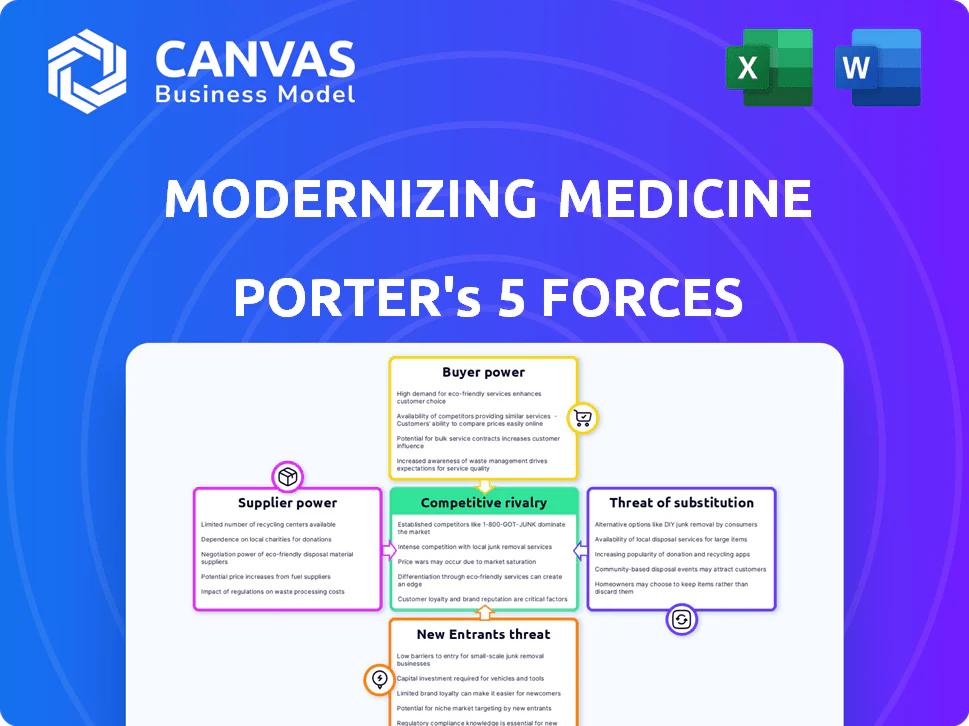
MODERNIZING MEDICINE PORTER'S FIVE FORCES TEMPLATE RESEARCH
What is included in the product
 Detailed Word Document
Tailored exclusively for Modernizing Medicine, analyzing its position within its competitive landscape.

 Customizable Excel Spreadsheet
Instantly visualize competitive forces, enabling quick pivots for your business.
Same Document Delivered
Modernizing Medicine Porter's Five Forces Analysis
This preview presents the complete Porter's Five Forces analysis of Modernizing Medicine. This is the exact, fully formatted document you'll receive immediately upon purchase, ready for your use.

Porter's Five Forces Analysis Template

Don't Miss the Bigger Picture
Modernizing Medicine faces moderate rivalry, with established players and emerging competitors. Buyer power is somewhat concentrated due to healthcare providers' purchasing decisions. Supplier power is moderate, influenced by EHR software and tech vendors. Threat of new entrants is limited by industry regulations and high initial costs. Substitute products, like other EHR systems, pose a moderate threat.
This brief snapshot only scratches the surface. Unlock the full Porter's Five Forces Analysis to explore Modernizing Medicine’s competitive dynamics, market pressures, and strategic advantages in detail.
Suppliers Bargaining Power

Limited number of specialized software component providers
The healthcare IT market, including EHR systems, relies on specialized software components. A limited supply of these components gives providers leverage over companies like Modernizing Medicine. For instance, in 2024, the top 5 EHR vendors controlled roughly 70% of the market, indicating supplier concentration. This concentration allows component providers to potentially dictate terms, affecting Modernizing Medicine's costs and innovation.
Dependence on cloud service providers
Modernizing Medicine's cloud platform heavily depends on cloud vendors like AWS and Microsoft Azure. These providers, with their market dominance, hold substantial negotiating power. In 2024, AWS controlled around 32% of the cloud infrastructure market, while Microsoft Azure held about 25%. This concentration allows them to influence pricing and service terms. This dependence can affect Modernizing Medicine's profitability and operational flexibility.

High switching costs for proprietary technology
Modernizing Medicine relies on specialized technology from suppliers, which gives these suppliers substantial bargaining power. Switching to a new supplier is expensive and difficult because of the unique nature of the technology involved. For example, in 2024, the healthcare IT market, where Modernizing Medicine operates, showed a 7.8% growth, indicating high demand, which strengthens supplier positions.

Strong relationships with technology partners
Modernizing Medicine's robust relationships with technology partners significantly reduce supplier power. They have diversified their supplier base, avoiding dependency on any single provider. This strategy enables favorable pricing and access to cutting-edge technology. Modernizing Medicine's approach is reflected in its strong financial performance, with 2024 revenue growth exceeding industry averages.
- Strategic Partnerships: Modernizing Medicine collaborates with diverse tech providers.
- Negotiating Power: These partnerships enhance negotiation leverage.
- Cost Efficiency: They secure better terms and pricing.
- Innovation Access: They stay at the forefront of technological advancements.
Availability of alternative suppliers
Modernizing Medicine can mitigate supplier power by leveraging alternative providers for non-specialized components. This strategic approach allows for more favorable terms in negotiations, especially for common software elements and services. The company's ability to integrate with various third-party vendors further strengthens its position. In 2024, the healthcare IT market saw a surge in interoperability solutions, increasing the options for businesses.
- Third-party integrations offer flexibility in sourcing.
- Increased competition among providers reduces supplier influence.
- Standardized components offer more supplier choices.
- Market trends show a rise in healthcare IT solutions.
Tech Supplier Dynamics: Power & Partnerships
Suppliers of specialized tech hold significant power over Modernizing Medicine. Concentration in the EHR and cloud markets, like AWS and Azure, impacts costs. However, strategic partnerships and diversified sourcing help mitigate this.
| Aspect | Impact | 2024 Data |
|---|---|---|
| EHR Market Concentration | Limits negotiation power | Top 5 vendors control ~70% of market |
| Cloud Vendor Dominance | Influences pricing | AWS (32%), Azure (25%) market share |
| Healthcare IT Growth | Increases supplier demand | ~7.8% growth in 2024 |
Customers Bargaining Power

High customer retention rates
Modernizing Medicine enjoys strong customer retention, a key factor in its business model. This high retention rate reduces the bargaining power of individual customers. In 2024, Modernizing Medicine's retention rate was approximately 95%, a testament to customer satisfaction and product value. This stability helps the company maintain pricing power and revenue predictability.
Availability of competing EHR systems
The EHR market features many competitors, such as Athenahealth and eClinicalWorks. This abundance of choices empowers customers with strong bargaining power. For instance, in 2024, the EHR market was valued at approximately $33.7 billion. The availability of alternatives allows customers to negotiate pricing and service terms effectively. This competitive landscape keeps vendors responsive.

Switching costs for customers
Modernizing Medicine's customer power is somewhat reduced by switching costs. Migrating to a new EHR system demands time, effort, and money for medical practices. A 2024 study showed that EHR system transitions average $30,000-$50,000 per provider. This cost can make customers hesitant to switch, giving Modernizing Medicine some leverage.

Customer demand for specific features and interoperability
Customers, mainly healthcare providers, are increasingly vocal about wanting specific features, ease of use, and the ability of different systems to work together. This growing demand empowers them when choosing and bargaining with EHR vendors. A recent report indicates that 78% of healthcare providers prioritize interoperability. This shift gives providers more options and negotiating power.
- The EHR market is competitive, with various vendors vying for contracts.
- Interoperability is critical, with 78% of providers prioritizing it.
- Providers seek user-friendly systems.
- This increases customer leverage in negotiations.
Influence of industry trends and regulations
Modernizing Medicine's customers, primarily healthcare providers, are significantly impacted by industry trends and regulations. The move towards value-based care, which rewards quality over quantity, pressures providers to adopt solutions that improve patient outcomes and reduce costs. Government regulations, such as those promoting the use of Electronic Health Records (EHRs) and interoperability, further shape customer needs and preferences, influencing their purchasing decisions. These factors collectively enhance customer bargaining power by providing them with more choices and leverage in negotiating terms with vendors like Modernizing Medicine.
- Value-based care models are projected to cover 60% of US healthcare spending by 2030.
- The ONC's (Office of the National Coordinator for Health Information Technology) interoperability regulations aim to make patient data more accessible.
- EHR adoption rates in the US are over 80% among hospitals.
EHR Market Dynamics: Customer Power Analysis
The EHR market's competitiveness gives customers significant bargaining power. Modernizing Medicine's high retention rate and switching costs slightly reduce this power. However, value-based care and interoperability trends further empower customers.
| Factor | Impact | Data |
|---|---|---|
| Market Competition | High customer bargaining power. | EHR market valued at $33.7B in 2024. |
| Switching Costs | Moderate customer power. | EHR transition costs $30-50K/provider. |
| Industry Trends | Increased customer power. | 78% providers prioritize interoperability. |
Rivalry Among Competitors

Presence of numerous competitors
The EHR market is intensely competitive. Modernizing Medicine faces numerous rivals. In 2024, the EHR market size was valued at over $30 billion. This high competition impacts pricing and market share.
Specialty-specific focus as a differentiator
Modernizing Medicine's specialty-specific focus sets it apart from generic EHR providers. This targeted approach allows them to create solutions tailored to specific medical fields. For instance, in 2024, the company's revenue reached $280 million. This specialization enhances their competitive edge.

Ongoing innovation and AI integration
Competitive rivalry in the EHR market is intense, fueled by ongoing innovation. Companies are aggressively integrating AI to enhance EHR systems. This includes improving documentation and patient care, pushing for better efficiency. In 2024, investment in AI within healthcare IT reached $1.9 billion, reflecting the competitive drive. The aim is to gain market share.

Customer retention and satisfaction
Customer retention and satisfaction are vital in competitive landscapes. Modernizing Medicine's ability to maintain high customer retention rates showcases its focus on building strong client relationships. This strategy helps in reducing churn and fortifying its market position. Data from 2024 indicates a continued emphasis on client satisfaction to maintain this competitive advantage.
- Modernizing Medicine's high customer retention rates signal strong relationship building.
- Focus on client satisfaction is crucial for reducing customer churn.
- 2024 data emphasizes the importance of client satisfaction.
Market growth and investment
The healthcare IT and EHR market is booming, attracting significant investment. This growth intensifies competition, with companies like Modernizing Medicine striving for market dominance. In 2024, the global healthcare IT market was valued at approximately $320 billion. This expansion encourages innovation and strategic moves by key players. Modernizing Medicine must navigate this competitive environment to maintain its position.
- Market growth fuels competition in healthcare IT.
- Global healthcare IT market valued around $320 billion in 2024.
- Companies like Modernizing Medicine compete for market share.
- Investment drives innovation and strategic actions.
Healthcare IT's $320B Battleground: Modernizing Medicine's Edge
Competitive rivalry in the EHR market is fierce, with numerous players vying for market share. Modernizing Medicine's specialization helps it stand out. The healthcare IT market, valued at $320B in 2024, fuels intense competition.
| Aspect | Details | 2024 Data |
|---|---|---|
| Market Size | Global Healthcare IT Market | $320 Billion |
| AI Investment | Healthcare IT | $1.9 Billion |
| Modernizing Medicine Revenue | Approximate | $280 Million |
MODERNIZING MEDICINE PORTER'S FIVE FORCES TEMPLATE RESEARCH
What is included in the product
Detailed Word Document
Tailored exclusively for Modernizing Medicine, analyzing its position within its competitive landscape.
Customizable Excel Spreadsheet
Instantly visualize competitive forces, enabling quick pivots for your business.
Same Document Delivered
Modernizing Medicine Porter's Five Forces Analysis
This preview presents the complete Porter's Five Forces analysis of Modernizing Medicine. This is the exact, fully formatted document you'll receive immediately upon purchase, ready for your use.
Porter's Five Forces Analysis Template
Don't Miss the Bigger Picture
Modernizing Medicine faces moderate rivalry, with established players and emerging competitors. Buyer power is somewhat concentrated due to healthcare providers' purchasing decisions. Supplier power is moderate, influenced by EHR software and tech vendors. Threat of new entrants is limited by industry regulations and high initial costs. Substitute products, like other EHR systems, pose a moderate threat.
This brief snapshot only scratches the surface. Unlock the full Porter's Five Forces Analysis to explore Modernizing Medicine’s competitive dynamics, market pressures, and strategic advantages in detail.
Suppliers Bargaining Power
Limited number of specialized software component providers
The healthcare IT market, including EHR systems, relies on specialized software components. A limited supply of these components gives providers leverage over companies like Modernizing Medicine. For instance, in 2024, the top 5 EHR vendors controlled roughly 70% of the market, indicating supplier concentration. This concentration allows component providers to potentially dictate terms, affecting Modernizing Medicine's costs and innovation.
Dependence on cloud service providers
Modernizing Medicine's cloud platform heavily depends on cloud vendors like AWS and Microsoft Azure. These providers, with their market dominance, hold substantial negotiating power. In 2024, AWS controlled around 32% of the cloud infrastructure market, while Microsoft Azure held about 25%. This concentration allows them to influence pricing and service terms. This dependence can affect Modernizing Medicine's profitability and operational flexibility.
High switching costs for proprietary technology
Modernizing Medicine relies on specialized technology from suppliers, which gives these suppliers substantial bargaining power. Switching to a new supplier is expensive and difficult because of the unique nature of the technology involved. For example, in 2024, the healthcare IT market, where Modernizing Medicine operates, showed a 7.8% growth, indicating high demand, which strengthens supplier positions.
Strong relationships with technology partners
Modernizing Medicine's robust relationships with technology partners significantly reduce supplier power. They have diversified their supplier base, avoiding dependency on any single provider. This strategy enables favorable pricing and access to cutting-edge technology. Modernizing Medicine's approach is reflected in its strong financial performance, with 2024 revenue growth exceeding industry averages.
- Strategic Partnerships: Modernizing Medicine collaborates with diverse tech providers.
- Negotiating Power: These partnerships enhance negotiation leverage.
- Cost Efficiency: They secure better terms and pricing.
- Innovation Access: They stay at the forefront of technological advancements.
Availability of alternative suppliers
Modernizing Medicine can mitigate supplier power by leveraging alternative providers for non-specialized components. This strategic approach allows for more favorable terms in negotiations, especially for common software elements and services. The company's ability to integrate with various third-party vendors further strengthens its position. In 2024, the healthcare IT market saw a surge in interoperability solutions, increasing the options for businesses.
- Third-party integrations offer flexibility in sourcing.
- Increased competition among providers reduces supplier influence.
- Standardized components offer more supplier choices.
- Market trends show a rise in healthcare IT solutions.
Tech Supplier Dynamics: Power & Partnerships
Suppliers of specialized tech hold significant power over Modernizing Medicine. Concentration in the EHR and cloud markets, like AWS and Azure, impacts costs. However, strategic partnerships and diversified sourcing help mitigate this.
| Aspect | Impact | 2024 Data |
|---|---|---|
| EHR Market Concentration | Limits negotiation power | Top 5 vendors control ~70% of market |
| Cloud Vendor Dominance | Influences pricing | AWS (32%), Azure (25%) market share |
| Healthcare IT Growth | Increases supplier demand | ~7.8% growth in 2024 |
Customers Bargaining Power
High customer retention rates
Modernizing Medicine enjoys strong customer retention, a key factor in its business model. This high retention rate reduces the bargaining power of individual customers. In 2024, Modernizing Medicine's retention rate was approximately 95%, a testament to customer satisfaction and product value. This stability helps the company maintain pricing power and revenue predictability.
Availability of competing EHR systems
The EHR market features many competitors, such as Athenahealth and eClinicalWorks. This abundance of choices empowers customers with strong bargaining power. For instance, in 2024, the EHR market was valued at approximately $33.7 billion. The availability of alternatives allows customers to negotiate pricing and service terms effectively. This competitive landscape keeps vendors responsive.
Switching costs for customers
Modernizing Medicine's customer power is somewhat reduced by switching costs. Migrating to a new EHR system demands time, effort, and money for medical practices. A 2024 study showed that EHR system transitions average $30,000-$50,000 per provider. This cost can make customers hesitant to switch, giving Modernizing Medicine some leverage.
Customer demand for specific features and interoperability
Customers, mainly healthcare providers, are increasingly vocal about wanting specific features, ease of use, and the ability of different systems to work together. This growing demand empowers them when choosing and bargaining with EHR vendors. A recent report indicates that 78% of healthcare providers prioritize interoperability. This shift gives providers more options and negotiating power.
- The EHR market is competitive, with various vendors vying for contracts.
- Interoperability is critical, with 78% of providers prioritizing it.
- Providers seek user-friendly systems.
- This increases customer leverage in negotiations.
Influence of industry trends and regulations
Modernizing Medicine's customers, primarily healthcare providers, are significantly impacted by industry trends and regulations. The move towards value-based care, which rewards quality over quantity, pressures providers to adopt solutions that improve patient outcomes and reduce costs. Government regulations, such as those promoting the use of Electronic Health Records (EHRs) and interoperability, further shape customer needs and preferences, influencing their purchasing decisions. These factors collectively enhance customer bargaining power by providing them with more choices and leverage in negotiating terms with vendors like Modernizing Medicine.
- Value-based care models are projected to cover 60% of US healthcare spending by 2030.
- The ONC's (Office of the National Coordinator for Health Information Technology) interoperability regulations aim to make patient data more accessible.
- EHR adoption rates in the US are over 80% among hospitals.
EHR Market Dynamics: Customer Power Analysis
The EHR market's competitiveness gives customers significant bargaining power. Modernizing Medicine's high retention rate and switching costs slightly reduce this power. However, value-based care and interoperability trends further empower customers.
| Factor | Impact | Data |
|---|---|---|
| Market Competition | High customer bargaining power. | EHR market valued at $33.7B in 2024. |
| Switching Costs | Moderate customer power. | EHR transition costs $30-50K/provider. |
| Industry Trends | Increased customer power. | 78% providers prioritize interoperability. |
Rivalry Among Competitors
Presence of numerous competitors
The EHR market is intensely competitive. Modernizing Medicine faces numerous rivals. In 2024, the EHR market size was valued at over $30 billion. This high competition impacts pricing and market share.
Specialty-specific focus as a differentiator
Modernizing Medicine's specialty-specific focus sets it apart from generic EHR providers. This targeted approach allows them to create solutions tailored to specific medical fields. For instance, in 2024, the company's revenue reached $280 million. This specialization enhances their competitive edge.
Ongoing innovation and AI integration
Competitive rivalry in the EHR market is intense, fueled by ongoing innovation. Companies are aggressively integrating AI to enhance EHR systems. This includes improving documentation and patient care, pushing for better efficiency. In 2024, investment in AI within healthcare IT reached $1.9 billion, reflecting the competitive drive. The aim is to gain market share.
Customer retention and satisfaction
Customer retention and satisfaction are vital in competitive landscapes. Modernizing Medicine's ability to maintain high customer retention rates showcases its focus on building strong client relationships. This strategy helps in reducing churn and fortifying its market position. Data from 2024 indicates a continued emphasis on client satisfaction to maintain this competitive advantage.
- Modernizing Medicine's high customer retention rates signal strong relationship building.
- Focus on client satisfaction is crucial for reducing customer churn.
- 2024 data emphasizes the importance of client satisfaction.
Market growth and investment
The healthcare IT and EHR market is booming, attracting significant investment. This growth intensifies competition, with companies like Modernizing Medicine striving for market dominance. In 2024, the global healthcare IT market was valued at approximately $320 billion. This expansion encourages innovation and strategic moves by key players. Modernizing Medicine must navigate this competitive environment to maintain its position.
- Market growth fuels competition in healthcare IT.
- Global healthcare IT market valued around $320 billion in 2024.
- Companies like Modernizing Medicine compete for market share.
- Investment drives innovation and strategic actions.
Healthcare IT's $320B Battleground: Modernizing Medicine's Edge
Competitive rivalry in the EHR market is fierce, with numerous players vying for market share. Modernizing Medicine's specialization helps it stand out. The healthcare IT market, valued at $320B in 2024, fuels intense competition.
| Aspect | Details | 2024 Data |
|---|---|---|
| Market Size | Global Healthcare IT Market | $320 Billion |
| AI Investment | Healthcare IT | $1.9 Billion |
| Modernizing Medicine Revenue | Approximate | $280 Million |
Product Information
Product Information
Shipping & Returns
Shipping & Returns
Description
What is included in the product
Detailed Word Document
Tailored exclusively for Modernizing Medicine, analyzing its position within its competitive landscape.
Customizable Excel Spreadsheet
Instantly visualize competitive forces, enabling quick pivots for your business.
Same Document Delivered
Modernizing Medicine Porter's Five Forces Analysis
This preview presents the complete Porter's Five Forces analysis of Modernizing Medicine. This is the exact, fully formatted document you'll receive immediately upon purchase, ready for your use.
Porter's Five Forces Analysis Template
Don't Miss the Bigger Picture
Modernizing Medicine faces moderate rivalry, with established players and emerging competitors. Buyer power is somewhat concentrated due to healthcare providers' purchasing decisions. Supplier power is moderate, influenced by EHR software and tech vendors. Threat of new entrants is limited by industry regulations and high initial costs. Substitute products, like other EHR systems, pose a moderate threat.
This brief snapshot only scratches the surface. Unlock the full Porter's Five Forces Analysis to explore Modernizing Medicine’s competitive dynamics, market pressures, and strategic advantages in detail.
Suppliers Bargaining Power
Limited number of specialized software component providers
The healthcare IT market, including EHR systems, relies on specialized software components. A limited supply of these components gives providers leverage over companies like Modernizing Medicine. For instance, in 2024, the top 5 EHR vendors controlled roughly 70% of the market, indicating supplier concentration. This concentration allows component providers to potentially dictate terms, affecting Modernizing Medicine's costs and innovation.
Dependence on cloud service providers
Modernizing Medicine's cloud platform heavily depends on cloud vendors like AWS and Microsoft Azure. These providers, with their market dominance, hold substantial negotiating power. In 2024, AWS controlled around 32% of the cloud infrastructure market, while Microsoft Azure held about 25%. This concentration allows them to influence pricing and service terms. This dependence can affect Modernizing Medicine's profitability and operational flexibility.
High switching costs for proprietary technology
Modernizing Medicine relies on specialized technology from suppliers, which gives these suppliers substantial bargaining power. Switching to a new supplier is expensive and difficult because of the unique nature of the technology involved. For example, in 2024, the healthcare IT market, where Modernizing Medicine operates, showed a 7.8% growth, indicating high demand, which strengthens supplier positions.
Strong relationships with technology partners
Modernizing Medicine's robust relationships with technology partners significantly reduce supplier power. They have diversified their supplier base, avoiding dependency on any single provider. This strategy enables favorable pricing and access to cutting-edge technology. Modernizing Medicine's approach is reflected in its strong financial performance, with 2024 revenue growth exceeding industry averages.
- Strategic Partnerships: Modernizing Medicine collaborates with diverse tech providers.
- Negotiating Power: These partnerships enhance negotiation leverage.
- Cost Efficiency: They secure better terms and pricing.
- Innovation Access: They stay at the forefront of technological advancements.
Availability of alternative suppliers
Modernizing Medicine can mitigate supplier power by leveraging alternative providers for non-specialized components. This strategic approach allows for more favorable terms in negotiations, especially for common software elements and services. The company's ability to integrate with various third-party vendors further strengthens its position. In 2024, the healthcare IT market saw a surge in interoperability solutions, increasing the options for businesses.
- Third-party integrations offer flexibility in sourcing.
- Increased competition among providers reduces supplier influence.
- Standardized components offer more supplier choices.
- Market trends show a rise in healthcare IT solutions.
Tech Supplier Dynamics: Power & Partnerships
Suppliers of specialized tech hold significant power over Modernizing Medicine. Concentration in the EHR and cloud markets, like AWS and Azure, impacts costs. However, strategic partnerships and diversified sourcing help mitigate this.
| Aspect | Impact | 2024 Data |
|---|---|---|
| EHR Market Concentration | Limits negotiation power | Top 5 vendors control ~70% of market |
| Cloud Vendor Dominance | Influences pricing | AWS (32%), Azure (25%) market share |
| Healthcare IT Growth | Increases supplier demand | ~7.8% growth in 2024 |
Customers Bargaining Power
High customer retention rates
Modernizing Medicine enjoys strong customer retention, a key factor in its business model. This high retention rate reduces the bargaining power of individual customers. In 2024, Modernizing Medicine's retention rate was approximately 95%, a testament to customer satisfaction and product value. This stability helps the company maintain pricing power and revenue predictability.
Availability of competing EHR systems
The EHR market features many competitors, such as Athenahealth and eClinicalWorks. This abundance of choices empowers customers with strong bargaining power. For instance, in 2024, the EHR market was valued at approximately $33.7 billion. The availability of alternatives allows customers to negotiate pricing and service terms effectively. This competitive landscape keeps vendors responsive.
Switching costs for customers
Modernizing Medicine's customer power is somewhat reduced by switching costs. Migrating to a new EHR system demands time, effort, and money for medical practices. A 2024 study showed that EHR system transitions average $30,000-$50,000 per provider. This cost can make customers hesitant to switch, giving Modernizing Medicine some leverage.
Customer demand for specific features and interoperability
Customers, mainly healthcare providers, are increasingly vocal about wanting specific features, ease of use, and the ability of different systems to work together. This growing demand empowers them when choosing and bargaining with EHR vendors. A recent report indicates that 78% of healthcare providers prioritize interoperability. This shift gives providers more options and negotiating power.
- The EHR market is competitive, with various vendors vying for contracts.
- Interoperability is critical, with 78% of providers prioritizing it.
- Providers seek user-friendly systems.
- This increases customer leverage in negotiations.
Influence of industry trends and regulations
Modernizing Medicine's customers, primarily healthcare providers, are significantly impacted by industry trends and regulations. The move towards value-based care, which rewards quality over quantity, pressures providers to adopt solutions that improve patient outcomes and reduce costs. Government regulations, such as those promoting the use of Electronic Health Records (EHRs) and interoperability, further shape customer needs and preferences, influencing their purchasing decisions. These factors collectively enhance customer bargaining power by providing them with more choices and leverage in negotiating terms with vendors like Modernizing Medicine.
- Value-based care models are projected to cover 60% of US healthcare spending by 2030.
- The ONC's (Office of the National Coordinator for Health Information Technology) interoperability regulations aim to make patient data more accessible.
- EHR adoption rates in the US are over 80% among hospitals.
EHR Market Dynamics: Customer Power Analysis
The EHR market's competitiveness gives customers significant bargaining power. Modernizing Medicine's high retention rate and switching costs slightly reduce this power. However, value-based care and interoperability trends further empower customers.
| Factor | Impact | Data |
|---|---|---|
| Market Competition | High customer bargaining power. | EHR market valued at $33.7B in 2024. |
| Switching Costs | Moderate customer power. | EHR transition costs $30-50K/provider. |
| Industry Trends | Increased customer power. | 78% providers prioritize interoperability. |
Rivalry Among Competitors
Presence of numerous competitors
The EHR market is intensely competitive. Modernizing Medicine faces numerous rivals. In 2024, the EHR market size was valued at over $30 billion. This high competition impacts pricing and market share.
Specialty-specific focus as a differentiator
Modernizing Medicine's specialty-specific focus sets it apart from generic EHR providers. This targeted approach allows them to create solutions tailored to specific medical fields. For instance, in 2024, the company's revenue reached $280 million. This specialization enhances their competitive edge.
Ongoing innovation and AI integration
Competitive rivalry in the EHR market is intense, fueled by ongoing innovation. Companies are aggressively integrating AI to enhance EHR systems. This includes improving documentation and patient care, pushing for better efficiency. In 2024, investment in AI within healthcare IT reached $1.9 billion, reflecting the competitive drive. The aim is to gain market share.
Customer retention and satisfaction
Customer retention and satisfaction are vital in competitive landscapes. Modernizing Medicine's ability to maintain high customer retention rates showcases its focus on building strong client relationships. This strategy helps in reducing churn and fortifying its market position. Data from 2024 indicates a continued emphasis on client satisfaction to maintain this competitive advantage.
- Modernizing Medicine's high customer retention rates signal strong relationship building.
- Focus on client satisfaction is crucial for reducing customer churn.
- 2024 data emphasizes the importance of client satisfaction.
Market growth and investment
The healthcare IT and EHR market is booming, attracting significant investment. This growth intensifies competition, with companies like Modernizing Medicine striving for market dominance. In 2024, the global healthcare IT market was valued at approximately $320 billion. This expansion encourages innovation and strategic moves by key players. Modernizing Medicine must navigate this competitive environment to maintain its position.
- Market growth fuels competition in healthcare IT.
- Global healthcare IT market valued around $320 billion in 2024.
- Companies like Modernizing Medicine compete for market share.
- Investment drives innovation and strategic actions.
Healthcare IT's $320B Battleground: Modernizing Medicine's Edge
Competitive rivalry in the EHR market is fierce, with numerous players vying for market share. Modernizing Medicine's specialization helps it stand out. The healthcare IT market, valued at $320B in 2024, fuels intense competition.
| Aspect | Details | 2024 Data |
|---|---|---|
| Market Size | Global Healthcare IT Market | $320 Billion |
| AI Investment | Healthcare IT | $1.9 Billion |
| Modernizing Medicine Revenue | Approximate | $280 Million |











