MODULAR MEDICAL PORTER'S FIVE FORCES TEMPLATE RESEARCH
What is included in the product
 Detailed Word Document
Analyzes Modular Medical's competitive landscape, covering threats, and bargaining power.

 Customizable Excel Spreadsheet
Modularize your analysis to easily visualize and respond to changing market dynamics.
Preview the Actual Deliverable
Modular Medical Porter's Five Forces Analysis
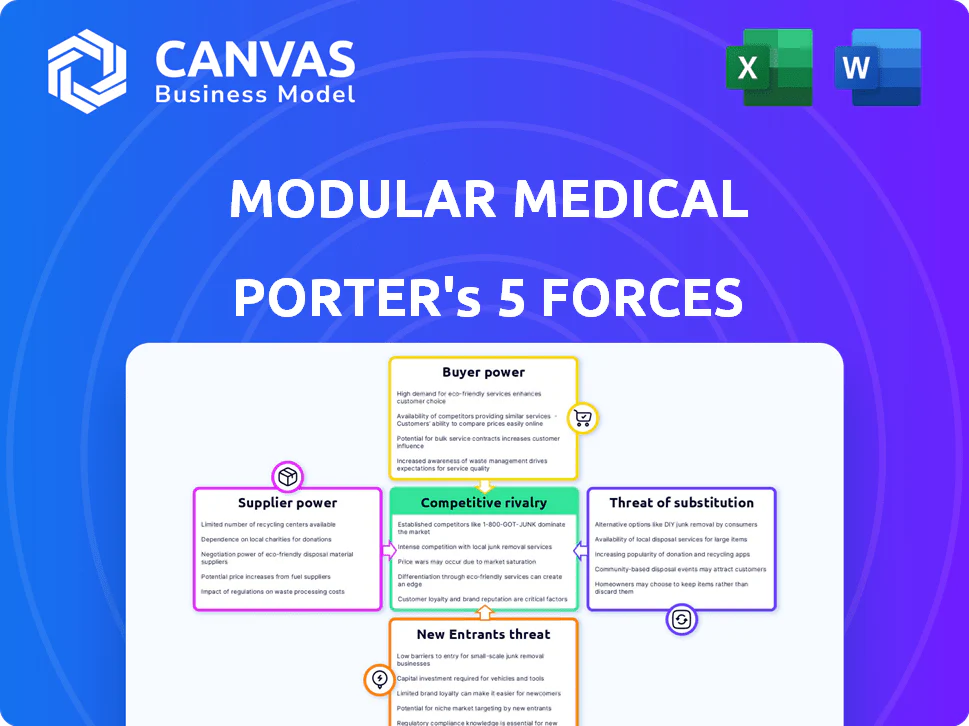
This preview showcases the complete Modular Medical Porter's Five Forces Analysis you'll receive. It meticulously examines the industry's competitive landscape. This document assesses threats from new entrants, supplier power, and buyer power. It further analyzes competitive rivalry and the threat of substitutes. Get instant access to this comprehensive analysis.

Porter's Five Forces Analysis Template

Elevate Your Analysis with the Complete Porter's Five Forces Analysis
Modular Medical faces intense rivalry, fueled by numerous competitors and product innovation. Buyer power is moderate, influenced by healthcare provider consolidation and purchasing groups. Supplier power is relatively low, with diverse component suppliers available. The threat of new entrants is moderate, given regulatory hurdles and capital requirements. Substitute products pose a limited threat, as specialized medical equipment is essential.
This preview is just the beginning. Dive into a complete, consultant-grade breakdown of Modular Medical’s industry competitiveness—ready for immediate use.
Suppliers Bargaining Power

Component and Raw Material Suppliers
Modular Medical's profitability depends on component and raw material suppliers. Their bargaining power hinges on supplier concentration and material uniqueness. For example, if key components have limited suppliers, those suppliers gain pricing power. This could affect Modular Medical's costs and margins. In 2024, supply chain disruptions increased supplier influence across various industries, including medical devices.
Specialized Manufacturing Partners
Modular Medical relies on specialized manufacturing partners for medical devices. These partners' expertise and certifications give them bargaining power. A manufacturer with unique capabilities can demand higher prices. In 2024, the medical device manufacturing market was worth $177.3 billion, showing partner influence.

Technology and Intellectual Property Providers
Modular Medical's reliance on external tech and IP providers, like specialized software vendors, grants these suppliers considerable leverage. In 2024, the licensing fees for medical software increased by about 7%. This can result in higher costs and limitations on how Modular Medical utilizes these technologies.

Regulatory and Testing Service Providers
For Modular Medical, regulatory and testing service providers hold significant bargaining power due to the critical need for approvals like FDA clearance. These specialized services are essential for market entry and compliance. The concentration of expertise within these providers, coupled with the complexity of regulatory processes, elevates their influence. The cost of these services can significantly impact overall project expenses and timelines.
- FDA premarket approval (PMA) applications in 2024 cost between $100,000 and $300,000.
- The average time for FDA clearance can range from 6 months to over a year.
- Regulatory consulting fees can range from $150 to $400 per hour.
- Failure to secure regulatory clearance results in lost revenue.
Labor Market for Skilled Personnel
Modular Medical's success hinges on skilled labor, including engineers and technicians. The medical device industry's demand for these professionals influences labor costs and talent retention. In 2024, the average salary for biomedical engineers was around $97,000, reflecting the competitive market. High demand can increase supplier power, impacting operational costs.
- Biomedical engineering job growth is projected at 10% from 2022 to 2032.
- The medical device market is expected to reach $671.4 billion by 2024.
- Employee turnover rates in the medical device sector average 12-15%.
- Labor costs can constitute up to 30% of total operational expenses.
Supplier Power Dynamics at Play
Modular Medical faces supplier bargaining power across various fronts. Suppliers of unique components and raw materials can exert pricing power, especially in a market affected by supply chain issues. Specialized manufacturing partners and external tech providers also hold significant leverage, impacting costs. Regulatory and testing service providers have strong influence due to compliance needs.
| Supplier Type | Impact on Modular Medical | 2024 Data |
|---|---|---|
| Component Suppliers | Pricing power, cost of goods sold (COGS) | Raw material costs increased 5-10% |
| Manufacturing Partners | Production costs, margins | Market value: $177.3B |
| Tech/IP Providers | Licensing costs, tech access | Software licensing fees rose 7% |
| Regulatory Services | Compliance costs, timelines | PMA application costs: $100K-$300K |
| Skilled Labor | Operational costs, talent retention | Biomedical engineer salary: $97K |
Customers Bargaining Power

Individual Patients and Caregivers
For individual patients and caregivers, bargaining power is usually low because insulin is medically essential. Switching methods is complex, limiting their ability to negotiate prices or terms. Patient advocacy groups and online resources offer some leverage, influencing product features and affordability. In 2024, the average cost of insulin in the U.S. was around $334 per month without insurance.
Healthcare Providers and Clinics
Hospitals and clinics greatly influence insulin pump choices. Their purchasing power is moderate due to their volume of orders. They assess ease of use and system integration. For instance, in 2024, hospital spending on medical devices rose by approximately 6%. This impacts product selection.

Insurance Companies and Reimbursement Bodies
Insurance companies and government programs, like Medicare and Medicaid, hold considerable sway over Modular Medical's revenue. They dictate which devices are covered and at what price. For example, in 2024, Medicare spending on durable medical equipment (DME) was about $12.5 billion. Modular Medical must prove its devices offer superior value to secure favorable reimbursement rates, which is crucial for profitability. This includes presenting robust clinical data and demonstrating cost-effectiveness to these powerful payers.

Group Purchasing Organizations (GPOs)
Group Purchasing Organizations (GPOs) are crucial in healthcare, enabling collective bargaining for better prices. Modular Medical might face increased customer bargaining power through GPOs, especially if they rely on them for market access. GPOs negotiate for their members, potentially squeezing profit margins for manufacturers. In 2024, the GPO market size was approximately $800 billion.
- GPOs negotiate pricing and terms.
- Modular Medical could become dependent on GPOs.
- GPOs can increase customer bargaining power.
- GPO market size was $800B in 2024.
Distributors and Pharmacies
Distributors and pharmacies are crucial in getting products to patients. They negotiate wholesale prices and decide which products to stock. Their power is notable, though generally less impactful compared to payers or large healthcare systems. For example, in 2024, the top three U.S. drug distributors controlled about 90% of the market.
- Market Control: Top three U.S. drug distributors held roughly 90% of the market share in 2024.
- Pricing Influence: Pharmacies negotiate directly for drug prices, affecting revenue.
- Product Selection: Distributors decide which drugs to offer.
- Customer Impact: Their choices affect patient access and costs.
Market Dynamics: Bargaining Power Analysis
Customer bargaining power varies significantly in Modular Medical's market.
Insurance companies and government programs, like Medicare, heavily influence revenue, dictating coverage and pricing. Group Purchasing Organizations (GPOs) also impact Modular Medical, negotiating for favorable terms, with a market size of $800 billion in 2024.
Distributors and pharmacies influence pricing and product selection, affecting patient access.
| Customer Type | Bargaining Power | Impact |
|---|---|---|
| Insurance/Govt. | High | Dictate coverage, pricing; influence revenue |
| GPOs | Moderate | Negotiate prices; market access ($800B in 2024) |
| Distributors/Pharmacies | Moderate | Influence pricing, product access |
Rivalry Among Competitors

Number and Diversity of Competitors
The medical device market, especially for diabetes management, features both established and new companies. The intensity of rivalry is high due to the number of competitors in insulin delivery. In 2024, the global insulin pump market was valued at approximately $5.5 billion. This includes various insulin delivery systems, increasing competition.
Market Growth Rate
The diabetes market's overall growth doesn't always reflect the wearable insulin delivery segment's pace. Rapid expansion can lessen competition by offering ample opportunities. However, certain high-growth areas within this segment can become fiercely competitive. The global diabetes devices market was valued at $15.3 billion in 2024, with expected growth. This indicates the potential for both collaboration and intense rivalry among companies.

Product Differentiation and Switching Costs
Modular Medical emphasizes user-friendliness and affordability to stand out. The ease of switching between insulin delivery systems affects rivalry. If patients and providers find it easy to switch, rivalry intensifies. In 2024, the insulin market saw increased competition, with companies like Novo Nordisk and Eli Lilly battling for market share. The higher the differentiation, the lower the rivalry.

Brand Identity and Loyalty
Established rivals in medical device manufacturing often possess substantial brand equity and customer allegiance, posing a significant challenge for newcomers like Modular Medical. Building a robust brand identity and fostering customer loyalty are crucial for Modular Medical to gain market share. In 2024, companies with strong brand recognition, like Medtronic, showed high customer retention rates, above 80% in some segments, indicating the challenge Modular Medical faces. Modular Medical must invest in brand-building activities to compete effectively.
- Medtronic's revenue in 2024 was approximately $32 billion, illustrating the scale of established competitors.
- Customer loyalty programs can boost retention rates.
- Innovation and strong marketing are key to creating brand awareness.
- Modular Medical should consider strategic partnerships to build trust.
Exit Barriers
High exit barriers in the medical device sector, encompassing specialized assets and regulatory hurdles, can trap companies. These barriers, including the need for FDA approvals and complex manufacturing, keep firms competing. Even with low profits, companies may persist due to the high costs of exiting. This intensifies competition, as firms fight for market share.
- FDA approval costs can range from $31 million to over $200 million.
- The medical device market was valued at $495.4 billion in 2023.
- Mergers and acquisitions in the medical device industry totaled $60 billion in 2024.
Diabetes Device Market: Fierce Competition
Competitive rivalry in the diabetes device market is intense due to numerous competitors. The global diabetes devices market reached $15.3 billion in 2024, fueling competition. High exit barriers, like FDA approvals, keep firms competing fiercely.
| Factor | Impact | Data (2024) |
|---|---|---|
| Market Value | High Rivalry | $15.3B (Diabetes Devices) |
| Brand Loyalty | Intensifies Rivalry | Medtronic Retention >80% |
| Exit Barriers | Intensifies Rivalry | FDA Approval Costs: $31M-$200M+ |
MODULAR MEDICAL PORTER'S FIVE FORCES TEMPLATE RESEARCH
What is included in the product
Detailed Word Document
Analyzes Modular Medical's competitive landscape, covering threats, and bargaining power.
Customizable Excel Spreadsheet
Modularize your analysis to easily visualize and respond to changing market dynamics.
Preview the Actual Deliverable
Modular Medical Porter's Five Forces Analysis
This preview showcases the complete Modular Medical Porter's Five Forces Analysis you'll receive. It meticulously examines the industry's competitive landscape. This document assesses threats from new entrants, supplier power, and buyer power. It further analyzes competitive rivalry and the threat of substitutes. Get instant access to this comprehensive analysis.
Porter's Five Forces Analysis Template
Elevate Your Analysis with the Complete Porter's Five Forces Analysis
Modular Medical faces intense rivalry, fueled by numerous competitors and product innovation. Buyer power is moderate, influenced by healthcare provider consolidation and purchasing groups. Supplier power is relatively low, with diverse component suppliers available. The threat of new entrants is moderate, given regulatory hurdles and capital requirements. Substitute products pose a limited threat, as specialized medical equipment is essential.
This preview is just the beginning. Dive into a complete, consultant-grade breakdown of Modular Medical’s industry competitiveness—ready for immediate use.
Suppliers Bargaining Power
Component and Raw Material Suppliers
Modular Medical's profitability depends on component and raw material suppliers. Their bargaining power hinges on supplier concentration and material uniqueness. For example, if key components have limited suppliers, those suppliers gain pricing power. This could affect Modular Medical's costs and margins. In 2024, supply chain disruptions increased supplier influence across various industries, including medical devices.
Specialized Manufacturing Partners
Modular Medical relies on specialized manufacturing partners for medical devices. These partners' expertise and certifications give them bargaining power. A manufacturer with unique capabilities can demand higher prices. In 2024, the medical device manufacturing market was worth $177.3 billion, showing partner influence.
Technology and Intellectual Property Providers
Modular Medical's reliance on external tech and IP providers, like specialized software vendors, grants these suppliers considerable leverage. In 2024, the licensing fees for medical software increased by about 7%. This can result in higher costs and limitations on how Modular Medical utilizes these technologies.
Regulatory and Testing Service Providers
For Modular Medical, regulatory and testing service providers hold significant bargaining power due to the critical need for approvals like FDA clearance. These specialized services are essential for market entry and compliance. The concentration of expertise within these providers, coupled with the complexity of regulatory processes, elevates their influence. The cost of these services can significantly impact overall project expenses and timelines.
- FDA premarket approval (PMA) applications in 2024 cost between $100,000 and $300,000.
- The average time for FDA clearance can range from 6 months to over a year.
- Regulatory consulting fees can range from $150 to $400 per hour.
- Failure to secure regulatory clearance results in lost revenue.
Labor Market for Skilled Personnel
Modular Medical's success hinges on skilled labor, including engineers and technicians. The medical device industry's demand for these professionals influences labor costs and talent retention. In 2024, the average salary for biomedical engineers was around $97,000, reflecting the competitive market. High demand can increase supplier power, impacting operational costs.
- Biomedical engineering job growth is projected at 10% from 2022 to 2032.
- The medical device market is expected to reach $671.4 billion by 2024.
- Employee turnover rates in the medical device sector average 12-15%.
- Labor costs can constitute up to 30% of total operational expenses.
Supplier Power Dynamics at Play
Modular Medical faces supplier bargaining power across various fronts. Suppliers of unique components and raw materials can exert pricing power, especially in a market affected by supply chain issues. Specialized manufacturing partners and external tech providers also hold significant leverage, impacting costs. Regulatory and testing service providers have strong influence due to compliance needs.
| Supplier Type | Impact on Modular Medical | 2024 Data |
|---|---|---|
| Component Suppliers | Pricing power, cost of goods sold (COGS) | Raw material costs increased 5-10% |
| Manufacturing Partners | Production costs, margins | Market value: $177.3B |
| Tech/IP Providers | Licensing costs, tech access | Software licensing fees rose 7% |
| Regulatory Services | Compliance costs, timelines | PMA application costs: $100K-$300K |
| Skilled Labor | Operational costs, talent retention | Biomedical engineer salary: $97K |
Customers Bargaining Power
Individual Patients and Caregivers
For individual patients and caregivers, bargaining power is usually low because insulin is medically essential. Switching methods is complex, limiting their ability to negotiate prices or terms. Patient advocacy groups and online resources offer some leverage, influencing product features and affordability. In 2024, the average cost of insulin in the U.S. was around $334 per month without insurance.
Healthcare Providers and Clinics
Hospitals and clinics greatly influence insulin pump choices. Their purchasing power is moderate due to their volume of orders. They assess ease of use and system integration. For instance, in 2024, hospital spending on medical devices rose by approximately 6%. This impacts product selection.
Insurance Companies and Reimbursement Bodies
Insurance companies and government programs, like Medicare and Medicaid, hold considerable sway over Modular Medical's revenue. They dictate which devices are covered and at what price. For example, in 2024, Medicare spending on durable medical equipment (DME) was about $12.5 billion. Modular Medical must prove its devices offer superior value to secure favorable reimbursement rates, which is crucial for profitability. This includes presenting robust clinical data and demonstrating cost-effectiveness to these powerful payers.
Group Purchasing Organizations (GPOs)
Group Purchasing Organizations (GPOs) are crucial in healthcare, enabling collective bargaining for better prices. Modular Medical might face increased customer bargaining power through GPOs, especially if they rely on them for market access. GPOs negotiate for their members, potentially squeezing profit margins for manufacturers. In 2024, the GPO market size was approximately $800 billion.
- GPOs negotiate pricing and terms.
- Modular Medical could become dependent on GPOs.
- GPOs can increase customer bargaining power.
- GPO market size was $800B in 2024.
Distributors and Pharmacies
Distributors and pharmacies are crucial in getting products to patients. They negotiate wholesale prices and decide which products to stock. Their power is notable, though generally less impactful compared to payers or large healthcare systems. For example, in 2024, the top three U.S. drug distributors controlled about 90% of the market.
- Market Control: Top three U.S. drug distributors held roughly 90% of the market share in 2024.
- Pricing Influence: Pharmacies negotiate directly for drug prices, affecting revenue.
- Product Selection: Distributors decide which drugs to offer.
- Customer Impact: Their choices affect patient access and costs.
Market Dynamics: Bargaining Power Analysis
Customer bargaining power varies significantly in Modular Medical's market.
Insurance companies and government programs, like Medicare, heavily influence revenue, dictating coverage and pricing. Group Purchasing Organizations (GPOs) also impact Modular Medical, negotiating for favorable terms, with a market size of $800 billion in 2024.
Distributors and pharmacies influence pricing and product selection, affecting patient access.
| Customer Type | Bargaining Power | Impact |
|---|---|---|
| Insurance/Govt. | High | Dictate coverage, pricing; influence revenue |
| GPOs | Moderate | Negotiate prices; market access ($800B in 2024) |
| Distributors/Pharmacies | Moderate | Influence pricing, product access |
Rivalry Among Competitors
Number and Diversity of Competitors
The medical device market, especially for diabetes management, features both established and new companies. The intensity of rivalry is high due to the number of competitors in insulin delivery. In 2024, the global insulin pump market was valued at approximately $5.5 billion. This includes various insulin delivery systems, increasing competition.
Market Growth Rate
The diabetes market's overall growth doesn't always reflect the wearable insulin delivery segment's pace. Rapid expansion can lessen competition by offering ample opportunities. However, certain high-growth areas within this segment can become fiercely competitive. The global diabetes devices market was valued at $15.3 billion in 2024, with expected growth. This indicates the potential for both collaboration and intense rivalry among companies.
Product Differentiation and Switching Costs
Modular Medical emphasizes user-friendliness and affordability to stand out. The ease of switching between insulin delivery systems affects rivalry. If patients and providers find it easy to switch, rivalry intensifies. In 2024, the insulin market saw increased competition, with companies like Novo Nordisk and Eli Lilly battling for market share. The higher the differentiation, the lower the rivalry.
Brand Identity and Loyalty
Established rivals in medical device manufacturing often possess substantial brand equity and customer allegiance, posing a significant challenge for newcomers like Modular Medical. Building a robust brand identity and fostering customer loyalty are crucial for Modular Medical to gain market share. In 2024, companies with strong brand recognition, like Medtronic, showed high customer retention rates, above 80% in some segments, indicating the challenge Modular Medical faces. Modular Medical must invest in brand-building activities to compete effectively.
- Medtronic's revenue in 2024 was approximately $32 billion, illustrating the scale of established competitors.
- Customer loyalty programs can boost retention rates.
- Innovation and strong marketing are key to creating brand awareness.
- Modular Medical should consider strategic partnerships to build trust.
Exit Barriers
High exit barriers in the medical device sector, encompassing specialized assets and regulatory hurdles, can trap companies. These barriers, including the need for FDA approvals and complex manufacturing, keep firms competing. Even with low profits, companies may persist due to the high costs of exiting. This intensifies competition, as firms fight for market share.
- FDA approval costs can range from $31 million to over $200 million.
- The medical device market was valued at $495.4 billion in 2023.
- Mergers and acquisitions in the medical device industry totaled $60 billion in 2024.
Diabetes Device Market: Fierce Competition
Competitive rivalry in the diabetes device market is intense due to numerous competitors. The global diabetes devices market reached $15.3 billion in 2024, fueling competition. High exit barriers, like FDA approvals, keep firms competing fiercely.
| Factor | Impact | Data (2024) |
|---|---|---|
| Market Value | High Rivalry | $15.3B (Diabetes Devices) |
| Brand Loyalty | Intensifies Rivalry | Medtronic Retention >80% |
| Exit Barriers | Intensifies Rivalry | FDA Approval Costs: $31M-$200M+ |
Product Information
Product Information
Shipping & Returns
Shipping & Returns
Description
What is included in the product
Detailed Word Document
Analyzes Modular Medical's competitive landscape, covering threats, and bargaining power.
Customizable Excel Spreadsheet
Modularize your analysis to easily visualize and respond to changing market dynamics.
Preview the Actual Deliverable
Modular Medical Porter's Five Forces Analysis
This preview showcases the complete Modular Medical Porter's Five Forces Analysis you'll receive. It meticulously examines the industry's competitive landscape. This document assesses threats from new entrants, supplier power, and buyer power. It further analyzes competitive rivalry and the threat of substitutes. Get instant access to this comprehensive analysis.
Porter's Five Forces Analysis Template
Elevate Your Analysis with the Complete Porter's Five Forces Analysis
Modular Medical faces intense rivalry, fueled by numerous competitors and product innovation. Buyer power is moderate, influenced by healthcare provider consolidation and purchasing groups. Supplier power is relatively low, with diverse component suppliers available. The threat of new entrants is moderate, given regulatory hurdles and capital requirements. Substitute products pose a limited threat, as specialized medical equipment is essential.
This preview is just the beginning. Dive into a complete, consultant-grade breakdown of Modular Medical’s industry competitiveness—ready for immediate use.
Suppliers Bargaining Power
Component and Raw Material Suppliers
Modular Medical's profitability depends on component and raw material suppliers. Their bargaining power hinges on supplier concentration and material uniqueness. For example, if key components have limited suppliers, those suppliers gain pricing power. This could affect Modular Medical's costs and margins. In 2024, supply chain disruptions increased supplier influence across various industries, including medical devices.
Specialized Manufacturing Partners
Modular Medical relies on specialized manufacturing partners for medical devices. These partners' expertise and certifications give them bargaining power. A manufacturer with unique capabilities can demand higher prices. In 2024, the medical device manufacturing market was worth $177.3 billion, showing partner influence.
Technology and Intellectual Property Providers
Modular Medical's reliance on external tech and IP providers, like specialized software vendors, grants these suppliers considerable leverage. In 2024, the licensing fees for medical software increased by about 7%. This can result in higher costs and limitations on how Modular Medical utilizes these technologies.
Regulatory and Testing Service Providers
For Modular Medical, regulatory and testing service providers hold significant bargaining power due to the critical need for approvals like FDA clearance. These specialized services are essential for market entry and compliance. The concentration of expertise within these providers, coupled with the complexity of regulatory processes, elevates their influence. The cost of these services can significantly impact overall project expenses and timelines.
- FDA premarket approval (PMA) applications in 2024 cost between $100,000 and $300,000.
- The average time for FDA clearance can range from 6 months to over a year.
- Regulatory consulting fees can range from $150 to $400 per hour.
- Failure to secure regulatory clearance results in lost revenue.
Labor Market for Skilled Personnel
Modular Medical's success hinges on skilled labor, including engineers and technicians. The medical device industry's demand for these professionals influences labor costs and talent retention. In 2024, the average salary for biomedical engineers was around $97,000, reflecting the competitive market. High demand can increase supplier power, impacting operational costs.
- Biomedical engineering job growth is projected at 10% from 2022 to 2032.
- The medical device market is expected to reach $671.4 billion by 2024.
- Employee turnover rates in the medical device sector average 12-15%.
- Labor costs can constitute up to 30% of total operational expenses.
Supplier Power Dynamics at Play
Modular Medical faces supplier bargaining power across various fronts. Suppliers of unique components and raw materials can exert pricing power, especially in a market affected by supply chain issues. Specialized manufacturing partners and external tech providers also hold significant leverage, impacting costs. Regulatory and testing service providers have strong influence due to compliance needs.
| Supplier Type | Impact on Modular Medical | 2024 Data |
|---|---|---|
| Component Suppliers | Pricing power, cost of goods sold (COGS) | Raw material costs increased 5-10% |
| Manufacturing Partners | Production costs, margins | Market value: $177.3B |
| Tech/IP Providers | Licensing costs, tech access | Software licensing fees rose 7% |
| Regulatory Services | Compliance costs, timelines | PMA application costs: $100K-$300K |
| Skilled Labor | Operational costs, talent retention | Biomedical engineer salary: $97K |
Customers Bargaining Power
Individual Patients and Caregivers
For individual patients and caregivers, bargaining power is usually low because insulin is medically essential. Switching methods is complex, limiting their ability to negotiate prices or terms. Patient advocacy groups and online resources offer some leverage, influencing product features and affordability. In 2024, the average cost of insulin in the U.S. was around $334 per month without insurance.
Healthcare Providers and Clinics
Hospitals and clinics greatly influence insulin pump choices. Their purchasing power is moderate due to their volume of orders. They assess ease of use and system integration. For instance, in 2024, hospital spending on medical devices rose by approximately 6%. This impacts product selection.
Insurance Companies and Reimbursement Bodies
Insurance companies and government programs, like Medicare and Medicaid, hold considerable sway over Modular Medical's revenue. They dictate which devices are covered and at what price. For example, in 2024, Medicare spending on durable medical equipment (DME) was about $12.5 billion. Modular Medical must prove its devices offer superior value to secure favorable reimbursement rates, which is crucial for profitability. This includes presenting robust clinical data and demonstrating cost-effectiveness to these powerful payers.
Group Purchasing Organizations (GPOs)
Group Purchasing Organizations (GPOs) are crucial in healthcare, enabling collective bargaining for better prices. Modular Medical might face increased customer bargaining power through GPOs, especially if they rely on them for market access. GPOs negotiate for their members, potentially squeezing profit margins for manufacturers. In 2024, the GPO market size was approximately $800 billion.
- GPOs negotiate pricing and terms.
- Modular Medical could become dependent on GPOs.
- GPOs can increase customer bargaining power.
- GPO market size was $800B in 2024.
Distributors and Pharmacies
Distributors and pharmacies are crucial in getting products to patients. They negotiate wholesale prices and decide which products to stock. Their power is notable, though generally less impactful compared to payers or large healthcare systems. For example, in 2024, the top three U.S. drug distributors controlled about 90% of the market.
- Market Control: Top three U.S. drug distributors held roughly 90% of the market share in 2024.
- Pricing Influence: Pharmacies negotiate directly for drug prices, affecting revenue.
- Product Selection: Distributors decide which drugs to offer.
- Customer Impact: Their choices affect patient access and costs.
Market Dynamics: Bargaining Power Analysis
Customer bargaining power varies significantly in Modular Medical's market.
Insurance companies and government programs, like Medicare, heavily influence revenue, dictating coverage and pricing. Group Purchasing Organizations (GPOs) also impact Modular Medical, negotiating for favorable terms, with a market size of $800 billion in 2024.
Distributors and pharmacies influence pricing and product selection, affecting patient access.
| Customer Type | Bargaining Power | Impact |
|---|---|---|
| Insurance/Govt. | High | Dictate coverage, pricing; influence revenue |
| GPOs | Moderate | Negotiate prices; market access ($800B in 2024) |
| Distributors/Pharmacies | Moderate | Influence pricing, product access |
Rivalry Among Competitors
Number and Diversity of Competitors
The medical device market, especially for diabetes management, features both established and new companies. The intensity of rivalry is high due to the number of competitors in insulin delivery. In 2024, the global insulin pump market was valued at approximately $5.5 billion. This includes various insulin delivery systems, increasing competition.
Market Growth Rate
The diabetes market's overall growth doesn't always reflect the wearable insulin delivery segment's pace. Rapid expansion can lessen competition by offering ample opportunities. However, certain high-growth areas within this segment can become fiercely competitive. The global diabetes devices market was valued at $15.3 billion in 2024, with expected growth. This indicates the potential for both collaboration and intense rivalry among companies.
Product Differentiation and Switching Costs
Modular Medical emphasizes user-friendliness and affordability to stand out. The ease of switching between insulin delivery systems affects rivalry. If patients and providers find it easy to switch, rivalry intensifies. In 2024, the insulin market saw increased competition, with companies like Novo Nordisk and Eli Lilly battling for market share. The higher the differentiation, the lower the rivalry.
Brand Identity and Loyalty
Established rivals in medical device manufacturing often possess substantial brand equity and customer allegiance, posing a significant challenge for newcomers like Modular Medical. Building a robust brand identity and fostering customer loyalty are crucial for Modular Medical to gain market share. In 2024, companies with strong brand recognition, like Medtronic, showed high customer retention rates, above 80% in some segments, indicating the challenge Modular Medical faces. Modular Medical must invest in brand-building activities to compete effectively.
- Medtronic's revenue in 2024 was approximately $32 billion, illustrating the scale of established competitors.
- Customer loyalty programs can boost retention rates.
- Innovation and strong marketing are key to creating brand awareness.
- Modular Medical should consider strategic partnerships to build trust.
Exit Barriers
High exit barriers in the medical device sector, encompassing specialized assets and regulatory hurdles, can trap companies. These barriers, including the need for FDA approvals and complex manufacturing, keep firms competing. Even with low profits, companies may persist due to the high costs of exiting. This intensifies competition, as firms fight for market share.
- FDA approval costs can range from $31 million to over $200 million.
- The medical device market was valued at $495.4 billion in 2023.
- Mergers and acquisitions in the medical device industry totaled $60 billion in 2024.
Diabetes Device Market: Fierce Competition
Competitive rivalry in the diabetes device market is intense due to numerous competitors. The global diabetes devices market reached $15.3 billion in 2024, fueling competition. High exit barriers, like FDA approvals, keep firms competing fiercely.
| Factor | Impact | Data (2024) |
|---|---|---|
| Market Value | High Rivalry | $15.3B (Diabetes Devices) |
| Brand Loyalty | Intensifies Rivalry | Medtronic Retention >80% |
| Exit Barriers | Intensifies Rivalry | FDA Approval Costs: $31M-$200M+ |











