MOMENTUS BUSINESS MODEL CANVAS TEMPLATE RESEARCH
What is included in the product
 Detailed Word Document
Covers customer segments, channels, and value propositions in full detail.

 Customizable Excel Spreadsheet
Quickly identify core components with a one-page business snapshot.
Delivered as Displayed
Business Model Canvas
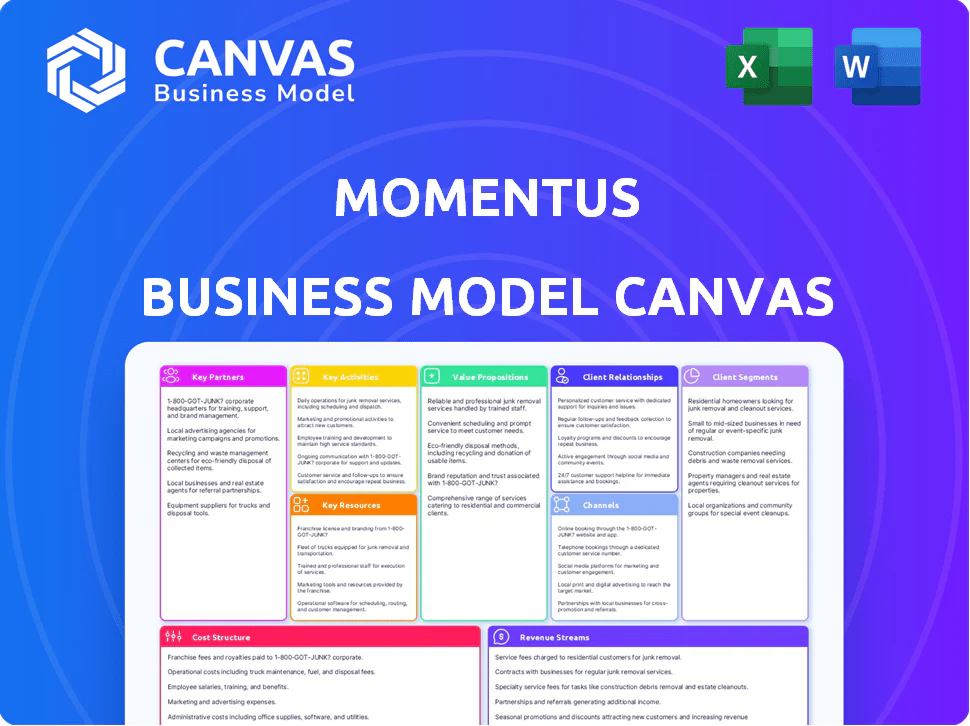
This is the actual Momentus Business Model Canvas you'll receive. It's not a partial sample; what you see here is what you'll get. Upon purchase, you'll have full access to this exact, ready-to-use document.

Business Model Canvas Template

Momentus: Business Model Canvas Unveiled!
Explore Momentus's strategic framework with our Business Model Canvas. Understand their core value propositions and how they reach their customers. Learn about their key activities, resources, and partnerships. This comprehensive document dissects Momentus's cost structure and revenue streams. It provides critical insights for investors and business strategists. Download the full Business Model Canvas for detailed analysis.
Partnerships

Launch Vehicle Providers
Momentus depends on launch vehicle providers, such as SpaceX, for its space transportation needs. These partnerships are vital for deploying its vehicles and customer payloads into space. SpaceX's Falcon 9 rocket has a proven track record, with over 300 successful launches as of late 2024. This collaborative approach allows Momentus to utilize rideshare missions, reducing costs.
Satellite Manufacturers
Momentus relies on key partnerships with satellite manufacturers. These collaborations ensure compatibility and successful deployment of spacecraft. In 2024, the satellite manufacturing market was valued at approximately $15 billion. This partnership is crucial for in-orbit services. Momentus needs these relationships for its revenue.

Technology Providers
Momentus's tech partnerships are crucial. They team up with companies like Velo3D for 3D printing. This helps create better vehicle parts. The aim is optimized designs, lower costs, and improved reliability. In 2024, 3D printing in aerospace saw a market of $3.2 billion, growing 20% annually.

Government Agencies
Momentus collaborates with government agencies, including NASA and the U.S. Air Force, to advance space technology. These partnerships facilitate technology development and demonstration missions, as well as potential contracts for space transportation and in-orbit services. Such collaborations support national security and scientific goals, creating opportunities for growth. In 2024, the U.S. government allocated billions to space exploration, indicating strong support for companies like Momentus.
- NASA awarded Momentus a contract in 2024 for lunar surface transportation services.
- The U.S. Air Force has shown interest in Momentus's in-space servicing capabilities.
- These partnerships provide access to funding and resources for mission development.
- Momentus's growth is partially fueled by government contracts.
Service Aggregators and Platforms
Momentus leverages service aggregators and platforms, such as RIDE! Space, to broaden its market reach. These partnerships are crucial for connecting with a diverse clientele, particularly small satellite operators. Collaborations simplify mission management and booking. In 2024, the small satellite market is projected to reach $7.6 billion.
- Partnerships streamline access to in-space services.
- They expand Momentus's customer base.
- These collaborations simplify mission logistics.
- The strategy aligns with market growth.
Momentus's Strategic Alliances: Key to Space Success
Momentus depends on key partnerships for its space operations. Strategic alliances with launch providers such as SpaceX, offer proven, cost-effective access to space; by the end of 2024 SpaceX's launch rate exceeded 30 successful missions. These partnerships ensure a broader reach, especially via collaborations with service aggregators and platforms. Government partnerships, exemplified by NASA, provide vital funding.
| Partner Type | Benefits | Examples |
|---|---|---|
| Launch Providers | Cost-effective space access, mission integration | SpaceX |
| Satellite Manufacturers | Payload integration, mission support | Key industry players |
| Government Agencies | Funding, tech validation | NASA, U.S. Air Force |
Activities

Developing and Manufacturing Space Vehicles
Momentus's key activities center on developing and manufacturing space vehicles. This includes designing, building, and testing their Vigoride and future orbital service vehicles. They focus on water plasma propulsion and other crucial systems. In 2024, Momentus aimed to launch Vigoride-7, showcasing its tech. The company's R&D spend was approximately $30 million in 2023.
Mission Planning and Execution
Mission planning and execution are critical for Momentus. This involves intricate logistical planning, precise trajectory calculations, and seamless in-orbit operations. The company's success hinges on efficient deployment of spacecraft. In 2024, Momentus aimed for several launches. The first commercial Vigoride mission was planned for late 2024.

Providing In-Orbit Services
Momentus's key activities involve offering in-orbit services, including satellite refueling, repair, relocation, and de-orbiting. This demands sophisticated robotics, autonomous systems, and precise maneuvering. In 2024, the in-space servicing market is projected to reach $3.5 billion, with significant growth expected. Momentus aims to capture a portion of this expanding market, using its Vigoride and Ardoride platforms. The company's focus is on extending satellite lifespans and reducing space debris.

Research and Development
Momentus's Research and Development (R&D) is crucial for its long-term success. Continuous innovation in propulsion systems, spacecraft tech, and in-space operations allows Momentus to stay ahead. This focus helps them expand services and meet market demands. According to a 2024 report, companies investing heavily in space tech R&D see significant returns.
- Momentus aims to enhance its Vigoride and Ardoride platforms.
- R&D spending is key to new product launches and mission success.
- The company invests in advanced propulsion and robotics.
- Momentus's goal is to offer more cost-effective space transport.
Sales and Business Development
Sales and business development are vital for Momentus, focusing on securing customer contracts, nurturing partner relationships, and spotting new market opportunities to boost revenue and expansion. In 2024, the commercial space sector saw over $8 billion in investments, highlighting the importance of strategic sales. Momentus aims to capitalize on this by expanding its customer base and identifying new service offerings.
- Contract negotiations are key to finalizing deals and securing revenue streams.
- Strategic partnerships can provide access to new markets and technologies.
- Market analysis helps identify unmet needs and potential growth areas.
Spacecraft Services: $3.5B Market Opportunity
Momentus focuses on spacecraft manufacturing, R&D, mission planning, and in-orbit services like refueling. R&D spending was around $30 million in 2023. In-space servicing market projected at $3.5 billion in 2024, highlighting market opportunity.
| Activity | Description | 2024 Focus |
|---|---|---|
| Vehicle Development | Design, build, and test Vigoride/future vehicles | Vigoride-7 launch, tech demonstration |
| Mission Planning | Logistical planning, trajectory calculations | Multiple launches; first Vigoride mission late 2024 |
| In-Orbit Services | Refueling, repair, relocation of satellites | Capture market share in the $3.5B sector |
Resources

Proprietary Technology
Momentus's water plasma propulsion system is a key asset, crucial for in-space transport. This tech could lower costs, making space travel more accessible. In 2024, the company focused on its first commercial mission. Momentus aims to provide efficient and cost-effective space logistics services.
Space Vehicles and Satellite Buses
Momentus relies heavily on its fleet of Vigoride and other space vehicles, along with satellite buses, which are crucial for its operations. As of 2024, the company has multiple Vigoride vehicles in operation, designed for in-space transportation and servicing. These vehicles are essential for delivering payloads and providing orbital services, representing a significant capital investment. The company's Q3 2024 report highlights the increasing demand for these services.

Skilled Personnel
Momentus relies heavily on skilled personnel, especially in engineering. A strong team is crucial for designing and operating complex space systems. In 2024, the company employed around 150 people, emphasizing technical expertise. This includes specialists in propulsion, robotics, and aerospace.

Intellectual Property
Momentus's intellectual property, including patents, is critical. It protects their innovative propulsion systems and in-space technologies, creating a competitive edge. These patents safeguard their unique solutions, like water plasma propulsion. Protecting IP is essential for a space company's long-term success and market position.
- Momentus's patent portfolio includes over 200 patents and patent applications.
- The company's water plasma propulsion system is a key focus for IP protection.
- IP helps Momentus maintain a competitive advantage.
- IP protection is vital for attracting investment and partnerships.
Customer Contracts and Relationships
Momentus's customer contracts and relationships are vital assets. They drive future revenue through agreements with space agencies and commercial entities. Robust partnerships, like the one with SpaceX, enhance mission reliability and market access. These relationships are key to securing launch opportunities and fueling growth in the space logistics sector. In 2024, the company continued building these strategic alliances to expand its service offerings.
- Contract Backlog: Momentus reported a significant contract backlog in 2024, indicating strong demand.
- Partnership Impact: Collaborations like the one with SpaceX contributed to mission success rates.
- Revenue Projections: Customer contracts support projected revenue growth, with forecasts showing positive trends.
- Customer Retention: High customer retention rates reflect the value of established relationships.
Momentus's Core Assets: Propulsion, Vehicles, and Talent
Key Resources for Momentus: These include the water plasma propulsion system and its fleet of space vehicles. The team's skilled personnel are crucial, especially engineers. Intellectual property like patents is also essential.
| Resource Category | Description | 2024 Status |
|---|---|---|
| Propulsion Technology | Water plasma propulsion systems | Focused on first commercial mission. |
| Space Vehicles | Vigoride and satellite buses | Multiple Vigoride vehicles in operation. |
| Human Capital | Engineering and technical experts | Employed around 150 people. |
Value Propositions

Cost-Effective In-Space Transportation
Momentus's in-space transportation offers cost savings. They target lower prices for orbital transfers, making space more accessible. This approach aims to broaden mission possibilities, including small satellite deployments. In 2024, the company is working to reduce per-kilogram launch costs.
Flexible and Precise Satellite Deployment
Momentus's service vehicles offer flexible, precise satellite deployment. This allows customers to reach custom orbits, enhancing mission success. In 2024, the demand for tailored orbital solutions grew significantly. The company's ability to adapt to specific needs is a key differentiator. This approach helps Momentus capture a larger market share.

Extended Satellite Lifespan and Enhanced Capabilities
In-orbit servicing dramatically extends satellite life and unlocks new functions, boosting value for satellite operators. Extending lifespan reduces replacement costs, which can save millions. According to 2024 reports, extending satellite life by 5 years can save up to 30% in operational costs. Enhancements can include upgraded sensors or software, increasing data output and revenue potential.

Reduced Time to Orbit
Momentus aims to cut down the transit time for satellites to their designated orbits, thanks to its rideshare and last-mile delivery services. This approach allows for quicker deployment compared to traditional methods. Reducing time to orbit translates to faster operational capabilities for customers and more efficient use of resources. This is crucial in a market where speed and responsiveness are key.
- Momentus's Vigoride orbital transfer vehicle (OTV) has demonstrated its ability to deploy satellites, as of late 2024.
- The company has agreements with SpaceX for launch services, enhancing its access to space.
- Momentus is targeting the growing small satellite market, which is rapidly expanding.
- They are focused on providing services for both commercial and government customers.
Enabling a Sustainable Space Economy
Momentus's value proposition centers on fostering a sustainable space economy. By providing services like de-orbiting, they help reduce space debris, mitigating collision risks. Their potential use of in-space resources, such as propellant from water, further promotes environmental responsibility. This approach supports long-term space activities and resource efficiency.
- Debris removal market is projected to reach $3.2 billion by 2030.
- Momentus has secured contracts valued at $1.1 billion as of late 2024.
- In-space resource utilization could cut launch costs by 90%.
- Momentus's Vigoride vehicle successfully deployed several payloads in 2024.
Momentus: Revolutionizing Space with Cost-Effective Solutions
Momentus reduces costs via affordable orbital transfers, focusing on small satellite deployments. Precise satellite deployment to custom orbits boosts mission success, crucial in the evolving market. Extending satellite life and adding functions through in-orbit servicing enhances value. Momentus provides faster, efficient satellite deployment and fosters a sustainable space economy with debris removal.
| Value Proposition | Details | 2024 Data Highlights |
|---|---|---|
| Cost-Effective Transportation | Lower orbital transfer prices increase accessibility and expand mission capabilities. | Targeting launch cost reductions per kilogram; secured $1.1B in contracts by late 2024. |
| Flexible Deployment | Precise satellite deployment enabling customized orbits; adapting to meet specific customer needs. | Vigoride successfully deployed multiple payloads. Market demand grew significantly in 2024. |
| In-Orbit Servicing | Extending satellite lifespan by providing upgrades & new functions, enhancing customer value and revenue. | Extending a satellite’s lifespan can cut operational costs by up to 30%. |
| Faster Deployment | Reduced transit times for quicker operational capabilities and more efficient resource usage. | |
| Sustainable Space Economy | De-orbiting, debris removal and resource utilization promotes environmental responsibility. | Debris removal market predicted to reach $3.2B by 2030. |
MOMENTUS BUSINESS MODEL CANVAS TEMPLATE RESEARCH
What is included in the product
Detailed Word Document
Covers customer segments, channels, and value propositions in full detail.
Customizable Excel Spreadsheet
Quickly identify core components with a one-page business snapshot.
Delivered as Displayed
Business Model Canvas
This is the actual Momentus Business Model Canvas you'll receive. It's not a partial sample; what you see here is what you'll get. Upon purchase, you'll have full access to this exact, ready-to-use document.
Business Model Canvas Template
Momentus: Business Model Canvas Unveiled!
Explore Momentus's strategic framework with our Business Model Canvas. Understand their core value propositions and how they reach their customers. Learn about their key activities, resources, and partnerships. This comprehensive document dissects Momentus's cost structure and revenue streams. It provides critical insights for investors and business strategists. Download the full Business Model Canvas for detailed analysis.
Partnerships
Launch Vehicle Providers
Momentus depends on launch vehicle providers, such as SpaceX, for its space transportation needs. These partnerships are vital for deploying its vehicles and customer payloads into space. SpaceX's Falcon 9 rocket has a proven track record, with over 300 successful launches as of late 2024. This collaborative approach allows Momentus to utilize rideshare missions, reducing costs.
Satellite Manufacturers
Momentus relies on key partnerships with satellite manufacturers. These collaborations ensure compatibility and successful deployment of spacecraft. In 2024, the satellite manufacturing market was valued at approximately $15 billion. This partnership is crucial for in-orbit services. Momentus needs these relationships for its revenue.
Technology Providers
Momentus's tech partnerships are crucial. They team up with companies like Velo3D for 3D printing. This helps create better vehicle parts. The aim is optimized designs, lower costs, and improved reliability. In 2024, 3D printing in aerospace saw a market of $3.2 billion, growing 20% annually.
Government Agencies
Momentus collaborates with government agencies, including NASA and the U.S. Air Force, to advance space technology. These partnerships facilitate technology development and demonstration missions, as well as potential contracts for space transportation and in-orbit services. Such collaborations support national security and scientific goals, creating opportunities for growth. In 2024, the U.S. government allocated billions to space exploration, indicating strong support for companies like Momentus.
- NASA awarded Momentus a contract in 2024 for lunar surface transportation services.
- The U.S. Air Force has shown interest in Momentus's in-space servicing capabilities.
- These partnerships provide access to funding and resources for mission development.
- Momentus's growth is partially fueled by government contracts.
Service Aggregators and Platforms
Momentus leverages service aggregators and platforms, such as RIDE! Space, to broaden its market reach. These partnerships are crucial for connecting with a diverse clientele, particularly small satellite operators. Collaborations simplify mission management and booking. In 2024, the small satellite market is projected to reach $7.6 billion.
- Partnerships streamline access to in-space services.
- They expand Momentus's customer base.
- These collaborations simplify mission logistics.
- The strategy aligns with market growth.
Momentus's Strategic Alliances: Key to Space Success
Momentus depends on key partnerships for its space operations. Strategic alliances with launch providers such as SpaceX, offer proven, cost-effective access to space; by the end of 2024 SpaceX's launch rate exceeded 30 successful missions. These partnerships ensure a broader reach, especially via collaborations with service aggregators and platforms. Government partnerships, exemplified by NASA, provide vital funding.
| Partner Type | Benefits | Examples |
|---|---|---|
| Launch Providers | Cost-effective space access, mission integration | SpaceX |
| Satellite Manufacturers | Payload integration, mission support | Key industry players |
| Government Agencies | Funding, tech validation | NASA, U.S. Air Force |
Activities
Developing and Manufacturing Space Vehicles
Momentus's key activities center on developing and manufacturing space vehicles. This includes designing, building, and testing their Vigoride and future orbital service vehicles. They focus on water plasma propulsion and other crucial systems. In 2024, Momentus aimed to launch Vigoride-7, showcasing its tech. The company's R&D spend was approximately $30 million in 2023.
Mission Planning and Execution
Mission planning and execution are critical for Momentus. This involves intricate logistical planning, precise trajectory calculations, and seamless in-orbit operations. The company's success hinges on efficient deployment of spacecraft. In 2024, Momentus aimed for several launches. The first commercial Vigoride mission was planned for late 2024.
Providing In-Orbit Services
Momentus's key activities involve offering in-orbit services, including satellite refueling, repair, relocation, and de-orbiting. This demands sophisticated robotics, autonomous systems, and precise maneuvering. In 2024, the in-space servicing market is projected to reach $3.5 billion, with significant growth expected. Momentus aims to capture a portion of this expanding market, using its Vigoride and Ardoride platforms. The company's focus is on extending satellite lifespans and reducing space debris.
Research and Development
Momentus's Research and Development (R&D) is crucial for its long-term success. Continuous innovation in propulsion systems, spacecraft tech, and in-space operations allows Momentus to stay ahead. This focus helps them expand services and meet market demands. According to a 2024 report, companies investing heavily in space tech R&D see significant returns.
- Momentus aims to enhance its Vigoride and Ardoride platforms.
- R&D spending is key to new product launches and mission success.
- The company invests in advanced propulsion and robotics.
- Momentus's goal is to offer more cost-effective space transport.
Sales and Business Development
Sales and business development are vital for Momentus, focusing on securing customer contracts, nurturing partner relationships, and spotting new market opportunities to boost revenue and expansion. In 2024, the commercial space sector saw over $8 billion in investments, highlighting the importance of strategic sales. Momentus aims to capitalize on this by expanding its customer base and identifying new service offerings.
- Contract negotiations are key to finalizing deals and securing revenue streams.
- Strategic partnerships can provide access to new markets and technologies.
- Market analysis helps identify unmet needs and potential growth areas.
Spacecraft Services: $3.5B Market Opportunity
Momentus focuses on spacecraft manufacturing, R&D, mission planning, and in-orbit services like refueling. R&D spending was around $30 million in 2023. In-space servicing market projected at $3.5 billion in 2024, highlighting market opportunity.
| Activity | Description | 2024 Focus |
|---|---|---|
| Vehicle Development | Design, build, and test Vigoride/future vehicles | Vigoride-7 launch, tech demonstration |
| Mission Planning | Logistical planning, trajectory calculations | Multiple launches; first Vigoride mission late 2024 |
| In-Orbit Services | Refueling, repair, relocation of satellites | Capture market share in the $3.5B sector |
Resources
Proprietary Technology
Momentus's water plasma propulsion system is a key asset, crucial for in-space transport. This tech could lower costs, making space travel more accessible. In 2024, the company focused on its first commercial mission. Momentus aims to provide efficient and cost-effective space logistics services.
Space Vehicles and Satellite Buses
Momentus relies heavily on its fleet of Vigoride and other space vehicles, along with satellite buses, which are crucial for its operations. As of 2024, the company has multiple Vigoride vehicles in operation, designed for in-space transportation and servicing. These vehicles are essential for delivering payloads and providing orbital services, representing a significant capital investment. The company's Q3 2024 report highlights the increasing demand for these services.
Skilled Personnel
Momentus relies heavily on skilled personnel, especially in engineering. A strong team is crucial for designing and operating complex space systems. In 2024, the company employed around 150 people, emphasizing technical expertise. This includes specialists in propulsion, robotics, and aerospace.
Intellectual Property
Momentus's intellectual property, including patents, is critical. It protects their innovative propulsion systems and in-space technologies, creating a competitive edge. These patents safeguard their unique solutions, like water plasma propulsion. Protecting IP is essential for a space company's long-term success and market position.
- Momentus's patent portfolio includes over 200 patents and patent applications.
- The company's water plasma propulsion system is a key focus for IP protection.
- IP helps Momentus maintain a competitive advantage.
- IP protection is vital for attracting investment and partnerships.
Customer Contracts and Relationships
Momentus's customer contracts and relationships are vital assets. They drive future revenue through agreements with space agencies and commercial entities. Robust partnerships, like the one with SpaceX, enhance mission reliability and market access. These relationships are key to securing launch opportunities and fueling growth in the space logistics sector. In 2024, the company continued building these strategic alliances to expand its service offerings.
- Contract Backlog: Momentus reported a significant contract backlog in 2024, indicating strong demand.
- Partnership Impact: Collaborations like the one with SpaceX contributed to mission success rates.
- Revenue Projections: Customer contracts support projected revenue growth, with forecasts showing positive trends.
- Customer Retention: High customer retention rates reflect the value of established relationships.
Momentus's Core Assets: Propulsion, Vehicles, and Talent
Key Resources for Momentus: These include the water plasma propulsion system and its fleet of space vehicles. The team's skilled personnel are crucial, especially engineers. Intellectual property like patents is also essential.
| Resource Category | Description | 2024 Status |
|---|---|---|
| Propulsion Technology | Water plasma propulsion systems | Focused on first commercial mission. |
| Space Vehicles | Vigoride and satellite buses | Multiple Vigoride vehicles in operation. |
| Human Capital | Engineering and technical experts | Employed around 150 people. |
Value Propositions
Cost-Effective In-Space Transportation
Momentus's in-space transportation offers cost savings. They target lower prices for orbital transfers, making space more accessible. This approach aims to broaden mission possibilities, including small satellite deployments. In 2024, the company is working to reduce per-kilogram launch costs.
Flexible and Precise Satellite Deployment
Momentus's service vehicles offer flexible, precise satellite deployment. This allows customers to reach custom orbits, enhancing mission success. In 2024, the demand for tailored orbital solutions grew significantly. The company's ability to adapt to specific needs is a key differentiator. This approach helps Momentus capture a larger market share.
Extended Satellite Lifespan and Enhanced Capabilities
In-orbit servicing dramatically extends satellite life and unlocks new functions, boosting value for satellite operators. Extending lifespan reduces replacement costs, which can save millions. According to 2024 reports, extending satellite life by 5 years can save up to 30% in operational costs. Enhancements can include upgraded sensors or software, increasing data output and revenue potential.
Reduced Time to Orbit
Momentus aims to cut down the transit time for satellites to their designated orbits, thanks to its rideshare and last-mile delivery services. This approach allows for quicker deployment compared to traditional methods. Reducing time to orbit translates to faster operational capabilities for customers and more efficient use of resources. This is crucial in a market where speed and responsiveness are key.
- Momentus's Vigoride orbital transfer vehicle (OTV) has demonstrated its ability to deploy satellites, as of late 2024.
- The company has agreements with SpaceX for launch services, enhancing its access to space.
- Momentus is targeting the growing small satellite market, which is rapidly expanding.
- They are focused on providing services for both commercial and government customers.
Enabling a Sustainable Space Economy
Momentus's value proposition centers on fostering a sustainable space economy. By providing services like de-orbiting, they help reduce space debris, mitigating collision risks. Their potential use of in-space resources, such as propellant from water, further promotes environmental responsibility. This approach supports long-term space activities and resource efficiency.
- Debris removal market is projected to reach $3.2 billion by 2030.
- Momentus has secured contracts valued at $1.1 billion as of late 2024.
- In-space resource utilization could cut launch costs by 90%.
- Momentus's Vigoride vehicle successfully deployed several payloads in 2024.
Momentus: Revolutionizing Space with Cost-Effective Solutions
Momentus reduces costs via affordable orbital transfers, focusing on small satellite deployments. Precise satellite deployment to custom orbits boosts mission success, crucial in the evolving market. Extending satellite life and adding functions through in-orbit servicing enhances value. Momentus provides faster, efficient satellite deployment and fosters a sustainable space economy with debris removal.
| Value Proposition | Details | 2024 Data Highlights |
|---|---|---|
| Cost-Effective Transportation | Lower orbital transfer prices increase accessibility and expand mission capabilities. | Targeting launch cost reductions per kilogram; secured $1.1B in contracts by late 2024. |
| Flexible Deployment | Precise satellite deployment enabling customized orbits; adapting to meet specific customer needs. | Vigoride successfully deployed multiple payloads. Market demand grew significantly in 2024. |
| In-Orbit Servicing | Extending satellite lifespan by providing upgrades & new functions, enhancing customer value and revenue. | Extending a satellite’s lifespan can cut operational costs by up to 30%. |
| Faster Deployment | Reduced transit times for quicker operational capabilities and more efficient resource usage. | |
| Sustainable Space Economy | De-orbiting, debris removal and resource utilization promotes environmental responsibility. | Debris removal market predicted to reach $3.2B by 2030. |
Product Information
Product Information
Shipping & Returns
Shipping & Returns
Description
What is included in the product
Detailed Word Document
Covers customer segments, channels, and value propositions in full detail.
Customizable Excel Spreadsheet
Quickly identify core components with a one-page business snapshot.
Delivered as Displayed
Business Model Canvas
This is the actual Momentus Business Model Canvas you'll receive. It's not a partial sample; what you see here is what you'll get. Upon purchase, you'll have full access to this exact, ready-to-use document.
Business Model Canvas Template
Momentus: Business Model Canvas Unveiled!
Explore Momentus's strategic framework with our Business Model Canvas. Understand their core value propositions and how they reach their customers. Learn about their key activities, resources, and partnerships. This comprehensive document dissects Momentus's cost structure and revenue streams. It provides critical insights for investors and business strategists. Download the full Business Model Canvas for detailed analysis.
Partnerships
Launch Vehicle Providers
Momentus depends on launch vehicle providers, such as SpaceX, for its space transportation needs. These partnerships are vital for deploying its vehicles and customer payloads into space. SpaceX's Falcon 9 rocket has a proven track record, with over 300 successful launches as of late 2024. This collaborative approach allows Momentus to utilize rideshare missions, reducing costs.
Satellite Manufacturers
Momentus relies on key partnerships with satellite manufacturers. These collaborations ensure compatibility and successful deployment of spacecraft. In 2024, the satellite manufacturing market was valued at approximately $15 billion. This partnership is crucial for in-orbit services. Momentus needs these relationships for its revenue.
Technology Providers
Momentus's tech partnerships are crucial. They team up with companies like Velo3D for 3D printing. This helps create better vehicle parts. The aim is optimized designs, lower costs, and improved reliability. In 2024, 3D printing in aerospace saw a market of $3.2 billion, growing 20% annually.
Government Agencies
Momentus collaborates with government agencies, including NASA and the U.S. Air Force, to advance space technology. These partnerships facilitate technology development and demonstration missions, as well as potential contracts for space transportation and in-orbit services. Such collaborations support national security and scientific goals, creating opportunities for growth. In 2024, the U.S. government allocated billions to space exploration, indicating strong support for companies like Momentus.
- NASA awarded Momentus a contract in 2024 for lunar surface transportation services.
- The U.S. Air Force has shown interest in Momentus's in-space servicing capabilities.
- These partnerships provide access to funding and resources for mission development.
- Momentus's growth is partially fueled by government contracts.
Service Aggregators and Platforms
Momentus leverages service aggregators and platforms, such as RIDE! Space, to broaden its market reach. These partnerships are crucial for connecting with a diverse clientele, particularly small satellite operators. Collaborations simplify mission management and booking. In 2024, the small satellite market is projected to reach $7.6 billion.
- Partnerships streamline access to in-space services.
- They expand Momentus's customer base.
- These collaborations simplify mission logistics.
- The strategy aligns with market growth.
Momentus's Strategic Alliances: Key to Space Success
Momentus depends on key partnerships for its space operations. Strategic alliances with launch providers such as SpaceX, offer proven, cost-effective access to space; by the end of 2024 SpaceX's launch rate exceeded 30 successful missions. These partnerships ensure a broader reach, especially via collaborations with service aggregators and platforms. Government partnerships, exemplified by NASA, provide vital funding.
| Partner Type | Benefits | Examples |
|---|---|---|
| Launch Providers | Cost-effective space access, mission integration | SpaceX |
| Satellite Manufacturers | Payload integration, mission support | Key industry players |
| Government Agencies | Funding, tech validation | NASA, U.S. Air Force |
Activities
Developing and Manufacturing Space Vehicles
Momentus's key activities center on developing and manufacturing space vehicles. This includes designing, building, and testing their Vigoride and future orbital service vehicles. They focus on water plasma propulsion and other crucial systems. In 2024, Momentus aimed to launch Vigoride-7, showcasing its tech. The company's R&D spend was approximately $30 million in 2023.
Mission Planning and Execution
Mission planning and execution are critical for Momentus. This involves intricate logistical planning, precise trajectory calculations, and seamless in-orbit operations. The company's success hinges on efficient deployment of spacecraft. In 2024, Momentus aimed for several launches. The first commercial Vigoride mission was planned for late 2024.
Providing In-Orbit Services
Momentus's key activities involve offering in-orbit services, including satellite refueling, repair, relocation, and de-orbiting. This demands sophisticated robotics, autonomous systems, and precise maneuvering. In 2024, the in-space servicing market is projected to reach $3.5 billion, with significant growth expected. Momentus aims to capture a portion of this expanding market, using its Vigoride and Ardoride platforms. The company's focus is on extending satellite lifespans and reducing space debris.
Research and Development
Momentus's Research and Development (R&D) is crucial for its long-term success. Continuous innovation in propulsion systems, spacecraft tech, and in-space operations allows Momentus to stay ahead. This focus helps them expand services and meet market demands. According to a 2024 report, companies investing heavily in space tech R&D see significant returns.
- Momentus aims to enhance its Vigoride and Ardoride platforms.
- R&D spending is key to new product launches and mission success.
- The company invests in advanced propulsion and robotics.
- Momentus's goal is to offer more cost-effective space transport.
Sales and Business Development
Sales and business development are vital for Momentus, focusing on securing customer contracts, nurturing partner relationships, and spotting new market opportunities to boost revenue and expansion. In 2024, the commercial space sector saw over $8 billion in investments, highlighting the importance of strategic sales. Momentus aims to capitalize on this by expanding its customer base and identifying new service offerings.
- Contract negotiations are key to finalizing deals and securing revenue streams.
- Strategic partnerships can provide access to new markets and technologies.
- Market analysis helps identify unmet needs and potential growth areas.
Spacecraft Services: $3.5B Market Opportunity
Momentus focuses on spacecraft manufacturing, R&D, mission planning, and in-orbit services like refueling. R&D spending was around $30 million in 2023. In-space servicing market projected at $3.5 billion in 2024, highlighting market opportunity.
| Activity | Description | 2024 Focus |
|---|---|---|
| Vehicle Development | Design, build, and test Vigoride/future vehicles | Vigoride-7 launch, tech demonstration |
| Mission Planning | Logistical planning, trajectory calculations | Multiple launches; first Vigoride mission late 2024 |
| In-Orbit Services | Refueling, repair, relocation of satellites | Capture market share in the $3.5B sector |
Resources
Proprietary Technology
Momentus's water plasma propulsion system is a key asset, crucial for in-space transport. This tech could lower costs, making space travel more accessible. In 2024, the company focused on its first commercial mission. Momentus aims to provide efficient and cost-effective space logistics services.
Space Vehicles and Satellite Buses
Momentus relies heavily on its fleet of Vigoride and other space vehicles, along with satellite buses, which are crucial for its operations. As of 2024, the company has multiple Vigoride vehicles in operation, designed for in-space transportation and servicing. These vehicles are essential for delivering payloads and providing orbital services, representing a significant capital investment. The company's Q3 2024 report highlights the increasing demand for these services.
Skilled Personnel
Momentus relies heavily on skilled personnel, especially in engineering. A strong team is crucial for designing and operating complex space systems. In 2024, the company employed around 150 people, emphasizing technical expertise. This includes specialists in propulsion, robotics, and aerospace.
Intellectual Property
Momentus's intellectual property, including patents, is critical. It protects their innovative propulsion systems and in-space technologies, creating a competitive edge. These patents safeguard their unique solutions, like water plasma propulsion. Protecting IP is essential for a space company's long-term success and market position.
- Momentus's patent portfolio includes over 200 patents and patent applications.
- The company's water plasma propulsion system is a key focus for IP protection.
- IP helps Momentus maintain a competitive advantage.
- IP protection is vital for attracting investment and partnerships.
Customer Contracts and Relationships
Momentus's customer contracts and relationships are vital assets. They drive future revenue through agreements with space agencies and commercial entities. Robust partnerships, like the one with SpaceX, enhance mission reliability and market access. These relationships are key to securing launch opportunities and fueling growth in the space logistics sector. In 2024, the company continued building these strategic alliances to expand its service offerings.
- Contract Backlog: Momentus reported a significant contract backlog in 2024, indicating strong demand.
- Partnership Impact: Collaborations like the one with SpaceX contributed to mission success rates.
- Revenue Projections: Customer contracts support projected revenue growth, with forecasts showing positive trends.
- Customer Retention: High customer retention rates reflect the value of established relationships.
Momentus's Core Assets: Propulsion, Vehicles, and Talent
Key Resources for Momentus: These include the water plasma propulsion system and its fleet of space vehicles. The team's skilled personnel are crucial, especially engineers. Intellectual property like patents is also essential.
| Resource Category | Description | 2024 Status |
|---|---|---|
| Propulsion Technology | Water plasma propulsion systems | Focused on first commercial mission. |
| Space Vehicles | Vigoride and satellite buses | Multiple Vigoride vehicles in operation. |
| Human Capital | Engineering and technical experts | Employed around 150 people. |
Value Propositions
Cost-Effective In-Space Transportation
Momentus's in-space transportation offers cost savings. They target lower prices for orbital transfers, making space more accessible. This approach aims to broaden mission possibilities, including small satellite deployments. In 2024, the company is working to reduce per-kilogram launch costs.
Flexible and Precise Satellite Deployment
Momentus's service vehicles offer flexible, precise satellite deployment. This allows customers to reach custom orbits, enhancing mission success. In 2024, the demand for tailored orbital solutions grew significantly. The company's ability to adapt to specific needs is a key differentiator. This approach helps Momentus capture a larger market share.
Extended Satellite Lifespan and Enhanced Capabilities
In-orbit servicing dramatically extends satellite life and unlocks new functions, boosting value for satellite operators. Extending lifespan reduces replacement costs, which can save millions. According to 2024 reports, extending satellite life by 5 years can save up to 30% in operational costs. Enhancements can include upgraded sensors or software, increasing data output and revenue potential.
Reduced Time to Orbit
Momentus aims to cut down the transit time for satellites to their designated orbits, thanks to its rideshare and last-mile delivery services. This approach allows for quicker deployment compared to traditional methods. Reducing time to orbit translates to faster operational capabilities for customers and more efficient use of resources. This is crucial in a market where speed and responsiveness are key.
- Momentus's Vigoride orbital transfer vehicle (OTV) has demonstrated its ability to deploy satellites, as of late 2024.
- The company has agreements with SpaceX for launch services, enhancing its access to space.
- Momentus is targeting the growing small satellite market, which is rapidly expanding.
- They are focused on providing services for both commercial and government customers.
Enabling a Sustainable Space Economy
Momentus's value proposition centers on fostering a sustainable space economy. By providing services like de-orbiting, they help reduce space debris, mitigating collision risks. Their potential use of in-space resources, such as propellant from water, further promotes environmental responsibility. This approach supports long-term space activities and resource efficiency.
- Debris removal market is projected to reach $3.2 billion by 2030.
- Momentus has secured contracts valued at $1.1 billion as of late 2024.
- In-space resource utilization could cut launch costs by 90%.
- Momentus's Vigoride vehicle successfully deployed several payloads in 2024.
Momentus: Revolutionizing Space with Cost-Effective Solutions
Momentus reduces costs via affordable orbital transfers, focusing on small satellite deployments. Precise satellite deployment to custom orbits boosts mission success, crucial in the evolving market. Extending satellite life and adding functions through in-orbit servicing enhances value. Momentus provides faster, efficient satellite deployment and fosters a sustainable space economy with debris removal.
| Value Proposition | Details | 2024 Data Highlights |
|---|---|---|
| Cost-Effective Transportation | Lower orbital transfer prices increase accessibility and expand mission capabilities. | Targeting launch cost reductions per kilogram; secured $1.1B in contracts by late 2024. |
| Flexible Deployment | Precise satellite deployment enabling customized orbits; adapting to meet specific customer needs. | Vigoride successfully deployed multiple payloads. Market demand grew significantly in 2024. |
| In-Orbit Servicing | Extending satellite lifespan by providing upgrades & new functions, enhancing customer value and revenue. | Extending a satellite’s lifespan can cut operational costs by up to 30%. |
| Faster Deployment | Reduced transit times for quicker operational capabilities and more efficient resource usage. | |
| Sustainable Space Economy | De-orbiting, debris removal and resource utilization promotes environmental responsibility. | Debris removal market predicted to reach $3.2B by 2030. |











