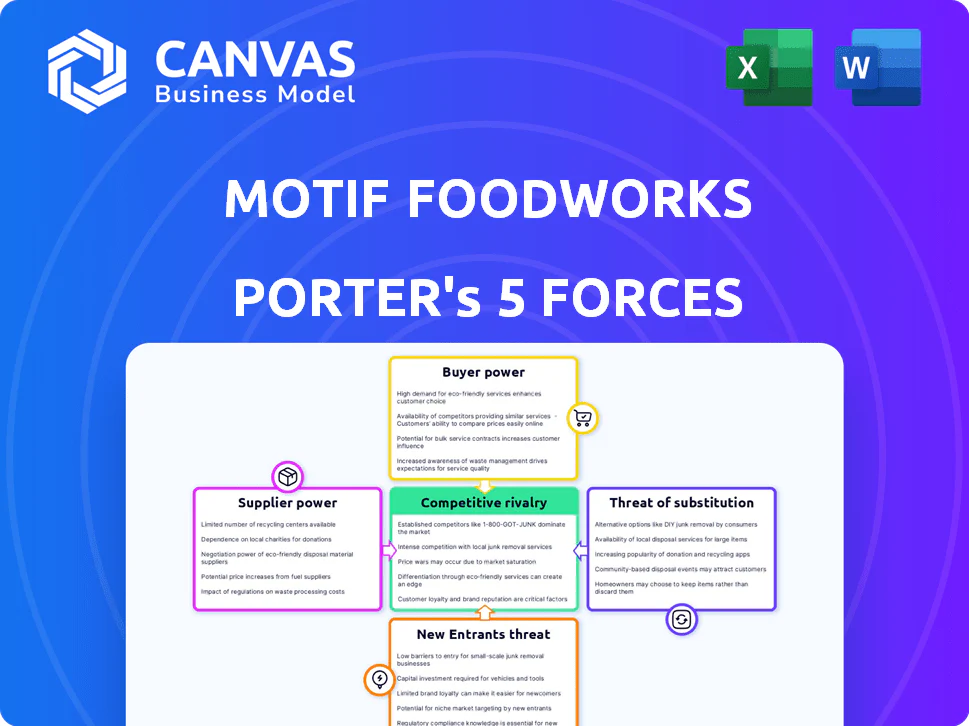
MOTIF FOODWORKS PORTER'S FIVE FORCES TEMPLATE RESEARCH
What is included in the product
 Detailed Word Document
Analyzes Motif FoodWorks' position, detailing competitive forces, threats, and market dynamics.

 Customizable Excel Spreadsheet
Visualize competitive threats with a clear, intuitive spider chart—no more guesswork.
What You See Is What You Get
Motif FoodWorks Porter's Five Forces Analysis
This preview presents Motif FoodWorks' Porter's Five Forces analysis, which examines industry competition. The document explores competitive rivalry, supplier power, and buyer power in detail. You'll also find analyses of the threat of substitutes and new entrants. This in-depth document is ready for instant download upon purchase.

Porter's Five Forces Analysis Template

A Must-Have Tool for Decision-Makers
Motif FoodWorks operates in a dynamic food technology landscape, facing unique pressures from suppliers, buyers, and potential disruptors. The threat of substitutes, such as alternative proteins, is constantly evolving. Competitive rivalry is fierce, with established food companies and startups vying for market share. Understanding these forces is crucial for strategic planning.
This brief snapshot only scratches the surface. Unlock the full Porter's Five Forces Analysis to explore Motif FoodWorks’s competitive dynamics, market pressures, and strategic advantages in detail.
Suppliers Bargaining Power

Limited Number of Specialized Ingredient Suppliers
Motif FoodWorks faces supplier power challenges due to the specialized nature of its ingredients. The market features a limited number of suppliers for unique plant-based components. In 2023, a concentrated supply base allowed suppliers to dictate terms. This concentration impacts Motif's cost structure and operational flexibility.
High Quality and Specialized Ingredients
Suppliers of unique, hard-to-duplicate ingredients hold significant power. Motif FoodWorks' pursuit of superior taste and texture hinges on these specialized inputs. The market for flavor and texture-enhancing ingredients in plant-based foods is expanding. In 2024, the plant-based food market hit $8.1 billion in the US, showing this growing demand.

Potential for Forward Integration by Suppliers
Suppliers could forward integrate, becoming direct competitors. This boosts their power over buyers like Motif FoodWorks. Some suppliers are already expanding beyond raw materials. For instance, Ingredion invested $100M+ in plant-based protein in 2024. This is a growing threat.

Dependency on Proprietary Ingredients
Motif FoodWorks' reliance on proprietary ingredients, like HEMAMI™ and APPETEX™, heightens supplier power. These unique formulations, essential for flavor and texture, could create a supplier lock-in. Dependence on specific ingredient suppliers or technology providers increases their leverage. This is especially true if there are few alternative sources for these specialized components.
- Motif's 2024 revenue was projected to reach $200 million, which could be affected by supplier issues.
- The cost of unique ingredients can represent up to 40% of the total production cost.
- Contracts with key suppliers often span 1-3 years, creating potential price and availability risks.
- The lack of substitute ingredients gives suppliers greater negotiation power.
Cost of Switching Suppliers
Switching suppliers for Motif FoodWorks, especially for specialized ingredients, is a complex process. It involves reformulation, rigorous testing, and potential production disruptions, which increases the bargaining power of existing suppliers. These specialized ingredients can constitute a significant portion of the procurement costs. For example, ingredient costs account for roughly 60% of the total cost of goods sold (COGS) in the food manufacturing industry. Higher switching costs empower suppliers to negotiate more favorable terms.
- Ingredient costs account for roughly 60% of the total COGS in the food manufacturing industry.
- Switching suppliers can lead to reformulation, testing, and production disruptions.
- Specialized ingredients increase supplier bargaining power.
Supplier Power & Plant-Based Food's Cost Challenges
Motif FoodWorks faces supplier power due to specialized ingredients and limited suppliers. The plant-based food market, valued at $8.1 billion in 2024, intensifies this. Ingredient costs can be up to 40% of production costs, impacting Motif's $200M revenue projection.
| Aspect | Impact | Data |
|---|---|---|
| Ingredient Costs | High | Up to 40% of production costs |
| Market Growth | Increased Demand | $8.1B US plant-based market (2024) |
| Revenue Projection | Potential Risk | $200M (2024) |
Customers Bargaining Power

Growing Demand for Plant-Based Products
The rising consumer interest in healthy, sustainable, and ethical food options boosts plant-based product demand. This growing market offers a strong customer base for Motif. The global plant-based food market is expected to reach $77.8 billion by 2025. This customer base gives Motif significant bargaining power.
Informed and Price-Sensitive Consumers
Motif FoodWorks faces strong customer bargaining power due to well-informed consumers. They are price-sensitive and easily compare options, often online. In 2024, online grocery sales in the U.S. reached $106.9 billion. This enables consumers to switch brands for better value. Consumers actively seek healthy alternatives.

Major Retailers and Foodservice Providers as Key Customers
Motif FoodWorks' customers include food manufacturers, potentially large retailers, and foodservice companies. These major buyers wield considerable bargaining power, influencing pricing and product specs due to purchase volume. Securing shelf space is highly competitive; for example, the U.S. grocery market generated about $800 billion in sales in 2023. This pressure can squeeze margins.

Availability of Alternative Ingredients and Products
The increasing availability of plant-based alternatives intensifies customer bargaining power for Motif FoodWorks. The market for alternative proteins is broadening, giving buyers leverage to negotiate prices and terms. This includes a variety of sources and technologies. Customers can choose from numerous suppliers, which limits Motif's pricing power.
- The global plant-based food market was valued at $36.3 billion in 2023.
- By 2028, it's projected to reach $77.8 billion.
- The rising number of competitors gives buyers more options.
- This market expansion increases customer negotiation power.
Customer Expectations for Taste, Texture, and Nutrition
Customers now expect plant-based foods to taste and feel like their animal-based counterparts, a significant challenge for companies like Motif FoodWorks. This demand directly impacts customer satisfaction and their ability to bargain. Taste and texture are major hurdles in consumer adoption, influencing purchasing decisions. Meeting these high expectations is crucial for Motif’s success.
- In 2024, the plant-based food market is valued at $36.3 billion.
- About 40% of consumers cite taste as the primary reason for not buying plant-based products.
- Texture is a critical factor, with 60% of consumers desiring similar textures to meat.
Customer Power Plays in the Plant-Based Arena
Motif FoodWorks faces strong customer bargaining power, particularly from well-informed consumers. These customers can readily compare options and switch brands. The plant-based food market, valued at $36.3 billion in 2024, offers various alternatives, increasing customer leverage.
| Factor | Impact | Data |
|---|---|---|
| Consumer Awareness | High | Online grocery sales in the U.S. reached $106.9B in 2024. |
| Market Competition | Intense | Plant-based market expected to hit $77.8B by 2028. |
| Product Expectations | Demanding | 40% cite taste as the reason for not buying plant-based products. |
Rivalry Among Competitors

Presence of Established Food Industry Giants
The plant-based food market sees intense competition from established food giants. These multinational companies possess substantial resources, distribution networks, and brand recognition. For example, Nestlé and Kraft Heinz are expanding their plant-based offerings, intensifying the rivalry. In 2024, Nestlé's sales in plant-based foods reached $800 million.
Increasing Number of Plant-Based Startups
The plant-based food sector is experiencing a boom, with numerous startups entering the market. This influx of competitors is heightening the battle for market share and consumer loyalty. In 2024, the alternative protein sector saw over $1.5 billion in investments, attracting many new entrants. This intense competition puts pressure on companies like Motif FoodWorks to differentiate themselves. The increasing number of players in the alternative protein market intensifies competitive rivalry, affecting profitability.

Differentiation Based on Technology and Ingredients
Competition in plant-based foods is fierce, with companies innovating through technology and ingredients. Motif FoodWorks aims to stand out by focusing on unique ingredient development. Precision fermentation and extrusion are key technologies. In 2024, the plant-based food market reached $8.3 billion in U.S. retail sales, highlighting the competition.

Price Competition
As the plant-based market grows, price competition intensifies, influencing consumer choices. Companies must balance competitive pricing with profitability, resulting in price wars. Consumer price sensitivity has risen, impacting market dynamics. The plant-based food market's value was estimated at $29.4 billion in 2024. This price pressure affects profitability, especially for new entrants.
- Increased competition drives down prices.
- Consumers are increasingly price-conscious.
- Profit margins are squeezed for all players.
- Market share becomes a key battleground.
Intellectual Property Battles
Intellectual property fights are a key competitive aspect in plant-based food tech. Motif FoodWorks has faced legal challenges over its innovations. These battles can be expensive, potentially impacting a company's resources. They might also slow down product development and market entry.
- 2024 saw ongoing IP litigation in the food tech sector.
- Legal fees for such cases can reach millions of dollars.
- Patent disputes can stall product launches.
- Companies must balance innovation with IP protection.
Plant-Based Food Fight: Market Dynamics
Competitive rivalry in the plant-based food market is fierce, with established giants and numerous startups vying for market share, intensifying price competition and squeezing profit margins. Consumer price sensitivity is high, influencing purchasing decisions. Intellectual property disputes add another layer of complexity, potentially impacting innovation and market entry.
| Aspect | Details | 2024 Data |
|---|---|---|
| Market Growth | Rapid expansion attracts many competitors. | U.S. retail sales: $8.3B |
| Price Pressure | Intense competition leads to price wars. | Market value est.: $29.4B |
| IP Challenges | Legal battles and patent disputes are common. | IP litigation costs: Millions |
Original: $10.00
-65%$10.00
$3.50MOTIF FOODWORKS PORTER'S FIVE FORCES TEMPLATE RESEARCH
What is included in the product
Detailed Word Document
Analyzes Motif FoodWorks' position, detailing competitive forces, threats, and market dynamics.
Customizable Excel Spreadsheet
Visualize competitive threats with a clear, intuitive spider chart—no more guesswork.
What You See Is What You Get
Motif FoodWorks Porter's Five Forces Analysis
This preview presents Motif FoodWorks' Porter's Five Forces analysis, which examines industry competition. The document explores competitive rivalry, supplier power, and buyer power in detail. You'll also find analyses of the threat of substitutes and new entrants. This in-depth document is ready for instant download upon purchase.
Porter's Five Forces Analysis Template
A Must-Have Tool for Decision-Makers
Motif FoodWorks operates in a dynamic food technology landscape, facing unique pressures from suppliers, buyers, and potential disruptors. The threat of substitutes, such as alternative proteins, is constantly evolving. Competitive rivalry is fierce, with established food companies and startups vying for market share. Understanding these forces is crucial for strategic planning.
This brief snapshot only scratches the surface. Unlock the full Porter's Five Forces Analysis to explore Motif FoodWorks’s competitive dynamics, market pressures, and strategic advantages in detail.
Suppliers Bargaining Power
Limited Number of Specialized Ingredient Suppliers
Motif FoodWorks faces supplier power challenges due to the specialized nature of its ingredients. The market features a limited number of suppliers for unique plant-based components. In 2023, a concentrated supply base allowed suppliers to dictate terms. This concentration impacts Motif's cost structure and operational flexibility.
High Quality and Specialized Ingredients
Suppliers of unique, hard-to-duplicate ingredients hold significant power. Motif FoodWorks' pursuit of superior taste and texture hinges on these specialized inputs. The market for flavor and texture-enhancing ingredients in plant-based foods is expanding. In 2024, the plant-based food market hit $8.1 billion in the US, showing this growing demand.
Potential for Forward Integration by Suppliers
Suppliers could forward integrate, becoming direct competitors. This boosts their power over buyers like Motif FoodWorks. Some suppliers are already expanding beyond raw materials. For instance, Ingredion invested $100M+ in plant-based protein in 2024. This is a growing threat.
Dependency on Proprietary Ingredients
Motif FoodWorks' reliance on proprietary ingredients, like HEMAMI™ and APPETEX™, heightens supplier power. These unique formulations, essential for flavor and texture, could create a supplier lock-in. Dependence on specific ingredient suppliers or technology providers increases their leverage. This is especially true if there are few alternative sources for these specialized components.
- Motif's 2024 revenue was projected to reach $200 million, which could be affected by supplier issues.
- The cost of unique ingredients can represent up to 40% of the total production cost.
- Contracts with key suppliers often span 1-3 years, creating potential price and availability risks.
- The lack of substitute ingredients gives suppliers greater negotiation power.
Cost of Switching Suppliers
Switching suppliers for Motif FoodWorks, especially for specialized ingredients, is a complex process. It involves reformulation, rigorous testing, and potential production disruptions, which increases the bargaining power of existing suppliers. These specialized ingredients can constitute a significant portion of the procurement costs. For example, ingredient costs account for roughly 60% of the total cost of goods sold (COGS) in the food manufacturing industry. Higher switching costs empower suppliers to negotiate more favorable terms.
- Ingredient costs account for roughly 60% of the total COGS in the food manufacturing industry.
- Switching suppliers can lead to reformulation, testing, and production disruptions.
- Specialized ingredients increase supplier bargaining power.
Supplier Power & Plant-Based Food's Cost Challenges
Motif FoodWorks faces supplier power due to specialized ingredients and limited suppliers. The plant-based food market, valued at $8.1 billion in 2024, intensifies this. Ingredient costs can be up to 40% of production costs, impacting Motif's $200M revenue projection.
| Aspect | Impact | Data |
|---|---|---|
| Ingredient Costs | High | Up to 40% of production costs |
| Market Growth | Increased Demand | $8.1B US plant-based market (2024) |
| Revenue Projection | Potential Risk | $200M (2024) |
Customers Bargaining Power
Growing Demand for Plant-Based Products
The rising consumer interest in healthy, sustainable, and ethical food options boosts plant-based product demand. This growing market offers a strong customer base for Motif. The global plant-based food market is expected to reach $77.8 billion by 2025. This customer base gives Motif significant bargaining power.
Informed and Price-Sensitive Consumers
Motif FoodWorks faces strong customer bargaining power due to well-informed consumers. They are price-sensitive and easily compare options, often online. In 2024, online grocery sales in the U.S. reached $106.9 billion. This enables consumers to switch brands for better value. Consumers actively seek healthy alternatives.
Major Retailers and Foodservice Providers as Key Customers
Motif FoodWorks' customers include food manufacturers, potentially large retailers, and foodservice companies. These major buyers wield considerable bargaining power, influencing pricing and product specs due to purchase volume. Securing shelf space is highly competitive; for example, the U.S. grocery market generated about $800 billion in sales in 2023. This pressure can squeeze margins.
Availability of Alternative Ingredients and Products
The increasing availability of plant-based alternatives intensifies customer bargaining power for Motif FoodWorks. The market for alternative proteins is broadening, giving buyers leverage to negotiate prices and terms. This includes a variety of sources and technologies. Customers can choose from numerous suppliers, which limits Motif's pricing power.
- The global plant-based food market was valued at $36.3 billion in 2023.
- By 2028, it's projected to reach $77.8 billion.
- The rising number of competitors gives buyers more options.
- This market expansion increases customer negotiation power.
Customer Expectations for Taste, Texture, and Nutrition
Customers now expect plant-based foods to taste and feel like their animal-based counterparts, a significant challenge for companies like Motif FoodWorks. This demand directly impacts customer satisfaction and their ability to bargain. Taste and texture are major hurdles in consumer adoption, influencing purchasing decisions. Meeting these high expectations is crucial for Motif’s success.
- In 2024, the plant-based food market is valued at $36.3 billion.
- About 40% of consumers cite taste as the primary reason for not buying plant-based products.
- Texture is a critical factor, with 60% of consumers desiring similar textures to meat.
Customer Power Plays in the Plant-Based Arena
Motif FoodWorks faces strong customer bargaining power, particularly from well-informed consumers. These customers can readily compare options and switch brands. The plant-based food market, valued at $36.3 billion in 2024, offers various alternatives, increasing customer leverage.
| Factor | Impact | Data |
|---|---|---|
| Consumer Awareness | High | Online grocery sales in the U.S. reached $106.9B in 2024. |
| Market Competition | Intense | Plant-based market expected to hit $77.8B by 2028. |
| Product Expectations | Demanding | 40% cite taste as the reason for not buying plant-based products. |
Rivalry Among Competitors
Presence of Established Food Industry Giants
The plant-based food market sees intense competition from established food giants. These multinational companies possess substantial resources, distribution networks, and brand recognition. For example, Nestlé and Kraft Heinz are expanding their plant-based offerings, intensifying the rivalry. In 2024, Nestlé's sales in plant-based foods reached $800 million.
Increasing Number of Plant-Based Startups
The plant-based food sector is experiencing a boom, with numerous startups entering the market. This influx of competitors is heightening the battle for market share and consumer loyalty. In 2024, the alternative protein sector saw over $1.5 billion in investments, attracting many new entrants. This intense competition puts pressure on companies like Motif FoodWorks to differentiate themselves. The increasing number of players in the alternative protein market intensifies competitive rivalry, affecting profitability.
Differentiation Based on Technology and Ingredients
Competition in plant-based foods is fierce, with companies innovating through technology and ingredients. Motif FoodWorks aims to stand out by focusing on unique ingredient development. Precision fermentation and extrusion are key technologies. In 2024, the plant-based food market reached $8.3 billion in U.S. retail sales, highlighting the competition.
Price Competition
As the plant-based market grows, price competition intensifies, influencing consumer choices. Companies must balance competitive pricing with profitability, resulting in price wars. Consumer price sensitivity has risen, impacting market dynamics. The plant-based food market's value was estimated at $29.4 billion in 2024. This price pressure affects profitability, especially for new entrants.
- Increased competition drives down prices.
- Consumers are increasingly price-conscious.
- Profit margins are squeezed for all players.
- Market share becomes a key battleground.
Intellectual Property Battles
Intellectual property fights are a key competitive aspect in plant-based food tech. Motif FoodWorks has faced legal challenges over its innovations. These battles can be expensive, potentially impacting a company's resources. They might also slow down product development and market entry.
- 2024 saw ongoing IP litigation in the food tech sector.
- Legal fees for such cases can reach millions of dollars.
- Patent disputes can stall product launches.
- Companies must balance innovation with IP protection.
Plant-Based Food Fight: Market Dynamics
Competitive rivalry in the plant-based food market is fierce, with established giants and numerous startups vying for market share, intensifying price competition and squeezing profit margins. Consumer price sensitivity is high, influencing purchasing decisions. Intellectual property disputes add another layer of complexity, potentially impacting innovation and market entry.
| Aspect | Details | 2024 Data |
|---|---|---|
| Market Growth | Rapid expansion attracts many competitors. | U.S. retail sales: $8.3B |
| Price Pressure | Intense competition leads to price wars. | Market value est.: $29.4B |
| IP Challenges | Legal battles and patent disputes are common. | IP litigation costs: Millions |
Product Information
Product Information
Shipping & Returns
Shipping & Returns
Description
What is included in the product
Detailed Word Document
Analyzes Motif FoodWorks' position, detailing competitive forces, threats, and market dynamics.
Customizable Excel Spreadsheet
Visualize competitive threats with a clear, intuitive spider chart—no more guesswork.
What You See Is What You Get
Motif FoodWorks Porter's Five Forces Analysis
This preview presents Motif FoodWorks' Porter's Five Forces analysis, which examines industry competition. The document explores competitive rivalry, supplier power, and buyer power in detail. You'll also find analyses of the threat of substitutes and new entrants. This in-depth document is ready for instant download upon purchase.
Porter's Five Forces Analysis Template
A Must-Have Tool for Decision-Makers
Motif FoodWorks operates in a dynamic food technology landscape, facing unique pressures from suppliers, buyers, and potential disruptors. The threat of substitutes, such as alternative proteins, is constantly evolving. Competitive rivalry is fierce, with established food companies and startups vying for market share. Understanding these forces is crucial for strategic planning.
This brief snapshot only scratches the surface. Unlock the full Porter's Five Forces Analysis to explore Motif FoodWorks’s competitive dynamics, market pressures, and strategic advantages in detail.
Suppliers Bargaining Power
Limited Number of Specialized Ingredient Suppliers
Motif FoodWorks faces supplier power challenges due to the specialized nature of its ingredients. The market features a limited number of suppliers for unique plant-based components. In 2023, a concentrated supply base allowed suppliers to dictate terms. This concentration impacts Motif's cost structure and operational flexibility.
High Quality and Specialized Ingredients
Suppliers of unique, hard-to-duplicate ingredients hold significant power. Motif FoodWorks' pursuit of superior taste and texture hinges on these specialized inputs. The market for flavor and texture-enhancing ingredients in plant-based foods is expanding. In 2024, the plant-based food market hit $8.1 billion in the US, showing this growing demand.
Potential for Forward Integration by Suppliers
Suppliers could forward integrate, becoming direct competitors. This boosts their power over buyers like Motif FoodWorks. Some suppliers are already expanding beyond raw materials. For instance, Ingredion invested $100M+ in plant-based protein in 2024. This is a growing threat.
Dependency on Proprietary Ingredients
Motif FoodWorks' reliance on proprietary ingredients, like HEMAMI™ and APPETEX™, heightens supplier power. These unique formulations, essential for flavor and texture, could create a supplier lock-in. Dependence on specific ingredient suppliers or technology providers increases their leverage. This is especially true if there are few alternative sources for these specialized components.
- Motif's 2024 revenue was projected to reach $200 million, which could be affected by supplier issues.
- The cost of unique ingredients can represent up to 40% of the total production cost.
- Contracts with key suppliers often span 1-3 years, creating potential price and availability risks.
- The lack of substitute ingredients gives suppliers greater negotiation power.
Cost of Switching Suppliers
Switching suppliers for Motif FoodWorks, especially for specialized ingredients, is a complex process. It involves reformulation, rigorous testing, and potential production disruptions, which increases the bargaining power of existing suppliers. These specialized ingredients can constitute a significant portion of the procurement costs. For example, ingredient costs account for roughly 60% of the total cost of goods sold (COGS) in the food manufacturing industry. Higher switching costs empower suppliers to negotiate more favorable terms.
- Ingredient costs account for roughly 60% of the total COGS in the food manufacturing industry.
- Switching suppliers can lead to reformulation, testing, and production disruptions.
- Specialized ingredients increase supplier bargaining power.
Supplier Power & Plant-Based Food's Cost Challenges
Motif FoodWorks faces supplier power due to specialized ingredients and limited suppliers. The plant-based food market, valued at $8.1 billion in 2024, intensifies this. Ingredient costs can be up to 40% of production costs, impacting Motif's $200M revenue projection.
| Aspect | Impact | Data |
|---|---|---|
| Ingredient Costs | High | Up to 40% of production costs |
| Market Growth | Increased Demand | $8.1B US plant-based market (2024) |
| Revenue Projection | Potential Risk | $200M (2024) |
Customers Bargaining Power
Growing Demand for Plant-Based Products
The rising consumer interest in healthy, sustainable, and ethical food options boosts plant-based product demand. This growing market offers a strong customer base for Motif. The global plant-based food market is expected to reach $77.8 billion by 2025. This customer base gives Motif significant bargaining power.
Informed and Price-Sensitive Consumers
Motif FoodWorks faces strong customer bargaining power due to well-informed consumers. They are price-sensitive and easily compare options, often online. In 2024, online grocery sales in the U.S. reached $106.9 billion. This enables consumers to switch brands for better value. Consumers actively seek healthy alternatives.
Major Retailers and Foodservice Providers as Key Customers
Motif FoodWorks' customers include food manufacturers, potentially large retailers, and foodservice companies. These major buyers wield considerable bargaining power, influencing pricing and product specs due to purchase volume. Securing shelf space is highly competitive; for example, the U.S. grocery market generated about $800 billion in sales in 2023. This pressure can squeeze margins.
Availability of Alternative Ingredients and Products
The increasing availability of plant-based alternatives intensifies customer bargaining power for Motif FoodWorks. The market for alternative proteins is broadening, giving buyers leverage to negotiate prices and terms. This includes a variety of sources and technologies. Customers can choose from numerous suppliers, which limits Motif's pricing power.
- The global plant-based food market was valued at $36.3 billion in 2023.
- By 2028, it's projected to reach $77.8 billion.
- The rising number of competitors gives buyers more options.
- This market expansion increases customer negotiation power.
Customer Expectations for Taste, Texture, and Nutrition
Customers now expect plant-based foods to taste and feel like their animal-based counterparts, a significant challenge for companies like Motif FoodWorks. This demand directly impacts customer satisfaction and their ability to bargain. Taste and texture are major hurdles in consumer adoption, influencing purchasing decisions. Meeting these high expectations is crucial for Motif’s success.
- In 2024, the plant-based food market is valued at $36.3 billion.
- About 40% of consumers cite taste as the primary reason for not buying plant-based products.
- Texture is a critical factor, with 60% of consumers desiring similar textures to meat.
Customer Power Plays in the Plant-Based Arena
Motif FoodWorks faces strong customer bargaining power, particularly from well-informed consumers. These customers can readily compare options and switch brands. The plant-based food market, valued at $36.3 billion in 2024, offers various alternatives, increasing customer leverage.
| Factor | Impact | Data |
|---|---|---|
| Consumer Awareness | High | Online grocery sales in the U.S. reached $106.9B in 2024. |
| Market Competition | Intense | Plant-based market expected to hit $77.8B by 2028. |
| Product Expectations | Demanding | 40% cite taste as the reason for not buying plant-based products. |
Rivalry Among Competitors
Presence of Established Food Industry Giants
The plant-based food market sees intense competition from established food giants. These multinational companies possess substantial resources, distribution networks, and brand recognition. For example, Nestlé and Kraft Heinz are expanding their plant-based offerings, intensifying the rivalry. In 2024, Nestlé's sales in plant-based foods reached $800 million.
Increasing Number of Plant-Based Startups
The plant-based food sector is experiencing a boom, with numerous startups entering the market. This influx of competitors is heightening the battle for market share and consumer loyalty. In 2024, the alternative protein sector saw over $1.5 billion in investments, attracting many new entrants. This intense competition puts pressure on companies like Motif FoodWorks to differentiate themselves. The increasing number of players in the alternative protein market intensifies competitive rivalry, affecting profitability.
Differentiation Based on Technology and Ingredients
Competition in plant-based foods is fierce, with companies innovating through technology and ingredients. Motif FoodWorks aims to stand out by focusing on unique ingredient development. Precision fermentation and extrusion are key technologies. In 2024, the plant-based food market reached $8.3 billion in U.S. retail sales, highlighting the competition.
Price Competition
As the plant-based market grows, price competition intensifies, influencing consumer choices. Companies must balance competitive pricing with profitability, resulting in price wars. Consumer price sensitivity has risen, impacting market dynamics. The plant-based food market's value was estimated at $29.4 billion in 2024. This price pressure affects profitability, especially for new entrants.
- Increased competition drives down prices.
- Consumers are increasingly price-conscious.
- Profit margins are squeezed for all players.
- Market share becomes a key battleground.
Intellectual Property Battles
Intellectual property fights are a key competitive aspect in plant-based food tech. Motif FoodWorks has faced legal challenges over its innovations. These battles can be expensive, potentially impacting a company's resources. They might also slow down product development and market entry.
- 2024 saw ongoing IP litigation in the food tech sector.
- Legal fees for such cases can reach millions of dollars.
- Patent disputes can stall product launches.
- Companies must balance innovation with IP protection.
Plant-Based Food Fight: Market Dynamics
Competitive rivalry in the plant-based food market is fierce, with established giants and numerous startups vying for market share, intensifying price competition and squeezing profit margins. Consumer price sensitivity is high, influencing purchasing decisions. Intellectual property disputes add another layer of complexity, potentially impacting innovation and market entry.
| Aspect | Details | 2024 Data |
|---|---|---|
| Market Growth | Rapid expansion attracts many competitors. | U.S. retail sales: $8.3B |
| Price Pressure | Intense competition leads to price wars. | Market value est.: $29.4B |
| IP Challenges | Legal battles and patent disputes are common. | IP litigation costs: Millions |











