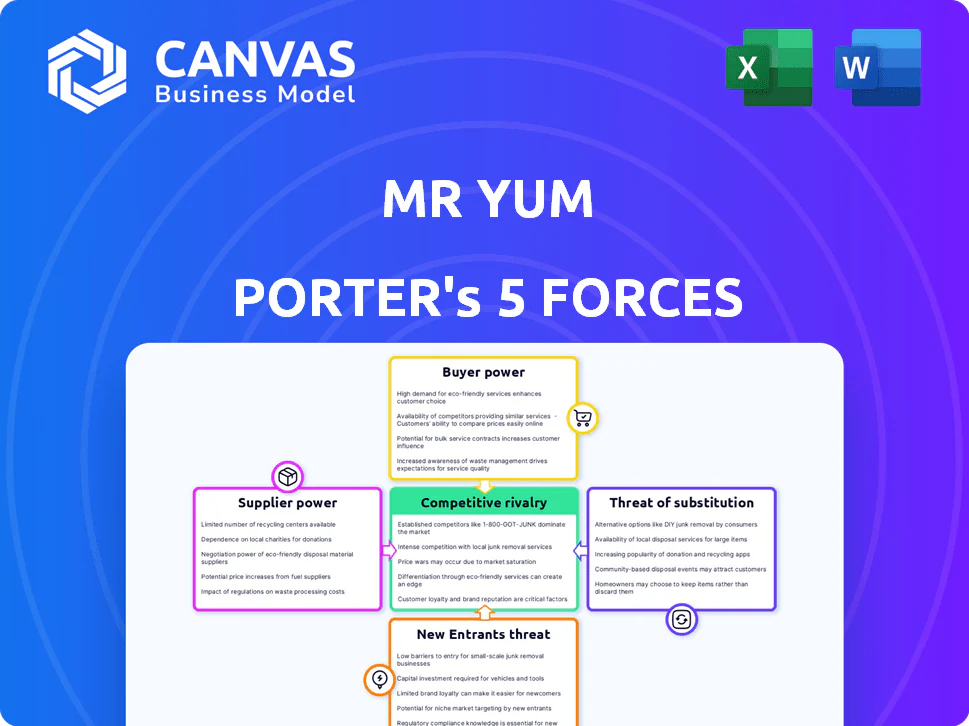
MR YUM PORTER'S FIVE FORCES TEMPLATE RESEARCH
What is included in the product
 Detailed Word Document
Analyzes Mr Yum's position within its competitive landscape, evaluating key market forces.

 Customizable Excel Spreadsheet
Quickly identify competitive threats with a color-coded summary of each force.
Preview the Actual Deliverable
Mr Yum Porter's Five Forces Analysis
This preview presents Mr Yum's Porter's Five Forces Analysis in its entirety. It's the complete, ready-to-use document you'll download instantly after purchase. This fully formatted analysis offers insights into industry dynamics. Expect immediate access to this exact, professionally crafted file. The provided document ensures clarity and concise analysis.

Porter's Five Forces Analysis Template

A Must-Have Tool for Decision-Makers
Mr Yum's competitive landscape is shaped by key forces. The threat of new entrants is moderate, while supplier power seems manageable. Buyer power is a factor, particularly in the competitive restaurant tech space. Substitute products, like other ordering systems, pose a threat. Competitive rivalry is high among similar tech providers.
This brief snapshot only scratches the surface. Unlock the full Porter's Five Forces Analysis to explore Mr Yum’s competitive dynamics, market pressures, and strategic advantages in detail.
Suppliers Bargaining Power

Dependence on technology providers
Mr Yum's dependence on tech suppliers, like payment gateways, impacts its bargaining power. If Mr Yum is locked into a single provider, that supplier gains leverage. For example, cloud services from AWS cost millions annually for many tech companies in 2024. High switching costs amplify this supplier power.
Availability of alternative technology solutions
Mr Yum's reliance on specific tech suppliers is lessened by market alternatives. In 2024, the cloud services market saw a $670 billion revenue, offering choices. This competition helps Mr Yum negotiate better terms. Switching providers is a viable strategy against supplier dominance.

Cost of technology and software development
The expenses tied to software development significantly affect Mr Yum. Labor costs for skilled developers can fluctuate, influencing Mr Yum's operational spending. As of late 2024, average software developer salaries range from $80,000 to $150,000 annually.

Integration with Point of Sale (POS) systems
Mr Yum's reliance on integrating with existing Point of Sale (POS) systems significantly empowers major POS providers. Compatibility is key for Mr Yum, and dominant POS companies could control integration terms. This dependence could increase costs or create integration challenges for Mr Yum. In 2024, the global POS market was valued at approximately $86 billion, highlighting the financial stakes involved.
- Integration complexity and costs can be influenced by POS providers.
- Mr Yum's expansion hinges on smooth POS system integration.
- Major POS companies possess substantial market power.
- The POS market's substantial value underscores its influence.
Data providers and analytics tools
Mr Yum leverages data and analytics for its clients, creating a dependency on these tools. Suppliers of these tools, such as data providers and analytics software companies, wield power. Their influence grows if they offer exclusive data or advanced analytical functions, which Mr Yum needs. For example, the global market for big data analytics is projected to reach $684.12 billion by 2028.
- Market Growth: The big data analytics market is expected to grow significantly.
- Exclusive Data: Suppliers with unique datasets have more leverage.
- Analytical Capabilities: Advanced tools offer a competitive edge.
- Dependency: Mr Yum relies on these suppliers for insights.
Supplier Power Dynamics: A Quick Look
Mr Yum's supplier power varies based on tech dependencies and market competition. The cloud services market, valued at $670 billion in 2024, offers alternatives. POS system integration and data analytics tool reliance also shape supplier leverage.
| Supplier Type | Influence Factor | Market Data (2024) |
|---|---|---|
| Cloud Services | Market Competition | $670B Revenue |
| POS Providers | Integration Needs | $86B Global Market |
| Data Analytics | Exclusive Data/Tools | $684.12B (by 2028) |
Customers Bargaining Power

Price sensitivity of hospitality venues
Hospitality venues, facing tight margins, are price-sensitive. In 2024, the average restaurant profit margin was around 3-5%. This sensitivity gives venues leverage in negotiating with tech providers like Mr Yum. Venues can push for lower prices or better contract terms. This impacts Mr Yum's revenue and profitability.
Availability of competing ordering platforms
The mobile ordering and payment market is crowded. Competitors like other QR code systems and delivery platforms provide choices. This abundance boosts customer power, as venues can switch if Mr Yum's offerings aren't appealing. In 2024, the food delivery market alone generated over $200 billion globally. Venues can leverage this competition for better terms.

Switching costs for venues
Switching costs for venues from Mr Yum Porter to another platform are not excessively high. The ease of data migration and comparable functionalities offered by competitors like Bopple or HungryHungry reduce friction. In 2024, the average contract length for POS systems was around 2-3 years, allowing for periodic evaluations. This strengthens venues' ability to negotiate better terms or switch providers.

Customer concentration
Customer concentration significantly impacts Mr Yum's bargaining power. If a few large hospitality groups generate most revenue, those customers gain leverage. This scenario allows them to dictate terms like pricing or service levels. Consider that in 2024, the top 10 restaurant chains controlled about 25% of the US market, showing consolidation.
- Concentrated customer base increases buyer power.
- Large buyers can demand lower prices or better services.
- Mr Yum's profitability could be squeezed.
- Reduced buyer power with a diverse customer base.
Influence of customer reviews and reputation
In the hospitality sector, customer reviews and brand reputation are crucial. Positive reviews for Mr Yum can drive business, while negative ones can hurt it, giving customers leverage. Online platforms have amplified this effect. Recent data shows that 93% of consumers read online reviews before visiting a business. This impacts Mr Yum's success.
- Influence of online reviews on venue selection is significant.
- Customer feedback can greatly affect a business's reputation.
- Negative reviews can deter potential customers.
- Mr Yum's success depends on customer satisfaction.
Venues' Power Play: Mobile Ordering's $30B Market
Hospitality venues have substantial bargaining power, especially with tight margins and numerous competitors. The mobile ordering market's competitiveness and the ease of switching platforms amplify this leverage. In 2024, the global market for mobile ordering and payments reached $30 billion. Customer concentration further empowers buyers.
| Factor | Impact on Mr Yum | 2024 Data |
|---|---|---|
| Price Sensitivity | Venues can negotiate lower prices. | Restaurant profit margin: 3-5% |
| Market Competition | Venues can switch providers easily. | Mobile ordering market: $30B |
| Switching Costs | Low switching costs for venues. | POS contract length: 2-3 years |
Rivalry Among Competitors

Number and diversity of competitors
Mr Yum faces intense competition, with many rivals in the mobile ordering space. The market includes platforms like Toast and Revel Systems. Traditional POS systems also compete for market share. In 2024, the restaurant tech market was valued at over $25 billion, highlighting the strong competition.
Intensity of marketing and pricing strategies
Marketing and pricing are key battlegrounds. Competitors like Square and Lightspeed actively market to venues. Aggressive pricing, like offering lower transaction fees, is common. For example, in 2024, Square's revenue reached $20.4 billion, showing the impact of its market strategies. Promotional offers further intensify competition.

Differentiation of services and features
Mr Yum, in a competitive landscape, must differentiate its features. Competitors vie on digital menus, loyalty programs, and integrations. To stay ahead, Mr Yum needs constant innovation. For example, the global restaurant tech market was valued at $76.8 billion in 2023 and is expected to reach $118.9 billion by 2029.

Market growth rate
As digital solutions become standard, the hospitality market faces a maturing phase in some areas. This shift intensifies competition among established companies, all vying for a larger piece of the pie. For example, the global digital restaurant market, valued at $15.4 billion in 2023, is expected to reach $28.5 billion by 2029. This growth, though significant, will likely be contested.
- Increased competition means businesses must aggressively seek market share.
- Mature markets often see price wars and innovative service offerings.
- Companies must differentiate to survive.
- Consolidation could become a common strategy.
Mergers and acquisitions among competitors
Consolidation, like the Mr Yum and me&u merger, reshapes competition, forming stronger rivals. This can intensify rivalry as fewer, larger players vie for market share. Such moves often lead to increased price wars or more aggressive marketing strategies. The industry's competitive dynamics are directly impacted by these strategic shifts.
- In 2024, the global M&A value reached approximately $2.9 trillion.
- The food service technology sector saw several M&A deals in 2024, reflecting consolidation trends.
- Mergers often aim to cut costs and boost efficiency, intensifying rivalry.
Market Dynamics: Mr Yum's Competitive Landscape
Competitive rivalry in Mr Yum's market is fierce, with many players vying for market share. Intense competition drives firms to use pricing and marketing strategies to attract customers. Market consolidation, like the Mr Yum and me&u merger, intensifies rivalry.
| Metric | 2023 Value | 2024 (Projected/Actual) |
|---|---|---|
| Restaurant Tech Market Size (Global) | $76.8B | $85B (Est.) |
| Digital Restaurant Market (Global) | $15.4B | $18B (Est.) |
| M&A Value (Global) | - | $2.9T (approx.) |
Original: $10.00
-65%$10.00
$3.50MR YUM PORTER'S FIVE FORCES TEMPLATE RESEARCH
What is included in the product
Detailed Word Document
Analyzes Mr Yum's position within its competitive landscape, evaluating key market forces.
Customizable Excel Spreadsheet
Quickly identify competitive threats with a color-coded summary of each force.
Preview the Actual Deliverable
Mr Yum Porter's Five Forces Analysis
This preview presents Mr Yum's Porter's Five Forces Analysis in its entirety. It's the complete, ready-to-use document you'll download instantly after purchase. This fully formatted analysis offers insights into industry dynamics. Expect immediate access to this exact, professionally crafted file. The provided document ensures clarity and concise analysis.
Porter's Five Forces Analysis Template
A Must-Have Tool for Decision-Makers
Mr Yum's competitive landscape is shaped by key forces. The threat of new entrants is moderate, while supplier power seems manageable. Buyer power is a factor, particularly in the competitive restaurant tech space. Substitute products, like other ordering systems, pose a threat. Competitive rivalry is high among similar tech providers.
This brief snapshot only scratches the surface. Unlock the full Porter's Five Forces Analysis to explore Mr Yum’s competitive dynamics, market pressures, and strategic advantages in detail.
Suppliers Bargaining Power
Dependence on technology providers
Mr Yum's dependence on tech suppliers, like payment gateways, impacts its bargaining power. If Mr Yum is locked into a single provider, that supplier gains leverage. For example, cloud services from AWS cost millions annually for many tech companies in 2024. High switching costs amplify this supplier power.
Availability of alternative technology solutions
Mr Yum's reliance on specific tech suppliers is lessened by market alternatives. In 2024, the cloud services market saw a $670 billion revenue, offering choices. This competition helps Mr Yum negotiate better terms. Switching providers is a viable strategy against supplier dominance.
Cost of technology and software development
The expenses tied to software development significantly affect Mr Yum. Labor costs for skilled developers can fluctuate, influencing Mr Yum's operational spending. As of late 2024, average software developer salaries range from $80,000 to $150,000 annually.
Integration with Point of Sale (POS) systems
Mr Yum's reliance on integrating with existing Point of Sale (POS) systems significantly empowers major POS providers. Compatibility is key for Mr Yum, and dominant POS companies could control integration terms. This dependence could increase costs or create integration challenges for Mr Yum. In 2024, the global POS market was valued at approximately $86 billion, highlighting the financial stakes involved.
- Integration complexity and costs can be influenced by POS providers.
- Mr Yum's expansion hinges on smooth POS system integration.
- Major POS companies possess substantial market power.
- The POS market's substantial value underscores its influence.
Data providers and analytics tools
Mr Yum leverages data and analytics for its clients, creating a dependency on these tools. Suppliers of these tools, such as data providers and analytics software companies, wield power. Their influence grows if they offer exclusive data or advanced analytical functions, which Mr Yum needs. For example, the global market for big data analytics is projected to reach $684.12 billion by 2028.
- Market Growth: The big data analytics market is expected to grow significantly.
- Exclusive Data: Suppliers with unique datasets have more leverage.
- Analytical Capabilities: Advanced tools offer a competitive edge.
- Dependency: Mr Yum relies on these suppliers for insights.
Supplier Power Dynamics: A Quick Look
Mr Yum's supplier power varies based on tech dependencies and market competition. The cloud services market, valued at $670 billion in 2024, offers alternatives. POS system integration and data analytics tool reliance also shape supplier leverage.
| Supplier Type | Influence Factor | Market Data (2024) |
|---|---|---|
| Cloud Services | Market Competition | $670B Revenue |
| POS Providers | Integration Needs | $86B Global Market |
| Data Analytics | Exclusive Data/Tools | $684.12B (by 2028) |
Customers Bargaining Power
Price sensitivity of hospitality venues
Hospitality venues, facing tight margins, are price-sensitive. In 2024, the average restaurant profit margin was around 3-5%. This sensitivity gives venues leverage in negotiating with tech providers like Mr Yum. Venues can push for lower prices or better contract terms. This impacts Mr Yum's revenue and profitability.
Availability of competing ordering platforms
The mobile ordering and payment market is crowded. Competitors like other QR code systems and delivery platforms provide choices. This abundance boosts customer power, as venues can switch if Mr Yum's offerings aren't appealing. In 2024, the food delivery market alone generated over $200 billion globally. Venues can leverage this competition for better terms.
Switching costs for venues
Switching costs for venues from Mr Yum Porter to another platform are not excessively high. The ease of data migration and comparable functionalities offered by competitors like Bopple or HungryHungry reduce friction. In 2024, the average contract length for POS systems was around 2-3 years, allowing for periodic evaluations. This strengthens venues' ability to negotiate better terms or switch providers.
Customer concentration
Customer concentration significantly impacts Mr Yum's bargaining power. If a few large hospitality groups generate most revenue, those customers gain leverage. This scenario allows them to dictate terms like pricing or service levels. Consider that in 2024, the top 10 restaurant chains controlled about 25% of the US market, showing consolidation.
- Concentrated customer base increases buyer power.
- Large buyers can demand lower prices or better services.
- Mr Yum's profitability could be squeezed.
- Reduced buyer power with a diverse customer base.
Influence of customer reviews and reputation
In the hospitality sector, customer reviews and brand reputation are crucial. Positive reviews for Mr Yum can drive business, while negative ones can hurt it, giving customers leverage. Online platforms have amplified this effect. Recent data shows that 93% of consumers read online reviews before visiting a business. This impacts Mr Yum's success.
- Influence of online reviews on venue selection is significant.
- Customer feedback can greatly affect a business's reputation.
- Negative reviews can deter potential customers.
- Mr Yum's success depends on customer satisfaction.
Venues' Power Play: Mobile Ordering's $30B Market
Hospitality venues have substantial bargaining power, especially with tight margins and numerous competitors. The mobile ordering market's competitiveness and the ease of switching platforms amplify this leverage. In 2024, the global market for mobile ordering and payments reached $30 billion. Customer concentration further empowers buyers.
| Factor | Impact on Mr Yum | 2024 Data |
|---|---|---|
| Price Sensitivity | Venues can negotiate lower prices. | Restaurant profit margin: 3-5% |
| Market Competition | Venues can switch providers easily. | Mobile ordering market: $30B |
| Switching Costs | Low switching costs for venues. | POS contract length: 2-3 years |
Rivalry Among Competitors
Number and diversity of competitors
Mr Yum faces intense competition, with many rivals in the mobile ordering space. The market includes platforms like Toast and Revel Systems. Traditional POS systems also compete for market share. In 2024, the restaurant tech market was valued at over $25 billion, highlighting the strong competition.
Intensity of marketing and pricing strategies
Marketing and pricing are key battlegrounds. Competitors like Square and Lightspeed actively market to venues. Aggressive pricing, like offering lower transaction fees, is common. For example, in 2024, Square's revenue reached $20.4 billion, showing the impact of its market strategies. Promotional offers further intensify competition.
Differentiation of services and features
Mr Yum, in a competitive landscape, must differentiate its features. Competitors vie on digital menus, loyalty programs, and integrations. To stay ahead, Mr Yum needs constant innovation. For example, the global restaurant tech market was valued at $76.8 billion in 2023 and is expected to reach $118.9 billion by 2029.
Market growth rate
As digital solutions become standard, the hospitality market faces a maturing phase in some areas. This shift intensifies competition among established companies, all vying for a larger piece of the pie. For example, the global digital restaurant market, valued at $15.4 billion in 2023, is expected to reach $28.5 billion by 2029. This growth, though significant, will likely be contested.
- Increased competition means businesses must aggressively seek market share.
- Mature markets often see price wars and innovative service offerings.
- Companies must differentiate to survive.
- Consolidation could become a common strategy.
Mergers and acquisitions among competitors
Consolidation, like the Mr Yum and me&u merger, reshapes competition, forming stronger rivals. This can intensify rivalry as fewer, larger players vie for market share. Such moves often lead to increased price wars or more aggressive marketing strategies. The industry's competitive dynamics are directly impacted by these strategic shifts.
- In 2024, the global M&A value reached approximately $2.9 trillion.
- The food service technology sector saw several M&A deals in 2024, reflecting consolidation trends.
- Mergers often aim to cut costs and boost efficiency, intensifying rivalry.
Market Dynamics: Mr Yum's Competitive Landscape
Competitive rivalry in Mr Yum's market is fierce, with many players vying for market share. Intense competition drives firms to use pricing and marketing strategies to attract customers. Market consolidation, like the Mr Yum and me&u merger, intensifies rivalry.
| Metric | 2023 Value | 2024 (Projected/Actual) |
|---|---|---|
| Restaurant Tech Market Size (Global) | $76.8B | $85B (Est.) |
| Digital Restaurant Market (Global) | $15.4B | $18B (Est.) |
| M&A Value (Global) | - | $2.9T (approx.) |
Product Information
Product Information
Shipping & Returns
Shipping & Returns
Description
What is included in the product
Detailed Word Document
Analyzes Mr Yum's position within its competitive landscape, evaluating key market forces.
Customizable Excel Spreadsheet
Quickly identify competitive threats with a color-coded summary of each force.
Preview the Actual Deliverable
Mr Yum Porter's Five Forces Analysis
This preview presents Mr Yum's Porter's Five Forces Analysis in its entirety. It's the complete, ready-to-use document you'll download instantly after purchase. This fully formatted analysis offers insights into industry dynamics. Expect immediate access to this exact, professionally crafted file. The provided document ensures clarity and concise analysis.
Porter's Five Forces Analysis Template
A Must-Have Tool for Decision-Makers
Mr Yum's competitive landscape is shaped by key forces. The threat of new entrants is moderate, while supplier power seems manageable. Buyer power is a factor, particularly in the competitive restaurant tech space. Substitute products, like other ordering systems, pose a threat. Competitive rivalry is high among similar tech providers.
This brief snapshot only scratches the surface. Unlock the full Porter's Five Forces Analysis to explore Mr Yum’s competitive dynamics, market pressures, and strategic advantages in detail.
Suppliers Bargaining Power
Dependence on technology providers
Mr Yum's dependence on tech suppliers, like payment gateways, impacts its bargaining power. If Mr Yum is locked into a single provider, that supplier gains leverage. For example, cloud services from AWS cost millions annually for many tech companies in 2024. High switching costs amplify this supplier power.
Availability of alternative technology solutions
Mr Yum's reliance on specific tech suppliers is lessened by market alternatives. In 2024, the cloud services market saw a $670 billion revenue, offering choices. This competition helps Mr Yum negotiate better terms. Switching providers is a viable strategy against supplier dominance.
Cost of technology and software development
The expenses tied to software development significantly affect Mr Yum. Labor costs for skilled developers can fluctuate, influencing Mr Yum's operational spending. As of late 2024, average software developer salaries range from $80,000 to $150,000 annually.
Integration with Point of Sale (POS) systems
Mr Yum's reliance on integrating with existing Point of Sale (POS) systems significantly empowers major POS providers. Compatibility is key for Mr Yum, and dominant POS companies could control integration terms. This dependence could increase costs or create integration challenges for Mr Yum. In 2024, the global POS market was valued at approximately $86 billion, highlighting the financial stakes involved.
- Integration complexity and costs can be influenced by POS providers.
- Mr Yum's expansion hinges on smooth POS system integration.
- Major POS companies possess substantial market power.
- The POS market's substantial value underscores its influence.
Data providers and analytics tools
Mr Yum leverages data and analytics for its clients, creating a dependency on these tools. Suppliers of these tools, such as data providers and analytics software companies, wield power. Their influence grows if they offer exclusive data or advanced analytical functions, which Mr Yum needs. For example, the global market for big data analytics is projected to reach $684.12 billion by 2028.
- Market Growth: The big data analytics market is expected to grow significantly.
- Exclusive Data: Suppliers with unique datasets have more leverage.
- Analytical Capabilities: Advanced tools offer a competitive edge.
- Dependency: Mr Yum relies on these suppliers for insights.
Supplier Power Dynamics: A Quick Look
Mr Yum's supplier power varies based on tech dependencies and market competition. The cloud services market, valued at $670 billion in 2024, offers alternatives. POS system integration and data analytics tool reliance also shape supplier leverage.
| Supplier Type | Influence Factor | Market Data (2024) |
|---|---|---|
| Cloud Services | Market Competition | $670B Revenue |
| POS Providers | Integration Needs | $86B Global Market |
| Data Analytics | Exclusive Data/Tools | $684.12B (by 2028) |
Customers Bargaining Power
Price sensitivity of hospitality venues
Hospitality venues, facing tight margins, are price-sensitive. In 2024, the average restaurant profit margin was around 3-5%. This sensitivity gives venues leverage in negotiating with tech providers like Mr Yum. Venues can push for lower prices or better contract terms. This impacts Mr Yum's revenue and profitability.
Availability of competing ordering platforms
The mobile ordering and payment market is crowded. Competitors like other QR code systems and delivery platforms provide choices. This abundance boosts customer power, as venues can switch if Mr Yum's offerings aren't appealing. In 2024, the food delivery market alone generated over $200 billion globally. Venues can leverage this competition for better terms.
Switching costs for venues
Switching costs for venues from Mr Yum Porter to another platform are not excessively high. The ease of data migration and comparable functionalities offered by competitors like Bopple or HungryHungry reduce friction. In 2024, the average contract length for POS systems was around 2-3 years, allowing for periodic evaluations. This strengthens venues' ability to negotiate better terms or switch providers.
Customer concentration
Customer concentration significantly impacts Mr Yum's bargaining power. If a few large hospitality groups generate most revenue, those customers gain leverage. This scenario allows them to dictate terms like pricing or service levels. Consider that in 2024, the top 10 restaurant chains controlled about 25% of the US market, showing consolidation.
- Concentrated customer base increases buyer power.
- Large buyers can demand lower prices or better services.
- Mr Yum's profitability could be squeezed.
- Reduced buyer power with a diverse customer base.
Influence of customer reviews and reputation
In the hospitality sector, customer reviews and brand reputation are crucial. Positive reviews for Mr Yum can drive business, while negative ones can hurt it, giving customers leverage. Online platforms have amplified this effect. Recent data shows that 93% of consumers read online reviews before visiting a business. This impacts Mr Yum's success.
- Influence of online reviews on venue selection is significant.
- Customer feedback can greatly affect a business's reputation.
- Negative reviews can deter potential customers.
- Mr Yum's success depends on customer satisfaction.
Venues' Power Play: Mobile Ordering's $30B Market
Hospitality venues have substantial bargaining power, especially with tight margins and numerous competitors. The mobile ordering market's competitiveness and the ease of switching platforms amplify this leverage. In 2024, the global market for mobile ordering and payments reached $30 billion. Customer concentration further empowers buyers.
| Factor | Impact on Mr Yum | 2024 Data |
|---|---|---|
| Price Sensitivity | Venues can negotiate lower prices. | Restaurant profit margin: 3-5% |
| Market Competition | Venues can switch providers easily. | Mobile ordering market: $30B |
| Switching Costs | Low switching costs for venues. | POS contract length: 2-3 years |
Rivalry Among Competitors
Number and diversity of competitors
Mr Yum faces intense competition, with many rivals in the mobile ordering space. The market includes platforms like Toast and Revel Systems. Traditional POS systems also compete for market share. In 2024, the restaurant tech market was valued at over $25 billion, highlighting the strong competition.
Intensity of marketing and pricing strategies
Marketing and pricing are key battlegrounds. Competitors like Square and Lightspeed actively market to venues. Aggressive pricing, like offering lower transaction fees, is common. For example, in 2024, Square's revenue reached $20.4 billion, showing the impact of its market strategies. Promotional offers further intensify competition.
Differentiation of services and features
Mr Yum, in a competitive landscape, must differentiate its features. Competitors vie on digital menus, loyalty programs, and integrations. To stay ahead, Mr Yum needs constant innovation. For example, the global restaurant tech market was valued at $76.8 billion in 2023 and is expected to reach $118.9 billion by 2029.
Market growth rate
As digital solutions become standard, the hospitality market faces a maturing phase in some areas. This shift intensifies competition among established companies, all vying for a larger piece of the pie. For example, the global digital restaurant market, valued at $15.4 billion in 2023, is expected to reach $28.5 billion by 2029. This growth, though significant, will likely be contested.
- Increased competition means businesses must aggressively seek market share.
- Mature markets often see price wars and innovative service offerings.
- Companies must differentiate to survive.
- Consolidation could become a common strategy.
Mergers and acquisitions among competitors
Consolidation, like the Mr Yum and me&u merger, reshapes competition, forming stronger rivals. This can intensify rivalry as fewer, larger players vie for market share. Such moves often lead to increased price wars or more aggressive marketing strategies. The industry's competitive dynamics are directly impacted by these strategic shifts.
- In 2024, the global M&A value reached approximately $2.9 trillion.
- The food service technology sector saw several M&A deals in 2024, reflecting consolidation trends.
- Mergers often aim to cut costs and boost efficiency, intensifying rivalry.
Market Dynamics: Mr Yum's Competitive Landscape
Competitive rivalry in Mr Yum's market is fierce, with many players vying for market share. Intense competition drives firms to use pricing and marketing strategies to attract customers. Market consolidation, like the Mr Yum and me&u merger, intensifies rivalry.
| Metric | 2023 Value | 2024 (Projected/Actual) |
|---|---|---|
| Restaurant Tech Market Size (Global) | $76.8B | $85B (Est.) |
| Digital Restaurant Market (Global) | $15.4B | $18B (Est.) |
| M&A Value (Global) | - | $2.9T (approx.) |











