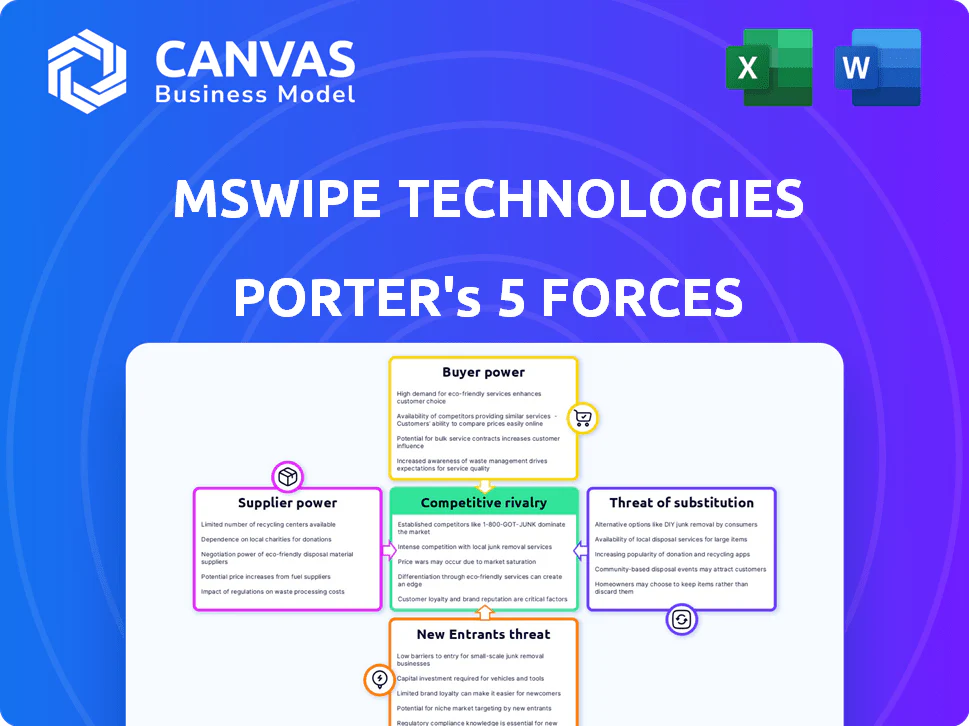
MSWIPE TECHNOLOGIES PORTER'S FIVE FORCES TEMPLATE RESEARCH
What is included in the product
 Detailed Word Document
Examines the competitive landscape of Mswipe, assessing threats, bargaining power, and rivalry.

 Customizable Excel Spreadsheet
Customize pressure levels based on new data or evolving market trends.
Preview the Actual Deliverable
Mswipe Technologies Porter's Five Forces Analysis
This is the complete Porter's Five Forces analysis for Mswipe Technologies. The displayed preview is the final, ready-to-use document you will receive. It's professionally written and fully formatted for immediate download. You'll get instant access to this exact analysis upon purchase. No revisions or further setup needed.

Porter's Five Forces Analysis Template

Go Beyond the Preview—Access the Full Strategic Report
Mswipe Technologies navigates a competitive landscape. Buyer power, particularly from merchants, influences pricing. Supplier power, mainly from hardware providers, impacts costs. The threat of new entrants, like digital payment platforms, is moderate. Rivalry among existing players, including established payment gateways, is high. The threat of substitutes, such as cash, remains.
This brief snapshot only scratches the surface. Unlock the full Porter's Five Forces Analysis to explore Mswipe Technologies’s competitive dynamics, market pressures, and strategic advantages in detail.
Suppliers Bargaining Power

Reliance on hardware manufacturers
Mswipe depends on hardware manufacturers for POS and mPOS devices. The bargaining power of these suppliers is affected by alternative manufacturers and the technology's uniqueness. In 2024, the POS market was valued at approximately $56 billion. If Mswipe has few alternatives, supplier power increases. The more specialized the tech, the greater the supplier's leverage.
Software and technology providers
Software and technology suppliers significantly influence Mswipe Technologies. This includes operating systems, payment gateways, and software vendors. The bargaining power of these suppliers is moderate. The global payment gateway market was valued at USD 45.5 billion in 2023. Strong suppliers could impact Mswipe's costs and service offerings.

Financial institutions and banks
Mswipe relies heavily on partnerships with financial institutions and banks to onboard merchants and facilitate transactions. These partnerships are vital for the company's operational success. The bargaining power of these suppliers, specifically banks, significantly influences Mswipe's operations and cost structure. For example, as of 2024, transaction fees charged by banks can range from 1.5% to 3% per transaction, directly impacting Mswipe's profitability.

Telecommunication providers
Telecommunication providers' bargaining power affects Mswipe Technologies. Reliable services are crucial for mobile POS devices and online transactions. The availability and pricing of these services impact Mswipe's delivery, influencing operational costs. In 2024, India's telecom sector saw significant fluctuations, with data costs varying. This can directly affect Mswipe's profitability.
- Data costs in India ranged from $0.10 to $0.20 per GB in 2024.
- Reliance Jio and Bharti Airtel are major players, controlling about 70% of the market.
- Pricing pressures could force Mswipe to seek alternative, cost-effective providers.
- Service disruptions from providers could directly impact transaction processing.
Network and infrastructure providers
Network and infrastructure providers significantly influence digital payment platforms. These suppliers offer essential services like data centers and cloud services. Their control over these resources can impact Mswipe's operational costs. Fluctuations in these costs directly affect profitability. For instance, cloud services spending rose 20% in 2024.
- Cloud infrastructure spending grew 20% in 2024.
- Data center services costs can vary widely.
- Network connectivity pricing impacts operational expenses.
- Supplier concentration increases bargaining power.
Supplier Power Dynamics: A Quick Look
Mswipe's supplier power varies by sector. Hardware suppliers' influence depends on alternatives and tech uniqueness. Banks' transaction fees, like 1.5%-3% in 2024, affect profits. Telecom costs in India, $0.10-$0.20/GB in 2024, also matter.
| Supplier Type | Impact on Mswipe | 2024 Data Points |
|---|---|---|
| Hardware | High if few alternatives | POS market ~$56B |
| Banks | Fees impact profitability | Transaction fees 1.5%-3% |
| Telecom | Data costs affect delivery | Data costs $0.10-$0.20/GB |
Customers Bargaining Power

Fragmented customer base
Mswipe's customer base consists mainly of SMBs. These businesses, due to their size, have less individual bargaining power. In 2024, SMBs accounted for approximately 60% of digital payments. This fragmentation limits their ability to negotiate favorable terms. Mswipe's focus on SMBs influences its pricing strategies.
Availability of alternatives
Merchants can choose from numerous digital payment solutions. In 2024, options like Paytm and PhonePe each processed billions of transactions. This competition gives merchants leverage. They can negotiate better terms or switch providers. This reduces Mswipe's control over pricing.

Price sensitivity of SMBs
Small and medium-sized businesses (SMBs) are typically very price-conscious. This sensitivity forces companies like Mswipe to carefully consider their pricing strategies. SMBs often compare providers based on transaction fees and device costs. In 2024, the average transaction fee for point-of-sale (POS) systems ranged from 1.5% to 3.5%.

Low switching costs
Low switching costs enhance customer bargaining power. Merchants can easily change payment solution providers, increasing their leverage. This ease of switching keeps providers competitive. In 2024, Mswipe faces this challenge, as alternatives are readily available. This environment pressures Mswipe to offer better terms.
- Competitive Pricing: The ability to switch encourages providers to offer competitive pricing.
- Service Quality: Merchants can demand higher service quality.
- Negotiation: Merchants can negotiate better terms.
- Market Dynamics: The overall market dynamics are shaped by this flexibility.
Demand for value-added services
Merchants increasingly seek value-added services beyond basic payment processing. This trend is evident in the FinTech sector, where demand for integrated solutions is growing. For instance, in 2024, the adoption rate of point-of-sale (POS) systems with integrated inventory management increased by 15% among small and medium-sized enterprises (SMEs). Providers that offer these enhanced features, such as Mswipe, are better positioned to attract and retain customers. This shift underscores the growing importance of comprehensive offerings in the competitive payments landscape.
- Integrated solutions adoption increased by 15% among SMEs in 2024.
- Merchants now demand services beyond basic payment processing.
- Providers with value-added services can retain customers.
- Mswipe, as a provider, needs to offer enhanced features.
SMBs' Digital Payment Power Dynamics
SMBs have limited bargaining power due to their size. Competition in digital payments gives merchants leverage to negotiate terms. Price sensitivity among SMBs forces Mswipe to be competitive. Low switching costs further enhance customer bargaining power.
| Aspect | Impact | 2024 Data |
|---|---|---|
| SMBs' Bargaining Power | Limited due to size | SMBs accounted for 60% of digital payments |
| Merchant Leverage | High due to competition | Average POS fee: 1.5%-3.5% |
| Switching Costs | Low, increasing power | Integrated POS adoption up 15% |
Rivalry Among Competitors

Presence of numerous players
The Indian digital payments market is fiercely competitive, hosting numerous players from established giants to agile startups. Mswipe faces stiff competition from prominent firms like Razorpay, PayU, and Pine Labs, all vying for market share. The intensity of rivalry is evident in the dynamic pricing strategies and constant innovation seen across the industry. For example, in 2024, the digital payments sector saw over $100 billion in transactions, highlighting the stakes.
Diverse range of competitors
Mswipe faces intense competition from diverse players in the digital payments landscape. This includes established POS providers, payment gateways, and mobile wallet companies like PhonePe and Paytm. Banks also compete by offering their digital payment solutions, intensifying the rivalry. In 2024, India's digital payments market was estimated at $3 trillion, highlighting the competitive pressure.

Rapid technological advancements
Rapid technological advancements intensify competition in fintech. Companies like Mswipe must continuously innovate to stay relevant. In 2024, the fintech market saw record investments, heightening the pressure to release cutting-edge solutions. This fast pace requires substantial R&D spending, adding to the competitive pressure.

Pricing pressure and fee structures
The payment solutions market is highly competitive, driving pricing pressure. This competition impacts transaction fees. For instance, in 2024, average transaction fees for digital payments in India ranged from 0.7% to 1.2%, a slight decrease from previous years due to competition. This affects Mswipe's profitability.
- Intense competition among payment gateways.
- Negotiations with merchants.
- Changes in regulatory environment.
- Impact on profit margins.
Focus on merchant acquisition and retention
Mswipe faces intense competition in acquiring and retaining merchants. Companies vie for merchants through pricing, product features, and customer support. This rivalry pressures margins and necessitates constant innovation. The digital payments market in India is highly contested, with numerous players.
- India's digital payments market is projected to reach $10 trillion by 2026.
- Mswipe's revenue was approximately INR 200 crore in FY23.
- Competitors include Razorpay, and Pine Labs.
- Merchant acquisition costs are a significant expense.
Mswipe's Market Fight: Rivals, Revenue, and a $10T Prize
Mswipe encounters fierce rivalry in India's digital payments market, with Razorpay and Pine Labs as key competitors. The market's growth, projected to $10 trillion by 2026, intensifies competition. Mswipe's FY23 revenue was around INR 200 crore, influenced by pricing pressure.
| Aspect | Details | Impact on Mswipe |
|---|---|---|
| Market Growth (2024 est.) | Digital payments market in India: $3 trillion | Increased competition for market share |
| Key Competitors | Razorpay, Pine Labs, PayU, PhonePe, Paytm | Pressure on pricing, innovation, and merchant acquisition |
| FY23 Revenue (Mswipe) | Approx. INR 200 crore | Profit margin impacted by transaction fees (0.7%-1.2% in 2024) |
Original: $10.00
-65%$10.00
$3.50MSWIPE TECHNOLOGIES PORTER'S FIVE FORCES TEMPLATE RESEARCH
What is included in the product
Detailed Word Document
Examines the competitive landscape of Mswipe, assessing threats, bargaining power, and rivalry.
Customizable Excel Spreadsheet
Customize pressure levels based on new data or evolving market trends.
Preview the Actual Deliverable
Mswipe Technologies Porter's Five Forces Analysis
This is the complete Porter's Five Forces analysis for Mswipe Technologies. The displayed preview is the final, ready-to-use document you will receive. It's professionally written and fully formatted for immediate download. You'll get instant access to this exact analysis upon purchase. No revisions or further setup needed.
Porter's Five Forces Analysis Template
Go Beyond the Preview—Access the Full Strategic Report
Mswipe Technologies navigates a competitive landscape. Buyer power, particularly from merchants, influences pricing. Supplier power, mainly from hardware providers, impacts costs. The threat of new entrants, like digital payment platforms, is moderate. Rivalry among existing players, including established payment gateways, is high. The threat of substitutes, such as cash, remains.
This brief snapshot only scratches the surface. Unlock the full Porter's Five Forces Analysis to explore Mswipe Technologies’s competitive dynamics, market pressures, and strategic advantages in detail.
Suppliers Bargaining Power
Reliance on hardware manufacturers
Mswipe depends on hardware manufacturers for POS and mPOS devices. The bargaining power of these suppliers is affected by alternative manufacturers and the technology's uniqueness. In 2024, the POS market was valued at approximately $56 billion. If Mswipe has few alternatives, supplier power increases. The more specialized the tech, the greater the supplier's leverage.
Software and technology providers
Software and technology suppliers significantly influence Mswipe Technologies. This includes operating systems, payment gateways, and software vendors. The bargaining power of these suppliers is moderate. The global payment gateway market was valued at USD 45.5 billion in 2023. Strong suppliers could impact Mswipe's costs and service offerings.
Financial institutions and banks
Mswipe relies heavily on partnerships with financial institutions and banks to onboard merchants and facilitate transactions. These partnerships are vital for the company's operational success. The bargaining power of these suppliers, specifically banks, significantly influences Mswipe's operations and cost structure. For example, as of 2024, transaction fees charged by banks can range from 1.5% to 3% per transaction, directly impacting Mswipe's profitability.
Telecommunication providers
Telecommunication providers' bargaining power affects Mswipe Technologies. Reliable services are crucial for mobile POS devices and online transactions. The availability and pricing of these services impact Mswipe's delivery, influencing operational costs. In 2024, India's telecom sector saw significant fluctuations, with data costs varying. This can directly affect Mswipe's profitability.
- Data costs in India ranged from $0.10 to $0.20 per GB in 2024.
- Reliance Jio and Bharti Airtel are major players, controlling about 70% of the market.
- Pricing pressures could force Mswipe to seek alternative, cost-effective providers.
- Service disruptions from providers could directly impact transaction processing.
Network and infrastructure providers
Network and infrastructure providers significantly influence digital payment platforms. These suppliers offer essential services like data centers and cloud services. Their control over these resources can impact Mswipe's operational costs. Fluctuations in these costs directly affect profitability. For instance, cloud services spending rose 20% in 2024.
- Cloud infrastructure spending grew 20% in 2024.
- Data center services costs can vary widely.
- Network connectivity pricing impacts operational expenses.
- Supplier concentration increases bargaining power.
Supplier Power Dynamics: A Quick Look
Mswipe's supplier power varies by sector. Hardware suppliers' influence depends on alternatives and tech uniqueness. Banks' transaction fees, like 1.5%-3% in 2024, affect profits. Telecom costs in India, $0.10-$0.20/GB in 2024, also matter.
| Supplier Type | Impact on Mswipe | 2024 Data Points |
|---|---|---|
| Hardware | High if few alternatives | POS market ~$56B |
| Banks | Fees impact profitability | Transaction fees 1.5%-3% |
| Telecom | Data costs affect delivery | Data costs $0.10-$0.20/GB |
Customers Bargaining Power
Fragmented customer base
Mswipe's customer base consists mainly of SMBs. These businesses, due to their size, have less individual bargaining power. In 2024, SMBs accounted for approximately 60% of digital payments. This fragmentation limits their ability to negotiate favorable terms. Mswipe's focus on SMBs influences its pricing strategies.
Availability of alternatives
Merchants can choose from numerous digital payment solutions. In 2024, options like Paytm and PhonePe each processed billions of transactions. This competition gives merchants leverage. They can negotiate better terms or switch providers. This reduces Mswipe's control over pricing.
Price sensitivity of SMBs
Small and medium-sized businesses (SMBs) are typically very price-conscious. This sensitivity forces companies like Mswipe to carefully consider their pricing strategies. SMBs often compare providers based on transaction fees and device costs. In 2024, the average transaction fee for point-of-sale (POS) systems ranged from 1.5% to 3.5%.
Low switching costs
Low switching costs enhance customer bargaining power. Merchants can easily change payment solution providers, increasing their leverage. This ease of switching keeps providers competitive. In 2024, Mswipe faces this challenge, as alternatives are readily available. This environment pressures Mswipe to offer better terms.
- Competitive Pricing: The ability to switch encourages providers to offer competitive pricing.
- Service Quality: Merchants can demand higher service quality.
- Negotiation: Merchants can negotiate better terms.
- Market Dynamics: The overall market dynamics are shaped by this flexibility.
Demand for value-added services
Merchants increasingly seek value-added services beyond basic payment processing. This trend is evident in the FinTech sector, where demand for integrated solutions is growing. For instance, in 2024, the adoption rate of point-of-sale (POS) systems with integrated inventory management increased by 15% among small and medium-sized enterprises (SMEs). Providers that offer these enhanced features, such as Mswipe, are better positioned to attract and retain customers. This shift underscores the growing importance of comprehensive offerings in the competitive payments landscape.
- Integrated solutions adoption increased by 15% among SMEs in 2024.
- Merchants now demand services beyond basic payment processing.
- Providers with value-added services can retain customers.
- Mswipe, as a provider, needs to offer enhanced features.
SMBs' Digital Payment Power Dynamics
SMBs have limited bargaining power due to their size. Competition in digital payments gives merchants leverage to negotiate terms. Price sensitivity among SMBs forces Mswipe to be competitive. Low switching costs further enhance customer bargaining power.
| Aspect | Impact | 2024 Data |
|---|---|---|
| SMBs' Bargaining Power | Limited due to size | SMBs accounted for 60% of digital payments |
| Merchant Leverage | High due to competition | Average POS fee: 1.5%-3.5% |
| Switching Costs | Low, increasing power | Integrated POS adoption up 15% |
Rivalry Among Competitors
Presence of numerous players
The Indian digital payments market is fiercely competitive, hosting numerous players from established giants to agile startups. Mswipe faces stiff competition from prominent firms like Razorpay, PayU, and Pine Labs, all vying for market share. The intensity of rivalry is evident in the dynamic pricing strategies and constant innovation seen across the industry. For example, in 2024, the digital payments sector saw over $100 billion in transactions, highlighting the stakes.
Diverse range of competitors
Mswipe faces intense competition from diverse players in the digital payments landscape. This includes established POS providers, payment gateways, and mobile wallet companies like PhonePe and Paytm. Banks also compete by offering their digital payment solutions, intensifying the rivalry. In 2024, India's digital payments market was estimated at $3 trillion, highlighting the competitive pressure.
Rapid technological advancements
Rapid technological advancements intensify competition in fintech. Companies like Mswipe must continuously innovate to stay relevant. In 2024, the fintech market saw record investments, heightening the pressure to release cutting-edge solutions. This fast pace requires substantial R&D spending, adding to the competitive pressure.
Pricing pressure and fee structures
The payment solutions market is highly competitive, driving pricing pressure. This competition impacts transaction fees. For instance, in 2024, average transaction fees for digital payments in India ranged from 0.7% to 1.2%, a slight decrease from previous years due to competition. This affects Mswipe's profitability.
- Intense competition among payment gateways.
- Negotiations with merchants.
- Changes in regulatory environment.
- Impact on profit margins.
Focus on merchant acquisition and retention
Mswipe faces intense competition in acquiring and retaining merchants. Companies vie for merchants through pricing, product features, and customer support. This rivalry pressures margins and necessitates constant innovation. The digital payments market in India is highly contested, with numerous players.
- India's digital payments market is projected to reach $10 trillion by 2026.
- Mswipe's revenue was approximately INR 200 crore in FY23.
- Competitors include Razorpay, and Pine Labs.
- Merchant acquisition costs are a significant expense.
Mswipe's Market Fight: Rivals, Revenue, and a $10T Prize
Mswipe encounters fierce rivalry in India's digital payments market, with Razorpay and Pine Labs as key competitors. The market's growth, projected to $10 trillion by 2026, intensifies competition. Mswipe's FY23 revenue was around INR 200 crore, influenced by pricing pressure.
| Aspect | Details | Impact on Mswipe |
|---|---|---|
| Market Growth (2024 est.) | Digital payments market in India: $3 trillion | Increased competition for market share |
| Key Competitors | Razorpay, Pine Labs, PayU, PhonePe, Paytm | Pressure on pricing, innovation, and merchant acquisition |
| FY23 Revenue (Mswipe) | Approx. INR 200 crore | Profit margin impacted by transaction fees (0.7%-1.2% in 2024) |
Product Information
Product Information
Shipping & Returns
Shipping & Returns
Description
What is included in the product
Detailed Word Document
Examines the competitive landscape of Mswipe, assessing threats, bargaining power, and rivalry.
Customizable Excel Spreadsheet
Customize pressure levels based on new data or evolving market trends.
Preview the Actual Deliverable
Mswipe Technologies Porter's Five Forces Analysis
This is the complete Porter's Five Forces analysis for Mswipe Technologies. The displayed preview is the final, ready-to-use document you will receive. It's professionally written and fully formatted for immediate download. You'll get instant access to this exact analysis upon purchase. No revisions or further setup needed.
Porter's Five Forces Analysis Template
Go Beyond the Preview—Access the Full Strategic Report
Mswipe Technologies navigates a competitive landscape. Buyer power, particularly from merchants, influences pricing. Supplier power, mainly from hardware providers, impacts costs. The threat of new entrants, like digital payment platforms, is moderate. Rivalry among existing players, including established payment gateways, is high. The threat of substitutes, such as cash, remains.
This brief snapshot only scratches the surface. Unlock the full Porter's Five Forces Analysis to explore Mswipe Technologies’s competitive dynamics, market pressures, and strategic advantages in detail.
Suppliers Bargaining Power
Reliance on hardware manufacturers
Mswipe depends on hardware manufacturers for POS and mPOS devices. The bargaining power of these suppliers is affected by alternative manufacturers and the technology's uniqueness. In 2024, the POS market was valued at approximately $56 billion. If Mswipe has few alternatives, supplier power increases. The more specialized the tech, the greater the supplier's leverage.
Software and technology providers
Software and technology suppliers significantly influence Mswipe Technologies. This includes operating systems, payment gateways, and software vendors. The bargaining power of these suppliers is moderate. The global payment gateway market was valued at USD 45.5 billion in 2023. Strong suppliers could impact Mswipe's costs and service offerings.
Financial institutions and banks
Mswipe relies heavily on partnerships with financial institutions and banks to onboard merchants and facilitate transactions. These partnerships are vital for the company's operational success. The bargaining power of these suppliers, specifically banks, significantly influences Mswipe's operations and cost structure. For example, as of 2024, transaction fees charged by banks can range from 1.5% to 3% per transaction, directly impacting Mswipe's profitability.
Telecommunication providers
Telecommunication providers' bargaining power affects Mswipe Technologies. Reliable services are crucial for mobile POS devices and online transactions. The availability and pricing of these services impact Mswipe's delivery, influencing operational costs. In 2024, India's telecom sector saw significant fluctuations, with data costs varying. This can directly affect Mswipe's profitability.
- Data costs in India ranged from $0.10 to $0.20 per GB in 2024.
- Reliance Jio and Bharti Airtel are major players, controlling about 70% of the market.
- Pricing pressures could force Mswipe to seek alternative, cost-effective providers.
- Service disruptions from providers could directly impact transaction processing.
Network and infrastructure providers
Network and infrastructure providers significantly influence digital payment platforms. These suppliers offer essential services like data centers and cloud services. Their control over these resources can impact Mswipe's operational costs. Fluctuations in these costs directly affect profitability. For instance, cloud services spending rose 20% in 2024.
- Cloud infrastructure spending grew 20% in 2024.
- Data center services costs can vary widely.
- Network connectivity pricing impacts operational expenses.
- Supplier concentration increases bargaining power.
Supplier Power Dynamics: A Quick Look
Mswipe's supplier power varies by sector. Hardware suppliers' influence depends on alternatives and tech uniqueness. Banks' transaction fees, like 1.5%-3% in 2024, affect profits. Telecom costs in India, $0.10-$0.20/GB in 2024, also matter.
| Supplier Type | Impact on Mswipe | 2024 Data Points |
|---|---|---|
| Hardware | High if few alternatives | POS market ~$56B |
| Banks | Fees impact profitability | Transaction fees 1.5%-3% |
| Telecom | Data costs affect delivery | Data costs $0.10-$0.20/GB |
Customers Bargaining Power
Fragmented customer base
Mswipe's customer base consists mainly of SMBs. These businesses, due to their size, have less individual bargaining power. In 2024, SMBs accounted for approximately 60% of digital payments. This fragmentation limits their ability to negotiate favorable terms. Mswipe's focus on SMBs influences its pricing strategies.
Availability of alternatives
Merchants can choose from numerous digital payment solutions. In 2024, options like Paytm and PhonePe each processed billions of transactions. This competition gives merchants leverage. They can negotiate better terms or switch providers. This reduces Mswipe's control over pricing.
Price sensitivity of SMBs
Small and medium-sized businesses (SMBs) are typically very price-conscious. This sensitivity forces companies like Mswipe to carefully consider their pricing strategies. SMBs often compare providers based on transaction fees and device costs. In 2024, the average transaction fee for point-of-sale (POS) systems ranged from 1.5% to 3.5%.
Low switching costs
Low switching costs enhance customer bargaining power. Merchants can easily change payment solution providers, increasing their leverage. This ease of switching keeps providers competitive. In 2024, Mswipe faces this challenge, as alternatives are readily available. This environment pressures Mswipe to offer better terms.
- Competitive Pricing: The ability to switch encourages providers to offer competitive pricing.
- Service Quality: Merchants can demand higher service quality.
- Negotiation: Merchants can negotiate better terms.
- Market Dynamics: The overall market dynamics are shaped by this flexibility.
Demand for value-added services
Merchants increasingly seek value-added services beyond basic payment processing. This trend is evident in the FinTech sector, where demand for integrated solutions is growing. For instance, in 2024, the adoption rate of point-of-sale (POS) systems with integrated inventory management increased by 15% among small and medium-sized enterprises (SMEs). Providers that offer these enhanced features, such as Mswipe, are better positioned to attract and retain customers. This shift underscores the growing importance of comprehensive offerings in the competitive payments landscape.
- Integrated solutions adoption increased by 15% among SMEs in 2024.
- Merchants now demand services beyond basic payment processing.
- Providers with value-added services can retain customers.
- Mswipe, as a provider, needs to offer enhanced features.
SMBs' Digital Payment Power Dynamics
SMBs have limited bargaining power due to their size. Competition in digital payments gives merchants leverage to negotiate terms. Price sensitivity among SMBs forces Mswipe to be competitive. Low switching costs further enhance customer bargaining power.
| Aspect | Impact | 2024 Data |
|---|---|---|
| SMBs' Bargaining Power | Limited due to size | SMBs accounted for 60% of digital payments |
| Merchant Leverage | High due to competition | Average POS fee: 1.5%-3.5% |
| Switching Costs | Low, increasing power | Integrated POS adoption up 15% |
Rivalry Among Competitors
Presence of numerous players
The Indian digital payments market is fiercely competitive, hosting numerous players from established giants to agile startups. Mswipe faces stiff competition from prominent firms like Razorpay, PayU, and Pine Labs, all vying for market share. The intensity of rivalry is evident in the dynamic pricing strategies and constant innovation seen across the industry. For example, in 2024, the digital payments sector saw over $100 billion in transactions, highlighting the stakes.
Diverse range of competitors
Mswipe faces intense competition from diverse players in the digital payments landscape. This includes established POS providers, payment gateways, and mobile wallet companies like PhonePe and Paytm. Banks also compete by offering their digital payment solutions, intensifying the rivalry. In 2024, India's digital payments market was estimated at $3 trillion, highlighting the competitive pressure.
Rapid technological advancements
Rapid technological advancements intensify competition in fintech. Companies like Mswipe must continuously innovate to stay relevant. In 2024, the fintech market saw record investments, heightening the pressure to release cutting-edge solutions. This fast pace requires substantial R&D spending, adding to the competitive pressure.
Pricing pressure and fee structures
The payment solutions market is highly competitive, driving pricing pressure. This competition impacts transaction fees. For instance, in 2024, average transaction fees for digital payments in India ranged from 0.7% to 1.2%, a slight decrease from previous years due to competition. This affects Mswipe's profitability.
- Intense competition among payment gateways.
- Negotiations with merchants.
- Changes in regulatory environment.
- Impact on profit margins.
Focus on merchant acquisition and retention
Mswipe faces intense competition in acquiring and retaining merchants. Companies vie for merchants through pricing, product features, and customer support. This rivalry pressures margins and necessitates constant innovation. The digital payments market in India is highly contested, with numerous players.
- India's digital payments market is projected to reach $10 trillion by 2026.
- Mswipe's revenue was approximately INR 200 crore in FY23.
- Competitors include Razorpay, and Pine Labs.
- Merchant acquisition costs are a significant expense.
Mswipe's Market Fight: Rivals, Revenue, and a $10T Prize
Mswipe encounters fierce rivalry in India's digital payments market, with Razorpay and Pine Labs as key competitors. The market's growth, projected to $10 trillion by 2026, intensifies competition. Mswipe's FY23 revenue was around INR 200 crore, influenced by pricing pressure.
| Aspect | Details | Impact on Mswipe |
|---|---|---|
| Market Growth (2024 est.) | Digital payments market in India: $3 trillion | Increased competition for market share |
| Key Competitors | Razorpay, Pine Labs, PayU, PhonePe, Paytm | Pressure on pricing, innovation, and merchant acquisition |
| FY23 Revenue (Mswipe) | Approx. INR 200 crore | Profit margin impacted by transaction fees (0.7%-1.2% in 2024) |











