MYNTRA PORTER'S FIVE FORCES TEMPLATE RESEARCH

From Overview to Strategy Blueprint
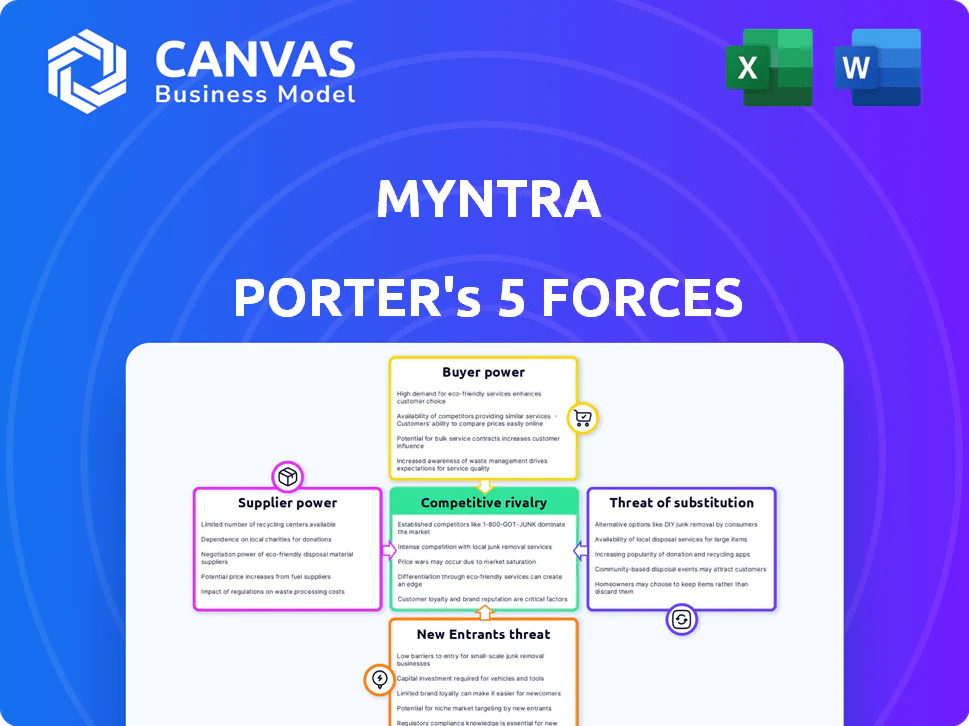
Myntra faces intense rivalry from Flipkart and Amazon, moderate supplier leverage from brands, strong buyer power due to price-sensitive consumers, rising threats from niche D2C players, and substitution risks from offline retail and resale; this snapshot highlights where strategic focus matters. Unlock the full Porter's Five Forces Analysis to explore detailed force ratings, visuals, and actionable recommendations.
Suppliers Bargaining Power

Fragmented supplier ecosystem
The vast majority of Myntra's vendor base are small-to-medium apparel manufacturers with limited leverage; over 85% of active sellers in 2025 had annual revenues under INR 50 million, so they act as price-takers.
Suppliers depend on Myntra's ~70 million monthly users and 2025 GMV of ~INR 42,000 crore for national reach, reducing their bargaining power.
By 2026, growth of third-party manufacturing hubs-estimated 15% year-on-year expansion since 2023-further fragments supply and weakens any single vendor's negotiating strength.
Dominance of global anchor brands
While small vendors have negligible leverage, global anchor brands like Nike, H&M, and Adidas-each with 2025 global brand values in the $6-40B range-command stronger terms, pushing for lower commissions as their presence drives Myntra's premium positioning; Myntra reported brand-led GMV share near 28% in FY2025, giving these partners bargaining clout, but Myntra offsets pressure by selling exclusive data analytics and targeted marketing (reducing CAC by ~15%) that few platforms match.

Expansion of high-margin private labels
Myntra's private labels-Roadster, HRX, Mast & Harbour-generated about ₹7,200 crore (~$860M) in FY2025, lifting private-label share to ~32% of GMV; by acting as supplier, Myntra cuts reliance on external vendors and limits margin pressure from supplier bargaining.
Backward integration lets Myntra own design, manufacturing, and distribution, capturing higher gross margins (private labels ~48% vs third-party ~28% in FY2025) and enabling strategic price undercutting to squeeze third-party sellers' margins.

Technological and logistical lock-in
Suppliers are deeply tied into Myntra's proprietary inventory and trend-forecasting systems, raising their switching costs; Myntra reported Fulfillment as a Service handled ~45% of seller SKUs in FY2025, making migration operationally hard.
By offering end-to-end fulfillment and analytics, Myntra causes supply disruption risk if suppliers move-estimated supplier churn cost >₹12-18 crore per large brand annually.
- 45% of seller SKUs on Myntra fulfillment (FY2025)
- High rebuild cost: integrations + forecasting models
- Estimated churn cost ₹12-18 crore/large brand/year
Shift toward sustainable sourcing mandates
Myntra enforces 2026 ESG-aligned sustainability and labor standards across its 6,500+ vendor base, raising supplier compliance costs by an estimated 4-7% and enabling Myntra to delist noncompliant vendors.
This regulatory-driven shift boosts Myntra's bargaining power: suppliers must meet Myntra's criteria to access its ~35% organized digital fashion market share, or risk losing ~$120K average annual revenue per delisted vendor.
- Myntra vendors: 6,500+
- Estimated supplier compliance cost increase: 4-7%
- Myntra organized digital market share: ~35%
- Avg revenue at risk per delisted vendor: ~$120,000/year
Myntra: Dominant scale-INR42,000cr GMV, 70M users, private labels & FaaS tighten supplier power
Suppliers hold low overall power: 85% had
| Metric | 2025 Value |
|---|---|
| GMV | INR42,000 crore |
| Monthly users | 70M |
| Private-label GMV | INR7,200 crore (32%) |
| Fulfillment SKU share | 45% |
What is included in the product
 Detailed Word Document
Tailored Porter's Five Forces analysis for Myntra that pinpoints competitive intensity, buyer and supplier leverage, barriers to entry, and substitution risks-highlighting emerging disruptors and strategic levers to defend market share.

 Customizable Excel Spreadsheet
A concise Porter's Five Forces snapshot for Myntra-visualize competitive pressure instantly and drop the chart directly into investor decks for faster, clearer decisions.
Customers Bargaining Power

Negligible switching costs for fashionistas
Negligible switching costs mean shoppers jump between Myntra, Ajio, and Amazon Fashion in seconds; in FY2025 Indian fashion GMV saw Myntra at ₹28,400 crore vs Amazon Fashion ₹32,100 crore and Ajio ₹9,300 crore, so price, delivery, and return terms drive choice.
High price sensitivity in mid-tier segments
High price sensitivity in mid-tier segments drives shoppers to wait for events like Myntra's End of Reason Sale; in FY2025 Indian online fashion GMV hit about $13.5B and Myntra's parent, Flipkart, reported ~₹1.2 trillion GMV, so sale-driven spikes concentrate demand and amplify buyer leverage.

Influence of social commerce and reviews
Modern shoppers use user-generated content and peer reviews heavily; 79% of Indian online shoppers consult reviews before buying, so negative social trends on quality or delivery can cut Myntra's app traffic and sales quickly.
Myntra spends on influencer-led live commerce-reported INR 250 crore in 2025 marketing/engagement initiatives-to counteract negatives, yet consumer feedback still drives brand success and pricing power.

Demand for seamless omnichannel experiences
By 2026 customers expect unified online-offline journeys-66% of Indian shoppers say seamless returns and in-store trials influence platform choice-pressuring Myntra to fund stores, pick-up points, and AR virtual-try-on (estimated ₹250-400 crore capex through 2025-26 for omnichannel tech).
If Myntra lags on AR or physical touchpoints, churn rises; competitors with better immersion capture wallet share-ZALORA/Flipkart/Others report 12-18% higher repeat rates when omnichannel is strong.
- 66% shoppers prefer seamless returns/trials
- ₹250-400 crore estimated omnichannel capex by 2025-26
- 12-18% higher repeat rates for omnichannel leaders
The rise of the Myntra Insider ecosystem
Myntra has grown its Insider loyalty into a soft lock-in: 2025 Insider members exceed 25 million, getting early sale access, exclusive drops, and tiered cashbacks up to 10%, which reduces price sensitivity and shifts bargaining power toward Myntra.
Rivals like Ajio and Amazon Fashion counter with targeted offers; Myntra's retention hinge rests on Insider conversion (estimated 18% of active shoppers) and Insider-driven GMV share near 22% in FY2025.
- 25M+ Insider members (2025)
- Tiered cashback up to 10%
- Insider ~18% of active shoppers
- Insider-driven GMV ~22% FY2025
Myntra: High Buyer Power Despite 25M Insiders and ₹28,400cr GMV, Omnichannel Gaps Persist
Customers hold strong bargaining power: low switching costs, price sensitivity, and review-driven decisions; Myntra FY2025 metrics-GMV ₹28,400 crore, Insider 25M+, Insider GMV share 22%-moderate power via loyalty and promotions but omnichannel gaps (₹250-400 crore capex) keep buyer leverage high.
| Metric | FY2025 |
|---|---|
| Myntra GMV | ₹28,400 crore |
| Insider members | 25M+ |
| Insider GMV share | 22% |
| Omnichannel capex | ₹250-400 crore |
Preview Before You Purchase
Myntra Porter's Five Forces Analysis
This preview shows the exact Porter's Five Forces analysis of Myntra you'll receive-no placeholders or mockups-fully formatted and ready for immediate download after purchase.

Original: $10.00
-65%$10.00
$3.50MYNTRA PORTER'S FIVE FORCES TEMPLATE RESEARCH
From Overview to Strategy Blueprint
Myntra faces intense rivalry from Flipkart and Amazon, moderate supplier leverage from brands, strong buyer power due to price-sensitive consumers, rising threats from niche D2C players, and substitution risks from offline retail and resale; this snapshot highlights where strategic focus matters. Unlock the full Porter's Five Forces Analysis to explore detailed force ratings, visuals, and actionable recommendations.
Suppliers Bargaining Power
Fragmented supplier ecosystem
The vast majority of Myntra's vendor base are small-to-medium apparel manufacturers with limited leverage; over 85% of active sellers in 2025 had annual revenues under INR 50 million, so they act as price-takers.
Suppliers depend on Myntra's ~70 million monthly users and 2025 GMV of ~INR 42,000 crore for national reach, reducing their bargaining power.
By 2026, growth of third-party manufacturing hubs-estimated 15% year-on-year expansion since 2023-further fragments supply and weakens any single vendor's negotiating strength.
Dominance of global anchor brands
While small vendors have negligible leverage, global anchor brands like Nike, H&M, and Adidas-each with 2025 global brand values in the $6-40B range-command stronger terms, pushing for lower commissions as their presence drives Myntra's premium positioning; Myntra reported brand-led GMV share near 28% in FY2025, giving these partners bargaining clout, but Myntra offsets pressure by selling exclusive data analytics and targeted marketing (reducing CAC by ~15%) that few platforms match.
Expansion of high-margin private labels
Myntra's private labels-Roadster, HRX, Mast & Harbour-generated about ₹7,200 crore (~$860M) in FY2025, lifting private-label share to ~32% of GMV; by acting as supplier, Myntra cuts reliance on external vendors and limits margin pressure from supplier bargaining.
Backward integration lets Myntra own design, manufacturing, and distribution, capturing higher gross margins (private labels ~48% vs third-party ~28% in FY2025) and enabling strategic price undercutting to squeeze third-party sellers' margins.
Technological and logistical lock-in
Suppliers are deeply tied into Myntra's proprietary inventory and trend-forecasting systems, raising their switching costs; Myntra reported Fulfillment as a Service handled ~45% of seller SKUs in FY2025, making migration operationally hard.
By offering end-to-end fulfillment and analytics, Myntra causes supply disruption risk if suppliers move-estimated supplier churn cost >₹12-18 crore per large brand annually.
- 45% of seller SKUs on Myntra fulfillment (FY2025)
- High rebuild cost: integrations + forecasting models
- Estimated churn cost ₹12-18 crore/large brand/year
Shift toward sustainable sourcing mandates
Myntra enforces 2026 ESG-aligned sustainability and labor standards across its 6,500+ vendor base, raising supplier compliance costs by an estimated 4-7% and enabling Myntra to delist noncompliant vendors.
This regulatory-driven shift boosts Myntra's bargaining power: suppliers must meet Myntra's criteria to access its ~35% organized digital fashion market share, or risk losing ~$120K average annual revenue per delisted vendor.
- Myntra vendors: 6,500+
- Estimated supplier compliance cost increase: 4-7%
- Myntra organized digital market share: ~35%
- Avg revenue at risk per delisted vendor: ~$120,000/year
Myntra: Dominant scale-INR42,000cr GMV, 70M users, private labels & FaaS tighten supplier power
Suppliers hold low overall power: 85% had
| Metric | 2025 Value |
|---|---|
| GMV | INR42,000 crore |
| Monthly users | 70M |
| Private-label GMV | INR7,200 crore (32%) |
| Fulfillment SKU share | 45% |
What is included in the product
Detailed Word Document
Tailored Porter's Five Forces analysis for Myntra that pinpoints competitive intensity, buyer and supplier leverage, barriers to entry, and substitution risks-highlighting emerging disruptors and strategic levers to defend market share.
Customizable Excel Spreadsheet
A concise Porter's Five Forces snapshot for Myntra-visualize competitive pressure instantly and drop the chart directly into investor decks for faster, clearer decisions.
Customers Bargaining Power
Negligible switching costs for fashionistas
Negligible switching costs mean shoppers jump between Myntra, Ajio, and Amazon Fashion in seconds; in FY2025 Indian fashion GMV saw Myntra at ₹28,400 crore vs Amazon Fashion ₹32,100 crore and Ajio ₹9,300 crore, so price, delivery, and return terms drive choice.
High price sensitivity in mid-tier segments
High price sensitivity in mid-tier segments drives shoppers to wait for events like Myntra's End of Reason Sale; in FY2025 Indian online fashion GMV hit about $13.5B and Myntra's parent, Flipkart, reported ~₹1.2 trillion GMV, so sale-driven spikes concentrate demand and amplify buyer leverage.
Influence of social commerce and reviews
Modern shoppers use user-generated content and peer reviews heavily; 79% of Indian online shoppers consult reviews before buying, so negative social trends on quality or delivery can cut Myntra's app traffic and sales quickly.
Myntra spends on influencer-led live commerce-reported INR 250 crore in 2025 marketing/engagement initiatives-to counteract negatives, yet consumer feedback still drives brand success and pricing power.
Demand for seamless omnichannel experiences
By 2026 customers expect unified online-offline journeys-66% of Indian shoppers say seamless returns and in-store trials influence platform choice-pressuring Myntra to fund stores, pick-up points, and AR virtual-try-on (estimated ₹250-400 crore capex through 2025-26 for omnichannel tech).
If Myntra lags on AR or physical touchpoints, churn rises; competitors with better immersion capture wallet share-ZALORA/Flipkart/Others report 12-18% higher repeat rates when omnichannel is strong.
- 66% shoppers prefer seamless returns/trials
- ₹250-400 crore estimated omnichannel capex by 2025-26
- 12-18% higher repeat rates for omnichannel leaders
The rise of the Myntra Insider ecosystem
Myntra has grown its Insider loyalty into a soft lock-in: 2025 Insider members exceed 25 million, getting early sale access, exclusive drops, and tiered cashbacks up to 10%, which reduces price sensitivity and shifts bargaining power toward Myntra.
Rivals like Ajio and Amazon Fashion counter with targeted offers; Myntra's retention hinge rests on Insider conversion (estimated 18% of active shoppers) and Insider-driven GMV share near 22% in FY2025.
- 25M+ Insider members (2025)
- Tiered cashback up to 10%
- Insider ~18% of active shoppers
- Insider-driven GMV ~22% FY2025
Myntra: High Buyer Power Despite 25M Insiders and ₹28,400cr GMV, Omnichannel Gaps Persist
Customers hold strong bargaining power: low switching costs, price sensitivity, and review-driven decisions; Myntra FY2025 metrics-GMV ₹28,400 crore, Insider 25M+, Insider GMV share 22%-moderate power via loyalty and promotions but omnichannel gaps (₹250-400 crore capex) keep buyer leverage high.
| Metric | FY2025 |
|---|---|
| Myntra GMV | ₹28,400 crore |
| Insider members | 25M+ |
| Insider GMV share | 22% |
| Omnichannel capex | ₹250-400 crore |
Preview Before You Purchase
Myntra Porter's Five Forces Analysis
This preview shows the exact Porter's Five Forces analysis of Myntra you'll receive-no placeholders or mockups-fully formatted and ready for immediate download after purchase.
Product Information
Product Information
Shipping & Returns
Shipping & Returns
Description
From Overview to Strategy Blueprint
Myntra faces intense rivalry from Flipkart and Amazon, moderate supplier leverage from brands, strong buyer power due to price-sensitive consumers, rising threats from niche D2C players, and substitution risks from offline retail and resale; this snapshot highlights where strategic focus matters. Unlock the full Porter's Five Forces Analysis to explore detailed force ratings, visuals, and actionable recommendations.
Suppliers Bargaining Power
Fragmented supplier ecosystem
The vast majority of Myntra's vendor base are small-to-medium apparel manufacturers with limited leverage; over 85% of active sellers in 2025 had annual revenues under INR 50 million, so they act as price-takers.
Suppliers depend on Myntra's ~70 million monthly users and 2025 GMV of ~INR 42,000 crore for national reach, reducing their bargaining power.
By 2026, growth of third-party manufacturing hubs-estimated 15% year-on-year expansion since 2023-further fragments supply and weakens any single vendor's negotiating strength.
Dominance of global anchor brands
While small vendors have negligible leverage, global anchor brands like Nike, H&M, and Adidas-each with 2025 global brand values in the $6-40B range-command stronger terms, pushing for lower commissions as their presence drives Myntra's premium positioning; Myntra reported brand-led GMV share near 28% in FY2025, giving these partners bargaining clout, but Myntra offsets pressure by selling exclusive data analytics and targeted marketing (reducing CAC by ~15%) that few platforms match.
Expansion of high-margin private labels
Myntra's private labels-Roadster, HRX, Mast & Harbour-generated about ₹7,200 crore (~$860M) in FY2025, lifting private-label share to ~32% of GMV; by acting as supplier, Myntra cuts reliance on external vendors and limits margin pressure from supplier bargaining.
Backward integration lets Myntra own design, manufacturing, and distribution, capturing higher gross margins (private labels ~48% vs third-party ~28% in FY2025) and enabling strategic price undercutting to squeeze third-party sellers' margins.
Technological and logistical lock-in
Suppliers are deeply tied into Myntra's proprietary inventory and trend-forecasting systems, raising their switching costs; Myntra reported Fulfillment as a Service handled ~45% of seller SKUs in FY2025, making migration operationally hard.
By offering end-to-end fulfillment and analytics, Myntra causes supply disruption risk if suppliers move-estimated supplier churn cost >₹12-18 crore per large brand annually.
- 45% of seller SKUs on Myntra fulfillment (FY2025)
- High rebuild cost: integrations + forecasting models
- Estimated churn cost ₹12-18 crore/large brand/year
Shift toward sustainable sourcing mandates
Myntra enforces 2026 ESG-aligned sustainability and labor standards across its 6,500+ vendor base, raising supplier compliance costs by an estimated 4-7% and enabling Myntra to delist noncompliant vendors.
This regulatory-driven shift boosts Myntra's bargaining power: suppliers must meet Myntra's criteria to access its ~35% organized digital fashion market share, or risk losing ~$120K average annual revenue per delisted vendor.
- Myntra vendors: 6,500+
- Estimated supplier compliance cost increase: 4-7%
- Myntra organized digital market share: ~35%
- Avg revenue at risk per delisted vendor: ~$120,000/year
Myntra: Dominant scale-INR42,000cr GMV, 70M users, private labels & FaaS tighten supplier power
Suppliers hold low overall power: 85% had
| Metric | 2025 Value |
|---|---|
| GMV | INR42,000 crore |
| Monthly users | 70M |
| Private-label GMV | INR7,200 crore (32%) |
| Fulfillment SKU share | 45% |
What is included in the product
Detailed Word Document
Tailored Porter's Five Forces analysis for Myntra that pinpoints competitive intensity, buyer and supplier leverage, barriers to entry, and substitution risks-highlighting emerging disruptors and strategic levers to defend market share.
Customizable Excel Spreadsheet
A concise Porter's Five Forces snapshot for Myntra-visualize competitive pressure instantly and drop the chart directly into investor decks for faster, clearer decisions.
Customers Bargaining Power
Negligible switching costs for fashionistas
Negligible switching costs mean shoppers jump between Myntra, Ajio, and Amazon Fashion in seconds; in FY2025 Indian fashion GMV saw Myntra at ₹28,400 crore vs Amazon Fashion ₹32,100 crore and Ajio ₹9,300 crore, so price, delivery, and return terms drive choice.
High price sensitivity in mid-tier segments
High price sensitivity in mid-tier segments drives shoppers to wait for events like Myntra's End of Reason Sale; in FY2025 Indian online fashion GMV hit about $13.5B and Myntra's parent, Flipkart, reported ~₹1.2 trillion GMV, so sale-driven spikes concentrate demand and amplify buyer leverage.
Influence of social commerce and reviews
Modern shoppers use user-generated content and peer reviews heavily; 79% of Indian online shoppers consult reviews before buying, so negative social trends on quality or delivery can cut Myntra's app traffic and sales quickly.
Myntra spends on influencer-led live commerce-reported INR 250 crore in 2025 marketing/engagement initiatives-to counteract negatives, yet consumer feedback still drives brand success and pricing power.
Demand for seamless omnichannel experiences
By 2026 customers expect unified online-offline journeys-66% of Indian shoppers say seamless returns and in-store trials influence platform choice-pressuring Myntra to fund stores, pick-up points, and AR virtual-try-on (estimated ₹250-400 crore capex through 2025-26 for omnichannel tech).
If Myntra lags on AR or physical touchpoints, churn rises; competitors with better immersion capture wallet share-ZALORA/Flipkart/Others report 12-18% higher repeat rates when omnichannel is strong.
- 66% shoppers prefer seamless returns/trials
- ₹250-400 crore estimated omnichannel capex by 2025-26
- 12-18% higher repeat rates for omnichannel leaders
The rise of the Myntra Insider ecosystem
Myntra has grown its Insider loyalty into a soft lock-in: 2025 Insider members exceed 25 million, getting early sale access, exclusive drops, and tiered cashbacks up to 10%, which reduces price sensitivity and shifts bargaining power toward Myntra.
Rivals like Ajio and Amazon Fashion counter with targeted offers; Myntra's retention hinge rests on Insider conversion (estimated 18% of active shoppers) and Insider-driven GMV share near 22% in FY2025.
- 25M+ Insider members (2025)
- Tiered cashback up to 10%
- Insider ~18% of active shoppers
- Insider-driven GMV ~22% FY2025
Myntra: High Buyer Power Despite 25M Insiders and ₹28,400cr GMV, Omnichannel Gaps Persist
Customers hold strong bargaining power: low switching costs, price sensitivity, and review-driven decisions; Myntra FY2025 metrics-GMV ₹28,400 crore, Insider 25M+, Insider GMV share 22%-moderate power via loyalty and promotions but omnichannel gaps (₹250-400 crore capex) keep buyer leverage high.
| Metric | FY2025 |
|---|---|
| Myntra GMV | ₹28,400 crore |
| Insider members | 25M+ |
| Insider GMV share | 22% |
| Omnichannel capex | ₹250-400 crore |
Preview Before You Purchase
Myntra Porter's Five Forces Analysis
This preview shows the exact Porter's Five Forces analysis of Myntra you'll receive-no placeholders or mockups-fully formatted and ready for immediate download after purchase.











