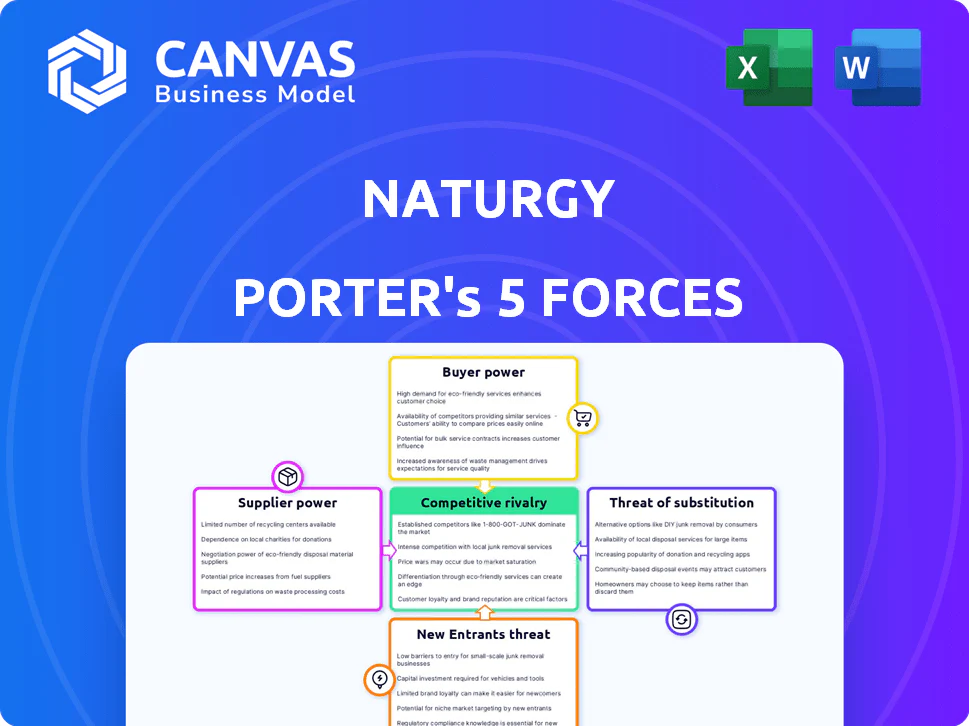
NATURGY PORTER'S FIVE FORCES TEMPLATE RESEARCH
What is included in the product
 Detailed Word Document
Analyzes Naturgy's competitive environment, including rivalry, suppliers, buyers, threats, and entry barriers.

 Customizable Excel Spreadsheet
Quickly identify vulnerabilities within the market, improving negotiation power.
Same Document Delivered
Naturgy Porter's Five Forces Analysis
This preview showcases the full Naturgy Porter's Five Forces analysis. The document displayed is identical to the one you'll download post-purchase. It includes a complete assessment of competitive forces. You'll receive a comprehensive, ready-to-use analysis file.

Porter's Five Forces Analysis Template

Elevate Your Analysis with the Complete Porter's Five Forces Analysis
Naturgy faces competition from substitute energy sources, impacting its pricing power. Bargaining power of suppliers, particularly for natural gas, is also a key factor. The threat of new entrants is moderate, due to the high capital investment and regulation in the energy sector. Buyer power varies by segment, with industrial clients holding more influence than residential customers. Competitive rivalry is intense, shaped by existing players and market dynamics.
Ready to move beyond the basics? Get a full strategic breakdown of Naturgy’s market position, competitive intensity, and external threats—all in one powerful analysis.
Suppliers Bargaining Power

Dependence on natural gas sources
Naturgy's reliance on natural gas makes it vulnerable to supplier bargaining power. Key suppliers like Sonatrach influence procurement prices. In 2024, fluctuations in natural gas prices directly affected Naturgy's margins. Securing long-term supply agreements is vital for mitigating supplier power and ensuring profitability.
Cost of raw materials and energy generation
Naturgy's operational expenses are significantly influenced by the cost of natural gas and other fuels. The bargaining power of suppliers is evident in their ability to control supply and pricing, directly affecting Naturgy's profitability. For instance, in 2024, gas and electricity prices declined, impacting the company's financial performance. This power is amplified by market dynamics and the suppliers' control over essential resources.

Technology and equipment providers
Naturgy's substantial investments in areas like distribution networks, renewable energy, and digital transformation create a strong reliance on technology and equipment suppliers. The specialized nature and limited availability of certain technologies can significantly enhance suppliers' bargaining power. For example, the cost of solar panel installations, a key component in renewable projects, varied considerably in 2024, with prices ranging from $0.70 to $1.20 per watt depending on the technology and supplier. This variation highlights the influence suppliers can exert.

Labor force and specialized skills
Naturgy's labor costs are affected by the bargaining power of suppliers, which includes the labor force. A skilled workforce is crucial for energy infrastructure and project development, especially in renewables and digital network management. The availability of specialized labor influences costs and timelines. In 2024, the energy sector faced challenges in securing skilled workers, impacting project efficiency and costs.
- High demand for specialized skills, particularly in renewable energy and digital network management, increases labor costs.
- Shortages in skilled labor can lead to project delays and increased expenses.
- Competitive labor markets can force companies to offer higher wages and benefits.
- The presence of strong unions can further enhance the bargaining power of the labor force.
Regulatory and environmental compliance inputs
Naturgy faces supplier power from those providing services and materials for regulatory and environmental compliance. Since compliance is mandatory, these suppliers hold some leverage. Naturgy must depend on reliable, certified suppliers to meet these demands. In 2024, environmental compliance costs in the energy sector rose by approximately 7%. This increases the bargaining power of compliant suppliers.
- Compliance costs: Increased by 7% in 2024.
- Supplier certification: Mandatory for many materials and services.
- Regulation impact: Stringent rules drive up supplier costs.
- Reliability: Key factor in supplier selection.
Naturgy's 2024 Profitability: Gas Prices & Supplier Power
Naturgy's profitability is directly impacted by supplier bargaining power, especially for natural gas. In 2024, natural gas prices fluctuated, affecting margins. Securing long-term agreements is vital to mitigate supplier influence.
| Factor | Impact | 2024 Data |
|---|---|---|
| Gas Prices | Direct impact on margins | Fluctuated significantly |
| Compliance Costs | Increased supplier power | Rose by ~7% |
| Solar Panel Costs | Varied by supplier | $0.70-$1.20/watt |
Customers Bargaining Power

Price sensitivity of customers
Naturgy's customers, spanning residential and industrial sectors, exhibit price sensitivity towards energy costs. The liberalized energy market in 2024 allows customers to switch providers based on pricing strategies and service quality. For instance, residential customers in Spain, representing a significant portion of Naturgy's client base, can easily compare tariffs. In 2024, the company's focus has been on offering competitive rates to retain and attract customers. This is vital because customer churn can directly impact revenue.
Availability of alternatives
The bargaining power of customers increases with the availability of alternatives. Customers can switch to solar panels or other renewable sources, reducing reliance on Naturgy. In 2024, solar installations grew by 30% in some regions, showing the rise of alternatives. This trend empowers customers, giving them more choice and leverage.

Customer concentration
Large industrial customers, like those in manufacturing, often wield significant bargaining power. In 2024, these customers, representing a substantial portion of Naturgy's revenue, can negotiate better terms. They may switch to cheaper suppliers. Energy-intensive industries, such as chemicals, have the most leverage.

Regulatory frameworks protecting consumers
Regulatory frameworks significantly influence Naturgy's customer bargaining power. Energy sector regulations often protect consumers, impacting pricing. For instance, price controls in regulated activities limit Naturgy's flexibility. These rules empower customers, affecting Naturgy's financial strategies.
- Price controls can cap profit margins, as seen in certain EU markets.
- Provisions for vulnerable customers may mandate discounts or payment plans.
- Regulatory bodies can investigate and penalize unfair pricing practices.
- Consumer protection laws enhance customer rights in contract disputes.
Information availability and ease of switching
Customers' bargaining power in the energy sector is rising, thanks to readily available information and the ease of switching providers. This allows consumers to compare deals and make informed choices, putting pressure on companies like Naturgy. In 2024, the average switching time for energy providers in Spain, where Naturgy operates, was reduced to approximately 10 days. This trend is supported by a 15% increase in online energy comparison tool usage in the last year, indicating greater customer awareness and engagement.
- Reduced Switching Times: Average switching time in Spain is approximately 10 days.
- Increased Online Tool Usage: 15% increase in online energy comparison tool usage in the last year.
- Enhanced Customer Awareness: Customers are more informed and engaged.
- Greater Bargaining Power: Customers can negotiate better deals.
Customer Power: Naturgy's Challenge
Customers' bargaining power significantly impacts Naturgy, fueled by market liberalization and readily available information. Increased switching rates and the growth of renewable energy options, like the 30% rise in solar installations, enhance customer leverage. Large industrial clients further strengthen their position by negotiating better terms, impacting Naturgy's revenue streams.
| Factor | Impact | Data (2024) |
|---|---|---|
| Switching Time | Increased Customer Mobility | ~10 days in Spain |
| Online Comparison | Enhanced Awareness | 15% growth in usage |
| Renewable Adoption | Alternative Energy | 30% solar growth |
Rivalry Among Competitors

Number and diversity of competitors
Naturgy faces intense competition due to numerous rivals. The energy sector includes major global firms and emerging renewable energy companies. This diversity increases rivalry, impacting pricing and market share. In 2024, the renewables sector saw significant growth, intensifying the competition.
Market growth rate
The energy market's growth rate significantly affects competitive rivalry. In 2024, the global energy market is experiencing moderate growth, with renewable energy sectors showing higher expansion rates than traditional fossil fuels. This dynamic influences how companies like Naturgy strategize. High growth can ease rivalry, as firms focus on expansion, while low growth intensifies competition for market share.

Product and service differentiation
Naturgy faces competition in a market where natural gas and electricity are similar. Companies differentiate through pricing, customer service, and bundled services. In 2024, the energy sector saw increased focus on sustainability, influencing brand perception. For example, customer satisfaction scores for energy providers vary significantly, impacting competitive positioning.

Exit barriers
High exit barriers significantly influence competitive rivalry within the energy sector. Substantial infrastructure investments and stringent regulatory obligations make it difficult for companies like Naturgy to leave the market, even during downturns. This situation intensifies competition as underperforming entities remain active, vying for market share. For example, in 2024, the European Union's energy market saw over €100 billion invested in infrastructure, demonstrating the capital-intensive nature of the industry.
- High capital expenditure requirements make it difficult to exit.
- Regulatory hurdles and compliance costs add to exit barriers.
- Long-term contracts and commitments can lock companies in.
Regulatory and political landscape
The regulatory and political landscape profoundly shapes Naturgy's competitive dynamics. Changes in energy policy, regulations, and government support for various energy sources significantly influence the competitive environment. For example, policies favoring renewable energy boost competition within that sector. These shifts can impact investment decisions and market share. Political stability and regulatory certainty are crucial.
- In 2024, Spain's government continued to support renewable energy, allocating significant funds.
- Regulatory changes in gas pricing and emissions standards also affected Naturgy.
- Political instability or policy U-turns pose risks to the company's investments.
- The EU's Green Deal and related regulations further influence Naturgy's strategic decisions.
Energy Sector Showdown: Naturgy's Competitive Arena
Competitive rivalry for Naturgy is high due to many competitors in the energy sector. Market growth and product similarity also intensify competition, pressuring pricing. High exit barriers and regulatory impacts further shape the competitive landscape.
| Factor | Impact | Example (2024 Data) |
|---|---|---|
| Competitors | High rivalry | Renewables sector grew, increasing competition. |
| Market Growth | Moderate growth | Global energy market: moderate growth; renewables: higher. |
| Exit Barriers | Intensified competition | EU invested over €100B in infrastructure. |
Original: $10.00
-65%$10.00
$3.50NATURGY PORTER'S FIVE FORCES TEMPLATE RESEARCH
What is included in the product
Detailed Word Document
Analyzes Naturgy's competitive environment, including rivalry, suppliers, buyers, threats, and entry barriers.
Customizable Excel Spreadsheet
Quickly identify vulnerabilities within the market, improving negotiation power.
Same Document Delivered
Naturgy Porter's Five Forces Analysis
This preview showcases the full Naturgy Porter's Five Forces analysis. The document displayed is identical to the one you'll download post-purchase. It includes a complete assessment of competitive forces. You'll receive a comprehensive, ready-to-use analysis file.
Porter's Five Forces Analysis Template
Elevate Your Analysis with the Complete Porter's Five Forces Analysis
Naturgy faces competition from substitute energy sources, impacting its pricing power. Bargaining power of suppliers, particularly for natural gas, is also a key factor. The threat of new entrants is moderate, due to the high capital investment and regulation in the energy sector. Buyer power varies by segment, with industrial clients holding more influence than residential customers. Competitive rivalry is intense, shaped by existing players and market dynamics.
Ready to move beyond the basics? Get a full strategic breakdown of Naturgy’s market position, competitive intensity, and external threats—all in one powerful analysis.
Suppliers Bargaining Power
Dependence on natural gas sources
Naturgy's reliance on natural gas makes it vulnerable to supplier bargaining power. Key suppliers like Sonatrach influence procurement prices. In 2024, fluctuations in natural gas prices directly affected Naturgy's margins. Securing long-term supply agreements is vital for mitigating supplier power and ensuring profitability.
Cost of raw materials and energy generation
Naturgy's operational expenses are significantly influenced by the cost of natural gas and other fuels. The bargaining power of suppliers is evident in their ability to control supply and pricing, directly affecting Naturgy's profitability. For instance, in 2024, gas and electricity prices declined, impacting the company's financial performance. This power is amplified by market dynamics and the suppliers' control over essential resources.
Technology and equipment providers
Naturgy's substantial investments in areas like distribution networks, renewable energy, and digital transformation create a strong reliance on technology and equipment suppliers. The specialized nature and limited availability of certain technologies can significantly enhance suppliers' bargaining power. For example, the cost of solar panel installations, a key component in renewable projects, varied considerably in 2024, with prices ranging from $0.70 to $1.20 per watt depending on the technology and supplier. This variation highlights the influence suppliers can exert.
Labor force and specialized skills
Naturgy's labor costs are affected by the bargaining power of suppliers, which includes the labor force. A skilled workforce is crucial for energy infrastructure and project development, especially in renewables and digital network management. The availability of specialized labor influences costs and timelines. In 2024, the energy sector faced challenges in securing skilled workers, impacting project efficiency and costs.
- High demand for specialized skills, particularly in renewable energy and digital network management, increases labor costs.
- Shortages in skilled labor can lead to project delays and increased expenses.
- Competitive labor markets can force companies to offer higher wages and benefits.
- The presence of strong unions can further enhance the bargaining power of the labor force.
Regulatory and environmental compliance inputs
Naturgy faces supplier power from those providing services and materials for regulatory and environmental compliance. Since compliance is mandatory, these suppliers hold some leverage. Naturgy must depend on reliable, certified suppliers to meet these demands. In 2024, environmental compliance costs in the energy sector rose by approximately 7%. This increases the bargaining power of compliant suppliers.
- Compliance costs: Increased by 7% in 2024.
- Supplier certification: Mandatory for many materials and services.
- Regulation impact: Stringent rules drive up supplier costs.
- Reliability: Key factor in supplier selection.
Naturgy's 2024 Profitability: Gas Prices & Supplier Power
Naturgy's profitability is directly impacted by supplier bargaining power, especially for natural gas. In 2024, natural gas prices fluctuated, affecting margins. Securing long-term agreements is vital to mitigate supplier influence.
| Factor | Impact | 2024 Data |
|---|---|---|
| Gas Prices | Direct impact on margins | Fluctuated significantly |
| Compliance Costs | Increased supplier power | Rose by ~7% |
| Solar Panel Costs | Varied by supplier | $0.70-$1.20/watt |
Customers Bargaining Power
Price sensitivity of customers
Naturgy's customers, spanning residential and industrial sectors, exhibit price sensitivity towards energy costs. The liberalized energy market in 2024 allows customers to switch providers based on pricing strategies and service quality. For instance, residential customers in Spain, representing a significant portion of Naturgy's client base, can easily compare tariffs. In 2024, the company's focus has been on offering competitive rates to retain and attract customers. This is vital because customer churn can directly impact revenue.
Availability of alternatives
The bargaining power of customers increases with the availability of alternatives. Customers can switch to solar panels or other renewable sources, reducing reliance on Naturgy. In 2024, solar installations grew by 30% in some regions, showing the rise of alternatives. This trend empowers customers, giving them more choice and leverage.
Customer concentration
Large industrial customers, like those in manufacturing, often wield significant bargaining power. In 2024, these customers, representing a substantial portion of Naturgy's revenue, can negotiate better terms. They may switch to cheaper suppliers. Energy-intensive industries, such as chemicals, have the most leverage.
Regulatory frameworks protecting consumers
Regulatory frameworks significantly influence Naturgy's customer bargaining power. Energy sector regulations often protect consumers, impacting pricing. For instance, price controls in regulated activities limit Naturgy's flexibility. These rules empower customers, affecting Naturgy's financial strategies.
- Price controls can cap profit margins, as seen in certain EU markets.
- Provisions for vulnerable customers may mandate discounts or payment plans.
- Regulatory bodies can investigate and penalize unfair pricing practices.
- Consumer protection laws enhance customer rights in contract disputes.
Information availability and ease of switching
Customers' bargaining power in the energy sector is rising, thanks to readily available information and the ease of switching providers. This allows consumers to compare deals and make informed choices, putting pressure on companies like Naturgy. In 2024, the average switching time for energy providers in Spain, where Naturgy operates, was reduced to approximately 10 days. This trend is supported by a 15% increase in online energy comparison tool usage in the last year, indicating greater customer awareness and engagement.
- Reduced Switching Times: Average switching time in Spain is approximately 10 days.
- Increased Online Tool Usage: 15% increase in online energy comparison tool usage in the last year.
- Enhanced Customer Awareness: Customers are more informed and engaged.
- Greater Bargaining Power: Customers can negotiate better deals.
Customer Power: Naturgy's Challenge
Customers' bargaining power significantly impacts Naturgy, fueled by market liberalization and readily available information. Increased switching rates and the growth of renewable energy options, like the 30% rise in solar installations, enhance customer leverage. Large industrial clients further strengthen their position by negotiating better terms, impacting Naturgy's revenue streams.
| Factor | Impact | Data (2024) |
|---|---|---|
| Switching Time | Increased Customer Mobility | ~10 days in Spain |
| Online Comparison | Enhanced Awareness | 15% growth in usage |
| Renewable Adoption | Alternative Energy | 30% solar growth |
Rivalry Among Competitors
Number and diversity of competitors
Naturgy faces intense competition due to numerous rivals. The energy sector includes major global firms and emerging renewable energy companies. This diversity increases rivalry, impacting pricing and market share. In 2024, the renewables sector saw significant growth, intensifying the competition.
Market growth rate
The energy market's growth rate significantly affects competitive rivalry. In 2024, the global energy market is experiencing moderate growth, with renewable energy sectors showing higher expansion rates than traditional fossil fuels. This dynamic influences how companies like Naturgy strategize. High growth can ease rivalry, as firms focus on expansion, while low growth intensifies competition for market share.
Product and service differentiation
Naturgy faces competition in a market where natural gas and electricity are similar. Companies differentiate through pricing, customer service, and bundled services. In 2024, the energy sector saw increased focus on sustainability, influencing brand perception. For example, customer satisfaction scores for energy providers vary significantly, impacting competitive positioning.
Exit barriers
High exit barriers significantly influence competitive rivalry within the energy sector. Substantial infrastructure investments and stringent regulatory obligations make it difficult for companies like Naturgy to leave the market, even during downturns. This situation intensifies competition as underperforming entities remain active, vying for market share. For example, in 2024, the European Union's energy market saw over €100 billion invested in infrastructure, demonstrating the capital-intensive nature of the industry.
- High capital expenditure requirements make it difficult to exit.
- Regulatory hurdles and compliance costs add to exit barriers.
- Long-term contracts and commitments can lock companies in.
Regulatory and political landscape
The regulatory and political landscape profoundly shapes Naturgy's competitive dynamics. Changes in energy policy, regulations, and government support for various energy sources significantly influence the competitive environment. For example, policies favoring renewable energy boost competition within that sector. These shifts can impact investment decisions and market share. Political stability and regulatory certainty are crucial.
- In 2024, Spain's government continued to support renewable energy, allocating significant funds.
- Regulatory changes in gas pricing and emissions standards also affected Naturgy.
- Political instability or policy U-turns pose risks to the company's investments.
- The EU's Green Deal and related regulations further influence Naturgy's strategic decisions.
Energy Sector Showdown: Naturgy's Competitive Arena
Competitive rivalry for Naturgy is high due to many competitors in the energy sector. Market growth and product similarity also intensify competition, pressuring pricing. High exit barriers and regulatory impacts further shape the competitive landscape.
| Factor | Impact | Example (2024 Data) |
|---|---|---|
| Competitors | High rivalry | Renewables sector grew, increasing competition. |
| Market Growth | Moderate growth | Global energy market: moderate growth; renewables: higher. |
| Exit Barriers | Intensified competition | EU invested over €100B in infrastructure. |
Product Information
Product Information
Shipping & Returns
Shipping & Returns
Description
What is included in the product
Detailed Word Document
Analyzes Naturgy's competitive environment, including rivalry, suppliers, buyers, threats, and entry barriers.
Customizable Excel Spreadsheet
Quickly identify vulnerabilities within the market, improving negotiation power.
Same Document Delivered
Naturgy Porter's Five Forces Analysis
This preview showcases the full Naturgy Porter's Five Forces analysis. The document displayed is identical to the one you'll download post-purchase. It includes a complete assessment of competitive forces. You'll receive a comprehensive, ready-to-use analysis file.
Porter's Five Forces Analysis Template
Elevate Your Analysis with the Complete Porter's Five Forces Analysis
Naturgy faces competition from substitute energy sources, impacting its pricing power. Bargaining power of suppliers, particularly for natural gas, is also a key factor. The threat of new entrants is moderate, due to the high capital investment and regulation in the energy sector. Buyer power varies by segment, with industrial clients holding more influence than residential customers. Competitive rivalry is intense, shaped by existing players and market dynamics.
Ready to move beyond the basics? Get a full strategic breakdown of Naturgy’s market position, competitive intensity, and external threats—all in one powerful analysis.
Suppliers Bargaining Power
Dependence on natural gas sources
Naturgy's reliance on natural gas makes it vulnerable to supplier bargaining power. Key suppliers like Sonatrach influence procurement prices. In 2024, fluctuations in natural gas prices directly affected Naturgy's margins. Securing long-term supply agreements is vital for mitigating supplier power and ensuring profitability.
Cost of raw materials and energy generation
Naturgy's operational expenses are significantly influenced by the cost of natural gas and other fuels. The bargaining power of suppliers is evident in their ability to control supply and pricing, directly affecting Naturgy's profitability. For instance, in 2024, gas and electricity prices declined, impacting the company's financial performance. This power is amplified by market dynamics and the suppliers' control over essential resources.
Technology and equipment providers
Naturgy's substantial investments in areas like distribution networks, renewable energy, and digital transformation create a strong reliance on technology and equipment suppliers. The specialized nature and limited availability of certain technologies can significantly enhance suppliers' bargaining power. For example, the cost of solar panel installations, a key component in renewable projects, varied considerably in 2024, with prices ranging from $0.70 to $1.20 per watt depending on the technology and supplier. This variation highlights the influence suppliers can exert.
Labor force and specialized skills
Naturgy's labor costs are affected by the bargaining power of suppliers, which includes the labor force. A skilled workforce is crucial for energy infrastructure and project development, especially in renewables and digital network management. The availability of specialized labor influences costs and timelines. In 2024, the energy sector faced challenges in securing skilled workers, impacting project efficiency and costs.
- High demand for specialized skills, particularly in renewable energy and digital network management, increases labor costs.
- Shortages in skilled labor can lead to project delays and increased expenses.
- Competitive labor markets can force companies to offer higher wages and benefits.
- The presence of strong unions can further enhance the bargaining power of the labor force.
Regulatory and environmental compliance inputs
Naturgy faces supplier power from those providing services and materials for regulatory and environmental compliance. Since compliance is mandatory, these suppliers hold some leverage. Naturgy must depend on reliable, certified suppliers to meet these demands. In 2024, environmental compliance costs in the energy sector rose by approximately 7%. This increases the bargaining power of compliant suppliers.
- Compliance costs: Increased by 7% in 2024.
- Supplier certification: Mandatory for many materials and services.
- Regulation impact: Stringent rules drive up supplier costs.
- Reliability: Key factor in supplier selection.
Naturgy's 2024 Profitability: Gas Prices & Supplier Power
Naturgy's profitability is directly impacted by supplier bargaining power, especially for natural gas. In 2024, natural gas prices fluctuated, affecting margins. Securing long-term agreements is vital to mitigate supplier influence.
| Factor | Impact | 2024 Data |
|---|---|---|
| Gas Prices | Direct impact on margins | Fluctuated significantly |
| Compliance Costs | Increased supplier power | Rose by ~7% |
| Solar Panel Costs | Varied by supplier | $0.70-$1.20/watt |
Customers Bargaining Power
Price sensitivity of customers
Naturgy's customers, spanning residential and industrial sectors, exhibit price sensitivity towards energy costs. The liberalized energy market in 2024 allows customers to switch providers based on pricing strategies and service quality. For instance, residential customers in Spain, representing a significant portion of Naturgy's client base, can easily compare tariffs. In 2024, the company's focus has been on offering competitive rates to retain and attract customers. This is vital because customer churn can directly impact revenue.
Availability of alternatives
The bargaining power of customers increases with the availability of alternatives. Customers can switch to solar panels or other renewable sources, reducing reliance on Naturgy. In 2024, solar installations grew by 30% in some regions, showing the rise of alternatives. This trend empowers customers, giving them more choice and leverage.
Customer concentration
Large industrial customers, like those in manufacturing, often wield significant bargaining power. In 2024, these customers, representing a substantial portion of Naturgy's revenue, can negotiate better terms. They may switch to cheaper suppliers. Energy-intensive industries, such as chemicals, have the most leverage.
Regulatory frameworks protecting consumers
Regulatory frameworks significantly influence Naturgy's customer bargaining power. Energy sector regulations often protect consumers, impacting pricing. For instance, price controls in regulated activities limit Naturgy's flexibility. These rules empower customers, affecting Naturgy's financial strategies.
- Price controls can cap profit margins, as seen in certain EU markets.
- Provisions for vulnerable customers may mandate discounts or payment plans.
- Regulatory bodies can investigate and penalize unfair pricing practices.
- Consumer protection laws enhance customer rights in contract disputes.
Information availability and ease of switching
Customers' bargaining power in the energy sector is rising, thanks to readily available information and the ease of switching providers. This allows consumers to compare deals and make informed choices, putting pressure on companies like Naturgy. In 2024, the average switching time for energy providers in Spain, where Naturgy operates, was reduced to approximately 10 days. This trend is supported by a 15% increase in online energy comparison tool usage in the last year, indicating greater customer awareness and engagement.
- Reduced Switching Times: Average switching time in Spain is approximately 10 days.
- Increased Online Tool Usage: 15% increase in online energy comparison tool usage in the last year.
- Enhanced Customer Awareness: Customers are more informed and engaged.
- Greater Bargaining Power: Customers can negotiate better deals.
Customer Power: Naturgy's Challenge
Customers' bargaining power significantly impacts Naturgy, fueled by market liberalization and readily available information. Increased switching rates and the growth of renewable energy options, like the 30% rise in solar installations, enhance customer leverage. Large industrial clients further strengthen their position by negotiating better terms, impacting Naturgy's revenue streams.
| Factor | Impact | Data (2024) |
|---|---|---|
| Switching Time | Increased Customer Mobility | ~10 days in Spain |
| Online Comparison | Enhanced Awareness | 15% growth in usage |
| Renewable Adoption | Alternative Energy | 30% solar growth |
Rivalry Among Competitors
Number and diversity of competitors
Naturgy faces intense competition due to numerous rivals. The energy sector includes major global firms and emerging renewable energy companies. This diversity increases rivalry, impacting pricing and market share. In 2024, the renewables sector saw significant growth, intensifying the competition.
Market growth rate
The energy market's growth rate significantly affects competitive rivalry. In 2024, the global energy market is experiencing moderate growth, with renewable energy sectors showing higher expansion rates than traditional fossil fuels. This dynamic influences how companies like Naturgy strategize. High growth can ease rivalry, as firms focus on expansion, while low growth intensifies competition for market share.
Product and service differentiation
Naturgy faces competition in a market where natural gas and electricity are similar. Companies differentiate through pricing, customer service, and bundled services. In 2024, the energy sector saw increased focus on sustainability, influencing brand perception. For example, customer satisfaction scores for energy providers vary significantly, impacting competitive positioning.
Exit barriers
High exit barriers significantly influence competitive rivalry within the energy sector. Substantial infrastructure investments and stringent regulatory obligations make it difficult for companies like Naturgy to leave the market, even during downturns. This situation intensifies competition as underperforming entities remain active, vying for market share. For example, in 2024, the European Union's energy market saw over €100 billion invested in infrastructure, demonstrating the capital-intensive nature of the industry.
- High capital expenditure requirements make it difficult to exit.
- Regulatory hurdles and compliance costs add to exit barriers.
- Long-term contracts and commitments can lock companies in.
Regulatory and political landscape
The regulatory and political landscape profoundly shapes Naturgy's competitive dynamics. Changes in energy policy, regulations, and government support for various energy sources significantly influence the competitive environment. For example, policies favoring renewable energy boost competition within that sector. These shifts can impact investment decisions and market share. Political stability and regulatory certainty are crucial.
- In 2024, Spain's government continued to support renewable energy, allocating significant funds.
- Regulatory changes in gas pricing and emissions standards also affected Naturgy.
- Political instability or policy U-turns pose risks to the company's investments.
- The EU's Green Deal and related regulations further influence Naturgy's strategic decisions.
Energy Sector Showdown: Naturgy's Competitive Arena
Competitive rivalry for Naturgy is high due to many competitors in the energy sector. Market growth and product similarity also intensify competition, pressuring pricing. High exit barriers and regulatory impacts further shape the competitive landscape.
| Factor | Impact | Example (2024 Data) |
|---|---|---|
| Competitors | High rivalry | Renewables sector grew, increasing competition. |
| Market Growth | Moderate growth | Global energy market: moderate growth; renewables: higher. |
| Exit Barriers | Intensified competition | EU invested over €100B in infrastructure. |











