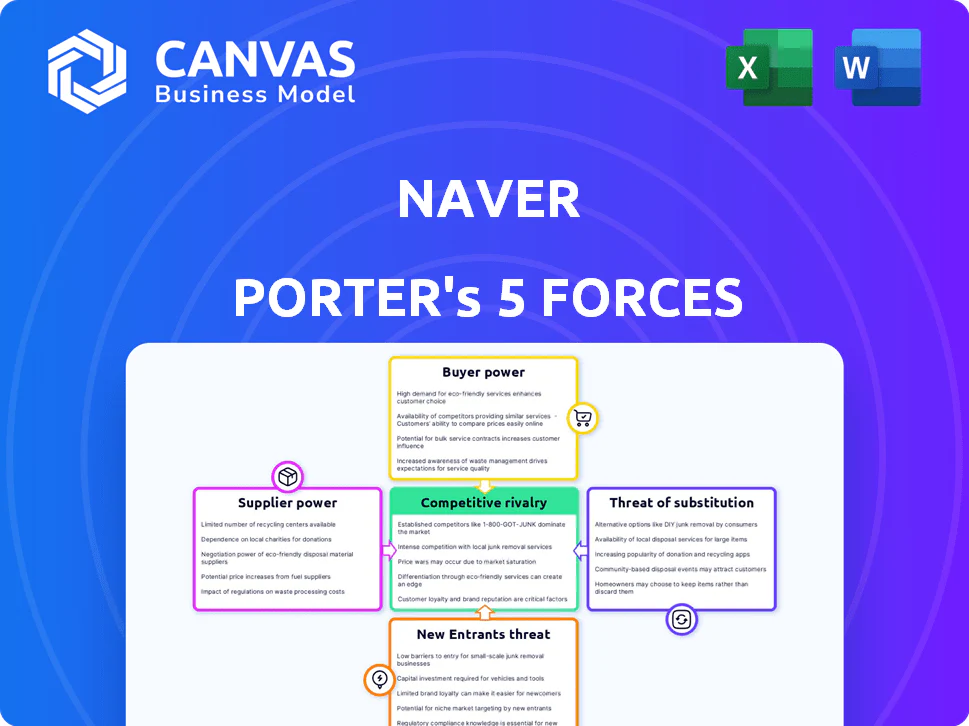
NAVER PORTER'S FIVE FORCES TEMPLATE RESEARCH

Go Beyond the Preview-Access the Full Strategic Report
Naver faces intense rivalry from global search and platform giants, moderate supplier leverage for ad tech and cloud services, and evolving buyer power as users shift between platforms; barriers to entry remain high but innovation and regional competitors keep threat of new entrants relevant. This brief snapshot only scratches the surface-unlock the full Porter's Five Forces Analysis to explore Naver's competitive dynamics, market pressures, and strategic advantages in detail.
Suppliers Bargaining Power

High Dependency on Specialized AI Talent
In 2026 the premium for generative AI talent peaked after 2025, when global top-tier AI hires averaged total comp of $600k-$1.2M; Naver faces direct competition from Google and OpenAI, eroding bargaining leverage.
Specialized engineers supply the core IP for HyperCLOVA X; Naver reported 2025 R&D spend of KRW 1.05 trillion, underscoring dependence on human capital.
Infrastructure and Semiconductor Bottlenecks
Naver relies on high-end GPUs from NVIDIA and foundry services for custom AI chips; in 2025 Naver reported capex on cloud/AI hardware of ₩620 billion, underscoring dependency on scarce suppliers.
Partnerships with Samsung Electronics reduce risk but the small pool of cutting‑edge silicon vendors keeps supplier power high; a 2024 TSMC/NVIDIA capacity crunch showed latency spikes and higher GPU spot prices.
Any semiconductor disruption directly constrains Naver's cloud and AI scaling-delays could slow AICC revenue growth (AI cloud) and inflate marginal costs for AI services.

Content Creator and IP Owner Leverage
The success of Naver depends on exclusive IP from top creators; Naver Webtoon accounted for roughly 30% of Naver's content engagement in 2025, so creators hold real leverage.
Global bidders like Netflix and Disney+ bid aggressively for Korean IP-Netflix spent $1.5B on Korean content in 2024-giving suppliers alternatives.
To retain talent, Naver raised creator revenue shares by ~5-8 percentage points in 2025 and increased advance payments, squeezing margins but protecting engagement.

Cloud Infrastructure Energy Costs
Naver, as a major data-center operator, is a large electricity buyer-2025 power spend estimated at KRW 850 billion (~USD 640m), making utilities a gatekeeper of costs and capacity.
Global fuel volatility in 2025-2026 pushed regional power tariffs up ~7% YoY, increasing Naver's energy cost volatility and supplier leverage.
Naver's carbon-neutral pledge restricts suppliers to renewables; in 2025 ~65% of its power came from certified green contracts, shrinking supplier pool and raising bargaining power.
- 2025 energy spend: KRW 850bn (~USD 640m)
- Tariff rise 2025-26: ~7% YoY
- Green sourcing 2025: ~65% of power
Strategic Partnerships in Global Logistics
Naver relies on third‑party logistics like CJ Logistics to deliver on Naver Guarantee; Naver holds equity stakes but cannot fully control costs.
Labor shortages and a 2025 Korea diesel price rise of ~12% directly pushed delivery unit costs up, transferring margin pressure to Naver's commerce arm.
Because logistics account for ~8-12% of e‑commerce order cost, supplier health is a material operational risk to Naver's ecosystem.
- Equity ties with CJ reduce but don't eliminate supplier leverage
- 2025 fuel +12% raises delivery expenses
- Labor shortages increase lead times and costs
- Logistics ~8-12% of order cost-material to margins
2025 Supplier Squeeze: AI Pay, Capex & Energy Drive Costs Up
Suppliers wield high power: talent (AI pay $600k-$1.2M in 2025), NVIDIA GPUs and foundries (capex ₩620bn in 2025), creators (Webtoon ~30% engagement), energy (2025 spend ₩850bn, 65% green, tariffs +7% YoY), logistics (fuel +12% 2025, 8-12% order cost).
| Item | 2025 |
|---|---|
| AI comp | $600k-$1.2M |
| R&D | ₩1.05T |
| Capex (AI) | ₩620B |
| Energy spend | ₩850B |
| Green power | 65% |
| Logistics cost | 8-12% |
What is included in the product
 Detailed Word Document
Tailored Porter's Five Forces analysis for Naver, uncovering competitive drivers, customer and supplier power, entry barriers, substitutes, and emerging threats to its market share and profitability.

 Customizable Excel Spreadsheet
A concise Porter's Five Forces snapshot for Naver that highlights competitive pressures and opportunity zones-ideal for rapid strategic decisions and investor briefings.
Customers Bargaining Power

Low Switching Costs for Search and Social
Users can pivot from Naver to Google or YouTube with one click, keeping individual bargaining power high; in 2025 Google Search held ~92% global desktop market share while Naver had ~3% in Korea, so small frictions matter.
The 2026 rise of AI answer engines (chat-based results now ~18% of global queries) makes loyalty fickle as users chase accuracy, raising churn risk.
Naver must keep innovating its UI-its 2025 R&D spend was ₩1.1 trillion-otherwise users shift to global rivals offering faster, more precise answers.
Price Sensitivity in E-commerce
Naver Shopping customers use real-time price comparison across Coupang and AliExpress, making price transparency high; 73% of Korean online shoppers cite price comparison as decisive (2024 KISA).
That transparency boosts buyer leverage to demand lowest prices and top service, pressuring margins-Naver reported 2025 commerce GMV of KRW 18.2 trillion, up 8%.
Naver counters with Naver Plus Membership, expanding members to 9.1 million in 2025, creating loyalty-led switching friction and higher CLV.

Merchant Leverage in the Smart Store Ecosystem
SMEs power Naver's Smart Store: ~90% of merchants, and multi-homing is rising as Coupang and TikTok Shop grew 18% and 45% seller counts in 2025; a commission hike would prompt significant switching of inventory and ad spend.

Enterprise Demands in Cloud and AI Services
Enterprise clients of Naver Cloud demand deep customization and strict SLAs; top 100 corporate contracts often account for over 30% of recurring cloud revenue in 2025, giving these buyers strong leverage.
Enterprises can switch to AWS or Microsoft Azure, so Naver competes by offering localized Korean-language AI accuracy - reported +12% task accuracy in 2025 benchmarks - and dedicated KOR support to retain deals.
- Top 100 clients ≈30%+ recurring revenue (2025)
- Switching alternatives: AWS, Azure
- Naver Korean-AI accuracy +12% (2025 benchmark)
- Negotiation hinges on SLAs, customization, local support
Influence of Young Demographic Shifts
Gen Z and Alpha in South Korea now use TikTok/Instagram for search and discovery; 2025 surveys show ~58% of users 13-24 prefer short-video platforms over traditional search, shifting ad spend away from Naver.
This gives young customers power to set platform relevance; if Naver loses them, analysts estimate up to a 12-18% hit to display ad revenue over 3 years.
Naver must add short-form video and social features-its 2025 capex increase of ₩200-300bn signals this pivot to retain younger users and advertisers.
- 58% of 13-24 users prefer short-video discovery
- Projected 12-18% display ad revenue risk over 3 years
- ₩200-300bn 2025 capex reallocated to video/social
Naver faces churn pressure despite scale: heavy R&D, commerce GMV, 9.1M members
Customers hold high bargaining power: global search alternatives (Google ~92% desktop share 2025) and short-video discovery (58% of 13-24 preferring TikTok/Instagram in 2025) raise churn; Naver's 2025 R&D ₩1.1T, commerce GMV KRW18.2T, Naver Plus 9.1M members, and top-100 clients ≈30% recurring revenue constrain price rises.
| Metric | 2025 value |
|---|---|
| Global desktop search share (Google) | ~92% |
| Naver commerce GMV | KRW 18.2T |
| R&D spend | ₩1.1T |
| Naver Plus members | 9.1M |
| Top-100 clients revenue | ≈30% recurring |
| 13-24 short-video preference | 58% |
Preview Before You Purchase
Naver Porter's Five Forces Analysis
This preview shows the exact Naver Porter's Five Forces analysis you'll receive upon purchase-no placeholders or samples-fully formatted and ready for immediate download and use.

Original: $10.00
-65%$10.00
$3.50NAVER PORTER'S FIVE FORCES TEMPLATE RESEARCH
Go Beyond the Preview-Access the Full Strategic Report
Naver faces intense rivalry from global search and platform giants, moderate supplier leverage for ad tech and cloud services, and evolving buyer power as users shift between platforms; barriers to entry remain high but innovation and regional competitors keep threat of new entrants relevant. This brief snapshot only scratches the surface-unlock the full Porter's Five Forces Analysis to explore Naver's competitive dynamics, market pressures, and strategic advantages in detail.
Suppliers Bargaining Power
High Dependency on Specialized AI Talent
In 2026 the premium for generative AI talent peaked after 2025, when global top-tier AI hires averaged total comp of $600k-$1.2M; Naver faces direct competition from Google and OpenAI, eroding bargaining leverage.
Specialized engineers supply the core IP for HyperCLOVA X; Naver reported 2025 R&D spend of KRW 1.05 trillion, underscoring dependence on human capital.
Infrastructure and Semiconductor Bottlenecks
Naver relies on high-end GPUs from NVIDIA and foundry services for custom AI chips; in 2025 Naver reported capex on cloud/AI hardware of ₩620 billion, underscoring dependency on scarce suppliers.
Partnerships with Samsung Electronics reduce risk but the small pool of cutting‑edge silicon vendors keeps supplier power high; a 2024 TSMC/NVIDIA capacity crunch showed latency spikes and higher GPU spot prices.
Any semiconductor disruption directly constrains Naver's cloud and AI scaling-delays could slow AICC revenue growth (AI cloud) and inflate marginal costs for AI services.
Content Creator and IP Owner Leverage
The success of Naver depends on exclusive IP from top creators; Naver Webtoon accounted for roughly 30% of Naver's content engagement in 2025, so creators hold real leverage.
Global bidders like Netflix and Disney+ bid aggressively for Korean IP-Netflix spent $1.5B on Korean content in 2024-giving suppliers alternatives.
To retain talent, Naver raised creator revenue shares by ~5-8 percentage points in 2025 and increased advance payments, squeezing margins but protecting engagement.
Cloud Infrastructure Energy Costs
Naver, as a major data-center operator, is a large electricity buyer-2025 power spend estimated at KRW 850 billion (~USD 640m), making utilities a gatekeeper of costs and capacity.
Global fuel volatility in 2025-2026 pushed regional power tariffs up ~7% YoY, increasing Naver's energy cost volatility and supplier leverage.
Naver's carbon-neutral pledge restricts suppliers to renewables; in 2025 ~65% of its power came from certified green contracts, shrinking supplier pool and raising bargaining power.
- 2025 energy spend: KRW 850bn (~USD 640m)
- Tariff rise 2025-26: ~7% YoY
- Green sourcing 2025: ~65% of power
Strategic Partnerships in Global Logistics
Naver relies on third‑party logistics like CJ Logistics to deliver on Naver Guarantee; Naver holds equity stakes but cannot fully control costs.
Labor shortages and a 2025 Korea diesel price rise of ~12% directly pushed delivery unit costs up, transferring margin pressure to Naver's commerce arm.
Because logistics account for ~8-12% of e‑commerce order cost, supplier health is a material operational risk to Naver's ecosystem.
- Equity ties with CJ reduce but don't eliminate supplier leverage
- 2025 fuel +12% raises delivery expenses
- Labor shortages increase lead times and costs
- Logistics ~8-12% of order cost-material to margins
2025 Supplier Squeeze: AI Pay, Capex & Energy Drive Costs Up
Suppliers wield high power: talent (AI pay $600k-$1.2M in 2025), NVIDIA GPUs and foundries (capex ₩620bn in 2025), creators (Webtoon ~30% engagement), energy (2025 spend ₩850bn, 65% green, tariffs +7% YoY), logistics (fuel +12% 2025, 8-12% order cost).
| Item | 2025 |
|---|---|
| AI comp | $600k-$1.2M |
| R&D | ₩1.05T |
| Capex (AI) | ₩620B |
| Energy spend | ₩850B |
| Green power | 65% |
| Logistics cost | 8-12% |
What is included in the product
Detailed Word Document
Tailored Porter's Five Forces analysis for Naver, uncovering competitive drivers, customer and supplier power, entry barriers, substitutes, and emerging threats to its market share and profitability.
Customizable Excel Spreadsheet
A concise Porter's Five Forces snapshot for Naver that highlights competitive pressures and opportunity zones-ideal for rapid strategic decisions and investor briefings.
Customers Bargaining Power
Low Switching Costs for Search and Social
Users can pivot from Naver to Google or YouTube with one click, keeping individual bargaining power high; in 2025 Google Search held ~92% global desktop market share while Naver had ~3% in Korea, so small frictions matter.
The 2026 rise of AI answer engines (chat-based results now ~18% of global queries) makes loyalty fickle as users chase accuracy, raising churn risk.
Naver must keep innovating its UI-its 2025 R&D spend was ₩1.1 trillion-otherwise users shift to global rivals offering faster, more precise answers.
Price Sensitivity in E-commerce
Naver Shopping customers use real-time price comparison across Coupang and AliExpress, making price transparency high; 73% of Korean online shoppers cite price comparison as decisive (2024 KISA).
That transparency boosts buyer leverage to demand lowest prices and top service, pressuring margins-Naver reported 2025 commerce GMV of KRW 18.2 trillion, up 8%.
Naver counters with Naver Plus Membership, expanding members to 9.1 million in 2025, creating loyalty-led switching friction and higher CLV.
Merchant Leverage in the Smart Store Ecosystem
SMEs power Naver's Smart Store: ~90% of merchants, and multi-homing is rising as Coupang and TikTok Shop grew 18% and 45% seller counts in 2025; a commission hike would prompt significant switching of inventory and ad spend.
Enterprise Demands in Cloud and AI Services
Enterprise clients of Naver Cloud demand deep customization and strict SLAs; top 100 corporate contracts often account for over 30% of recurring cloud revenue in 2025, giving these buyers strong leverage.
Enterprises can switch to AWS or Microsoft Azure, so Naver competes by offering localized Korean-language AI accuracy - reported +12% task accuracy in 2025 benchmarks - and dedicated KOR support to retain deals.
- Top 100 clients ≈30%+ recurring revenue (2025)
- Switching alternatives: AWS, Azure
- Naver Korean-AI accuracy +12% (2025 benchmark)
- Negotiation hinges on SLAs, customization, local support
Influence of Young Demographic Shifts
Gen Z and Alpha in South Korea now use TikTok/Instagram for search and discovery; 2025 surveys show ~58% of users 13-24 prefer short-video platforms over traditional search, shifting ad spend away from Naver.
This gives young customers power to set platform relevance; if Naver loses them, analysts estimate up to a 12-18% hit to display ad revenue over 3 years.
Naver must add short-form video and social features-its 2025 capex increase of ₩200-300bn signals this pivot to retain younger users and advertisers.
- 58% of 13-24 users prefer short-video discovery
- Projected 12-18% display ad revenue risk over 3 years
- ₩200-300bn 2025 capex reallocated to video/social
Naver faces churn pressure despite scale: heavy R&D, commerce GMV, 9.1M members
Customers hold high bargaining power: global search alternatives (Google ~92% desktop share 2025) and short-video discovery (58% of 13-24 preferring TikTok/Instagram in 2025) raise churn; Naver's 2025 R&D ₩1.1T, commerce GMV KRW18.2T, Naver Plus 9.1M members, and top-100 clients ≈30% recurring revenue constrain price rises.
| Metric | 2025 value |
|---|---|
| Global desktop search share (Google) | ~92% |
| Naver commerce GMV | KRW 18.2T |
| R&D spend | ₩1.1T |
| Naver Plus members | 9.1M |
| Top-100 clients revenue | ≈30% recurring |
| 13-24 short-video preference | 58% |
Preview Before You Purchase
Naver Porter's Five Forces Analysis
This preview shows the exact Naver Porter's Five Forces analysis you'll receive upon purchase-no placeholders or samples-fully formatted and ready for immediate download and use.
Product Information
Product Information
Shipping & Returns
Shipping & Returns
Description
Go Beyond the Preview-Access the Full Strategic Report
Naver faces intense rivalry from global search and platform giants, moderate supplier leverage for ad tech and cloud services, and evolving buyer power as users shift between platforms; barriers to entry remain high but innovation and regional competitors keep threat of new entrants relevant. This brief snapshot only scratches the surface-unlock the full Porter's Five Forces Analysis to explore Naver's competitive dynamics, market pressures, and strategic advantages in detail.
Suppliers Bargaining Power
High Dependency on Specialized AI Talent
In 2026 the premium for generative AI talent peaked after 2025, when global top-tier AI hires averaged total comp of $600k-$1.2M; Naver faces direct competition from Google and OpenAI, eroding bargaining leverage.
Specialized engineers supply the core IP for HyperCLOVA X; Naver reported 2025 R&D spend of KRW 1.05 trillion, underscoring dependence on human capital.
Infrastructure and Semiconductor Bottlenecks
Naver relies on high-end GPUs from NVIDIA and foundry services for custom AI chips; in 2025 Naver reported capex on cloud/AI hardware of ₩620 billion, underscoring dependency on scarce suppliers.
Partnerships with Samsung Electronics reduce risk but the small pool of cutting‑edge silicon vendors keeps supplier power high; a 2024 TSMC/NVIDIA capacity crunch showed latency spikes and higher GPU spot prices.
Any semiconductor disruption directly constrains Naver's cloud and AI scaling-delays could slow AICC revenue growth (AI cloud) and inflate marginal costs for AI services.
Content Creator and IP Owner Leverage
The success of Naver depends on exclusive IP from top creators; Naver Webtoon accounted for roughly 30% of Naver's content engagement in 2025, so creators hold real leverage.
Global bidders like Netflix and Disney+ bid aggressively for Korean IP-Netflix spent $1.5B on Korean content in 2024-giving suppliers alternatives.
To retain talent, Naver raised creator revenue shares by ~5-8 percentage points in 2025 and increased advance payments, squeezing margins but protecting engagement.
Cloud Infrastructure Energy Costs
Naver, as a major data-center operator, is a large electricity buyer-2025 power spend estimated at KRW 850 billion (~USD 640m), making utilities a gatekeeper of costs and capacity.
Global fuel volatility in 2025-2026 pushed regional power tariffs up ~7% YoY, increasing Naver's energy cost volatility and supplier leverage.
Naver's carbon-neutral pledge restricts suppliers to renewables; in 2025 ~65% of its power came from certified green contracts, shrinking supplier pool and raising bargaining power.
- 2025 energy spend: KRW 850bn (~USD 640m)
- Tariff rise 2025-26: ~7% YoY
- Green sourcing 2025: ~65% of power
Strategic Partnerships in Global Logistics
Naver relies on third‑party logistics like CJ Logistics to deliver on Naver Guarantee; Naver holds equity stakes but cannot fully control costs.
Labor shortages and a 2025 Korea diesel price rise of ~12% directly pushed delivery unit costs up, transferring margin pressure to Naver's commerce arm.
Because logistics account for ~8-12% of e‑commerce order cost, supplier health is a material operational risk to Naver's ecosystem.
- Equity ties with CJ reduce but don't eliminate supplier leverage
- 2025 fuel +12% raises delivery expenses
- Labor shortages increase lead times and costs
- Logistics ~8-12% of order cost-material to margins
2025 Supplier Squeeze: AI Pay, Capex & Energy Drive Costs Up
Suppliers wield high power: talent (AI pay $600k-$1.2M in 2025), NVIDIA GPUs and foundries (capex ₩620bn in 2025), creators (Webtoon ~30% engagement), energy (2025 spend ₩850bn, 65% green, tariffs +7% YoY), logistics (fuel +12% 2025, 8-12% order cost).
| Item | 2025 |
|---|---|
| AI comp | $600k-$1.2M |
| R&D | ₩1.05T |
| Capex (AI) | ₩620B |
| Energy spend | ₩850B |
| Green power | 65% |
| Logistics cost | 8-12% |
What is included in the product
Detailed Word Document
Tailored Porter's Five Forces analysis for Naver, uncovering competitive drivers, customer and supplier power, entry barriers, substitutes, and emerging threats to its market share and profitability.
Customizable Excel Spreadsheet
A concise Porter's Five Forces snapshot for Naver that highlights competitive pressures and opportunity zones-ideal for rapid strategic decisions and investor briefings.
Customers Bargaining Power
Low Switching Costs for Search and Social
Users can pivot from Naver to Google or YouTube with one click, keeping individual bargaining power high; in 2025 Google Search held ~92% global desktop market share while Naver had ~3% in Korea, so small frictions matter.
The 2026 rise of AI answer engines (chat-based results now ~18% of global queries) makes loyalty fickle as users chase accuracy, raising churn risk.
Naver must keep innovating its UI-its 2025 R&D spend was ₩1.1 trillion-otherwise users shift to global rivals offering faster, more precise answers.
Price Sensitivity in E-commerce
Naver Shopping customers use real-time price comparison across Coupang and AliExpress, making price transparency high; 73% of Korean online shoppers cite price comparison as decisive (2024 KISA).
That transparency boosts buyer leverage to demand lowest prices and top service, pressuring margins-Naver reported 2025 commerce GMV of KRW 18.2 trillion, up 8%.
Naver counters with Naver Plus Membership, expanding members to 9.1 million in 2025, creating loyalty-led switching friction and higher CLV.
Merchant Leverage in the Smart Store Ecosystem
SMEs power Naver's Smart Store: ~90% of merchants, and multi-homing is rising as Coupang and TikTok Shop grew 18% and 45% seller counts in 2025; a commission hike would prompt significant switching of inventory and ad spend.
Enterprise Demands in Cloud and AI Services
Enterprise clients of Naver Cloud demand deep customization and strict SLAs; top 100 corporate contracts often account for over 30% of recurring cloud revenue in 2025, giving these buyers strong leverage.
Enterprises can switch to AWS or Microsoft Azure, so Naver competes by offering localized Korean-language AI accuracy - reported +12% task accuracy in 2025 benchmarks - and dedicated KOR support to retain deals.
- Top 100 clients ≈30%+ recurring revenue (2025)
- Switching alternatives: AWS, Azure
- Naver Korean-AI accuracy +12% (2025 benchmark)
- Negotiation hinges on SLAs, customization, local support
Influence of Young Demographic Shifts
Gen Z and Alpha in South Korea now use TikTok/Instagram for search and discovery; 2025 surveys show ~58% of users 13-24 prefer short-video platforms over traditional search, shifting ad spend away from Naver.
This gives young customers power to set platform relevance; if Naver loses them, analysts estimate up to a 12-18% hit to display ad revenue over 3 years.
Naver must add short-form video and social features-its 2025 capex increase of ₩200-300bn signals this pivot to retain younger users and advertisers.
- 58% of 13-24 users prefer short-video discovery
- Projected 12-18% display ad revenue risk over 3 years
- ₩200-300bn 2025 capex reallocated to video/social
Naver faces churn pressure despite scale: heavy R&D, commerce GMV, 9.1M members
Customers hold high bargaining power: global search alternatives (Google ~92% desktop share 2025) and short-video discovery (58% of 13-24 preferring TikTok/Instagram in 2025) raise churn; Naver's 2025 R&D ₩1.1T, commerce GMV KRW18.2T, Naver Plus 9.1M members, and top-100 clients ≈30% recurring revenue constrain price rises.
| Metric | 2025 value |
|---|---|
| Global desktop search share (Google) | ~92% |
| Naver commerce GMV | KRW 18.2T |
| R&D spend | ₩1.1T |
| Naver Plus members | 9.1M |
| Top-100 clients revenue | ≈30% recurring |
| 13-24 short-video preference | 58% |
Preview Before You Purchase
Naver Porter's Five Forces Analysis
This preview shows the exact Naver Porter's Five Forces analysis you'll receive upon purchase-no placeholders or samples-fully formatted and ready for immediate download and use.











