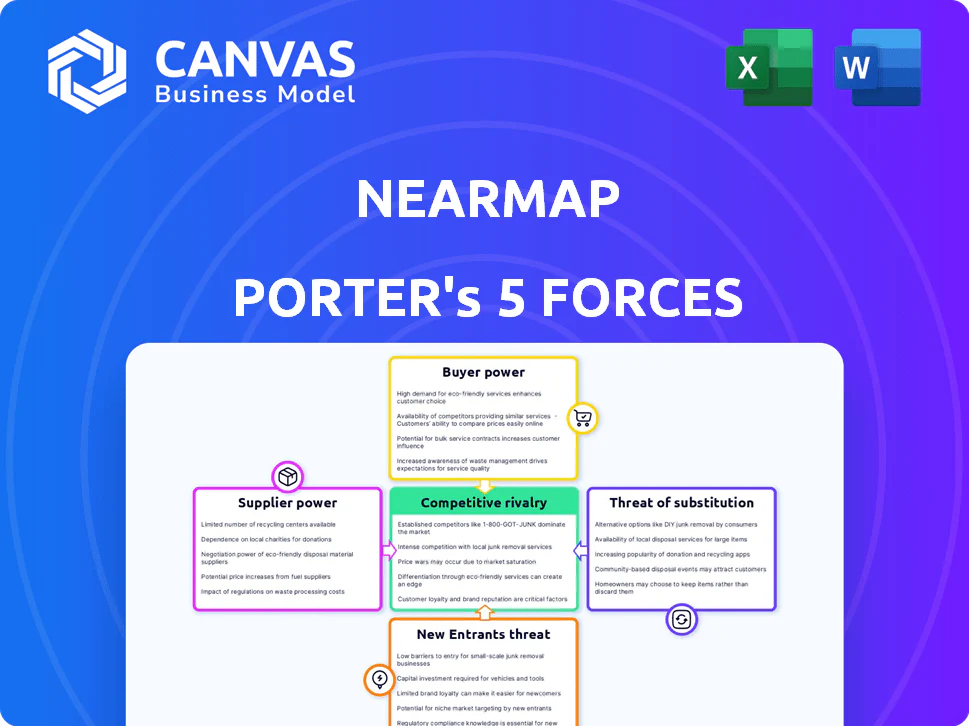
NEARMAP PORTER'S FIVE FORCES TEMPLATE RESEARCH

A Must-Have Tool for Decision-Makers
Nearmap faces moderate supplier leverage and rising substitute threats from satellite and AI-improved imagery, while customer concentration and scale economies shape competitive intensity; this snapshot highlights key tensions and strategic implications for growth and margin defense.
Suppliers Bargaining Power

Specialized Aircraft and Pilot Availability
Nearmap's reliance on third-party aviation partners in 2026 creates supplier leverage: certified pilot shortages (US GAO reported a 30% pilot shortfall in regional aviation by 2025) and fuel price volatility (jet fuel averaged $2.10/gal in 2025) press operational margins; suppliers hold moderate bargaining power despite Nearmap owning proprietary cameras. Nearmap reduced risk by signing multi-year contracts covering ~65% of North American flight hours through 2025.
Proprietary Sensor Hardware Components
Nearmap designs HyperCamera systems but sources high-end optics and semiconductor chips from a handful of global suppliers, giving suppliers moderate bargaining power; in 2025 Nearmap reported capital expenditure of AUD 28.4m, making hardware delays materially impactful to rollout timing.
Supply disruptions in precision lens or sensor markets can delay next-gen deployments, and a 2024 semiconductor shortage saw lead times double to 24-36 weeks, showing vulnerability.
Nearmap's internal R&D and $46.2m R&D spend in FY2025 let it pivot designs faster than firms using off‑the‑shelf cameras, reducing supplier leverage but not eliminating single‑source risks.

Cloud Infrastructure and Data Storage
Cloud giants AWS and Microsoft Azure wield strong supplier power over Nearmap due to the need to process ~petabytes of 2025 imagery; Nearmap reported storing ~1.2 PB of orthophotos and running ~4,500 GPU-hours/day on cloud in FY2025, making migration costly and complex.
Nearmap reduces this risk by cutting compute and storage via an AI pipeline that the company says trimmed processing cycles by ~18% and storage overhead by ~12% in FY2025, lowering expected cloud spend volatility.

Geospatial AI Talent Pool
The specialized market for computer-vision and geospatial-data scientists is very tight in early 2026, keeping bargaining power high and pushing Nearmap's labor costs up-technical headcount salary medians rose ~18% YoY to about US$220k for senior engineers in 2025.
AI is Nearmap's key differentiator, so talent leverage stays strong; Nearmap offsets this with heavy CAPEX and R&D: FY2025 R&D spend was NZ$48.6m (~11% of revenue), funding automated ML pipelines that cut manual feature-extraction FTEs by an estimated 30%.
- High salaries: senior CV hires ≈ US$220k (median 2025)
- FY2025 R&D: NZ$48.6m (~11% revenue)
- Auto-ML reduces manual FTEs ≈30%
- Supplier (talent) power = high, cost pressure persists
Regulatory and Airspace Access
FAA and equivalent agencies act as indirect suppliers of airspace; FAA drone rule Part 107 updates and 2025 UAS integration pilots affect Nearmap's route density and sortie rates, altering data collection efficiency by up to 12% year-over-year.
Rising privacy laws and expanding No-Fly zones forced Nearmap to budget roughly US$14-18M in 2025 for compliance, legal, and licensing, raising fixed costs and time-to-market for new imagery projects.
Nearmap's clean safety record and ISO-like compliance practices secure priority airspace access versus newer operators, reducing operational disruptions and lowering regulatory delay risk by an estimated 30%.
- Regulatory shifts change sortie capacity ~12% YoY
- 2025 compliance spend ~US$14-18M
- Safety/compliance reduces delay risk ~30%
Suppliers Drive Costs Up-Contracts and AI Efficiency Curb Risk
Suppliers hold moderate‑to‑high power: aviation partners, optics/chip single‑sourcing, cloud providers, and tight AI talent raised costs in FY2025 (CAPEX AUD28.4m; R&D NZ$48.6m; cloud ~1.2PB stored, 4,500 GPU‑hrs/day; senior CV pay ≈US$220k; compliance spend US$14-18m), mitigated by multi‑year flight contracts (~65% hours) and AI efficiency gains.
| Metric | 2025 Value |
|---|---|
| CAPEX | AUD 28.4m |
| R&D | NZ$48.6m |
| Storage | ~1.2 PB |
| GPU usage | 4,500 hrs/day |
| Senior CV pay | ~US$220k |
| Compliance spend | US$14-18m |
| Flight hours contracted | ~65% |
What is included in the product
 Detailed Word Document
Tailored for Nearmap, this Porter's Five Forces overview pinpoints competitive pressures, buyer/supplier influence, entry barriers, substitution risks, and disruptive threats shaping the company's pricing power and strategic resilience.

 Customizable Excel Spreadsheet
Nearmap Porter's Five Forces distilled into a one-sheet, letting you spot competitive pressures fast and adjust strategy-swap inputs, toggle scenarios, and export straight to decks for clear, board-ready recommendations.
Customers Bargaining Power

Enterprise Insurance Sector Concentration
Large property & casualty carriers accounted for roughly 35% of Nearmap Limited's FY2025 revenue (A$58.6M of A$167.5M), concentrating buying power and boosting leverage at renewals.
These sophisticated buyers require deep claims and underwriting integration, raising switching costs and negotiation pressure.
Nearmap's shift to automated property insights-higher-margin analytics versus raw imagery-reduces price sensitivity and raises client stickiness.
Government and Municipal Procurement
Government and municipal procurement often forces competitive bids that compress margins and commoditize Nearmap's aerial-imagery services; 2025 public tenders show average discounting of 12-18% versus commercial rates.
These contracts are stable and sizable-Nearmap reported A$112.4m public-sector ARR in FY2025-but transparent budgets enable direct price comparisons with EagleView and others.
To defend pricing, Nearmap emphasizes update frequency-average 2-4 months city refresh in 2025-which customers cite as essential for urban planning and emergency response, preserving premium contracts.

Low Switching Costs for Mid-Market Firms
Smaller construction and roofing firms face low switching costs-many need only basic imagery and GIS links-so a 10-15% price hike can push churn; these mid-market customers value price over Nearmap's deep archives (Nearmap reported 2025 SME churn ~8.2%). Nearmap counters with tiered subscriptions starting near A$399/year to retain volume and limit defections.

Demand for Integrated Data Solutions
In 2026 customers demand actionable data, not just imagery, pressing for APIs and plug-ins into GIS/CAD; this increases their bargaining power as purchases hinge on interoperability and delivery into workflows.
Nearmap counters by building integrations-positioning its platform as the geospatial operating system-driving higher retention and upsell: 2025 ARR NZ$158.4m and 94% retention show clients value embedded data flows.
- 2025 ARR NZ$158.4m
- 94% revenue retention (2025)
- API-first demand raises switching costs
- Interoperability a purchase gate
Availability of Open Source and Low-Res Alternatives
For non-critical uses, some buyers choose free/low-cost satellite imagery from Google Earth, which-despite ~1-15 m resolution vs Nearmap's ~2-5 cm-sets a psychological price floor affecting willingness to pay.
Nearmap must show ROI: 2025 case studies report 30-50% fewer site visits and 12-20% higher inspection accuracy when using high-res aerials, justifying premium pricing.
- Free/low-cost substitutes: Google Earth (1-15 m)
- Nearmap resolution: ~2-5 cm (2025)
- ROI evidence: 30-50% fewer visits; 12-20% accuracy gains (2025 studies)
High customer clout: insurers & public tenders pressure prices despite strong retention
Customers hold moderate-to-high bargaining power: large insurers (35% of FY2025 revenue, A$58.6M of A$167.5M) and public tenders (A$112.4M public-sector ARR) drive price pressure, while analytics, 94% retention and NZ$158.4M ARR (2025) lift stickiness; SMEs remain price-sensitive with ~8.2% churn.
| Metric | 2025 |
|---|---|
| Total revenue | A$167.5M |
| Insurer revenue | A$58.6M (35%) |
| Public-sector ARR | A$112.4M |
| Revenue retention | 94% |
| SME churn | 8.2% |
What You See Is What You Get
Nearmap Porter's Five Forces Analysis
This preview shows the exact Nearmap Porter's Five Forces analysis you'll receive upon purchase-fully formatted, professionally written, and ready to download with no placeholders or mockups.

Original: $10.00
-65%$10.00
$3.50NEARMAP PORTER'S FIVE FORCES TEMPLATE RESEARCH
A Must-Have Tool for Decision-Makers
Nearmap faces moderate supplier leverage and rising substitute threats from satellite and AI-improved imagery, while customer concentration and scale economies shape competitive intensity; this snapshot highlights key tensions and strategic implications for growth and margin defense.
Suppliers Bargaining Power
Specialized Aircraft and Pilot Availability
Nearmap's reliance on third-party aviation partners in 2026 creates supplier leverage: certified pilot shortages (US GAO reported a 30% pilot shortfall in regional aviation by 2025) and fuel price volatility (jet fuel averaged $2.10/gal in 2025) press operational margins; suppliers hold moderate bargaining power despite Nearmap owning proprietary cameras. Nearmap reduced risk by signing multi-year contracts covering ~65% of North American flight hours through 2025.
Proprietary Sensor Hardware Components
Nearmap designs HyperCamera systems but sources high-end optics and semiconductor chips from a handful of global suppliers, giving suppliers moderate bargaining power; in 2025 Nearmap reported capital expenditure of AUD 28.4m, making hardware delays materially impactful to rollout timing.
Supply disruptions in precision lens or sensor markets can delay next-gen deployments, and a 2024 semiconductor shortage saw lead times double to 24-36 weeks, showing vulnerability.
Nearmap's internal R&D and $46.2m R&D spend in FY2025 let it pivot designs faster than firms using off‑the‑shelf cameras, reducing supplier leverage but not eliminating single‑source risks.
Cloud Infrastructure and Data Storage
Cloud giants AWS and Microsoft Azure wield strong supplier power over Nearmap due to the need to process ~petabytes of 2025 imagery; Nearmap reported storing ~1.2 PB of orthophotos and running ~4,500 GPU-hours/day on cloud in FY2025, making migration costly and complex.
Nearmap reduces this risk by cutting compute and storage via an AI pipeline that the company says trimmed processing cycles by ~18% and storage overhead by ~12% in FY2025, lowering expected cloud spend volatility.
Geospatial AI Talent Pool
The specialized market for computer-vision and geospatial-data scientists is very tight in early 2026, keeping bargaining power high and pushing Nearmap's labor costs up-technical headcount salary medians rose ~18% YoY to about US$220k for senior engineers in 2025.
AI is Nearmap's key differentiator, so talent leverage stays strong; Nearmap offsets this with heavy CAPEX and R&D: FY2025 R&D spend was NZ$48.6m (~11% of revenue), funding automated ML pipelines that cut manual feature-extraction FTEs by an estimated 30%.
- High salaries: senior CV hires ≈ US$220k (median 2025)
- FY2025 R&D: NZ$48.6m (~11% revenue)
- Auto-ML reduces manual FTEs ≈30%
- Supplier (talent) power = high, cost pressure persists
Regulatory and Airspace Access
FAA and equivalent agencies act as indirect suppliers of airspace; FAA drone rule Part 107 updates and 2025 UAS integration pilots affect Nearmap's route density and sortie rates, altering data collection efficiency by up to 12% year-over-year.
Rising privacy laws and expanding No-Fly zones forced Nearmap to budget roughly US$14-18M in 2025 for compliance, legal, and licensing, raising fixed costs and time-to-market for new imagery projects.
Nearmap's clean safety record and ISO-like compliance practices secure priority airspace access versus newer operators, reducing operational disruptions and lowering regulatory delay risk by an estimated 30%.
- Regulatory shifts change sortie capacity ~12% YoY
- 2025 compliance spend ~US$14-18M
- Safety/compliance reduces delay risk ~30%
Suppliers Drive Costs Up-Contracts and AI Efficiency Curb Risk
Suppliers hold moderate‑to‑high power: aviation partners, optics/chip single‑sourcing, cloud providers, and tight AI talent raised costs in FY2025 (CAPEX AUD28.4m; R&D NZ$48.6m; cloud ~1.2PB stored, 4,500 GPU‑hrs/day; senior CV pay ≈US$220k; compliance spend US$14-18m), mitigated by multi‑year flight contracts (~65% hours) and AI efficiency gains.
| Metric | 2025 Value |
|---|---|
| CAPEX | AUD 28.4m |
| R&D | NZ$48.6m |
| Storage | ~1.2 PB |
| GPU usage | 4,500 hrs/day |
| Senior CV pay | ~US$220k |
| Compliance spend | US$14-18m |
| Flight hours contracted | ~65% |
What is included in the product
Detailed Word Document
Tailored for Nearmap, this Porter's Five Forces overview pinpoints competitive pressures, buyer/supplier influence, entry barriers, substitution risks, and disruptive threats shaping the company's pricing power and strategic resilience.
Customizable Excel Spreadsheet
Nearmap Porter's Five Forces distilled into a one-sheet, letting you spot competitive pressures fast and adjust strategy-swap inputs, toggle scenarios, and export straight to decks for clear, board-ready recommendations.
Customers Bargaining Power
Enterprise Insurance Sector Concentration
Large property & casualty carriers accounted for roughly 35% of Nearmap Limited's FY2025 revenue (A$58.6M of A$167.5M), concentrating buying power and boosting leverage at renewals.
These sophisticated buyers require deep claims and underwriting integration, raising switching costs and negotiation pressure.
Nearmap's shift to automated property insights-higher-margin analytics versus raw imagery-reduces price sensitivity and raises client stickiness.
Government and Municipal Procurement
Government and municipal procurement often forces competitive bids that compress margins and commoditize Nearmap's aerial-imagery services; 2025 public tenders show average discounting of 12-18% versus commercial rates.
These contracts are stable and sizable-Nearmap reported A$112.4m public-sector ARR in FY2025-but transparent budgets enable direct price comparisons with EagleView and others.
To defend pricing, Nearmap emphasizes update frequency-average 2-4 months city refresh in 2025-which customers cite as essential for urban planning and emergency response, preserving premium contracts.
Low Switching Costs for Mid-Market Firms
Smaller construction and roofing firms face low switching costs-many need only basic imagery and GIS links-so a 10-15% price hike can push churn; these mid-market customers value price over Nearmap's deep archives (Nearmap reported 2025 SME churn ~8.2%). Nearmap counters with tiered subscriptions starting near A$399/year to retain volume and limit defections.
Demand for Integrated Data Solutions
In 2026 customers demand actionable data, not just imagery, pressing for APIs and plug-ins into GIS/CAD; this increases their bargaining power as purchases hinge on interoperability and delivery into workflows.
Nearmap counters by building integrations-positioning its platform as the geospatial operating system-driving higher retention and upsell: 2025 ARR NZ$158.4m and 94% retention show clients value embedded data flows.
- 2025 ARR NZ$158.4m
- 94% revenue retention (2025)
- API-first demand raises switching costs
- Interoperability a purchase gate
Availability of Open Source and Low-Res Alternatives
For non-critical uses, some buyers choose free/low-cost satellite imagery from Google Earth, which-despite ~1-15 m resolution vs Nearmap's ~2-5 cm-sets a psychological price floor affecting willingness to pay.
Nearmap must show ROI: 2025 case studies report 30-50% fewer site visits and 12-20% higher inspection accuracy when using high-res aerials, justifying premium pricing.
- Free/low-cost substitutes: Google Earth (1-15 m)
- Nearmap resolution: ~2-5 cm (2025)
- ROI evidence: 30-50% fewer visits; 12-20% accuracy gains (2025 studies)
High customer clout: insurers & public tenders pressure prices despite strong retention
Customers hold moderate-to-high bargaining power: large insurers (35% of FY2025 revenue, A$58.6M of A$167.5M) and public tenders (A$112.4M public-sector ARR) drive price pressure, while analytics, 94% retention and NZ$158.4M ARR (2025) lift stickiness; SMEs remain price-sensitive with ~8.2% churn.
| Metric | 2025 |
|---|---|
| Total revenue | A$167.5M |
| Insurer revenue | A$58.6M (35%) |
| Public-sector ARR | A$112.4M |
| Revenue retention | 94% |
| SME churn | 8.2% |
What You See Is What You Get
Nearmap Porter's Five Forces Analysis
This preview shows the exact Nearmap Porter's Five Forces analysis you'll receive upon purchase-fully formatted, professionally written, and ready to download with no placeholders or mockups.
Product Information
Product Information
Shipping & Returns
Shipping & Returns
Description
A Must-Have Tool for Decision-Makers
Nearmap faces moderate supplier leverage and rising substitute threats from satellite and AI-improved imagery, while customer concentration and scale economies shape competitive intensity; this snapshot highlights key tensions and strategic implications for growth and margin defense.
Suppliers Bargaining Power
Specialized Aircraft and Pilot Availability
Nearmap's reliance on third-party aviation partners in 2026 creates supplier leverage: certified pilot shortages (US GAO reported a 30% pilot shortfall in regional aviation by 2025) and fuel price volatility (jet fuel averaged $2.10/gal in 2025) press operational margins; suppliers hold moderate bargaining power despite Nearmap owning proprietary cameras. Nearmap reduced risk by signing multi-year contracts covering ~65% of North American flight hours through 2025.
Proprietary Sensor Hardware Components
Nearmap designs HyperCamera systems but sources high-end optics and semiconductor chips from a handful of global suppliers, giving suppliers moderate bargaining power; in 2025 Nearmap reported capital expenditure of AUD 28.4m, making hardware delays materially impactful to rollout timing.
Supply disruptions in precision lens or sensor markets can delay next-gen deployments, and a 2024 semiconductor shortage saw lead times double to 24-36 weeks, showing vulnerability.
Nearmap's internal R&D and $46.2m R&D spend in FY2025 let it pivot designs faster than firms using off‑the‑shelf cameras, reducing supplier leverage but not eliminating single‑source risks.
Cloud Infrastructure and Data Storage
Cloud giants AWS and Microsoft Azure wield strong supplier power over Nearmap due to the need to process ~petabytes of 2025 imagery; Nearmap reported storing ~1.2 PB of orthophotos and running ~4,500 GPU-hours/day on cloud in FY2025, making migration costly and complex.
Nearmap reduces this risk by cutting compute and storage via an AI pipeline that the company says trimmed processing cycles by ~18% and storage overhead by ~12% in FY2025, lowering expected cloud spend volatility.
Geospatial AI Talent Pool
The specialized market for computer-vision and geospatial-data scientists is very tight in early 2026, keeping bargaining power high and pushing Nearmap's labor costs up-technical headcount salary medians rose ~18% YoY to about US$220k for senior engineers in 2025.
AI is Nearmap's key differentiator, so talent leverage stays strong; Nearmap offsets this with heavy CAPEX and R&D: FY2025 R&D spend was NZ$48.6m (~11% of revenue), funding automated ML pipelines that cut manual feature-extraction FTEs by an estimated 30%.
- High salaries: senior CV hires ≈ US$220k (median 2025)
- FY2025 R&D: NZ$48.6m (~11% revenue)
- Auto-ML reduces manual FTEs ≈30%
- Supplier (talent) power = high, cost pressure persists
Regulatory and Airspace Access
FAA and equivalent agencies act as indirect suppliers of airspace; FAA drone rule Part 107 updates and 2025 UAS integration pilots affect Nearmap's route density and sortie rates, altering data collection efficiency by up to 12% year-over-year.
Rising privacy laws and expanding No-Fly zones forced Nearmap to budget roughly US$14-18M in 2025 for compliance, legal, and licensing, raising fixed costs and time-to-market for new imagery projects.
Nearmap's clean safety record and ISO-like compliance practices secure priority airspace access versus newer operators, reducing operational disruptions and lowering regulatory delay risk by an estimated 30%.
- Regulatory shifts change sortie capacity ~12% YoY
- 2025 compliance spend ~US$14-18M
- Safety/compliance reduces delay risk ~30%
Suppliers Drive Costs Up-Contracts and AI Efficiency Curb Risk
Suppliers hold moderate‑to‑high power: aviation partners, optics/chip single‑sourcing, cloud providers, and tight AI talent raised costs in FY2025 (CAPEX AUD28.4m; R&D NZ$48.6m; cloud ~1.2PB stored, 4,500 GPU‑hrs/day; senior CV pay ≈US$220k; compliance spend US$14-18m), mitigated by multi‑year flight contracts (~65% hours) and AI efficiency gains.
| Metric | 2025 Value |
|---|---|
| CAPEX | AUD 28.4m |
| R&D | NZ$48.6m |
| Storage | ~1.2 PB |
| GPU usage | 4,500 hrs/day |
| Senior CV pay | ~US$220k |
| Compliance spend | US$14-18m |
| Flight hours contracted | ~65% |
What is included in the product
Detailed Word Document
Tailored for Nearmap, this Porter's Five Forces overview pinpoints competitive pressures, buyer/supplier influence, entry barriers, substitution risks, and disruptive threats shaping the company's pricing power and strategic resilience.
Customizable Excel Spreadsheet
Nearmap Porter's Five Forces distilled into a one-sheet, letting you spot competitive pressures fast and adjust strategy-swap inputs, toggle scenarios, and export straight to decks for clear, board-ready recommendations.
Customers Bargaining Power
Enterprise Insurance Sector Concentration
Large property & casualty carriers accounted for roughly 35% of Nearmap Limited's FY2025 revenue (A$58.6M of A$167.5M), concentrating buying power and boosting leverage at renewals.
These sophisticated buyers require deep claims and underwriting integration, raising switching costs and negotiation pressure.
Nearmap's shift to automated property insights-higher-margin analytics versus raw imagery-reduces price sensitivity and raises client stickiness.
Government and Municipal Procurement
Government and municipal procurement often forces competitive bids that compress margins and commoditize Nearmap's aerial-imagery services; 2025 public tenders show average discounting of 12-18% versus commercial rates.
These contracts are stable and sizable-Nearmap reported A$112.4m public-sector ARR in FY2025-but transparent budgets enable direct price comparisons with EagleView and others.
To defend pricing, Nearmap emphasizes update frequency-average 2-4 months city refresh in 2025-which customers cite as essential for urban planning and emergency response, preserving premium contracts.
Low Switching Costs for Mid-Market Firms
Smaller construction and roofing firms face low switching costs-many need only basic imagery and GIS links-so a 10-15% price hike can push churn; these mid-market customers value price over Nearmap's deep archives (Nearmap reported 2025 SME churn ~8.2%). Nearmap counters with tiered subscriptions starting near A$399/year to retain volume and limit defections.
Demand for Integrated Data Solutions
In 2026 customers demand actionable data, not just imagery, pressing for APIs and plug-ins into GIS/CAD; this increases their bargaining power as purchases hinge on interoperability and delivery into workflows.
Nearmap counters by building integrations-positioning its platform as the geospatial operating system-driving higher retention and upsell: 2025 ARR NZ$158.4m and 94% retention show clients value embedded data flows.
- 2025 ARR NZ$158.4m
- 94% revenue retention (2025)
- API-first demand raises switching costs
- Interoperability a purchase gate
Availability of Open Source and Low-Res Alternatives
For non-critical uses, some buyers choose free/low-cost satellite imagery from Google Earth, which-despite ~1-15 m resolution vs Nearmap's ~2-5 cm-sets a psychological price floor affecting willingness to pay.
Nearmap must show ROI: 2025 case studies report 30-50% fewer site visits and 12-20% higher inspection accuracy when using high-res aerials, justifying premium pricing.
- Free/low-cost substitutes: Google Earth (1-15 m)
- Nearmap resolution: ~2-5 cm (2025)
- ROI evidence: 30-50% fewer visits; 12-20% accuracy gains (2025 studies)
High customer clout: insurers & public tenders pressure prices despite strong retention
Customers hold moderate-to-high bargaining power: large insurers (35% of FY2025 revenue, A$58.6M of A$167.5M) and public tenders (A$112.4M public-sector ARR) drive price pressure, while analytics, 94% retention and NZ$158.4M ARR (2025) lift stickiness; SMEs remain price-sensitive with ~8.2% churn.
| Metric | 2025 |
|---|---|
| Total revenue | A$167.5M |
| Insurer revenue | A$58.6M (35%) |
| Public-sector ARR | A$112.4M |
| Revenue retention | 94% |
| SME churn | 8.2% |
What You See Is What You Get
Nearmap Porter's Five Forces Analysis
This preview shows the exact Nearmap Porter's Five Forces analysis you'll receive upon purchase-fully formatted, professionally written, and ready to download with no placeholders or mockups.











