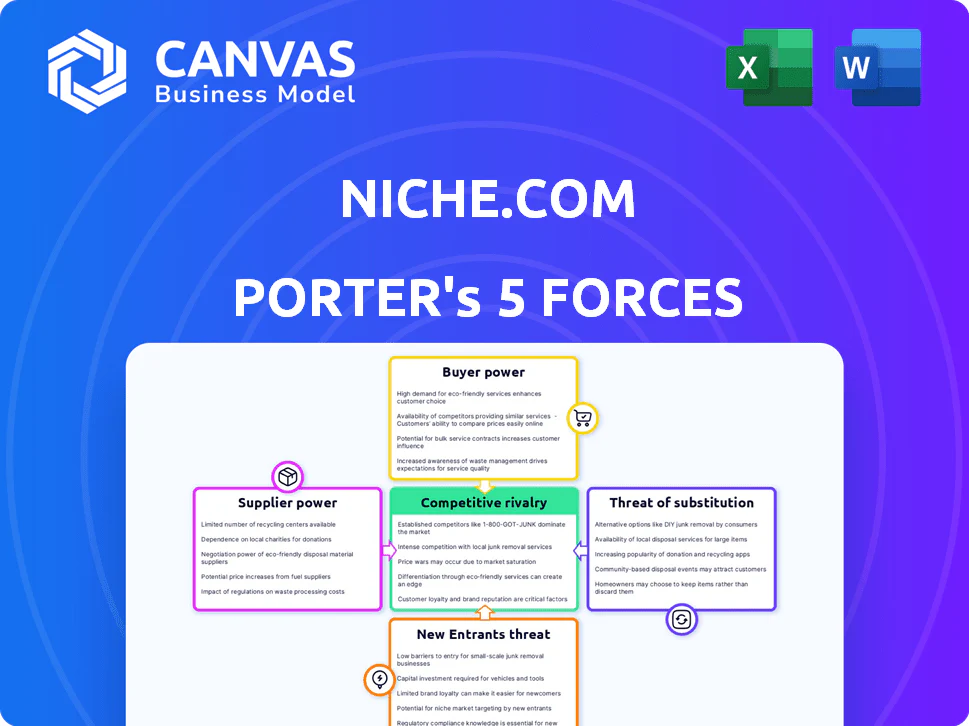
NICHE.COM PORTER'S FIVE FORCES TEMPLATE RESEARCH
What is included in the product
 Detailed Word Document
Tailored exclusively for Niche.com, analyzing its position within its competitive landscape.

 Customizable Excel Spreadsheet
Swap in your own data, labels, and notes to reflect current business conditions.
Preview Before You Purchase
Niche.com Porter's Five Forces Analysis
This is the complete Niche.com Porter's Five Forces analysis. The document you're viewing provides the same detailed insights you'll get immediately after purchasing. We've included the full analysis to give you a clear understanding. It's expertly written and professionally formatted for your immediate use. No edits needed; it's ready to download and utilize.

Porter's Five Forces Analysis Template

Don't Miss the Bigger Picture
Niche.com operates within a competitive landscape influenced by various forces. Buyer power, stemming from consumers' choice, plays a key role in shaping its strategy. The threat of new entrants, especially from tech-savvy startups, is also a concern. Understanding these dynamics is crucial. Supplier bargaining power, alongside substitute products, adds complexity. Analyzing all these forces helps assess Niche.com’s positioning.
This brief snapshot only scratches the surface. Unlock the full Porter's Five Forces Analysis to explore Niche.com’s competitive dynamics, market pressures, and strategic advantages in detail.
Suppliers Bargaining Power

Data Providers
Niche.com's reliance on data from sources like the Department of Education and the U.S. Census gives suppliers significant bargaining power. In 2024, the U.S. Department of Education’s budget was over $75 billion. If access to these crucial datasets is restricted or altered, Niche's ability to provide comprehensive school rankings and reviews could be compromised. Accurate and accessible data is vital.
Technology Providers
Niche.com's tech relies on various providers for programming, frameworks, and hosting. If Niche is highly dependent on a specific, specialized tech provider, that supplier gains bargaining power. For example, a crucial hosting service outage could significantly impact Niche's operations. In 2024, the global cloud computing market reached approximately $670 billion, indicating the scale of these providers.

Review and Survey Contributors
Niche.com relies heavily on user-generated content like reviews and surveys, so a collective drop in contributions could hurt its data. In 2024, user-generated content accounted for roughly 60% of all data used by online platforms. If users moved to competing platforms, Niche's data quality would suffer. This could decrease the platform's attractiveness to users and advertisers.

Schools and Colleges (as data providers)
Schools and colleges supply essential data to Niche via a partner portal, fueling the platform's profiles. Their bargaining power is limited, as Niche also uses public data sources. However, these institutions could impact their profile presentation if they withheld data or demanded changes. In 2024, Niche's revenue was approximately $50 million, highlighting its dependency on data quality.
- Data Provision: Schools and colleges provide data through a partner portal.
- Influence: They could exert some influence by withholding data.
- Mitigation: Niche's use of public data reduces their bargaining power.
- Financial Context: Niche's 2024 revenue was about $50 million.
Advertising Partners (as revenue suppliers)
Niche.com's revenue relies on advertising from schools and businesses. Large advertisers can exert power by negotiating lower rates. If a few partners contribute significantly, Niche's revenue is vulnerable. This bargaining power impacts profitability and financial stability.
- Advertising revenue in 2024 accounted for a significant portion of Niche's income.
- Major advertisers, such as large universities, could negotiate favorable deals.
- A few key partners might control a large share of advertising spending.
- Niche must manage relationships to maintain pricing power.
Supplier Power Dynamics: A Look Inside
Niche.com's supplier power varies across data sources and tech providers. Dependency on critical data, like that from the U.S. Department of Education, increases supplier leverage. Conversely, Niche's reliance on user-generated content gives users some power. Large advertisers also have influence, impacting revenue.
| Supplier Type | Bargaining Power | Impact on Niche |
|---|---|---|
| Data Providers (e.g., Dept. of Ed.) | High | Data quality, platform accuracy |
| Tech Providers (Hosting, etc.) | Moderate | Operational stability, service |
| Content Creators (Users) | Moderate | Data volume, platform appeal |
Customers Bargaining Power

Students and Families
Students and families wield significant power as the main consumers of Niche's free platform. They can easily switch to competitors like GreatSchools.org or niche-specific sites. Data from 2024 shows over 60 million unique visitors use these types of platforms monthly. Their continued engagement is key to Niche's success.
Schools and Colleges (as paying clients)
Schools and colleges utilize Niche.com's services, like premium profiles and ads, as paying clients. Their bargaining power stems from marketing budgets and student attraction needs. In 2024, U.S. higher education institutions spent approximately $12.6 billion on marketing. Niche's ROI demonstration is vital for client retention, as shown by 2023 data.

Businesses (e.g., Real Estate)
Other businesses, like real estate, buy Niche's data. Their power depends on how unique and valuable Niche's data is versus other sources. If similar data exists, their power grows. For example, in 2024, real estate data analytics spending hit $1.5 billion.

Users Contributing Reviews and Data
Niche.com relies on user-generated content like reviews, which gives its users a degree of indirect bargaining power. These users don't directly pay, but their contributions are vital for the site's content and appeal. If users stopped contributing, the platform's value would decrease, affecting its competitive edge. For example, in 2024, platforms with active user participation saw engagement rates increase by about 15%.
- User-generated content is a core asset.
- Reduced contributions diminish value.
- User engagement affects platform competitiveness.
- Active users boost platform appeal.
Advertisers
Advertisers on Niche.com aim to target a specific audience, influencing their bargaining power. This power is tied to how well Niche's advertising channels perform and their cost versus other platforms. In 2024, digital ad spending is expected to reach $272.7 billion. Advertisers will assess Niche's value by comparing it to competitors like Yelp or specialized platforms. The more effective and cost-efficient Niche is, the lower the advertisers' bargaining power becomes.
- Digital ad spending is projected to hit $272.7 billion in 2024.
- Advertisers compare Niche's value to rivals.
- Effectiveness and cost impact advertiser power.
Customer Power Dynamics: A Breakdown
Niche.com's customer power varies across different user groups. Students and families have high power due to easy platform switching. Schools and colleges possess power through marketing budgets. Advertisers' power hinges on Niche's ad performance compared to rivals.
| Customer Type | Bargaining Power | Factors |
|---|---|---|
| Students/Families | High | Switching costs, competitor options |
| Schools/Colleges | Medium | Marketing budgets ($12.6B in 2024), ROI |
| Advertisers | Medium | Ad performance, digital ad spending ($272.7B in 2024) |
Rivalry Among Competitors

Direct Competitors (Other Ranking/Review Sites)
Niche competes directly with platforms like GreatSchools and U.S. News & World Report, which offer similar ranking and review services. The competitive rivalry is high due to the presence of established players. Switching costs for users are low, intensifying the competition. For example, in 2024, GreatSchools had approximately 50 million unique visitors.
Traditional Education and Real Estate Information Sources
Traditional sources like guidebooks, school websites, and real estate agents compete with Niche.com. While Niche offers a consolidated online platform, these methods still hold relevance. The National Association of Realtors reported a 2024 median existing-home sales price of $389,500. In 2024, about 78% of home buyers used the internet to search for homes.

Specialized Niche Platforms
Specialized niche platforms, like those focusing on graduate schools or specific real estate demographics, intensify competitive rivalry. These platforms offer tailored, in-depth information, potentially attracting users seeking highly specific data. For instance, Zillow, a major player in real estate, faces competition from niche sites specializing in particular areas. This targeted approach can erode market share for broader platforms. In 2024, the real estate market saw increased competition from specialized platforms.

Search Engines and Portals
Large search engines and online portals present indirect competition to Niche.com. These platforms, offering basic information or aggregating data, can divert users. For instance, Google and Yelp are significant players in this space. Data indicates that in 2024, Google processes trillions of searches annually, including those related to schools and locations.
- Google's annual ad revenue is over $280 billion in 2024.
- Yelp's revenue was over $1.2 billion in 2023.
- Approximately 77% of US consumers start their product searches on Google.
- Niche.com's estimated revenue in 2023 was around $70 million.
Internal School/College Resources
Schools and colleges compete by directly offering information to prospective students and families via their websites, admissions offices, and marketing. This dual role as both a resource and a competitor shapes their approach to attracting the target audience. For instance, a 2024 study showed that 75% of prospective students rely on school websites for initial information. This internal competition influences how schools present themselves. The competition is evident in the marketing budgets allocated.
- 75% of prospective students use school websites for initial info.
- Schools compete through websites, admissions, and marketing.
- Marketing budgets reflect this internal competition.
- Schools are partners and competitors.
Market Rivalry: A Look at the Competition
Niche.com faces intense competition from established platforms like GreatSchools and U.S. News & World Report. Low switching costs amplify this rivalry. Specialized niche platforms and search engines also compete, fragmenting the market. Google's 2024 ad revenue exceeded $280 billion.
| Competitor Type | Example | 2024 Data Point |
|---|---|---|
| Established Platform | GreatSchools | 50M unique visitors |
| Niche Platform | Zillow | Increased competition |
| Search Engine | $280B+ ad revenue |
Original: $10.00
-65%$10.00
$3.50NICHE.COM PORTER'S FIVE FORCES TEMPLATE RESEARCH
What is included in the product
Detailed Word Document
Tailored exclusively for Niche.com, analyzing its position within its competitive landscape.
Customizable Excel Spreadsheet
Swap in your own data, labels, and notes to reflect current business conditions.
Preview Before You Purchase
Niche.com Porter's Five Forces Analysis
This is the complete Niche.com Porter's Five Forces analysis. The document you're viewing provides the same detailed insights you'll get immediately after purchasing. We've included the full analysis to give you a clear understanding. It's expertly written and professionally formatted for your immediate use. No edits needed; it's ready to download and utilize.
Porter's Five Forces Analysis Template
Don't Miss the Bigger Picture
Niche.com operates within a competitive landscape influenced by various forces. Buyer power, stemming from consumers' choice, plays a key role in shaping its strategy. The threat of new entrants, especially from tech-savvy startups, is also a concern. Understanding these dynamics is crucial. Supplier bargaining power, alongside substitute products, adds complexity. Analyzing all these forces helps assess Niche.com’s positioning.
This brief snapshot only scratches the surface. Unlock the full Porter's Five Forces Analysis to explore Niche.com’s competitive dynamics, market pressures, and strategic advantages in detail.
Suppliers Bargaining Power
Data Providers
Niche.com's reliance on data from sources like the Department of Education and the U.S. Census gives suppliers significant bargaining power. In 2024, the U.S. Department of Education’s budget was over $75 billion. If access to these crucial datasets is restricted or altered, Niche's ability to provide comprehensive school rankings and reviews could be compromised. Accurate and accessible data is vital.
Technology Providers
Niche.com's tech relies on various providers for programming, frameworks, and hosting. If Niche is highly dependent on a specific, specialized tech provider, that supplier gains bargaining power. For example, a crucial hosting service outage could significantly impact Niche's operations. In 2024, the global cloud computing market reached approximately $670 billion, indicating the scale of these providers.
Review and Survey Contributors
Niche.com relies heavily on user-generated content like reviews and surveys, so a collective drop in contributions could hurt its data. In 2024, user-generated content accounted for roughly 60% of all data used by online platforms. If users moved to competing platforms, Niche's data quality would suffer. This could decrease the platform's attractiveness to users and advertisers.
Schools and Colleges (as data providers)
Schools and colleges supply essential data to Niche via a partner portal, fueling the platform's profiles. Their bargaining power is limited, as Niche also uses public data sources. However, these institutions could impact their profile presentation if they withheld data or demanded changes. In 2024, Niche's revenue was approximately $50 million, highlighting its dependency on data quality.
- Data Provision: Schools and colleges provide data through a partner portal.
- Influence: They could exert some influence by withholding data.
- Mitigation: Niche's use of public data reduces their bargaining power.
- Financial Context: Niche's 2024 revenue was about $50 million.
Advertising Partners (as revenue suppliers)
Niche.com's revenue relies on advertising from schools and businesses. Large advertisers can exert power by negotiating lower rates. If a few partners contribute significantly, Niche's revenue is vulnerable. This bargaining power impacts profitability and financial stability.
- Advertising revenue in 2024 accounted for a significant portion of Niche's income.
- Major advertisers, such as large universities, could negotiate favorable deals.
- A few key partners might control a large share of advertising spending.
- Niche must manage relationships to maintain pricing power.
Supplier Power Dynamics: A Look Inside
Niche.com's supplier power varies across data sources and tech providers. Dependency on critical data, like that from the U.S. Department of Education, increases supplier leverage. Conversely, Niche's reliance on user-generated content gives users some power. Large advertisers also have influence, impacting revenue.
| Supplier Type | Bargaining Power | Impact on Niche |
|---|---|---|
| Data Providers (e.g., Dept. of Ed.) | High | Data quality, platform accuracy |
| Tech Providers (Hosting, etc.) | Moderate | Operational stability, service |
| Content Creators (Users) | Moderate | Data volume, platform appeal |
Customers Bargaining Power
Students and Families
Students and families wield significant power as the main consumers of Niche's free platform. They can easily switch to competitors like GreatSchools.org or niche-specific sites. Data from 2024 shows over 60 million unique visitors use these types of platforms monthly. Their continued engagement is key to Niche's success.
Schools and Colleges (as paying clients)
Schools and colleges utilize Niche.com's services, like premium profiles and ads, as paying clients. Their bargaining power stems from marketing budgets and student attraction needs. In 2024, U.S. higher education institutions spent approximately $12.6 billion on marketing. Niche's ROI demonstration is vital for client retention, as shown by 2023 data.
Businesses (e.g., Real Estate)
Other businesses, like real estate, buy Niche's data. Their power depends on how unique and valuable Niche's data is versus other sources. If similar data exists, their power grows. For example, in 2024, real estate data analytics spending hit $1.5 billion.
Users Contributing Reviews and Data
Niche.com relies on user-generated content like reviews, which gives its users a degree of indirect bargaining power. These users don't directly pay, but their contributions are vital for the site's content and appeal. If users stopped contributing, the platform's value would decrease, affecting its competitive edge. For example, in 2024, platforms with active user participation saw engagement rates increase by about 15%.
- User-generated content is a core asset.
- Reduced contributions diminish value.
- User engagement affects platform competitiveness.
- Active users boost platform appeal.
Advertisers
Advertisers on Niche.com aim to target a specific audience, influencing their bargaining power. This power is tied to how well Niche's advertising channels perform and their cost versus other platforms. In 2024, digital ad spending is expected to reach $272.7 billion. Advertisers will assess Niche's value by comparing it to competitors like Yelp or specialized platforms. The more effective and cost-efficient Niche is, the lower the advertisers' bargaining power becomes.
- Digital ad spending is projected to hit $272.7 billion in 2024.
- Advertisers compare Niche's value to rivals.
- Effectiveness and cost impact advertiser power.
Customer Power Dynamics: A Breakdown
Niche.com's customer power varies across different user groups. Students and families have high power due to easy platform switching. Schools and colleges possess power through marketing budgets. Advertisers' power hinges on Niche's ad performance compared to rivals.
| Customer Type | Bargaining Power | Factors |
|---|---|---|
| Students/Families | High | Switching costs, competitor options |
| Schools/Colleges | Medium | Marketing budgets ($12.6B in 2024), ROI |
| Advertisers | Medium | Ad performance, digital ad spending ($272.7B in 2024) |
Rivalry Among Competitors
Direct Competitors (Other Ranking/Review Sites)
Niche competes directly with platforms like GreatSchools and U.S. News & World Report, which offer similar ranking and review services. The competitive rivalry is high due to the presence of established players. Switching costs for users are low, intensifying the competition. For example, in 2024, GreatSchools had approximately 50 million unique visitors.
Traditional Education and Real Estate Information Sources
Traditional sources like guidebooks, school websites, and real estate agents compete with Niche.com. While Niche offers a consolidated online platform, these methods still hold relevance. The National Association of Realtors reported a 2024 median existing-home sales price of $389,500. In 2024, about 78% of home buyers used the internet to search for homes.
Specialized Niche Platforms
Specialized niche platforms, like those focusing on graduate schools or specific real estate demographics, intensify competitive rivalry. These platforms offer tailored, in-depth information, potentially attracting users seeking highly specific data. For instance, Zillow, a major player in real estate, faces competition from niche sites specializing in particular areas. This targeted approach can erode market share for broader platforms. In 2024, the real estate market saw increased competition from specialized platforms.
Search Engines and Portals
Large search engines and online portals present indirect competition to Niche.com. These platforms, offering basic information or aggregating data, can divert users. For instance, Google and Yelp are significant players in this space. Data indicates that in 2024, Google processes trillions of searches annually, including those related to schools and locations.
- Google's annual ad revenue is over $280 billion in 2024.
- Yelp's revenue was over $1.2 billion in 2023.
- Approximately 77% of US consumers start their product searches on Google.
- Niche.com's estimated revenue in 2023 was around $70 million.
Internal School/College Resources
Schools and colleges compete by directly offering information to prospective students and families via their websites, admissions offices, and marketing. This dual role as both a resource and a competitor shapes their approach to attracting the target audience. For instance, a 2024 study showed that 75% of prospective students rely on school websites for initial information. This internal competition influences how schools present themselves. The competition is evident in the marketing budgets allocated.
- 75% of prospective students use school websites for initial info.
- Schools compete through websites, admissions, and marketing.
- Marketing budgets reflect this internal competition.
- Schools are partners and competitors.
Market Rivalry: A Look at the Competition
Niche.com faces intense competition from established platforms like GreatSchools and U.S. News & World Report. Low switching costs amplify this rivalry. Specialized niche platforms and search engines also compete, fragmenting the market. Google's 2024 ad revenue exceeded $280 billion.
| Competitor Type | Example | 2024 Data Point |
|---|---|---|
| Established Platform | GreatSchools | 50M unique visitors |
| Niche Platform | Zillow | Increased competition |
| Search Engine | $280B+ ad revenue |
Product Information
Product Information
Shipping & Returns
Shipping & Returns
Description
What is included in the product
Detailed Word Document
Tailored exclusively for Niche.com, analyzing its position within its competitive landscape.
Customizable Excel Spreadsheet
Swap in your own data, labels, and notes to reflect current business conditions.
Preview Before You Purchase
Niche.com Porter's Five Forces Analysis
This is the complete Niche.com Porter's Five Forces analysis. The document you're viewing provides the same detailed insights you'll get immediately after purchasing. We've included the full analysis to give you a clear understanding. It's expertly written and professionally formatted for your immediate use. No edits needed; it's ready to download and utilize.
Porter's Five Forces Analysis Template
Don't Miss the Bigger Picture
Niche.com operates within a competitive landscape influenced by various forces. Buyer power, stemming from consumers' choice, plays a key role in shaping its strategy. The threat of new entrants, especially from tech-savvy startups, is also a concern. Understanding these dynamics is crucial. Supplier bargaining power, alongside substitute products, adds complexity. Analyzing all these forces helps assess Niche.com’s positioning.
This brief snapshot only scratches the surface. Unlock the full Porter's Five Forces Analysis to explore Niche.com’s competitive dynamics, market pressures, and strategic advantages in detail.
Suppliers Bargaining Power
Data Providers
Niche.com's reliance on data from sources like the Department of Education and the U.S. Census gives suppliers significant bargaining power. In 2024, the U.S. Department of Education’s budget was over $75 billion. If access to these crucial datasets is restricted or altered, Niche's ability to provide comprehensive school rankings and reviews could be compromised. Accurate and accessible data is vital.
Technology Providers
Niche.com's tech relies on various providers for programming, frameworks, and hosting. If Niche is highly dependent on a specific, specialized tech provider, that supplier gains bargaining power. For example, a crucial hosting service outage could significantly impact Niche's operations. In 2024, the global cloud computing market reached approximately $670 billion, indicating the scale of these providers.
Review and Survey Contributors
Niche.com relies heavily on user-generated content like reviews and surveys, so a collective drop in contributions could hurt its data. In 2024, user-generated content accounted for roughly 60% of all data used by online platforms. If users moved to competing platforms, Niche's data quality would suffer. This could decrease the platform's attractiveness to users and advertisers.
Schools and Colleges (as data providers)
Schools and colleges supply essential data to Niche via a partner portal, fueling the platform's profiles. Their bargaining power is limited, as Niche also uses public data sources. However, these institutions could impact their profile presentation if they withheld data or demanded changes. In 2024, Niche's revenue was approximately $50 million, highlighting its dependency on data quality.
- Data Provision: Schools and colleges provide data through a partner portal.
- Influence: They could exert some influence by withholding data.
- Mitigation: Niche's use of public data reduces their bargaining power.
- Financial Context: Niche's 2024 revenue was about $50 million.
Advertising Partners (as revenue suppliers)
Niche.com's revenue relies on advertising from schools and businesses. Large advertisers can exert power by negotiating lower rates. If a few partners contribute significantly, Niche's revenue is vulnerable. This bargaining power impacts profitability and financial stability.
- Advertising revenue in 2024 accounted for a significant portion of Niche's income.
- Major advertisers, such as large universities, could negotiate favorable deals.
- A few key partners might control a large share of advertising spending.
- Niche must manage relationships to maintain pricing power.
Supplier Power Dynamics: A Look Inside
Niche.com's supplier power varies across data sources and tech providers. Dependency on critical data, like that from the U.S. Department of Education, increases supplier leverage. Conversely, Niche's reliance on user-generated content gives users some power. Large advertisers also have influence, impacting revenue.
| Supplier Type | Bargaining Power | Impact on Niche |
|---|---|---|
| Data Providers (e.g., Dept. of Ed.) | High | Data quality, platform accuracy |
| Tech Providers (Hosting, etc.) | Moderate | Operational stability, service |
| Content Creators (Users) | Moderate | Data volume, platform appeal |
Customers Bargaining Power
Students and Families
Students and families wield significant power as the main consumers of Niche's free platform. They can easily switch to competitors like GreatSchools.org or niche-specific sites. Data from 2024 shows over 60 million unique visitors use these types of platforms monthly. Their continued engagement is key to Niche's success.
Schools and Colleges (as paying clients)
Schools and colleges utilize Niche.com's services, like premium profiles and ads, as paying clients. Their bargaining power stems from marketing budgets and student attraction needs. In 2024, U.S. higher education institutions spent approximately $12.6 billion on marketing. Niche's ROI demonstration is vital for client retention, as shown by 2023 data.
Businesses (e.g., Real Estate)
Other businesses, like real estate, buy Niche's data. Their power depends on how unique and valuable Niche's data is versus other sources. If similar data exists, their power grows. For example, in 2024, real estate data analytics spending hit $1.5 billion.
Users Contributing Reviews and Data
Niche.com relies on user-generated content like reviews, which gives its users a degree of indirect bargaining power. These users don't directly pay, but their contributions are vital for the site's content and appeal. If users stopped contributing, the platform's value would decrease, affecting its competitive edge. For example, in 2024, platforms with active user participation saw engagement rates increase by about 15%.
- User-generated content is a core asset.
- Reduced contributions diminish value.
- User engagement affects platform competitiveness.
- Active users boost platform appeal.
Advertisers
Advertisers on Niche.com aim to target a specific audience, influencing their bargaining power. This power is tied to how well Niche's advertising channels perform and their cost versus other platforms. In 2024, digital ad spending is expected to reach $272.7 billion. Advertisers will assess Niche's value by comparing it to competitors like Yelp or specialized platforms. The more effective and cost-efficient Niche is, the lower the advertisers' bargaining power becomes.
- Digital ad spending is projected to hit $272.7 billion in 2024.
- Advertisers compare Niche's value to rivals.
- Effectiveness and cost impact advertiser power.
Customer Power Dynamics: A Breakdown
Niche.com's customer power varies across different user groups. Students and families have high power due to easy platform switching. Schools and colleges possess power through marketing budgets. Advertisers' power hinges on Niche's ad performance compared to rivals.
| Customer Type | Bargaining Power | Factors |
|---|---|---|
| Students/Families | High | Switching costs, competitor options |
| Schools/Colleges | Medium | Marketing budgets ($12.6B in 2024), ROI |
| Advertisers | Medium | Ad performance, digital ad spending ($272.7B in 2024) |
Rivalry Among Competitors
Direct Competitors (Other Ranking/Review Sites)
Niche competes directly with platforms like GreatSchools and U.S. News & World Report, which offer similar ranking and review services. The competitive rivalry is high due to the presence of established players. Switching costs for users are low, intensifying the competition. For example, in 2024, GreatSchools had approximately 50 million unique visitors.
Traditional Education and Real Estate Information Sources
Traditional sources like guidebooks, school websites, and real estate agents compete with Niche.com. While Niche offers a consolidated online platform, these methods still hold relevance. The National Association of Realtors reported a 2024 median existing-home sales price of $389,500. In 2024, about 78% of home buyers used the internet to search for homes.
Specialized Niche Platforms
Specialized niche platforms, like those focusing on graduate schools or specific real estate demographics, intensify competitive rivalry. These platforms offer tailored, in-depth information, potentially attracting users seeking highly specific data. For instance, Zillow, a major player in real estate, faces competition from niche sites specializing in particular areas. This targeted approach can erode market share for broader platforms. In 2024, the real estate market saw increased competition from specialized platforms.
Search Engines and Portals
Large search engines and online portals present indirect competition to Niche.com. These platforms, offering basic information or aggregating data, can divert users. For instance, Google and Yelp are significant players in this space. Data indicates that in 2024, Google processes trillions of searches annually, including those related to schools and locations.
- Google's annual ad revenue is over $280 billion in 2024.
- Yelp's revenue was over $1.2 billion in 2023.
- Approximately 77% of US consumers start their product searches on Google.
- Niche.com's estimated revenue in 2023 was around $70 million.
Internal School/College Resources
Schools and colleges compete by directly offering information to prospective students and families via their websites, admissions offices, and marketing. This dual role as both a resource and a competitor shapes their approach to attracting the target audience. For instance, a 2024 study showed that 75% of prospective students rely on school websites for initial information. This internal competition influences how schools present themselves. The competition is evident in the marketing budgets allocated.
- 75% of prospective students use school websites for initial info.
- Schools compete through websites, admissions, and marketing.
- Marketing budgets reflect this internal competition.
- Schools are partners and competitors.
Market Rivalry: A Look at the Competition
Niche.com faces intense competition from established platforms like GreatSchools and U.S. News & World Report. Low switching costs amplify this rivalry. Specialized niche platforms and search engines also compete, fragmenting the market. Google's 2024 ad revenue exceeded $280 billion.
| Competitor Type | Example | 2024 Data Point |
|---|---|---|
| Established Platform | GreatSchools | 50M unique visitors |
| Niche Platform | Zillow | Increased competition |
| Search Engine | $280B+ ad revenue |











