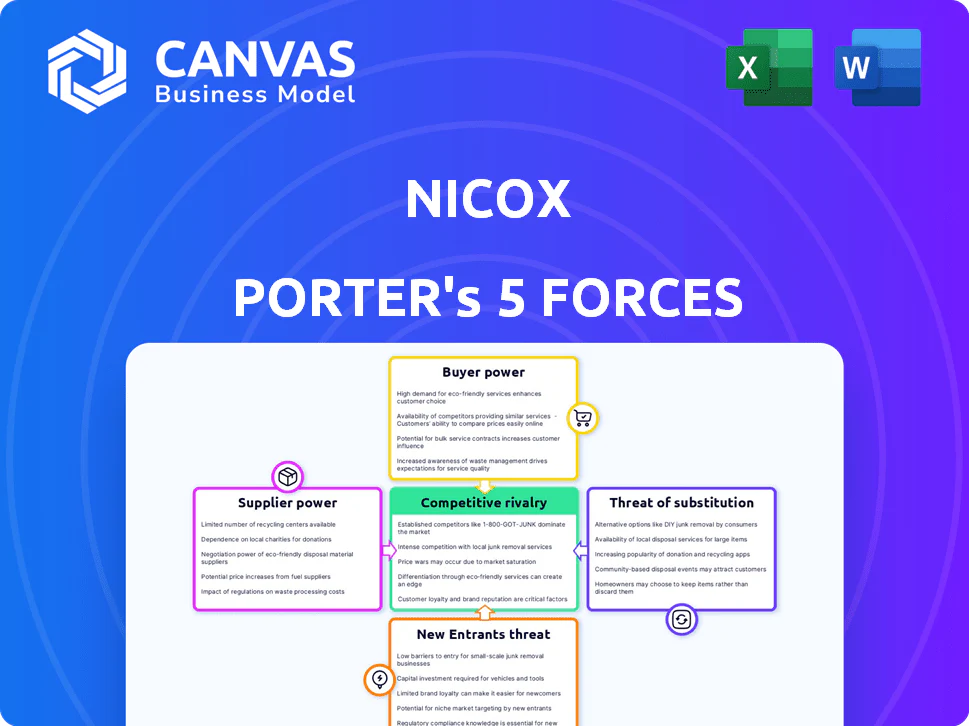
NICOX PORTER'S FIVE FORCES TEMPLATE RESEARCH
What is included in the product
 Detailed Word Document
Detailed analysis of each competitive force, supported by industry data and strategic commentary.

 Customizable Excel Spreadsheet
Easily swap data and labels to reflect business conditions with this customizable analysis.
Preview Before You Purchase
NicOx Porter's Five Forces Analysis
This preview offers the full NicOx Porter's Five Forces analysis. It includes detailed assessments of competitive rivalry, supplier power, buyer power, threat of substitution, and threat of new entrants.
The document presented is the complete analysis you'll receive, providing a comprehensive understanding of NicOx's industry dynamics.
Everything displayed is included in the downloadable file. The full analysis is available immediately after your purchase.
No content changes will occur after your purchase; you get the complete analysis you see right now.
This preview represents the final document; it is ready for you to download and utilize instantly after payment.

Porter's Five Forces Analysis Template

Go Beyond the Preview—Access the Full Strategic Report
NicOx faces a complex market influenced by factors like generic competition and drug development costs. Bargaining power of buyers, such as healthcare providers, affects pricing. Supplier power, including API providers, also plays a role. The threat of new entrants is moderate, while substitute treatments pose a constant challenge. Competitive rivalry among pharmaceutical companies is intense.
Ready to move beyond the basics? Get a full strategic breakdown of NicOx’s market position, competitive intensity, and external threats—all in one powerful analysis.
Suppliers Bargaining Power

Reliance on Third-Party Manufacturers
Nicox's dependence on third-party manufacturers grants them bargaining power. This reliance limits Nicox's control over production and costs. Issues with manufacturers could disrupt product supply and trial progress. In 2024, many pharmaceutical companies faced supply chain challenges. These challenges included increased costs for raw materials and manufacturing delays.
Specialized Technology and Expertise
NicOx's reliance on nitric oxide tech could mean fewer specialized suppliers. These suppliers, with proprietary tech, might command higher prices. In 2024, the cost of specialized chemical compounds rose by approximately 7%. This could significantly impact NicOx's production costs.

Availability of Raw Materials
NicOx's reliance on specific raw materials grants suppliers leverage. For instance, in 2024, the cost of specialized chemical compounds increased by 7%, potentially affecting NicOx's production expenses. Any supply chain disruptions or price hikes could squeeze profit margins, reflecting supplier power's impact.

Supplier Concentration
Supplier concentration significantly shapes NicOx's operational landscape. If a limited number of specialized suppliers exist, their leverage increases. This scenario is common in pharmaceuticals, where unique manufacturing capabilities are essential. For instance, in 2024, the global pharmaceutical contract manufacturing market was valued at approximately $73.5 billion, highlighting the industry's reliance on external suppliers. This dependency can impact NicOx's costs and production timelines.
- Limited suppliers can dictate terms, potentially increasing costs.
- Specialized components or services enhance supplier power.
- Dependency on suppliers impacts production agility.
- Industry data suggests a concentrated supplier base.
Switching Costs
Switching costs significantly impact supplier power. For Nicox, high switching costs, such as those related to specialized manufacturing processes or regulatory approvals, can make it difficult to change suppliers. This reduced ability to switch enhances the suppliers' bargaining power. Consider that the pharmaceutical industry, where Nicox operates, has average switching costs of approximately $100,000 to $500,000 per product due to regulatory requirements alone. This figure underscores the suppliers' leverage in pricing and contract terms.
- High switching costs increase supplier power.
- Regulatory hurdles significantly raise these costs.
- The pharmaceutical industry faces substantial switching costs.
- This impacts Nicox's negotiation leverage.
NicOx's Supplier Dynamics: Costs, Risks, and Dependencies
Suppliers' power over NicOx stems from factors like limited specialized options and reliance on specific materials. This can lead to increased production expenses and potential supply chain disruptions. High switching costs, such as those related to specialized manufacturing processes or regulatory approvals, further amplify suppliers' influence.
| Factor | Impact on NicOx | 2024 Data |
|---|---|---|
| Supplier Concentration | Higher costs, supply risks | Pharma contract manufacturing: $73.5B |
| Switching Costs | Reduced negotiation power | Switching costs: $100K-$500K/product |
| Material Dependency | Margin squeeze | Specialized chemical costs rose by 7% |
Customers Bargaining Power

Availability of Treatment Options
The bargaining power of customers, including patients and healthcare providers, is affected by the availability of alternative treatments for eye conditions like glaucoma and retinal diseases, NicOx's focus. If many treatment options exist, customers can choose based on price, effectiveness, and how well they are tolerated. The ophthalmic pharmaceutical market was valued at $31.4 billion in 2023. The more choices available, the stronger the customer's negotiating position. This can pressure NicOx to offer competitive pricing and demonstrate superior product benefits.
Reimbursement and Pricing Pressure
Healthcare systems and insurance providers, key payers in the ophthalmic drug market, wield considerable bargaining power. They influence pricing and reimbursement for drugs like those from Nicox. This power can limit Nicox's ability to set high prices for its innovative products. In 2024, the pharmaceutical industry faced intense scrutiny over drug pricing, with some payers pushing back on costs. For example, the Centers for Medicare & Medicaid Services (CMS) finalized a rule in 2024 allowing Medicare to negotiate drug prices, impacting companies like Nicox.

Clinical Trial Results and Product Differentiation
Positive clinical trial results for Nicox's NCX 470 could enhance its appeal, potentially lessening customer price sensitivity. If competitors offer comparable benefits, customer bargaining power stays strong. In 2024, the pharmaceutical industry saw about $1.5 trillion in global sales, with customer choices heavily influencing market dynamics. Product differentiation is key to maintain customer loyalty.

Key Opinion Leaders and Physician Prescribing Habits
Ophthalmologists and eye care professionals significantly shape treatment choices. Their prescribing habits directly affect Nicox's market success. Physician preferences for established or novel therapies are crucial for product adoption. Factors like drug efficacy and side effects greatly influence their decisions.
- In 2024, approximately 20,000 ophthalmologists practiced in the U.S.
- About 70% of prescriptions are influenced by physician recommendations.
- Nicox's net product sales in 2023 were around €10.4 million.
Patient Advocacy and Awareness
Patient advocacy and awareness significantly shape customer bargaining power in the pharmaceutical sector. Informed patients, often supported by advocacy groups, influence treatment choices and demand access to specific therapies. This can boost demand for effective treatments, but also compels companies to prove value and affordability. For instance, in 2024, patient groups successfully lobbied for lower drug prices in several countries.
- Patient advocacy groups significantly influence treatment choices.
- They increase demand for effective treatments.
- Companies must demonstrate value and affordability.
- In 2024, groups lobbied for lower drug prices.
NicOx's Market: Bargaining Power & Dynamics
Customer bargaining power significantly shapes NicOx's market dynamics. The ophthalmic pharmaceutical market reached $31.4 billion in 2023. Healthcare payers and patient advocacy groups influence pricing and treatment choices. Product differentiation and physician preferences are crucial for success.
| Aspect | Impact on NicOx | 2024 Data |
|---|---|---|
| Competition | Pricing pressure | $1.5T global pharma sales |
| Payers | Price negotiation | CMS rule on drug prices |
| Physicians | Prescribing influence | 20,000 U.S. ophthalmologists |
Rivalry Among Competitors

Presence of Established Players
The ophthalmology market is highly competitive, featuring established pharmaceutical giants. These companies possess substantial resources, advanced commercial infrastructures, and diverse product portfolios. In 2024, companies like Novartis and Roche reported billions in revenue from ophthalmology products. This makes them formidable rivals for Nicox.
Pipeline and Emerging Therapies
Competitive rivalry in the ophthalmic market is significantly influenced by the emerging therapies pipeline. New products with innovative mechanisms can heighten competition, posing challenges for NicOx. For instance, in 2024, several companies are advancing treatments for glaucoma and dry eye, potentially impacting NicOx's market share. The competitive landscape is dynamic, with clinical trial results and regulatory approvals shaping the intensity of rivalry.

Generic Competition
Generic competition significantly affects Nicox. The availability of cheaper generic drugs like latanoprost intensifies price pressure. Nicox's products must offer compelling advantages to compete effectively. For example, in 2024, generic ophthalmic drugs held a substantial market share. This necessitates strong differentiation and value demonstration.

Innovation and Differentiation
Nicox's innovation in nitric oxide-donating technology is a key differentiator, setting it apart in the pharmaceutical market. This focus aims to improve drug efficacy and safety profiles. The success of this approach, measured by clinical trial results and market uptake, will significantly shape competitive dynamics. It's crucial to monitor how well Nicox's products perform against existing treatments and new entrants.
- Nicox's lead product, VYZULTA, generated $75.7 million in net sales in 2023.
- The global glaucoma market is projected to reach $4.7 billion by 2028.
- Clinical trial success rates for new glaucoma treatments average around 60%.
- Nicox's market cap as of March 2024 was approximately $150 million.
Marketing and Sales Capabilities
Nicox's success hinges on its marketing and sales prowess, particularly through partnerships like Bausch + Lomb and Ocumension. These alliances are vital for competing effectively. Strong commercial capabilities are essential to capture market share from competitors. In 2024, effective sales strategies are key in the pharmaceutical industry.
- Nicox's strategy involves leveraging partners for market reach.
- Commercial strength is vital for gaining a competitive edge.
- In 2024, marketing and sales are crucial for success.
Ophthalmology's Battleground: Giants vs. Nicox
Competitive rivalry in ophthalmology is fierce due to established giants and generic competition. Nicox faces challenges from rivals like Novartis and Roche, which reported billions in ophthalmic sales in 2024. The glaucoma market, valued at $4.7 billion by 2028, intensifies the competition.
| Aspect | Details | Impact on Nicox |
|---|---|---|
| Key Competitors | Novartis, Roche, generic drug makers | Pressure on market share |
| Market Size (Glaucoma) | $4.7 billion by 2028 | High stakes, intense rivalry |
| VYZULTA Sales (2023) | $75.7 million | Need for strong market presence |
Original: $10.00
-65%$10.00
$3.50NICOX PORTER'S FIVE FORCES TEMPLATE RESEARCH
What is included in the product
Detailed Word Document
Detailed analysis of each competitive force, supported by industry data and strategic commentary.
Customizable Excel Spreadsheet
Easily swap data and labels to reflect business conditions with this customizable analysis.
Preview Before You Purchase
NicOx Porter's Five Forces Analysis
This preview offers the full NicOx Porter's Five Forces analysis. It includes detailed assessments of competitive rivalry, supplier power, buyer power, threat of substitution, and threat of new entrants.
The document presented is the complete analysis you'll receive, providing a comprehensive understanding of NicOx's industry dynamics.
Everything displayed is included in the downloadable file. The full analysis is available immediately after your purchase.
No content changes will occur after your purchase; you get the complete analysis you see right now.
This preview represents the final document; it is ready for you to download and utilize instantly after payment.
Porter's Five Forces Analysis Template
Go Beyond the Preview—Access the Full Strategic Report
NicOx faces a complex market influenced by factors like generic competition and drug development costs. Bargaining power of buyers, such as healthcare providers, affects pricing. Supplier power, including API providers, also plays a role. The threat of new entrants is moderate, while substitute treatments pose a constant challenge. Competitive rivalry among pharmaceutical companies is intense.
Ready to move beyond the basics? Get a full strategic breakdown of NicOx’s market position, competitive intensity, and external threats—all in one powerful analysis.
Suppliers Bargaining Power
Reliance on Third-Party Manufacturers
Nicox's dependence on third-party manufacturers grants them bargaining power. This reliance limits Nicox's control over production and costs. Issues with manufacturers could disrupt product supply and trial progress. In 2024, many pharmaceutical companies faced supply chain challenges. These challenges included increased costs for raw materials and manufacturing delays.
Specialized Technology and Expertise
NicOx's reliance on nitric oxide tech could mean fewer specialized suppliers. These suppliers, with proprietary tech, might command higher prices. In 2024, the cost of specialized chemical compounds rose by approximately 7%. This could significantly impact NicOx's production costs.
Availability of Raw Materials
NicOx's reliance on specific raw materials grants suppliers leverage. For instance, in 2024, the cost of specialized chemical compounds increased by 7%, potentially affecting NicOx's production expenses. Any supply chain disruptions or price hikes could squeeze profit margins, reflecting supplier power's impact.
Supplier Concentration
Supplier concentration significantly shapes NicOx's operational landscape. If a limited number of specialized suppliers exist, their leverage increases. This scenario is common in pharmaceuticals, where unique manufacturing capabilities are essential. For instance, in 2024, the global pharmaceutical contract manufacturing market was valued at approximately $73.5 billion, highlighting the industry's reliance on external suppliers. This dependency can impact NicOx's costs and production timelines.
- Limited suppliers can dictate terms, potentially increasing costs.
- Specialized components or services enhance supplier power.
- Dependency on suppliers impacts production agility.
- Industry data suggests a concentrated supplier base.
Switching Costs
Switching costs significantly impact supplier power. For Nicox, high switching costs, such as those related to specialized manufacturing processes or regulatory approvals, can make it difficult to change suppliers. This reduced ability to switch enhances the suppliers' bargaining power. Consider that the pharmaceutical industry, where Nicox operates, has average switching costs of approximately $100,000 to $500,000 per product due to regulatory requirements alone. This figure underscores the suppliers' leverage in pricing and contract terms.
- High switching costs increase supplier power.
- Regulatory hurdles significantly raise these costs.
- The pharmaceutical industry faces substantial switching costs.
- This impacts Nicox's negotiation leverage.
NicOx's Supplier Dynamics: Costs, Risks, and Dependencies
Suppliers' power over NicOx stems from factors like limited specialized options and reliance on specific materials. This can lead to increased production expenses and potential supply chain disruptions. High switching costs, such as those related to specialized manufacturing processes or regulatory approvals, further amplify suppliers' influence.
| Factor | Impact on NicOx | 2024 Data |
|---|---|---|
| Supplier Concentration | Higher costs, supply risks | Pharma contract manufacturing: $73.5B |
| Switching Costs | Reduced negotiation power | Switching costs: $100K-$500K/product |
| Material Dependency | Margin squeeze | Specialized chemical costs rose by 7% |
Customers Bargaining Power
Availability of Treatment Options
The bargaining power of customers, including patients and healthcare providers, is affected by the availability of alternative treatments for eye conditions like glaucoma and retinal diseases, NicOx's focus. If many treatment options exist, customers can choose based on price, effectiveness, and how well they are tolerated. The ophthalmic pharmaceutical market was valued at $31.4 billion in 2023. The more choices available, the stronger the customer's negotiating position. This can pressure NicOx to offer competitive pricing and demonstrate superior product benefits.
Reimbursement and Pricing Pressure
Healthcare systems and insurance providers, key payers in the ophthalmic drug market, wield considerable bargaining power. They influence pricing and reimbursement for drugs like those from Nicox. This power can limit Nicox's ability to set high prices for its innovative products. In 2024, the pharmaceutical industry faced intense scrutiny over drug pricing, with some payers pushing back on costs. For example, the Centers for Medicare & Medicaid Services (CMS) finalized a rule in 2024 allowing Medicare to negotiate drug prices, impacting companies like Nicox.
Clinical Trial Results and Product Differentiation
Positive clinical trial results for Nicox's NCX 470 could enhance its appeal, potentially lessening customer price sensitivity. If competitors offer comparable benefits, customer bargaining power stays strong. In 2024, the pharmaceutical industry saw about $1.5 trillion in global sales, with customer choices heavily influencing market dynamics. Product differentiation is key to maintain customer loyalty.
Key Opinion Leaders and Physician Prescribing Habits
Ophthalmologists and eye care professionals significantly shape treatment choices. Their prescribing habits directly affect Nicox's market success. Physician preferences for established or novel therapies are crucial for product adoption. Factors like drug efficacy and side effects greatly influence their decisions.
- In 2024, approximately 20,000 ophthalmologists practiced in the U.S.
- About 70% of prescriptions are influenced by physician recommendations.
- Nicox's net product sales in 2023 were around €10.4 million.
Patient Advocacy and Awareness
Patient advocacy and awareness significantly shape customer bargaining power in the pharmaceutical sector. Informed patients, often supported by advocacy groups, influence treatment choices and demand access to specific therapies. This can boost demand for effective treatments, but also compels companies to prove value and affordability. For instance, in 2024, patient groups successfully lobbied for lower drug prices in several countries.
- Patient advocacy groups significantly influence treatment choices.
- They increase demand for effective treatments.
- Companies must demonstrate value and affordability.
- In 2024, groups lobbied for lower drug prices.
NicOx's Market: Bargaining Power & Dynamics
Customer bargaining power significantly shapes NicOx's market dynamics. The ophthalmic pharmaceutical market reached $31.4 billion in 2023. Healthcare payers and patient advocacy groups influence pricing and treatment choices. Product differentiation and physician preferences are crucial for success.
| Aspect | Impact on NicOx | 2024 Data |
|---|---|---|
| Competition | Pricing pressure | $1.5T global pharma sales |
| Payers | Price negotiation | CMS rule on drug prices |
| Physicians | Prescribing influence | 20,000 U.S. ophthalmologists |
Rivalry Among Competitors
Presence of Established Players
The ophthalmology market is highly competitive, featuring established pharmaceutical giants. These companies possess substantial resources, advanced commercial infrastructures, and diverse product portfolios. In 2024, companies like Novartis and Roche reported billions in revenue from ophthalmology products. This makes them formidable rivals for Nicox.
Pipeline and Emerging Therapies
Competitive rivalry in the ophthalmic market is significantly influenced by the emerging therapies pipeline. New products with innovative mechanisms can heighten competition, posing challenges for NicOx. For instance, in 2024, several companies are advancing treatments for glaucoma and dry eye, potentially impacting NicOx's market share. The competitive landscape is dynamic, with clinical trial results and regulatory approvals shaping the intensity of rivalry.
Generic Competition
Generic competition significantly affects Nicox. The availability of cheaper generic drugs like latanoprost intensifies price pressure. Nicox's products must offer compelling advantages to compete effectively. For example, in 2024, generic ophthalmic drugs held a substantial market share. This necessitates strong differentiation and value demonstration.
Innovation and Differentiation
Nicox's innovation in nitric oxide-donating technology is a key differentiator, setting it apart in the pharmaceutical market. This focus aims to improve drug efficacy and safety profiles. The success of this approach, measured by clinical trial results and market uptake, will significantly shape competitive dynamics. It's crucial to monitor how well Nicox's products perform against existing treatments and new entrants.
- Nicox's lead product, VYZULTA, generated $75.7 million in net sales in 2023.
- The global glaucoma market is projected to reach $4.7 billion by 2028.
- Clinical trial success rates for new glaucoma treatments average around 60%.
- Nicox's market cap as of March 2024 was approximately $150 million.
Marketing and Sales Capabilities
Nicox's success hinges on its marketing and sales prowess, particularly through partnerships like Bausch + Lomb and Ocumension. These alliances are vital for competing effectively. Strong commercial capabilities are essential to capture market share from competitors. In 2024, effective sales strategies are key in the pharmaceutical industry.
- Nicox's strategy involves leveraging partners for market reach.
- Commercial strength is vital for gaining a competitive edge.
- In 2024, marketing and sales are crucial for success.
Ophthalmology's Battleground: Giants vs. Nicox
Competitive rivalry in ophthalmology is fierce due to established giants and generic competition. Nicox faces challenges from rivals like Novartis and Roche, which reported billions in ophthalmic sales in 2024. The glaucoma market, valued at $4.7 billion by 2028, intensifies the competition.
| Aspect | Details | Impact on Nicox |
|---|---|---|
| Key Competitors | Novartis, Roche, generic drug makers | Pressure on market share |
| Market Size (Glaucoma) | $4.7 billion by 2028 | High stakes, intense rivalry |
| VYZULTA Sales (2023) | $75.7 million | Need for strong market presence |
Product Information
Product Information
Shipping & Returns
Shipping & Returns
Description
What is included in the product
Detailed Word Document
Detailed analysis of each competitive force, supported by industry data and strategic commentary.
Customizable Excel Spreadsheet
Easily swap data and labels to reflect business conditions with this customizable analysis.
Preview Before You Purchase
NicOx Porter's Five Forces Analysis
This preview offers the full NicOx Porter's Five Forces analysis. It includes detailed assessments of competitive rivalry, supplier power, buyer power, threat of substitution, and threat of new entrants.
The document presented is the complete analysis you'll receive, providing a comprehensive understanding of NicOx's industry dynamics.
Everything displayed is included in the downloadable file. The full analysis is available immediately after your purchase.
No content changes will occur after your purchase; you get the complete analysis you see right now.
This preview represents the final document; it is ready for you to download and utilize instantly after payment.
Porter's Five Forces Analysis Template
Go Beyond the Preview—Access the Full Strategic Report
NicOx faces a complex market influenced by factors like generic competition and drug development costs. Bargaining power of buyers, such as healthcare providers, affects pricing. Supplier power, including API providers, also plays a role. The threat of new entrants is moderate, while substitute treatments pose a constant challenge. Competitive rivalry among pharmaceutical companies is intense.
Ready to move beyond the basics? Get a full strategic breakdown of NicOx’s market position, competitive intensity, and external threats—all in one powerful analysis.
Suppliers Bargaining Power
Reliance on Third-Party Manufacturers
Nicox's dependence on third-party manufacturers grants them bargaining power. This reliance limits Nicox's control over production and costs. Issues with manufacturers could disrupt product supply and trial progress. In 2024, many pharmaceutical companies faced supply chain challenges. These challenges included increased costs for raw materials and manufacturing delays.
Specialized Technology and Expertise
NicOx's reliance on nitric oxide tech could mean fewer specialized suppliers. These suppliers, with proprietary tech, might command higher prices. In 2024, the cost of specialized chemical compounds rose by approximately 7%. This could significantly impact NicOx's production costs.
Availability of Raw Materials
NicOx's reliance on specific raw materials grants suppliers leverage. For instance, in 2024, the cost of specialized chemical compounds increased by 7%, potentially affecting NicOx's production expenses. Any supply chain disruptions or price hikes could squeeze profit margins, reflecting supplier power's impact.
Supplier Concentration
Supplier concentration significantly shapes NicOx's operational landscape. If a limited number of specialized suppliers exist, their leverage increases. This scenario is common in pharmaceuticals, where unique manufacturing capabilities are essential. For instance, in 2024, the global pharmaceutical contract manufacturing market was valued at approximately $73.5 billion, highlighting the industry's reliance on external suppliers. This dependency can impact NicOx's costs and production timelines.
- Limited suppliers can dictate terms, potentially increasing costs.
- Specialized components or services enhance supplier power.
- Dependency on suppliers impacts production agility.
- Industry data suggests a concentrated supplier base.
Switching Costs
Switching costs significantly impact supplier power. For Nicox, high switching costs, such as those related to specialized manufacturing processes or regulatory approvals, can make it difficult to change suppliers. This reduced ability to switch enhances the suppliers' bargaining power. Consider that the pharmaceutical industry, where Nicox operates, has average switching costs of approximately $100,000 to $500,000 per product due to regulatory requirements alone. This figure underscores the suppliers' leverage in pricing and contract terms.
- High switching costs increase supplier power.
- Regulatory hurdles significantly raise these costs.
- The pharmaceutical industry faces substantial switching costs.
- This impacts Nicox's negotiation leverage.
NicOx's Supplier Dynamics: Costs, Risks, and Dependencies
Suppliers' power over NicOx stems from factors like limited specialized options and reliance on specific materials. This can lead to increased production expenses and potential supply chain disruptions. High switching costs, such as those related to specialized manufacturing processes or regulatory approvals, further amplify suppliers' influence.
| Factor | Impact on NicOx | 2024 Data |
|---|---|---|
| Supplier Concentration | Higher costs, supply risks | Pharma contract manufacturing: $73.5B |
| Switching Costs | Reduced negotiation power | Switching costs: $100K-$500K/product |
| Material Dependency | Margin squeeze | Specialized chemical costs rose by 7% |
Customers Bargaining Power
Availability of Treatment Options
The bargaining power of customers, including patients and healthcare providers, is affected by the availability of alternative treatments for eye conditions like glaucoma and retinal diseases, NicOx's focus. If many treatment options exist, customers can choose based on price, effectiveness, and how well they are tolerated. The ophthalmic pharmaceutical market was valued at $31.4 billion in 2023. The more choices available, the stronger the customer's negotiating position. This can pressure NicOx to offer competitive pricing and demonstrate superior product benefits.
Reimbursement and Pricing Pressure
Healthcare systems and insurance providers, key payers in the ophthalmic drug market, wield considerable bargaining power. They influence pricing and reimbursement for drugs like those from Nicox. This power can limit Nicox's ability to set high prices for its innovative products. In 2024, the pharmaceutical industry faced intense scrutiny over drug pricing, with some payers pushing back on costs. For example, the Centers for Medicare & Medicaid Services (CMS) finalized a rule in 2024 allowing Medicare to negotiate drug prices, impacting companies like Nicox.
Clinical Trial Results and Product Differentiation
Positive clinical trial results for Nicox's NCX 470 could enhance its appeal, potentially lessening customer price sensitivity. If competitors offer comparable benefits, customer bargaining power stays strong. In 2024, the pharmaceutical industry saw about $1.5 trillion in global sales, with customer choices heavily influencing market dynamics. Product differentiation is key to maintain customer loyalty.
Key Opinion Leaders and Physician Prescribing Habits
Ophthalmologists and eye care professionals significantly shape treatment choices. Their prescribing habits directly affect Nicox's market success. Physician preferences for established or novel therapies are crucial for product adoption. Factors like drug efficacy and side effects greatly influence their decisions.
- In 2024, approximately 20,000 ophthalmologists practiced in the U.S.
- About 70% of prescriptions are influenced by physician recommendations.
- Nicox's net product sales in 2023 were around €10.4 million.
Patient Advocacy and Awareness
Patient advocacy and awareness significantly shape customer bargaining power in the pharmaceutical sector. Informed patients, often supported by advocacy groups, influence treatment choices and demand access to specific therapies. This can boost demand for effective treatments, but also compels companies to prove value and affordability. For instance, in 2024, patient groups successfully lobbied for lower drug prices in several countries.
- Patient advocacy groups significantly influence treatment choices.
- They increase demand for effective treatments.
- Companies must demonstrate value and affordability.
- In 2024, groups lobbied for lower drug prices.
NicOx's Market: Bargaining Power & Dynamics
Customer bargaining power significantly shapes NicOx's market dynamics. The ophthalmic pharmaceutical market reached $31.4 billion in 2023. Healthcare payers and patient advocacy groups influence pricing and treatment choices. Product differentiation and physician preferences are crucial for success.
| Aspect | Impact on NicOx | 2024 Data |
|---|---|---|
| Competition | Pricing pressure | $1.5T global pharma sales |
| Payers | Price negotiation | CMS rule on drug prices |
| Physicians | Prescribing influence | 20,000 U.S. ophthalmologists |
Rivalry Among Competitors
Presence of Established Players
The ophthalmology market is highly competitive, featuring established pharmaceutical giants. These companies possess substantial resources, advanced commercial infrastructures, and diverse product portfolios. In 2024, companies like Novartis and Roche reported billions in revenue from ophthalmology products. This makes them formidable rivals for Nicox.
Pipeline and Emerging Therapies
Competitive rivalry in the ophthalmic market is significantly influenced by the emerging therapies pipeline. New products with innovative mechanisms can heighten competition, posing challenges for NicOx. For instance, in 2024, several companies are advancing treatments for glaucoma and dry eye, potentially impacting NicOx's market share. The competitive landscape is dynamic, with clinical trial results and regulatory approvals shaping the intensity of rivalry.
Generic Competition
Generic competition significantly affects Nicox. The availability of cheaper generic drugs like latanoprost intensifies price pressure. Nicox's products must offer compelling advantages to compete effectively. For example, in 2024, generic ophthalmic drugs held a substantial market share. This necessitates strong differentiation and value demonstration.
Innovation and Differentiation
Nicox's innovation in nitric oxide-donating technology is a key differentiator, setting it apart in the pharmaceutical market. This focus aims to improve drug efficacy and safety profiles. The success of this approach, measured by clinical trial results and market uptake, will significantly shape competitive dynamics. It's crucial to monitor how well Nicox's products perform against existing treatments and new entrants.
- Nicox's lead product, VYZULTA, generated $75.7 million in net sales in 2023.
- The global glaucoma market is projected to reach $4.7 billion by 2028.
- Clinical trial success rates for new glaucoma treatments average around 60%.
- Nicox's market cap as of March 2024 was approximately $150 million.
Marketing and Sales Capabilities
Nicox's success hinges on its marketing and sales prowess, particularly through partnerships like Bausch + Lomb and Ocumension. These alliances are vital for competing effectively. Strong commercial capabilities are essential to capture market share from competitors. In 2024, effective sales strategies are key in the pharmaceutical industry.
- Nicox's strategy involves leveraging partners for market reach.
- Commercial strength is vital for gaining a competitive edge.
- In 2024, marketing and sales are crucial for success.
Ophthalmology's Battleground: Giants vs. Nicox
Competitive rivalry in ophthalmology is fierce due to established giants and generic competition. Nicox faces challenges from rivals like Novartis and Roche, which reported billions in ophthalmic sales in 2024. The glaucoma market, valued at $4.7 billion by 2028, intensifies the competition.
| Aspect | Details | Impact on Nicox |
|---|---|---|
| Key Competitors | Novartis, Roche, generic drug makers | Pressure on market share |
| Market Size (Glaucoma) | $4.7 billion by 2028 | High stakes, intense rivalry |
| VYZULTA Sales (2023) | $75.7 million | Need for strong market presence |











