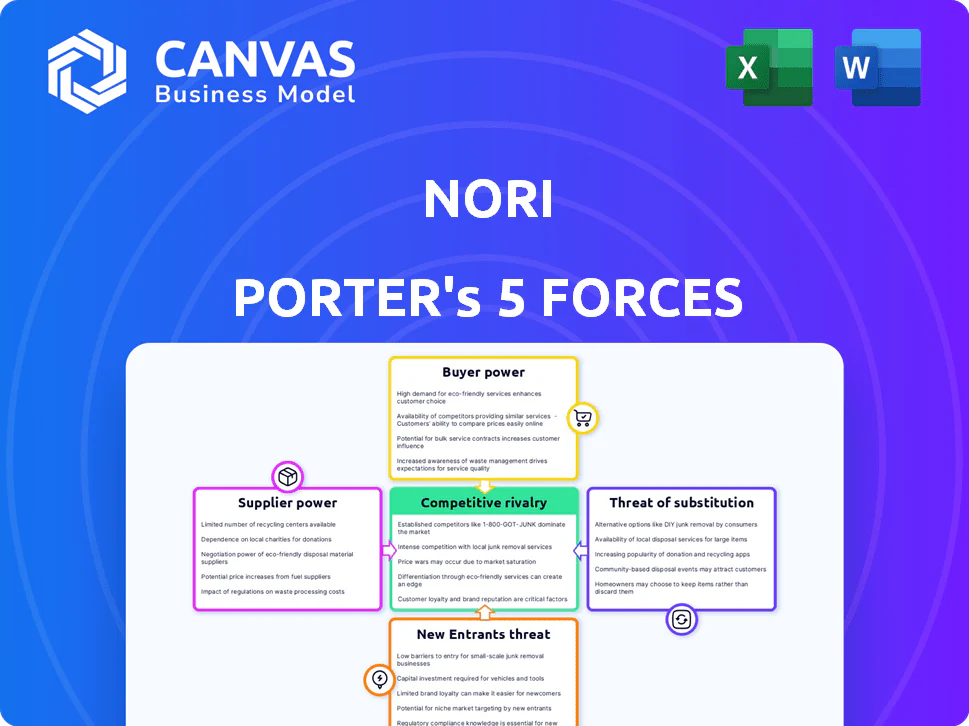
NORI PORTER'S FIVE FORCES TEMPLATE RESEARCH
What is included in the product
 Detailed Word Document
Detailed analysis of each competitive force, supported by industry data and strategic commentary.

 Customizable Excel Spreadsheet
Instantly identify key industry pressures with color-coded force scores.
What You See Is What You Get
Nori Porter's Five Forces Analysis
This preview unveils the complete Nori Porter's Five Forces analysis. The document displayed mirrors the full version accessible immediately after purchase. Expect a thoroughly researched examination of industry dynamics. It’s formatted professionally, ready for instant download.

Porter's Five Forces Analysis Template

Don't Miss the Bigger Picture
Nori operates in a complex carbon removal market, facing unique competitive pressures. Buyer power stems from large corporations' ability to negotiate prices. The threat of new entrants is moderate due to capital requirements and regulatory hurdles. Substitute products like nature-based solutions pose a threat, while supplier power from landholders varies. Competitive rivalry is increasing as the market matures.
This brief snapshot only scratches the surface. Unlock the full Porter's Five Forces Analysis to explore Nori’s competitive dynamics, market pressures, and strategic advantages in detail.
Suppliers Bargaining Power

Limited number of carbon removal technology suppliers.
The market for carbon removal, especially soil carbon sequestration, can be concentrated, impacting Nori. A limited number of suppliers with unique technologies can influence pricing and terms, as seen with some biochar providers. Nori needs strategic partnerships to secure a stable supply of carbon removal credits. In 2024, the carbon removal market was valued at $800 million, highlighting supplier power.
Dependence on agricultural practices.
Nori's success hinges on farmers' adoption of regenerative agriculture. This directly influences the supply of carbon removal credits. In 2024, the market saw a growing interest in these credits, with prices fluctuating. Farmers' willingness to participate grants them some bargaining power. For instance, in 2024, a ton of CO2 removal credits cost around $15-$25.

Verification and measurement challenges.
Accurately measuring and verifying carbon removal is complex and expensive. Suppliers with verifiable carbon removal have more power in negotiations. Nori's standardization efforts help, but verification ease and cost affect supplier power. In 2024, the average cost for carbon removal verification was $15-$25 per credit.

Development of new carbon removal technologies.
The bargaining power of suppliers in the carbon removal market is evolving. As new technologies like direct air capture and biochar develop, the landscape of suppliers changes. These suppliers could gain more influence over carbon credit types and prices on marketplaces. The value of the carbon removal market is projected to reach $2.1 billion by 2024.
- Direct air capture (DAC) facilities are growing, with several projects planned or operational globally.
- Biochar production and supply chains are expanding, though still relatively niche.
- The price of carbon credits varies significantly based on the removal method.
- Marketplaces like Nori facilitate transactions between suppliers and buyers.
Supplier concentration in specific project types.
Supplier concentration significantly impacts Nori's bargaining power. If Nori heavily depends on a specific carbon removal project type, concentrated suppliers gain leverage. Bayer Carbon Program's influence exemplifies this dynamic.
- Bayer's program could impact Nori's supply.
- Concentrated suppliers can raise prices.
- Diversification reduces supplier power.
- Market dynamics shift with project focus.
Carbon Removal: Supplier Dynamics
Supplier power in carbon removal varies. Technologies and market concentration affect Nori's leverage. In 2024, the market was $800M, with direct air capture expanding. Strategic partnerships and diversification are key.
| Aspect | Impact on Nori | 2024 Data |
|---|---|---|
| Supplier Concentration | Higher power for concentrated suppliers | DAC market share: 5% |
| Technology | Influences credit type, price | Biochar credit price: $15-$30/ton |
| Market Growth | Impacts supplier bargaining | Market value: $800M |
Customers Bargaining Power

Increasing corporate demand for high-quality carbon removal.
Corporate demand for carbon removal is on the rise, driven by net-zero goals. This shift boosts buyer power, particularly for substantial or long-term credit purchases. Increased selectivity enables buyers to negotiate favorable terms. The market for carbon credits is projected to reach $100 billion by 2030, with high-quality credits gaining premium value.
Availability of alternative carbon offsetting options.
Customers can offset carbon footprints through various methods. This includes emission reduction projects and different carbon credit types (avoidance vs. removal). The availability of alternatives gives customers leverage. They can choose the best method, potentially pressuring Nori's pricing. The global carbon offset market was valued at $271.3 billion in 2023.

Focus on credit quality and integrity.
Buyers' sophistication increases scrutiny of carbon credits. This focus on credit quality empowers buyers. Rigorous verification and transparent reporting are in demand. In 2024, the voluntary carbon market saw significant growth, with over $2 billion in transactions.

Large corporations making significant purchase commitments.
Large corporations, when committing to significant carbon removal credit purchases, wield considerable market influence. These major buyers, such as Microsoft and Stripe, often dictate specific requirements, impacting project standards. Their substantial purchasing power allows them to negotiate favorable terms, influencing pricing dynamics. This dynamic underscores the importance of understanding customer bargaining power in the carbon removal market.
- Microsoft has committed to purchasing 1.5 million tons of carbon removal by 2025.
- Stripe has spent over $10 million on carbon removal purchases.
- These large buyers drive innovation and market standards.
- Negotiated terms include pricing, credit quality, and project specifics.
Customer preference for specific carbon removal methods.
Customer preference significantly shapes the carbon removal market. If buyers favor nature-based solutions over technology, and Nori's offerings don't align, customers gain leverage. This can drive them to competitors or influence Nori's pricing and strategy. For example, in 2024, nature-based solutions attracted 55% of carbon credit investments.
- Nature-based solutions: 55% of 2024 carbon credit investments.
- Technological approaches: Remainder of investments.
- Customer preference directly impacts demand.
- Misalignment can reduce Nori's market share.
Carbon Removal: Buyer Power Dynamics
Buyer power in carbon removal is strong, especially for large purchasers. Corporate demand influences pricing and project standards. The availability of alternatives and preferences for specific solutions like nature-based credits further boost customer leverage.
| Aspect | Details | 2024 Data |
|---|---|---|
| Market Growth | Overall market expansion and value | Voluntary carbon market transactions exceeded $2B |
| Investment Preferences | Allocation of investments across different credit types | Nature-based solutions attracted 55% of carbon credit investments |
| Key Buyers | Impact of major corporate purchasers | Microsoft committed to 1.5M tons of removal by 2025 |
Rivalry Among Competitors

Presence of other carbon marketplaces and registries.
Nori faces competition from other carbon marketplaces and registries, increasing competitive rivalry. These platforms offer similar services, vying for both suppliers and buyers of carbon credits. The level of competition hinges on how each platform differentiates itself. For instance, as of 2024, the carbon credit market is valued at over $850 billion, showing the scale of competition.
Competition from different carbon removal methodologies.
Nori, initially focused on soil carbon, faces competition from diverse carbon removal methods, including direct air capture and biochar.
These alternatives vie for buyer interest and investment, influencing rivalry dynamics.
Competition hinges on perceived effectiveness, cost, and scalability of each approach.
In 2024, direct air capture projects saw significant investment, with over $1 billion in funding, intensifying competition.
This rivalry impacts pricing and market share in the carbon credit sector.

Emergence of integrated climate solution providers.
Integrated climate solution providers are emerging, offering comprehensive services beyond carbon offsetting. These firms, like those providing emissions tracking and reduction strategies, compete directly with Nori. For instance, in 2024, the market for integrated climate solutions grew by 15%, indicating rising rivalry. This trend presents a challenge for Nori, as businesses seek one-stop solutions.

Pricing pressure in the voluntary carbon market.
Pricing pressure is significant in the voluntary carbon market, intensifying rivalry among providers. This is especially true for specific credit types, leading to price fluctuations. Competitors fiercely battle on cost while striving to uphold credit value and integrity. The market saw varied pricing in 2024, with some credits trading lower.
- Carbon credit prices have decreased in 2024, indicating increased competition.
- Competition focuses on both cost and maintaining credit quality.
- Platforms and suppliers face pressure to offer competitive pricing.
- The integrity of carbon removal credits is crucial in this rivalry.
Differentiation through verification standards and technology.
Carbon marketplaces fiercely compete by establishing credible, transparent verification methods and leveraging technology. Nori aims to stand out with blockchain use and standardization, aiming to build trust and draw users. The success of these efforts directly affects Nori's competitive standing in the carbon market. For instance, in 2024, the carbon market saw significant growth, with voluntary carbon credit transactions reaching approximately $2 billion.
- Marketplace competition hinges on verification and tech.
- Nori uses blockchain and standardization.
- Trust and user attraction are key.
- Voluntary carbon market transactions reached $2 billion in 2024.
Carbon Market Dynamics: A $2B Voluntary Sector
Competitive rivalry in the carbon market is intense, impacting pricing and market share. Platforms compete on cost, credit quality, and technology like blockchain. The voluntary carbon market saw $2B in transactions in 2024.
| Aspect | Details | 2024 Data |
|---|---|---|
| Market Value | Total Carbon Market | Over $850 Billion |
| Voluntary Market | Transactions | Approximately $2 Billion |
| Direct Air Capture | Investment | Over $1 Billion in Funding |
Original: $10.00
-65%$10.00
$3.50NORI PORTER'S FIVE FORCES TEMPLATE RESEARCH
What is included in the product
Detailed Word Document
Detailed analysis of each competitive force, supported by industry data and strategic commentary.
Customizable Excel Spreadsheet
Instantly identify key industry pressures with color-coded force scores.
What You See Is What You Get
Nori Porter's Five Forces Analysis
This preview unveils the complete Nori Porter's Five Forces analysis. The document displayed mirrors the full version accessible immediately after purchase. Expect a thoroughly researched examination of industry dynamics. It’s formatted professionally, ready for instant download.
Porter's Five Forces Analysis Template
Don't Miss the Bigger Picture
Nori operates in a complex carbon removal market, facing unique competitive pressures. Buyer power stems from large corporations' ability to negotiate prices. The threat of new entrants is moderate due to capital requirements and regulatory hurdles. Substitute products like nature-based solutions pose a threat, while supplier power from landholders varies. Competitive rivalry is increasing as the market matures.
This brief snapshot only scratches the surface. Unlock the full Porter's Five Forces Analysis to explore Nori’s competitive dynamics, market pressures, and strategic advantages in detail.
Suppliers Bargaining Power
Limited number of carbon removal technology suppliers.
The market for carbon removal, especially soil carbon sequestration, can be concentrated, impacting Nori. A limited number of suppliers with unique technologies can influence pricing and terms, as seen with some biochar providers. Nori needs strategic partnerships to secure a stable supply of carbon removal credits. In 2024, the carbon removal market was valued at $800 million, highlighting supplier power.
Dependence on agricultural practices.
Nori's success hinges on farmers' adoption of regenerative agriculture. This directly influences the supply of carbon removal credits. In 2024, the market saw a growing interest in these credits, with prices fluctuating. Farmers' willingness to participate grants them some bargaining power. For instance, in 2024, a ton of CO2 removal credits cost around $15-$25.
Verification and measurement challenges.
Accurately measuring and verifying carbon removal is complex and expensive. Suppliers with verifiable carbon removal have more power in negotiations. Nori's standardization efforts help, but verification ease and cost affect supplier power. In 2024, the average cost for carbon removal verification was $15-$25 per credit.
Development of new carbon removal technologies.
The bargaining power of suppliers in the carbon removal market is evolving. As new technologies like direct air capture and biochar develop, the landscape of suppliers changes. These suppliers could gain more influence over carbon credit types and prices on marketplaces. The value of the carbon removal market is projected to reach $2.1 billion by 2024.
- Direct air capture (DAC) facilities are growing, with several projects planned or operational globally.
- Biochar production and supply chains are expanding, though still relatively niche.
- The price of carbon credits varies significantly based on the removal method.
- Marketplaces like Nori facilitate transactions between suppliers and buyers.
Supplier concentration in specific project types.
Supplier concentration significantly impacts Nori's bargaining power. If Nori heavily depends on a specific carbon removal project type, concentrated suppliers gain leverage. Bayer Carbon Program's influence exemplifies this dynamic.
- Bayer's program could impact Nori's supply.
- Concentrated suppliers can raise prices.
- Diversification reduces supplier power.
- Market dynamics shift with project focus.
Carbon Removal: Supplier Dynamics
Supplier power in carbon removal varies. Technologies and market concentration affect Nori's leverage. In 2024, the market was $800M, with direct air capture expanding. Strategic partnerships and diversification are key.
| Aspect | Impact on Nori | 2024 Data |
|---|---|---|
| Supplier Concentration | Higher power for concentrated suppliers | DAC market share: 5% |
| Technology | Influences credit type, price | Biochar credit price: $15-$30/ton |
| Market Growth | Impacts supplier bargaining | Market value: $800M |
Customers Bargaining Power
Increasing corporate demand for high-quality carbon removal.
Corporate demand for carbon removal is on the rise, driven by net-zero goals. This shift boosts buyer power, particularly for substantial or long-term credit purchases. Increased selectivity enables buyers to negotiate favorable terms. The market for carbon credits is projected to reach $100 billion by 2030, with high-quality credits gaining premium value.
Availability of alternative carbon offsetting options.
Customers can offset carbon footprints through various methods. This includes emission reduction projects and different carbon credit types (avoidance vs. removal). The availability of alternatives gives customers leverage. They can choose the best method, potentially pressuring Nori's pricing. The global carbon offset market was valued at $271.3 billion in 2023.
Focus on credit quality and integrity.
Buyers' sophistication increases scrutiny of carbon credits. This focus on credit quality empowers buyers. Rigorous verification and transparent reporting are in demand. In 2024, the voluntary carbon market saw significant growth, with over $2 billion in transactions.
Large corporations making significant purchase commitments.
Large corporations, when committing to significant carbon removal credit purchases, wield considerable market influence. These major buyers, such as Microsoft and Stripe, often dictate specific requirements, impacting project standards. Their substantial purchasing power allows them to negotiate favorable terms, influencing pricing dynamics. This dynamic underscores the importance of understanding customer bargaining power in the carbon removal market.
- Microsoft has committed to purchasing 1.5 million tons of carbon removal by 2025.
- Stripe has spent over $10 million on carbon removal purchases.
- These large buyers drive innovation and market standards.
- Negotiated terms include pricing, credit quality, and project specifics.
Customer preference for specific carbon removal methods.
Customer preference significantly shapes the carbon removal market. If buyers favor nature-based solutions over technology, and Nori's offerings don't align, customers gain leverage. This can drive them to competitors or influence Nori's pricing and strategy. For example, in 2024, nature-based solutions attracted 55% of carbon credit investments.
- Nature-based solutions: 55% of 2024 carbon credit investments.
- Technological approaches: Remainder of investments.
- Customer preference directly impacts demand.
- Misalignment can reduce Nori's market share.
Carbon Removal: Buyer Power Dynamics
Buyer power in carbon removal is strong, especially for large purchasers. Corporate demand influences pricing and project standards. The availability of alternatives and preferences for specific solutions like nature-based credits further boost customer leverage.
| Aspect | Details | 2024 Data |
|---|---|---|
| Market Growth | Overall market expansion and value | Voluntary carbon market transactions exceeded $2B |
| Investment Preferences | Allocation of investments across different credit types | Nature-based solutions attracted 55% of carbon credit investments |
| Key Buyers | Impact of major corporate purchasers | Microsoft committed to 1.5M tons of removal by 2025 |
Rivalry Among Competitors
Presence of other carbon marketplaces and registries.
Nori faces competition from other carbon marketplaces and registries, increasing competitive rivalry. These platforms offer similar services, vying for both suppliers and buyers of carbon credits. The level of competition hinges on how each platform differentiates itself. For instance, as of 2024, the carbon credit market is valued at over $850 billion, showing the scale of competition.
Competition from different carbon removal methodologies.
Nori, initially focused on soil carbon, faces competition from diverse carbon removal methods, including direct air capture and biochar.
These alternatives vie for buyer interest and investment, influencing rivalry dynamics.
Competition hinges on perceived effectiveness, cost, and scalability of each approach.
In 2024, direct air capture projects saw significant investment, with over $1 billion in funding, intensifying competition.
This rivalry impacts pricing and market share in the carbon credit sector.
Emergence of integrated climate solution providers.
Integrated climate solution providers are emerging, offering comprehensive services beyond carbon offsetting. These firms, like those providing emissions tracking and reduction strategies, compete directly with Nori. For instance, in 2024, the market for integrated climate solutions grew by 15%, indicating rising rivalry. This trend presents a challenge for Nori, as businesses seek one-stop solutions.
Pricing pressure in the voluntary carbon market.
Pricing pressure is significant in the voluntary carbon market, intensifying rivalry among providers. This is especially true for specific credit types, leading to price fluctuations. Competitors fiercely battle on cost while striving to uphold credit value and integrity. The market saw varied pricing in 2024, with some credits trading lower.
- Carbon credit prices have decreased in 2024, indicating increased competition.
- Competition focuses on both cost and maintaining credit quality.
- Platforms and suppliers face pressure to offer competitive pricing.
- The integrity of carbon removal credits is crucial in this rivalry.
Differentiation through verification standards and technology.
Carbon marketplaces fiercely compete by establishing credible, transparent verification methods and leveraging technology. Nori aims to stand out with blockchain use and standardization, aiming to build trust and draw users. The success of these efforts directly affects Nori's competitive standing in the carbon market. For instance, in 2024, the carbon market saw significant growth, with voluntary carbon credit transactions reaching approximately $2 billion.
- Marketplace competition hinges on verification and tech.
- Nori uses blockchain and standardization.
- Trust and user attraction are key.
- Voluntary carbon market transactions reached $2 billion in 2024.
Carbon Market Dynamics: A $2B Voluntary Sector
Competitive rivalry in the carbon market is intense, impacting pricing and market share. Platforms compete on cost, credit quality, and technology like blockchain. The voluntary carbon market saw $2B in transactions in 2024.
| Aspect | Details | 2024 Data |
|---|---|---|
| Market Value | Total Carbon Market | Over $850 Billion |
| Voluntary Market | Transactions | Approximately $2 Billion |
| Direct Air Capture | Investment | Over $1 Billion in Funding |
Product Information
Product Information
Shipping & Returns
Shipping & Returns
Description
What is included in the product
Detailed Word Document
Detailed analysis of each competitive force, supported by industry data and strategic commentary.
Customizable Excel Spreadsheet
Instantly identify key industry pressures with color-coded force scores.
What You See Is What You Get
Nori Porter's Five Forces Analysis
This preview unveils the complete Nori Porter's Five Forces analysis. The document displayed mirrors the full version accessible immediately after purchase. Expect a thoroughly researched examination of industry dynamics. It’s formatted professionally, ready for instant download.
Porter's Five Forces Analysis Template
Don't Miss the Bigger Picture
Nori operates in a complex carbon removal market, facing unique competitive pressures. Buyer power stems from large corporations' ability to negotiate prices. The threat of new entrants is moderate due to capital requirements and regulatory hurdles. Substitute products like nature-based solutions pose a threat, while supplier power from landholders varies. Competitive rivalry is increasing as the market matures.
This brief snapshot only scratches the surface. Unlock the full Porter's Five Forces Analysis to explore Nori’s competitive dynamics, market pressures, and strategic advantages in detail.
Suppliers Bargaining Power
Limited number of carbon removal technology suppliers.
The market for carbon removal, especially soil carbon sequestration, can be concentrated, impacting Nori. A limited number of suppliers with unique technologies can influence pricing and terms, as seen with some biochar providers. Nori needs strategic partnerships to secure a stable supply of carbon removal credits. In 2024, the carbon removal market was valued at $800 million, highlighting supplier power.
Dependence on agricultural practices.
Nori's success hinges on farmers' adoption of regenerative agriculture. This directly influences the supply of carbon removal credits. In 2024, the market saw a growing interest in these credits, with prices fluctuating. Farmers' willingness to participate grants them some bargaining power. For instance, in 2024, a ton of CO2 removal credits cost around $15-$25.
Verification and measurement challenges.
Accurately measuring and verifying carbon removal is complex and expensive. Suppliers with verifiable carbon removal have more power in negotiations. Nori's standardization efforts help, but verification ease and cost affect supplier power. In 2024, the average cost for carbon removal verification was $15-$25 per credit.
Development of new carbon removal technologies.
The bargaining power of suppliers in the carbon removal market is evolving. As new technologies like direct air capture and biochar develop, the landscape of suppliers changes. These suppliers could gain more influence over carbon credit types and prices on marketplaces. The value of the carbon removal market is projected to reach $2.1 billion by 2024.
- Direct air capture (DAC) facilities are growing, with several projects planned or operational globally.
- Biochar production and supply chains are expanding, though still relatively niche.
- The price of carbon credits varies significantly based on the removal method.
- Marketplaces like Nori facilitate transactions between suppliers and buyers.
Supplier concentration in specific project types.
Supplier concentration significantly impacts Nori's bargaining power. If Nori heavily depends on a specific carbon removal project type, concentrated suppliers gain leverage. Bayer Carbon Program's influence exemplifies this dynamic.
- Bayer's program could impact Nori's supply.
- Concentrated suppliers can raise prices.
- Diversification reduces supplier power.
- Market dynamics shift with project focus.
Carbon Removal: Supplier Dynamics
Supplier power in carbon removal varies. Technologies and market concentration affect Nori's leverage. In 2024, the market was $800M, with direct air capture expanding. Strategic partnerships and diversification are key.
| Aspect | Impact on Nori | 2024 Data |
|---|---|---|
| Supplier Concentration | Higher power for concentrated suppliers | DAC market share: 5% |
| Technology | Influences credit type, price | Biochar credit price: $15-$30/ton |
| Market Growth | Impacts supplier bargaining | Market value: $800M |
Customers Bargaining Power
Increasing corporate demand for high-quality carbon removal.
Corporate demand for carbon removal is on the rise, driven by net-zero goals. This shift boosts buyer power, particularly for substantial or long-term credit purchases. Increased selectivity enables buyers to negotiate favorable terms. The market for carbon credits is projected to reach $100 billion by 2030, with high-quality credits gaining premium value.
Availability of alternative carbon offsetting options.
Customers can offset carbon footprints through various methods. This includes emission reduction projects and different carbon credit types (avoidance vs. removal). The availability of alternatives gives customers leverage. They can choose the best method, potentially pressuring Nori's pricing. The global carbon offset market was valued at $271.3 billion in 2023.
Focus on credit quality and integrity.
Buyers' sophistication increases scrutiny of carbon credits. This focus on credit quality empowers buyers. Rigorous verification and transparent reporting are in demand. In 2024, the voluntary carbon market saw significant growth, with over $2 billion in transactions.
Large corporations making significant purchase commitments.
Large corporations, when committing to significant carbon removal credit purchases, wield considerable market influence. These major buyers, such as Microsoft and Stripe, often dictate specific requirements, impacting project standards. Their substantial purchasing power allows them to negotiate favorable terms, influencing pricing dynamics. This dynamic underscores the importance of understanding customer bargaining power in the carbon removal market.
- Microsoft has committed to purchasing 1.5 million tons of carbon removal by 2025.
- Stripe has spent over $10 million on carbon removal purchases.
- These large buyers drive innovation and market standards.
- Negotiated terms include pricing, credit quality, and project specifics.
Customer preference for specific carbon removal methods.
Customer preference significantly shapes the carbon removal market. If buyers favor nature-based solutions over technology, and Nori's offerings don't align, customers gain leverage. This can drive them to competitors or influence Nori's pricing and strategy. For example, in 2024, nature-based solutions attracted 55% of carbon credit investments.
- Nature-based solutions: 55% of 2024 carbon credit investments.
- Technological approaches: Remainder of investments.
- Customer preference directly impacts demand.
- Misalignment can reduce Nori's market share.
Carbon Removal: Buyer Power Dynamics
Buyer power in carbon removal is strong, especially for large purchasers. Corporate demand influences pricing and project standards. The availability of alternatives and preferences for specific solutions like nature-based credits further boost customer leverage.
| Aspect | Details | 2024 Data |
|---|---|---|
| Market Growth | Overall market expansion and value | Voluntary carbon market transactions exceeded $2B |
| Investment Preferences | Allocation of investments across different credit types | Nature-based solutions attracted 55% of carbon credit investments |
| Key Buyers | Impact of major corporate purchasers | Microsoft committed to 1.5M tons of removal by 2025 |
Rivalry Among Competitors
Presence of other carbon marketplaces and registries.
Nori faces competition from other carbon marketplaces and registries, increasing competitive rivalry. These platforms offer similar services, vying for both suppliers and buyers of carbon credits. The level of competition hinges on how each platform differentiates itself. For instance, as of 2024, the carbon credit market is valued at over $850 billion, showing the scale of competition.
Competition from different carbon removal methodologies.
Nori, initially focused on soil carbon, faces competition from diverse carbon removal methods, including direct air capture and biochar.
These alternatives vie for buyer interest and investment, influencing rivalry dynamics.
Competition hinges on perceived effectiveness, cost, and scalability of each approach.
In 2024, direct air capture projects saw significant investment, with over $1 billion in funding, intensifying competition.
This rivalry impacts pricing and market share in the carbon credit sector.
Emergence of integrated climate solution providers.
Integrated climate solution providers are emerging, offering comprehensive services beyond carbon offsetting. These firms, like those providing emissions tracking and reduction strategies, compete directly with Nori. For instance, in 2024, the market for integrated climate solutions grew by 15%, indicating rising rivalry. This trend presents a challenge for Nori, as businesses seek one-stop solutions.
Pricing pressure in the voluntary carbon market.
Pricing pressure is significant in the voluntary carbon market, intensifying rivalry among providers. This is especially true for specific credit types, leading to price fluctuations. Competitors fiercely battle on cost while striving to uphold credit value and integrity. The market saw varied pricing in 2024, with some credits trading lower.
- Carbon credit prices have decreased in 2024, indicating increased competition.
- Competition focuses on both cost and maintaining credit quality.
- Platforms and suppliers face pressure to offer competitive pricing.
- The integrity of carbon removal credits is crucial in this rivalry.
Differentiation through verification standards and technology.
Carbon marketplaces fiercely compete by establishing credible, transparent verification methods and leveraging technology. Nori aims to stand out with blockchain use and standardization, aiming to build trust and draw users. The success of these efforts directly affects Nori's competitive standing in the carbon market. For instance, in 2024, the carbon market saw significant growth, with voluntary carbon credit transactions reaching approximately $2 billion.
- Marketplace competition hinges on verification and tech.
- Nori uses blockchain and standardization.
- Trust and user attraction are key.
- Voluntary carbon market transactions reached $2 billion in 2024.
Carbon Market Dynamics: A $2B Voluntary Sector
Competitive rivalry in the carbon market is intense, impacting pricing and market share. Platforms compete on cost, credit quality, and technology like blockchain. The voluntary carbon market saw $2B in transactions in 2024.
| Aspect | Details | 2024 Data |
|---|---|---|
| Market Value | Total Carbon Market | Over $850 Billion |
| Voluntary Market | Transactions | Approximately $2 Billion |
| Direct Air Capture | Investment | Over $1 Billion in Funding |











