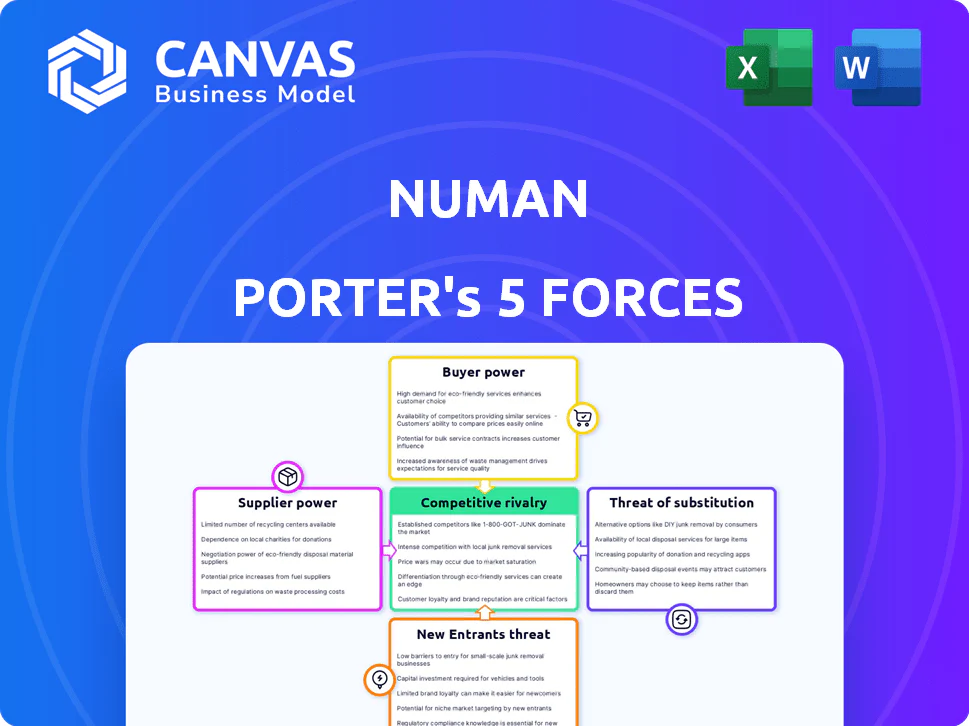
NUMAN PORTER'S FIVE FORCES TEMPLATE RESEARCH
What is included in the product
 Detailed Word Document
Tailored exclusively for Numan, analyzing its position within its competitive landscape.

 Customizable Excel Spreadsheet
Swap in your own data, labels, and notes to reflect current business conditions.
Full Version Awaits
Numan Porter's Five Forces Analysis
This is the full, complete Numan Porter's Five Forces Analysis. The preview accurately reflects the final document. You'll receive this detailed, ready-to-use analysis instantly. It's professionally formatted, covering all five forces. There are no hidden elements or different versions.

Porter's Five Forces Analysis Template

Don't Miss the Bigger Picture
Numan operates within a competitive market, subject to various forces. The threat of new entrants and substitutes must be considered. Buyer and supplier power also play critical roles in shaping Numan's landscape. Competitive rivalry among existing players adds further pressure. Understanding these forces is crucial for strategic planning.
This preview is just the beginning. The full analysis provides a complete strategic snapshot with force-by-force ratings, visuals, and business implications tailored to Numan.
Suppliers Bargaining Power

Pharmaceutical Manufacturers
Numan Health heavily depends on pharmaceutical manufacturers for its medications. The bargaining power of these suppliers varies. For instance, in 2024, brand-name drug prices increased by an average of 5.1%, impacting Numan's costs. When generic alternatives are available, supplier power decreases. However, for patented drugs with few suppliers, like some specialty medications, manufacturers have greater leverage, influencing Numan's profitability. In 2024, the U.S. pharmaceutical market reached approximately $600 billion, showing the immense scale.
Medical Professionals
Numan relies on doctors, pharmacists, and nurses for online consultations and prescriptions. The bargaining power of these medical professionals is affected by telemedicine demand, provider availability, and their interest in digital health. As of 2024, the telehealth market is booming, with a projected value of $78.7 billion, increasing their leverage. The shortage of healthcare workers also strengthens their position.

Technology Providers
Technology providers significantly influence digital health platforms. Their bargaining power stems from the uniqueness of their cloud services and software. For example, in 2024, cloud computing spending reached $678.8 billion globally, showcasing their market dominance. Switching costs, like data migration, further solidify their power.

Diagnostic Laboratories
For Numan, diagnostic laboratories hold significant bargaining power, especially for services like at-home blood testing where they process samples and deliver results. This power is affected by factors such as accreditation and the speed at which they can return results, known as turnaround times. The volume of tests Numan orders also influences this power dynamic. In 2024, the global clinical laboratory services market was valued at approximately $270 billion, showcasing the labs' substantial influence.
- Accreditation by organizations like the College of American Pathologists (CAP) enhances a lab's credibility and bargaining position.
- Faster turnaround times (TAT) can give labs a competitive edge, impacting their pricing power.
- High-volume testing contracts can improve Numan's negotiating position.
- Market consolidation in the lab industry can increase supplier power.
Delivery and Logistics Partners
Numan depends on delivery and logistics firms to deliver medications and other items to customers' homes. The efficiency and coverage of these partners are vital to Numan's operations. Their bargaining power is influenced by fuel costs, delivery network density, and demand for their services. In 2024, the logistics sector saw a 5% increase in operational costs due to rising fuel prices. This impacts Numan's costs directly.
- Fuel prices and network density influence costs.
- Delivery partners' bargaining power is key.
- Logistics costs rose 5% in 2024.
- Numan relies on efficient delivery.
Numan's Supplier Dynamics: Pharma, Tech, and Logistics
Supplier power varies for Numan. Pharma suppliers have leverage, with brand drug prices up 5.1% in 2024. Tech providers' cloud services influence digital health. In 2024, cloud spending hit $678.8B, affecting Numan.
| Supplier Type | Influence Factor | 2024 Data |
|---|---|---|
| Pharmaceuticals | Brand Drug Price Increase | 5.1% |
| Technology | Cloud Computing Spending | $678.8B |
| Delivery | Logistics Cost Increase | 5% |
Customers Bargaining Power

Availability of Alternatives
Customers possess substantial bargaining power due to readily available alternatives for men's health solutions. They can choose traditional healthcare, digital platforms, or over-the-counter products. This wide selection enables customers to switch providers if dissatisfied with Numan's offerings. The global telehealth market was valued at $62.6 billion in 2023, showing customer's options.
Price Sensitivity
Customers, particularly for ongoing treatments, are often price-conscious. Online pricing transparency and easy cost comparisons intensify this, pushing Numan to be competitive. In 2024, the telehealth market saw a 15% rise in price-based customer switching.

Access to Information
Customers' increased access to health information online significantly boosts their bargaining power. They can research conditions and treatments, reducing dependence on a single healthcare provider. For instance, in 2024, over 80% of U.S. adults used the internet to find health information, showcasing this trend. This empowers them to make informed choices. This shift is also reflected in the rise of telehealth, with an estimated 35% increase in usage in 2024, giving patients more options and leverage.

Low Switching Costs
For Numan, low switching costs significantly impact customer bargaining power. Customers can easily move to competitors if they find better prices or services. This forces Numan to focus on customer satisfaction and competitive pricing. The digital health market is competitive, with platforms like Hims & Hers offering similar services.
- Switching costs in the telehealth market range from $0 to a few dollars, depending on the platform.
- Customer churn rates in the telehealth sector average 10-15% annually.
- Numan's marketing spend in 2024 was approximately £15 million.
Influence of Reviews and Reputation
Online reviews significantly impact customer choices in digital health. Customers readily share experiences, affecting Numan's reputation and new customer decisions. Negative reviews can deter potential users, while positive ones build trust and attract more clients. Reputation management is crucial for Numan's success in this competitive landscape. According to a 2024 study, 88% of consumers trust online reviews as much as personal recommendations.
- Customer reviews directly influence purchasing decisions.
- Reputation can significantly impact brand value.
- Positive reviews enhance brand trust and attract new customers.
- Negative reviews can lead to loss of potential customers.
Men's Health: Customer Power Dynamics
Customers wield significant power due to abundant alternatives in the men's health market, including telehealth and OTC products. Price sensitivity, fueled by online transparency, compels competitive pricing. Easy switching between providers and online reviews further amplify customer influence.
| Factor | Impact | Data (2024) |
|---|---|---|
| Market Alternatives | High | Telehealth market: $70B+ |
| Price Sensitivity | High | 15% increase in price-based switching |
| Switching Costs | Low | $0-$5 |
Rivalry Among Competitors

Presence of Direct Competitors
Numan faces fierce competition from platforms like Hims & Hers. The men's health market is crowded. These rivals offer similar services, driving competition. In 2024, Hims & Hers reported revenue of $1.12 billion. This highlights the intense market rivalry.
Breadth of Services
Competitors might provide more services or focus on specific men's health niches. This intensifies competition as firms vie for a larger client pool or particular market sections. For example, in 2024, telehealth services for men's health saw a 20% rise in usage, showing this trend.

Pricing and Subscription Models
Pricing and subscription models are crucial in the competitive digital health market. Companies like Numan and others use diverse strategies, like monthly subscriptions or tiered pricing. In 2024, subscription-based healthcare services grew, with a 15% increase in user adoption. Discounts and bundled services are common tactics to gain market share.

Marketing and Brand Building
Digital health firms pour resources into marketing to stand out. Strong brands and effective campaigns intensify competition. For instance, in 2024, telehealth advertising spending surged. This emphasis on brand building directly impacts how companies compete for user attention and market share. The more successful the marketing, the more intense the rivalry.
- Telehealth ad spending increased by 20% in 2024.
- Brand recognition is crucial for customer loyalty.
- Competition is higher with aggressive marketing.
- Effective campaigns lead to market share gains.
Technological Innovation
Technological innovation significantly fuels competitive rivalry in healthcare. Continuous advancements, like AI in diagnostics and personalized treatments, intensify competition. Companies vie by adopting cutting-edge technologies to improve services and customer experiences. This drives a race to innovate, impacting market share and profitability. The healthcare tech market is expected to reach $600 billion by 2024, showcasing this rivalry.
- AI in healthcare market is projected to reach $187.9 billion by 2030.
- Telehealth market grew by 38% in 2023, reflecting tech adoption.
- Investment in digital health reached $21.3 billion in 2024.
- Companies spent an average of 12% of revenue on R&D in 2024.
Men's Health Market Heats Up: Rivals Clash!
Numan battles fierce rivals such as Hims & Hers in the men's health sector. Intense competition is fueled by similar service offerings, driving the need for differentiation. The telehealth market's 20% increase in advertising spending during 2024 underscores this rivalry.
Pricing strategies and subscription models further intensify this competitive landscape. Companies use varied tactics to attract customers. Tech innovations, including AI in diagnostics, also play a key role, intensifying the competition.
| Aspect | Data | Year |
|---|---|---|
| Hims & Hers Revenue | $1.12 Billion | 2024 |
| Telehealth Ad Spending Increase | 20% | 2024 |
| Digital Health Investment | $21.3 Billion | 2024 |
Original: $10.00
-65%$10.00
$3.50NUMAN PORTER'S FIVE FORCES TEMPLATE RESEARCH
What is included in the product
Detailed Word Document
Tailored exclusively for Numan, analyzing its position within its competitive landscape.
Customizable Excel Spreadsheet
Swap in your own data, labels, and notes to reflect current business conditions.
Full Version Awaits
Numan Porter's Five Forces Analysis
This is the full, complete Numan Porter's Five Forces Analysis. The preview accurately reflects the final document. You'll receive this detailed, ready-to-use analysis instantly. It's professionally formatted, covering all five forces. There are no hidden elements or different versions.
Porter's Five Forces Analysis Template
Don't Miss the Bigger Picture
Numan operates within a competitive market, subject to various forces. The threat of new entrants and substitutes must be considered. Buyer and supplier power also play critical roles in shaping Numan's landscape. Competitive rivalry among existing players adds further pressure. Understanding these forces is crucial for strategic planning.
This preview is just the beginning. The full analysis provides a complete strategic snapshot with force-by-force ratings, visuals, and business implications tailored to Numan.
Suppliers Bargaining Power
Pharmaceutical Manufacturers
Numan Health heavily depends on pharmaceutical manufacturers for its medications. The bargaining power of these suppliers varies. For instance, in 2024, brand-name drug prices increased by an average of 5.1%, impacting Numan's costs. When generic alternatives are available, supplier power decreases. However, for patented drugs with few suppliers, like some specialty medications, manufacturers have greater leverage, influencing Numan's profitability. In 2024, the U.S. pharmaceutical market reached approximately $600 billion, showing the immense scale.
Medical Professionals
Numan relies on doctors, pharmacists, and nurses for online consultations and prescriptions. The bargaining power of these medical professionals is affected by telemedicine demand, provider availability, and their interest in digital health. As of 2024, the telehealth market is booming, with a projected value of $78.7 billion, increasing their leverage. The shortage of healthcare workers also strengthens their position.
Technology Providers
Technology providers significantly influence digital health platforms. Their bargaining power stems from the uniqueness of their cloud services and software. For example, in 2024, cloud computing spending reached $678.8 billion globally, showcasing their market dominance. Switching costs, like data migration, further solidify their power.
Diagnostic Laboratories
For Numan, diagnostic laboratories hold significant bargaining power, especially for services like at-home blood testing where they process samples and deliver results. This power is affected by factors such as accreditation and the speed at which they can return results, known as turnaround times. The volume of tests Numan orders also influences this power dynamic. In 2024, the global clinical laboratory services market was valued at approximately $270 billion, showcasing the labs' substantial influence.
- Accreditation by organizations like the College of American Pathologists (CAP) enhances a lab's credibility and bargaining position.
- Faster turnaround times (TAT) can give labs a competitive edge, impacting their pricing power.
- High-volume testing contracts can improve Numan's negotiating position.
- Market consolidation in the lab industry can increase supplier power.
Delivery and Logistics Partners
Numan depends on delivery and logistics firms to deliver medications and other items to customers' homes. The efficiency and coverage of these partners are vital to Numan's operations. Their bargaining power is influenced by fuel costs, delivery network density, and demand for their services. In 2024, the logistics sector saw a 5% increase in operational costs due to rising fuel prices. This impacts Numan's costs directly.
- Fuel prices and network density influence costs.
- Delivery partners' bargaining power is key.
- Logistics costs rose 5% in 2024.
- Numan relies on efficient delivery.
Numan's Supplier Dynamics: Pharma, Tech, and Logistics
Supplier power varies for Numan. Pharma suppliers have leverage, with brand drug prices up 5.1% in 2024. Tech providers' cloud services influence digital health. In 2024, cloud spending hit $678.8B, affecting Numan.
| Supplier Type | Influence Factor | 2024 Data |
|---|---|---|
| Pharmaceuticals | Brand Drug Price Increase | 5.1% |
| Technology | Cloud Computing Spending | $678.8B |
| Delivery | Logistics Cost Increase | 5% |
Customers Bargaining Power
Availability of Alternatives
Customers possess substantial bargaining power due to readily available alternatives for men's health solutions. They can choose traditional healthcare, digital platforms, or over-the-counter products. This wide selection enables customers to switch providers if dissatisfied with Numan's offerings. The global telehealth market was valued at $62.6 billion in 2023, showing customer's options.
Price Sensitivity
Customers, particularly for ongoing treatments, are often price-conscious. Online pricing transparency and easy cost comparisons intensify this, pushing Numan to be competitive. In 2024, the telehealth market saw a 15% rise in price-based customer switching.
Access to Information
Customers' increased access to health information online significantly boosts their bargaining power. They can research conditions and treatments, reducing dependence on a single healthcare provider. For instance, in 2024, over 80% of U.S. adults used the internet to find health information, showcasing this trend. This empowers them to make informed choices. This shift is also reflected in the rise of telehealth, with an estimated 35% increase in usage in 2024, giving patients more options and leverage.
Low Switching Costs
For Numan, low switching costs significantly impact customer bargaining power. Customers can easily move to competitors if they find better prices or services. This forces Numan to focus on customer satisfaction and competitive pricing. The digital health market is competitive, with platforms like Hims & Hers offering similar services.
- Switching costs in the telehealth market range from $0 to a few dollars, depending on the platform.
- Customer churn rates in the telehealth sector average 10-15% annually.
- Numan's marketing spend in 2024 was approximately £15 million.
Influence of Reviews and Reputation
Online reviews significantly impact customer choices in digital health. Customers readily share experiences, affecting Numan's reputation and new customer decisions. Negative reviews can deter potential users, while positive ones build trust and attract more clients. Reputation management is crucial for Numan's success in this competitive landscape. According to a 2024 study, 88% of consumers trust online reviews as much as personal recommendations.
- Customer reviews directly influence purchasing decisions.
- Reputation can significantly impact brand value.
- Positive reviews enhance brand trust and attract new customers.
- Negative reviews can lead to loss of potential customers.
Men's Health: Customer Power Dynamics
Customers wield significant power due to abundant alternatives in the men's health market, including telehealth and OTC products. Price sensitivity, fueled by online transparency, compels competitive pricing. Easy switching between providers and online reviews further amplify customer influence.
| Factor | Impact | Data (2024) |
|---|---|---|
| Market Alternatives | High | Telehealth market: $70B+ |
| Price Sensitivity | High | 15% increase in price-based switching |
| Switching Costs | Low | $0-$5 |
Rivalry Among Competitors
Presence of Direct Competitors
Numan faces fierce competition from platforms like Hims & Hers. The men's health market is crowded. These rivals offer similar services, driving competition. In 2024, Hims & Hers reported revenue of $1.12 billion. This highlights the intense market rivalry.
Breadth of Services
Competitors might provide more services or focus on specific men's health niches. This intensifies competition as firms vie for a larger client pool or particular market sections. For example, in 2024, telehealth services for men's health saw a 20% rise in usage, showing this trend.
Pricing and Subscription Models
Pricing and subscription models are crucial in the competitive digital health market. Companies like Numan and others use diverse strategies, like monthly subscriptions or tiered pricing. In 2024, subscription-based healthcare services grew, with a 15% increase in user adoption. Discounts and bundled services are common tactics to gain market share.
Marketing and Brand Building
Digital health firms pour resources into marketing to stand out. Strong brands and effective campaigns intensify competition. For instance, in 2024, telehealth advertising spending surged. This emphasis on brand building directly impacts how companies compete for user attention and market share. The more successful the marketing, the more intense the rivalry.
- Telehealth ad spending increased by 20% in 2024.
- Brand recognition is crucial for customer loyalty.
- Competition is higher with aggressive marketing.
- Effective campaigns lead to market share gains.
Technological Innovation
Technological innovation significantly fuels competitive rivalry in healthcare. Continuous advancements, like AI in diagnostics and personalized treatments, intensify competition. Companies vie by adopting cutting-edge technologies to improve services and customer experiences. This drives a race to innovate, impacting market share and profitability. The healthcare tech market is expected to reach $600 billion by 2024, showcasing this rivalry.
- AI in healthcare market is projected to reach $187.9 billion by 2030.
- Telehealth market grew by 38% in 2023, reflecting tech adoption.
- Investment in digital health reached $21.3 billion in 2024.
- Companies spent an average of 12% of revenue on R&D in 2024.
Men's Health Market Heats Up: Rivals Clash!
Numan battles fierce rivals such as Hims & Hers in the men's health sector. Intense competition is fueled by similar service offerings, driving the need for differentiation. The telehealth market's 20% increase in advertising spending during 2024 underscores this rivalry.
Pricing strategies and subscription models further intensify this competitive landscape. Companies use varied tactics to attract customers. Tech innovations, including AI in diagnostics, also play a key role, intensifying the competition.
| Aspect | Data | Year |
|---|---|---|
| Hims & Hers Revenue | $1.12 Billion | 2024 |
| Telehealth Ad Spending Increase | 20% | 2024 |
| Digital Health Investment | $21.3 Billion | 2024 |
Product Information
Product Information
Shipping & Returns
Shipping & Returns
Description
What is included in the product
Detailed Word Document
Tailored exclusively for Numan, analyzing its position within its competitive landscape.
Customizable Excel Spreadsheet
Swap in your own data, labels, and notes to reflect current business conditions.
Full Version Awaits
Numan Porter's Five Forces Analysis
This is the full, complete Numan Porter's Five Forces Analysis. The preview accurately reflects the final document. You'll receive this detailed, ready-to-use analysis instantly. It's professionally formatted, covering all five forces. There are no hidden elements or different versions.
Porter's Five Forces Analysis Template
Don't Miss the Bigger Picture
Numan operates within a competitive market, subject to various forces. The threat of new entrants and substitutes must be considered. Buyer and supplier power also play critical roles in shaping Numan's landscape. Competitive rivalry among existing players adds further pressure. Understanding these forces is crucial for strategic planning.
This preview is just the beginning. The full analysis provides a complete strategic snapshot with force-by-force ratings, visuals, and business implications tailored to Numan.
Suppliers Bargaining Power
Pharmaceutical Manufacturers
Numan Health heavily depends on pharmaceutical manufacturers for its medications. The bargaining power of these suppliers varies. For instance, in 2024, brand-name drug prices increased by an average of 5.1%, impacting Numan's costs. When generic alternatives are available, supplier power decreases. However, for patented drugs with few suppliers, like some specialty medications, manufacturers have greater leverage, influencing Numan's profitability. In 2024, the U.S. pharmaceutical market reached approximately $600 billion, showing the immense scale.
Medical Professionals
Numan relies on doctors, pharmacists, and nurses for online consultations and prescriptions. The bargaining power of these medical professionals is affected by telemedicine demand, provider availability, and their interest in digital health. As of 2024, the telehealth market is booming, with a projected value of $78.7 billion, increasing their leverage. The shortage of healthcare workers also strengthens their position.
Technology Providers
Technology providers significantly influence digital health platforms. Their bargaining power stems from the uniqueness of their cloud services and software. For example, in 2024, cloud computing spending reached $678.8 billion globally, showcasing their market dominance. Switching costs, like data migration, further solidify their power.
Diagnostic Laboratories
For Numan, diagnostic laboratories hold significant bargaining power, especially for services like at-home blood testing where they process samples and deliver results. This power is affected by factors such as accreditation and the speed at which they can return results, known as turnaround times. The volume of tests Numan orders also influences this power dynamic. In 2024, the global clinical laboratory services market was valued at approximately $270 billion, showcasing the labs' substantial influence.
- Accreditation by organizations like the College of American Pathologists (CAP) enhances a lab's credibility and bargaining position.
- Faster turnaround times (TAT) can give labs a competitive edge, impacting their pricing power.
- High-volume testing contracts can improve Numan's negotiating position.
- Market consolidation in the lab industry can increase supplier power.
Delivery and Logistics Partners
Numan depends on delivery and logistics firms to deliver medications and other items to customers' homes. The efficiency and coverage of these partners are vital to Numan's operations. Their bargaining power is influenced by fuel costs, delivery network density, and demand for their services. In 2024, the logistics sector saw a 5% increase in operational costs due to rising fuel prices. This impacts Numan's costs directly.
- Fuel prices and network density influence costs.
- Delivery partners' bargaining power is key.
- Logistics costs rose 5% in 2024.
- Numan relies on efficient delivery.
Numan's Supplier Dynamics: Pharma, Tech, and Logistics
Supplier power varies for Numan. Pharma suppliers have leverage, with brand drug prices up 5.1% in 2024. Tech providers' cloud services influence digital health. In 2024, cloud spending hit $678.8B, affecting Numan.
| Supplier Type | Influence Factor | 2024 Data |
|---|---|---|
| Pharmaceuticals | Brand Drug Price Increase | 5.1% |
| Technology | Cloud Computing Spending | $678.8B |
| Delivery | Logistics Cost Increase | 5% |
Customers Bargaining Power
Availability of Alternatives
Customers possess substantial bargaining power due to readily available alternatives for men's health solutions. They can choose traditional healthcare, digital platforms, or over-the-counter products. This wide selection enables customers to switch providers if dissatisfied with Numan's offerings. The global telehealth market was valued at $62.6 billion in 2023, showing customer's options.
Price Sensitivity
Customers, particularly for ongoing treatments, are often price-conscious. Online pricing transparency and easy cost comparisons intensify this, pushing Numan to be competitive. In 2024, the telehealth market saw a 15% rise in price-based customer switching.
Access to Information
Customers' increased access to health information online significantly boosts their bargaining power. They can research conditions and treatments, reducing dependence on a single healthcare provider. For instance, in 2024, over 80% of U.S. adults used the internet to find health information, showcasing this trend. This empowers them to make informed choices. This shift is also reflected in the rise of telehealth, with an estimated 35% increase in usage in 2024, giving patients more options and leverage.
Low Switching Costs
For Numan, low switching costs significantly impact customer bargaining power. Customers can easily move to competitors if they find better prices or services. This forces Numan to focus on customer satisfaction and competitive pricing. The digital health market is competitive, with platforms like Hims & Hers offering similar services.
- Switching costs in the telehealth market range from $0 to a few dollars, depending on the platform.
- Customer churn rates in the telehealth sector average 10-15% annually.
- Numan's marketing spend in 2024 was approximately £15 million.
Influence of Reviews and Reputation
Online reviews significantly impact customer choices in digital health. Customers readily share experiences, affecting Numan's reputation and new customer decisions. Negative reviews can deter potential users, while positive ones build trust and attract more clients. Reputation management is crucial for Numan's success in this competitive landscape. According to a 2024 study, 88% of consumers trust online reviews as much as personal recommendations.
- Customer reviews directly influence purchasing decisions.
- Reputation can significantly impact brand value.
- Positive reviews enhance brand trust and attract new customers.
- Negative reviews can lead to loss of potential customers.
Men's Health: Customer Power Dynamics
Customers wield significant power due to abundant alternatives in the men's health market, including telehealth and OTC products. Price sensitivity, fueled by online transparency, compels competitive pricing. Easy switching between providers and online reviews further amplify customer influence.
| Factor | Impact | Data (2024) |
|---|---|---|
| Market Alternatives | High | Telehealth market: $70B+ |
| Price Sensitivity | High | 15% increase in price-based switching |
| Switching Costs | Low | $0-$5 |
Rivalry Among Competitors
Presence of Direct Competitors
Numan faces fierce competition from platforms like Hims & Hers. The men's health market is crowded. These rivals offer similar services, driving competition. In 2024, Hims & Hers reported revenue of $1.12 billion. This highlights the intense market rivalry.
Breadth of Services
Competitors might provide more services or focus on specific men's health niches. This intensifies competition as firms vie for a larger client pool or particular market sections. For example, in 2024, telehealth services for men's health saw a 20% rise in usage, showing this trend.
Pricing and Subscription Models
Pricing and subscription models are crucial in the competitive digital health market. Companies like Numan and others use diverse strategies, like monthly subscriptions or tiered pricing. In 2024, subscription-based healthcare services grew, with a 15% increase in user adoption. Discounts and bundled services are common tactics to gain market share.
Marketing and Brand Building
Digital health firms pour resources into marketing to stand out. Strong brands and effective campaigns intensify competition. For instance, in 2024, telehealth advertising spending surged. This emphasis on brand building directly impacts how companies compete for user attention and market share. The more successful the marketing, the more intense the rivalry.
- Telehealth ad spending increased by 20% in 2024.
- Brand recognition is crucial for customer loyalty.
- Competition is higher with aggressive marketing.
- Effective campaigns lead to market share gains.
Technological Innovation
Technological innovation significantly fuels competitive rivalry in healthcare. Continuous advancements, like AI in diagnostics and personalized treatments, intensify competition. Companies vie by adopting cutting-edge technologies to improve services and customer experiences. This drives a race to innovate, impacting market share and profitability. The healthcare tech market is expected to reach $600 billion by 2024, showcasing this rivalry.
- AI in healthcare market is projected to reach $187.9 billion by 2030.
- Telehealth market grew by 38% in 2023, reflecting tech adoption.
- Investment in digital health reached $21.3 billion in 2024.
- Companies spent an average of 12% of revenue on R&D in 2024.
Men's Health Market Heats Up: Rivals Clash!
Numan battles fierce rivals such as Hims & Hers in the men's health sector. Intense competition is fueled by similar service offerings, driving the need for differentiation. The telehealth market's 20% increase in advertising spending during 2024 underscores this rivalry.
Pricing strategies and subscription models further intensify this competitive landscape. Companies use varied tactics to attract customers. Tech innovations, including AI in diagnostics, also play a key role, intensifying the competition.
| Aspect | Data | Year |
|---|---|---|
| Hims & Hers Revenue | $1.12 Billion | 2024 |
| Telehealth Ad Spending Increase | 20% | 2024 |
| Digital Health Investment | $21.3 Billion | 2024 |











