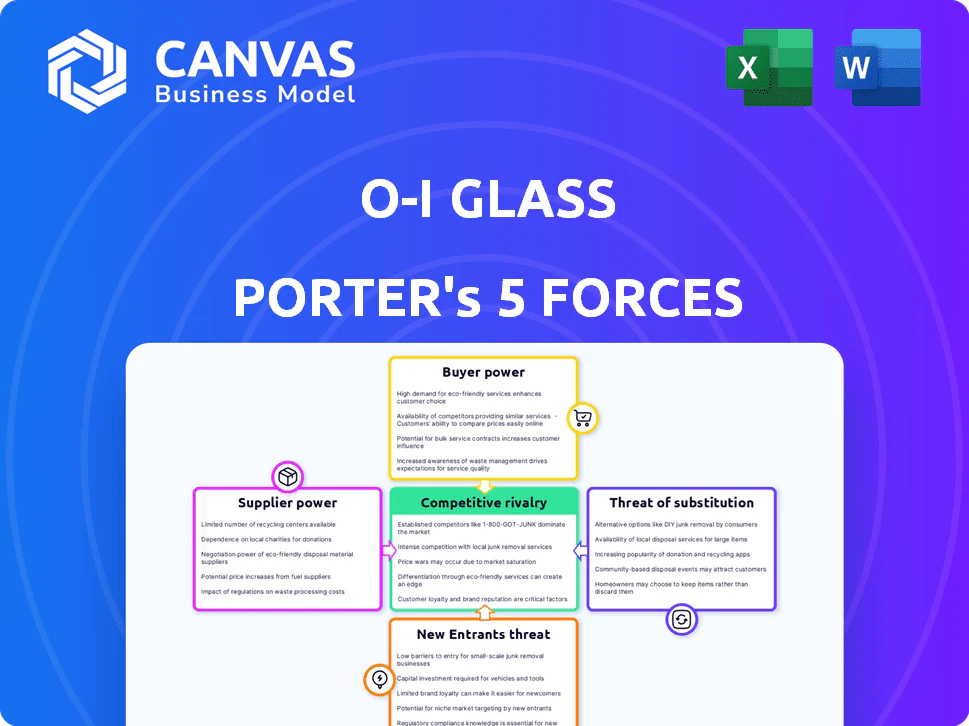
O-I GLASS PORTER'S FIVE FORCES TEMPLATE RESEARCH

Elevate Your Analysis with the Complete Porter's Five Forces Analysis
O-I Glass faces moderate supplier power, intense rivalry, and steady buyer pressure amid rising sustainability demands and overcapacity risks; substitutes are limited but innovation could shift dynamics. This brief snapshot only scratches the surface-unlock the full Porter's Five Forces Analysis to explore O-I Glass's competitive dynamics, market pressures, and strategic advantages in detail.
Suppliers Bargaining Power

Energy Market Volatility
Natural gas fuels O-I Glass's (O-I Glass, Inc.) melting furnaces, so a 40% yearly gas-price spike in 2022-2024 left margins exposed; hedges cut volatility but energy suppliers still wield leverage during geopolitical shocks-O-I reported energy costs of $1.1 billion in FY2024.
Soda Ash Scarcity
Soda ash, essential for glass, is produced by few global miners; in 2025, the top five suppliers control ~65% of supply, so disruptions or consolidation can spike prices by 10-25% within months.
O-I Glass (Owens-Illinois) faces moderate-high supplier power: in 2025 raw materials accounted for ~38% of COGS, forcing O-I to absorb margins or pass increases to customers amid limited sourcing options.

Cullet Availability
Recycled glass (cullet) cuts O-I Glass's melting energy by ~25% and helped hit its 2025 target of 40% recycled content; global demand rose 12% YoY in 2024, tightening supply and pushing cullet prices up ~18% in 2025, so waste managers now exert greater pricing power and can demand premium contracts from glassmakers.

Specialized Equipment Providers
O-I Glass relies on a small set of specialized engineering firms for high-capacity glass-forming furnaces; these vendors command pricing power given limited alternatives and multi-year OEM service contracts covering ~70% of global furnace uptime and $250m-$350m annual maintenance spend industry-wide (2025 est.).
Ongoing upgrades and spare parts tie O-I to suppliers, so negotiations favor vendors on lead times, warranty terms, and capex timing, increasing supplier bargaining power and raising switching costs.
- Few suppliers: concentrated market
- High switching cost: multi-month furnace changeovers
- Service reliance: ~70% uptime under vendor contracts
- Spending scale: industry maintenance $250m-$350m (2025)
Labor and Logistics Costs
O-I Glass faces rising supplier leverage as its labor‑intensive glass manufacturing and dependence on regional trucking and rail pushed cost per ton up; average hourly manufacturing wages rose ~5.2% in 2025, and U.S. intermodal rates climbed ~9% YoY, squeezing 2025 gross margin to about 18.4%.
Freight capacity volatility and tight labor markets through early 2026 kept negotiation power with logistics and labor suppliers high, adding ~$25-40/ton in variable costs versus 2023 and pressuring operating margin.
- 2025 average hourly manufacturing wages +5.2%
- U.S. intermodal rates +9% YoY in 2025
- 2025 gross margin ~18.4%
- Incremental cost ~$25-40 per ton vs 2023
Rising supplier power squeezes margins: energy, materials, wages and logistics spike
Supplier power is moderate-high: energy costs $1.1B in FY2024, raw materials ~38% of COGS (2025), top-5 soda ash suppliers ~65% share, cullet prices +18% (2025), maintenance spend est. $250-$350M (2025), wages +5.2% and intermodal +9% (2025) - raising switching costs and margin pressure.
| Metric | 2025/2024 |
|---|---|
| Energy cost | $1.1B FY2024 |
| Raw materials of COGS | ~38% (2025) |
| Soda ash market | Top-5 ≈65% |
| Cullet price change | +18% (2025) |
| Maintenance spend | $250-$350M (2025 est.) |
| Wages | +5.2% (2025) |
| Intermodal rates | +9% YoY (2025) |
What is included in the product
 Detailed Word Document
Tailored exclusively for O-I Glass, this Porter's Five Forces overview uncovers key competitive drivers, supplier and buyer power, entry barriers, substitutes, and emerging threats shaping the company's pricing, margins, and strategic positioning.

 Customizable Excel Spreadsheet
One-sheet Porter's Five Forces for O-I Glass-spot competitive pressure, supplier risks, and buyer leverage at a glance to speed strategic decisions.
Customers Bargaining Power

Consolidation of Global Brands
O-I Glass serves giants like AB InBev and Diageo, which together account for multi‑percent shares of global beverage volumes; AB InBev bought ~567 million HL beer in 2024, letting them demand lower glass prices and multi‑year contracts from O‑I Glass.
Price Sensitivity in Mass Markets
In value-tier food and beverage, buyers push hard on packaging costs-retailers target gross-margin bumps of 50-200 basis points, so a 5-10% rise in glass price (O-I Glass reported global container volume down 3% in FY2025 vs FY2024) triggers immediate concession demands or down-gauging threats.

Demand for Sustainable Innovation
Modern buyers demand carbon-neutral packaging and lightweight glass; in 2025 O-I Glass reported $7.2B revenue and targeted 30% lower carbon intensity by 2030, so large customers can force tight specs.
Those specs create partnership openings but raise bargaining power, pushing O-I to spend-its 2025 R&D and sustainability capex rose to $220M-to stay a preferred vendor.

Low Switching Costs for Standardized Goods
For basic jars and bottles, switching costs are low-buyers can move to Ardagh or Verallia with minimal change; O-I Glass reported 2025 glass container volumes of 11.7 billion units, so volume buyers wield leverage.
Geographic proximity helps O-I but standardized specs let customers pit suppliers on price; industry average selling-price pressure trimmed margins, with container glass industry EBITDA margins near 14% in 2025.
That keeps pricing competitive and buyer-centric, especially for CPG and beverage customers who source across suppliers to shave cents per unit.
- Low switching cost: modular specs, minimal retooling
- 2025 volume: O-I 11.7B units-buying power
- Industry EBITDA ~14% in 2025-tight pricing
- Geography helps but doesn't prevent price shopping
Vertical Integration Risks
Large beverage firms like Anheuser-Busch InBev and Coca-Cola have capex to build glass plants; in 2025 AB InBev's 2024 capex was $6.3bn and Coca‑Cola FEMSA's 2024 capex was $1.2bn, so backward integration is rare but feasible.
The threat of in‑house production keeps O‑I Glass (2025 revenue $7.1bn) focused on 98% on‑time delivery and tight pricing; losing a major account would cut margins sharply.
Even with high barriers-typical brownfield glass plant costs >$150m and multi‑year paybacks-the leverage remains a negotiation lever for top customers.
- High capex barrier: glass plant >$150m
- Major customers' 2024 capex: AB InBev $6.3bn
- O‑I Glass 2025 revenue: $7.1bn
- Service focus: ~98% on‑time delivery
Buyers' scale pressures O‑I: $7.2B sales, high R&D capex as switching risks rise
Buyers (AB InBev, Diageo) wield strong price and spec leverage-O‑I Glass FY2025 revenue $7.2B, volumes 11.7B units; industry EBITDA ~14% (2025); large buyers' capex (AB InBev 2024 $6.3B) makes backward integration costly but possible, so switching is easy and sustainability/spec demands raise O‑I's R&D/sustainability capex ($220M in 2025).
| Metric | 2025 Value |
|---|---|
| O‑I revenue | $7.2B |
| Container volumes | 11.7B units |
| Industry EBITDA | ~14% |
| O‑I R&D/sustainability capex | $220M |
| AB InBev 2024 capex | $6.3B |
Same Document Delivered
O-I Glass Porter's Five Forces Analysis
This preview shows the exact Porter's Five Forces analysis of O-I Glass you'll receive immediately after purchase-no placeholders or samples. The document is fully formatted, professionally written, and ready for download and use the moment you buy, covering supplier power, buyer power, industry rivalry, threat of substitutes, and barriers to entry.

O-I GLASS PORTER'S FIVE FORCES TEMPLATE RESEARCH
Elevate Your Analysis with the Complete Porter's Five Forces Analysis
O-I Glass faces moderate supplier power, intense rivalry, and steady buyer pressure amid rising sustainability demands and overcapacity risks; substitutes are limited but innovation could shift dynamics. This brief snapshot only scratches the surface-unlock the full Porter's Five Forces Analysis to explore O-I Glass's competitive dynamics, market pressures, and strategic advantages in detail.
Suppliers Bargaining Power
Energy Market Volatility
Natural gas fuels O-I Glass's (O-I Glass, Inc.) melting furnaces, so a 40% yearly gas-price spike in 2022-2024 left margins exposed; hedges cut volatility but energy suppliers still wield leverage during geopolitical shocks-O-I reported energy costs of $1.1 billion in FY2024.
Soda Ash Scarcity
Soda ash, essential for glass, is produced by few global miners; in 2025, the top five suppliers control ~65% of supply, so disruptions or consolidation can spike prices by 10-25% within months.
O-I Glass (Owens-Illinois) faces moderate-high supplier power: in 2025 raw materials accounted for ~38% of COGS, forcing O-I to absorb margins or pass increases to customers amid limited sourcing options.
Cullet Availability
Recycled glass (cullet) cuts O-I Glass's melting energy by ~25% and helped hit its 2025 target of 40% recycled content; global demand rose 12% YoY in 2024, tightening supply and pushing cullet prices up ~18% in 2025, so waste managers now exert greater pricing power and can demand premium contracts from glassmakers.
Specialized Equipment Providers
O-I Glass relies on a small set of specialized engineering firms for high-capacity glass-forming furnaces; these vendors command pricing power given limited alternatives and multi-year OEM service contracts covering ~70% of global furnace uptime and $250m-$350m annual maintenance spend industry-wide (2025 est.).
Ongoing upgrades and spare parts tie O-I to suppliers, so negotiations favor vendors on lead times, warranty terms, and capex timing, increasing supplier bargaining power and raising switching costs.
- Few suppliers: concentrated market
- High switching cost: multi-month furnace changeovers
- Service reliance: ~70% uptime under vendor contracts
- Spending scale: industry maintenance $250m-$350m (2025)
Labor and Logistics Costs
O-I Glass faces rising supplier leverage as its labor‑intensive glass manufacturing and dependence on regional trucking and rail pushed cost per ton up; average hourly manufacturing wages rose ~5.2% in 2025, and U.S. intermodal rates climbed ~9% YoY, squeezing 2025 gross margin to about 18.4%.
Freight capacity volatility and tight labor markets through early 2026 kept negotiation power with logistics and labor suppliers high, adding ~$25-40/ton in variable costs versus 2023 and pressuring operating margin.
- 2025 average hourly manufacturing wages +5.2%
- U.S. intermodal rates +9% YoY in 2025
- 2025 gross margin ~18.4%
- Incremental cost ~$25-40 per ton vs 2023
Rising supplier power squeezes margins: energy, materials, wages and logistics spike
Supplier power is moderate-high: energy costs $1.1B in FY2024, raw materials ~38% of COGS (2025), top-5 soda ash suppliers ~65% share, cullet prices +18% (2025), maintenance spend est. $250-$350M (2025), wages +5.2% and intermodal +9% (2025) - raising switching costs and margin pressure.
| Metric | 2025/2024 |
|---|---|
| Energy cost | $1.1B FY2024 |
| Raw materials of COGS | ~38% (2025) |
| Soda ash market | Top-5 ≈65% |
| Cullet price change | +18% (2025) |
| Maintenance spend | $250-$350M (2025 est.) |
| Wages | +5.2% (2025) |
| Intermodal rates | +9% YoY (2025) |
What is included in the product
Detailed Word Document
Tailored exclusively for O-I Glass, this Porter's Five Forces overview uncovers key competitive drivers, supplier and buyer power, entry barriers, substitutes, and emerging threats shaping the company's pricing, margins, and strategic positioning.
Customizable Excel Spreadsheet
One-sheet Porter's Five Forces for O-I Glass-spot competitive pressure, supplier risks, and buyer leverage at a glance to speed strategic decisions.
Customers Bargaining Power
Consolidation of Global Brands
O-I Glass serves giants like AB InBev and Diageo, which together account for multi‑percent shares of global beverage volumes; AB InBev bought ~567 million HL beer in 2024, letting them demand lower glass prices and multi‑year contracts from O‑I Glass.
Price Sensitivity in Mass Markets
In value-tier food and beverage, buyers push hard on packaging costs-retailers target gross-margin bumps of 50-200 basis points, so a 5-10% rise in glass price (O-I Glass reported global container volume down 3% in FY2025 vs FY2024) triggers immediate concession demands or down-gauging threats.
Demand for Sustainable Innovation
Modern buyers demand carbon-neutral packaging and lightweight glass; in 2025 O-I Glass reported $7.2B revenue and targeted 30% lower carbon intensity by 2030, so large customers can force tight specs.
Those specs create partnership openings but raise bargaining power, pushing O-I to spend-its 2025 R&D and sustainability capex rose to $220M-to stay a preferred vendor.
Low Switching Costs for Standardized Goods
For basic jars and bottles, switching costs are low-buyers can move to Ardagh or Verallia with minimal change; O-I Glass reported 2025 glass container volumes of 11.7 billion units, so volume buyers wield leverage.
Geographic proximity helps O-I but standardized specs let customers pit suppliers on price; industry average selling-price pressure trimmed margins, with container glass industry EBITDA margins near 14% in 2025.
That keeps pricing competitive and buyer-centric, especially for CPG and beverage customers who source across suppliers to shave cents per unit.
- Low switching cost: modular specs, minimal retooling
- 2025 volume: O-I 11.7B units-buying power
- Industry EBITDA ~14% in 2025-tight pricing
- Geography helps but doesn't prevent price shopping
Vertical Integration Risks
Large beverage firms like Anheuser-Busch InBev and Coca-Cola have capex to build glass plants; in 2025 AB InBev's 2024 capex was $6.3bn and Coca‑Cola FEMSA's 2024 capex was $1.2bn, so backward integration is rare but feasible.
The threat of in‑house production keeps O‑I Glass (2025 revenue $7.1bn) focused on 98% on‑time delivery and tight pricing; losing a major account would cut margins sharply.
Even with high barriers-typical brownfield glass plant costs >$150m and multi‑year paybacks-the leverage remains a negotiation lever for top customers.
- High capex barrier: glass plant >$150m
- Major customers' 2024 capex: AB InBev $6.3bn
- O‑I Glass 2025 revenue: $7.1bn
- Service focus: ~98% on‑time delivery
Buyers' scale pressures O‑I: $7.2B sales, high R&D capex as switching risks rise
Buyers (AB InBev, Diageo) wield strong price and spec leverage-O‑I Glass FY2025 revenue $7.2B, volumes 11.7B units; industry EBITDA ~14% (2025); large buyers' capex (AB InBev 2024 $6.3B) makes backward integration costly but possible, so switching is easy and sustainability/spec demands raise O‑I's R&D/sustainability capex ($220M in 2025).
| Metric | 2025 Value |
|---|---|
| O‑I revenue | $7.2B |
| Container volumes | 11.7B units |
| Industry EBITDA | ~14% |
| O‑I R&D/sustainability capex | $220M |
| AB InBev 2024 capex | $6.3B |
Same Document Delivered
O-I Glass Porter's Five Forces Analysis
This preview shows the exact Porter's Five Forces analysis of O-I Glass you'll receive immediately after purchase-no placeholders or samples. The document is fully formatted, professionally written, and ready for download and use the moment you buy, covering supplier power, buyer power, industry rivalry, threat of substitutes, and barriers to entry.
Product Information
Product Information
Shipping & Returns
Shipping & Returns
Description
Elevate Your Analysis with the Complete Porter's Five Forces Analysis
O-I Glass faces moderate supplier power, intense rivalry, and steady buyer pressure amid rising sustainability demands and overcapacity risks; substitutes are limited but innovation could shift dynamics. This brief snapshot only scratches the surface-unlock the full Porter's Five Forces Analysis to explore O-I Glass's competitive dynamics, market pressures, and strategic advantages in detail.
Suppliers Bargaining Power
Energy Market Volatility
Natural gas fuels O-I Glass's (O-I Glass, Inc.) melting furnaces, so a 40% yearly gas-price spike in 2022-2024 left margins exposed; hedges cut volatility but energy suppliers still wield leverage during geopolitical shocks-O-I reported energy costs of $1.1 billion in FY2024.
Soda Ash Scarcity
Soda ash, essential for glass, is produced by few global miners; in 2025, the top five suppliers control ~65% of supply, so disruptions or consolidation can spike prices by 10-25% within months.
O-I Glass (Owens-Illinois) faces moderate-high supplier power: in 2025 raw materials accounted for ~38% of COGS, forcing O-I to absorb margins or pass increases to customers amid limited sourcing options.
Cullet Availability
Recycled glass (cullet) cuts O-I Glass's melting energy by ~25% and helped hit its 2025 target of 40% recycled content; global demand rose 12% YoY in 2024, tightening supply and pushing cullet prices up ~18% in 2025, so waste managers now exert greater pricing power and can demand premium contracts from glassmakers.
Specialized Equipment Providers
O-I Glass relies on a small set of specialized engineering firms for high-capacity glass-forming furnaces; these vendors command pricing power given limited alternatives and multi-year OEM service contracts covering ~70% of global furnace uptime and $250m-$350m annual maintenance spend industry-wide (2025 est.).
Ongoing upgrades and spare parts tie O-I to suppliers, so negotiations favor vendors on lead times, warranty terms, and capex timing, increasing supplier bargaining power and raising switching costs.
- Few suppliers: concentrated market
- High switching cost: multi-month furnace changeovers
- Service reliance: ~70% uptime under vendor contracts
- Spending scale: industry maintenance $250m-$350m (2025)
Labor and Logistics Costs
O-I Glass faces rising supplier leverage as its labor‑intensive glass manufacturing and dependence on regional trucking and rail pushed cost per ton up; average hourly manufacturing wages rose ~5.2% in 2025, and U.S. intermodal rates climbed ~9% YoY, squeezing 2025 gross margin to about 18.4%.
Freight capacity volatility and tight labor markets through early 2026 kept negotiation power with logistics and labor suppliers high, adding ~$25-40/ton in variable costs versus 2023 and pressuring operating margin.
- 2025 average hourly manufacturing wages +5.2%
- U.S. intermodal rates +9% YoY in 2025
- 2025 gross margin ~18.4%
- Incremental cost ~$25-40 per ton vs 2023
Rising supplier power squeezes margins: energy, materials, wages and logistics spike
Supplier power is moderate-high: energy costs $1.1B in FY2024, raw materials ~38% of COGS (2025), top-5 soda ash suppliers ~65% share, cullet prices +18% (2025), maintenance spend est. $250-$350M (2025), wages +5.2% and intermodal +9% (2025) - raising switching costs and margin pressure.
| Metric | 2025/2024 |
|---|---|
| Energy cost | $1.1B FY2024 |
| Raw materials of COGS | ~38% (2025) |
| Soda ash market | Top-5 ≈65% |
| Cullet price change | +18% (2025) |
| Maintenance spend | $250-$350M (2025 est.) |
| Wages | +5.2% (2025) |
| Intermodal rates | +9% YoY (2025) |
What is included in the product
Detailed Word Document
Tailored exclusively for O-I Glass, this Porter's Five Forces overview uncovers key competitive drivers, supplier and buyer power, entry barriers, substitutes, and emerging threats shaping the company's pricing, margins, and strategic positioning.
Customizable Excel Spreadsheet
One-sheet Porter's Five Forces for O-I Glass-spot competitive pressure, supplier risks, and buyer leverage at a glance to speed strategic decisions.
Customers Bargaining Power
Consolidation of Global Brands
O-I Glass serves giants like AB InBev and Diageo, which together account for multi‑percent shares of global beverage volumes; AB InBev bought ~567 million HL beer in 2024, letting them demand lower glass prices and multi‑year contracts from O‑I Glass.
Price Sensitivity in Mass Markets
In value-tier food and beverage, buyers push hard on packaging costs-retailers target gross-margin bumps of 50-200 basis points, so a 5-10% rise in glass price (O-I Glass reported global container volume down 3% in FY2025 vs FY2024) triggers immediate concession demands or down-gauging threats.
Demand for Sustainable Innovation
Modern buyers demand carbon-neutral packaging and lightweight glass; in 2025 O-I Glass reported $7.2B revenue and targeted 30% lower carbon intensity by 2030, so large customers can force tight specs.
Those specs create partnership openings but raise bargaining power, pushing O-I to spend-its 2025 R&D and sustainability capex rose to $220M-to stay a preferred vendor.
Low Switching Costs for Standardized Goods
For basic jars and bottles, switching costs are low-buyers can move to Ardagh or Verallia with minimal change; O-I Glass reported 2025 glass container volumes of 11.7 billion units, so volume buyers wield leverage.
Geographic proximity helps O-I but standardized specs let customers pit suppliers on price; industry average selling-price pressure trimmed margins, with container glass industry EBITDA margins near 14% in 2025.
That keeps pricing competitive and buyer-centric, especially for CPG and beverage customers who source across suppliers to shave cents per unit.
- Low switching cost: modular specs, minimal retooling
- 2025 volume: O-I 11.7B units-buying power
- Industry EBITDA ~14% in 2025-tight pricing
- Geography helps but doesn't prevent price shopping
Vertical Integration Risks
Large beverage firms like Anheuser-Busch InBev and Coca-Cola have capex to build glass plants; in 2025 AB InBev's 2024 capex was $6.3bn and Coca‑Cola FEMSA's 2024 capex was $1.2bn, so backward integration is rare but feasible.
The threat of in‑house production keeps O‑I Glass (2025 revenue $7.1bn) focused on 98% on‑time delivery and tight pricing; losing a major account would cut margins sharply.
Even with high barriers-typical brownfield glass plant costs >$150m and multi‑year paybacks-the leverage remains a negotiation lever for top customers.
- High capex barrier: glass plant >$150m
- Major customers' 2024 capex: AB InBev $6.3bn
- O‑I Glass 2025 revenue: $7.1bn
- Service focus: ~98% on‑time delivery
Buyers' scale pressures O‑I: $7.2B sales, high R&D capex as switching risks rise
Buyers (AB InBev, Diageo) wield strong price and spec leverage-O‑I Glass FY2025 revenue $7.2B, volumes 11.7B units; industry EBITDA ~14% (2025); large buyers' capex (AB InBev 2024 $6.3B) makes backward integration costly but possible, so switching is easy and sustainability/spec demands raise O‑I's R&D/sustainability capex ($220M in 2025).
| Metric | 2025 Value |
|---|---|
| O‑I revenue | $7.2B |
| Container volumes | 11.7B units |
| Industry EBITDA | ~14% |
| O‑I R&D/sustainability capex | $220M |
| AB InBev 2024 capex | $6.3B |
Same Document Delivered
O-I Glass Porter's Five Forces Analysis
This preview shows the exact Porter's Five Forces analysis of O-I Glass you'll receive immediately after purchase-no placeholders or samples. The document is fully formatted, professionally written, and ready for download and use the moment you buy, covering supplier power, buyer power, industry rivalry, threat of substitutes, and barriers to entry.











