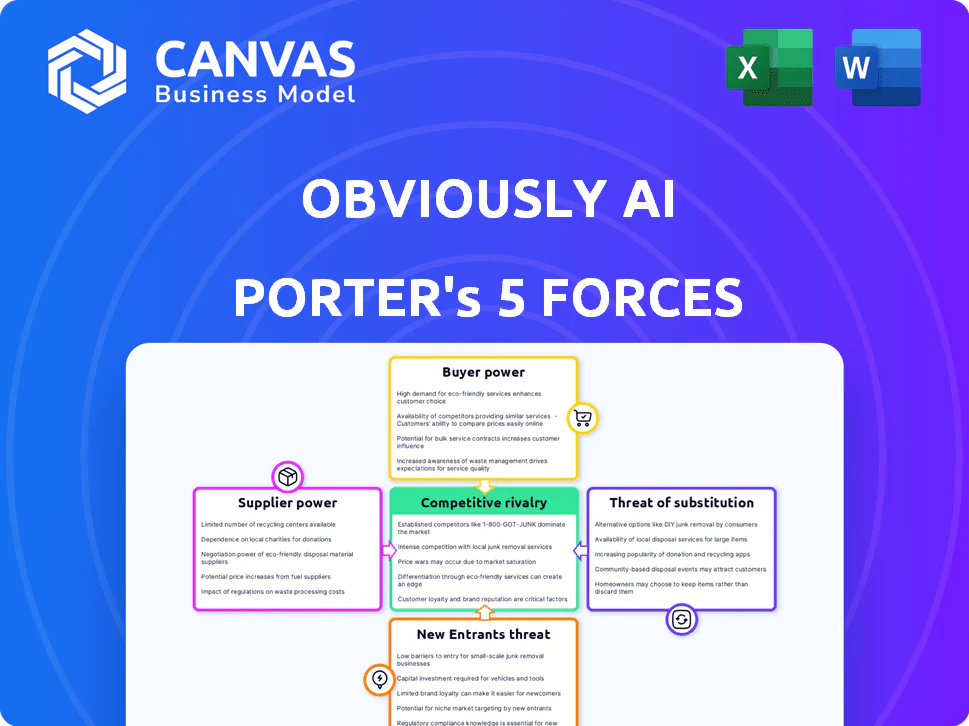
OBVIOUSLY AI PORTER'S FIVE FORCES TEMPLATE RESEARCH
What is included in the product
 Detailed Word Document
Tailored exclusively for Obviously AI, analyzing its position within its competitive landscape.

 Customizable Excel Spreadsheet
Gain immediate clarity on competitive dynamics with a spider/radar chart for easy interpretation.
Preview Before You Purchase
Obviously AI Porter's Five Forces Analysis
This is the complete Porter's Five Forces analysis you will receive. The preview you see here is the exact, ready-to-use document you get instantly upon purchase.

Porter's Five Forces Analysis Template

A Must-Have Tool for Decision-Makers
Understanding Obviously AI's competitive landscape is crucial for informed decisions. Our Porter's Five Forces analysis provides a concise overview of industry dynamics. It examines buyer power, supplier influence, and the threat of new entrants and substitutes. We assess competitive rivalry to reveal the key pressures facing Obviously AI. This helps you understand market intensity and opportunities.
This brief snapshot only scratches the surface. Unlock the full Porter's Five Forces Analysis to explore Obviously AI’s competitive dynamics, market pressures, and strategic advantages in detail.
Suppliers Bargaining Power

Reliance on Cloud Providers
Obviously AI's reliance on cloud providers like AWS, Google Cloud, and Microsoft Azure gives these suppliers strong bargaining power. These providers offer specialized services crucial for AI operations. For example, AWS's revenue reached $85.1 billion in 2023. Their control over essential infrastructure influences Obviously AI's costs and operational flexibility.
Availability of Data
High-quality data fuels AI models. Obviously AI's no-code approach is affected by external data providers. In 2024, data costs varied, but diverse datasets were crucial. Organizations build in-house data or use synthetic data. Data availability directly impacts AI model effectiveness.

Specialized Hardware
Obviously AI faces supplier power challenges, especially with specialized hardware for AI model training and deployment. NVIDIA, a key supplier of GPUs, holds significant market power. In 2024, NVIDIA's revenue surged, highlighting its strong position. This concentration affects Obviously AI's costs and operational efficiency.

Talent Pool
The bargaining power of suppliers in the AI industry, particularly in areas like Obviously AI, is significantly influenced by the talent pool. The demand for specialized AI researchers and engineers is high, yet the supply of such skilled professionals is limited. This scarcity allows these experts to command higher salaries and benefits, increasing labor costs for companies. For instance, the average AI engineer salary in the US was approximately $171,715 in 2024.
- High demand for AI talent drives up labor costs.
- Limited supply of skilled professionals enhances their negotiating position.
- Companies face increased expenses to attract and retain top talent.
- This impacts overall profitability and operational budgets.
Open-Source Resources
The rise of open-source AI tools impacts supplier bargaining power. Open-source resources offer alternatives to proprietary tech, reducing dependence. This shift gives Obviously AI more negotiation leverage and cost savings. According to a 2024 report, the open-source AI market grew by 30%.
- Open-source AI frameworks increase competition among suppliers.
- Reduced reliance on single suppliers enhances flexibility.
- Cost-effective alternatives improve financial performance.
- Negotiating power is strengthened by diverse options.
AI's Power Players: Suppliers' Grip on the Industry
Suppliers wield significant power over Obviously AI, especially cloud providers like AWS, which generated $85.1 billion in revenue in 2023. Data providers and specialized hardware manufacturers, such as NVIDIA, also hold considerable influence. The demand for AI talent further enhances supplier bargaining power, with average salaries in the US reaching $171,715 in 2024.
| Supplier Type | Impact on Obviously AI | 2024 Data |
|---|---|---|
| Cloud Providers (AWS, Azure) | Controls infrastructure, influences costs | AWS revenue: $85.1B (2023) |
| Data Providers | Affects AI model effectiveness | Data costs varied |
| Hardware (NVIDIA) | Impacts costs, operational efficiency | NVIDIA revenue surged |
| AI Talent | Increases labor costs | Avg. AI Engineer Salary: $171,715 |
Customers Bargaining Power

Availability of Alternatives
Customers wield more power due to the proliferation of AI and no-code platforms. Competitors offer similar predictive analytics or extensive AI development capabilities, making it easier for customers to change vendors. The market saw significant growth in 2024, with spending on AI software reaching approximately $120 billion globally. This gives customers leverage in negotiating prices and terms.
Price Sensitivity
Price sensitivity is heightened in the AI market. The proliferation of AI platforms and growing customer AI literacy drive this. SMBs often prioritize cost-effectiveness, influencing pricing strategies. In 2024, the AI market saw increased price competition.

Customization Demands
Customers of Obviously AI, especially large enterprises, might demand significant customization, potentially increasing their bargaining power. If Obviously AI can't offer flexible solutions, customer influence could grow. For example, in 2024, the enterprise no-code market saw a 35% rise in demand for customized solutions. This pressure can affect pricing and features.

Ease of Use and Accessibility
Obviously AI's no-code platform directly influences customer bargaining power through ease of use. This accessibility impacts customer satisfaction and adoption rates. Simplified AI tools empower users, potentially increasing switching costs if the platform meets their needs. User-friendly design and intuitive interfaces are crucial for retaining customers. In 2024, the no-code AI market is projected to reach $27.3 billion, showcasing its growing importance.
- Simplified AI tools empower users, potentially increasing switching costs.
- User-friendly design and intuitive interfaces are crucial for retaining customers.
- The no-code AI market is projected to reach $27.3 billion in 2024.
Integration with Existing Systems
Customers' bargaining power increases when AI platforms must integrate with existing systems. This integration is crucial for seamless data flow. It boosts the platform's value and locks customers in. High integration needs make switching costs higher.
- 2024: 70% of businesses prioritize AI integration with existing tools.
- Switching costs can rise by 30% due to complex integrations.
- Seamless integration boosts customer retention rates by 20%.
- Compatibility issues can lead to a 15% drop in user satisfaction.
AI Market: Customer Power Surges
Customers gain power in the AI market due to platform competition. Price sensitivity is high, especially for SMBs, impacting pricing. Customization demands from large enterprises influence bargaining power. No-code platforms' ease of use and integration needs further affect customer influence.
| Factor | Impact | 2024 Data |
|---|---|---|
| Price Sensitivity | High, especially for SMBs | AI software spending: $120B |
| Customization | Enterprise demand increases power | No-code customization demand up 35% |
| Integration | Seamless integration is crucial | 70% prioritize AI integration |
Rivalry Among Competitors

Number of Competitors
The no-code AI market is booming, drawing many competitors. This crowded space intensifies rivalry. In 2024, the market's value surged, with over 100 active companies. Increased competition means more aggressive pricing and innovation.
Product Differentiation
Product differentiation in the AI space involves competing through unique features. Companies like Obviously AI compete by offering easy-to-use AI tools. Obviously AI's no-code platform helps non-technical users build models rapidly. This approach contrasts with competitors focusing on complex, code-heavy solutions.

Technological Advancements
The AI sector, especially with generative AI and LLMs, sees rapid tech shifts. To stay ahead, firms must constantly innovate; in 2024, AI software revenue hit $62.5 billion. Continuous updates are crucial for survival.

Market Growth Rate
The no-code AI market's rapid expansion is a double-edged sword. High growth rates attract numerous competitors, intensifying rivalry. This dynamic forces businesses to innovate continuously to maintain their position. The competition is fierce, with companies battling for a slice of the expanding pie.
- Market size expected to reach $187.5 billion by 2027.
- Compound annual growth rate (CAGR) of 24.2% from 2023 to 2030.
- Over 150 vendors compete in the no-code AI market.
- Focus on user-friendly platforms and specialized solutions.
Switching Costs
Switching costs in the no-code AI space, like with other software, influence competitive dynamics. Migrating data and integrating new platforms represent significant investments. These costs can lock in users, reducing their willingness to switch to a competitor. This dynamic affects competitive rivalry by making it harder for new entrants to gain market share.
- Data migration costs can range from $5,000 to over $50,000, depending on data complexity.
- Integration with existing systems often requires specialized expertise, adding to switching expenses.
- A 2024 study found that 40% of businesses cite integration challenges as a primary reason for sticking with their current software.
- Vendor lock-in is a key strategy, with 60% of SaaS businesses focusing on customer retention through integration.
No-Code AI: A Battleground of Innovation
The no-code AI market's intense rivalry stems from its rapid growth and many players. The market's 24.2% CAGR through 2030 fuels competition. Over 150 vendors compete, driving innovation and potentially, price wars.
| Aspect | Details | Impact |
|---|---|---|
| Market Growth | Expected to hit $187.5B by 2027 | Attracts new entrants, intensifies competition. |
| Vendor Count | Over 150 vendors | High competition, diverse solutions. |
| Differentiation | Focus on user-friendly platforms | Forces innovation, potential price wars. |
OBVIOUSLY AI PORTER'S FIVE FORCES TEMPLATE RESEARCH
What is included in the product
Detailed Word Document
Tailored exclusively for Obviously AI, analyzing its position within its competitive landscape.
Customizable Excel Spreadsheet
Gain immediate clarity on competitive dynamics with a spider/radar chart for easy interpretation.
Preview Before You Purchase
Obviously AI Porter's Five Forces Analysis
This is the complete Porter's Five Forces analysis you will receive. The preview you see here is the exact, ready-to-use document you get instantly upon purchase.
Porter's Five Forces Analysis Template
A Must-Have Tool for Decision-Makers
Understanding Obviously AI's competitive landscape is crucial for informed decisions. Our Porter's Five Forces analysis provides a concise overview of industry dynamics. It examines buyer power, supplier influence, and the threat of new entrants and substitutes. We assess competitive rivalry to reveal the key pressures facing Obviously AI. This helps you understand market intensity and opportunities.
This brief snapshot only scratches the surface. Unlock the full Porter's Five Forces Analysis to explore Obviously AI’s competitive dynamics, market pressures, and strategic advantages in detail.
Suppliers Bargaining Power
Reliance on Cloud Providers
Obviously AI's reliance on cloud providers like AWS, Google Cloud, and Microsoft Azure gives these suppliers strong bargaining power. These providers offer specialized services crucial for AI operations. For example, AWS's revenue reached $85.1 billion in 2023. Their control over essential infrastructure influences Obviously AI's costs and operational flexibility.
Availability of Data
High-quality data fuels AI models. Obviously AI's no-code approach is affected by external data providers. In 2024, data costs varied, but diverse datasets were crucial. Organizations build in-house data or use synthetic data. Data availability directly impacts AI model effectiveness.
Specialized Hardware
Obviously AI faces supplier power challenges, especially with specialized hardware for AI model training and deployment. NVIDIA, a key supplier of GPUs, holds significant market power. In 2024, NVIDIA's revenue surged, highlighting its strong position. This concentration affects Obviously AI's costs and operational efficiency.
Talent Pool
The bargaining power of suppliers in the AI industry, particularly in areas like Obviously AI, is significantly influenced by the talent pool. The demand for specialized AI researchers and engineers is high, yet the supply of such skilled professionals is limited. This scarcity allows these experts to command higher salaries and benefits, increasing labor costs for companies. For instance, the average AI engineer salary in the US was approximately $171,715 in 2024.
- High demand for AI talent drives up labor costs.
- Limited supply of skilled professionals enhances their negotiating position.
- Companies face increased expenses to attract and retain top talent.
- This impacts overall profitability and operational budgets.
Open-Source Resources
The rise of open-source AI tools impacts supplier bargaining power. Open-source resources offer alternatives to proprietary tech, reducing dependence. This shift gives Obviously AI more negotiation leverage and cost savings. According to a 2024 report, the open-source AI market grew by 30%.
- Open-source AI frameworks increase competition among suppliers.
- Reduced reliance on single suppliers enhances flexibility.
- Cost-effective alternatives improve financial performance.
- Negotiating power is strengthened by diverse options.
AI's Power Players: Suppliers' Grip on the Industry
Suppliers wield significant power over Obviously AI, especially cloud providers like AWS, which generated $85.1 billion in revenue in 2023. Data providers and specialized hardware manufacturers, such as NVIDIA, also hold considerable influence. The demand for AI talent further enhances supplier bargaining power, with average salaries in the US reaching $171,715 in 2024.
| Supplier Type | Impact on Obviously AI | 2024 Data |
|---|---|---|
| Cloud Providers (AWS, Azure) | Controls infrastructure, influences costs | AWS revenue: $85.1B (2023) |
| Data Providers | Affects AI model effectiveness | Data costs varied |
| Hardware (NVIDIA) | Impacts costs, operational efficiency | NVIDIA revenue surged |
| AI Talent | Increases labor costs | Avg. AI Engineer Salary: $171,715 |
Customers Bargaining Power
Availability of Alternatives
Customers wield more power due to the proliferation of AI and no-code platforms. Competitors offer similar predictive analytics or extensive AI development capabilities, making it easier for customers to change vendors. The market saw significant growth in 2024, with spending on AI software reaching approximately $120 billion globally. This gives customers leverage in negotiating prices and terms.
Price Sensitivity
Price sensitivity is heightened in the AI market. The proliferation of AI platforms and growing customer AI literacy drive this. SMBs often prioritize cost-effectiveness, influencing pricing strategies. In 2024, the AI market saw increased price competition.
Customization Demands
Customers of Obviously AI, especially large enterprises, might demand significant customization, potentially increasing their bargaining power. If Obviously AI can't offer flexible solutions, customer influence could grow. For example, in 2024, the enterprise no-code market saw a 35% rise in demand for customized solutions. This pressure can affect pricing and features.
Ease of Use and Accessibility
Obviously AI's no-code platform directly influences customer bargaining power through ease of use. This accessibility impacts customer satisfaction and adoption rates. Simplified AI tools empower users, potentially increasing switching costs if the platform meets their needs. User-friendly design and intuitive interfaces are crucial for retaining customers. In 2024, the no-code AI market is projected to reach $27.3 billion, showcasing its growing importance.
- Simplified AI tools empower users, potentially increasing switching costs.
- User-friendly design and intuitive interfaces are crucial for retaining customers.
- The no-code AI market is projected to reach $27.3 billion in 2024.
Integration with Existing Systems
Customers' bargaining power increases when AI platforms must integrate with existing systems. This integration is crucial for seamless data flow. It boosts the platform's value and locks customers in. High integration needs make switching costs higher.
- 2024: 70% of businesses prioritize AI integration with existing tools.
- Switching costs can rise by 30% due to complex integrations.
- Seamless integration boosts customer retention rates by 20%.
- Compatibility issues can lead to a 15% drop in user satisfaction.
AI Market: Customer Power Surges
Customers gain power in the AI market due to platform competition. Price sensitivity is high, especially for SMBs, impacting pricing. Customization demands from large enterprises influence bargaining power. No-code platforms' ease of use and integration needs further affect customer influence.
| Factor | Impact | 2024 Data |
|---|---|---|
| Price Sensitivity | High, especially for SMBs | AI software spending: $120B |
| Customization | Enterprise demand increases power | No-code customization demand up 35% |
| Integration | Seamless integration is crucial | 70% prioritize AI integration |
Rivalry Among Competitors
Number of Competitors
The no-code AI market is booming, drawing many competitors. This crowded space intensifies rivalry. In 2024, the market's value surged, with over 100 active companies. Increased competition means more aggressive pricing and innovation.
Product Differentiation
Product differentiation in the AI space involves competing through unique features. Companies like Obviously AI compete by offering easy-to-use AI tools. Obviously AI's no-code platform helps non-technical users build models rapidly. This approach contrasts with competitors focusing on complex, code-heavy solutions.
Technological Advancements
The AI sector, especially with generative AI and LLMs, sees rapid tech shifts. To stay ahead, firms must constantly innovate; in 2024, AI software revenue hit $62.5 billion. Continuous updates are crucial for survival.
Market Growth Rate
The no-code AI market's rapid expansion is a double-edged sword. High growth rates attract numerous competitors, intensifying rivalry. This dynamic forces businesses to innovate continuously to maintain their position. The competition is fierce, with companies battling for a slice of the expanding pie.
- Market size expected to reach $187.5 billion by 2027.
- Compound annual growth rate (CAGR) of 24.2% from 2023 to 2030.
- Over 150 vendors compete in the no-code AI market.
- Focus on user-friendly platforms and specialized solutions.
Switching Costs
Switching costs in the no-code AI space, like with other software, influence competitive dynamics. Migrating data and integrating new platforms represent significant investments. These costs can lock in users, reducing their willingness to switch to a competitor. This dynamic affects competitive rivalry by making it harder for new entrants to gain market share.
- Data migration costs can range from $5,000 to over $50,000, depending on data complexity.
- Integration with existing systems often requires specialized expertise, adding to switching expenses.
- A 2024 study found that 40% of businesses cite integration challenges as a primary reason for sticking with their current software.
- Vendor lock-in is a key strategy, with 60% of SaaS businesses focusing on customer retention through integration.
No-Code AI: A Battleground of Innovation
The no-code AI market's intense rivalry stems from its rapid growth and many players. The market's 24.2% CAGR through 2030 fuels competition. Over 150 vendors compete, driving innovation and potentially, price wars.
| Aspect | Details | Impact |
|---|---|---|
| Market Growth | Expected to hit $187.5B by 2027 | Attracts new entrants, intensifies competition. |
| Vendor Count | Over 150 vendors | High competition, diverse solutions. |
| Differentiation | Focus on user-friendly platforms | Forces innovation, potential price wars. |
Product Information
Product Information
Shipping & Returns
Shipping & Returns
Description
What is included in the product
Detailed Word Document
Tailored exclusively for Obviously AI, analyzing its position within its competitive landscape.
Customizable Excel Spreadsheet
Gain immediate clarity on competitive dynamics with a spider/radar chart for easy interpretation.
Preview Before You Purchase
Obviously AI Porter's Five Forces Analysis
This is the complete Porter's Five Forces analysis you will receive. The preview you see here is the exact, ready-to-use document you get instantly upon purchase.
Porter's Five Forces Analysis Template
A Must-Have Tool for Decision-Makers
Understanding Obviously AI's competitive landscape is crucial for informed decisions. Our Porter's Five Forces analysis provides a concise overview of industry dynamics. It examines buyer power, supplier influence, and the threat of new entrants and substitutes. We assess competitive rivalry to reveal the key pressures facing Obviously AI. This helps you understand market intensity and opportunities.
This brief snapshot only scratches the surface. Unlock the full Porter's Five Forces Analysis to explore Obviously AI’s competitive dynamics, market pressures, and strategic advantages in detail.
Suppliers Bargaining Power
Reliance on Cloud Providers
Obviously AI's reliance on cloud providers like AWS, Google Cloud, and Microsoft Azure gives these suppliers strong bargaining power. These providers offer specialized services crucial for AI operations. For example, AWS's revenue reached $85.1 billion in 2023. Their control over essential infrastructure influences Obviously AI's costs and operational flexibility.
Availability of Data
High-quality data fuels AI models. Obviously AI's no-code approach is affected by external data providers. In 2024, data costs varied, but diverse datasets were crucial. Organizations build in-house data or use synthetic data. Data availability directly impacts AI model effectiveness.
Specialized Hardware
Obviously AI faces supplier power challenges, especially with specialized hardware for AI model training and deployment. NVIDIA, a key supplier of GPUs, holds significant market power. In 2024, NVIDIA's revenue surged, highlighting its strong position. This concentration affects Obviously AI's costs and operational efficiency.
Talent Pool
The bargaining power of suppliers in the AI industry, particularly in areas like Obviously AI, is significantly influenced by the talent pool. The demand for specialized AI researchers and engineers is high, yet the supply of such skilled professionals is limited. This scarcity allows these experts to command higher salaries and benefits, increasing labor costs for companies. For instance, the average AI engineer salary in the US was approximately $171,715 in 2024.
- High demand for AI talent drives up labor costs.
- Limited supply of skilled professionals enhances their negotiating position.
- Companies face increased expenses to attract and retain top talent.
- This impacts overall profitability and operational budgets.
Open-Source Resources
The rise of open-source AI tools impacts supplier bargaining power. Open-source resources offer alternatives to proprietary tech, reducing dependence. This shift gives Obviously AI more negotiation leverage and cost savings. According to a 2024 report, the open-source AI market grew by 30%.
- Open-source AI frameworks increase competition among suppliers.
- Reduced reliance on single suppliers enhances flexibility.
- Cost-effective alternatives improve financial performance.
- Negotiating power is strengthened by diverse options.
AI's Power Players: Suppliers' Grip on the Industry
Suppliers wield significant power over Obviously AI, especially cloud providers like AWS, which generated $85.1 billion in revenue in 2023. Data providers and specialized hardware manufacturers, such as NVIDIA, also hold considerable influence. The demand for AI talent further enhances supplier bargaining power, with average salaries in the US reaching $171,715 in 2024.
| Supplier Type | Impact on Obviously AI | 2024 Data |
|---|---|---|
| Cloud Providers (AWS, Azure) | Controls infrastructure, influences costs | AWS revenue: $85.1B (2023) |
| Data Providers | Affects AI model effectiveness | Data costs varied |
| Hardware (NVIDIA) | Impacts costs, operational efficiency | NVIDIA revenue surged |
| AI Talent | Increases labor costs | Avg. AI Engineer Salary: $171,715 |
Customers Bargaining Power
Availability of Alternatives
Customers wield more power due to the proliferation of AI and no-code platforms. Competitors offer similar predictive analytics or extensive AI development capabilities, making it easier for customers to change vendors. The market saw significant growth in 2024, with spending on AI software reaching approximately $120 billion globally. This gives customers leverage in negotiating prices and terms.
Price Sensitivity
Price sensitivity is heightened in the AI market. The proliferation of AI platforms and growing customer AI literacy drive this. SMBs often prioritize cost-effectiveness, influencing pricing strategies. In 2024, the AI market saw increased price competition.
Customization Demands
Customers of Obviously AI, especially large enterprises, might demand significant customization, potentially increasing their bargaining power. If Obviously AI can't offer flexible solutions, customer influence could grow. For example, in 2024, the enterprise no-code market saw a 35% rise in demand for customized solutions. This pressure can affect pricing and features.
Ease of Use and Accessibility
Obviously AI's no-code platform directly influences customer bargaining power through ease of use. This accessibility impacts customer satisfaction and adoption rates. Simplified AI tools empower users, potentially increasing switching costs if the platform meets their needs. User-friendly design and intuitive interfaces are crucial for retaining customers. In 2024, the no-code AI market is projected to reach $27.3 billion, showcasing its growing importance.
- Simplified AI tools empower users, potentially increasing switching costs.
- User-friendly design and intuitive interfaces are crucial for retaining customers.
- The no-code AI market is projected to reach $27.3 billion in 2024.
Integration with Existing Systems
Customers' bargaining power increases when AI platforms must integrate with existing systems. This integration is crucial for seamless data flow. It boosts the platform's value and locks customers in. High integration needs make switching costs higher.
- 2024: 70% of businesses prioritize AI integration with existing tools.
- Switching costs can rise by 30% due to complex integrations.
- Seamless integration boosts customer retention rates by 20%.
- Compatibility issues can lead to a 15% drop in user satisfaction.
AI Market: Customer Power Surges
Customers gain power in the AI market due to platform competition. Price sensitivity is high, especially for SMBs, impacting pricing. Customization demands from large enterprises influence bargaining power. No-code platforms' ease of use and integration needs further affect customer influence.
| Factor | Impact | 2024 Data |
|---|---|---|
| Price Sensitivity | High, especially for SMBs | AI software spending: $120B |
| Customization | Enterprise demand increases power | No-code customization demand up 35% |
| Integration | Seamless integration is crucial | 70% prioritize AI integration |
Rivalry Among Competitors
Number of Competitors
The no-code AI market is booming, drawing many competitors. This crowded space intensifies rivalry. In 2024, the market's value surged, with over 100 active companies. Increased competition means more aggressive pricing and innovation.
Product Differentiation
Product differentiation in the AI space involves competing through unique features. Companies like Obviously AI compete by offering easy-to-use AI tools. Obviously AI's no-code platform helps non-technical users build models rapidly. This approach contrasts with competitors focusing on complex, code-heavy solutions.
Technological Advancements
The AI sector, especially with generative AI and LLMs, sees rapid tech shifts. To stay ahead, firms must constantly innovate; in 2024, AI software revenue hit $62.5 billion. Continuous updates are crucial for survival.
Market Growth Rate
The no-code AI market's rapid expansion is a double-edged sword. High growth rates attract numerous competitors, intensifying rivalry. This dynamic forces businesses to innovate continuously to maintain their position. The competition is fierce, with companies battling for a slice of the expanding pie.
- Market size expected to reach $187.5 billion by 2027.
- Compound annual growth rate (CAGR) of 24.2% from 2023 to 2030.
- Over 150 vendors compete in the no-code AI market.
- Focus on user-friendly platforms and specialized solutions.
Switching Costs
Switching costs in the no-code AI space, like with other software, influence competitive dynamics. Migrating data and integrating new platforms represent significant investments. These costs can lock in users, reducing their willingness to switch to a competitor. This dynamic affects competitive rivalry by making it harder for new entrants to gain market share.
- Data migration costs can range from $5,000 to over $50,000, depending on data complexity.
- Integration with existing systems often requires specialized expertise, adding to switching expenses.
- A 2024 study found that 40% of businesses cite integration challenges as a primary reason for sticking with their current software.
- Vendor lock-in is a key strategy, with 60% of SaaS businesses focusing on customer retention through integration.
No-Code AI: A Battleground of Innovation
The no-code AI market's intense rivalry stems from its rapid growth and many players. The market's 24.2% CAGR through 2030 fuels competition. Over 150 vendors compete, driving innovation and potentially, price wars.
| Aspect | Details | Impact |
|---|---|---|
| Market Growth | Expected to hit $187.5B by 2027 | Attracts new entrants, intensifies competition. |
| Vendor Count | Over 150 vendors | High competition, diverse solutions. |
| Differentiation | Focus on user-friendly platforms | Forces innovation, potential price wars. |











