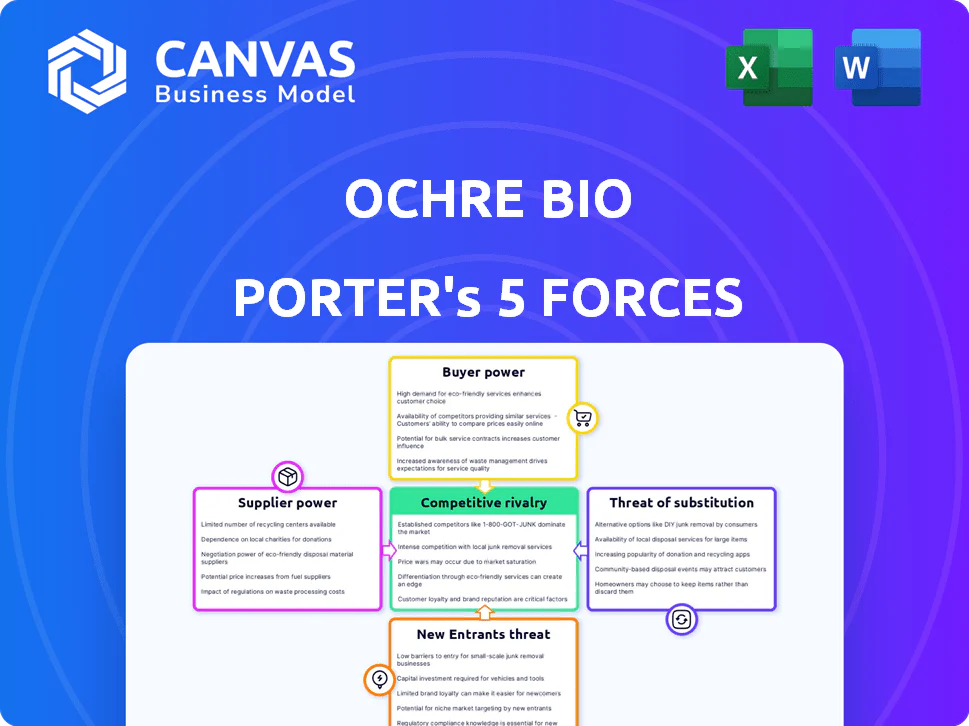
OCHRE BIO PORTER'S FIVE FORCES TEMPLATE RESEARCH
What is included in the product
 Detailed Word Document
Analyzes Ochre Bio's competitive environment, pinpointing threats and opportunities for strategic advantage.

 Customizable Excel Spreadsheet
Customize the impact of each force with easy-to-use sliders, for scenario planning.
What You See Is What You Get
Ochre Bio Porter's Five Forces Analysis
This is the complete Ochre Bio Porter's Five Forces Analysis you'll receive. The preview showcases the identical, professionally written document available immediately after purchase. Explore the analysis of industry competition, and the other four forces, just as you'll receive it. This means ready-to-use insights upon checkout! The quality and content are exactly the same.

Porter's Five Forces Analysis Template

A Must-Have Tool for Decision-Makers
Ochre Bio faces moderate competition, with some buyer power from research institutions and pharmaceutical companies. Supplier bargaining power is limited due to a specialized market. The threat of new entrants is moderate, balanced by high capital needs. Substitute products present a low to moderate risk. Rivalry among existing firms is relatively high, affecting pricing.
This brief snapshot only scratches the surface. Unlock the full Porter's Five Forces Analysis to explore Ochre Bio’s competitive dynamics, market pressures, and strategic advantages in detail.
Suppliers Bargaining Power

Specialized Reagents and Materials
Ochre Bio's reliance on specialized reagents and materials gives suppliers leverage. Proprietary or scarce biological materials, essential for deep phenotyping and RNA therapy, enhance supplier power. The uniqueness of materials for liver perfusion increases this. In 2024, the market for specialized reagents grew by 7%, reflecting the importance of these inputs.
Access to Human Livers
Ochre Bio's access to human donor livers, unsuitable for transplant, is crucial. Organ procurement organizations (OPOs) and other sources hold bargaining power over availability. In 2024, over 42,000 transplants were performed in the U.S., highlighting the critical demand. Any supply constraint directly impacts Ochre Bio's research timeline and scaling capabilities.

Advanced Technology and Equipment Providers
Advanced technology and equipment suppliers, crucial for Ochre Bio's deep phenotyping, may wield significant bargaining power. The complexity and expense of genomics platforms and imaging systems contribute to their influence. As of 2024, the cost of advanced sequencing can range from $750 to $1,000 per human genome. This directly impacts Ochre Bio's operational expenses and reliance on these vendors.

Talented Personnel
In the biotech sector, skilled personnel represent a critical 'supplier.' Competition for top talent, especially in areas such as RNA biology, gives these individuals significant bargaining power. This translates to higher salary expectations, robust benefits packages, and the ability to influence research direction. For instance, in 2024, average salaries for biotech scientists increased by 7% due to high demand.
- Average salaries for biotech scientists increased by 7% in 2024.
- Competition for talent impacts cost structures.
- Key areas of expertise: RNA biology, genomics.
- High demand drives bargaining power.
Data and Computational Resources
Suppliers of crucial data and computational resources significantly impact Ochre Bio. These providers, offering large biological datasets and high-performance computing, hold considerable bargaining power. The proprietary nature of some datasets and the substantial infrastructure costs for analysis further amplify this influence. For instance, the global cloud computing market, essential for data processing, reached $545.8 billion in 2023, showing their leverage.
- Cloud computing market reached $545.8 billion in 2023.
- Proprietary datasets limit access and increase costs.
- High-performance computing is essential for genomic analysis.
- Infrastructure costs influence operational efficiency.
Ochre Bio: Navigating Supplier Dynamics in 2024
Ochre Bio faces supplier power in specialized reagents, with a 7% market growth in 2024. Access to human livers from OPOs grants suppliers leverage in a market with over 42,000 transplants in 2024. Advanced tech suppliers, like genomics platforms costing $750-$1,000 per genome in 2024, also exert influence.
| Supplier Type | Bargaining Power | 2024 Data |
|---|---|---|
| Reagents | High | 7% market growth |
| Human Livers | Medium | 42,000+ transplants |
| Tech & Equipment | High | $750-$1,000/genome |
Customers Bargaining Power

Pharmaceutical and Biotech Partners
Ochre Bio's primary customers will be major pharmaceutical and biotech firms. These companies possess significant bargaining power. They have vast resources and the option to pursue alternative R&D avenues.
Healthcare Systems and Transplant Centers
If Ochre Bio targets healthcare systems and transplant centers, these entities become key customers. Their ability to negotiate prices is significant, particularly due to their considerable purchasing volume. Data from 2024 indicates that the U.S. spent $4.8 trillion on healthcare, highlighting the financial stakes involved. This purchasing power is amplified by the demand for affordable, high-impact solutions in transplant medicine.

Patient Advocacy Groups and Regulatory Bodies
Patient advocacy groups and regulatory bodies, though not direct customers, wield considerable influence over Ochre Bio. Their acceptance of therapies is vital for market access. In 2024, the FDA approved 48 new drugs, highlighting regulatory impact. The EMA also plays a crucial role in the EU market. This influence can be seen as a form of customer power.

Research Collaborators
For Ochre Bio, research collaborators, like academic institutions, act as customers for their data and platform. Their bargaining power hinges on Ochre Bio's unique offerings and the value they provide. If Ochre Bio's data is essential, the collaborators' power diminishes; otherwise, they may seek alternatives. This dynamic impacts pricing and collaboration terms.
- In 2024, the global pharmaceutical R&D market was valued at approximately $270 billion.
- The cost of drug development can range from $1 billion to $2.8 billion per drug.
- Around 20% of clinical trials fail due to lack of efficacy.
- Ochre Bio's platform could reduce costs and improve success rates for collaborators.
Investors
Investors, though not customers, hold substantial power over Ochre Bio. They provide critical capital, significantly impacting the company's strategic direction and valuation. This influence stems from their assessment of market potential and the progress Ochre Bio makes. For instance, the biotech sector saw $26.9 billion in venture capital in 2024. This capital fuels innovation.
- VC investment in biotech in 2024: $26.9 billion.
- Investor influence: Direct impact on strategic decisions.
- Valuation: Heavily reliant on investor perception.
- Market Potential: Investors assess future opportunities.
Ochre Bio's Market Dynamics: Power Players & Pricing
Ochre Bio's customers, including pharma firms and healthcare systems, have considerable bargaining power. Their purchasing volume and ability to seek alternatives influence pricing. Patient advocacy groups and regulators also exert significant influence, impacting market access. Collaboration partners' power depends on Ochre Bio's unique value.
| Customer Type | Bargaining Power | Impact |
|---|---|---|
| Pharma/Biotech | High | Price/Terms |
| Healthcare Systems | High | Volume Discounts |
| Regulatory Bodies | High | Market Access |
Rivalry Among Competitors

Other Liver Disease Therapeutics Companies
The competitive arena features firms like Novo Nordisk and Gilead Sciences, targeting chronic liver diseases and cirrhosis. In 2024, Gilead's revenue from liver disease treatments was approximately $2.3 billion. These companies explore diverse treatment approaches, intensifying competition in this space. The presence of these competitors necessitates Ochre Bio to demonstrate its therapeutic advantages.
Companies in Regenerative Medicine
Companies like Vertex Pharmaceuticals and BioTime (now AgeX Therapeutics) are actively involved in regenerative medicine. They compete with Ochre Bio by targeting similar unmet needs in liver health, using diverse technologies. For example, Vertex's cystic fibrosis treatments generated $9.96 billion in revenue in 2023. This competition drives innovation, but also increases the risk of market share dilution for Ochre Bio.

Companies with Competing Technology Platforms
Several firms employ similar technology to Ochre Bio. Companies like Recursion Pharmaceuticals use AI for drug discovery, posing a competitive threat. In 2024, Recursion's market cap was approximately $1.5 billion. These competitors could shift focus to liver disease, intensifying rivalry. The competition for skilled scientists and resources will likely increase.

Established Pharmaceutical Companies with Liver Disease Pipelines
Established pharmaceutical giants pose a strong competitive threat to Ochre Bio. Companies like Gilead Sciences and Novartis, with their significant market presence and regulatory expertise, are formidable rivals. These firms have substantial financial resources to invest in R&D, including liver disease treatments. They can leverage existing infrastructure and established sales networks, creating a challenging landscape for newcomers.
- Gilead's 2023 revenue was $27.1 billion, demonstrating its financial strength.
- Novartis's R&D spending in 2023 reached $10.8 billion.
- These companies have a proven track record in navigating the complex regulatory environment.
Academic and Research Institutions
Leading academic and research institutions are pivotal in liver biology and therapeutics. These institutions, such as the University of Oxford, significantly influence the competitive landscape. They drive innovation by generating new knowledge and pioneering therapeutic approaches. For example, in 2024, Oxford's Department of Physiology, Anatomy, and Genetics received over £20 million in research grants, fueling advancements in related fields.
- Oxford University's research grants: Over £20M in 2024.
- Contribution: New knowledge and therapeutic approaches.
- Impact: Influences the competitive landscape.
- Strategic Role: Drive innovation.
Pharma Titans Clash: Liver Disease Therapeutics Race
Competitive rivalry in the liver disease therapeutics sector is fierce, involving established and emerging players. Gilead's 2023 revenue reached $27.1B, and Novartis invested $10.8B in R&D, showcasing their financial strength. These giants, alongside academic institutions, drive innovation, intensifying competition for Ochre Bio.
| Competitor Type | Key Players | Financials/Metrics (2024 est.) |
|---|---|---|
| Established Pharma | Gilead, Novartis | Gilead Liver Rx Revenue: $2.3B; Novartis R&D: ~$11B |
| Emerging Biotech | Vertex, Recursion | Vertex CF Revenue (2023): $9.96B; Recursion Mkt Cap: $1.5B |
| Academic Institutions | University of Oxford | Oxford Research Grants (2024): >£20M |
OCHRE BIO PORTER'S FIVE FORCES TEMPLATE RESEARCH
What is included in the product
Detailed Word Document
Analyzes Ochre Bio's competitive environment, pinpointing threats and opportunities for strategic advantage.
Customizable Excel Spreadsheet
Customize the impact of each force with easy-to-use sliders, for scenario planning.
What You See Is What You Get
Ochre Bio Porter's Five Forces Analysis
This is the complete Ochre Bio Porter's Five Forces Analysis you'll receive. The preview showcases the identical, professionally written document available immediately after purchase. Explore the analysis of industry competition, and the other four forces, just as you'll receive it. This means ready-to-use insights upon checkout! The quality and content are exactly the same.
Porter's Five Forces Analysis Template
A Must-Have Tool for Decision-Makers
Ochre Bio faces moderate competition, with some buyer power from research institutions and pharmaceutical companies. Supplier bargaining power is limited due to a specialized market. The threat of new entrants is moderate, balanced by high capital needs. Substitute products present a low to moderate risk. Rivalry among existing firms is relatively high, affecting pricing.
This brief snapshot only scratches the surface. Unlock the full Porter's Five Forces Analysis to explore Ochre Bio’s competitive dynamics, market pressures, and strategic advantages in detail.
Suppliers Bargaining Power
Specialized Reagents and Materials
Ochre Bio's reliance on specialized reagents and materials gives suppliers leverage. Proprietary or scarce biological materials, essential for deep phenotyping and RNA therapy, enhance supplier power. The uniqueness of materials for liver perfusion increases this. In 2024, the market for specialized reagents grew by 7%, reflecting the importance of these inputs.
Access to Human Livers
Ochre Bio's access to human donor livers, unsuitable for transplant, is crucial. Organ procurement organizations (OPOs) and other sources hold bargaining power over availability. In 2024, over 42,000 transplants were performed in the U.S., highlighting the critical demand. Any supply constraint directly impacts Ochre Bio's research timeline and scaling capabilities.
Advanced Technology and Equipment Providers
Advanced technology and equipment suppliers, crucial for Ochre Bio's deep phenotyping, may wield significant bargaining power. The complexity and expense of genomics platforms and imaging systems contribute to their influence. As of 2024, the cost of advanced sequencing can range from $750 to $1,000 per human genome. This directly impacts Ochre Bio's operational expenses and reliance on these vendors.
Talented Personnel
In the biotech sector, skilled personnel represent a critical 'supplier.' Competition for top talent, especially in areas such as RNA biology, gives these individuals significant bargaining power. This translates to higher salary expectations, robust benefits packages, and the ability to influence research direction. For instance, in 2024, average salaries for biotech scientists increased by 7% due to high demand.
- Average salaries for biotech scientists increased by 7% in 2024.
- Competition for talent impacts cost structures.
- Key areas of expertise: RNA biology, genomics.
- High demand drives bargaining power.
Data and Computational Resources
Suppliers of crucial data and computational resources significantly impact Ochre Bio. These providers, offering large biological datasets and high-performance computing, hold considerable bargaining power. The proprietary nature of some datasets and the substantial infrastructure costs for analysis further amplify this influence. For instance, the global cloud computing market, essential for data processing, reached $545.8 billion in 2023, showing their leverage.
- Cloud computing market reached $545.8 billion in 2023.
- Proprietary datasets limit access and increase costs.
- High-performance computing is essential for genomic analysis.
- Infrastructure costs influence operational efficiency.
Ochre Bio: Navigating Supplier Dynamics in 2024
Ochre Bio faces supplier power in specialized reagents, with a 7% market growth in 2024. Access to human livers from OPOs grants suppliers leverage in a market with over 42,000 transplants in 2024. Advanced tech suppliers, like genomics platforms costing $750-$1,000 per genome in 2024, also exert influence.
| Supplier Type | Bargaining Power | 2024 Data |
|---|---|---|
| Reagents | High | 7% market growth |
| Human Livers | Medium | 42,000+ transplants |
| Tech & Equipment | High | $750-$1,000/genome |
Customers Bargaining Power
Pharmaceutical and Biotech Partners
Ochre Bio's primary customers will be major pharmaceutical and biotech firms. These companies possess significant bargaining power. They have vast resources and the option to pursue alternative R&D avenues.
Healthcare Systems and Transplant Centers
If Ochre Bio targets healthcare systems and transplant centers, these entities become key customers. Their ability to negotiate prices is significant, particularly due to their considerable purchasing volume. Data from 2024 indicates that the U.S. spent $4.8 trillion on healthcare, highlighting the financial stakes involved. This purchasing power is amplified by the demand for affordable, high-impact solutions in transplant medicine.
Patient Advocacy Groups and Regulatory Bodies
Patient advocacy groups and regulatory bodies, though not direct customers, wield considerable influence over Ochre Bio. Their acceptance of therapies is vital for market access. In 2024, the FDA approved 48 new drugs, highlighting regulatory impact. The EMA also plays a crucial role in the EU market. This influence can be seen as a form of customer power.
Research Collaborators
For Ochre Bio, research collaborators, like academic institutions, act as customers for their data and platform. Their bargaining power hinges on Ochre Bio's unique offerings and the value they provide. If Ochre Bio's data is essential, the collaborators' power diminishes; otherwise, they may seek alternatives. This dynamic impacts pricing and collaboration terms.
- In 2024, the global pharmaceutical R&D market was valued at approximately $270 billion.
- The cost of drug development can range from $1 billion to $2.8 billion per drug.
- Around 20% of clinical trials fail due to lack of efficacy.
- Ochre Bio's platform could reduce costs and improve success rates for collaborators.
Investors
Investors, though not customers, hold substantial power over Ochre Bio. They provide critical capital, significantly impacting the company's strategic direction and valuation. This influence stems from their assessment of market potential and the progress Ochre Bio makes. For instance, the biotech sector saw $26.9 billion in venture capital in 2024. This capital fuels innovation.
- VC investment in biotech in 2024: $26.9 billion.
- Investor influence: Direct impact on strategic decisions.
- Valuation: Heavily reliant on investor perception.
- Market Potential: Investors assess future opportunities.
Ochre Bio's Market Dynamics: Power Players & Pricing
Ochre Bio's customers, including pharma firms and healthcare systems, have considerable bargaining power. Their purchasing volume and ability to seek alternatives influence pricing. Patient advocacy groups and regulators also exert significant influence, impacting market access. Collaboration partners' power depends on Ochre Bio's unique value.
| Customer Type | Bargaining Power | Impact |
|---|---|---|
| Pharma/Biotech | High | Price/Terms |
| Healthcare Systems | High | Volume Discounts |
| Regulatory Bodies | High | Market Access |
Rivalry Among Competitors
Other Liver Disease Therapeutics Companies
The competitive arena features firms like Novo Nordisk and Gilead Sciences, targeting chronic liver diseases and cirrhosis. In 2024, Gilead's revenue from liver disease treatments was approximately $2.3 billion. These companies explore diverse treatment approaches, intensifying competition in this space. The presence of these competitors necessitates Ochre Bio to demonstrate its therapeutic advantages.
Companies in Regenerative Medicine
Companies like Vertex Pharmaceuticals and BioTime (now AgeX Therapeutics) are actively involved in regenerative medicine. They compete with Ochre Bio by targeting similar unmet needs in liver health, using diverse technologies. For example, Vertex's cystic fibrosis treatments generated $9.96 billion in revenue in 2023. This competition drives innovation, but also increases the risk of market share dilution for Ochre Bio.
Companies with Competing Technology Platforms
Several firms employ similar technology to Ochre Bio. Companies like Recursion Pharmaceuticals use AI for drug discovery, posing a competitive threat. In 2024, Recursion's market cap was approximately $1.5 billion. These competitors could shift focus to liver disease, intensifying rivalry. The competition for skilled scientists and resources will likely increase.
Established Pharmaceutical Companies with Liver Disease Pipelines
Established pharmaceutical giants pose a strong competitive threat to Ochre Bio. Companies like Gilead Sciences and Novartis, with their significant market presence and regulatory expertise, are formidable rivals. These firms have substantial financial resources to invest in R&D, including liver disease treatments. They can leverage existing infrastructure and established sales networks, creating a challenging landscape for newcomers.
- Gilead's 2023 revenue was $27.1 billion, demonstrating its financial strength.
- Novartis's R&D spending in 2023 reached $10.8 billion.
- These companies have a proven track record in navigating the complex regulatory environment.
Academic and Research Institutions
Leading academic and research institutions are pivotal in liver biology and therapeutics. These institutions, such as the University of Oxford, significantly influence the competitive landscape. They drive innovation by generating new knowledge and pioneering therapeutic approaches. For example, in 2024, Oxford's Department of Physiology, Anatomy, and Genetics received over £20 million in research grants, fueling advancements in related fields.
- Oxford University's research grants: Over £20M in 2024.
- Contribution: New knowledge and therapeutic approaches.
- Impact: Influences the competitive landscape.
- Strategic Role: Drive innovation.
Pharma Titans Clash: Liver Disease Therapeutics Race
Competitive rivalry in the liver disease therapeutics sector is fierce, involving established and emerging players. Gilead's 2023 revenue reached $27.1B, and Novartis invested $10.8B in R&D, showcasing their financial strength. These giants, alongside academic institutions, drive innovation, intensifying competition for Ochre Bio.
| Competitor Type | Key Players | Financials/Metrics (2024 est.) |
|---|---|---|
| Established Pharma | Gilead, Novartis | Gilead Liver Rx Revenue: $2.3B; Novartis R&D: ~$11B |
| Emerging Biotech | Vertex, Recursion | Vertex CF Revenue (2023): $9.96B; Recursion Mkt Cap: $1.5B |
| Academic Institutions | University of Oxford | Oxford Research Grants (2024): >£20M |
Product Information
Product Information
Shipping & Returns
Shipping & Returns
Description
What is included in the product
Detailed Word Document
Analyzes Ochre Bio's competitive environment, pinpointing threats and opportunities for strategic advantage.
Customizable Excel Spreadsheet
Customize the impact of each force with easy-to-use sliders, for scenario planning.
What You See Is What You Get
Ochre Bio Porter's Five Forces Analysis
This is the complete Ochre Bio Porter's Five Forces Analysis you'll receive. The preview showcases the identical, professionally written document available immediately after purchase. Explore the analysis of industry competition, and the other four forces, just as you'll receive it. This means ready-to-use insights upon checkout! The quality and content are exactly the same.
Porter's Five Forces Analysis Template
A Must-Have Tool for Decision-Makers
Ochre Bio faces moderate competition, with some buyer power from research institutions and pharmaceutical companies. Supplier bargaining power is limited due to a specialized market. The threat of new entrants is moderate, balanced by high capital needs. Substitute products present a low to moderate risk. Rivalry among existing firms is relatively high, affecting pricing.
This brief snapshot only scratches the surface. Unlock the full Porter's Five Forces Analysis to explore Ochre Bio’s competitive dynamics, market pressures, and strategic advantages in detail.
Suppliers Bargaining Power
Specialized Reagents and Materials
Ochre Bio's reliance on specialized reagents and materials gives suppliers leverage. Proprietary or scarce biological materials, essential for deep phenotyping and RNA therapy, enhance supplier power. The uniqueness of materials for liver perfusion increases this. In 2024, the market for specialized reagents grew by 7%, reflecting the importance of these inputs.
Access to Human Livers
Ochre Bio's access to human donor livers, unsuitable for transplant, is crucial. Organ procurement organizations (OPOs) and other sources hold bargaining power over availability. In 2024, over 42,000 transplants were performed in the U.S., highlighting the critical demand. Any supply constraint directly impacts Ochre Bio's research timeline and scaling capabilities.
Advanced Technology and Equipment Providers
Advanced technology and equipment suppliers, crucial for Ochre Bio's deep phenotyping, may wield significant bargaining power. The complexity and expense of genomics platforms and imaging systems contribute to their influence. As of 2024, the cost of advanced sequencing can range from $750 to $1,000 per human genome. This directly impacts Ochre Bio's operational expenses and reliance on these vendors.
Talented Personnel
In the biotech sector, skilled personnel represent a critical 'supplier.' Competition for top talent, especially in areas such as RNA biology, gives these individuals significant bargaining power. This translates to higher salary expectations, robust benefits packages, and the ability to influence research direction. For instance, in 2024, average salaries for biotech scientists increased by 7% due to high demand.
- Average salaries for biotech scientists increased by 7% in 2024.
- Competition for talent impacts cost structures.
- Key areas of expertise: RNA biology, genomics.
- High demand drives bargaining power.
Data and Computational Resources
Suppliers of crucial data and computational resources significantly impact Ochre Bio. These providers, offering large biological datasets and high-performance computing, hold considerable bargaining power. The proprietary nature of some datasets and the substantial infrastructure costs for analysis further amplify this influence. For instance, the global cloud computing market, essential for data processing, reached $545.8 billion in 2023, showing their leverage.
- Cloud computing market reached $545.8 billion in 2023.
- Proprietary datasets limit access and increase costs.
- High-performance computing is essential for genomic analysis.
- Infrastructure costs influence operational efficiency.
Ochre Bio: Navigating Supplier Dynamics in 2024
Ochre Bio faces supplier power in specialized reagents, with a 7% market growth in 2024. Access to human livers from OPOs grants suppliers leverage in a market with over 42,000 transplants in 2024. Advanced tech suppliers, like genomics platforms costing $750-$1,000 per genome in 2024, also exert influence.
| Supplier Type | Bargaining Power | 2024 Data |
|---|---|---|
| Reagents | High | 7% market growth |
| Human Livers | Medium | 42,000+ transplants |
| Tech & Equipment | High | $750-$1,000/genome |
Customers Bargaining Power
Pharmaceutical and Biotech Partners
Ochre Bio's primary customers will be major pharmaceutical and biotech firms. These companies possess significant bargaining power. They have vast resources and the option to pursue alternative R&D avenues.
Healthcare Systems and Transplant Centers
If Ochre Bio targets healthcare systems and transplant centers, these entities become key customers. Their ability to negotiate prices is significant, particularly due to their considerable purchasing volume. Data from 2024 indicates that the U.S. spent $4.8 trillion on healthcare, highlighting the financial stakes involved. This purchasing power is amplified by the demand for affordable, high-impact solutions in transplant medicine.
Patient Advocacy Groups and Regulatory Bodies
Patient advocacy groups and regulatory bodies, though not direct customers, wield considerable influence over Ochre Bio. Their acceptance of therapies is vital for market access. In 2024, the FDA approved 48 new drugs, highlighting regulatory impact. The EMA also plays a crucial role in the EU market. This influence can be seen as a form of customer power.
Research Collaborators
For Ochre Bio, research collaborators, like academic institutions, act as customers for their data and platform. Their bargaining power hinges on Ochre Bio's unique offerings and the value they provide. If Ochre Bio's data is essential, the collaborators' power diminishes; otherwise, they may seek alternatives. This dynamic impacts pricing and collaboration terms.
- In 2024, the global pharmaceutical R&D market was valued at approximately $270 billion.
- The cost of drug development can range from $1 billion to $2.8 billion per drug.
- Around 20% of clinical trials fail due to lack of efficacy.
- Ochre Bio's platform could reduce costs and improve success rates for collaborators.
Investors
Investors, though not customers, hold substantial power over Ochre Bio. They provide critical capital, significantly impacting the company's strategic direction and valuation. This influence stems from their assessment of market potential and the progress Ochre Bio makes. For instance, the biotech sector saw $26.9 billion in venture capital in 2024. This capital fuels innovation.
- VC investment in biotech in 2024: $26.9 billion.
- Investor influence: Direct impact on strategic decisions.
- Valuation: Heavily reliant on investor perception.
- Market Potential: Investors assess future opportunities.
Ochre Bio's Market Dynamics: Power Players & Pricing
Ochre Bio's customers, including pharma firms and healthcare systems, have considerable bargaining power. Their purchasing volume and ability to seek alternatives influence pricing. Patient advocacy groups and regulators also exert significant influence, impacting market access. Collaboration partners' power depends on Ochre Bio's unique value.
| Customer Type | Bargaining Power | Impact |
|---|---|---|
| Pharma/Biotech | High | Price/Terms |
| Healthcare Systems | High | Volume Discounts |
| Regulatory Bodies | High | Market Access |
Rivalry Among Competitors
Other Liver Disease Therapeutics Companies
The competitive arena features firms like Novo Nordisk and Gilead Sciences, targeting chronic liver diseases and cirrhosis. In 2024, Gilead's revenue from liver disease treatments was approximately $2.3 billion. These companies explore diverse treatment approaches, intensifying competition in this space. The presence of these competitors necessitates Ochre Bio to demonstrate its therapeutic advantages.
Companies in Regenerative Medicine
Companies like Vertex Pharmaceuticals and BioTime (now AgeX Therapeutics) are actively involved in regenerative medicine. They compete with Ochre Bio by targeting similar unmet needs in liver health, using diverse technologies. For example, Vertex's cystic fibrosis treatments generated $9.96 billion in revenue in 2023. This competition drives innovation, but also increases the risk of market share dilution for Ochre Bio.
Companies with Competing Technology Platforms
Several firms employ similar technology to Ochre Bio. Companies like Recursion Pharmaceuticals use AI for drug discovery, posing a competitive threat. In 2024, Recursion's market cap was approximately $1.5 billion. These competitors could shift focus to liver disease, intensifying rivalry. The competition for skilled scientists and resources will likely increase.
Established Pharmaceutical Companies with Liver Disease Pipelines
Established pharmaceutical giants pose a strong competitive threat to Ochre Bio. Companies like Gilead Sciences and Novartis, with their significant market presence and regulatory expertise, are formidable rivals. These firms have substantial financial resources to invest in R&D, including liver disease treatments. They can leverage existing infrastructure and established sales networks, creating a challenging landscape for newcomers.
- Gilead's 2023 revenue was $27.1 billion, demonstrating its financial strength.
- Novartis's R&D spending in 2023 reached $10.8 billion.
- These companies have a proven track record in navigating the complex regulatory environment.
Academic and Research Institutions
Leading academic and research institutions are pivotal in liver biology and therapeutics. These institutions, such as the University of Oxford, significantly influence the competitive landscape. They drive innovation by generating new knowledge and pioneering therapeutic approaches. For example, in 2024, Oxford's Department of Physiology, Anatomy, and Genetics received over £20 million in research grants, fueling advancements in related fields.
- Oxford University's research grants: Over £20M in 2024.
- Contribution: New knowledge and therapeutic approaches.
- Impact: Influences the competitive landscape.
- Strategic Role: Drive innovation.
Pharma Titans Clash: Liver Disease Therapeutics Race
Competitive rivalry in the liver disease therapeutics sector is fierce, involving established and emerging players. Gilead's 2023 revenue reached $27.1B, and Novartis invested $10.8B in R&D, showcasing their financial strength. These giants, alongside academic institutions, drive innovation, intensifying competition for Ochre Bio.
| Competitor Type | Key Players | Financials/Metrics (2024 est.) |
|---|---|---|
| Established Pharma | Gilead, Novartis | Gilead Liver Rx Revenue: $2.3B; Novartis R&D: ~$11B |
| Emerging Biotech | Vertex, Recursion | Vertex CF Revenue (2023): $9.96B; Recursion Mkt Cap: $1.5B |
| Academic Institutions | University of Oxford | Oxford Research Grants (2024): >£20M |











