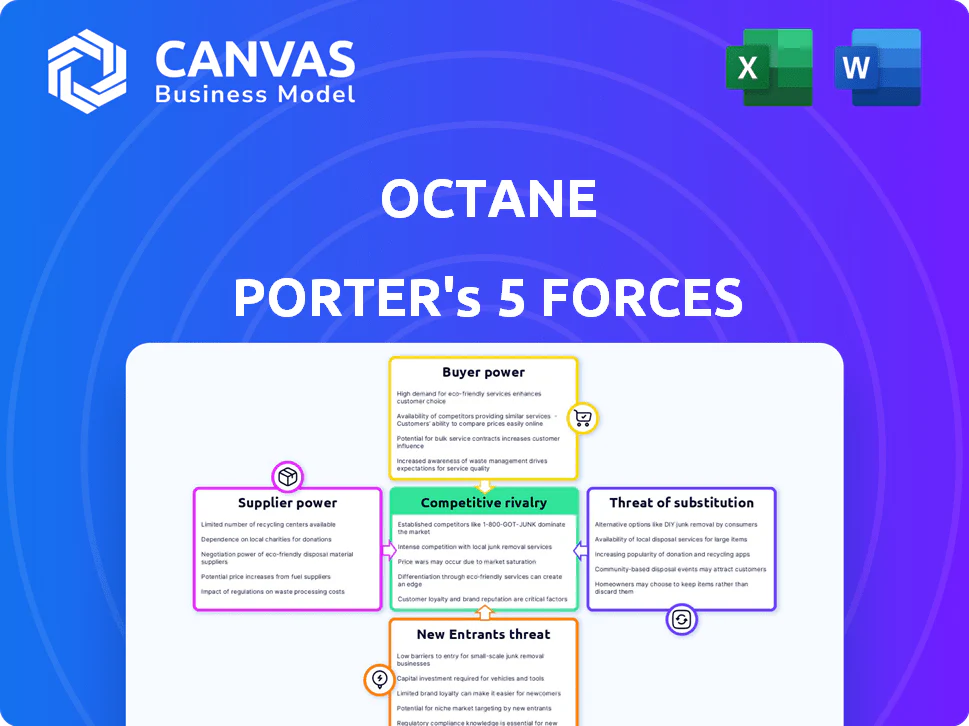
OCTANE PORTER'S FIVE FORCES TEMPLATE RESEARCH
What is included in the product
 Detailed Word Document
Tailored exclusively for Octane, analyzing its position within its competitive landscape.

 Customizable Excel Spreadsheet
Understand strategic pressure instantly via a powerful spider/radar chart.
Full Version Awaits
Octane Porter's Five Forces Analysis
This preview showcases the complete Octane Porter's Five Forces analysis. The document offers a thorough evaluation of the competitive landscape. It covers each force, like rivalry & threat of substitutes, in detail. The analysis is professionally written and immediately available after purchase.

Porter's Five Forces Analysis Template

A Must-Have Tool for Decision-Makers
Octane's industry faces intense competition, shaped by several key forces. Buyer power, driven by price sensitivity, is a significant consideration. The threat of new entrants, particularly from innovative tech companies, is also substantial. Supplier bargaining power and substitute products add further complexities.
However, the intensity of rivalry, shaped by a fragmented market, presents unique opportunities. Explore the full Porter's Five Forces Analysis to explore Octane’s competitive dynamics, market pressures, and strategic advantages in detail.
Suppliers Bargaining Power

Dependence on Capital Markets
Octane's ability to offer financing hinges on its access to capital markets. Securing favorable funding rates directly impacts Octane’s profitability. In 2024, the company actively utilized forward-flow deals and securitizations. These financial maneuvers highlight the vital role of investor relationships. Octane’s financial health is closely tied to the terms it negotiates with lenders.
Relationships with Lenders
Octane's platform success depends on lender relationships. The financial terms from lenders shape customer financing choices. In 2024, Octane facilitated over $1 billion in loans. Maintaining a diverse lender base is essential for competitive offerings. Strong relationships ensure attractive financing options.

Technology Providers
Octane, as a fintech firm, relies heavily on technology providers for its digital platform. The expenses and dependability of these technologies directly influence Octane's operational effectiveness. For example, in 2024, tech spending in fintech saw a 12% rise. This includes tech for credit risk assessment.

Data Providers
Octane relies heavily on data providers for credit risk assessment. Accurate and comprehensive data from credit bureaus is crucial for their underwriting processes. The cost and availability of this data directly impact Octane's ability to assess risk. This, in turn, affects their capacity to provide competitive financing. In 2024, the data analytics market was valued at over $270 billion, highlighting the significance of data.
- Data providers like credit bureaus hold significant power.
- Their pricing models and data quality directly affect Octane.
- Competitive financing depends on effective risk assessment.
- The data analytics market's value underscores data's importance.
OEM and Dealership Partnerships
Octane's relationships with original equipment manufacturers (OEMs) and dealerships are crucial. These partnerships enable loan origination, impacting loan application volume and quality. Promotional financing deals negotiated with OEMs can significantly affect loan demand. For instance, in 2024, such agreements led to a 15% increase in loan applications.
- Partnerships with OEMs and dealerships facilitate loan origination.
- Promotional financing terms influence loan application volume.
- Agreements can boost loan demand, as seen in 2024.
- The quality of loan applications is also affected by these partnerships.
Octane's Supplier Dynamics: Costs & Impacts
Supplier power affects Octane's costs and operations. Data and tech providers' pricing impacts Octane's risk assessment and platform. Strong supplier bargaining can increase expenses. In 2024, fintech tech spending rose, emphasizing supplier importance.
| Supplier Type | Impact on Octane | 2024 Data |
|---|---|---|
| Data Providers | Credit risk assessment costs | Data analytics market: $270B+ |
| Tech Providers | Platform operational costs | Fintech tech spending +12% |
| Lenders | Financing availability | $1B+ in loans facilitated |
Customers Bargaining Power

Availability of Financing Options
Customers have financing choices for recreational vehicles, powersports, and autos. Traditional banks, credit unions, and fintech companies offer options. This allows customers to compare offers. Octane must provide competitive rates and flexible terms. In 2024, RV sales saw a slight dip, impacting financing demand.
Digital-First Experience
Octane's digital platform offers a convenient financing experience, appealing to customers seeking simplicity. However, customers hold bargaining power; if Octane's digital offerings falter, they can switch to competitors. In 2024, digital lending platforms saw a 20% increase in user engagement. This highlights the critical importance of a seamless digital experience.

Access to Information
Customers' ability to research financing options online bolsters their bargaining power. This transparency, a key aspect of Octane's market, lets them compare rates easily. Octane's prequalification tools offer quick financing access. As of Q4 2023, online auto loan applications surged, showing customer control. This trend impacts Octane's pricing.

Price Sensitivity
Price sensitivity is a key factor for Octane’s customers. Interest rates and overall financing costs heavily influence their choices. In 2024, the average interest rate on new car loans was around 7.2%. Customers will likely choose lenders with the best rates, pressuring Octane.
- Competitive Pricing: Customers seek the lowest financing costs.
- Market Pressure: Octane must offer attractive rates.
- Interest Rate Impact: Rates significantly affect purchasing decisions.
- 2024 Data: Average new car loan rate was about 7.2%.
Dealership Influence
Dealerships hold some sway in directing customers toward financing options. Octane relies on these partnerships to connect with customers at the point of sale. Dealerships can promote specific financing to influence customer choices. In 2024, Octane's dealership partnerships facilitated a significant portion of its loan originations. This strategy directly impacts Octane's revenue and market reach.
- Dealerships guide financing decisions.
- Partnerships are crucial for Octane.
- Influence impacts loan originations.
- Strategy affects revenue and reach.
Car Loan Dynamics: Rates, Engagement & Choices
Customers have significant bargaining power due to financing choices. They can compare offers from banks, credit unions, and fintech firms. Digital platforms' user engagement saw a 20% increase in 2024, emphasizing the need for a seamless experience. Price sensitivity is high, with the average new car loan rate at 7.2% in 2024.
| Aspect | Impact | 2024 Data |
|---|---|---|
| Financing Options | Comparison of offers | Banks, Credit Unions, Fintech |
| Digital Engagement | Seamless experience | 20% increase in user engagement |
| Price Sensitivity | Rate influences decisions | Avg. new car loan rate 7.2% |
Rivalry Among Competitors

Presence of Traditional Financial Institutions
Traditional financial institutions like banks and credit unions are formidable competitors in vehicle financing. They boast established brands and extensive customer bases. In 2024, these institutions controlled a substantial portion of the auto loan market, around 60%. Octane differentiates itself through a digital, streamlined experience. This specialized approach targets recreational vehicle purchases, creating a niche.
Other Fintech Lenders
The fintech lending space is highly competitive, with numerous digital platforms vying for market share. However, Octane distinguishes itself by specializing in recreational vehicles, powersports, and automobiles. In 2024, the powersports market saw approximately $20 billion in sales, highlighting the potential for Octane's focused approach. This specialization allows Octane to offer tailored financing solutions, setting it apart from more generalized lenders.

Dealership Captive Finance Companies
Dealership captive finance companies, like those of major automakers, present strong competition. These entities, such as Ford Motor Credit or GM Financial, provide financing exclusively for their brand's vehicles. In 2024, these captives often offer lower rates and incentives, challenging independent lenders. Captives accounted for about 58% of new vehicle financing in 2024, making it tough for Octane to compete.

Online Lending Marketplaces
Online lending marketplaces intensify competition by enabling easy comparison of financing options. Octane's platform, acting as a marketplace, links customers with lenders and dealerships, thus increasing rivalry. This marketplace model fosters price competition and product differentiation. The online lending market is projected to reach $1.1 trillion by 2024.
- Increased competition from multiple lenders.
- Octane's role as a marketplace.
- Focus on price and product comparisons.
- Market size projected at $1.1T by 2024.
Focus on Niche Markets
Octane Finance's focus on niche markets, like recreational vehicles and powersports, offers some protection from broader competition. However, it still contends with rivals specializing in these areas. The competitive landscape includes both large financial institutions and smaller, specialized lenders. For example, in 2024, the RV industry saw over $28 billion in retail sales, indicating a substantial market Octane competes within.
- Specialization helps, but doesn't eliminate competition.
- Rivals range from big banks to niche lenders.
- RV market sales were significant in 2024.
- Octane must compete effectively in these specific niches.
Auto Loan Arena: Fierce Competition Ahead!
Competitive rivalry for Octane Finance is intense due to a mix of traditional and digital lenders. The company faces competition from banks, fintech platforms, and dealership financing arms. Octane's marketplace model intensifies price and product competition, with the online lending market reaching $1.1 trillion in 2024.
| Competitor Type | Market Presence (2024) | Competitive Strategy |
|---|---|---|
| Banks/Credit Unions | ~60% of auto loans | Established brands, broad customer base |
| Fintech Platforms | Growing, varied | Digital, streamlined experiences |
| Dealership Captives | ~58% of new vehicle financing | Lower rates, brand loyalty |
OCTANE PORTER'S FIVE FORCES TEMPLATE RESEARCH
What is included in the product
Detailed Word Document
Tailored exclusively for Octane, analyzing its position within its competitive landscape.
Customizable Excel Spreadsheet
Understand strategic pressure instantly via a powerful spider/radar chart.
Full Version Awaits
Octane Porter's Five Forces Analysis
This preview showcases the complete Octane Porter's Five Forces analysis. The document offers a thorough evaluation of the competitive landscape. It covers each force, like rivalry & threat of substitutes, in detail. The analysis is professionally written and immediately available after purchase.
Porter's Five Forces Analysis Template
A Must-Have Tool for Decision-Makers
Octane's industry faces intense competition, shaped by several key forces. Buyer power, driven by price sensitivity, is a significant consideration. The threat of new entrants, particularly from innovative tech companies, is also substantial. Supplier bargaining power and substitute products add further complexities.
However, the intensity of rivalry, shaped by a fragmented market, presents unique opportunities. Explore the full Porter's Five Forces Analysis to explore Octane’s competitive dynamics, market pressures, and strategic advantages in detail.
Suppliers Bargaining Power
Dependence on Capital Markets
Octane's ability to offer financing hinges on its access to capital markets. Securing favorable funding rates directly impacts Octane’s profitability. In 2024, the company actively utilized forward-flow deals and securitizations. These financial maneuvers highlight the vital role of investor relationships. Octane’s financial health is closely tied to the terms it negotiates with lenders.
Relationships with Lenders
Octane's platform success depends on lender relationships. The financial terms from lenders shape customer financing choices. In 2024, Octane facilitated over $1 billion in loans. Maintaining a diverse lender base is essential for competitive offerings. Strong relationships ensure attractive financing options.
Technology Providers
Octane, as a fintech firm, relies heavily on technology providers for its digital platform. The expenses and dependability of these technologies directly influence Octane's operational effectiveness. For example, in 2024, tech spending in fintech saw a 12% rise. This includes tech for credit risk assessment.
Data Providers
Octane relies heavily on data providers for credit risk assessment. Accurate and comprehensive data from credit bureaus is crucial for their underwriting processes. The cost and availability of this data directly impact Octane's ability to assess risk. This, in turn, affects their capacity to provide competitive financing. In 2024, the data analytics market was valued at over $270 billion, highlighting the significance of data.
- Data providers like credit bureaus hold significant power.
- Their pricing models and data quality directly affect Octane.
- Competitive financing depends on effective risk assessment.
- The data analytics market's value underscores data's importance.
OEM and Dealership Partnerships
Octane's relationships with original equipment manufacturers (OEMs) and dealerships are crucial. These partnerships enable loan origination, impacting loan application volume and quality. Promotional financing deals negotiated with OEMs can significantly affect loan demand. For instance, in 2024, such agreements led to a 15% increase in loan applications.
- Partnerships with OEMs and dealerships facilitate loan origination.
- Promotional financing terms influence loan application volume.
- Agreements can boost loan demand, as seen in 2024.
- The quality of loan applications is also affected by these partnerships.
Octane's Supplier Dynamics: Costs & Impacts
Supplier power affects Octane's costs and operations. Data and tech providers' pricing impacts Octane's risk assessment and platform. Strong supplier bargaining can increase expenses. In 2024, fintech tech spending rose, emphasizing supplier importance.
| Supplier Type | Impact on Octane | 2024 Data |
|---|---|---|
| Data Providers | Credit risk assessment costs | Data analytics market: $270B+ |
| Tech Providers | Platform operational costs | Fintech tech spending +12% |
| Lenders | Financing availability | $1B+ in loans facilitated |
Customers Bargaining Power
Availability of Financing Options
Customers have financing choices for recreational vehicles, powersports, and autos. Traditional banks, credit unions, and fintech companies offer options. This allows customers to compare offers. Octane must provide competitive rates and flexible terms. In 2024, RV sales saw a slight dip, impacting financing demand.
Digital-First Experience
Octane's digital platform offers a convenient financing experience, appealing to customers seeking simplicity. However, customers hold bargaining power; if Octane's digital offerings falter, they can switch to competitors. In 2024, digital lending platforms saw a 20% increase in user engagement. This highlights the critical importance of a seamless digital experience.
Access to Information
Customers' ability to research financing options online bolsters their bargaining power. This transparency, a key aspect of Octane's market, lets them compare rates easily. Octane's prequalification tools offer quick financing access. As of Q4 2023, online auto loan applications surged, showing customer control. This trend impacts Octane's pricing.
Price Sensitivity
Price sensitivity is a key factor for Octane’s customers. Interest rates and overall financing costs heavily influence their choices. In 2024, the average interest rate on new car loans was around 7.2%. Customers will likely choose lenders with the best rates, pressuring Octane.
- Competitive Pricing: Customers seek the lowest financing costs.
- Market Pressure: Octane must offer attractive rates.
- Interest Rate Impact: Rates significantly affect purchasing decisions.
- 2024 Data: Average new car loan rate was about 7.2%.
Dealership Influence
Dealerships hold some sway in directing customers toward financing options. Octane relies on these partnerships to connect with customers at the point of sale. Dealerships can promote specific financing to influence customer choices. In 2024, Octane's dealership partnerships facilitated a significant portion of its loan originations. This strategy directly impacts Octane's revenue and market reach.
- Dealerships guide financing decisions.
- Partnerships are crucial for Octane.
- Influence impacts loan originations.
- Strategy affects revenue and reach.
Car Loan Dynamics: Rates, Engagement & Choices
Customers have significant bargaining power due to financing choices. They can compare offers from banks, credit unions, and fintech firms. Digital platforms' user engagement saw a 20% increase in 2024, emphasizing the need for a seamless experience. Price sensitivity is high, with the average new car loan rate at 7.2% in 2024.
| Aspect | Impact | 2024 Data |
|---|---|---|
| Financing Options | Comparison of offers | Banks, Credit Unions, Fintech |
| Digital Engagement | Seamless experience | 20% increase in user engagement |
| Price Sensitivity | Rate influences decisions | Avg. new car loan rate 7.2% |
Rivalry Among Competitors
Presence of Traditional Financial Institutions
Traditional financial institutions like banks and credit unions are formidable competitors in vehicle financing. They boast established brands and extensive customer bases. In 2024, these institutions controlled a substantial portion of the auto loan market, around 60%. Octane differentiates itself through a digital, streamlined experience. This specialized approach targets recreational vehicle purchases, creating a niche.
Other Fintech Lenders
The fintech lending space is highly competitive, with numerous digital platforms vying for market share. However, Octane distinguishes itself by specializing in recreational vehicles, powersports, and automobiles. In 2024, the powersports market saw approximately $20 billion in sales, highlighting the potential for Octane's focused approach. This specialization allows Octane to offer tailored financing solutions, setting it apart from more generalized lenders.
Dealership Captive Finance Companies
Dealership captive finance companies, like those of major automakers, present strong competition. These entities, such as Ford Motor Credit or GM Financial, provide financing exclusively for their brand's vehicles. In 2024, these captives often offer lower rates and incentives, challenging independent lenders. Captives accounted for about 58% of new vehicle financing in 2024, making it tough for Octane to compete.
Online Lending Marketplaces
Online lending marketplaces intensify competition by enabling easy comparison of financing options. Octane's platform, acting as a marketplace, links customers with lenders and dealerships, thus increasing rivalry. This marketplace model fosters price competition and product differentiation. The online lending market is projected to reach $1.1 trillion by 2024.
- Increased competition from multiple lenders.
- Octane's role as a marketplace.
- Focus on price and product comparisons.
- Market size projected at $1.1T by 2024.
Focus on Niche Markets
Octane Finance's focus on niche markets, like recreational vehicles and powersports, offers some protection from broader competition. However, it still contends with rivals specializing in these areas. The competitive landscape includes both large financial institutions and smaller, specialized lenders. For example, in 2024, the RV industry saw over $28 billion in retail sales, indicating a substantial market Octane competes within.
- Specialization helps, but doesn't eliminate competition.
- Rivals range from big banks to niche lenders.
- RV market sales were significant in 2024.
- Octane must compete effectively in these specific niches.
Auto Loan Arena: Fierce Competition Ahead!
Competitive rivalry for Octane Finance is intense due to a mix of traditional and digital lenders. The company faces competition from banks, fintech platforms, and dealership financing arms. Octane's marketplace model intensifies price and product competition, with the online lending market reaching $1.1 trillion in 2024.
| Competitor Type | Market Presence (2024) | Competitive Strategy |
|---|---|---|
| Banks/Credit Unions | ~60% of auto loans | Established brands, broad customer base |
| Fintech Platforms | Growing, varied | Digital, streamlined experiences |
| Dealership Captives | ~58% of new vehicle financing | Lower rates, brand loyalty |
Product Information
Product Information
Shipping & Returns
Shipping & Returns
Description
What is included in the product
Detailed Word Document
Tailored exclusively for Octane, analyzing its position within its competitive landscape.
Customizable Excel Spreadsheet
Understand strategic pressure instantly via a powerful spider/radar chart.
Full Version Awaits
Octane Porter's Five Forces Analysis
This preview showcases the complete Octane Porter's Five Forces analysis. The document offers a thorough evaluation of the competitive landscape. It covers each force, like rivalry & threat of substitutes, in detail. The analysis is professionally written and immediately available after purchase.
Porter's Five Forces Analysis Template
A Must-Have Tool for Decision-Makers
Octane's industry faces intense competition, shaped by several key forces. Buyer power, driven by price sensitivity, is a significant consideration. The threat of new entrants, particularly from innovative tech companies, is also substantial. Supplier bargaining power and substitute products add further complexities.
However, the intensity of rivalry, shaped by a fragmented market, presents unique opportunities. Explore the full Porter's Five Forces Analysis to explore Octane’s competitive dynamics, market pressures, and strategic advantages in detail.
Suppliers Bargaining Power
Dependence on Capital Markets
Octane's ability to offer financing hinges on its access to capital markets. Securing favorable funding rates directly impacts Octane’s profitability. In 2024, the company actively utilized forward-flow deals and securitizations. These financial maneuvers highlight the vital role of investor relationships. Octane’s financial health is closely tied to the terms it negotiates with lenders.
Relationships with Lenders
Octane's platform success depends on lender relationships. The financial terms from lenders shape customer financing choices. In 2024, Octane facilitated over $1 billion in loans. Maintaining a diverse lender base is essential for competitive offerings. Strong relationships ensure attractive financing options.
Technology Providers
Octane, as a fintech firm, relies heavily on technology providers for its digital platform. The expenses and dependability of these technologies directly influence Octane's operational effectiveness. For example, in 2024, tech spending in fintech saw a 12% rise. This includes tech for credit risk assessment.
Data Providers
Octane relies heavily on data providers for credit risk assessment. Accurate and comprehensive data from credit bureaus is crucial for their underwriting processes. The cost and availability of this data directly impact Octane's ability to assess risk. This, in turn, affects their capacity to provide competitive financing. In 2024, the data analytics market was valued at over $270 billion, highlighting the significance of data.
- Data providers like credit bureaus hold significant power.
- Their pricing models and data quality directly affect Octane.
- Competitive financing depends on effective risk assessment.
- The data analytics market's value underscores data's importance.
OEM and Dealership Partnerships
Octane's relationships with original equipment manufacturers (OEMs) and dealerships are crucial. These partnerships enable loan origination, impacting loan application volume and quality. Promotional financing deals negotiated with OEMs can significantly affect loan demand. For instance, in 2024, such agreements led to a 15% increase in loan applications.
- Partnerships with OEMs and dealerships facilitate loan origination.
- Promotional financing terms influence loan application volume.
- Agreements can boost loan demand, as seen in 2024.
- The quality of loan applications is also affected by these partnerships.
Octane's Supplier Dynamics: Costs & Impacts
Supplier power affects Octane's costs and operations. Data and tech providers' pricing impacts Octane's risk assessment and platform. Strong supplier bargaining can increase expenses. In 2024, fintech tech spending rose, emphasizing supplier importance.
| Supplier Type | Impact on Octane | 2024 Data |
|---|---|---|
| Data Providers | Credit risk assessment costs | Data analytics market: $270B+ |
| Tech Providers | Platform operational costs | Fintech tech spending +12% |
| Lenders | Financing availability | $1B+ in loans facilitated |
Customers Bargaining Power
Availability of Financing Options
Customers have financing choices for recreational vehicles, powersports, and autos. Traditional banks, credit unions, and fintech companies offer options. This allows customers to compare offers. Octane must provide competitive rates and flexible terms. In 2024, RV sales saw a slight dip, impacting financing demand.
Digital-First Experience
Octane's digital platform offers a convenient financing experience, appealing to customers seeking simplicity. However, customers hold bargaining power; if Octane's digital offerings falter, they can switch to competitors. In 2024, digital lending platforms saw a 20% increase in user engagement. This highlights the critical importance of a seamless digital experience.
Access to Information
Customers' ability to research financing options online bolsters their bargaining power. This transparency, a key aspect of Octane's market, lets them compare rates easily. Octane's prequalification tools offer quick financing access. As of Q4 2023, online auto loan applications surged, showing customer control. This trend impacts Octane's pricing.
Price Sensitivity
Price sensitivity is a key factor for Octane’s customers. Interest rates and overall financing costs heavily influence their choices. In 2024, the average interest rate on new car loans was around 7.2%. Customers will likely choose lenders with the best rates, pressuring Octane.
- Competitive Pricing: Customers seek the lowest financing costs.
- Market Pressure: Octane must offer attractive rates.
- Interest Rate Impact: Rates significantly affect purchasing decisions.
- 2024 Data: Average new car loan rate was about 7.2%.
Dealership Influence
Dealerships hold some sway in directing customers toward financing options. Octane relies on these partnerships to connect with customers at the point of sale. Dealerships can promote specific financing to influence customer choices. In 2024, Octane's dealership partnerships facilitated a significant portion of its loan originations. This strategy directly impacts Octane's revenue and market reach.
- Dealerships guide financing decisions.
- Partnerships are crucial for Octane.
- Influence impacts loan originations.
- Strategy affects revenue and reach.
Car Loan Dynamics: Rates, Engagement & Choices
Customers have significant bargaining power due to financing choices. They can compare offers from banks, credit unions, and fintech firms. Digital platforms' user engagement saw a 20% increase in 2024, emphasizing the need for a seamless experience. Price sensitivity is high, with the average new car loan rate at 7.2% in 2024.
| Aspect | Impact | 2024 Data |
|---|---|---|
| Financing Options | Comparison of offers | Banks, Credit Unions, Fintech |
| Digital Engagement | Seamless experience | 20% increase in user engagement |
| Price Sensitivity | Rate influences decisions | Avg. new car loan rate 7.2% |
Rivalry Among Competitors
Presence of Traditional Financial Institutions
Traditional financial institutions like banks and credit unions are formidable competitors in vehicle financing. They boast established brands and extensive customer bases. In 2024, these institutions controlled a substantial portion of the auto loan market, around 60%. Octane differentiates itself through a digital, streamlined experience. This specialized approach targets recreational vehicle purchases, creating a niche.
Other Fintech Lenders
The fintech lending space is highly competitive, with numerous digital platforms vying for market share. However, Octane distinguishes itself by specializing in recreational vehicles, powersports, and automobiles. In 2024, the powersports market saw approximately $20 billion in sales, highlighting the potential for Octane's focused approach. This specialization allows Octane to offer tailored financing solutions, setting it apart from more generalized lenders.
Dealership Captive Finance Companies
Dealership captive finance companies, like those of major automakers, present strong competition. These entities, such as Ford Motor Credit or GM Financial, provide financing exclusively for their brand's vehicles. In 2024, these captives often offer lower rates and incentives, challenging independent lenders. Captives accounted for about 58% of new vehicle financing in 2024, making it tough for Octane to compete.
Online Lending Marketplaces
Online lending marketplaces intensify competition by enabling easy comparison of financing options. Octane's platform, acting as a marketplace, links customers with lenders and dealerships, thus increasing rivalry. This marketplace model fosters price competition and product differentiation. The online lending market is projected to reach $1.1 trillion by 2024.
- Increased competition from multiple lenders.
- Octane's role as a marketplace.
- Focus on price and product comparisons.
- Market size projected at $1.1T by 2024.
Focus on Niche Markets
Octane Finance's focus on niche markets, like recreational vehicles and powersports, offers some protection from broader competition. However, it still contends with rivals specializing in these areas. The competitive landscape includes both large financial institutions and smaller, specialized lenders. For example, in 2024, the RV industry saw over $28 billion in retail sales, indicating a substantial market Octane competes within.
- Specialization helps, but doesn't eliminate competition.
- Rivals range from big banks to niche lenders.
- RV market sales were significant in 2024.
- Octane must compete effectively in these specific niches.
Auto Loan Arena: Fierce Competition Ahead!
Competitive rivalry for Octane Finance is intense due to a mix of traditional and digital lenders. The company faces competition from banks, fintech platforms, and dealership financing arms. Octane's marketplace model intensifies price and product competition, with the online lending market reaching $1.1 trillion in 2024.
| Competitor Type | Market Presence (2024) | Competitive Strategy |
|---|---|---|
| Banks/Credit Unions | ~60% of auto loans | Established brands, broad customer base |
| Fintech Platforms | Growing, varied | Digital, streamlined experiences |
| Dealership Captives | ~58% of new vehicle financing | Lower rates, brand loyalty |











