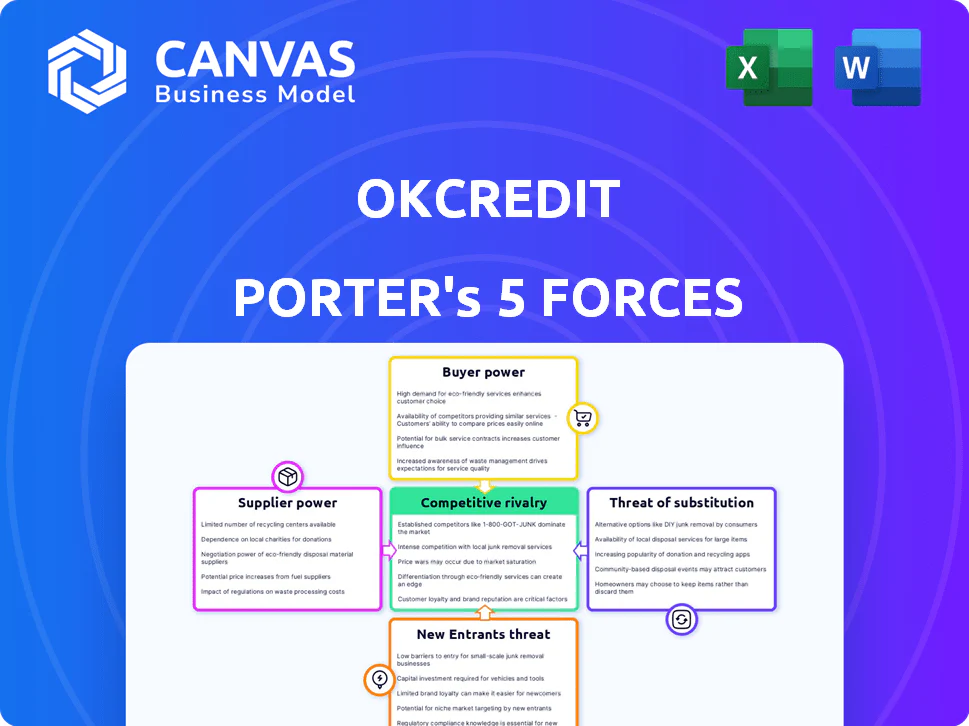
OKCREDIT PORTER'S FIVE FORCES TEMPLATE RESEARCH
What is included in the product
 Detailed Word Document
Analyzes competitive forces impacting OkCredit, including buyer/supplier power, threats, and entry barriers.

 Customizable Excel Spreadsheet
Visually explore all five forces to instantly identify threats and opportunities for OkCredit.
What You See Is What You Get
OkCredit Porter's Five Forces Analysis
This preview showcases the complete OkCredit Porter's Five Forces Analysis. The document displayed is the same detailed analysis you'll receive instantly upon purchase, fully formatted and ready. No need to wait, it's ready to download and use right away.

Porter's Five Forces Analysis Template

Elevate Your Analysis with the Complete Porter's Five Forces Analysis
OkCredit faces diverse forces in its competitive landscape. Bargaining power of suppliers is moderate. Buyer power is also considerable. The threat of new entrants is low. Substitute products pose a moderate threat. Rivalry among existing competitors is intense.
Ready to move beyond the basics? Get a full strategic breakdown of OkCredit’s market position, competitive intensity, and external threats—all in one powerful analysis.
Suppliers Bargaining Power

Dependency on Technology Infrastructure
OkCredit's reliance on tech infrastructure, like cloud services, gives suppliers considerable leverage. The cloud market is dominated by a few giants; Amazon Web Services (AWS), Microsoft Azure, and Google Cloud, holding a combined 66% of the market share in 2024. These suppliers can dictate terms.
Limited Number of Software Service Providers
The software development market features a limited number of specialized service providers, which can shift bargaining power. These suppliers can negotiate better pricing, particularly for custom software needing specific expertise. In 2024, the global software market reached $750 billion, showing the high stakes involved. This concentration allows suppliers to leverage their specialized skills for higher rates.

Cost of Switching Infrastructure Providers
Switching cloud infrastructure providers is complex and costly for OkCredit. High switching costs boost suppliers' bargaining power. Migration can involve data transfer and system redesign. In 2024, cloud migration costs averaged $1.2 million. This gives suppliers leverage in pricing and terms.

Availability of Skilled Labor
OkCredit's reliance on skilled tech professionals significantly influences supplier power. The limited supply of skilled software developers and IT specialists elevates their bargaining leverage. This can lead to increased costs for hiring, training, and retaining essential personnel. These costs directly impact OkCredit's operational expenses and profitability.
- In 2024, the demand for software developers rose by 20%, reflecting a talent shortage.
- Average salaries for tech roles increased by 15% in the same period.
- Companies are now offering up to 25% more in benefits to attract top talent.
- The cost of outsourcing IT services has climbed by 18%.
Proprietary Technology and Licenses
OkCredit's reliance on proprietary technology or software licenses from external providers can increase supplier bargaining power. If these technologies are critical for OkCredit's operations and have few substitutes, suppliers gain leverage. For instance, if OkCredit uses a specific payment gateway with limited alternatives, that supplier can potentially dictate terms. This can influence the company's cost structure.
- In 2024, the global fintech software market was valued at approximately $111.2 billion.
- The market is projected to reach $205.6 billion by 2029.
- Companies like OkCredit must navigate a competitive landscape with key technology providers.
- Negotiating favorable licensing agreements is crucial for cost management.
Supplier Power Threatens Fintech Firm
OkCredit faces significant supplier bargaining power due to its reliance on key tech and software providers. The cloud services market, dominated by a few major players, allows suppliers to dictate terms. Switching costs, averaging $1.2 million in 2024, further strengthen their position.
| Factor | Impact | 2024 Data |
|---|---|---|
| Cloud Services | High Leverage | AWS, Azure, Google Cloud: 66% market share |
| Software Devs | Increased Costs | Demand up 20%, salaries up 15% |
| Fintech Software | Supplier Influence | $111.2B market value |
Customers Bargaining Power

Large and Fragmented Customer Base
OkCredit's customer base is vast and diverse, consisting mainly of India's small and medium businesses. Individually, these customers have limited power. However, the large user volume gives them some leverage in shaping OkCredit's services and pricing. This is especially true given the availability of competing digital ledger platforms.
Availability of Alternatives
Customers of OkCredit have many bookkeeping options, like paper ledgers and digital apps. This access to alternatives, including competitors like Khatabook, strengthens customer bargaining power. For instance, Khatabook had over 20 million monthly active users in 2024. If users are unsatisfied with OkCredit, they can easily switch platforms. This competitive landscape forces OkCredit to offer better services to retain users.

Low Switching Costs for Customers
Switching costs for customers of digital ledger apps, like OkCredit, are generally low. This allows customers to easily move to competitors. In 2024, the average cost to switch apps was estimated to be under $50 for small businesses, based on time investment alone, according to a study by the Small Business Technology Council. This low barrier increases customer bargaining power.

Price Sensitivity of Small Businesses
Small and medium-sized businesses (SMBs) tend to be highly price-sensitive. OkCredit's freemium model is a direct response to this, offering basic services at no cost. Any shift toward paid features or higher prices could lead to customer churn, especially if competitors offer similar services for less. In 2024, 68% of SMBs cited cost as a primary factor in their technology adoption decisions.
- Freemium model is a direct response to the price sensitivity of SMBs.
- Customer churn risk exists with any move towards paid features or increased costs.
- 68% of SMBs cited cost as a primary factor in tech adoption in 2024.
Customer Access to Information
Customers of digital bookkeeping apps like OkCredit have significant bargaining power due to readily available information. They can easily compare features, pricing, and user reviews of various apps, enhancing their ability to negotiate for better terms or switch to a competitor. This transparency forces companies to offer competitive pricing and value propositions to attract and retain users. In 2024, the digital bookkeeping market saw over 100 different apps, with a churn rate of around 15-20% as users switched to find the best fit.
- Market Transparency: The digital bookkeeping market offers high transparency, with pricing and features easily accessible.
- Competitive Landscape: Over 100 apps compete for users, intensifying competition.
- Switching Costs: Low switching costs allow customers to easily move between apps.
- Churn Rate: The churn rate for digital bookkeeping apps is between 15-20% in 2024.
SMBs' Bargaining Power: A Digital Ledger Showdown
OkCredit's customers, primarily Indian SMBs, wield considerable bargaining power. This stems from the availability of competing digital ledger platforms, like Khatabook, which had over 20 million monthly active users in 2024. Low switching costs, estimated under $50, and high price sensitivity, with 68% of SMBs prioritizing cost in tech adoption in 2024, further amplify customer influence. Transparency in the market, with over 100 apps and a 15-20% churn rate in 2024, enables informed choices.
| Factor | Impact | Data (2024) |
|---|---|---|
| Competition | High | 100+ apps |
| Switching Costs | Low | Under $50 |
| Price Sensitivity | High | 68% SMBs |
Rivalry Among Competitors

Presence of Direct Competitors
OkCredit faces intense competition from direct rivals like Khatabook, which has a significant user base. Khatabook's valuation was estimated at $300 million in 2024. This competition drives innovation and price wars.
Low Barriers to Entry for Similar Apps
The digital ledger app market sees low barriers to entry. Building a user base and a platform needs big investments. The basic concept of such an app has low tech barriers, so more rivals arise. In 2024, the market saw many new apps emerge. This increased competition for OkCredit.

Feature Set and Innovation
OkCredit's rivals continually enhance their offerings. They introduce new features like multi-language support and payment reminders. This rapid innovation intensifies the competition. Competitors strive to attract users with the latest functionalities. For example, in 2024, digital payment apps saw a 20% increase in feature updates.

Pricing Strategies
Competitive rivalry in the digital payments space, including OkCredit, often hinges on pricing strategies. Companies frequently compete by offering attractive pricing models to lure in and keep customers. These strategies include freemium models, where basic services are free, and premium services that require a fee. For example, in 2024, many fintech companies have adopted tiered pricing structures to cater to different user needs.
- Freemium models are prevalent, with basic features offered without charge to attract users.
- Premium features, like advanced analytics, come at a cost.
- Competition drives companies to balance pricing with service value.
- Market dynamics influence pricing decisions.
Market Growth Potential
The Indian market for small and medium-sized businesses (SMBs) is booming, creating a huge opportunity for financial service providers like OkCredit. However, this growth also intensifies competition. In 2024, the SMB sector in India saw a 10% increase in digital transactions, highlighting the market's potential but also the need for companies to differentiate themselves. Intense rivalry means businesses must constantly innovate and improve their offerings to stay ahead.
- The Indian SMB market is projected to reach $700 billion by 2026.
- Over 63 million SMBs operate in India.
- Digital payments among SMBs grew by 15% in 2023.
- Competition is high due to the low barriers to entry for digital financial tools.
Digital Ledger Wars: $700B SMB Market Fuels Fierce Battle!
OkCredit contends with fierce rivals like Khatabook, valued at $300 million in 2024, fueling innovation and price wars. The digital ledger market's low entry barriers and rapid feature updates, with a 20% increase in 2024, amplify competition. Pricing strategies, including freemium models, are crucial, especially in the booming Indian SMB market, projected at $700 billion by 2026, where digital transactions grew 10% in 2024.
| Aspect | Details | Impact |
|---|---|---|
| Key Competitors | Khatabook, others | Intensifies rivalry |
| Market Growth (SMBs) | Projected $700B by 2026 | Attracts more entrants |
| Digital Trans. Growth (2024) | 10% increase | Heightens competition |
OKCREDIT PORTER'S FIVE FORCES TEMPLATE RESEARCH
What is included in the product
Detailed Word Document
Analyzes competitive forces impacting OkCredit, including buyer/supplier power, threats, and entry barriers.
Customizable Excel Spreadsheet
Visually explore all five forces to instantly identify threats and opportunities for OkCredit.
What You See Is What You Get
OkCredit Porter's Five Forces Analysis
This preview showcases the complete OkCredit Porter's Five Forces Analysis. The document displayed is the same detailed analysis you'll receive instantly upon purchase, fully formatted and ready. No need to wait, it's ready to download and use right away.
Porter's Five Forces Analysis Template
Elevate Your Analysis with the Complete Porter's Five Forces Analysis
OkCredit faces diverse forces in its competitive landscape. Bargaining power of suppliers is moderate. Buyer power is also considerable. The threat of new entrants is low. Substitute products pose a moderate threat. Rivalry among existing competitors is intense.
Ready to move beyond the basics? Get a full strategic breakdown of OkCredit’s market position, competitive intensity, and external threats—all in one powerful analysis.
Suppliers Bargaining Power
Dependency on Technology Infrastructure
OkCredit's reliance on tech infrastructure, like cloud services, gives suppliers considerable leverage. The cloud market is dominated by a few giants; Amazon Web Services (AWS), Microsoft Azure, and Google Cloud, holding a combined 66% of the market share in 2024. These suppliers can dictate terms.
Limited Number of Software Service Providers
The software development market features a limited number of specialized service providers, which can shift bargaining power. These suppliers can negotiate better pricing, particularly for custom software needing specific expertise. In 2024, the global software market reached $750 billion, showing the high stakes involved. This concentration allows suppliers to leverage their specialized skills for higher rates.
Cost of Switching Infrastructure Providers
Switching cloud infrastructure providers is complex and costly for OkCredit. High switching costs boost suppliers' bargaining power. Migration can involve data transfer and system redesign. In 2024, cloud migration costs averaged $1.2 million. This gives suppliers leverage in pricing and terms.
Availability of Skilled Labor
OkCredit's reliance on skilled tech professionals significantly influences supplier power. The limited supply of skilled software developers and IT specialists elevates their bargaining leverage. This can lead to increased costs for hiring, training, and retaining essential personnel. These costs directly impact OkCredit's operational expenses and profitability.
- In 2024, the demand for software developers rose by 20%, reflecting a talent shortage.
- Average salaries for tech roles increased by 15% in the same period.
- Companies are now offering up to 25% more in benefits to attract top talent.
- The cost of outsourcing IT services has climbed by 18%.
Proprietary Technology and Licenses
OkCredit's reliance on proprietary technology or software licenses from external providers can increase supplier bargaining power. If these technologies are critical for OkCredit's operations and have few substitutes, suppliers gain leverage. For instance, if OkCredit uses a specific payment gateway with limited alternatives, that supplier can potentially dictate terms. This can influence the company's cost structure.
- In 2024, the global fintech software market was valued at approximately $111.2 billion.
- The market is projected to reach $205.6 billion by 2029.
- Companies like OkCredit must navigate a competitive landscape with key technology providers.
- Negotiating favorable licensing agreements is crucial for cost management.
Supplier Power Threatens Fintech Firm
OkCredit faces significant supplier bargaining power due to its reliance on key tech and software providers. The cloud services market, dominated by a few major players, allows suppliers to dictate terms. Switching costs, averaging $1.2 million in 2024, further strengthen their position.
| Factor | Impact | 2024 Data |
|---|---|---|
| Cloud Services | High Leverage | AWS, Azure, Google Cloud: 66% market share |
| Software Devs | Increased Costs | Demand up 20%, salaries up 15% |
| Fintech Software | Supplier Influence | $111.2B market value |
Customers Bargaining Power
Large and Fragmented Customer Base
OkCredit's customer base is vast and diverse, consisting mainly of India's small and medium businesses. Individually, these customers have limited power. However, the large user volume gives them some leverage in shaping OkCredit's services and pricing. This is especially true given the availability of competing digital ledger platforms.
Availability of Alternatives
Customers of OkCredit have many bookkeeping options, like paper ledgers and digital apps. This access to alternatives, including competitors like Khatabook, strengthens customer bargaining power. For instance, Khatabook had over 20 million monthly active users in 2024. If users are unsatisfied with OkCredit, they can easily switch platforms. This competitive landscape forces OkCredit to offer better services to retain users.
Low Switching Costs for Customers
Switching costs for customers of digital ledger apps, like OkCredit, are generally low. This allows customers to easily move to competitors. In 2024, the average cost to switch apps was estimated to be under $50 for small businesses, based on time investment alone, according to a study by the Small Business Technology Council. This low barrier increases customer bargaining power.
Price Sensitivity of Small Businesses
Small and medium-sized businesses (SMBs) tend to be highly price-sensitive. OkCredit's freemium model is a direct response to this, offering basic services at no cost. Any shift toward paid features or higher prices could lead to customer churn, especially if competitors offer similar services for less. In 2024, 68% of SMBs cited cost as a primary factor in their technology adoption decisions.
- Freemium model is a direct response to the price sensitivity of SMBs.
- Customer churn risk exists with any move towards paid features or increased costs.
- 68% of SMBs cited cost as a primary factor in tech adoption in 2024.
Customer Access to Information
Customers of digital bookkeeping apps like OkCredit have significant bargaining power due to readily available information. They can easily compare features, pricing, and user reviews of various apps, enhancing their ability to negotiate for better terms or switch to a competitor. This transparency forces companies to offer competitive pricing and value propositions to attract and retain users. In 2024, the digital bookkeeping market saw over 100 different apps, with a churn rate of around 15-20% as users switched to find the best fit.
- Market Transparency: The digital bookkeeping market offers high transparency, with pricing and features easily accessible.
- Competitive Landscape: Over 100 apps compete for users, intensifying competition.
- Switching Costs: Low switching costs allow customers to easily move between apps.
- Churn Rate: The churn rate for digital bookkeeping apps is between 15-20% in 2024.
SMBs' Bargaining Power: A Digital Ledger Showdown
OkCredit's customers, primarily Indian SMBs, wield considerable bargaining power. This stems from the availability of competing digital ledger platforms, like Khatabook, which had over 20 million monthly active users in 2024. Low switching costs, estimated under $50, and high price sensitivity, with 68% of SMBs prioritizing cost in tech adoption in 2024, further amplify customer influence. Transparency in the market, with over 100 apps and a 15-20% churn rate in 2024, enables informed choices.
| Factor | Impact | Data (2024) |
|---|---|---|
| Competition | High | 100+ apps |
| Switching Costs | Low | Under $50 |
| Price Sensitivity | High | 68% SMBs |
Rivalry Among Competitors
Presence of Direct Competitors
OkCredit faces intense competition from direct rivals like Khatabook, which has a significant user base. Khatabook's valuation was estimated at $300 million in 2024. This competition drives innovation and price wars.
Low Barriers to Entry for Similar Apps
The digital ledger app market sees low barriers to entry. Building a user base and a platform needs big investments. The basic concept of such an app has low tech barriers, so more rivals arise. In 2024, the market saw many new apps emerge. This increased competition for OkCredit.
Feature Set and Innovation
OkCredit's rivals continually enhance their offerings. They introduce new features like multi-language support and payment reminders. This rapid innovation intensifies the competition. Competitors strive to attract users with the latest functionalities. For example, in 2024, digital payment apps saw a 20% increase in feature updates.
Pricing Strategies
Competitive rivalry in the digital payments space, including OkCredit, often hinges on pricing strategies. Companies frequently compete by offering attractive pricing models to lure in and keep customers. These strategies include freemium models, where basic services are free, and premium services that require a fee. For example, in 2024, many fintech companies have adopted tiered pricing structures to cater to different user needs.
- Freemium models are prevalent, with basic features offered without charge to attract users.
- Premium features, like advanced analytics, come at a cost.
- Competition drives companies to balance pricing with service value.
- Market dynamics influence pricing decisions.
Market Growth Potential
The Indian market for small and medium-sized businesses (SMBs) is booming, creating a huge opportunity for financial service providers like OkCredit. However, this growth also intensifies competition. In 2024, the SMB sector in India saw a 10% increase in digital transactions, highlighting the market's potential but also the need for companies to differentiate themselves. Intense rivalry means businesses must constantly innovate and improve their offerings to stay ahead.
- The Indian SMB market is projected to reach $700 billion by 2026.
- Over 63 million SMBs operate in India.
- Digital payments among SMBs grew by 15% in 2023.
- Competition is high due to the low barriers to entry for digital financial tools.
Digital Ledger Wars: $700B SMB Market Fuels Fierce Battle!
OkCredit contends with fierce rivals like Khatabook, valued at $300 million in 2024, fueling innovation and price wars. The digital ledger market's low entry barriers and rapid feature updates, with a 20% increase in 2024, amplify competition. Pricing strategies, including freemium models, are crucial, especially in the booming Indian SMB market, projected at $700 billion by 2026, where digital transactions grew 10% in 2024.
| Aspect | Details | Impact |
|---|---|---|
| Key Competitors | Khatabook, others | Intensifies rivalry |
| Market Growth (SMBs) | Projected $700B by 2026 | Attracts more entrants |
| Digital Trans. Growth (2024) | 10% increase | Heightens competition |
Product Information
Product Information
Shipping & Returns
Shipping & Returns
Description
What is included in the product
Detailed Word Document
Analyzes competitive forces impacting OkCredit, including buyer/supplier power, threats, and entry barriers.
Customizable Excel Spreadsheet
Visually explore all five forces to instantly identify threats and opportunities for OkCredit.
What You See Is What You Get
OkCredit Porter's Five Forces Analysis
This preview showcases the complete OkCredit Porter's Five Forces Analysis. The document displayed is the same detailed analysis you'll receive instantly upon purchase, fully formatted and ready. No need to wait, it's ready to download and use right away.
Porter's Five Forces Analysis Template
Elevate Your Analysis with the Complete Porter's Five Forces Analysis
OkCredit faces diverse forces in its competitive landscape. Bargaining power of suppliers is moderate. Buyer power is also considerable. The threat of new entrants is low. Substitute products pose a moderate threat. Rivalry among existing competitors is intense.
Ready to move beyond the basics? Get a full strategic breakdown of OkCredit’s market position, competitive intensity, and external threats—all in one powerful analysis.
Suppliers Bargaining Power
Dependency on Technology Infrastructure
OkCredit's reliance on tech infrastructure, like cloud services, gives suppliers considerable leverage. The cloud market is dominated by a few giants; Amazon Web Services (AWS), Microsoft Azure, and Google Cloud, holding a combined 66% of the market share in 2024. These suppliers can dictate terms.
Limited Number of Software Service Providers
The software development market features a limited number of specialized service providers, which can shift bargaining power. These suppliers can negotiate better pricing, particularly for custom software needing specific expertise. In 2024, the global software market reached $750 billion, showing the high stakes involved. This concentration allows suppliers to leverage their specialized skills for higher rates.
Cost of Switching Infrastructure Providers
Switching cloud infrastructure providers is complex and costly for OkCredit. High switching costs boost suppliers' bargaining power. Migration can involve data transfer and system redesign. In 2024, cloud migration costs averaged $1.2 million. This gives suppliers leverage in pricing and terms.
Availability of Skilled Labor
OkCredit's reliance on skilled tech professionals significantly influences supplier power. The limited supply of skilled software developers and IT specialists elevates their bargaining leverage. This can lead to increased costs for hiring, training, and retaining essential personnel. These costs directly impact OkCredit's operational expenses and profitability.
- In 2024, the demand for software developers rose by 20%, reflecting a talent shortage.
- Average salaries for tech roles increased by 15% in the same period.
- Companies are now offering up to 25% more in benefits to attract top talent.
- The cost of outsourcing IT services has climbed by 18%.
Proprietary Technology and Licenses
OkCredit's reliance on proprietary technology or software licenses from external providers can increase supplier bargaining power. If these technologies are critical for OkCredit's operations and have few substitutes, suppliers gain leverage. For instance, if OkCredit uses a specific payment gateway with limited alternatives, that supplier can potentially dictate terms. This can influence the company's cost structure.
- In 2024, the global fintech software market was valued at approximately $111.2 billion.
- The market is projected to reach $205.6 billion by 2029.
- Companies like OkCredit must navigate a competitive landscape with key technology providers.
- Negotiating favorable licensing agreements is crucial for cost management.
Supplier Power Threatens Fintech Firm
OkCredit faces significant supplier bargaining power due to its reliance on key tech and software providers. The cloud services market, dominated by a few major players, allows suppliers to dictate terms. Switching costs, averaging $1.2 million in 2024, further strengthen their position.
| Factor | Impact | 2024 Data |
|---|---|---|
| Cloud Services | High Leverage | AWS, Azure, Google Cloud: 66% market share |
| Software Devs | Increased Costs | Demand up 20%, salaries up 15% |
| Fintech Software | Supplier Influence | $111.2B market value |
Customers Bargaining Power
Large and Fragmented Customer Base
OkCredit's customer base is vast and diverse, consisting mainly of India's small and medium businesses. Individually, these customers have limited power. However, the large user volume gives them some leverage in shaping OkCredit's services and pricing. This is especially true given the availability of competing digital ledger platforms.
Availability of Alternatives
Customers of OkCredit have many bookkeeping options, like paper ledgers and digital apps. This access to alternatives, including competitors like Khatabook, strengthens customer bargaining power. For instance, Khatabook had over 20 million monthly active users in 2024. If users are unsatisfied with OkCredit, they can easily switch platforms. This competitive landscape forces OkCredit to offer better services to retain users.
Low Switching Costs for Customers
Switching costs for customers of digital ledger apps, like OkCredit, are generally low. This allows customers to easily move to competitors. In 2024, the average cost to switch apps was estimated to be under $50 for small businesses, based on time investment alone, according to a study by the Small Business Technology Council. This low barrier increases customer bargaining power.
Price Sensitivity of Small Businesses
Small and medium-sized businesses (SMBs) tend to be highly price-sensitive. OkCredit's freemium model is a direct response to this, offering basic services at no cost. Any shift toward paid features or higher prices could lead to customer churn, especially if competitors offer similar services for less. In 2024, 68% of SMBs cited cost as a primary factor in their technology adoption decisions.
- Freemium model is a direct response to the price sensitivity of SMBs.
- Customer churn risk exists with any move towards paid features or increased costs.
- 68% of SMBs cited cost as a primary factor in tech adoption in 2024.
Customer Access to Information
Customers of digital bookkeeping apps like OkCredit have significant bargaining power due to readily available information. They can easily compare features, pricing, and user reviews of various apps, enhancing their ability to negotiate for better terms or switch to a competitor. This transparency forces companies to offer competitive pricing and value propositions to attract and retain users. In 2024, the digital bookkeeping market saw over 100 different apps, with a churn rate of around 15-20% as users switched to find the best fit.
- Market Transparency: The digital bookkeeping market offers high transparency, with pricing and features easily accessible.
- Competitive Landscape: Over 100 apps compete for users, intensifying competition.
- Switching Costs: Low switching costs allow customers to easily move between apps.
- Churn Rate: The churn rate for digital bookkeeping apps is between 15-20% in 2024.
SMBs' Bargaining Power: A Digital Ledger Showdown
OkCredit's customers, primarily Indian SMBs, wield considerable bargaining power. This stems from the availability of competing digital ledger platforms, like Khatabook, which had over 20 million monthly active users in 2024. Low switching costs, estimated under $50, and high price sensitivity, with 68% of SMBs prioritizing cost in tech adoption in 2024, further amplify customer influence. Transparency in the market, with over 100 apps and a 15-20% churn rate in 2024, enables informed choices.
| Factor | Impact | Data (2024) |
|---|---|---|
| Competition | High | 100+ apps |
| Switching Costs | Low | Under $50 |
| Price Sensitivity | High | 68% SMBs |
Rivalry Among Competitors
Presence of Direct Competitors
OkCredit faces intense competition from direct rivals like Khatabook, which has a significant user base. Khatabook's valuation was estimated at $300 million in 2024. This competition drives innovation and price wars.
Low Barriers to Entry for Similar Apps
The digital ledger app market sees low barriers to entry. Building a user base and a platform needs big investments. The basic concept of such an app has low tech barriers, so more rivals arise. In 2024, the market saw many new apps emerge. This increased competition for OkCredit.
Feature Set and Innovation
OkCredit's rivals continually enhance their offerings. They introduce new features like multi-language support and payment reminders. This rapid innovation intensifies the competition. Competitors strive to attract users with the latest functionalities. For example, in 2024, digital payment apps saw a 20% increase in feature updates.
Pricing Strategies
Competitive rivalry in the digital payments space, including OkCredit, often hinges on pricing strategies. Companies frequently compete by offering attractive pricing models to lure in and keep customers. These strategies include freemium models, where basic services are free, and premium services that require a fee. For example, in 2024, many fintech companies have adopted tiered pricing structures to cater to different user needs.
- Freemium models are prevalent, with basic features offered without charge to attract users.
- Premium features, like advanced analytics, come at a cost.
- Competition drives companies to balance pricing with service value.
- Market dynamics influence pricing decisions.
Market Growth Potential
The Indian market for small and medium-sized businesses (SMBs) is booming, creating a huge opportunity for financial service providers like OkCredit. However, this growth also intensifies competition. In 2024, the SMB sector in India saw a 10% increase in digital transactions, highlighting the market's potential but also the need for companies to differentiate themselves. Intense rivalry means businesses must constantly innovate and improve their offerings to stay ahead.
- The Indian SMB market is projected to reach $700 billion by 2026.
- Over 63 million SMBs operate in India.
- Digital payments among SMBs grew by 15% in 2023.
- Competition is high due to the low barriers to entry for digital financial tools.
Digital Ledger Wars: $700B SMB Market Fuels Fierce Battle!
OkCredit contends with fierce rivals like Khatabook, valued at $300 million in 2024, fueling innovation and price wars. The digital ledger market's low entry barriers and rapid feature updates, with a 20% increase in 2024, amplify competition. Pricing strategies, including freemium models, are crucial, especially in the booming Indian SMB market, projected at $700 billion by 2026, where digital transactions grew 10% in 2024.
| Aspect | Details | Impact |
|---|---|---|
| Key Competitors | Khatabook, others | Intensifies rivalry |
| Market Growth (SMBs) | Projected $700B by 2026 | Attracts more entrants |
| Digital Trans. Growth (2024) | 10% increase | Heightens competition |











