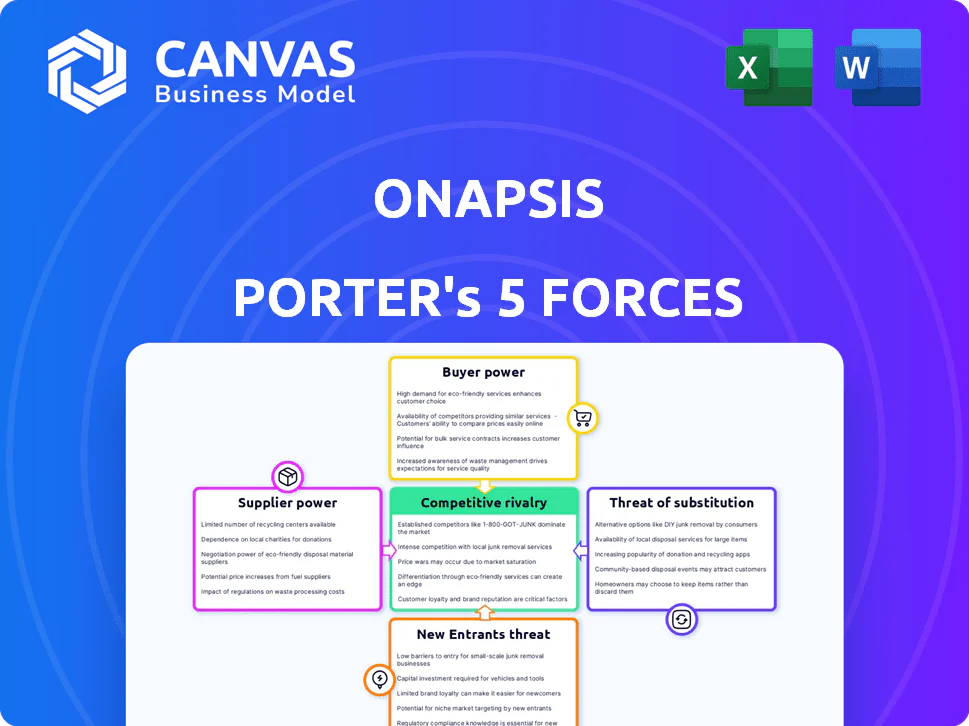
ONAPSIS PORTER'S FIVE FORCES TEMPLATE RESEARCH
What is included in the product
 Detailed Word Document
Analyzes Onapsis's position by examining competitive forces, threats, and market dynamics.

 Customizable Excel Spreadsheet
Automate analysis, update forces in seconds—no more manual data crunching!
Full Version Awaits
Onapsis Porter's Five Forces Analysis
This preview provides a Porter's Five Forces analysis of Onapsis. It breaks down the competitive landscape. The document assesses industry rivalry, supplier/buyer power, and threat of substitutes/new entrants. What you see is the complete analysis you'll receive immediately after purchase. Fully ready to use.

Porter's Five Forces Analysis Template

Don't Miss the Bigger Picture
Onapsis faces a dynamic security landscape shaped by shifting competitive forces. Supplier power varies, influenced by the availability of specialized cybersecurity talent. The threat of new entrants is moderate, requiring significant capital and expertise. Buyer power is substantial, reflecting a competitive market. Substitute products pose a limited but evolving threat. Competitive rivalry is intense, fueled by the rapid pace of cybersecurity innovation.
This brief snapshot only scratches the surface. Unlock the full Porter's Five Forces Analysis to explore Onapsis’s competitive dynamics, market pressures, and strategic advantages in detail.
Suppliers Bargaining Power

Specialized Expertise Required
Onapsis relies on suppliers with specialized cybersecurity expertise for SAP and Oracle systems. The demand for these niche skills and technologies is high. This can give suppliers significant leverage in negotiations. For instance, the cybersecurity market is projected to reach $326.7 billion in 2024.
Reliance on Core Technology Providers
Onapsis' reliance on SAP and Oracle ERP systems gives these suppliers substantial bargaining power. These providers control access to critical platforms, APIs, and technical support. SAP's revenue in 2024 was approximately €31.5 billion, highlighting their financial strength. This dependence can impact Onapsis' costs and operational flexibility. In 2024, Oracle's revenue reached about $50 billion, demonstrating their influence.

Importance of Threat Intelligence
Onapsis's ability to protect systems hinges on current threat intelligence. These information suppliers, like research labs or third-party feeds, wield influence, especially if their data is unique. For example, the global cybersecurity market, valued at $202.8 billion in 2024, underscores the value of such intel.

Talent Pool for Specialized Skills
The cybersecurity industry, particularly in ERP security, struggles with a skills shortage, amplifying the bargaining power of those with specialized knowledge. This scarcity allows skilled professionals to command higher salaries and benefits. Companies compete fiercely for talent, driving up labor costs and potentially impacting profitability. This dynamic necessitates robust talent acquisition and retention strategies for Onapsis.
- Cybersecurity Ventures predicted a global cybersecurity workforce shortage of 3.5 million unfilled positions in 2023.
- The average salary for cybersecurity professionals in the US was $120,000 in 2024, reflecting high demand.
- Retention rates are crucial; the average tenure in a cybersecurity role is just 2-3 years.
Potential for In-House Development
Onapsis faces moderate supplier power regarding in-house development. While their specialized security tech is complex, big firms could develop basic ERP monitoring internally. This requires substantial investment in tech and talent. The average cost to build an in-house cybersecurity team can range from $500,000 to $2 million annually, according to a 2024 report by Cybersecurity Ventures.
- Investment in in-house cybersecurity can be costly and time-consuming.
- Large organizations need significant resources for in-house development.
- Onapsis's specialized tech offers a competitive advantage.
- Basic ERP monitoring could be a starting point for internal teams.
Onapsis: Supplier Power Dynamics in Cybersecurity
Onapsis faces supplier power due to its reliance on specialized cybersecurity expertise and SAP/Oracle systems. The cybersecurity market reached $326.7B in 2024, boosting suppliers’ leverage. SAP and Oracle's financial strength, with revenues of €31.5B and $50B in 2024, increases their bargaining power.
| Supplier Type | Impact on Onapsis | 2024 Data |
|---|---|---|
| Cybersecurity Experts | High bargaining power | Market: $326.7B |
| SAP & Oracle | High bargaining power | SAP Revenue: €31.5B, Oracle Revenue: $50B |
| Threat Intelligence | Moderate bargaining power | Market: $202.8B |
Customers Bargaining Power

Concentrated Customer Base
Onapsis's customer base is concentrated, with many Fortune 100 companies. This concentration gives customers substantial bargaining power. For example, losing a major client could significantly impact revenue. In 2024, the top 10 clients might represent a large portion of total sales. Consider that a single contract loss could affect profit margins by over 10%.
High Cost of Solutions
Implementing cybersecurity solutions for complex ERP systems is a significant customer investment. High costs empower customers to demand better value and support. In 2024, cybersecurity spending reached $214 billion globally. This can lead to pressure for lower prices. Customers seek maximum return on investment.

Importance of Customer Retention
Onapsis boasts a strong customer retention rate, signaling high satisfaction and dependence on their offerings. This implies individual customers wield some power, yet the collective customer base values Onapsis' solutions. In 2024, customer retention rates in the cybersecurity sector averaged around 85%, and Onapsis likely aligns with or surpasses this figure. This diminishes overall customer bargaining power.

Availability of Alternative Security Measures
Customers of Onapsis, while needing ERP security, have options. They can use generic security tools, rely on internal teams, or use basic ERP vendor features. This limits Onapsis's power, as alternatives exist. The global cybersecurity market was valued at $200 billion in 2024, showing these alternatives are significant.
- Market size of the global cybersecurity market reached $200 billion in 2024.
- Many companies use generic security tools.
- Some rely on internal security teams.
- ERP vendors offer basic security features.
Influence of Consulting and Audit Firms
Consulting and audit firms significantly shape customer decisions regarding cybersecurity solutions like Onapsis. These firms, including major players like Deloitte and EY, often recommend specific vendors to their clients, acting as influential intermediaries. Their recommendations can sway customer choices, potentially reducing the direct bargaining power of individual clients. The consulting market is substantial, with firms like Accenture reporting over $64 billion in revenue in 2023, indicating their considerable market influence.
- Consulting firms recommend Onapsis.
- They influence customer choices.
- Intermediary role impacts bargaining.
- Large consulting market size.
Customer Power Dynamics: A Cybersecurity View
Onapsis faces customer bargaining power, particularly from concentrated clients. High costs and available alternatives enable customers to negotiate. Consulting firms also shape customer decisions, influencing vendor choices.
| Factor | Impact | Data (2024) |
|---|---|---|
| Concentration | High power | Top 10 clients = significant revenue share |
| Alternatives | Reduced power | Cybersecurity market: $200B |
| Consultants | Influenced choices | Accenture revenue: $64B (2023) |
Rivalry Among Competitors

Niche Market with Specialized Competitors
Onapsis faces competition within its niche of business-critical application security, focusing on SAP and Oracle systems. The cybersecurity market is broad, but fewer companies directly compete with Onapsis's specialized expertise. For instance, the global cybersecurity market was valued at $223.8 billion in 2023. This concentration of expertise could lead to intense rivalry.
Differentiation through Specialization and Research
Onapsis carves out a niche by focusing on ERP security, setting it apart from broader cybersecurity firms. Its research labs and SAP partnership further enhance this specialized approach. This targeted strategy helps limit competition from generalists. In 2024, the ERP security market grew, signaling the importance of Onapsis's focus.

Presence of Larger Cybersecurity Companies
The presence of larger, more diversified cybersecurity companies introduces significant competitive rivalry. These firms, such as Palo Alto Networks or CrowdStrike, could expand into business-critical application security. This increases pressure on specialized firms like Onapsis. For instance, in 2024, Palo Alto Networks reported over $8 billion in revenue, showcasing its market power.

Importance of Partnerships
Onapsis boosts its competitive edge via strategic partnerships. Collaborations with SAP, AWS, and Microsoft Azure are key. Such alliances improve market reach and offer competitive advantages. This approach can lead to higher market share and stronger customer relationships. These partnerships are crucial for industry leadership in 2024.
- SAP partnership: Enhances cybersecurity solutions.
- AWS and Azure: Cloud platform integration for wider reach.
- Consulting firms: Expand market coverage and expertise.
- These partnerships boost market position.
Innovation and Product Development
The cybersecurity market sees fierce competition, fueled by rapid innovation. Onapsis must continually invest in R&D to compete. This investment is essential to develop new product features. These features are critical to stay ahead of the competition and emerging threats. The cybersecurity market is projected to reach $345.7 billion in 2024.
- The cybersecurity market's growth is driven by constant innovation.
- Onapsis must invest in R&D to compete.
- New product features are key to staying ahead.
- The market is expected to be worth $345.7 billion in 2024.
Onapsis Faces Fierce Cybersecurity Rivals
Competitive rivalry for Onapsis is high due to a growing cybersecurity market. The market's value reached $223.8B in 2023 and is projected to hit $345.7B in 2024. Onapsis faces competition from larger firms. Innovation and R&D are crucial for Onapsis to stay competitive.
| Aspect | Details | 2024 Data |
|---|---|---|
| Market Size | Global Cybersecurity Market | $345.7 Billion (Projected) |
| Key Competitors | Larger Cybersecurity Firms | Palo Alto Networks ($8B+ Revenue) |
| Competitive Strategy | Innovation & R&D | Continuous investment |
ONAPSIS PORTER'S FIVE FORCES TEMPLATE RESEARCH
What is included in the product
Detailed Word Document
Analyzes Onapsis's position by examining competitive forces, threats, and market dynamics.
Customizable Excel Spreadsheet
Automate analysis, update forces in seconds—no more manual data crunching!
Full Version Awaits
Onapsis Porter's Five Forces Analysis
This preview provides a Porter's Five Forces analysis of Onapsis. It breaks down the competitive landscape. The document assesses industry rivalry, supplier/buyer power, and threat of substitutes/new entrants. What you see is the complete analysis you'll receive immediately after purchase. Fully ready to use.
Porter's Five Forces Analysis Template
Don't Miss the Bigger Picture
Onapsis faces a dynamic security landscape shaped by shifting competitive forces. Supplier power varies, influenced by the availability of specialized cybersecurity talent. The threat of new entrants is moderate, requiring significant capital and expertise. Buyer power is substantial, reflecting a competitive market. Substitute products pose a limited but evolving threat. Competitive rivalry is intense, fueled by the rapid pace of cybersecurity innovation.
This brief snapshot only scratches the surface. Unlock the full Porter's Five Forces Analysis to explore Onapsis’s competitive dynamics, market pressures, and strategic advantages in detail.
Suppliers Bargaining Power
Specialized Expertise Required
Onapsis relies on suppliers with specialized cybersecurity expertise for SAP and Oracle systems. The demand for these niche skills and technologies is high. This can give suppliers significant leverage in negotiations. For instance, the cybersecurity market is projected to reach $326.7 billion in 2024.
Reliance on Core Technology Providers
Onapsis' reliance on SAP and Oracle ERP systems gives these suppliers substantial bargaining power. These providers control access to critical platforms, APIs, and technical support. SAP's revenue in 2024 was approximately €31.5 billion, highlighting their financial strength. This dependence can impact Onapsis' costs and operational flexibility. In 2024, Oracle's revenue reached about $50 billion, demonstrating their influence.
Importance of Threat Intelligence
Onapsis's ability to protect systems hinges on current threat intelligence. These information suppliers, like research labs or third-party feeds, wield influence, especially if their data is unique. For example, the global cybersecurity market, valued at $202.8 billion in 2024, underscores the value of such intel.
Talent Pool for Specialized Skills
The cybersecurity industry, particularly in ERP security, struggles with a skills shortage, amplifying the bargaining power of those with specialized knowledge. This scarcity allows skilled professionals to command higher salaries and benefits. Companies compete fiercely for talent, driving up labor costs and potentially impacting profitability. This dynamic necessitates robust talent acquisition and retention strategies for Onapsis.
- Cybersecurity Ventures predicted a global cybersecurity workforce shortage of 3.5 million unfilled positions in 2023.
- The average salary for cybersecurity professionals in the US was $120,000 in 2024, reflecting high demand.
- Retention rates are crucial; the average tenure in a cybersecurity role is just 2-3 years.
Potential for In-House Development
Onapsis faces moderate supplier power regarding in-house development. While their specialized security tech is complex, big firms could develop basic ERP monitoring internally. This requires substantial investment in tech and talent. The average cost to build an in-house cybersecurity team can range from $500,000 to $2 million annually, according to a 2024 report by Cybersecurity Ventures.
- Investment in in-house cybersecurity can be costly and time-consuming.
- Large organizations need significant resources for in-house development.
- Onapsis's specialized tech offers a competitive advantage.
- Basic ERP monitoring could be a starting point for internal teams.
Onapsis: Supplier Power Dynamics in Cybersecurity
Onapsis faces supplier power due to its reliance on specialized cybersecurity expertise and SAP/Oracle systems. The cybersecurity market reached $326.7B in 2024, boosting suppliers’ leverage. SAP and Oracle's financial strength, with revenues of €31.5B and $50B in 2024, increases their bargaining power.
| Supplier Type | Impact on Onapsis | 2024 Data |
|---|---|---|
| Cybersecurity Experts | High bargaining power | Market: $326.7B |
| SAP & Oracle | High bargaining power | SAP Revenue: €31.5B, Oracle Revenue: $50B |
| Threat Intelligence | Moderate bargaining power | Market: $202.8B |
Customers Bargaining Power
Concentrated Customer Base
Onapsis's customer base is concentrated, with many Fortune 100 companies. This concentration gives customers substantial bargaining power. For example, losing a major client could significantly impact revenue. In 2024, the top 10 clients might represent a large portion of total sales. Consider that a single contract loss could affect profit margins by over 10%.
High Cost of Solutions
Implementing cybersecurity solutions for complex ERP systems is a significant customer investment. High costs empower customers to demand better value and support. In 2024, cybersecurity spending reached $214 billion globally. This can lead to pressure for lower prices. Customers seek maximum return on investment.
Importance of Customer Retention
Onapsis boasts a strong customer retention rate, signaling high satisfaction and dependence on their offerings. This implies individual customers wield some power, yet the collective customer base values Onapsis' solutions. In 2024, customer retention rates in the cybersecurity sector averaged around 85%, and Onapsis likely aligns with or surpasses this figure. This diminishes overall customer bargaining power.
Availability of Alternative Security Measures
Customers of Onapsis, while needing ERP security, have options. They can use generic security tools, rely on internal teams, or use basic ERP vendor features. This limits Onapsis's power, as alternatives exist. The global cybersecurity market was valued at $200 billion in 2024, showing these alternatives are significant.
- Market size of the global cybersecurity market reached $200 billion in 2024.
- Many companies use generic security tools.
- Some rely on internal security teams.
- ERP vendors offer basic security features.
Influence of Consulting and Audit Firms
Consulting and audit firms significantly shape customer decisions regarding cybersecurity solutions like Onapsis. These firms, including major players like Deloitte and EY, often recommend specific vendors to their clients, acting as influential intermediaries. Their recommendations can sway customer choices, potentially reducing the direct bargaining power of individual clients. The consulting market is substantial, with firms like Accenture reporting over $64 billion in revenue in 2023, indicating their considerable market influence.
- Consulting firms recommend Onapsis.
- They influence customer choices.
- Intermediary role impacts bargaining.
- Large consulting market size.
Customer Power Dynamics: A Cybersecurity View
Onapsis faces customer bargaining power, particularly from concentrated clients. High costs and available alternatives enable customers to negotiate. Consulting firms also shape customer decisions, influencing vendor choices.
| Factor | Impact | Data (2024) |
|---|---|---|
| Concentration | High power | Top 10 clients = significant revenue share |
| Alternatives | Reduced power | Cybersecurity market: $200B |
| Consultants | Influenced choices | Accenture revenue: $64B (2023) |
Rivalry Among Competitors
Niche Market with Specialized Competitors
Onapsis faces competition within its niche of business-critical application security, focusing on SAP and Oracle systems. The cybersecurity market is broad, but fewer companies directly compete with Onapsis's specialized expertise. For instance, the global cybersecurity market was valued at $223.8 billion in 2023. This concentration of expertise could lead to intense rivalry.
Differentiation through Specialization and Research
Onapsis carves out a niche by focusing on ERP security, setting it apart from broader cybersecurity firms. Its research labs and SAP partnership further enhance this specialized approach. This targeted strategy helps limit competition from generalists. In 2024, the ERP security market grew, signaling the importance of Onapsis's focus.
Presence of Larger Cybersecurity Companies
The presence of larger, more diversified cybersecurity companies introduces significant competitive rivalry. These firms, such as Palo Alto Networks or CrowdStrike, could expand into business-critical application security. This increases pressure on specialized firms like Onapsis. For instance, in 2024, Palo Alto Networks reported over $8 billion in revenue, showcasing its market power.
Importance of Partnerships
Onapsis boosts its competitive edge via strategic partnerships. Collaborations with SAP, AWS, and Microsoft Azure are key. Such alliances improve market reach and offer competitive advantages. This approach can lead to higher market share and stronger customer relationships. These partnerships are crucial for industry leadership in 2024.
- SAP partnership: Enhances cybersecurity solutions.
- AWS and Azure: Cloud platform integration for wider reach.
- Consulting firms: Expand market coverage and expertise.
- These partnerships boost market position.
Innovation and Product Development
The cybersecurity market sees fierce competition, fueled by rapid innovation. Onapsis must continually invest in R&D to compete. This investment is essential to develop new product features. These features are critical to stay ahead of the competition and emerging threats. The cybersecurity market is projected to reach $345.7 billion in 2024.
- The cybersecurity market's growth is driven by constant innovation.
- Onapsis must invest in R&D to compete.
- New product features are key to staying ahead.
- The market is expected to be worth $345.7 billion in 2024.
Onapsis Faces Fierce Cybersecurity Rivals
Competitive rivalry for Onapsis is high due to a growing cybersecurity market. The market's value reached $223.8B in 2023 and is projected to hit $345.7B in 2024. Onapsis faces competition from larger firms. Innovation and R&D are crucial for Onapsis to stay competitive.
| Aspect | Details | 2024 Data |
|---|---|---|
| Market Size | Global Cybersecurity Market | $345.7 Billion (Projected) |
| Key Competitors | Larger Cybersecurity Firms | Palo Alto Networks ($8B+ Revenue) |
| Competitive Strategy | Innovation & R&D | Continuous investment |
Product Information
Product Information
Shipping & Returns
Shipping & Returns
Description
What is included in the product
Detailed Word Document
Analyzes Onapsis's position by examining competitive forces, threats, and market dynamics.
Customizable Excel Spreadsheet
Automate analysis, update forces in seconds—no more manual data crunching!
Full Version Awaits
Onapsis Porter's Five Forces Analysis
This preview provides a Porter's Five Forces analysis of Onapsis. It breaks down the competitive landscape. The document assesses industry rivalry, supplier/buyer power, and threat of substitutes/new entrants. What you see is the complete analysis you'll receive immediately after purchase. Fully ready to use.
Porter's Five Forces Analysis Template
Don't Miss the Bigger Picture
Onapsis faces a dynamic security landscape shaped by shifting competitive forces. Supplier power varies, influenced by the availability of specialized cybersecurity talent. The threat of new entrants is moderate, requiring significant capital and expertise. Buyer power is substantial, reflecting a competitive market. Substitute products pose a limited but evolving threat. Competitive rivalry is intense, fueled by the rapid pace of cybersecurity innovation.
This brief snapshot only scratches the surface. Unlock the full Porter's Five Forces Analysis to explore Onapsis’s competitive dynamics, market pressures, and strategic advantages in detail.
Suppliers Bargaining Power
Specialized Expertise Required
Onapsis relies on suppliers with specialized cybersecurity expertise for SAP and Oracle systems. The demand for these niche skills and technologies is high. This can give suppliers significant leverage in negotiations. For instance, the cybersecurity market is projected to reach $326.7 billion in 2024.
Reliance on Core Technology Providers
Onapsis' reliance on SAP and Oracle ERP systems gives these suppliers substantial bargaining power. These providers control access to critical platforms, APIs, and technical support. SAP's revenue in 2024 was approximately €31.5 billion, highlighting their financial strength. This dependence can impact Onapsis' costs and operational flexibility. In 2024, Oracle's revenue reached about $50 billion, demonstrating their influence.
Importance of Threat Intelligence
Onapsis's ability to protect systems hinges on current threat intelligence. These information suppliers, like research labs or third-party feeds, wield influence, especially if their data is unique. For example, the global cybersecurity market, valued at $202.8 billion in 2024, underscores the value of such intel.
Talent Pool for Specialized Skills
The cybersecurity industry, particularly in ERP security, struggles with a skills shortage, amplifying the bargaining power of those with specialized knowledge. This scarcity allows skilled professionals to command higher salaries and benefits. Companies compete fiercely for talent, driving up labor costs and potentially impacting profitability. This dynamic necessitates robust talent acquisition and retention strategies for Onapsis.
- Cybersecurity Ventures predicted a global cybersecurity workforce shortage of 3.5 million unfilled positions in 2023.
- The average salary for cybersecurity professionals in the US was $120,000 in 2024, reflecting high demand.
- Retention rates are crucial; the average tenure in a cybersecurity role is just 2-3 years.
Potential for In-House Development
Onapsis faces moderate supplier power regarding in-house development. While their specialized security tech is complex, big firms could develop basic ERP monitoring internally. This requires substantial investment in tech and talent. The average cost to build an in-house cybersecurity team can range from $500,000 to $2 million annually, according to a 2024 report by Cybersecurity Ventures.
- Investment in in-house cybersecurity can be costly and time-consuming.
- Large organizations need significant resources for in-house development.
- Onapsis's specialized tech offers a competitive advantage.
- Basic ERP monitoring could be a starting point for internal teams.
Onapsis: Supplier Power Dynamics in Cybersecurity
Onapsis faces supplier power due to its reliance on specialized cybersecurity expertise and SAP/Oracle systems. The cybersecurity market reached $326.7B in 2024, boosting suppliers’ leverage. SAP and Oracle's financial strength, with revenues of €31.5B and $50B in 2024, increases their bargaining power.
| Supplier Type | Impact on Onapsis | 2024 Data |
|---|---|---|
| Cybersecurity Experts | High bargaining power | Market: $326.7B |
| SAP & Oracle | High bargaining power | SAP Revenue: €31.5B, Oracle Revenue: $50B |
| Threat Intelligence | Moderate bargaining power | Market: $202.8B |
Customers Bargaining Power
Concentrated Customer Base
Onapsis's customer base is concentrated, with many Fortune 100 companies. This concentration gives customers substantial bargaining power. For example, losing a major client could significantly impact revenue. In 2024, the top 10 clients might represent a large portion of total sales. Consider that a single contract loss could affect profit margins by over 10%.
High Cost of Solutions
Implementing cybersecurity solutions for complex ERP systems is a significant customer investment. High costs empower customers to demand better value and support. In 2024, cybersecurity spending reached $214 billion globally. This can lead to pressure for lower prices. Customers seek maximum return on investment.
Importance of Customer Retention
Onapsis boasts a strong customer retention rate, signaling high satisfaction and dependence on their offerings. This implies individual customers wield some power, yet the collective customer base values Onapsis' solutions. In 2024, customer retention rates in the cybersecurity sector averaged around 85%, and Onapsis likely aligns with or surpasses this figure. This diminishes overall customer bargaining power.
Availability of Alternative Security Measures
Customers of Onapsis, while needing ERP security, have options. They can use generic security tools, rely on internal teams, or use basic ERP vendor features. This limits Onapsis's power, as alternatives exist. The global cybersecurity market was valued at $200 billion in 2024, showing these alternatives are significant.
- Market size of the global cybersecurity market reached $200 billion in 2024.
- Many companies use generic security tools.
- Some rely on internal security teams.
- ERP vendors offer basic security features.
Influence of Consulting and Audit Firms
Consulting and audit firms significantly shape customer decisions regarding cybersecurity solutions like Onapsis. These firms, including major players like Deloitte and EY, often recommend specific vendors to their clients, acting as influential intermediaries. Their recommendations can sway customer choices, potentially reducing the direct bargaining power of individual clients. The consulting market is substantial, with firms like Accenture reporting over $64 billion in revenue in 2023, indicating their considerable market influence.
- Consulting firms recommend Onapsis.
- They influence customer choices.
- Intermediary role impacts bargaining.
- Large consulting market size.
Customer Power Dynamics: A Cybersecurity View
Onapsis faces customer bargaining power, particularly from concentrated clients. High costs and available alternatives enable customers to negotiate. Consulting firms also shape customer decisions, influencing vendor choices.
| Factor | Impact | Data (2024) |
|---|---|---|
| Concentration | High power | Top 10 clients = significant revenue share |
| Alternatives | Reduced power | Cybersecurity market: $200B |
| Consultants | Influenced choices | Accenture revenue: $64B (2023) |
Rivalry Among Competitors
Niche Market with Specialized Competitors
Onapsis faces competition within its niche of business-critical application security, focusing on SAP and Oracle systems. The cybersecurity market is broad, but fewer companies directly compete with Onapsis's specialized expertise. For instance, the global cybersecurity market was valued at $223.8 billion in 2023. This concentration of expertise could lead to intense rivalry.
Differentiation through Specialization and Research
Onapsis carves out a niche by focusing on ERP security, setting it apart from broader cybersecurity firms. Its research labs and SAP partnership further enhance this specialized approach. This targeted strategy helps limit competition from generalists. In 2024, the ERP security market grew, signaling the importance of Onapsis's focus.
Presence of Larger Cybersecurity Companies
The presence of larger, more diversified cybersecurity companies introduces significant competitive rivalry. These firms, such as Palo Alto Networks or CrowdStrike, could expand into business-critical application security. This increases pressure on specialized firms like Onapsis. For instance, in 2024, Palo Alto Networks reported over $8 billion in revenue, showcasing its market power.
Importance of Partnerships
Onapsis boosts its competitive edge via strategic partnerships. Collaborations with SAP, AWS, and Microsoft Azure are key. Such alliances improve market reach and offer competitive advantages. This approach can lead to higher market share and stronger customer relationships. These partnerships are crucial for industry leadership in 2024.
- SAP partnership: Enhances cybersecurity solutions.
- AWS and Azure: Cloud platform integration for wider reach.
- Consulting firms: Expand market coverage and expertise.
- These partnerships boost market position.
Innovation and Product Development
The cybersecurity market sees fierce competition, fueled by rapid innovation. Onapsis must continually invest in R&D to compete. This investment is essential to develop new product features. These features are critical to stay ahead of the competition and emerging threats. The cybersecurity market is projected to reach $345.7 billion in 2024.
- The cybersecurity market's growth is driven by constant innovation.
- Onapsis must invest in R&D to compete.
- New product features are key to staying ahead.
- The market is expected to be worth $345.7 billion in 2024.
Onapsis Faces Fierce Cybersecurity Rivals
Competitive rivalry for Onapsis is high due to a growing cybersecurity market. The market's value reached $223.8B in 2023 and is projected to hit $345.7B in 2024. Onapsis faces competition from larger firms. Innovation and R&D are crucial for Onapsis to stay competitive.
| Aspect | Details | 2024 Data |
|---|---|---|
| Market Size | Global Cybersecurity Market | $345.7 Billion (Projected) |
| Key Competitors | Larger Cybersecurity Firms | Palo Alto Networks ($8B+ Revenue) |
| Competitive Strategy | Innovation & R&D | Continuous investment |











