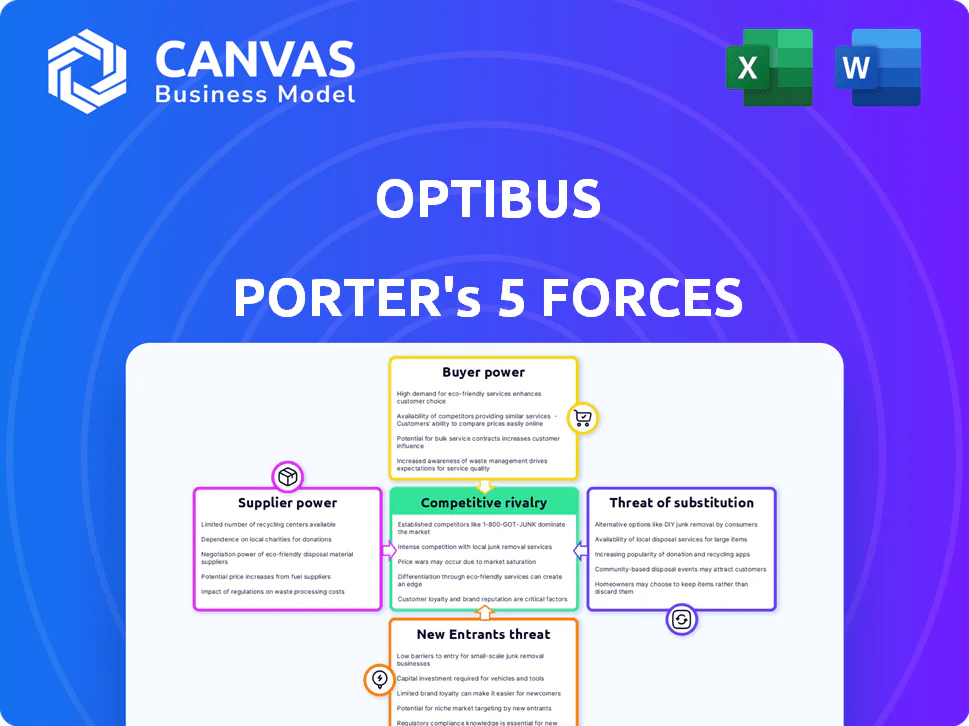
OPTIBUS PORTER'S FIVE FORCES TEMPLATE RESEARCH
What is included in the product
 Detailed Word Document
Tailored exclusively for Optibus, analyzing its position within its competitive landscape.

 Customizable Excel Spreadsheet
Dynamic and intuitive—analyze any market with the integrated Porter's Five Forces spider chart.
What You See Is What You Get
Optibus Porter's Five Forces Analysis
This preview showcases the full Porter's Five Forces analysis for Optibus. You're seeing the exact, professionally written document. Immediately after your purchase, this complete analysis is ready for download.

Porter's Five Forces Analysis Template

A Must-Have Tool for Decision-Makers
Optibus operates in a dynamic market, making its competitive landscape crucial to understand. The threat of new entrants, like tech giants, is moderate, given the industry's complexity. Buyer power is significant due to transit agencies' negotiation leverage. Supplier power, especially from software developers, is also a factor. Substitute threats, such as private transportation, are present.
Unlock key insights into Optibus’s industry forces—from buyer power to substitute threats—and use this knowledge to inform strategy or investment decisions.
Suppliers Bargaining Power

Limited number of specialized tech suppliers for AI and SaaS components.
The market for specialized AI and SaaS components is dominated by a handful of suppliers. These suppliers hold considerable power due to the critical role their technology plays in Optibus' platform. For example, the global SaaS market was valued at $172.2 billion in 2022 and is projected to reach $716.5 billion by 2029. This concentration increases Optibus' reliance on specific vendors.
High switching costs for Optibus if seeking alternative suppliers.
Switching core tech suppliers is costly for Optibus. Data migration, staff retraining, and system integration are expensive. This increases existing suppliers' power.

Suppliers' strong focus on quality and innovation demands higher costs.
Optibus's dependence on cutting-edge AI and SaaS means suppliers, focused on innovation, can command higher prices. These suppliers, investing significantly in R&D, transfer costs to clients. For instance, R&D spending in the SaaS industry averaged 11.3% of revenue in 2023. This can elevate Optibus's operational expenses.

Potential for suppliers to integrate vertically, increasing their power.
If Optibus's key technology suppliers vertically integrate, it poses a major threat. They could directly compete by offering similar end-to-end solutions. This scenario would limit Optibus's access to crucial components and potentially inflate costs. For example, the global market for transit technology is projected to reach $27.5 billion by 2024.
- Supplier integration can create direct competitors.
- Increased costs and limited access to essential components are possible.
- Market size of transit technology is significant.
Dependence on data providers for real-time information.
Optibus depends on real-time data suppliers for its AI-driven platform. These suppliers have bargaining power because disruptions or increased data costs can affect Optibus's services. This dependence is crucial for route optimization and operational efficiency. The cost of data can significantly impact Optibus's cost structure and service quality.
- Data costs increased by 15% in 2024 for some AI-driven platforms.
- Real-time data providers' market share is highly concentrated, with the top 3 controlling over 70%.
- Optibus's operational costs are affected by data pricing.
- Service quality depends on the reliability and timeliness of data.
Supplier Power Dynamics: A Deep Dive
Optibus faces supplier power from specialized AI and SaaS providers due to their technology's critical role. Switching suppliers is costly, increasing existing vendors' leverage. Dependence on innovation allows suppliers to command higher prices, impacting Optibus's operational expenses.
| Aspect | Details | Impact on Optibus |
|---|---|---|
| SaaS Market Growth | Projected to reach $716.5B by 2029 | Increased reliance on suppliers |
| R&D Spending (SaaS) | Averaged 11.3% of revenue in 2023 | Elevated operational costs |
| Transit Tech Market (2024) | $27.5B | Threat of supplier integration |
Customers Bargaining Power

Public transportation agencies and operators are the primary customers.
Optibus primarily serves public transit agencies, making them key customers. These agencies, especially large ones, wield considerable buying power. In 2024, public transit saw a 20% ridership increase. This leverage impacts pricing and service demands for Optibus.
Customers may have existing relationships with competitors.
Many public transit agencies may already use software from competitors. Switching to Optibus involves costs and disruption, giving competitors bargaining power. For example, in 2024, the global transit software market was valued at $1.8 billion. This provides competitors with leverage. The switching costs can be significant.

Customers' need for tailored and integrated solutions.
Public transit systems have unique needs based on size, location, and operational issues. Optibus' ability to offer customized, integrated solutions gives customers leverage. This is especially true as the global smart transit market is projected to reach $36.8B by 2029, with a CAGR of 13.5% from 2022. Customers are increasingly demanding tailored services.

Customer focus on ROI and efficiency gains.
Public transit agencies, Optibus' main customers, constantly seek ways to boost efficiency and cut costs. Their bargaining power is significant because they scrutinize Optibus' ROI and operational improvements. For instance, in 2024, agencies faced a 10-15% budget squeeze, intensifying the focus on cost-effective solutions. This pressure directly influences Optibus' pricing and service terms, favoring the customer.
- Agencies prioritize solutions that demonstrably save money and enhance service quality.
- The ability to prove a strong return on investment is crucial for Optibus to secure contracts.
- Customers will negotiate aggressively based on the perceived value and efficiency gains.
- Price sensitivity among agencies is high, impacting Optibus' pricing strategies.
Availability of alternative solutions.
Optibus faces customer bargaining power due to alternative solutions. Customers might switch to competitors or stick with older systems. This option limits Optibus's pricing power and demands better service. The global market for transportation software was valued at $10.8 billion in 2023, showing many substitutes.
- Competitor landscape: Numerous companies offer similar solutions.
- Switching costs: Low switching costs can encourage customers to explore alternatives.
- Customer sophistication: Financially-literate customers can negotiate better deals.
- Market dynamics: Market competition forces companies to improve offerings.
Transit's $36.8B Future: Challenges & Opportunities
Public transit agencies, Optibus' main clients, have substantial bargaining power, especially large ones. They seek cost-effective, efficient solutions, scrutinizing ROI and operational improvements. The smart transit market, projected to reach $36.8B by 2029, heightens demands for customized services.
| Factor | Impact | Data |
|---|---|---|
| Ridership Increase (2024) | Increased Agency Focus | 20% |
| Transit Software Market (2024) | Competitor Leverage | $1.8B |
| Budget Squeeze (2024) | Cost Pressure | 10-15% |
Rivalry Among Competitors

Presence of established competitors in the transportation software market.
The public transportation software market is highly competitive, featuring established firms. Trapeze Group and Routematch are key rivals to Optibus. These competitors offer similar solutions for transit agencies. In 2024, the market saw increased consolidation, impacting competitive dynamics.
Increasing adoption of AI and technology in public transport.
The adoption of AI in public transport is heating up competition. Rivals are investing heavily in AI solutions. For instance, in 2024, the global market for AI in transportation was valued at $2.2 billion, showing rapid growth. This rise fuels a dynamic, competitive environment.

Differentiation through advanced optimization algorithms and cloud-native platform.
Optibus differentiates itself with AI-powered algorithms and a cloud-native platform. This allows for faster, more accurate, and more efficient transit planning. Competitors with legacy systems may struggle to match this speed. In 2024, the transit tech market saw a 15% rise in cloud-based solutions adoption.

Competition based on pricing and contract terms.
Public transportation contracts frequently involve competitive bidding, intensifying the rivalry Optibus experiences. This competition revolves around pricing structures, contract specifics, and the capacity to prove cost efficiencies and operational advantages to prospective clients. In 2024, the global smart transit market, where Optibus operates, saw a 15% increase in competitive bidding for software solutions. Optibus's success depends on its ability to offer compelling terms.
- Competitive bidding is common in public transit.
- Pricing and contract terms are key differentiators.
- Demonstrating cost savings is crucial.
- The smart transit market is highly competitive.
Global market reach and regional competition.
Optibus, as a global player, contends with a mix of international and regional rivals. The level of competition shifts based on location, amplified by strong local competitors. For instance, in North America, Optibus competes with established firms like Via Transportation and Remix (acquired by Google in 2021). The intensity is dynamic.
- Via Transportation raised $130 million in Series G funding in 2023.
- Remix's acquisition by Google highlights the strategic importance of this market.
- The global smart transit market is projected to reach $30.8 billion by 2027.
- Competition varies; for example, in Europe, local players like Citymapper also pose a threat.
Transit Tech Titans Clash: AI & Bidding Wars
The public transit software market is intensely competitive. Optibus faces rivals like Trapeze Group and Routematch, which offer similar solutions. Competitive bidding and AI adoption further fuel this rivalry.
| Aspect | Details | 2024 Data |
|---|---|---|
| Market Growth | Overall transit tech market expansion. | Cloud-based solutions adoption rose by 15%. |
| AI in Transportation | Investment and growth in AI solutions. | Global market valued at $2.2 billion. |
| Competitive Bidding | Impact on market rivalry. | Smart transit market saw 15% increase. |
OPTIBUS PORTER'S FIVE FORCES TEMPLATE RESEARCH
What is included in the product
Detailed Word Document
Tailored exclusively for Optibus, analyzing its position within its competitive landscape.
Customizable Excel Spreadsheet
Dynamic and intuitive—analyze any market with the integrated Porter's Five Forces spider chart.
What You See Is What You Get
Optibus Porter's Five Forces Analysis
This preview showcases the full Porter's Five Forces analysis for Optibus. You're seeing the exact, professionally written document. Immediately after your purchase, this complete analysis is ready for download.
Porter's Five Forces Analysis Template
A Must-Have Tool for Decision-Makers
Optibus operates in a dynamic market, making its competitive landscape crucial to understand. The threat of new entrants, like tech giants, is moderate, given the industry's complexity. Buyer power is significant due to transit agencies' negotiation leverage. Supplier power, especially from software developers, is also a factor. Substitute threats, such as private transportation, are present.
Unlock key insights into Optibus’s industry forces—from buyer power to substitute threats—and use this knowledge to inform strategy or investment decisions.
Suppliers Bargaining Power
Limited number of specialized tech suppliers for AI and SaaS components.
The market for specialized AI and SaaS components is dominated by a handful of suppliers. These suppliers hold considerable power due to the critical role their technology plays in Optibus' platform. For example, the global SaaS market was valued at $172.2 billion in 2022 and is projected to reach $716.5 billion by 2029. This concentration increases Optibus' reliance on specific vendors.
High switching costs for Optibus if seeking alternative suppliers.
Switching core tech suppliers is costly for Optibus. Data migration, staff retraining, and system integration are expensive. This increases existing suppliers' power.
Suppliers' strong focus on quality and innovation demands higher costs.
Optibus's dependence on cutting-edge AI and SaaS means suppliers, focused on innovation, can command higher prices. These suppliers, investing significantly in R&D, transfer costs to clients. For instance, R&D spending in the SaaS industry averaged 11.3% of revenue in 2023. This can elevate Optibus's operational expenses.
Potential for suppliers to integrate vertically, increasing their power.
If Optibus's key technology suppliers vertically integrate, it poses a major threat. They could directly compete by offering similar end-to-end solutions. This scenario would limit Optibus's access to crucial components and potentially inflate costs. For example, the global market for transit technology is projected to reach $27.5 billion by 2024.
- Supplier integration can create direct competitors.
- Increased costs and limited access to essential components are possible.
- Market size of transit technology is significant.
Dependence on data providers for real-time information.
Optibus depends on real-time data suppliers for its AI-driven platform. These suppliers have bargaining power because disruptions or increased data costs can affect Optibus's services. This dependence is crucial for route optimization and operational efficiency. The cost of data can significantly impact Optibus's cost structure and service quality.
- Data costs increased by 15% in 2024 for some AI-driven platforms.
- Real-time data providers' market share is highly concentrated, with the top 3 controlling over 70%.
- Optibus's operational costs are affected by data pricing.
- Service quality depends on the reliability and timeliness of data.
Supplier Power Dynamics: A Deep Dive
Optibus faces supplier power from specialized AI and SaaS providers due to their technology's critical role. Switching suppliers is costly, increasing existing vendors' leverage. Dependence on innovation allows suppliers to command higher prices, impacting Optibus's operational expenses.
| Aspect | Details | Impact on Optibus |
|---|---|---|
| SaaS Market Growth | Projected to reach $716.5B by 2029 | Increased reliance on suppliers |
| R&D Spending (SaaS) | Averaged 11.3% of revenue in 2023 | Elevated operational costs |
| Transit Tech Market (2024) | $27.5B | Threat of supplier integration |
Customers Bargaining Power
Public transportation agencies and operators are the primary customers.
Optibus primarily serves public transit agencies, making them key customers. These agencies, especially large ones, wield considerable buying power. In 2024, public transit saw a 20% ridership increase. This leverage impacts pricing and service demands for Optibus.
Customers may have existing relationships with competitors.
Many public transit agencies may already use software from competitors. Switching to Optibus involves costs and disruption, giving competitors bargaining power. For example, in 2024, the global transit software market was valued at $1.8 billion. This provides competitors with leverage. The switching costs can be significant.
Customers' need for tailored and integrated solutions.
Public transit systems have unique needs based on size, location, and operational issues. Optibus' ability to offer customized, integrated solutions gives customers leverage. This is especially true as the global smart transit market is projected to reach $36.8B by 2029, with a CAGR of 13.5% from 2022. Customers are increasingly demanding tailored services.
Customer focus on ROI and efficiency gains.
Public transit agencies, Optibus' main customers, constantly seek ways to boost efficiency and cut costs. Their bargaining power is significant because they scrutinize Optibus' ROI and operational improvements. For instance, in 2024, agencies faced a 10-15% budget squeeze, intensifying the focus on cost-effective solutions. This pressure directly influences Optibus' pricing and service terms, favoring the customer.
- Agencies prioritize solutions that demonstrably save money and enhance service quality.
- The ability to prove a strong return on investment is crucial for Optibus to secure contracts.
- Customers will negotiate aggressively based on the perceived value and efficiency gains.
- Price sensitivity among agencies is high, impacting Optibus' pricing strategies.
Availability of alternative solutions.
Optibus faces customer bargaining power due to alternative solutions. Customers might switch to competitors or stick with older systems. This option limits Optibus's pricing power and demands better service. The global market for transportation software was valued at $10.8 billion in 2023, showing many substitutes.
- Competitor landscape: Numerous companies offer similar solutions.
- Switching costs: Low switching costs can encourage customers to explore alternatives.
- Customer sophistication: Financially-literate customers can negotiate better deals.
- Market dynamics: Market competition forces companies to improve offerings.
Transit's $36.8B Future: Challenges & Opportunities
Public transit agencies, Optibus' main clients, have substantial bargaining power, especially large ones. They seek cost-effective, efficient solutions, scrutinizing ROI and operational improvements. The smart transit market, projected to reach $36.8B by 2029, heightens demands for customized services.
| Factor | Impact | Data |
|---|---|---|
| Ridership Increase (2024) | Increased Agency Focus | 20% |
| Transit Software Market (2024) | Competitor Leverage | $1.8B |
| Budget Squeeze (2024) | Cost Pressure | 10-15% |
Rivalry Among Competitors
Presence of established competitors in the transportation software market.
The public transportation software market is highly competitive, featuring established firms. Trapeze Group and Routematch are key rivals to Optibus. These competitors offer similar solutions for transit agencies. In 2024, the market saw increased consolidation, impacting competitive dynamics.
Increasing adoption of AI and technology in public transport.
The adoption of AI in public transport is heating up competition. Rivals are investing heavily in AI solutions. For instance, in 2024, the global market for AI in transportation was valued at $2.2 billion, showing rapid growth. This rise fuels a dynamic, competitive environment.
Differentiation through advanced optimization algorithms and cloud-native platform.
Optibus differentiates itself with AI-powered algorithms and a cloud-native platform. This allows for faster, more accurate, and more efficient transit planning. Competitors with legacy systems may struggle to match this speed. In 2024, the transit tech market saw a 15% rise in cloud-based solutions adoption.
Competition based on pricing and contract terms.
Public transportation contracts frequently involve competitive bidding, intensifying the rivalry Optibus experiences. This competition revolves around pricing structures, contract specifics, and the capacity to prove cost efficiencies and operational advantages to prospective clients. In 2024, the global smart transit market, where Optibus operates, saw a 15% increase in competitive bidding for software solutions. Optibus's success depends on its ability to offer compelling terms.
- Competitive bidding is common in public transit.
- Pricing and contract terms are key differentiators.
- Demonstrating cost savings is crucial.
- The smart transit market is highly competitive.
Global market reach and regional competition.
Optibus, as a global player, contends with a mix of international and regional rivals. The level of competition shifts based on location, amplified by strong local competitors. For instance, in North America, Optibus competes with established firms like Via Transportation and Remix (acquired by Google in 2021). The intensity is dynamic.
- Via Transportation raised $130 million in Series G funding in 2023.
- Remix's acquisition by Google highlights the strategic importance of this market.
- The global smart transit market is projected to reach $30.8 billion by 2027.
- Competition varies; for example, in Europe, local players like Citymapper also pose a threat.
Transit Tech Titans Clash: AI & Bidding Wars
The public transit software market is intensely competitive. Optibus faces rivals like Trapeze Group and Routematch, which offer similar solutions. Competitive bidding and AI adoption further fuel this rivalry.
| Aspect | Details | 2024 Data |
|---|---|---|
| Market Growth | Overall transit tech market expansion. | Cloud-based solutions adoption rose by 15%. |
| AI in Transportation | Investment and growth in AI solutions. | Global market valued at $2.2 billion. |
| Competitive Bidding | Impact on market rivalry. | Smart transit market saw 15% increase. |
Product Information
Product Information
Shipping & Returns
Shipping & Returns
Description
What is included in the product
Detailed Word Document
Tailored exclusively for Optibus, analyzing its position within its competitive landscape.
Customizable Excel Spreadsheet
Dynamic and intuitive—analyze any market with the integrated Porter's Five Forces spider chart.
What You See Is What You Get
Optibus Porter's Five Forces Analysis
This preview showcases the full Porter's Five Forces analysis for Optibus. You're seeing the exact, professionally written document. Immediately after your purchase, this complete analysis is ready for download.
Porter's Five Forces Analysis Template
A Must-Have Tool for Decision-Makers
Optibus operates in a dynamic market, making its competitive landscape crucial to understand. The threat of new entrants, like tech giants, is moderate, given the industry's complexity. Buyer power is significant due to transit agencies' negotiation leverage. Supplier power, especially from software developers, is also a factor. Substitute threats, such as private transportation, are present.
Unlock key insights into Optibus’s industry forces—from buyer power to substitute threats—and use this knowledge to inform strategy or investment decisions.
Suppliers Bargaining Power
Limited number of specialized tech suppliers for AI and SaaS components.
The market for specialized AI and SaaS components is dominated by a handful of suppliers. These suppliers hold considerable power due to the critical role their technology plays in Optibus' platform. For example, the global SaaS market was valued at $172.2 billion in 2022 and is projected to reach $716.5 billion by 2029. This concentration increases Optibus' reliance on specific vendors.
High switching costs for Optibus if seeking alternative suppliers.
Switching core tech suppliers is costly for Optibus. Data migration, staff retraining, and system integration are expensive. This increases existing suppliers' power.
Suppliers' strong focus on quality and innovation demands higher costs.
Optibus's dependence on cutting-edge AI and SaaS means suppliers, focused on innovation, can command higher prices. These suppliers, investing significantly in R&D, transfer costs to clients. For instance, R&D spending in the SaaS industry averaged 11.3% of revenue in 2023. This can elevate Optibus's operational expenses.
Potential for suppliers to integrate vertically, increasing their power.
If Optibus's key technology suppliers vertically integrate, it poses a major threat. They could directly compete by offering similar end-to-end solutions. This scenario would limit Optibus's access to crucial components and potentially inflate costs. For example, the global market for transit technology is projected to reach $27.5 billion by 2024.
- Supplier integration can create direct competitors.
- Increased costs and limited access to essential components are possible.
- Market size of transit technology is significant.
Dependence on data providers for real-time information.
Optibus depends on real-time data suppliers for its AI-driven platform. These suppliers have bargaining power because disruptions or increased data costs can affect Optibus's services. This dependence is crucial for route optimization and operational efficiency. The cost of data can significantly impact Optibus's cost structure and service quality.
- Data costs increased by 15% in 2024 for some AI-driven platforms.
- Real-time data providers' market share is highly concentrated, with the top 3 controlling over 70%.
- Optibus's operational costs are affected by data pricing.
- Service quality depends on the reliability and timeliness of data.
Supplier Power Dynamics: A Deep Dive
Optibus faces supplier power from specialized AI and SaaS providers due to their technology's critical role. Switching suppliers is costly, increasing existing vendors' leverage. Dependence on innovation allows suppliers to command higher prices, impacting Optibus's operational expenses.
| Aspect | Details | Impact on Optibus |
|---|---|---|
| SaaS Market Growth | Projected to reach $716.5B by 2029 | Increased reliance on suppliers |
| R&D Spending (SaaS) | Averaged 11.3% of revenue in 2023 | Elevated operational costs |
| Transit Tech Market (2024) | $27.5B | Threat of supplier integration |
Customers Bargaining Power
Public transportation agencies and operators are the primary customers.
Optibus primarily serves public transit agencies, making them key customers. These agencies, especially large ones, wield considerable buying power. In 2024, public transit saw a 20% ridership increase. This leverage impacts pricing and service demands for Optibus.
Customers may have existing relationships with competitors.
Many public transit agencies may already use software from competitors. Switching to Optibus involves costs and disruption, giving competitors bargaining power. For example, in 2024, the global transit software market was valued at $1.8 billion. This provides competitors with leverage. The switching costs can be significant.
Customers' need for tailored and integrated solutions.
Public transit systems have unique needs based on size, location, and operational issues. Optibus' ability to offer customized, integrated solutions gives customers leverage. This is especially true as the global smart transit market is projected to reach $36.8B by 2029, with a CAGR of 13.5% from 2022. Customers are increasingly demanding tailored services.
Customer focus on ROI and efficiency gains.
Public transit agencies, Optibus' main customers, constantly seek ways to boost efficiency and cut costs. Their bargaining power is significant because they scrutinize Optibus' ROI and operational improvements. For instance, in 2024, agencies faced a 10-15% budget squeeze, intensifying the focus on cost-effective solutions. This pressure directly influences Optibus' pricing and service terms, favoring the customer.
- Agencies prioritize solutions that demonstrably save money and enhance service quality.
- The ability to prove a strong return on investment is crucial for Optibus to secure contracts.
- Customers will negotiate aggressively based on the perceived value and efficiency gains.
- Price sensitivity among agencies is high, impacting Optibus' pricing strategies.
Availability of alternative solutions.
Optibus faces customer bargaining power due to alternative solutions. Customers might switch to competitors or stick with older systems. This option limits Optibus's pricing power and demands better service. The global market for transportation software was valued at $10.8 billion in 2023, showing many substitutes.
- Competitor landscape: Numerous companies offer similar solutions.
- Switching costs: Low switching costs can encourage customers to explore alternatives.
- Customer sophistication: Financially-literate customers can negotiate better deals.
- Market dynamics: Market competition forces companies to improve offerings.
Transit's $36.8B Future: Challenges & Opportunities
Public transit agencies, Optibus' main clients, have substantial bargaining power, especially large ones. They seek cost-effective, efficient solutions, scrutinizing ROI and operational improvements. The smart transit market, projected to reach $36.8B by 2029, heightens demands for customized services.
| Factor | Impact | Data |
|---|---|---|
| Ridership Increase (2024) | Increased Agency Focus | 20% |
| Transit Software Market (2024) | Competitor Leverage | $1.8B |
| Budget Squeeze (2024) | Cost Pressure | 10-15% |
Rivalry Among Competitors
Presence of established competitors in the transportation software market.
The public transportation software market is highly competitive, featuring established firms. Trapeze Group and Routematch are key rivals to Optibus. These competitors offer similar solutions for transit agencies. In 2024, the market saw increased consolidation, impacting competitive dynamics.
Increasing adoption of AI and technology in public transport.
The adoption of AI in public transport is heating up competition. Rivals are investing heavily in AI solutions. For instance, in 2024, the global market for AI in transportation was valued at $2.2 billion, showing rapid growth. This rise fuels a dynamic, competitive environment.
Differentiation through advanced optimization algorithms and cloud-native platform.
Optibus differentiates itself with AI-powered algorithms and a cloud-native platform. This allows for faster, more accurate, and more efficient transit planning. Competitors with legacy systems may struggle to match this speed. In 2024, the transit tech market saw a 15% rise in cloud-based solutions adoption.
Competition based on pricing and contract terms.
Public transportation contracts frequently involve competitive bidding, intensifying the rivalry Optibus experiences. This competition revolves around pricing structures, contract specifics, and the capacity to prove cost efficiencies and operational advantages to prospective clients. In 2024, the global smart transit market, where Optibus operates, saw a 15% increase in competitive bidding for software solutions. Optibus's success depends on its ability to offer compelling terms.
- Competitive bidding is common in public transit.
- Pricing and contract terms are key differentiators.
- Demonstrating cost savings is crucial.
- The smart transit market is highly competitive.
Global market reach and regional competition.
Optibus, as a global player, contends with a mix of international and regional rivals. The level of competition shifts based on location, amplified by strong local competitors. For instance, in North America, Optibus competes with established firms like Via Transportation and Remix (acquired by Google in 2021). The intensity is dynamic.
- Via Transportation raised $130 million in Series G funding in 2023.
- Remix's acquisition by Google highlights the strategic importance of this market.
- The global smart transit market is projected to reach $30.8 billion by 2027.
- Competition varies; for example, in Europe, local players like Citymapper also pose a threat.
Transit Tech Titans Clash: AI & Bidding Wars
The public transit software market is intensely competitive. Optibus faces rivals like Trapeze Group and Routematch, which offer similar solutions. Competitive bidding and AI adoption further fuel this rivalry.
| Aspect | Details | 2024 Data |
|---|---|---|
| Market Growth | Overall transit tech market expansion. | Cloud-based solutions adoption rose by 15%. |
| AI in Transportation | Investment and growth in AI solutions. | Global market valued at $2.2 billion. |
| Competitive Bidding | Impact on market rivalry. | Smart transit market saw 15% increase. |











