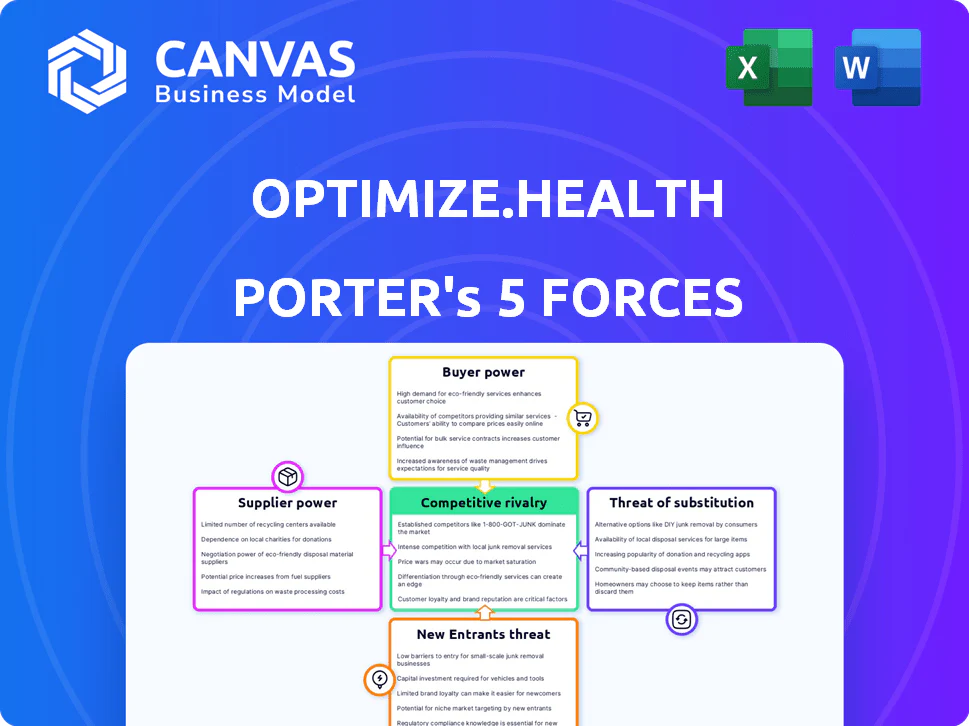
OPTIMIZE.HEALTH PORTER'S FIVE FORCES TEMPLATE RESEARCH
What is included in the product
 Detailed Word Document
Tailored exclusively for Optimize.health, analyzing its position within its competitive landscape.

 Customizable Excel Spreadsheet
Optimize.health's analysis simplifies complex forces, giving you a clear, concise strategic overview.
Preview Before You Purchase
Optimize.health Porter's Five Forces Analysis
This preview reveals Optimize.health's Porter's Five Forces analysis in its entirety. The detailed document, fully formatted, is what you'll download immediately after purchase. It includes a thorough assessment of the industry's competitive landscape. No revisions or edits are necessary; you'll receive the same analysis instantly.

Porter's Five Forces Analysis Template

A Must-Have Tool for Decision-Makers
Optimize.health operates within a dynamic healthcare market. The threat of new entrants is moderate, given regulatory hurdles and established players. Buyer power is significant, with consumers having choices. Supplier power, especially for technology, can be impactful. Substitute products/services (telehealth) pose a growing threat. Competitive rivalry is intense with various digital health platforms vying for market share.
Ready to move beyond the basics? Get a full strategic breakdown of Optimize.health’s market position, competitive intensity, and external threats—all in one powerful analysis.
Suppliers Bargaining Power

Device Manufacturers
Optimize.health depends on device makers for its RPM platform. The uniqueness of device tech, supplier options, and switching costs affect supplier power. In 2024, the RPM market was valued at $61.6 billion, showing supplier impact. Switching suppliers can involve significant costs and time.
Technology Providers
Technology providers, including cloud computing and data analytics services, wield moderate bargaining power over Optimize.health. The complexity and proprietary nature of these technologies, coupled with integration needs, influence this dynamic.
In 2024, cloud computing spending is projected to reach $670 billion globally, indicating a strong supplier market. The ease of integrating such technologies is crucial for Optimize.health's operational efficiency.
The availability and cost of AI/machine learning tools also affect bargaining power. The market for AI software is forecasted to grow to $139.8 billion by 2024, providing more options, but also potential cost pressures.
Optimize.health must manage these supplier relationships to ensure competitive pricing and access to essential technologies. This is especially true with the growing importance of data analytics in healthcare.
In 2024, the healthcare analytics market is estimated at $32.5 billion, showing the critical role of these suppliers.

Software and Platform Developers
Optimize.health's reliance on third-party software affects supplier power. The cost of in-house development and availability of alternatives are key. Software costs rose by 8% in 2024. A critical component gives suppliers more leverage.

Data and Analytics Providers
Data and analytics providers could wield significant bargaining power, especially if they offer unique or crucial health data or advanced analytical tools. Their leverage increases with the uniqueness and value of their offerings, influencing Optimize.health's operational capabilities. A 2024 report shows the health analytics market is projected to reach $68.01 billion by 2030. This growth underscores the importance of data providers.
- Data exclusivity elevates supplier power.
- Advanced analytics tools are key.
- Market growth boosts provider influence.
- High-quality data is essential.
Healthcare IT Infrastructure Providers
Suppliers of hosting, security, and network infrastructure services significantly influence Optimize.health. The healthcare sector's reliance on dependable, secure systems and regulatory compliance elevates these suppliers' leverage. This dependency enables them to negotiate more favorable terms. For example, the global healthcare IT market was valued at $176.6 billion in 2023.
- Market Size: Healthcare IT market reached $176.6B in 2023.
- Compliance: Meeting stringent data privacy rules.
- Security: Protecting sensitive patient information.
- Dependence: Critical for operational functionality.
Supplier Power Dynamics: A Deep Dive
Optimize.health faces supplier bargaining power across multiple fronts. Device makers significantly influence the RPM platform, with the 2024 market valued at $61.6 billion. Technology providers, including cloud services, have moderate power, reflected in the $670 billion cloud spending in 2024. Data analytics suppliers also wield considerable leverage, boosted by the $32.5 billion healthcare analytics market in 2024.
| Supplier Type | Market Size (2024) | Impact on Optimize.health |
|---|---|---|
| Device Makers | $61.6 Billion (RPM) | Influences platform capabilities |
| Cloud Providers | $670 Billion (Global) | Affects operational efficiency |
| Data Analytics | $32.5 Billion (Healthcare) | Critical for insights and operations |
Customers Bargaining Power

Healthcare Providers (Clinics, Hospitals, etc.)
Optimize.health primarily serves healthcare providers, making them key customers. Their bargaining power varies. Larger healthcare systems, managing more patients, often wield greater influence. In 2024, the RPM market was valued at $1.8 billion, and competition is increasing, potentially shifting power. The ability to switch to alternative RPM solutions also impacts this power.
Patients (Indirectly)
Patients indirectly shape Optimize.health's success through their acceptance of remote patient monitoring (RPM). Their satisfaction with device usability and perceived value impacts demand from healthcare providers. In 2024, patient engagement rates in RPM programs have seen a 15% increase, influencing provider adoption. The ease of use directly correlates with patient retention, affecting platform utilization. Patient feedback and satisfaction scores are key metrics for optimizing services, as evidenced by a recent study showing a 20% higher satisfaction rate for user-friendly platforms.

Payers (Insurance Companies)
Insurance companies wield substantial influence over Optimize.health's RPM services adoption and revenue. Their coverage decisions and reimbursement rates directly impact healthcare providers' interest, giving payers considerable bargaining power. In 2024, UnitedHealth Group, a major payer, reported a revenue of $372.1 billion, highlighting their financial sway in healthcare. Reimbursement rates for RPM codes, like those used by Optimize.health, are crucial; changes can significantly alter profitability and market attractiveness.

Government and Regulatory Bodies
Government and regulatory bodies wield considerable power in the Remote Patient Monitoring (RPM) market. Regulations, like those from Medicare and Medicaid in the U.S., heavily influence demand and profitability for companies such as Optimize.health. These entities set reimbursement rates, which can directly affect the financial viability of RPM services. Any shifts in these policies can significantly alter the market dynamics.
- In 2024, CMS proposed updates to RPM billing codes, potentially impacting reimbursement.
- Medicare spending on RPM services is projected to grow, influencing market trends.
- Changes in regulatory compliance requirements can increase operational costs.
- Government initiatives support RPM adoption, affecting market growth.
Employer Groups
Employer groups, especially those self-insuring or offering wellness programs, wield influence as customers. Their focus on employee health and cost control shapes RPM adoption. They negotiate with healthcare providers and platforms, impacting market dynamics. This power stems from their ability to steer demand and pricing. In 2024, 60% of large employers self-insured, highlighting their bargaining position.
- Self-insured employers control a significant portion of healthcare spending.
- Wellness programs drive demand for health solutions.
- Cost management is a primary goal for employers.
- Negotiating power impacts RPM pricing and adoption.
RPM Market Dynamics: Provider Power & Pricing
Healthcare providers, as primary customers, have variable bargaining power. Larger systems often have more influence. The RPM market, valued at $1.8B in 2024, faces rising competition. Switching costs also affect provider power.
| Customer Type | Influence Factor | Impact on Optimize.health |
|---|---|---|
| Healthcare Providers | Size & Market Share | Affects contract terms and pricing. |
| Patients | Satisfaction & Engagement | Influences platform adoption rates. |
| Insurance Companies | Coverage & Reimbursement | Determines revenue streams. |
Rivalry Among Competitors

Number and Diversity of Competitors
The RPM market's expansion fuels competitive rivalry, drawing in varied players. This includes startups, device manufacturers, and telehealth providers. Recent data shows the RPM market reached $1.8 billion in 2023, with a projected $3.5 billion by 2028. This growth intensifies competition.
Market Growth Rate
The remote patient monitoring market anticipates substantial growth. The global market was valued at $1.3 billion in 2023. High growth often lessens rivalry. However, it also pulls in more companies. The market is projected to reach $3.6 billion by 2029.

Product Differentiation
Product differentiation significantly impacts rivalry within the RPM market. Optimize.health aims to stand out with its comprehensive platform, user-friendly design, and robust support. Despite these efforts, many competitors offer similar core RPM functionalities, intensifying competition. The RPM market is projected to reach $29.9 billion by 2024, with a CAGR of 19.3% from 2024 to 2032, making differentiation crucial for success.

Switching Costs for Customers
Switching costs significantly impact rivalry in the RPM market. High integration with EHRs and existing workflows creates barriers. This makes it harder for healthcare providers to switch RPM platforms. As of 2024, the average integration cost can range from $5,000 to $20,000 per practice.
- EHR integration complexity is a key factor.
- High switching costs can reduce rivalry among existing customers.
- Acquiring new customers becomes more challenging.
- Cost data is based on 2024 market analysis.
Industry Concentration
The competitive landscape within the healthcare technology sector, like Optimize.health's market, is marked by a mix of many participants, with the potential for consolidation. This market dynamic affects pricing strategies and the drive for market share. Market concentration influences the intensity of competition and strategic decisions. For example, in 2024, the telehealth market experienced significant M&A activity, indicating possible future consolidation.
- Market concentration can lead to more aggressive pricing strategies.
- Consolidation could shift the balance of power among competitors.
- Strategic moves are crucial in a concentrated market.
- Increased competition can affect profitability.
RPM Market: Intense Competition Ahead!
Competitive rivalry in the RPM market is intense, fueled by growth and diverse players. The market's value reached $1.8B in 2023 and is projected to $3.5B by 2028. Product differentiation and switching costs significantly influence competition, with EHR integration costing $5,000-$20,000 per practice in 2024.
| Factor | Impact | Data (2024) |
|---|---|---|
| Market Growth | Intensifies rivalry, attracts competitors | RPM market projected to $29.9B, CAGR 19.3% (2024-2032) |
| Differentiation | Crucial for success | Many competitors offer similar core functions |
| Switching Costs | High costs reduce rivalry among existing customers | EHR integration costs $5,000-$20,000 per practice |
OPTIMIZE.HEALTH PORTER'S FIVE FORCES TEMPLATE RESEARCH
What is included in the product
Detailed Word Document
Tailored exclusively for Optimize.health, analyzing its position within its competitive landscape.
Customizable Excel Spreadsheet
Optimize.health's analysis simplifies complex forces, giving you a clear, concise strategic overview.
Preview Before You Purchase
Optimize.health Porter's Five Forces Analysis
This preview reveals Optimize.health's Porter's Five Forces analysis in its entirety. The detailed document, fully formatted, is what you'll download immediately after purchase. It includes a thorough assessment of the industry's competitive landscape. No revisions or edits are necessary; you'll receive the same analysis instantly.
Porter's Five Forces Analysis Template
A Must-Have Tool for Decision-Makers
Optimize.health operates within a dynamic healthcare market. The threat of new entrants is moderate, given regulatory hurdles and established players. Buyer power is significant, with consumers having choices. Supplier power, especially for technology, can be impactful. Substitute products/services (telehealth) pose a growing threat. Competitive rivalry is intense with various digital health platforms vying for market share.
Ready to move beyond the basics? Get a full strategic breakdown of Optimize.health’s market position, competitive intensity, and external threats—all in one powerful analysis.
Suppliers Bargaining Power
Device Manufacturers
Optimize.health depends on device makers for its RPM platform. The uniqueness of device tech, supplier options, and switching costs affect supplier power. In 2024, the RPM market was valued at $61.6 billion, showing supplier impact. Switching suppliers can involve significant costs and time.
Technology Providers
Technology providers, including cloud computing and data analytics services, wield moderate bargaining power over Optimize.health. The complexity and proprietary nature of these technologies, coupled with integration needs, influence this dynamic.
In 2024, cloud computing spending is projected to reach $670 billion globally, indicating a strong supplier market. The ease of integrating such technologies is crucial for Optimize.health's operational efficiency.
The availability and cost of AI/machine learning tools also affect bargaining power. The market for AI software is forecasted to grow to $139.8 billion by 2024, providing more options, but also potential cost pressures.
Optimize.health must manage these supplier relationships to ensure competitive pricing and access to essential technologies. This is especially true with the growing importance of data analytics in healthcare.
In 2024, the healthcare analytics market is estimated at $32.5 billion, showing the critical role of these suppliers.
Software and Platform Developers
Optimize.health's reliance on third-party software affects supplier power. The cost of in-house development and availability of alternatives are key. Software costs rose by 8% in 2024. A critical component gives suppliers more leverage.
Data and Analytics Providers
Data and analytics providers could wield significant bargaining power, especially if they offer unique or crucial health data or advanced analytical tools. Their leverage increases with the uniqueness and value of their offerings, influencing Optimize.health's operational capabilities. A 2024 report shows the health analytics market is projected to reach $68.01 billion by 2030. This growth underscores the importance of data providers.
- Data exclusivity elevates supplier power.
- Advanced analytics tools are key.
- Market growth boosts provider influence.
- High-quality data is essential.
Healthcare IT Infrastructure Providers
Suppliers of hosting, security, and network infrastructure services significantly influence Optimize.health. The healthcare sector's reliance on dependable, secure systems and regulatory compliance elevates these suppliers' leverage. This dependency enables them to negotiate more favorable terms. For example, the global healthcare IT market was valued at $176.6 billion in 2023.
- Market Size: Healthcare IT market reached $176.6B in 2023.
- Compliance: Meeting stringent data privacy rules.
- Security: Protecting sensitive patient information.
- Dependence: Critical for operational functionality.
Supplier Power Dynamics: A Deep Dive
Optimize.health faces supplier bargaining power across multiple fronts. Device makers significantly influence the RPM platform, with the 2024 market valued at $61.6 billion. Technology providers, including cloud services, have moderate power, reflected in the $670 billion cloud spending in 2024. Data analytics suppliers also wield considerable leverage, boosted by the $32.5 billion healthcare analytics market in 2024.
| Supplier Type | Market Size (2024) | Impact on Optimize.health |
|---|---|---|
| Device Makers | $61.6 Billion (RPM) | Influences platform capabilities |
| Cloud Providers | $670 Billion (Global) | Affects operational efficiency |
| Data Analytics | $32.5 Billion (Healthcare) | Critical for insights and operations |
Customers Bargaining Power
Healthcare Providers (Clinics, Hospitals, etc.)
Optimize.health primarily serves healthcare providers, making them key customers. Their bargaining power varies. Larger healthcare systems, managing more patients, often wield greater influence. In 2024, the RPM market was valued at $1.8 billion, and competition is increasing, potentially shifting power. The ability to switch to alternative RPM solutions also impacts this power.
Patients (Indirectly)
Patients indirectly shape Optimize.health's success through their acceptance of remote patient monitoring (RPM). Their satisfaction with device usability and perceived value impacts demand from healthcare providers. In 2024, patient engagement rates in RPM programs have seen a 15% increase, influencing provider adoption. The ease of use directly correlates with patient retention, affecting platform utilization. Patient feedback and satisfaction scores are key metrics for optimizing services, as evidenced by a recent study showing a 20% higher satisfaction rate for user-friendly platforms.
Payers (Insurance Companies)
Insurance companies wield substantial influence over Optimize.health's RPM services adoption and revenue. Their coverage decisions and reimbursement rates directly impact healthcare providers' interest, giving payers considerable bargaining power. In 2024, UnitedHealth Group, a major payer, reported a revenue of $372.1 billion, highlighting their financial sway in healthcare. Reimbursement rates for RPM codes, like those used by Optimize.health, are crucial; changes can significantly alter profitability and market attractiveness.
Government and Regulatory Bodies
Government and regulatory bodies wield considerable power in the Remote Patient Monitoring (RPM) market. Regulations, like those from Medicare and Medicaid in the U.S., heavily influence demand and profitability for companies such as Optimize.health. These entities set reimbursement rates, which can directly affect the financial viability of RPM services. Any shifts in these policies can significantly alter the market dynamics.
- In 2024, CMS proposed updates to RPM billing codes, potentially impacting reimbursement.
- Medicare spending on RPM services is projected to grow, influencing market trends.
- Changes in regulatory compliance requirements can increase operational costs.
- Government initiatives support RPM adoption, affecting market growth.
Employer Groups
Employer groups, especially those self-insuring or offering wellness programs, wield influence as customers. Their focus on employee health and cost control shapes RPM adoption. They negotiate with healthcare providers and platforms, impacting market dynamics. This power stems from their ability to steer demand and pricing. In 2024, 60% of large employers self-insured, highlighting their bargaining position.
- Self-insured employers control a significant portion of healthcare spending.
- Wellness programs drive demand for health solutions.
- Cost management is a primary goal for employers.
- Negotiating power impacts RPM pricing and adoption.
RPM Market Dynamics: Provider Power & Pricing
Healthcare providers, as primary customers, have variable bargaining power. Larger systems often have more influence. The RPM market, valued at $1.8B in 2024, faces rising competition. Switching costs also affect provider power.
| Customer Type | Influence Factor | Impact on Optimize.health |
|---|---|---|
| Healthcare Providers | Size & Market Share | Affects contract terms and pricing. |
| Patients | Satisfaction & Engagement | Influences platform adoption rates. |
| Insurance Companies | Coverage & Reimbursement | Determines revenue streams. |
Rivalry Among Competitors
Number and Diversity of Competitors
The RPM market's expansion fuels competitive rivalry, drawing in varied players. This includes startups, device manufacturers, and telehealth providers. Recent data shows the RPM market reached $1.8 billion in 2023, with a projected $3.5 billion by 2028. This growth intensifies competition.
Market Growth Rate
The remote patient monitoring market anticipates substantial growth. The global market was valued at $1.3 billion in 2023. High growth often lessens rivalry. However, it also pulls in more companies. The market is projected to reach $3.6 billion by 2029.
Product Differentiation
Product differentiation significantly impacts rivalry within the RPM market. Optimize.health aims to stand out with its comprehensive platform, user-friendly design, and robust support. Despite these efforts, many competitors offer similar core RPM functionalities, intensifying competition. The RPM market is projected to reach $29.9 billion by 2024, with a CAGR of 19.3% from 2024 to 2032, making differentiation crucial for success.
Switching Costs for Customers
Switching costs significantly impact rivalry in the RPM market. High integration with EHRs and existing workflows creates barriers. This makes it harder for healthcare providers to switch RPM platforms. As of 2024, the average integration cost can range from $5,000 to $20,000 per practice.
- EHR integration complexity is a key factor.
- High switching costs can reduce rivalry among existing customers.
- Acquiring new customers becomes more challenging.
- Cost data is based on 2024 market analysis.
Industry Concentration
The competitive landscape within the healthcare technology sector, like Optimize.health's market, is marked by a mix of many participants, with the potential for consolidation. This market dynamic affects pricing strategies and the drive for market share. Market concentration influences the intensity of competition and strategic decisions. For example, in 2024, the telehealth market experienced significant M&A activity, indicating possible future consolidation.
- Market concentration can lead to more aggressive pricing strategies.
- Consolidation could shift the balance of power among competitors.
- Strategic moves are crucial in a concentrated market.
- Increased competition can affect profitability.
RPM Market: Intense Competition Ahead!
Competitive rivalry in the RPM market is intense, fueled by growth and diverse players. The market's value reached $1.8B in 2023 and is projected to $3.5B by 2028. Product differentiation and switching costs significantly influence competition, with EHR integration costing $5,000-$20,000 per practice in 2024.
| Factor | Impact | Data (2024) |
|---|---|---|
| Market Growth | Intensifies rivalry, attracts competitors | RPM market projected to $29.9B, CAGR 19.3% (2024-2032) |
| Differentiation | Crucial for success | Many competitors offer similar core functions |
| Switching Costs | High costs reduce rivalry among existing customers | EHR integration costs $5,000-$20,000 per practice |
Product Information
Product Information
Shipping & Returns
Shipping & Returns
Description
What is included in the product
Detailed Word Document
Tailored exclusively for Optimize.health, analyzing its position within its competitive landscape.
Customizable Excel Spreadsheet
Optimize.health's analysis simplifies complex forces, giving you a clear, concise strategic overview.
Preview Before You Purchase
Optimize.health Porter's Five Forces Analysis
This preview reveals Optimize.health's Porter's Five Forces analysis in its entirety. The detailed document, fully formatted, is what you'll download immediately after purchase. It includes a thorough assessment of the industry's competitive landscape. No revisions or edits are necessary; you'll receive the same analysis instantly.
Porter's Five Forces Analysis Template
A Must-Have Tool for Decision-Makers
Optimize.health operates within a dynamic healthcare market. The threat of new entrants is moderate, given regulatory hurdles and established players. Buyer power is significant, with consumers having choices. Supplier power, especially for technology, can be impactful. Substitute products/services (telehealth) pose a growing threat. Competitive rivalry is intense with various digital health platforms vying for market share.
Ready to move beyond the basics? Get a full strategic breakdown of Optimize.health’s market position, competitive intensity, and external threats—all in one powerful analysis.
Suppliers Bargaining Power
Device Manufacturers
Optimize.health depends on device makers for its RPM platform. The uniqueness of device tech, supplier options, and switching costs affect supplier power. In 2024, the RPM market was valued at $61.6 billion, showing supplier impact. Switching suppliers can involve significant costs and time.
Technology Providers
Technology providers, including cloud computing and data analytics services, wield moderate bargaining power over Optimize.health. The complexity and proprietary nature of these technologies, coupled with integration needs, influence this dynamic.
In 2024, cloud computing spending is projected to reach $670 billion globally, indicating a strong supplier market. The ease of integrating such technologies is crucial for Optimize.health's operational efficiency.
The availability and cost of AI/machine learning tools also affect bargaining power. The market for AI software is forecasted to grow to $139.8 billion by 2024, providing more options, but also potential cost pressures.
Optimize.health must manage these supplier relationships to ensure competitive pricing and access to essential technologies. This is especially true with the growing importance of data analytics in healthcare.
In 2024, the healthcare analytics market is estimated at $32.5 billion, showing the critical role of these suppliers.
Software and Platform Developers
Optimize.health's reliance on third-party software affects supplier power. The cost of in-house development and availability of alternatives are key. Software costs rose by 8% in 2024. A critical component gives suppliers more leverage.
Data and Analytics Providers
Data and analytics providers could wield significant bargaining power, especially if they offer unique or crucial health data or advanced analytical tools. Their leverage increases with the uniqueness and value of their offerings, influencing Optimize.health's operational capabilities. A 2024 report shows the health analytics market is projected to reach $68.01 billion by 2030. This growth underscores the importance of data providers.
- Data exclusivity elevates supplier power.
- Advanced analytics tools are key.
- Market growth boosts provider influence.
- High-quality data is essential.
Healthcare IT Infrastructure Providers
Suppliers of hosting, security, and network infrastructure services significantly influence Optimize.health. The healthcare sector's reliance on dependable, secure systems and regulatory compliance elevates these suppliers' leverage. This dependency enables them to negotiate more favorable terms. For example, the global healthcare IT market was valued at $176.6 billion in 2023.
- Market Size: Healthcare IT market reached $176.6B in 2023.
- Compliance: Meeting stringent data privacy rules.
- Security: Protecting sensitive patient information.
- Dependence: Critical for operational functionality.
Supplier Power Dynamics: A Deep Dive
Optimize.health faces supplier bargaining power across multiple fronts. Device makers significantly influence the RPM platform, with the 2024 market valued at $61.6 billion. Technology providers, including cloud services, have moderate power, reflected in the $670 billion cloud spending in 2024. Data analytics suppliers also wield considerable leverage, boosted by the $32.5 billion healthcare analytics market in 2024.
| Supplier Type | Market Size (2024) | Impact on Optimize.health |
|---|---|---|
| Device Makers | $61.6 Billion (RPM) | Influences platform capabilities |
| Cloud Providers | $670 Billion (Global) | Affects operational efficiency |
| Data Analytics | $32.5 Billion (Healthcare) | Critical for insights and operations |
Customers Bargaining Power
Healthcare Providers (Clinics, Hospitals, etc.)
Optimize.health primarily serves healthcare providers, making them key customers. Their bargaining power varies. Larger healthcare systems, managing more patients, often wield greater influence. In 2024, the RPM market was valued at $1.8 billion, and competition is increasing, potentially shifting power. The ability to switch to alternative RPM solutions also impacts this power.
Patients (Indirectly)
Patients indirectly shape Optimize.health's success through their acceptance of remote patient monitoring (RPM). Their satisfaction with device usability and perceived value impacts demand from healthcare providers. In 2024, patient engagement rates in RPM programs have seen a 15% increase, influencing provider adoption. The ease of use directly correlates with patient retention, affecting platform utilization. Patient feedback and satisfaction scores are key metrics for optimizing services, as evidenced by a recent study showing a 20% higher satisfaction rate for user-friendly platforms.
Payers (Insurance Companies)
Insurance companies wield substantial influence over Optimize.health's RPM services adoption and revenue. Their coverage decisions and reimbursement rates directly impact healthcare providers' interest, giving payers considerable bargaining power. In 2024, UnitedHealth Group, a major payer, reported a revenue of $372.1 billion, highlighting their financial sway in healthcare. Reimbursement rates for RPM codes, like those used by Optimize.health, are crucial; changes can significantly alter profitability and market attractiveness.
Government and Regulatory Bodies
Government and regulatory bodies wield considerable power in the Remote Patient Monitoring (RPM) market. Regulations, like those from Medicare and Medicaid in the U.S., heavily influence demand and profitability for companies such as Optimize.health. These entities set reimbursement rates, which can directly affect the financial viability of RPM services. Any shifts in these policies can significantly alter the market dynamics.
- In 2024, CMS proposed updates to RPM billing codes, potentially impacting reimbursement.
- Medicare spending on RPM services is projected to grow, influencing market trends.
- Changes in regulatory compliance requirements can increase operational costs.
- Government initiatives support RPM adoption, affecting market growth.
Employer Groups
Employer groups, especially those self-insuring or offering wellness programs, wield influence as customers. Their focus on employee health and cost control shapes RPM adoption. They negotiate with healthcare providers and platforms, impacting market dynamics. This power stems from their ability to steer demand and pricing. In 2024, 60% of large employers self-insured, highlighting their bargaining position.
- Self-insured employers control a significant portion of healthcare spending.
- Wellness programs drive demand for health solutions.
- Cost management is a primary goal for employers.
- Negotiating power impacts RPM pricing and adoption.
RPM Market Dynamics: Provider Power & Pricing
Healthcare providers, as primary customers, have variable bargaining power. Larger systems often have more influence. The RPM market, valued at $1.8B in 2024, faces rising competition. Switching costs also affect provider power.
| Customer Type | Influence Factor | Impact on Optimize.health |
|---|---|---|
| Healthcare Providers | Size & Market Share | Affects contract terms and pricing. |
| Patients | Satisfaction & Engagement | Influences platform adoption rates. |
| Insurance Companies | Coverage & Reimbursement | Determines revenue streams. |
Rivalry Among Competitors
Number and Diversity of Competitors
The RPM market's expansion fuels competitive rivalry, drawing in varied players. This includes startups, device manufacturers, and telehealth providers. Recent data shows the RPM market reached $1.8 billion in 2023, with a projected $3.5 billion by 2028. This growth intensifies competition.
Market Growth Rate
The remote patient monitoring market anticipates substantial growth. The global market was valued at $1.3 billion in 2023. High growth often lessens rivalry. However, it also pulls in more companies. The market is projected to reach $3.6 billion by 2029.
Product Differentiation
Product differentiation significantly impacts rivalry within the RPM market. Optimize.health aims to stand out with its comprehensive platform, user-friendly design, and robust support. Despite these efforts, many competitors offer similar core RPM functionalities, intensifying competition. The RPM market is projected to reach $29.9 billion by 2024, with a CAGR of 19.3% from 2024 to 2032, making differentiation crucial for success.
Switching Costs for Customers
Switching costs significantly impact rivalry in the RPM market. High integration with EHRs and existing workflows creates barriers. This makes it harder for healthcare providers to switch RPM platforms. As of 2024, the average integration cost can range from $5,000 to $20,000 per practice.
- EHR integration complexity is a key factor.
- High switching costs can reduce rivalry among existing customers.
- Acquiring new customers becomes more challenging.
- Cost data is based on 2024 market analysis.
Industry Concentration
The competitive landscape within the healthcare technology sector, like Optimize.health's market, is marked by a mix of many participants, with the potential for consolidation. This market dynamic affects pricing strategies and the drive for market share. Market concentration influences the intensity of competition and strategic decisions. For example, in 2024, the telehealth market experienced significant M&A activity, indicating possible future consolidation.
- Market concentration can lead to more aggressive pricing strategies.
- Consolidation could shift the balance of power among competitors.
- Strategic moves are crucial in a concentrated market.
- Increased competition can affect profitability.
RPM Market: Intense Competition Ahead!
Competitive rivalry in the RPM market is intense, fueled by growth and diverse players. The market's value reached $1.8B in 2023 and is projected to $3.5B by 2028. Product differentiation and switching costs significantly influence competition, with EHR integration costing $5,000-$20,000 per practice in 2024.
| Factor | Impact | Data (2024) |
|---|---|---|
| Market Growth | Intensifies rivalry, attracts competitors | RPM market projected to $29.9B, CAGR 19.3% (2024-2032) |
| Differentiation | Crucial for success | Many competitors offer similar core functions |
| Switching Costs | High costs reduce rivalry among existing customers | EHR integration costs $5,000-$20,000 per practice |











