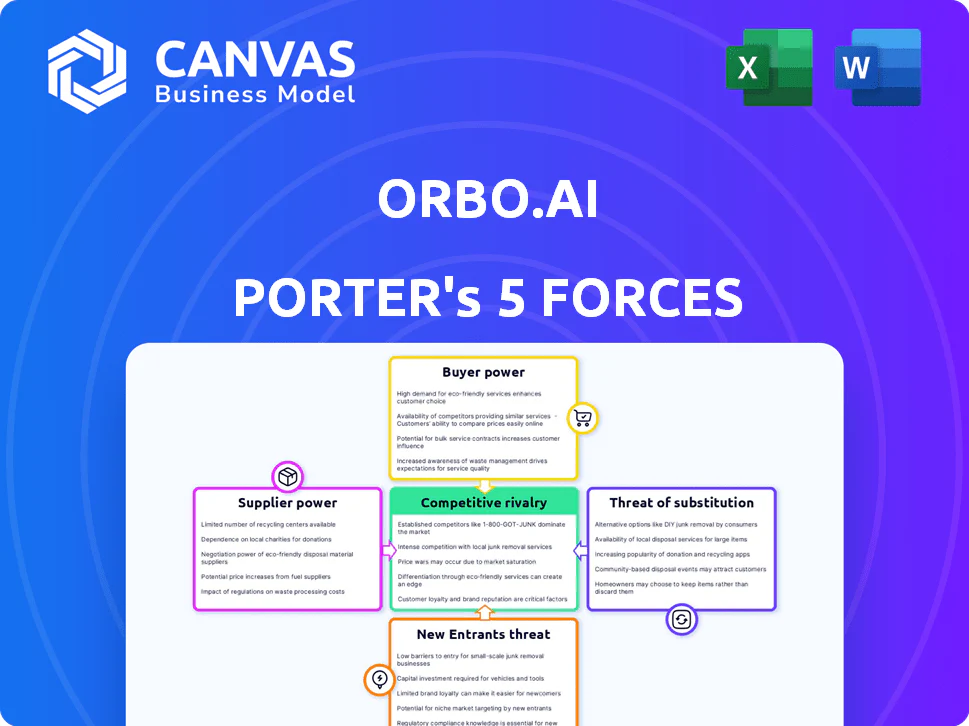
ORBO.AI PORTER'S FIVE FORCES TEMPLATE RESEARCH
What is included in the product
 Detailed Word Document
Analyzes Orbo.ai's competitive forces: rivalry, suppliers, buyers, threats, and entry barriers.

 Customizable Excel Spreadsheet
Avoid complex spreadsheets—get strategic clarity with an intuitive, color-coded format.
Preview the Actual Deliverable
Orbo.ai Porter's Five Forces Analysis
This preview offers a complete Orbo.ai Porter's Five Forces analysis. You're seeing the final, fully formatted document you'll instantly receive. It's the same professional analysis, ready for your use. There are no hidden changes or alterations. The document you see is exactly what you'll download.

Porter's Five Forces Analysis Template

Elevate Your Analysis with the Complete Porter's Five Forces Analysis
Orbo.ai faces moderate rivalry within the AI solutions market, driven by both established tech giants and nimble startups. Buyer power is relatively high, as clients have diverse options. Supplier power is moderate due to reliance on specialized talent and technology. The threat of new entrants is significant given the rapid innovation. Substitute products, like other automation software, pose a moderate threat.
The complete report reveals the real forces shaping Orbo.ai’s industry—from supplier influence to threat of new entrants. Gain actionable insights to drive smarter decision-making.
Suppliers Bargaining Power

Availability of Data and Algorithms
Orbo.ai's reliance on data impacts supplier power. The cost and availability of high-quality datasets are crucial. In 2024, the data science market was valued at $132.9 billion. Access to advanced algorithms, often from universities, also affects bargaining dynamics.
Hardware and Infrastructure Providers
Orbo.ai's reliance on computing power gives hardware and infrastructure suppliers some bargaining power. Companies like NVIDIA, with a 70% share in the discrete GPU market in Q4 2023, could hold sway. However, Orbo's strategy to minimize GPU and cloud use may limit supplier influence. This approach could be a cost-saving measure.

Talent Pool and Expertise
Orbo.ai's access to skilled AI researchers, computer vision engineers, and deep learning specialists significantly impacts its operations. The limited availability of this talent pool gives these professionals considerable bargaining power. In 2024, the average salary for AI specialists rose by 8%, reflecting this increased leverage.

Software and Tool Providers
Orbo.ai relies on software and tool providers for its operations. Suppliers of AI development frameworks, like TensorFlow or PyTorch, and image processing libraries such as OpenCV, hold some bargaining power. Their influence is amplified if their tools are widely adopted industry standards. For instance, in 2024, the global AI software market was valued at approximately $62.4 billion.
- Dependence on key tools increases supplier power.
- Standardization of tools elevates supplier influence.
- Market size of AI software is substantial.
- Providers of operating systems also impact operations.
Research Institutions and Universities
Orbo.ai's dependence on research institutions and universities for AI and computer vision advancements creates a supplier relationship. These institutions, holding valuable intellectual property, can dictate terms for partnerships or access to research. This can affect Orbo.ai's ability to innovate and compete effectively. In 2024, the global AI market was valued at $200 billion, with significant research contributions from academia.
- Research access terms impact innovation.
- Market growth depends on research.
- Intellectual property is a key factor.
- Partnerships are subject to conditions.
Supplier Power Dynamics in the AI Realm
Orbo.ai's supplier power varies across datasets, computing, talent, and tools. Dependence on key resources like data and AI specialists grants suppliers leverage. The AI market's growth, reaching $200B in 2024, amplifies this dynamic.
| Supplier Type | Impact | 2024 Data |
|---|---|---|
| Data Providers | High, data crucial | Data science market: $132.9B |
| Computing | Moderate, GPU/cloud | NVIDIA GPU share: 70% |
| Talent | High, skilled AI | AI specialist salary up 8% |
| Software/Tools | Moderate, standard tools | AI software market: $62.4B |
| Research | Moderate, IP access | Global AI market: $200B |
Customers Bargaining Power

Diverse Industry Applications
Orbo.ai's broad market reach, from mobile to e-commerce, dilutes customer bargaining power. This diversification helps shield Orbo.ai. For example, in 2024, the global computer vision market was valued at $16.47 billion, showing varied customer influence. The company's strategy reduces dependence on any single customer segment.
Importance of Technology to Customers
Orbo.ai's tech, like virtual try-ons and skin analysis, boosts customer experience and sales. If these features are crucial to a customer's business, their power increases. For example, in 2024, e-commerce sales hit $1.1 trillion, showing the importance of tech in retail.

Switching Costs for Customers
Switching costs, encompassing integration efforts and potential disruptions, significantly affect customer bargaining power. If Orbo.ai's tech is deeply integrated, customers face higher switching costs, reducing their power. Conversely, easily transferable solutions increase customer power. For example, in 2024, the average cost to switch enterprise software was $15,000.

Customer Concentration
Customer concentration significantly impacts Orbo.ai's bargaining power. If a few major clients generate most of Orbo.ai's revenue, those customers wield considerable influence. This concentration allows them to negotiate lower prices or demand better terms. However, specific data on Orbo.ai's customer base isn't publicly accessible.
- High customer concentration increases customer bargaining power.
- Limited public information hinders detailed analysis.
- The size of the customer base is crucial.
- Negotiating leverage impacts profitability.
Customer's Ability to Develop In-House Solutions
Large customers, particularly those with substantial financial backing, possess the option to create their own computer vision and facial recognition solutions, thus reducing their reliance on external vendors like Orbo.ai. This in-house development strategy can significantly enhance their bargaining power. A 2024 study revealed that companies investing over $50 million annually in R&D are 30% more likely to internalize technological solutions. The cost-effectiveness of these solutions is crucial.
- Internal development offers potential cost savings over time.
- However, it requires significant upfront investment in infrastructure.
- The feasibility depends on the customer's technical expertise.
- This capability limits Orbo.ai's pricing flexibility.
Orbo.ai's Customer Power Dynamics: A Quick Look
Orbo.ai's diverse market presence weakens customer influence, yet tech-dependent clients gain leverage. Switching costs affect customer power, and concentration matters. Big customers can build solutions, impacting Orbo.ai's pricing.
| Factor | Impact on Bargaining Power | 2024 Data |
|---|---|---|
| Market Diversification | Lowers customer power | Computer vision market: $16.47B |
| Tech Integration | Increases power | E-commerce sales: $1.1T |
| Switching Costs | Reduces power | Avg. software switch cost: $15K |
| Customer Concentration | Increases power | R&D spend for in-house tech: $50M+ |
Rivalry Among Competitors

Number and Capability of Competitors
The computer vision market is fiercely competitive, hosting numerous firms with similar tech. Established giants and innovative startups constantly heighten rivalry. The global computer vision market was valued at $15.8 billion in 2023. Experts project it to reach $37.3 billion by 2029.
Market Growth Rate
The computer vision and facial recognition markets are booming. A high growth rate usually eases competition, but it can also lure in more rivals. For example, the global computer vision market was valued at $15.8 billion in 2023. It's expected to reach $44.3 billion by 2028, per MarketsandMarkets.

Industry Concentration
Orbo.ai's competitive landscape features numerous participants, yet a few could dominate market share or focus on specific areas. For instance, in 2024, the top 5 AI companies collectively controlled about 60% of the market, indicating moderate concentration. This concentration level directly impacts the intensity of rivalry.

Product Differentiation
Orbo.ai's product differentiation, like its lightweight 3D facial model, reduces competition. Offering unique features lessens direct rivalry in the market. This strategy helps Orbo.ai stand out from competitors. By focusing on specific AI applications, they carve a niche. Such differentiation is key to competitive advantage.
- Orbo.ai's focus on niche AI applications minimizes direct competition.
- Unique features, such as offline capabilities, set it apart.
- Differentiation is crucial for competitive success.
- This approach helps Orbo.ai gain a market advantage.
Exit Barriers
Exit barriers significantly shape competitive rivalry within the AI landscape, including Orbo.ai's domain. If it's tough for companies to leave, they're more likely to fight hard. High barriers, like specialized tech or significant investments, keep firms in the game, intensifying competition. This can lead to price wars or increased innovation to survive. For example, in 2024, the AI market saw heightened rivalry due to high exit costs.
- High exit barriers intensify competition.
- Specialized tech and investments are typical barriers.
- Rivalry can lead to price wars or innovation.
- The AI market's 2024 competition was fierce.
Orbo.ai's Market: Fierce Competition & Key Factors
Competitive rivalry in Orbo.ai's market is intense, with many players. Differentiation, like unique features, helps reduce direct competition. High exit barriers, such as specialized tech, intensify this rivalry. The global AI market was worth $196.63 billion in 2023.
| Factor | Impact | Example |
|---|---|---|
| Market Competition | High | Numerous AI firms |
| Differentiation | Reduces Rivalry | Orbo.ai's 3D model |
| Exit Barriers | Increases Rivalry | Specialized tech |
Original: $10.00
-65%$10.00
$3.50ORBO.AI PORTER'S FIVE FORCES TEMPLATE RESEARCH
What is included in the product
Detailed Word Document
Analyzes Orbo.ai's competitive forces: rivalry, suppliers, buyers, threats, and entry barriers.
Customizable Excel Spreadsheet
Avoid complex spreadsheets—get strategic clarity with an intuitive, color-coded format.
Preview the Actual Deliverable
Orbo.ai Porter's Five Forces Analysis
This preview offers a complete Orbo.ai Porter's Five Forces analysis. You're seeing the final, fully formatted document you'll instantly receive. It's the same professional analysis, ready for your use. There are no hidden changes or alterations. The document you see is exactly what you'll download.
Porter's Five Forces Analysis Template
Elevate Your Analysis with the Complete Porter's Five Forces Analysis
Orbo.ai faces moderate rivalry within the AI solutions market, driven by both established tech giants and nimble startups. Buyer power is relatively high, as clients have diverse options. Supplier power is moderate due to reliance on specialized talent and technology. The threat of new entrants is significant given the rapid innovation. Substitute products, like other automation software, pose a moderate threat.
The complete report reveals the real forces shaping Orbo.ai’s industry—from supplier influence to threat of new entrants. Gain actionable insights to drive smarter decision-making.
Suppliers Bargaining Power
Availability of Data and Algorithms
Orbo.ai's reliance on data impacts supplier power. The cost and availability of high-quality datasets are crucial. In 2024, the data science market was valued at $132.9 billion. Access to advanced algorithms, often from universities, also affects bargaining dynamics.
Hardware and Infrastructure Providers
Orbo.ai's reliance on computing power gives hardware and infrastructure suppliers some bargaining power. Companies like NVIDIA, with a 70% share in the discrete GPU market in Q4 2023, could hold sway. However, Orbo's strategy to minimize GPU and cloud use may limit supplier influence. This approach could be a cost-saving measure.
Talent Pool and Expertise
Orbo.ai's access to skilled AI researchers, computer vision engineers, and deep learning specialists significantly impacts its operations. The limited availability of this talent pool gives these professionals considerable bargaining power. In 2024, the average salary for AI specialists rose by 8%, reflecting this increased leverage.
Software and Tool Providers
Orbo.ai relies on software and tool providers for its operations. Suppliers of AI development frameworks, like TensorFlow or PyTorch, and image processing libraries such as OpenCV, hold some bargaining power. Their influence is amplified if their tools are widely adopted industry standards. For instance, in 2024, the global AI software market was valued at approximately $62.4 billion.
- Dependence on key tools increases supplier power.
- Standardization of tools elevates supplier influence.
- Market size of AI software is substantial.
- Providers of operating systems also impact operations.
Research Institutions and Universities
Orbo.ai's dependence on research institutions and universities for AI and computer vision advancements creates a supplier relationship. These institutions, holding valuable intellectual property, can dictate terms for partnerships or access to research. This can affect Orbo.ai's ability to innovate and compete effectively. In 2024, the global AI market was valued at $200 billion, with significant research contributions from academia.
- Research access terms impact innovation.
- Market growth depends on research.
- Intellectual property is a key factor.
- Partnerships are subject to conditions.
Supplier Power Dynamics in the AI Realm
Orbo.ai's supplier power varies across datasets, computing, talent, and tools. Dependence on key resources like data and AI specialists grants suppliers leverage. The AI market's growth, reaching $200B in 2024, amplifies this dynamic.
| Supplier Type | Impact | 2024 Data |
|---|---|---|
| Data Providers | High, data crucial | Data science market: $132.9B |
| Computing | Moderate, GPU/cloud | NVIDIA GPU share: 70% |
| Talent | High, skilled AI | AI specialist salary up 8% |
| Software/Tools | Moderate, standard tools | AI software market: $62.4B |
| Research | Moderate, IP access | Global AI market: $200B |
Customers Bargaining Power
Diverse Industry Applications
Orbo.ai's broad market reach, from mobile to e-commerce, dilutes customer bargaining power. This diversification helps shield Orbo.ai. For example, in 2024, the global computer vision market was valued at $16.47 billion, showing varied customer influence. The company's strategy reduces dependence on any single customer segment.
Importance of Technology to Customers
Orbo.ai's tech, like virtual try-ons and skin analysis, boosts customer experience and sales. If these features are crucial to a customer's business, their power increases. For example, in 2024, e-commerce sales hit $1.1 trillion, showing the importance of tech in retail.
Switching Costs for Customers
Switching costs, encompassing integration efforts and potential disruptions, significantly affect customer bargaining power. If Orbo.ai's tech is deeply integrated, customers face higher switching costs, reducing their power. Conversely, easily transferable solutions increase customer power. For example, in 2024, the average cost to switch enterprise software was $15,000.
Customer Concentration
Customer concentration significantly impacts Orbo.ai's bargaining power. If a few major clients generate most of Orbo.ai's revenue, those customers wield considerable influence. This concentration allows them to negotiate lower prices or demand better terms. However, specific data on Orbo.ai's customer base isn't publicly accessible.
- High customer concentration increases customer bargaining power.
- Limited public information hinders detailed analysis.
- The size of the customer base is crucial.
- Negotiating leverage impacts profitability.
Customer's Ability to Develop In-House Solutions
Large customers, particularly those with substantial financial backing, possess the option to create their own computer vision and facial recognition solutions, thus reducing their reliance on external vendors like Orbo.ai. This in-house development strategy can significantly enhance their bargaining power. A 2024 study revealed that companies investing over $50 million annually in R&D are 30% more likely to internalize technological solutions. The cost-effectiveness of these solutions is crucial.
- Internal development offers potential cost savings over time.
- However, it requires significant upfront investment in infrastructure.
- The feasibility depends on the customer's technical expertise.
- This capability limits Orbo.ai's pricing flexibility.
Orbo.ai's Customer Power Dynamics: A Quick Look
Orbo.ai's diverse market presence weakens customer influence, yet tech-dependent clients gain leverage. Switching costs affect customer power, and concentration matters. Big customers can build solutions, impacting Orbo.ai's pricing.
| Factor | Impact on Bargaining Power | 2024 Data |
|---|---|---|
| Market Diversification | Lowers customer power | Computer vision market: $16.47B |
| Tech Integration | Increases power | E-commerce sales: $1.1T |
| Switching Costs | Reduces power | Avg. software switch cost: $15K |
| Customer Concentration | Increases power | R&D spend for in-house tech: $50M+ |
Rivalry Among Competitors
Number and Capability of Competitors
The computer vision market is fiercely competitive, hosting numerous firms with similar tech. Established giants and innovative startups constantly heighten rivalry. The global computer vision market was valued at $15.8 billion in 2023. Experts project it to reach $37.3 billion by 2029.
Market Growth Rate
The computer vision and facial recognition markets are booming. A high growth rate usually eases competition, but it can also lure in more rivals. For example, the global computer vision market was valued at $15.8 billion in 2023. It's expected to reach $44.3 billion by 2028, per MarketsandMarkets.
Industry Concentration
Orbo.ai's competitive landscape features numerous participants, yet a few could dominate market share or focus on specific areas. For instance, in 2024, the top 5 AI companies collectively controlled about 60% of the market, indicating moderate concentration. This concentration level directly impacts the intensity of rivalry.
Product Differentiation
Orbo.ai's product differentiation, like its lightweight 3D facial model, reduces competition. Offering unique features lessens direct rivalry in the market. This strategy helps Orbo.ai stand out from competitors. By focusing on specific AI applications, they carve a niche. Such differentiation is key to competitive advantage.
- Orbo.ai's focus on niche AI applications minimizes direct competition.
- Unique features, such as offline capabilities, set it apart.
- Differentiation is crucial for competitive success.
- This approach helps Orbo.ai gain a market advantage.
Exit Barriers
Exit barriers significantly shape competitive rivalry within the AI landscape, including Orbo.ai's domain. If it's tough for companies to leave, they're more likely to fight hard. High barriers, like specialized tech or significant investments, keep firms in the game, intensifying competition. This can lead to price wars or increased innovation to survive. For example, in 2024, the AI market saw heightened rivalry due to high exit costs.
- High exit barriers intensify competition.
- Specialized tech and investments are typical barriers.
- Rivalry can lead to price wars or innovation.
- The AI market's 2024 competition was fierce.
Orbo.ai's Market: Fierce Competition & Key Factors
Competitive rivalry in Orbo.ai's market is intense, with many players. Differentiation, like unique features, helps reduce direct competition. High exit barriers, such as specialized tech, intensify this rivalry. The global AI market was worth $196.63 billion in 2023.
| Factor | Impact | Example |
|---|---|---|
| Market Competition | High | Numerous AI firms |
| Differentiation | Reduces Rivalry | Orbo.ai's 3D model |
| Exit Barriers | Increases Rivalry | Specialized tech |
Product Information
Product Information
Shipping & Returns
Shipping & Returns
Description
What is included in the product
Detailed Word Document
Analyzes Orbo.ai's competitive forces: rivalry, suppliers, buyers, threats, and entry barriers.
Customizable Excel Spreadsheet
Avoid complex spreadsheets—get strategic clarity with an intuitive, color-coded format.
Preview the Actual Deliverable
Orbo.ai Porter's Five Forces Analysis
This preview offers a complete Orbo.ai Porter's Five Forces analysis. You're seeing the final, fully formatted document you'll instantly receive. It's the same professional analysis, ready for your use. There are no hidden changes or alterations. The document you see is exactly what you'll download.
Porter's Five Forces Analysis Template
Elevate Your Analysis with the Complete Porter's Five Forces Analysis
Orbo.ai faces moderate rivalry within the AI solutions market, driven by both established tech giants and nimble startups. Buyer power is relatively high, as clients have diverse options. Supplier power is moderate due to reliance on specialized talent and technology. The threat of new entrants is significant given the rapid innovation. Substitute products, like other automation software, pose a moderate threat.
The complete report reveals the real forces shaping Orbo.ai’s industry—from supplier influence to threat of new entrants. Gain actionable insights to drive smarter decision-making.
Suppliers Bargaining Power
Availability of Data and Algorithms
Orbo.ai's reliance on data impacts supplier power. The cost and availability of high-quality datasets are crucial. In 2024, the data science market was valued at $132.9 billion. Access to advanced algorithms, often from universities, also affects bargaining dynamics.
Hardware and Infrastructure Providers
Orbo.ai's reliance on computing power gives hardware and infrastructure suppliers some bargaining power. Companies like NVIDIA, with a 70% share in the discrete GPU market in Q4 2023, could hold sway. However, Orbo's strategy to minimize GPU and cloud use may limit supplier influence. This approach could be a cost-saving measure.
Talent Pool and Expertise
Orbo.ai's access to skilled AI researchers, computer vision engineers, and deep learning specialists significantly impacts its operations. The limited availability of this talent pool gives these professionals considerable bargaining power. In 2024, the average salary for AI specialists rose by 8%, reflecting this increased leverage.
Software and Tool Providers
Orbo.ai relies on software and tool providers for its operations. Suppliers of AI development frameworks, like TensorFlow or PyTorch, and image processing libraries such as OpenCV, hold some bargaining power. Their influence is amplified if their tools are widely adopted industry standards. For instance, in 2024, the global AI software market was valued at approximately $62.4 billion.
- Dependence on key tools increases supplier power.
- Standardization of tools elevates supplier influence.
- Market size of AI software is substantial.
- Providers of operating systems also impact operations.
Research Institutions and Universities
Orbo.ai's dependence on research institutions and universities for AI and computer vision advancements creates a supplier relationship. These institutions, holding valuable intellectual property, can dictate terms for partnerships or access to research. This can affect Orbo.ai's ability to innovate and compete effectively. In 2024, the global AI market was valued at $200 billion, with significant research contributions from academia.
- Research access terms impact innovation.
- Market growth depends on research.
- Intellectual property is a key factor.
- Partnerships are subject to conditions.
Supplier Power Dynamics in the AI Realm
Orbo.ai's supplier power varies across datasets, computing, talent, and tools. Dependence on key resources like data and AI specialists grants suppliers leverage. The AI market's growth, reaching $200B in 2024, amplifies this dynamic.
| Supplier Type | Impact | 2024 Data |
|---|---|---|
| Data Providers | High, data crucial | Data science market: $132.9B |
| Computing | Moderate, GPU/cloud | NVIDIA GPU share: 70% |
| Talent | High, skilled AI | AI specialist salary up 8% |
| Software/Tools | Moderate, standard tools | AI software market: $62.4B |
| Research | Moderate, IP access | Global AI market: $200B |
Customers Bargaining Power
Diverse Industry Applications
Orbo.ai's broad market reach, from mobile to e-commerce, dilutes customer bargaining power. This diversification helps shield Orbo.ai. For example, in 2024, the global computer vision market was valued at $16.47 billion, showing varied customer influence. The company's strategy reduces dependence on any single customer segment.
Importance of Technology to Customers
Orbo.ai's tech, like virtual try-ons and skin analysis, boosts customer experience and sales. If these features are crucial to a customer's business, their power increases. For example, in 2024, e-commerce sales hit $1.1 trillion, showing the importance of tech in retail.
Switching Costs for Customers
Switching costs, encompassing integration efforts and potential disruptions, significantly affect customer bargaining power. If Orbo.ai's tech is deeply integrated, customers face higher switching costs, reducing their power. Conversely, easily transferable solutions increase customer power. For example, in 2024, the average cost to switch enterprise software was $15,000.
Customer Concentration
Customer concentration significantly impacts Orbo.ai's bargaining power. If a few major clients generate most of Orbo.ai's revenue, those customers wield considerable influence. This concentration allows them to negotiate lower prices or demand better terms. However, specific data on Orbo.ai's customer base isn't publicly accessible.
- High customer concentration increases customer bargaining power.
- Limited public information hinders detailed analysis.
- The size of the customer base is crucial.
- Negotiating leverage impacts profitability.
Customer's Ability to Develop In-House Solutions
Large customers, particularly those with substantial financial backing, possess the option to create their own computer vision and facial recognition solutions, thus reducing their reliance on external vendors like Orbo.ai. This in-house development strategy can significantly enhance their bargaining power. A 2024 study revealed that companies investing over $50 million annually in R&D are 30% more likely to internalize technological solutions. The cost-effectiveness of these solutions is crucial.
- Internal development offers potential cost savings over time.
- However, it requires significant upfront investment in infrastructure.
- The feasibility depends on the customer's technical expertise.
- This capability limits Orbo.ai's pricing flexibility.
Orbo.ai's Customer Power Dynamics: A Quick Look
Orbo.ai's diverse market presence weakens customer influence, yet tech-dependent clients gain leverage. Switching costs affect customer power, and concentration matters. Big customers can build solutions, impacting Orbo.ai's pricing.
| Factor | Impact on Bargaining Power | 2024 Data |
|---|---|---|
| Market Diversification | Lowers customer power | Computer vision market: $16.47B |
| Tech Integration | Increases power | E-commerce sales: $1.1T |
| Switching Costs | Reduces power | Avg. software switch cost: $15K |
| Customer Concentration | Increases power | R&D spend for in-house tech: $50M+ |
Rivalry Among Competitors
Number and Capability of Competitors
The computer vision market is fiercely competitive, hosting numerous firms with similar tech. Established giants and innovative startups constantly heighten rivalry. The global computer vision market was valued at $15.8 billion in 2023. Experts project it to reach $37.3 billion by 2029.
Market Growth Rate
The computer vision and facial recognition markets are booming. A high growth rate usually eases competition, but it can also lure in more rivals. For example, the global computer vision market was valued at $15.8 billion in 2023. It's expected to reach $44.3 billion by 2028, per MarketsandMarkets.
Industry Concentration
Orbo.ai's competitive landscape features numerous participants, yet a few could dominate market share or focus on specific areas. For instance, in 2024, the top 5 AI companies collectively controlled about 60% of the market, indicating moderate concentration. This concentration level directly impacts the intensity of rivalry.
Product Differentiation
Orbo.ai's product differentiation, like its lightweight 3D facial model, reduces competition. Offering unique features lessens direct rivalry in the market. This strategy helps Orbo.ai stand out from competitors. By focusing on specific AI applications, they carve a niche. Such differentiation is key to competitive advantage.
- Orbo.ai's focus on niche AI applications minimizes direct competition.
- Unique features, such as offline capabilities, set it apart.
- Differentiation is crucial for competitive success.
- This approach helps Orbo.ai gain a market advantage.
Exit Barriers
Exit barriers significantly shape competitive rivalry within the AI landscape, including Orbo.ai's domain. If it's tough for companies to leave, they're more likely to fight hard. High barriers, like specialized tech or significant investments, keep firms in the game, intensifying competition. This can lead to price wars or increased innovation to survive. For example, in 2024, the AI market saw heightened rivalry due to high exit costs.
- High exit barriers intensify competition.
- Specialized tech and investments are typical barriers.
- Rivalry can lead to price wars or innovation.
- The AI market's 2024 competition was fierce.
Orbo.ai's Market: Fierce Competition & Key Factors
Competitive rivalry in Orbo.ai's market is intense, with many players. Differentiation, like unique features, helps reduce direct competition. High exit barriers, such as specialized tech, intensify this rivalry. The global AI market was worth $196.63 billion in 2023.
| Factor | Impact | Example |
|---|---|---|
| Market Competition | High | Numerous AI firms |
| Differentiation | Reduces Rivalry | Orbo.ai's 3D model |
| Exit Barriers | Increases Rivalry | Specialized tech |











