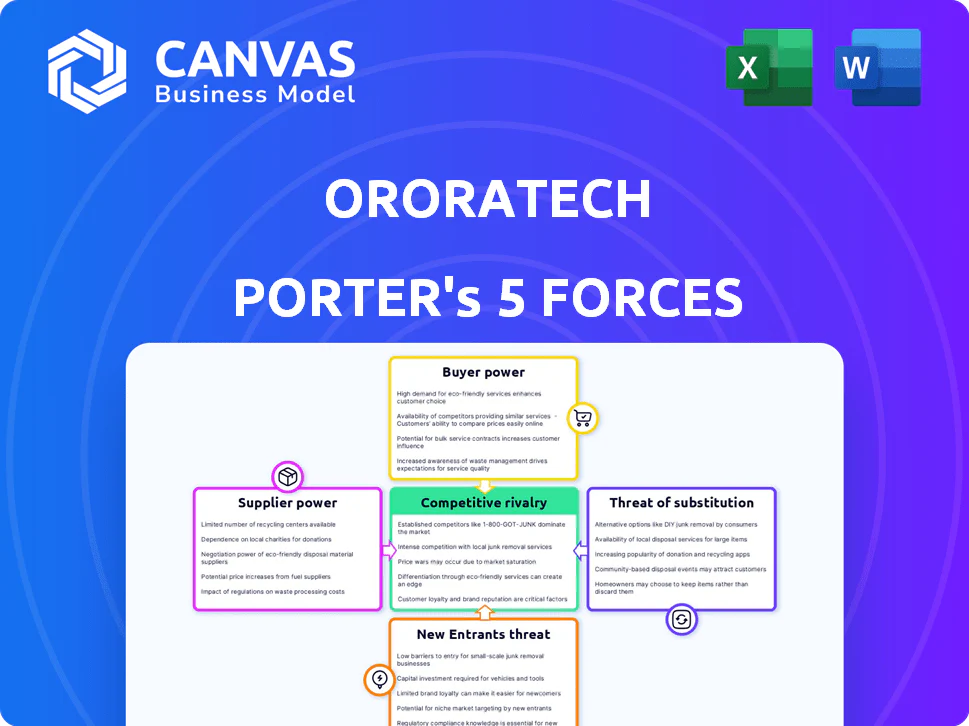
ORORATECH PORTER'S FIVE FORCES TEMPLATE RESEARCH
What is included in the product
 Detailed Word Document
Tailored exclusively for OroraTech, analyzing its position within its competitive landscape.

 Customizable Excel Spreadsheet
Customize pressure levels based on new data or evolving market trends.
Preview the Actual Deliverable
OroraTech Porter's Five Forces Analysis
You're viewing the complete OroraTech Porter's Five Forces analysis. This preview offers full transparency: the document presented here is the same professionally crafted analysis you'll receive immediately after your purchase, fully formatted and ready for your use. There are no hidden sections or different versions. This means your downloaded file will match this preview.

Porter's Five Forces Analysis Template

From Overview to Strategy Blueprint
OroraTech operates within a dynamic market, influenced by various competitive forces. Analyzing these forces is crucial for understanding its strategic position. Bargaining power of suppliers impacts operational costs and innovation. Buyer power, especially from government entities, affects pricing. The threat of new entrants, though, is tempered by high technology costs. Substitute products, like drone services, pose a moderate risk to its market share. Finally, intense rivalry with other satellite data companies influences margins.
This brief snapshot only scratches the surface. Unlock the full Porter's Five Forces Analysis to explore OroraTech’s competitive dynamics, market pressures, and strategic advantages in detail.
Suppliers Bargaining Power

Satellite Data Providers
OroraTech's supplier power is influenced by thermal data sources. Public data from NASA and ESA offers leverage, potentially decreasing supplier power. Commercial satellite data costs and terms also affect this power dynamic. In 2024, the global Earth observation market was valued at approximately $4.3 billion.
Satellite Manufacturers
OroraTech's bargaining power with satellite manufacturers is influenced by its own satellite operations and partnerships. The availability and capacity of manufacturers, like Spire Global, to build specialized thermal imaging satellites are crucial. In 2024, the market for satellite manufacturing is competitive, with companies like Airbus and Boeing holding significant market share. This competition can give OroraTech leverage in negotiating prices and terms.

Launch Service Providers
OroraTech relies on launch service providers for satellite deployment, a crucial aspect of its business. The bargaining power of suppliers, such as Rocket Lab, is significant, influencing OroraTech's costs. In 2024, Rocket Lab completed multiple successful launches, highlighting its role. The availability and pricing of these services directly impact OroraTech’s operational efficiency and expansion plans.

Technology and Component Providers
OroraTech's operational success heavily depends on its technology and component suppliers, particularly those providing specialized thermal imaging sensors, data processing units, and AI capabilities. These suppliers have significant bargaining power, given the specialized nature and often limited availability of these critical components. For instance, the global thermal sensor market was valued at approximately $7.5 billion in 2024, with key players like FLIR Systems (Teledyne FLIR) holding considerable influence. This power is amplified by the potential for supply chain disruptions and the high switching costs associated with changing suppliers, potentially impacting OroraTech's profit margins.
- Specialized components are essential for operations.
- Limited supplier options increase bargaining power.
- Switching suppliers can be costly.
- Supply chain disruptions are a risk.
Software and Analytics Providers
OroraTech relies heavily on software and analytics providers for its wildfire detection and prediction platform. The company integrates data from various sources, utilizing advanced AI and cloud infrastructure, primarily Google Cloud. The bargaining power of these suppliers is moderate, as OroraTech depends on their sophisticated algorithms and services. This dependence can influence pricing and service terms.
- Google Cloud's revenue in Q3 2024 was $10.8 billion.
- The global wildfire analytics market is projected to reach $1.5 billion by 2029.
- OroraTech secured a €10 million funding round in 2023.
OroraTech's Supplier Power Dynamics: A Detailed Look
OroraTech's supplier power varies across different areas. Suppliers of specialized components, like thermal sensors, hold significant power due to limited options and high switching costs. Launch service providers also have notable influence, affecting costs. The bargaining power of software and analytics providers is moderate.
| Supplier Type | Bargaining Power | Factors Influencing Power |
|---|---|---|
| Thermal Sensor Suppliers | High | Specialization, limited options, high switching costs. The thermal sensor market was $7.5B in 2024. |
| Launch Service Providers | Significant | Availability, pricing of services. Rocket Lab had multiple launches in 2024. |
| Software/Analytics Providers | Moderate | Dependence on algorithms and services. Google Cloud revenue was $10.8B in Q3 2024. |
Customers Bargaining Power

Government Agencies and Fire Services
Government agencies and fire services are crucial customers for OroraTech. Their significant purchasing power stems from the vital need for wildfire management and large-scale operations. OroraTech has contracts with governments globally. For example, in 2024, OroraTech secured a contract with the German government.
Commercial Forestry and Insurance Companies
Commercial forestry companies and insurance providers represent significant customer segments, with their bargaining power shaped by wildfire impacts. The economic fallout from wildfires directly affects their operations, potentially leading to substantial financial losses. In 2024, the insurance industry paid out billions due to wildfire damage. The availability of alternative risk mitigation strategies further influences their negotiation leverage.

NGOs and Environmental Organizations
NGOs and environmental organizations leverage OroraTech's data for conservation efforts. Their bargaining power is influenced by data utility for their goals. For example, in 2024, environmental monitoring spending reached $10 billion. The value of OroraTech's data is its impact on their missions.

Geographic Diversity of Customers
OroraTech's geographic diversity, spanning Europe, North America, and Australia, is a key factor. This broad reach helps mitigate the bargaining power of individual customers. A diversified customer base means OroraTech isn't overly reliant on any single client or region. This distribution strengthens OroraTech's market position.
- OroraTech operates across multiple continents.
- Diversification reduces customer dependence.
- Geographic spread lowers customer bargaining power.
- This strategy strengthens market positioning.
Integration with Existing Systems
The ease of integrating OroraTech's solution with current systems significantly impacts customer power. Seamless integration lowers switching costs, making it harder for customers to leave. In 2024, businesses increasingly prioritize interoperability, with 73% citing it as crucial for new tech adoption. This is especially true in sectors like emergency response, where data sharing is vital.
- Interoperability is a key factor for 73% of businesses in 2024.
- Reduced switching costs increase customer power.
- Data sharing is crucial in emergency response.
- OroraTech must offer easy integration.
Customer Power Dynamics: A Look at OroraTech
OroraTech's customer bargaining power varies across segments. Government agencies and commercial entities have significant influence. Geographic diversity and easy system integration help OroraTech. In 2024, wildfire damages cost billions.
| Customer Type | Bargaining Power | Mitigation |
|---|---|---|
| Government/Fire Services | High | Contracts, Global Presence |
| Commercial Forestry/Insurance | Moderate | Value of Data, Integration |
| NGOs/Environmental Orgs | Moderate | Data Utility, Diversification |
Rivalry Among Competitors

Other Satellite-Based Wildfire Detection Companies
OroraTech faces competition from FireSat and others using MODIS/VIIRS data for wildfire detection. Increased competition, especially from those with advanced tech, heightens rivalry. FireSat's funding in 2024 was $12 million, showing serious industry investment. This competition can lower margins, but also drives innovation.
Companies with Diverse Earth Observation Portfolios
Planet and Spire Global, with broader portfolios, are strong competitors. In 2024, Planet's revenue was about $218 million. Spire Global's 2024 revenue stood at roughly $95 million. Their established infrastructure and diverse offerings present significant challenges.

Providers of Other Wildfire Detection Technologies
Competitive rivalry involves firms providing alternative wildfire detection technologies. These include ground sensors, drones, and camera systems. For example, Pano AI secured $17 million in funding in 2024 for its wildfire detection platform. The cost-effectiveness of these alternatives impacts OroraTech.

Market Growth Rate
The market for forest wildfire detection systems is expanding rapidly. This growth can lessen competitive pressures, as multiple companies can thrive. However, rapid expansion also attracts new entrants, intensifying competition. The global market was valued at $2.1 billion in 2024. It's projected to reach $4.5 billion by 2029, growing at a CAGR of 16.5%.
- Market size in 2024: $2.1 billion.
- Projected market size by 2029: $4.5 billion.
- Compound Annual Growth Rate (CAGR): 16.5%.
- Growth indicates opportunities for all players.
Differentiation of Services
OroraTech's competitive edge stems from its unique offerings. Their proprietary satellite network, providing high-resolution thermal data, sets them apart. This real-time insight and predictive analytics capability reduces rivalry. In 2024, the global market for Earth observation services was valued at $6.5 billion, highlighting differentiation's impact.
- Proprietary Satellite Constellation: Enhanced data control.
- High-Resolution Thermal Data: Superior image quality.
- Real-Time Insights: Quick, actionable information.
- Predictive Analytics: Forecasts for proactive strategies.
Market Rivals: Funding & Revenue Insights
Competitive rivalry in OroraTech's market includes FireSat and Planet. FireSat's 2024 funding was $12 million. Planet's 2024 revenue was approximately $218 million. Alternative technologies like drones also intensify competition.
| Competitor | 2024 Revenue/Funding | Notes |
|---|---|---|
| Planet | $218 million (Revenue) | Broader portfolio, established infrastructure |
| FireSat | $12 million (Funding) | Focus on wildfire detection |
| Pano AI | $17 million (Funding) | Alternative wildfire detection platform |
ORORATECH PORTER'S FIVE FORCES TEMPLATE RESEARCH
What is included in the product
Detailed Word Document
Tailored exclusively for OroraTech, analyzing its position within its competitive landscape.
Customizable Excel Spreadsheet
Customize pressure levels based on new data or evolving market trends.
Preview the Actual Deliverable
OroraTech Porter's Five Forces Analysis
You're viewing the complete OroraTech Porter's Five Forces analysis. This preview offers full transparency: the document presented here is the same professionally crafted analysis you'll receive immediately after your purchase, fully formatted and ready for your use. There are no hidden sections or different versions. This means your downloaded file will match this preview.
Porter's Five Forces Analysis Template
From Overview to Strategy Blueprint
OroraTech operates within a dynamic market, influenced by various competitive forces. Analyzing these forces is crucial for understanding its strategic position. Bargaining power of suppliers impacts operational costs and innovation. Buyer power, especially from government entities, affects pricing. The threat of new entrants, though, is tempered by high technology costs. Substitute products, like drone services, pose a moderate risk to its market share. Finally, intense rivalry with other satellite data companies influences margins.
This brief snapshot only scratches the surface. Unlock the full Porter's Five Forces Analysis to explore OroraTech’s competitive dynamics, market pressures, and strategic advantages in detail.
Suppliers Bargaining Power
Satellite Data Providers
OroraTech's supplier power is influenced by thermal data sources. Public data from NASA and ESA offers leverage, potentially decreasing supplier power. Commercial satellite data costs and terms also affect this power dynamic. In 2024, the global Earth observation market was valued at approximately $4.3 billion.
Satellite Manufacturers
OroraTech's bargaining power with satellite manufacturers is influenced by its own satellite operations and partnerships. The availability and capacity of manufacturers, like Spire Global, to build specialized thermal imaging satellites are crucial. In 2024, the market for satellite manufacturing is competitive, with companies like Airbus and Boeing holding significant market share. This competition can give OroraTech leverage in negotiating prices and terms.
Launch Service Providers
OroraTech relies on launch service providers for satellite deployment, a crucial aspect of its business. The bargaining power of suppliers, such as Rocket Lab, is significant, influencing OroraTech's costs. In 2024, Rocket Lab completed multiple successful launches, highlighting its role. The availability and pricing of these services directly impact OroraTech’s operational efficiency and expansion plans.
Technology and Component Providers
OroraTech's operational success heavily depends on its technology and component suppliers, particularly those providing specialized thermal imaging sensors, data processing units, and AI capabilities. These suppliers have significant bargaining power, given the specialized nature and often limited availability of these critical components. For instance, the global thermal sensor market was valued at approximately $7.5 billion in 2024, with key players like FLIR Systems (Teledyne FLIR) holding considerable influence. This power is amplified by the potential for supply chain disruptions and the high switching costs associated with changing suppliers, potentially impacting OroraTech's profit margins.
- Specialized components are essential for operations.
- Limited supplier options increase bargaining power.
- Switching suppliers can be costly.
- Supply chain disruptions are a risk.
Software and Analytics Providers
OroraTech relies heavily on software and analytics providers for its wildfire detection and prediction platform. The company integrates data from various sources, utilizing advanced AI and cloud infrastructure, primarily Google Cloud. The bargaining power of these suppliers is moderate, as OroraTech depends on their sophisticated algorithms and services. This dependence can influence pricing and service terms.
- Google Cloud's revenue in Q3 2024 was $10.8 billion.
- The global wildfire analytics market is projected to reach $1.5 billion by 2029.
- OroraTech secured a €10 million funding round in 2023.
OroraTech's Supplier Power Dynamics: A Detailed Look
OroraTech's supplier power varies across different areas. Suppliers of specialized components, like thermal sensors, hold significant power due to limited options and high switching costs. Launch service providers also have notable influence, affecting costs. The bargaining power of software and analytics providers is moderate.
| Supplier Type | Bargaining Power | Factors Influencing Power |
|---|---|---|
| Thermal Sensor Suppliers | High | Specialization, limited options, high switching costs. The thermal sensor market was $7.5B in 2024. |
| Launch Service Providers | Significant | Availability, pricing of services. Rocket Lab had multiple launches in 2024. |
| Software/Analytics Providers | Moderate | Dependence on algorithms and services. Google Cloud revenue was $10.8B in Q3 2024. |
Customers Bargaining Power
Government Agencies and Fire Services
Government agencies and fire services are crucial customers for OroraTech. Their significant purchasing power stems from the vital need for wildfire management and large-scale operations. OroraTech has contracts with governments globally. For example, in 2024, OroraTech secured a contract with the German government.
Commercial Forestry and Insurance Companies
Commercial forestry companies and insurance providers represent significant customer segments, with their bargaining power shaped by wildfire impacts. The economic fallout from wildfires directly affects their operations, potentially leading to substantial financial losses. In 2024, the insurance industry paid out billions due to wildfire damage. The availability of alternative risk mitigation strategies further influences their negotiation leverage.
NGOs and Environmental Organizations
NGOs and environmental organizations leverage OroraTech's data for conservation efforts. Their bargaining power is influenced by data utility for their goals. For example, in 2024, environmental monitoring spending reached $10 billion. The value of OroraTech's data is its impact on their missions.
Geographic Diversity of Customers
OroraTech's geographic diversity, spanning Europe, North America, and Australia, is a key factor. This broad reach helps mitigate the bargaining power of individual customers. A diversified customer base means OroraTech isn't overly reliant on any single client or region. This distribution strengthens OroraTech's market position.
- OroraTech operates across multiple continents.
- Diversification reduces customer dependence.
- Geographic spread lowers customer bargaining power.
- This strategy strengthens market positioning.
Integration with Existing Systems
The ease of integrating OroraTech's solution with current systems significantly impacts customer power. Seamless integration lowers switching costs, making it harder for customers to leave. In 2024, businesses increasingly prioritize interoperability, with 73% citing it as crucial for new tech adoption. This is especially true in sectors like emergency response, where data sharing is vital.
- Interoperability is a key factor for 73% of businesses in 2024.
- Reduced switching costs increase customer power.
- Data sharing is crucial in emergency response.
- OroraTech must offer easy integration.
Customer Power Dynamics: A Look at OroraTech
OroraTech's customer bargaining power varies across segments. Government agencies and commercial entities have significant influence. Geographic diversity and easy system integration help OroraTech. In 2024, wildfire damages cost billions.
| Customer Type | Bargaining Power | Mitigation |
|---|---|---|
| Government/Fire Services | High | Contracts, Global Presence |
| Commercial Forestry/Insurance | Moderate | Value of Data, Integration |
| NGOs/Environmental Orgs | Moderate | Data Utility, Diversification |
Rivalry Among Competitors
Other Satellite-Based Wildfire Detection Companies
OroraTech faces competition from FireSat and others using MODIS/VIIRS data for wildfire detection. Increased competition, especially from those with advanced tech, heightens rivalry. FireSat's funding in 2024 was $12 million, showing serious industry investment. This competition can lower margins, but also drives innovation.
Companies with Diverse Earth Observation Portfolios
Planet and Spire Global, with broader portfolios, are strong competitors. In 2024, Planet's revenue was about $218 million. Spire Global's 2024 revenue stood at roughly $95 million. Their established infrastructure and diverse offerings present significant challenges.
Providers of Other Wildfire Detection Technologies
Competitive rivalry involves firms providing alternative wildfire detection technologies. These include ground sensors, drones, and camera systems. For example, Pano AI secured $17 million in funding in 2024 for its wildfire detection platform. The cost-effectiveness of these alternatives impacts OroraTech.
Market Growth Rate
The market for forest wildfire detection systems is expanding rapidly. This growth can lessen competitive pressures, as multiple companies can thrive. However, rapid expansion also attracts new entrants, intensifying competition. The global market was valued at $2.1 billion in 2024. It's projected to reach $4.5 billion by 2029, growing at a CAGR of 16.5%.
- Market size in 2024: $2.1 billion.
- Projected market size by 2029: $4.5 billion.
- Compound Annual Growth Rate (CAGR): 16.5%.
- Growth indicates opportunities for all players.
Differentiation of Services
OroraTech's competitive edge stems from its unique offerings. Their proprietary satellite network, providing high-resolution thermal data, sets them apart. This real-time insight and predictive analytics capability reduces rivalry. In 2024, the global market for Earth observation services was valued at $6.5 billion, highlighting differentiation's impact.
- Proprietary Satellite Constellation: Enhanced data control.
- High-Resolution Thermal Data: Superior image quality.
- Real-Time Insights: Quick, actionable information.
- Predictive Analytics: Forecasts for proactive strategies.
Market Rivals: Funding & Revenue Insights
Competitive rivalry in OroraTech's market includes FireSat and Planet. FireSat's 2024 funding was $12 million. Planet's 2024 revenue was approximately $218 million. Alternative technologies like drones also intensify competition.
| Competitor | 2024 Revenue/Funding | Notes |
|---|---|---|
| Planet | $218 million (Revenue) | Broader portfolio, established infrastructure |
| FireSat | $12 million (Funding) | Focus on wildfire detection |
| Pano AI | $17 million (Funding) | Alternative wildfire detection platform |
Product Information
Product Information
Shipping & Returns
Shipping & Returns
Description
What is included in the product
Detailed Word Document
Tailored exclusively for OroraTech, analyzing its position within its competitive landscape.
Customizable Excel Spreadsheet
Customize pressure levels based on new data or evolving market trends.
Preview the Actual Deliverable
OroraTech Porter's Five Forces Analysis
You're viewing the complete OroraTech Porter's Five Forces analysis. This preview offers full transparency: the document presented here is the same professionally crafted analysis you'll receive immediately after your purchase, fully formatted and ready for your use. There are no hidden sections or different versions. This means your downloaded file will match this preview.
Porter's Five Forces Analysis Template
From Overview to Strategy Blueprint
OroraTech operates within a dynamic market, influenced by various competitive forces. Analyzing these forces is crucial for understanding its strategic position. Bargaining power of suppliers impacts operational costs and innovation. Buyer power, especially from government entities, affects pricing. The threat of new entrants, though, is tempered by high technology costs. Substitute products, like drone services, pose a moderate risk to its market share. Finally, intense rivalry with other satellite data companies influences margins.
This brief snapshot only scratches the surface. Unlock the full Porter's Five Forces Analysis to explore OroraTech’s competitive dynamics, market pressures, and strategic advantages in detail.
Suppliers Bargaining Power
Satellite Data Providers
OroraTech's supplier power is influenced by thermal data sources. Public data from NASA and ESA offers leverage, potentially decreasing supplier power. Commercial satellite data costs and terms also affect this power dynamic. In 2024, the global Earth observation market was valued at approximately $4.3 billion.
Satellite Manufacturers
OroraTech's bargaining power with satellite manufacturers is influenced by its own satellite operations and partnerships. The availability and capacity of manufacturers, like Spire Global, to build specialized thermal imaging satellites are crucial. In 2024, the market for satellite manufacturing is competitive, with companies like Airbus and Boeing holding significant market share. This competition can give OroraTech leverage in negotiating prices and terms.
Launch Service Providers
OroraTech relies on launch service providers for satellite deployment, a crucial aspect of its business. The bargaining power of suppliers, such as Rocket Lab, is significant, influencing OroraTech's costs. In 2024, Rocket Lab completed multiple successful launches, highlighting its role. The availability and pricing of these services directly impact OroraTech’s operational efficiency and expansion plans.
Technology and Component Providers
OroraTech's operational success heavily depends on its technology and component suppliers, particularly those providing specialized thermal imaging sensors, data processing units, and AI capabilities. These suppliers have significant bargaining power, given the specialized nature and often limited availability of these critical components. For instance, the global thermal sensor market was valued at approximately $7.5 billion in 2024, with key players like FLIR Systems (Teledyne FLIR) holding considerable influence. This power is amplified by the potential for supply chain disruptions and the high switching costs associated with changing suppliers, potentially impacting OroraTech's profit margins.
- Specialized components are essential for operations.
- Limited supplier options increase bargaining power.
- Switching suppliers can be costly.
- Supply chain disruptions are a risk.
Software and Analytics Providers
OroraTech relies heavily on software and analytics providers for its wildfire detection and prediction platform. The company integrates data from various sources, utilizing advanced AI and cloud infrastructure, primarily Google Cloud. The bargaining power of these suppliers is moderate, as OroraTech depends on their sophisticated algorithms and services. This dependence can influence pricing and service terms.
- Google Cloud's revenue in Q3 2024 was $10.8 billion.
- The global wildfire analytics market is projected to reach $1.5 billion by 2029.
- OroraTech secured a €10 million funding round in 2023.
OroraTech's Supplier Power Dynamics: A Detailed Look
OroraTech's supplier power varies across different areas. Suppliers of specialized components, like thermal sensors, hold significant power due to limited options and high switching costs. Launch service providers also have notable influence, affecting costs. The bargaining power of software and analytics providers is moderate.
| Supplier Type | Bargaining Power | Factors Influencing Power |
|---|---|---|
| Thermal Sensor Suppliers | High | Specialization, limited options, high switching costs. The thermal sensor market was $7.5B in 2024. |
| Launch Service Providers | Significant | Availability, pricing of services. Rocket Lab had multiple launches in 2024. |
| Software/Analytics Providers | Moderate | Dependence on algorithms and services. Google Cloud revenue was $10.8B in Q3 2024. |
Customers Bargaining Power
Government Agencies and Fire Services
Government agencies and fire services are crucial customers for OroraTech. Their significant purchasing power stems from the vital need for wildfire management and large-scale operations. OroraTech has contracts with governments globally. For example, in 2024, OroraTech secured a contract with the German government.
Commercial Forestry and Insurance Companies
Commercial forestry companies and insurance providers represent significant customer segments, with their bargaining power shaped by wildfire impacts. The economic fallout from wildfires directly affects their operations, potentially leading to substantial financial losses. In 2024, the insurance industry paid out billions due to wildfire damage. The availability of alternative risk mitigation strategies further influences their negotiation leverage.
NGOs and Environmental Organizations
NGOs and environmental organizations leverage OroraTech's data for conservation efforts. Their bargaining power is influenced by data utility for their goals. For example, in 2024, environmental monitoring spending reached $10 billion. The value of OroraTech's data is its impact on their missions.
Geographic Diversity of Customers
OroraTech's geographic diversity, spanning Europe, North America, and Australia, is a key factor. This broad reach helps mitigate the bargaining power of individual customers. A diversified customer base means OroraTech isn't overly reliant on any single client or region. This distribution strengthens OroraTech's market position.
- OroraTech operates across multiple continents.
- Diversification reduces customer dependence.
- Geographic spread lowers customer bargaining power.
- This strategy strengthens market positioning.
Integration with Existing Systems
The ease of integrating OroraTech's solution with current systems significantly impacts customer power. Seamless integration lowers switching costs, making it harder for customers to leave. In 2024, businesses increasingly prioritize interoperability, with 73% citing it as crucial for new tech adoption. This is especially true in sectors like emergency response, where data sharing is vital.
- Interoperability is a key factor for 73% of businesses in 2024.
- Reduced switching costs increase customer power.
- Data sharing is crucial in emergency response.
- OroraTech must offer easy integration.
Customer Power Dynamics: A Look at OroraTech
OroraTech's customer bargaining power varies across segments. Government agencies and commercial entities have significant influence. Geographic diversity and easy system integration help OroraTech. In 2024, wildfire damages cost billions.
| Customer Type | Bargaining Power | Mitigation |
|---|---|---|
| Government/Fire Services | High | Contracts, Global Presence |
| Commercial Forestry/Insurance | Moderate | Value of Data, Integration |
| NGOs/Environmental Orgs | Moderate | Data Utility, Diversification |
Rivalry Among Competitors
Other Satellite-Based Wildfire Detection Companies
OroraTech faces competition from FireSat and others using MODIS/VIIRS data for wildfire detection. Increased competition, especially from those with advanced tech, heightens rivalry. FireSat's funding in 2024 was $12 million, showing serious industry investment. This competition can lower margins, but also drives innovation.
Companies with Diverse Earth Observation Portfolios
Planet and Spire Global, with broader portfolios, are strong competitors. In 2024, Planet's revenue was about $218 million. Spire Global's 2024 revenue stood at roughly $95 million. Their established infrastructure and diverse offerings present significant challenges.
Providers of Other Wildfire Detection Technologies
Competitive rivalry involves firms providing alternative wildfire detection technologies. These include ground sensors, drones, and camera systems. For example, Pano AI secured $17 million in funding in 2024 for its wildfire detection platform. The cost-effectiveness of these alternatives impacts OroraTech.
Market Growth Rate
The market for forest wildfire detection systems is expanding rapidly. This growth can lessen competitive pressures, as multiple companies can thrive. However, rapid expansion also attracts new entrants, intensifying competition. The global market was valued at $2.1 billion in 2024. It's projected to reach $4.5 billion by 2029, growing at a CAGR of 16.5%.
- Market size in 2024: $2.1 billion.
- Projected market size by 2029: $4.5 billion.
- Compound Annual Growth Rate (CAGR): 16.5%.
- Growth indicates opportunities for all players.
Differentiation of Services
OroraTech's competitive edge stems from its unique offerings. Their proprietary satellite network, providing high-resolution thermal data, sets them apart. This real-time insight and predictive analytics capability reduces rivalry. In 2024, the global market for Earth observation services was valued at $6.5 billion, highlighting differentiation's impact.
- Proprietary Satellite Constellation: Enhanced data control.
- High-Resolution Thermal Data: Superior image quality.
- Real-Time Insights: Quick, actionable information.
- Predictive Analytics: Forecasts for proactive strategies.
Market Rivals: Funding & Revenue Insights
Competitive rivalry in OroraTech's market includes FireSat and Planet. FireSat's 2024 funding was $12 million. Planet's 2024 revenue was approximately $218 million. Alternative technologies like drones also intensify competition.
| Competitor | 2024 Revenue/Funding | Notes |
|---|---|---|
| Planet | $218 million (Revenue) | Broader portfolio, established infrastructure |
| FireSat | $12 million (Funding) | Focus on wildfire detection |
| Pano AI | $17 million (Funding) | Alternative wildfire detection platform |











