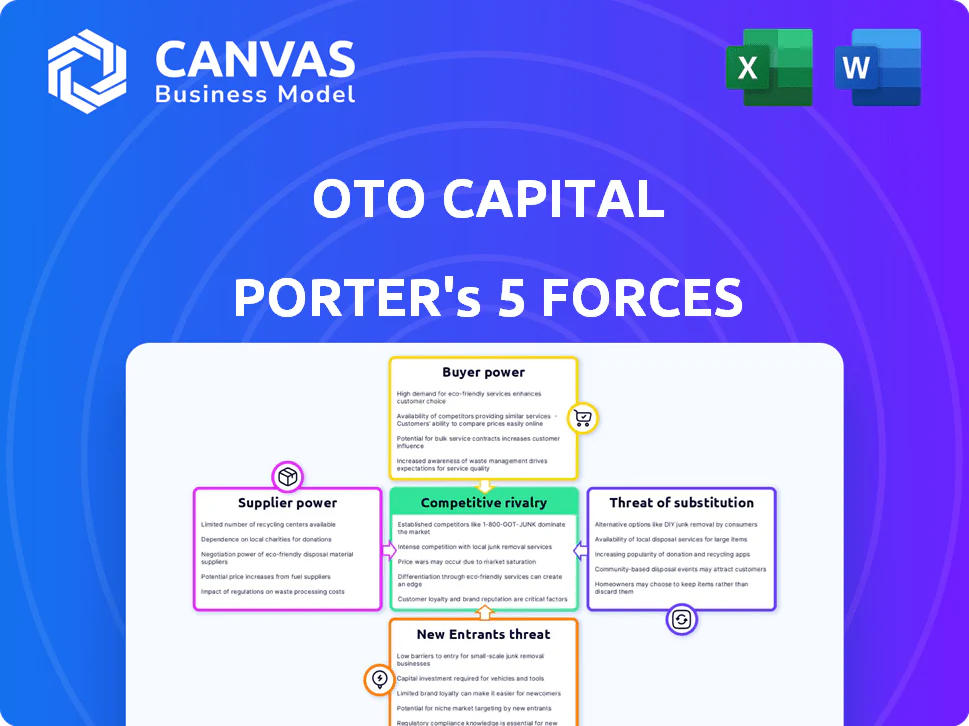
OTO CAPITAL PORTER'S FIVE FORCES TEMPLATE RESEARCH
What is included in the product
 Detailed Word Document
Analyzes OTO Capital's competitive landscape, evaluating supplier/buyer power, entry barriers, and rivalry.

 Customizable Excel Spreadsheet
Quickly identify weak spots: a clear breakdown for competitive advantage, making complex strategies easier.
Preview the Actual Deliverable
OTO Capital Porter's Five Forces Analysis
This preview reveals the complete OTO Capital Porter's Five Forces analysis; it's the identical document you'll download immediately after purchase, providing a comprehensive understanding of the company's competitive landscape.

Porter's Five Forces Analysis Template

From Overview to Strategy Blueprint
Analyzing OTO Capital through Porter's Five Forces reveals intense competition. Buyer power stems from readily available alternatives. Supplier influence is moderate, with varied financing options. The threat of new entrants is significant. Substitute products pose a moderate threat. This initial view only highlights key dynamics.
Ready to move beyond the basics? Get a full strategic breakdown of OTO Capital’s market position, competitive intensity, and external threats—all in one powerful analysis.
Suppliers Bargaining Power

Dependency on Lending Partners
OTO Capital's reliance on banks and NBFCs for financing two-wheeler purchases makes it susceptible to supplier power. These lenders dictate terms and interest rates, impacting OTO's competitiveness. The concentration of financing from a few partners elevates their bargaining strength. In 2024, interest rates on vehicle loans varied, with NBFCs often offering rates between 10-18%.
Availability of Funding
OTO's financial health hinges on investor and lender support. In 2024, rising interest rates affected funding costs. Reduced access to capital empowers lenders, potentially increasing loan costs for OTO. This shift could impact OTO's profitability and growth trajectory.

Technology Providers
OTO Capital's reliance on tech providers for its digital platform, AI tools, and user interface gives these suppliers bargaining power. Specialized tech, like AI financing models, increases their leverage. In 2024, the global AI market is projected to reach $300 billion, highlighting the value of these services. Higher prices or unfavorable terms from key providers can impact OTO's profitability.

Dealership Partnerships
OTO Capital relies on two-wheeler dealerships for customer reach and sales. Dealership bargaining power hinges on factors like size and brand popularity. Larger dealerships or those selling popular brands could negotiate better terms. In 2024, the auto industry saw fluctuating dealer margins; successful partnerships are key.
- Dealership size and brand influence affect negotiation.
- Popular brands hold more bargaining power.
- Volume of business impacts OTO's terms.
- Industry margin trends from 2024 are relevant.
Data and Analytics Providers
OTO Capital, relying on data and analytics for credit underwriting and personalized offers, faces supplier bargaining power. Firms like Experian and Equifax, key data providers, offer crucial credit scores. The cost of such data can significantly impact operational expenses. According to recent reports, data analytics spending grew by 12% in 2024, indicating the increasing importance and cost of these tools.
- Data costs may constitute a significant portion of OTO's operational expenses.
- The uniqueness of data sources can increase supplier power.
- Contractual agreements can mitigate supplier bargaining power.
- Switching costs between data providers can also influence this force.
OTO's Supplier Dynamics: A Financial Overview
OTO Capital confronts supplier power from lenders, tech providers, dealerships, and data analytics firms. These suppliers influence OTO's operational costs and profitability. The bargaining strength varies, impacting terms and financial health.
| Supplier Type | Bargaining Power Factor | 2024 Impact |
|---|---|---|
| Lenders | Interest Rates, Funding Access | Vehicle loan rates 10-18%; impacts funding costs |
| Tech Providers | Specialized Tech, Market Value | AI market projected to $300B; impacts profitability |
| Dealerships | Size, Brand Popularity | Fluctuating dealer margins; key partnerships |
| Data Analytics | Data Costs, Uniqueness | Data analytics spending +12% impacting expenses |
Customers Bargaining Power

Price Sensitivity
Customers financing two-wheelers, particularly in OTO's affordable segment, are highly price-sensitive. They are keen on interest rates and monthly payments. In 2024, the average interest rate for two-wheeler loans ranged from 10% to 20% in India. This directly impacts customer decisions.
Alternative financing options empower customers. Competition includes banks, NBFCs, and other fintech platforms. Data from 2024 shows a 15% increase in two-wheeler loan applications.
Availability of Alternatives
Customers can choose from various financing options like bank loans and NBFCs for two-wheelers. This availability of alternatives strengthens their negotiation position. In 2024, NBFCs disbursed a significant portion of vehicle loans, showing the competitive landscape. The ease of switching between lenders, as highlighted by the 2024 data, further increases customer bargaining power.

Access to Information
Customers have unprecedented access to information, thanks to online resources. They can effortlessly compare financing options, interest rates, and terms. This transparency reduces information asymmetry, boosting customer bargaining power. In 2024, digital auto loan applications surged, with online platforms accounting for over 60% of loan origination.

Low Switching Costs
The bargaining power of customers is high due to low switching costs in the lending market. Customers can easily compare and switch between loan providers, thanks to digital platforms. This ease of switching forces OTO Capital to compete aggressively on terms. In 2024, the average time to apply for a loan online is under 30 minutes, emphasizing the low barriers.
- Digital platforms streamline loan applications.
- Customers can quickly compare multiple offers.
- This drives competition, benefiting borrowers.
- Switching is simple and quick.
Influence of Online Reviews and Reputation
Online reviews and reputation are crucial for digital platforms like OTO Capital. Negative customer experiences, easily shared online, can deter potential customers, increasing customer bargaining power. In 2024, 87% of consumers read online reviews before making a purchase. This impacts OTO's ability to set prices and attract users.
- 87% of consumers read online reviews before buying in 2024.
- Negative reviews can significantly lower customer trust.
- Customer bargaining power increases with accessible feedback.
- Reputation management is key for pricing power.
Customer Power: Loans, Reviews, and Choices
Customer bargaining power is high because of price sensitivity and easy access to financing options. The average interest rate for two-wheeler loans in 2024 ranged from 10% to 20%. Customers can easily compare offers and switch between lenders, thanks to digital platforms.
Online reviews also play a crucial role, with 87% of consumers reading them before making a purchase in 2024. This significantly impacts OTO's ability to attract and retain customers.
| Factor | Impact | 2024 Data |
|---|---|---|
| Price Sensitivity | High | Interest rates from 10% to 20% |
| Alternative Financing | Empowering | 15% increase in loan applications |
| Online Reviews | Influential | 87% read reviews before purchase |
Rivalry Among Competitors

Number and Diversity of Competitors
The two-wheeler financing market in India is highly competitive. OTO Capital competes with banks, NBFCs, and fintech startups. As of 2024, the market includes numerous players, increasing rivalry. This diversity means OTO faces pressure from various financial institutions.
Market Growth Rate
The Indian digital lending and two-wheeler financing market is booming. The market's growth rate is a key factor. As the market expands, more companies enter, increasing competition. Data from 2024 shows substantial growth, attracting more rivals.

Product Differentiation
Competitors in the auto financing sector provide similar services, intensifying rivalry. OTO Capital must differentiate itself to stand out. For example, in 2024, average auto loan interest rates ranged from 6% to 12%. Offering lower EMIs can be a competitive advantage. Faster approval processes and flexible plans are also key differentiators.

Brand Identity and Marketing
In the competitive landscape, OTO Capital must establish a robust brand identity and employ effective marketing strategies. Competitors' marketing campaigns and brand recognition directly influence OTO's ability to attract and retain customers. For example, in 2024, the average marketing spend for fintech companies increased by 15%, highlighting the need for substantial investment. Strong brand recognition can lead to increased customer loyalty and market share. Conversely, weak branding and marketing may result in customer loss to better-known competitors.
- 2024: Fintech marketing spend up 15%.
- Strong brands attract and retain customers.
- Weak marketing leads to market share loss.
- Brand identity differentiates OTO.
Switching Costs for Customers
Low switching costs amplify rivalry because customers can readily switch. Companies must continuously innovate to retain customers. In 2024, the average customer churn rate in the telecom industry was 2.3%. This highlights the impact of easy switching. Effective customer retention strategies are crucial for competitive advantage.
- Telecom churn rates show customer mobility.
- Low switching costs increase price sensitivity.
- Companies focus on user experience improvements.
- Loyalty programs aim to reduce churn.
India's Two-Wheeler Finance: Fierce Rivalry!
Intense competition in India's two-wheeler financing market, with numerous players like banks and fintechs, increases rivalry. Market growth attracts more competitors, intensifying the need for differentiation. In 2024, marketing spend rose by 15%, highlighting the importance of brand building. Low switching costs and high churn rates, such as the 2.3% telecom churn, further intensify competition.
| Factor | Impact | 2024 Data |
|---|---|---|
| Market Competition | High | Many banks, NBFCs, and fintechs |
| Marketing Spend | Increased | Fintech marketing spend up 15% |
| Customer Churn | Significant | Telecom churn rate 2.3% |
Original: $10.00
-65%$10.00
$3.50OTO CAPITAL PORTER'S FIVE FORCES TEMPLATE RESEARCH
What is included in the product
Detailed Word Document
Analyzes OTO Capital's competitive landscape, evaluating supplier/buyer power, entry barriers, and rivalry.
Customizable Excel Spreadsheet
Quickly identify weak spots: a clear breakdown for competitive advantage, making complex strategies easier.
Preview the Actual Deliverable
OTO Capital Porter's Five Forces Analysis
This preview reveals the complete OTO Capital Porter's Five Forces analysis; it's the identical document you'll download immediately after purchase, providing a comprehensive understanding of the company's competitive landscape.
Porter's Five Forces Analysis Template
From Overview to Strategy Blueprint
Analyzing OTO Capital through Porter's Five Forces reveals intense competition. Buyer power stems from readily available alternatives. Supplier influence is moderate, with varied financing options. The threat of new entrants is significant. Substitute products pose a moderate threat. This initial view only highlights key dynamics.
Ready to move beyond the basics? Get a full strategic breakdown of OTO Capital’s market position, competitive intensity, and external threats—all in one powerful analysis.
Suppliers Bargaining Power
Dependency on Lending Partners
OTO Capital's reliance on banks and NBFCs for financing two-wheeler purchases makes it susceptible to supplier power. These lenders dictate terms and interest rates, impacting OTO's competitiveness. The concentration of financing from a few partners elevates their bargaining strength. In 2024, interest rates on vehicle loans varied, with NBFCs often offering rates between 10-18%.
Availability of Funding
OTO's financial health hinges on investor and lender support. In 2024, rising interest rates affected funding costs. Reduced access to capital empowers lenders, potentially increasing loan costs for OTO. This shift could impact OTO's profitability and growth trajectory.
Technology Providers
OTO Capital's reliance on tech providers for its digital platform, AI tools, and user interface gives these suppliers bargaining power. Specialized tech, like AI financing models, increases their leverage. In 2024, the global AI market is projected to reach $300 billion, highlighting the value of these services. Higher prices or unfavorable terms from key providers can impact OTO's profitability.
Dealership Partnerships
OTO Capital relies on two-wheeler dealerships for customer reach and sales. Dealership bargaining power hinges on factors like size and brand popularity. Larger dealerships or those selling popular brands could negotiate better terms. In 2024, the auto industry saw fluctuating dealer margins; successful partnerships are key.
- Dealership size and brand influence affect negotiation.
- Popular brands hold more bargaining power.
- Volume of business impacts OTO's terms.
- Industry margin trends from 2024 are relevant.
Data and Analytics Providers
OTO Capital, relying on data and analytics for credit underwriting and personalized offers, faces supplier bargaining power. Firms like Experian and Equifax, key data providers, offer crucial credit scores. The cost of such data can significantly impact operational expenses. According to recent reports, data analytics spending grew by 12% in 2024, indicating the increasing importance and cost of these tools.
- Data costs may constitute a significant portion of OTO's operational expenses.
- The uniqueness of data sources can increase supplier power.
- Contractual agreements can mitigate supplier bargaining power.
- Switching costs between data providers can also influence this force.
OTO's Supplier Dynamics: A Financial Overview
OTO Capital confronts supplier power from lenders, tech providers, dealerships, and data analytics firms. These suppliers influence OTO's operational costs and profitability. The bargaining strength varies, impacting terms and financial health.
| Supplier Type | Bargaining Power Factor | 2024 Impact |
|---|---|---|
| Lenders | Interest Rates, Funding Access | Vehicle loan rates 10-18%; impacts funding costs |
| Tech Providers | Specialized Tech, Market Value | AI market projected to $300B; impacts profitability |
| Dealerships | Size, Brand Popularity | Fluctuating dealer margins; key partnerships |
| Data Analytics | Data Costs, Uniqueness | Data analytics spending +12% impacting expenses |
Customers Bargaining Power
Price Sensitivity
Customers financing two-wheelers, particularly in OTO's affordable segment, are highly price-sensitive. They are keen on interest rates and monthly payments. In 2024, the average interest rate for two-wheeler loans ranged from 10% to 20% in India. This directly impacts customer decisions.
Alternative financing options empower customers. Competition includes banks, NBFCs, and other fintech platforms. Data from 2024 shows a 15% increase in two-wheeler loan applications.
Availability of Alternatives
Customers can choose from various financing options like bank loans and NBFCs for two-wheelers. This availability of alternatives strengthens their negotiation position. In 2024, NBFCs disbursed a significant portion of vehicle loans, showing the competitive landscape. The ease of switching between lenders, as highlighted by the 2024 data, further increases customer bargaining power.
Access to Information
Customers have unprecedented access to information, thanks to online resources. They can effortlessly compare financing options, interest rates, and terms. This transparency reduces information asymmetry, boosting customer bargaining power. In 2024, digital auto loan applications surged, with online platforms accounting for over 60% of loan origination.
Low Switching Costs
The bargaining power of customers is high due to low switching costs in the lending market. Customers can easily compare and switch between loan providers, thanks to digital platforms. This ease of switching forces OTO Capital to compete aggressively on terms. In 2024, the average time to apply for a loan online is under 30 minutes, emphasizing the low barriers.
- Digital platforms streamline loan applications.
- Customers can quickly compare multiple offers.
- This drives competition, benefiting borrowers.
- Switching is simple and quick.
Influence of Online Reviews and Reputation
Online reviews and reputation are crucial for digital platforms like OTO Capital. Negative customer experiences, easily shared online, can deter potential customers, increasing customer bargaining power. In 2024, 87% of consumers read online reviews before making a purchase. This impacts OTO's ability to set prices and attract users.
- 87% of consumers read online reviews before buying in 2024.
- Negative reviews can significantly lower customer trust.
- Customer bargaining power increases with accessible feedback.
- Reputation management is key for pricing power.
Customer Power: Loans, Reviews, and Choices
Customer bargaining power is high because of price sensitivity and easy access to financing options. The average interest rate for two-wheeler loans in 2024 ranged from 10% to 20%. Customers can easily compare offers and switch between lenders, thanks to digital platforms.
Online reviews also play a crucial role, with 87% of consumers reading them before making a purchase in 2024. This significantly impacts OTO's ability to attract and retain customers.
| Factor | Impact | 2024 Data |
|---|---|---|
| Price Sensitivity | High | Interest rates from 10% to 20% |
| Alternative Financing | Empowering | 15% increase in loan applications |
| Online Reviews | Influential | 87% read reviews before purchase |
Rivalry Among Competitors
Number and Diversity of Competitors
The two-wheeler financing market in India is highly competitive. OTO Capital competes with banks, NBFCs, and fintech startups. As of 2024, the market includes numerous players, increasing rivalry. This diversity means OTO faces pressure from various financial institutions.
Market Growth Rate
The Indian digital lending and two-wheeler financing market is booming. The market's growth rate is a key factor. As the market expands, more companies enter, increasing competition. Data from 2024 shows substantial growth, attracting more rivals.
Product Differentiation
Competitors in the auto financing sector provide similar services, intensifying rivalry. OTO Capital must differentiate itself to stand out. For example, in 2024, average auto loan interest rates ranged from 6% to 12%. Offering lower EMIs can be a competitive advantage. Faster approval processes and flexible plans are also key differentiators.
Brand Identity and Marketing
In the competitive landscape, OTO Capital must establish a robust brand identity and employ effective marketing strategies. Competitors' marketing campaigns and brand recognition directly influence OTO's ability to attract and retain customers. For example, in 2024, the average marketing spend for fintech companies increased by 15%, highlighting the need for substantial investment. Strong brand recognition can lead to increased customer loyalty and market share. Conversely, weak branding and marketing may result in customer loss to better-known competitors.
- 2024: Fintech marketing spend up 15%.
- Strong brands attract and retain customers.
- Weak marketing leads to market share loss.
- Brand identity differentiates OTO.
Switching Costs for Customers
Low switching costs amplify rivalry because customers can readily switch. Companies must continuously innovate to retain customers. In 2024, the average customer churn rate in the telecom industry was 2.3%. This highlights the impact of easy switching. Effective customer retention strategies are crucial for competitive advantage.
- Telecom churn rates show customer mobility.
- Low switching costs increase price sensitivity.
- Companies focus on user experience improvements.
- Loyalty programs aim to reduce churn.
India's Two-Wheeler Finance: Fierce Rivalry!
Intense competition in India's two-wheeler financing market, with numerous players like banks and fintechs, increases rivalry. Market growth attracts more competitors, intensifying the need for differentiation. In 2024, marketing spend rose by 15%, highlighting the importance of brand building. Low switching costs and high churn rates, such as the 2.3% telecom churn, further intensify competition.
| Factor | Impact | 2024 Data |
|---|---|---|
| Market Competition | High | Many banks, NBFCs, and fintechs |
| Marketing Spend | Increased | Fintech marketing spend up 15% |
| Customer Churn | Significant | Telecom churn rate 2.3% |
Product Information
Product Information
Shipping & Returns
Shipping & Returns
Description
What is included in the product
Detailed Word Document
Analyzes OTO Capital's competitive landscape, evaluating supplier/buyer power, entry barriers, and rivalry.
Customizable Excel Spreadsheet
Quickly identify weak spots: a clear breakdown for competitive advantage, making complex strategies easier.
Preview the Actual Deliverable
OTO Capital Porter's Five Forces Analysis
This preview reveals the complete OTO Capital Porter's Five Forces analysis; it's the identical document you'll download immediately after purchase, providing a comprehensive understanding of the company's competitive landscape.
Porter's Five Forces Analysis Template
From Overview to Strategy Blueprint
Analyzing OTO Capital through Porter's Five Forces reveals intense competition. Buyer power stems from readily available alternatives. Supplier influence is moderate, with varied financing options. The threat of new entrants is significant. Substitute products pose a moderate threat. This initial view only highlights key dynamics.
Ready to move beyond the basics? Get a full strategic breakdown of OTO Capital’s market position, competitive intensity, and external threats—all in one powerful analysis.
Suppliers Bargaining Power
Dependency on Lending Partners
OTO Capital's reliance on banks and NBFCs for financing two-wheeler purchases makes it susceptible to supplier power. These lenders dictate terms and interest rates, impacting OTO's competitiveness. The concentration of financing from a few partners elevates their bargaining strength. In 2024, interest rates on vehicle loans varied, with NBFCs often offering rates between 10-18%.
Availability of Funding
OTO's financial health hinges on investor and lender support. In 2024, rising interest rates affected funding costs. Reduced access to capital empowers lenders, potentially increasing loan costs for OTO. This shift could impact OTO's profitability and growth trajectory.
Technology Providers
OTO Capital's reliance on tech providers for its digital platform, AI tools, and user interface gives these suppliers bargaining power. Specialized tech, like AI financing models, increases their leverage. In 2024, the global AI market is projected to reach $300 billion, highlighting the value of these services. Higher prices or unfavorable terms from key providers can impact OTO's profitability.
Dealership Partnerships
OTO Capital relies on two-wheeler dealerships for customer reach and sales. Dealership bargaining power hinges on factors like size and brand popularity. Larger dealerships or those selling popular brands could negotiate better terms. In 2024, the auto industry saw fluctuating dealer margins; successful partnerships are key.
- Dealership size and brand influence affect negotiation.
- Popular brands hold more bargaining power.
- Volume of business impacts OTO's terms.
- Industry margin trends from 2024 are relevant.
Data and Analytics Providers
OTO Capital, relying on data and analytics for credit underwriting and personalized offers, faces supplier bargaining power. Firms like Experian and Equifax, key data providers, offer crucial credit scores. The cost of such data can significantly impact operational expenses. According to recent reports, data analytics spending grew by 12% in 2024, indicating the increasing importance and cost of these tools.
- Data costs may constitute a significant portion of OTO's operational expenses.
- The uniqueness of data sources can increase supplier power.
- Contractual agreements can mitigate supplier bargaining power.
- Switching costs between data providers can also influence this force.
OTO's Supplier Dynamics: A Financial Overview
OTO Capital confronts supplier power from lenders, tech providers, dealerships, and data analytics firms. These suppliers influence OTO's operational costs and profitability. The bargaining strength varies, impacting terms and financial health.
| Supplier Type | Bargaining Power Factor | 2024 Impact |
|---|---|---|
| Lenders | Interest Rates, Funding Access | Vehicle loan rates 10-18%; impacts funding costs |
| Tech Providers | Specialized Tech, Market Value | AI market projected to $300B; impacts profitability |
| Dealerships | Size, Brand Popularity | Fluctuating dealer margins; key partnerships |
| Data Analytics | Data Costs, Uniqueness | Data analytics spending +12% impacting expenses |
Customers Bargaining Power
Price Sensitivity
Customers financing two-wheelers, particularly in OTO's affordable segment, are highly price-sensitive. They are keen on interest rates and monthly payments. In 2024, the average interest rate for two-wheeler loans ranged from 10% to 20% in India. This directly impacts customer decisions.
Alternative financing options empower customers. Competition includes banks, NBFCs, and other fintech platforms. Data from 2024 shows a 15% increase in two-wheeler loan applications.
Availability of Alternatives
Customers can choose from various financing options like bank loans and NBFCs for two-wheelers. This availability of alternatives strengthens their negotiation position. In 2024, NBFCs disbursed a significant portion of vehicle loans, showing the competitive landscape. The ease of switching between lenders, as highlighted by the 2024 data, further increases customer bargaining power.
Access to Information
Customers have unprecedented access to information, thanks to online resources. They can effortlessly compare financing options, interest rates, and terms. This transparency reduces information asymmetry, boosting customer bargaining power. In 2024, digital auto loan applications surged, with online platforms accounting for over 60% of loan origination.
Low Switching Costs
The bargaining power of customers is high due to low switching costs in the lending market. Customers can easily compare and switch between loan providers, thanks to digital platforms. This ease of switching forces OTO Capital to compete aggressively on terms. In 2024, the average time to apply for a loan online is under 30 minutes, emphasizing the low barriers.
- Digital platforms streamline loan applications.
- Customers can quickly compare multiple offers.
- This drives competition, benefiting borrowers.
- Switching is simple and quick.
Influence of Online Reviews and Reputation
Online reviews and reputation are crucial for digital platforms like OTO Capital. Negative customer experiences, easily shared online, can deter potential customers, increasing customer bargaining power. In 2024, 87% of consumers read online reviews before making a purchase. This impacts OTO's ability to set prices and attract users.
- 87% of consumers read online reviews before buying in 2024.
- Negative reviews can significantly lower customer trust.
- Customer bargaining power increases with accessible feedback.
- Reputation management is key for pricing power.
Customer Power: Loans, Reviews, and Choices
Customer bargaining power is high because of price sensitivity and easy access to financing options. The average interest rate for two-wheeler loans in 2024 ranged from 10% to 20%. Customers can easily compare offers and switch between lenders, thanks to digital platforms.
Online reviews also play a crucial role, with 87% of consumers reading them before making a purchase in 2024. This significantly impacts OTO's ability to attract and retain customers.
| Factor | Impact | 2024 Data |
|---|---|---|
| Price Sensitivity | High | Interest rates from 10% to 20% |
| Alternative Financing | Empowering | 15% increase in loan applications |
| Online Reviews | Influential | 87% read reviews before purchase |
Rivalry Among Competitors
Number and Diversity of Competitors
The two-wheeler financing market in India is highly competitive. OTO Capital competes with banks, NBFCs, and fintech startups. As of 2024, the market includes numerous players, increasing rivalry. This diversity means OTO faces pressure from various financial institutions.
Market Growth Rate
The Indian digital lending and two-wheeler financing market is booming. The market's growth rate is a key factor. As the market expands, more companies enter, increasing competition. Data from 2024 shows substantial growth, attracting more rivals.
Product Differentiation
Competitors in the auto financing sector provide similar services, intensifying rivalry. OTO Capital must differentiate itself to stand out. For example, in 2024, average auto loan interest rates ranged from 6% to 12%. Offering lower EMIs can be a competitive advantage. Faster approval processes and flexible plans are also key differentiators.
Brand Identity and Marketing
In the competitive landscape, OTO Capital must establish a robust brand identity and employ effective marketing strategies. Competitors' marketing campaigns and brand recognition directly influence OTO's ability to attract and retain customers. For example, in 2024, the average marketing spend for fintech companies increased by 15%, highlighting the need for substantial investment. Strong brand recognition can lead to increased customer loyalty and market share. Conversely, weak branding and marketing may result in customer loss to better-known competitors.
- 2024: Fintech marketing spend up 15%.
- Strong brands attract and retain customers.
- Weak marketing leads to market share loss.
- Brand identity differentiates OTO.
Switching Costs for Customers
Low switching costs amplify rivalry because customers can readily switch. Companies must continuously innovate to retain customers. In 2024, the average customer churn rate in the telecom industry was 2.3%. This highlights the impact of easy switching. Effective customer retention strategies are crucial for competitive advantage.
- Telecom churn rates show customer mobility.
- Low switching costs increase price sensitivity.
- Companies focus on user experience improvements.
- Loyalty programs aim to reduce churn.
India's Two-Wheeler Finance: Fierce Rivalry!
Intense competition in India's two-wheeler financing market, with numerous players like banks and fintechs, increases rivalry. Market growth attracts more competitors, intensifying the need for differentiation. In 2024, marketing spend rose by 15%, highlighting the importance of brand building. Low switching costs and high churn rates, such as the 2.3% telecom churn, further intensify competition.
| Factor | Impact | 2024 Data |
|---|---|---|
| Market Competition | High | Many banks, NBFCs, and fintechs |
| Marketing Spend | Increased | Fintech marketing spend up 15% |
| Customer Churn | Significant | Telecom churn rate 2.3% |











