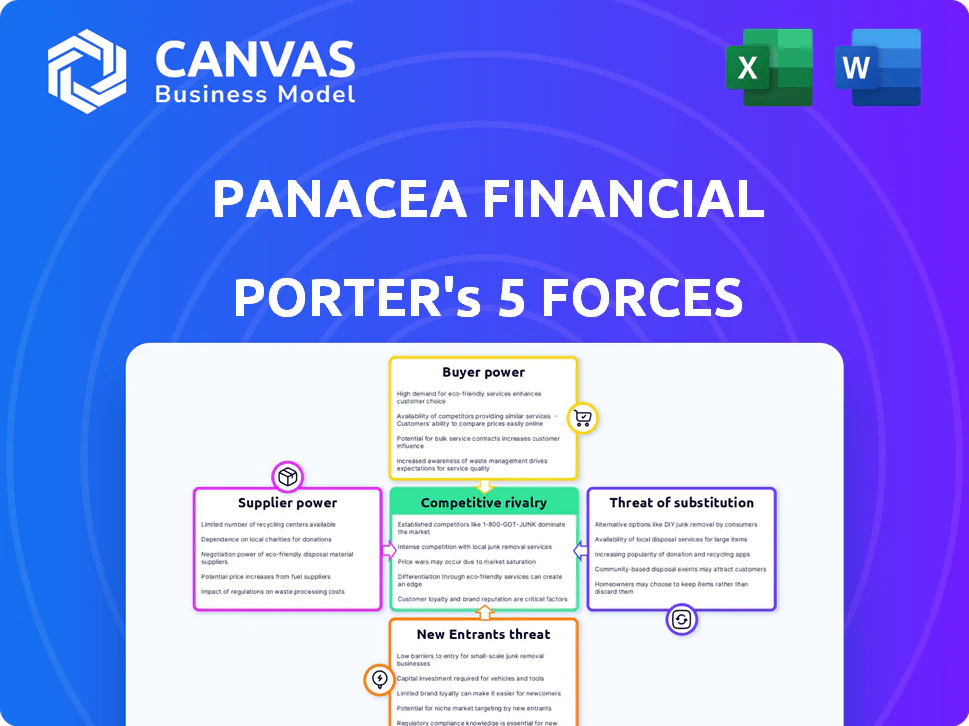
PANACEA FINANCIAL PORTER'S FIVE FORCES TEMPLATE RESEARCH
What is included in the product
 Detailed Word Document
Analyzes Panacea Financial's competitive landscape, pinpointing threats and opportunities within the market.

 Customizable Excel Spreadsheet
Customize pressure levels based on new data or evolving market trends.
Preview the Actual Deliverable
Panacea Financial Porter's Five Forces Analysis
This is the complete Porter's Five Forces analysis for Panacea Financial. The analysis you see is the same expert document you'll receive instantly after purchase—fully detailed and insightful.

Porter's Five Forces Analysis Template

A Must-Have Tool for Decision-Makers
Panacea Financial's competitive landscape is shaped by the financial industry's complexities. Understanding the bargaining power of both buyers and suppliers is crucial for strategic positioning. The threat of new entrants and substitute services adds further pressure. Recognizing the intensity of rivalry within this sector is paramount.
This brief snapshot only scratches the surface. Unlock the full Porter's Five Forces Analysis to explore Panacea Financial’s competitive dynamics, market pressures, and strategic advantages in detail.
Suppliers Bargaining Power

Reliance on Technology Providers
Panacea Financial's reliance on tech providers, like Bankjoy, gives these suppliers considerable bargaining power. Limited alternatives or high switching costs amplify this. In 2024, fintech spending reached $170 billion globally. This dependency can impact Panacea's operational costs and service offerings.
Access to Capital and Funding
Panacea Financial relies on capital and funding sources like investors and other institutions to offer financial products. The availability and terms of this funding are influenced by these suppliers. For instance, in 2024, Panacea received Series B funding, signaling a dependence on investors for growth. Access to capital is crucial for their operations. This includes deposits and external funding.

Relationship with Partner Bank
Panacea Financial's partnership with Primis Bank, where it functions as a division, means Primis Bank wields significant power. Primis Bank supplies essential banking infrastructure, regulatory knowledge, and deposit insurance, critical to Panacea's operations. The reliance on Primis Bank’s balance sheet for lending activities further strengthens Primis's bargaining position. In 2024, the FDIC insured up to $250,000 per depositor, a key element in this dynamic.

Data and Information Providers
Panacea Financial, like other lenders, depends on data providers for credit assessments and market insights. These suppliers’ bargaining power affects data availability, accuracy, and costs, influencing Panacea's operational efficiency. The market for financial data is competitive, but some providers hold significant market share. This can impact pricing and service terms.
- Experian, Equifax, and TransUnion control approximately 90% of the U.S. credit reporting market.
- The global financial data and analytics market was valued at $29.3 billion in 2023.
- Data breaches and cybersecurity incidents can compromise data accuracy.
- Data costs vary widely, with premium services costing significantly more.
Specialized Service Providers
Panacea Financial's reliance on specialized service providers, such as those handling loan servicing or compliance, introduces a unique dynamic to supplier bargaining power. The fewer the alternative providers for these crucial, industry-specific services, the stronger the suppliers' position. Consider the healthcare sector, where compliance costs have risen by 15% in 2024, increasing the value of specialized compliance providers. This trend gives these suppliers more leverage in negotiations.
- Healthcare compliance costs increased by 15% in 2024.
- The number of specialized healthcare service providers is limited.
- Unique service offerings enhance supplier bargaining power.
- Service providers' leverage depends on the availability of alternatives.
Supplier Power Dynamics: A Fintech Challenge
Panacea Financial faces supplier power from tech, capital, and service providers, impacting costs and operations. Fintech spending reached $170 billion in 2024, highlighting tech supplier influence. Limited alternatives and specialized services amplify supplier leverage. Data providers like Experian, Equifax, and TransUnion, controlling 90% of the U.S. credit reporting market, also exert significant influence.
| Supplier Type | Impact on Panacea | 2024 Data Point |
|---|---|---|
| Tech Providers | Cost, Service Offerings | Fintech spending: $170B |
| Capital Sources | Funding Terms, Availability | Series B funding received |
| Data Providers | Data Accuracy, Costs | Data & analytics market: $29.3B (2023) |
| Specialized Services | Compliance Costs, Operational Efficiency | Healthcare compliance costs up 15% |
Customers Bargaining Power

Niche Market with Specific Needs
Panacea Financial focuses on medical professionals, a niche market. These customers, including doctors and dentists, have distinct financial needs. They often carry significant student loan debt and require practice financing. Their specialized needs can empower them if Panacea's services don't fully satisfy them. In 2024, the average medical school debt was around $200,000.
Access to Alternative Financial Services
Panacea Financial's customers, primarily medical professionals, have choices beyond Panacea. Traditional banks, credit unions, and fintech firms offer financial services, increasing customer bargaining power. In 2024, approximately 85% of U.S. adults used banking services. This widespread access to alternatives limits Panacea's ability to dictate terms.

High Lifetime Value of Customers
Doctors and dentists, a key customer segment for Panacea Financial, often start with substantial debt but have high lifetime earning potential. Panacea's strategy focuses on building lasting relationships with these professionals. The high lifetime value of these customers increases their importance to Panacea. This can give them more bargaining power, influencing terms and services.

Professional Associations and Networks
Medical professionals' bargaining power is shaped by their affiliations with professional associations. These groups, like the American Dental Association (ADA), can sway members' financial decisions. Panacea Financial leverages these associations to offer tailored financial products. For example, in 2024, the ADA had over 160,000 members, showcasing significant collective influence.
- ADA membership in 2024: Over 160,000 dentists.
- Influence: Associations negotiate favorable terms.
- Panacea's Strategy: Partnerships with professional groups.
- Impact: Access to tailored financial solutions.
Digital Convenience and Expectations
Panacea Financial's digital-first model means customers expect top-notch online and mobile banking. Their ability to easily switch to competitors, combined with high service expectations, boosts their bargaining power. If Panacea's digital services falter, customers have the upper hand. Banks must invest heavily in tech to meet digital demands.
- In 2024, digital banking adoption reached 60% globally.
- Customer satisfaction with digital banking is at 80%, but drops with poor UX.
- Switching costs for digital banking are low, increasing customer power.
- Investment in digital banking tech grew by 15% in 2024.
Doctors' Financial Power: Key Facts
Medical professionals, Panacea's main customers, have considerable bargaining power due to their specific needs and access to alternatives. They can choose from various financial institutions, which increases their leverage. Associations like the ADA further enhance their influence. Digital banking's ease of switching also empowers customers.
| Aspect | Details | 2024 Data |
|---|---|---|
| Debt | Average medical school debt | ~$200,000 |
| Banking Usage | U.S. adults using banking services | ~85% |
| ADA Membership | American Dental Association members | Over 160,000 |
| Digital Banking Adoption | Global digital banking adoption | ~60% |
Rivalry Among Competitors

Presence of Niche and Traditional Competitors
Panacea Financial faces rivalry from traditional banks such as First Citizens Bank and Bank of America, offering similar financial products. Fintech companies like Laurel Road also compete by targeting healthcare professionals. The presence of these competitors intensifies rivalry within the financial services sector. In 2024, the U.S. banking industry's assets totaled over $23 trillion, highlighting the scale of competition.
Specialized Focus as a Differentiator
Panacea Financial's competitive edge stems from its niche focus on healthcare professionals. This targeted approach allows for tailored financial products. Competitors, including established banks like KeyBank, could try mirroring this strategy. For example, KeyBank had $173 billion in total assets as of Q4 2023.

Importance of Digital Experience and Technology
In digital banking, the digital platform's quality and tech stack are key. Panacea's digital transformation, with partners like Bankjoy, boosts competitiveness. Constant improvement in the digital customer experience is a key rivalry factor. Digital banking users in 2024 increased by 15% globally.

Pricing and Product Offerings
Competitive rivalry in the financial sector, including for Panacea Financial, hinges on pricing and product diversity. Banks and credit unions compete fiercely on interest rates for loans and savings, alongside fees. To stay competitive, Panacea needs to offer attractive terms and a range of products tailored to its niche market of healthcare professionals. This includes competitive loan rates and specialized financial products.
- Average interest rates on student loans in 2024 ranged from 5.5% to 7.5%.
- Many banks offer rewards checking accounts with higher interest rates, such as 0.25% to 1.0% APY.
- Panacea Financial's competitive advantage lies in understanding the unique financial needs of healthcare professionals.
Marketing and Customer Acquisition Costs
Marketing and customer acquisition costs are significant in the financial sector. Panacea Financial must strategize effectively to reach its target audience, which includes physicians and dentists. Competitive rivalry can increase these costs as firms vie for similar clients. In 2024, the average cost to acquire a new banking customer was around $300.
- Marketing expenses can be high for financial services.
- Targeted strategies are crucial for Panacea.
- Competition increases customer acquisition costs.
- The average cost per lead for financial services in 2024 was $100.
Competitive Landscape: Student Loan Rates & Rivals
Panacea Financial faces intense competition from banks and fintechs, such as First Citizens Bank and Laurel Road. Rivalry is driven by pricing, product diversity, and marketing costs. In 2024, average student loan rates ranged from 5.5% to 7.5%.
| Aspect | Details |
|---|---|
| Main Competitors | Traditional banks, Fintech companies |
| Key Factors | Pricing, product range, marketing costs |
| 2024 Data | Student loan rates 5.5%-7.5% |
Original: $10.00
-65%$10.00
$3.50PANACEA FINANCIAL PORTER'S FIVE FORCES TEMPLATE RESEARCH
What is included in the product
Detailed Word Document
Analyzes Panacea Financial's competitive landscape, pinpointing threats and opportunities within the market.
Customizable Excel Spreadsheet
Customize pressure levels based on new data or evolving market trends.
Preview the Actual Deliverable
Panacea Financial Porter's Five Forces Analysis
This is the complete Porter's Five Forces analysis for Panacea Financial. The analysis you see is the same expert document you'll receive instantly after purchase—fully detailed and insightful.
Porter's Five Forces Analysis Template
A Must-Have Tool for Decision-Makers
Panacea Financial's competitive landscape is shaped by the financial industry's complexities. Understanding the bargaining power of both buyers and suppliers is crucial for strategic positioning. The threat of new entrants and substitute services adds further pressure. Recognizing the intensity of rivalry within this sector is paramount.
This brief snapshot only scratches the surface. Unlock the full Porter's Five Forces Analysis to explore Panacea Financial’s competitive dynamics, market pressures, and strategic advantages in detail.
Suppliers Bargaining Power
Reliance on Technology Providers
Panacea Financial's reliance on tech providers, like Bankjoy, gives these suppliers considerable bargaining power. Limited alternatives or high switching costs amplify this. In 2024, fintech spending reached $170 billion globally. This dependency can impact Panacea's operational costs and service offerings.
Access to Capital and Funding
Panacea Financial relies on capital and funding sources like investors and other institutions to offer financial products. The availability and terms of this funding are influenced by these suppliers. For instance, in 2024, Panacea received Series B funding, signaling a dependence on investors for growth. Access to capital is crucial for their operations. This includes deposits and external funding.
Relationship with Partner Bank
Panacea Financial's partnership with Primis Bank, where it functions as a division, means Primis Bank wields significant power. Primis Bank supplies essential banking infrastructure, regulatory knowledge, and deposit insurance, critical to Panacea's operations. The reliance on Primis Bank’s balance sheet for lending activities further strengthens Primis's bargaining position. In 2024, the FDIC insured up to $250,000 per depositor, a key element in this dynamic.
Data and Information Providers
Panacea Financial, like other lenders, depends on data providers for credit assessments and market insights. These suppliers’ bargaining power affects data availability, accuracy, and costs, influencing Panacea's operational efficiency. The market for financial data is competitive, but some providers hold significant market share. This can impact pricing and service terms.
- Experian, Equifax, and TransUnion control approximately 90% of the U.S. credit reporting market.
- The global financial data and analytics market was valued at $29.3 billion in 2023.
- Data breaches and cybersecurity incidents can compromise data accuracy.
- Data costs vary widely, with premium services costing significantly more.
Specialized Service Providers
Panacea Financial's reliance on specialized service providers, such as those handling loan servicing or compliance, introduces a unique dynamic to supplier bargaining power. The fewer the alternative providers for these crucial, industry-specific services, the stronger the suppliers' position. Consider the healthcare sector, where compliance costs have risen by 15% in 2024, increasing the value of specialized compliance providers. This trend gives these suppliers more leverage in negotiations.
- Healthcare compliance costs increased by 15% in 2024.
- The number of specialized healthcare service providers is limited.
- Unique service offerings enhance supplier bargaining power.
- Service providers' leverage depends on the availability of alternatives.
Supplier Power Dynamics: A Fintech Challenge
Panacea Financial faces supplier power from tech, capital, and service providers, impacting costs and operations. Fintech spending reached $170 billion in 2024, highlighting tech supplier influence. Limited alternatives and specialized services amplify supplier leverage. Data providers like Experian, Equifax, and TransUnion, controlling 90% of the U.S. credit reporting market, also exert significant influence.
| Supplier Type | Impact on Panacea | 2024 Data Point |
|---|---|---|
| Tech Providers | Cost, Service Offerings | Fintech spending: $170B |
| Capital Sources | Funding Terms, Availability | Series B funding received |
| Data Providers | Data Accuracy, Costs | Data & analytics market: $29.3B (2023) |
| Specialized Services | Compliance Costs, Operational Efficiency | Healthcare compliance costs up 15% |
Customers Bargaining Power
Niche Market with Specific Needs
Panacea Financial focuses on medical professionals, a niche market. These customers, including doctors and dentists, have distinct financial needs. They often carry significant student loan debt and require practice financing. Their specialized needs can empower them if Panacea's services don't fully satisfy them. In 2024, the average medical school debt was around $200,000.
Access to Alternative Financial Services
Panacea Financial's customers, primarily medical professionals, have choices beyond Panacea. Traditional banks, credit unions, and fintech firms offer financial services, increasing customer bargaining power. In 2024, approximately 85% of U.S. adults used banking services. This widespread access to alternatives limits Panacea's ability to dictate terms.
High Lifetime Value of Customers
Doctors and dentists, a key customer segment for Panacea Financial, often start with substantial debt but have high lifetime earning potential. Panacea's strategy focuses on building lasting relationships with these professionals. The high lifetime value of these customers increases their importance to Panacea. This can give them more bargaining power, influencing terms and services.
Professional Associations and Networks
Medical professionals' bargaining power is shaped by their affiliations with professional associations. These groups, like the American Dental Association (ADA), can sway members' financial decisions. Panacea Financial leverages these associations to offer tailored financial products. For example, in 2024, the ADA had over 160,000 members, showcasing significant collective influence.
- ADA membership in 2024: Over 160,000 dentists.
- Influence: Associations negotiate favorable terms.
- Panacea's Strategy: Partnerships with professional groups.
- Impact: Access to tailored financial solutions.
Digital Convenience and Expectations
Panacea Financial's digital-first model means customers expect top-notch online and mobile banking. Their ability to easily switch to competitors, combined with high service expectations, boosts their bargaining power. If Panacea's digital services falter, customers have the upper hand. Banks must invest heavily in tech to meet digital demands.
- In 2024, digital banking adoption reached 60% globally.
- Customer satisfaction with digital banking is at 80%, but drops with poor UX.
- Switching costs for digital banking are low, increasing customer power.
- Investment in digital banking tech grew by 15% in 2024.
Doctors' Financial Power: Key Facts
Medical professionals, Panacea's main customers, have considerable bargaining power due to their specific needs and access to alternatives. They can choose from various financial institutions, which increases their leverage. Associations like the ADA further enhance their influence. Digital banking's ease of switching also empowers customers.
| Aspect | Details | 2024 Data |
|---|---|---|
| Debt | Average medical school debt | ~$200,000 |
| Banking Usage | U.S. adults using banking services | ~85% |
| ADA Membership | American Dental Association members | Over 160,000 |
| Digital Banking Adoption | Global digital banking adoption | ~60% |
Rivalry Among Competitors
Presence of Niche and Traditional Competitors
Panacea Financial faces rivalry from traditional banks such as First Citizens Bank and Bank of America, offering similar financial products. Fintech companies like Laurel Road also compete by targeting healthcare professionals. The presence of these competitors intensifies rivalry within the financial services sector. In 2024, the U.S. banking industry's assets totaled over $23 trillion, highlighting the scale of competition.
Specialized Focus as a Differentiator
Panacea Financial's competitive edge stems from its niche focus on healthcare professionals. This targeted approach allows for tailored financial products. Competitors, including established banks like KeyBank, could try mirroring this strategy. For example, KeyBank had $173 billion in total assets as of Q4 2023.
Importance of Digital Experience and Technology
In digital banking, the digital platform's quality and tech stack are key. Panacea's digital transformation, with partners like Bankjoy, boosts competitiveness. Constant improvement in the digital customer experience is a key rivalry factor. Digital banking users in 2024 increased by 15% globally.
Pricing and Product Offerings
Competitive rivalry in the financial sector, including for Panacea Financial, hinges on pricing and product diversity. Banks and credit unions compete fiercely on interest rates for loans and savings, alongside fees. To stay competitive, Panacea needs to offer attractive terms and a range of products tailored to its niche market of healthcare professionals. This includes competitive loan rates and specialized financial products.
- Average interest rates on student loans in 2024 ranged from 5.5% to 7.5%.
- Many banks offer rewards checking accounts with higher interest rates, such as 0.25% to 1.0% APY.
- Panacea Financial's competitive advantage lies in understanding the unique financial needs of healthcare professionals.
Marketing and Customer Acquisition Costs
Marketing and customer acquisition costs are significant in the financial sector. Panacea Financial must strategize effectively to reach its target audience, which includes physicians and dentists. Competitive rivalry can increase these costs as firms vie for similar clients. In 2024, the average cost to acquire a new banking customer was around $300.
- Marketing expenses can be high for financial services.
- Targeted strategies are crucial for Panacea.
- Competition increases customer acquisition costs.
- The average cost per lead for financial services in 2024 was $100.
Competitive Landscape: Student Loan Rates & Rivals
Panacea Financial faces intense competition from banks and fintechs, such as First Citizens Bank and Laurel Road. Rivalry is driven by pricing, product diversity, and marketing costs. In 2024, average student loan rates ranged from 5.5% to 7.5%.
| Aspect | Details |
|---|---|
| Main Competitors | Traditional banks, Fintech companies |
| Key Factors | Pricing, product range, marketing costs |
| 2024 Data | Student loan rates 5.5%-7.5% |
Product Information
Product Information
Shipping & Returns
Shipping & Returns
Description
What is included in the product
Detailed Word Document
Analyzes Panacea Financial's competitive landscape, pinpointing threats and opportunities within the market.
Customizable Excel Spreadsheet
Customize pressure levels based on new data or evolving market trends.
Preview the Actual Deliverable
Panacea Financial Porter's Five Forces Analysis
This is the complete Porter's Five Forces analysis for Panacea Financial. The analysis you see is the same expert document you'll receive instantly after purchase—fully detailed and insightful.
Porter's Five Forces Analysis Template
A Must-Have Tool for Decision-Makers
Panacea Financial's competitive landscape is shaped by the financial industry's complexities. Understanding the bargaining power of both buyers and suppliers is crucial for strategic positioning. The threat of new entrants and substitute services adds further pressure. Recognizing the intensity of rivalry within this sector is paramount.
This brief snapshot only scratches the surface. Unlock the full Porter's Five Forces Analysis to explore Panacea Financial’s competitive dynamics, market pressures, and strategic advantages in detail.
Suppliers Bargaining Power
Reliance on Technology Providers
Panacea Financial's reliance on tech providers, like Bankjoy, gives these suppliers considerable bargaining power. Limited alternatives or high switching costs amplify this. In 2024, fintech spending reached $170 billion globally. This dependency can impact Panacea's operational costs and service offerings.
Access to Capital and Funding
Panacea Financial relies on capital and funding sources like investors and other institutions to offer financial products. The availability and terms of this funding are influenced by these suppliers. For instance, in 2024, Panacea received Series B funding, signaling a dependence on investors for growth. Access to capital is crucial for their operations. This includes deposits and external funding.
Relationship with Partner Bank
Panacea Financial's partnership with Primis Bank, where it functions as a division, means Primis Bank wields significant power. Primis Bank supplies essential banking infrastructure, regulatory knowledge, and deposit insurance, critical to Panacea's operations. The reliance on Primis Bank’s balance sheet for lending activities further strengthens Primis's bargaining position. In 2024, the FDIC insured up to $250,000 per depositor, a key element in this dynamic.
Data and Information Providers
Panacea Financial, like other lenders, depends on data providers for credit assessments and market insights. These suppliers’ bargaining power affects data availability, accuracy, and costs, influencing Panacea's operational efficiency. The market for financial data is competitive, but some providers hold significant market share. This can impact pricing and service terms.
- Experian, Equifax, and TransUnion control approximately 90% of the U.S. credit reporting market.
- The global financial data and analytics market was valued at $29.3 billion in 2023.
- Data breaches and cybersecurity incidents can compromise data accuracy.
- Data costs vary widely, with premium services costing significantly more.
Specialized Service Providers
Panacea Financial's reliance on specialized service providers, such as those handling loan servicing or compliance, introduces a unique dynamic to supplier bargaining power. The fewer the alternative providers for these crucial, industry-specific services, the stronger the suppliers' position. Consider the healthcare sector, where compliance costs have risen by 15% in 2024, increasing the value of specialized compliance providers. This trend gives these suppliers more leverage in negotiations.
- Healthcare compliance costs increased by 15% in 2024.
- The number of specialized healthcare service providers is limited.
- Unique service offerings enhance supplier bargaining power.
- Service providers' leverage depends on the availability of alternatives.
Supplier Power Dynamics: A Fintech Challenge
Panacea Financial faces supplier power from tech, capital, and service providers, impacting costs and operations. Fintech spending reached $170 billion in 2024, highlighting tech supplier influence. Limited alternatives and specialized services amplify supplier leverage. Data providers like Experian, Equifax, and TransUnion, controlling 90% of the U.S. credit reporting market, also exert significant influence.
| Supplier Type | Impact on Panacea | 2024 Data Point |
|---|---|---|
| Tech Providers | Cost, Service Offerings | Fintech spending: $170B |
| Capital Sources | Funding Terms, Availability | Series B funding received |
| Data Providers | Data Accuracy, Costs | Data & analytics market: $29.3B (2023) |
| Specialized Services | Compliance Costs, Operational Efficiency | Healthcare compliance costs up 15% |
Customers Bargaining Power
Niche Market with Specific Needs
Panacea Financial focuses on medical professionals, a niche market. These customers, including doctors and dentists, have distinct financial needs. They often carry significant student loan debt and require practice financing. Their specialized needs can empower them if Panacea's services don't fully satisfy them. In 2024, the average medical school debt was around $200,000.
Access to Alternative Financial Services
Panacea Financial's customers, primarily medical professionals, have choices beyond Panacea. Traditional banks, credit unions, and fintech firms offer financial services, increasing customer bargaining power. In 2024, approximately 85% of U.S. adults used banking services. This widespread access to alternatives limits Panacea's ability to dictate terms.
High Lifetime Value of Customers
Doctors and dentists, a key customer segment for Panacea Financial, often start with substantial debt but have high lifetime earning potential. Panacea's strategy focuses on building lasting relationships with these professionals. The high lifetime value of these customers increases their importance to Panacea. This can give them more bargaining power, influencing terms and services.
Professional Associations and Networks
Medical professionals' bargaining power is shaped by their affiliations with professional associations. These groups, like the American Dental Association (ADA), can sway members' financial decisions. Panacea Financial leverages these associations to offer tailored financial products. For example, in 2024, the ADA had over 160,000 members, showcasing significant collective influence.
- ADA membership in 2024: Over 160,000 dentists.
- Influence: Associations negotiate favorable terms.
- Panacea's Strategy: Partnerships with professional groups.
- Impact: Access to tailored financial solutions.
Digital Convenience and Expectations
Panacea Financial's digital-first model means customers expect top-notch online and mobile banking. Their ability to easily switch to competitors, combined with high service expectations, boosts their bargaining power. If Panacea's digital services falter, customers have the upper hand. Banks must invest heavily in tech to meet digital demands.
- In 2024, digital banking adoption reached 60% globally.
- Customer satisfaction with digital banking is at 80%, but drops with poor UX.
- Switching costs for digital banking are low, increasing customer power.
- Investment in digital banking tech grew by 15% in 2024.
Doctors' Financial Power: Key Facts
Medical professionals, Panacea's main customers, have considerable bargaining power due to their specific needs and access to alternatives. They can choose from various financial institutions, which increases their leverage. Associations like the ADA further enhance their influence. Digital banking's ease of switching also empowers customers.
| Aspect | Details | 2024 Data |
|---|---|---|
| Debt | Average medical school debt | ~$200,000 |
| Banking Usage | U.S. adults using banking services | ~85% |
| ADA Membership | American Dental Association members | Over 160,000 |
| Digital Banking Adoption | Global digital banking adoption | ~60% |
Rivalry Among Competitors
Presence of Niche and Traditional Competitors
Panacea Financial faces rivalry from traditional banks such as First Citizens Bank and Bank of America, offering similar financial products. Fintech companies like Laurel Road also compete by targeting healthcare professionals. The presence of these competitors intensifies rivalry within the financial services sector. In 2024, the U.S. banking industry's assets totaled over $23 trillion, highlighting the scale of competition.
Specialized Focus as a Differentiator
Panacea Financial's competitive edge stems from its niche focus on healthcare professionals. This targeted approach allows for tailored financial products. Competitors, including established banks like KeyBank, could try mirroring this strategy. For example, KeyBank had $173 billion in total assets as of Q4 2023.
Importance of Digital Experience and Technology
In digital banking, the digital platform's quality and tech stack are key. Panacea's digital transformation, with partners like Bankjoy, boosts competitiveness. Constant improvement in the digital customer experience is a key rivalry factor. Digital banking users in 2024 increased by 15% globally.
Pricing and Product Offerings
Competitive rivalry in the financial sector, including for Panacea Financial, hinges on pricing and product diversity. Banks and credit unions compete fiercely on interest rates for loans and savings, alongside fees. To stay competitive, Panacea needs to offer attractive terms and a range of products tailored to its niche market of healthcare professionals. This includes competitive loan rates and specialized financial products.
- Average interest rates on student loans in 2024 ranged from 5.5% to 7.5%.
- Many banks offer rewards checking accounts with higher interest rates, such as 0.25% to 1.0% APY.
- Panacea Financial's competitive advantage lies in understanding the unique financial needs of healthcare professionals.
Marketing and Customer Acquisition Costs
Marketing and customer acquisition costs are significant in the financial sector. Panacea Financial must strategize effectively to reach its target audience, which includes physicians and dentists. Competitive rivalry can increase these costs as firms vie for similar clients. In 2024, the average cost to acquire a new banking customer was around $300.
- Marketing expenses can be high for financial services.
- Targeted strategies are crucial for Panacea.
- Competition increases customer acquisition costs.
- The average cost per lead for financial services in 2024 was $100.
Competitive Landscape: Student Loan Rates & Rivals
Panacea Financial faces intense competition from banks and fintechs, such as First Citizens Bank and Laurel Road. Rivalry is driven by pricing, product diversity, and marketing costs. In 2024, average student loan rates ranged from 5.5% to 7.5%.
| Aspect | Details |
|---|---|
| Main Competitors | Traditional banks, Fintech companies |
| Key Factors | Pricing, product range, marketing costs |
| 2024 Data | Student loan rates 5.5%-7.5% |











