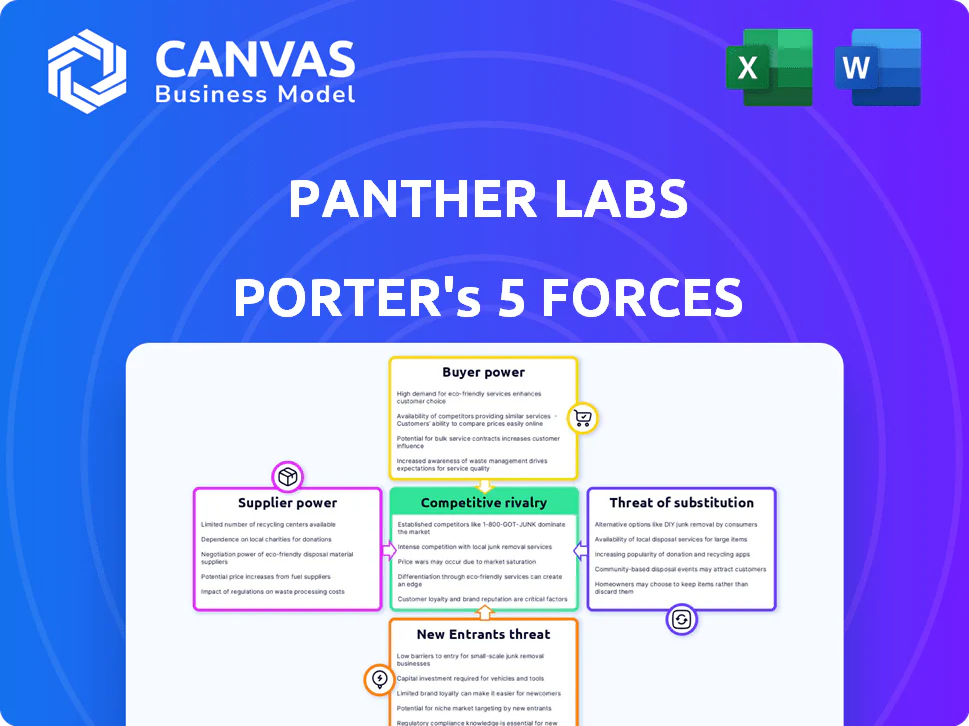
PANTHER LABS PORTER'S FIVE FORCES TEMPLATE RESEARCH
What is included in the product
 Detailed Word Document
Evaluates control by suppliers & buyers, influencing pricing and profitability, customized for Panther Labs.

 Customizable Excel Spreadsheet
Swap in your own data, labels, and notes to reflect current business conditions.
What You See Is What You Get
Panther Labs Porter's Five Forces Analysis
This preview offers a look at Panther Labs' Porter's Five Forces analysis. The detailed insights into each force—rivalry, new entrants, suppliers, buyers, and substitutes—are all included. Every chart, every conclusion you see is part of the purchased document. This professionally written, fully formatted analysis is ready for download immediately after you buy.

Porter's Five Forces Analysis Template

Don't Miss the Bigger Picture
Panther Labs faces complex industry dynamics. The analysis reveals moderate buyer power, influenced by competitive pricing. Threat of new entrants is low due to high barriers. Substitutes pose a moderate threat, primarily from cloud-based alternatives. Supplier power is relatively weak. Competitive rivalry is intense.
Ready to move beyond the basics? Get a full strategic breakdown of Panther Labs’s market position, competitive intensity, and external threats—all in one powerful analysis.
Suppliers Bargaining Power

Reliance on Cloud Infrastructure Providers
Panther Labs depends on cloud providers like AWS, Azure, and Google Cloud for its storage. These providers hold substantial bargaining power. In 2024, Amazon Web Services (AWS) controlled about 32% of the cloud infrastructure market, Microsoft Azure 25%, and Google Cloud 11%. This dependence impacts Panther Labs' costs and operational flexibility.
Availability of Data Sources
Panther Labs sources security data from diverse areas like apps and cloud storage. The reliance on crucial, potentially proprietary security data could give some suppliers an edge. The global cybersecurity market is projected to reach $345.7 billion in 2024, highlighting the value of this data. This dynamic could influence pricing and service terms.

Dependency on Snowflake
Panther Labs' security data lake architecture relies on Snowflake, creating a dependency. This reliance could give Snowflake some bargaining power. In 2024, Snowflake's revenue reached $2.8 billion, showing its market dominance. Panther's open data lake approach, however, could lessen this power by providing data management flexibility.

Talent Pool for Cybersecurity Experts
Panther Labs relies heavily on skilled cybersecurity professionals, granting this talent pool bargaining power. Founded by security practitioners, the company understands the critical role of specialized expertise. Demand for these experts is high, influencing salary expectations and negotiation leverage. This dynamic impacts Panther's operational costs and ability to attract top talent. In 2024, the average cybersecurity analyst salary was around $105,000.
- High demand for cybersecurity experts, influencing salary and benefits.
- Panther Labs' founders' background emphasizes the importance of this talent.
- Competition for skilled professionals is fierce in the current market.
- Average cybersecurity analyst salary in 2024 was approximately $105,000.
Access to Threat Intelligence Feeds
Panther's real-time threat detection depends on timely threat intelligence. Suppliers of top-tier, proprietary threat intelligence feeds can wield bargaining power. However, open-source alternatives also exist, balancing the power dynamic. In 2024, the cybersecurity market saw a 13.4% growth, underscoring the demand for threat intelligence. The global threat intelligence market is projected to reach $20.3 billion by 2028.
- Proprietary threat intelligence offers advanced insights.
- Open-source intelligence provides accessible alternatives.
- Market growth increases the value of intelligence.
- Demand fuels the competition among providers.
Supplier Power Dynamics in Cybersecurity
Panther Labs faces supplier power from cloud providers and data sources like AWS, Azure, and Snowflake, impacting costs. The cybersecurity market's growth, projected to $345.7 billion in 2024, increases this influence. High demand for skilled cybersecurity professionals, with an average analyst salary of $105,000 in 2024, also grants them bargaining power.
| Supplier Category | Supplier | Bargaining Power |
|---|---|---|
| Cloud Providers | AWS, Azure, Google Cloud | High (market share control) |
| Data Sources | Snowflake, Threat Intel | Moderate to High (demand-driven) |
| Talent | Cybersecurity Professionals | High (skills scarcity) |
Customers Bargaining Power

Availability of Alternatives
Customers in the SIEM and security analytics market possess considerable bargaining power due to the availability of alternatives. They can choose from established legacy SIEM providers and newer cloud-native solutions. The market is competitive, with vendors like Splunk and Microsoft Sentinel vying for market share, reported at $3.4 billion and $2.3 billion in revenue, respectively, in 2024. Customers also have the option to build their own solutions using open-source tools, increasing their leverage.
Customer Size and Concentration
Panther Labs' customer base includes large enterprises, potentially giving these customers significant bargaining power. Large clients often command better pricing or tailored services due to the substantial revenue they generate. For example, in 2024, enterprise clients accounted for 60% of cybersecurity software spending, highlighting their market influence.

Switching Costs
Switching costs affect customer bargaining power. Panther Labs offers faster deployment than legacy systems, but migrating security data is still costly. In 2024, the average cost to switch SIEM platforms ranged from $50,000 to $250,000. These costs can make customers less likely to switch, bolstering Panther's position.

Customer's Security Expertise
Customers with strong internal security expertise can significantly influence pricing and service terms. They possess a clearer grasp of market offerings, enabling them to negotiate effectively. This expertise allows them to assess the value proposition of Panther Labs' services more critically. For instance, in 2024, 65% of large enterprises had in-house cybersecurity teams, indicating a high level of customer sophistication.
- Negotiating Power: Sophisticated customers can push for lower prices or better service agreements.
- Evaluation Capability: They can thoroughly evaluate Panther Labs' offerings against competitors.
- Market Awareness: Internal teams possess a better understanding of industry standards and pricing.
- Risk Reduction: Increased security knowledge reduces reliance on external vendors.
Importance of Real-time Detection and Response
For organizations, real-time threat detection and quick response are essential. Customers needing these capabilities might pay more for a platform that delivers them effectively. This reduces the emphasis on price-based bargaining. The cybersecurity market is projected to reach $326.7 billion in 2024.
- Prioritize platforms offering strong real-time features.
- Consider paying more for superior detection and response.
- Cybersecurity spending is consistently increasing.
- Focus on value beyond just the price.
SIEM Market: Customer Power Dynamics
Customer bargaining power in the SIEM market is high due to available alternatives and competitive pricing. Enterprise clients, accounting for 60% of 2024 cybersecurity spending, wield significant influence. However, switching costs, averaging $50,000-$250,000, and the need for real-time threat detection can reduce this power.
| Factor | Impact | Data (2024) |
|---|---|---|
| Alternatives | Increased Bargaining Power | Splunk ($3.4B), Microsoft Sentinel ($2.3B) Revenue |
| Enterprise Influence | Stronger Negotiation | 60% of Cybersecurity Spending |
| Switching Costs | Reduced Bargaining Power | $50,000 - $250,000 Average Cost |
Rivalry Among Competitors

Number and Diversity of Competitors
The SIEM and cloud security market is highly competitive, featuring a blend of seasoned and cloud-focused companies. Panther Labs faces rivalry from Splunk, Sumo Logic, and Microsoft Sentinel. The global cybersecurity market is projected to reach $345.4 billion in 2024. This competitive landscape demands constant innovation.
Market Growth Rate
The cloud security and SIEM markets are growing rapidly. This attracts more competitors, increasing rivalry. In 2024, the global cloud security market was valued at $65.4 billion. It is expected to reach $144.8 billion by 2029.

Differentiation of Offerings
Panther Labs aims to stand out with its cloud-native design, detection-as-code, and security data lake. Competitors’ offerings and how customers value these aspects directly affect rivalry intensity. In 2024, the cybersecurity market is valued at over $200 billion, with cloud security growing at 20% annually.

Mergers and Acquisitions
Mergers and acquisitions (M&A) significantly impact competitive rivalry. Consolidation in the cybersecurity market, exemplified by Cisco's acquisition of Splunk for approximately $28 billion in 2023, reshapes the competitive landscape. This creates larger, more powerful entities. These acquisitions can lead to increased market concentration.
- Cisco acquired Splunk for roughly $28 billion in 2023.
- Palo Alto Networks acquired QRadar assets in 2024.
- M&A activity can boost market concentration.
- Larger competitors can exert more market influence.
Pricing Strategies
Pricing strategies significantly influence competitive rivalry, particularly as Panther Labs positions itself as a cost-effective SIEM solution. Competitors' pricing models and their propensity for price wars directly affect Panther's market positioning and profitability. In 2024, the SIEM market saw a 7% increase in price-based competition. This necessitates a keen understanding of pricing dynamics.
- Competitor pricing models must be analyzed.
- Price wars can erode profit margins.
- Panther Labs aims for a cost-effective edge.
- Market dynamics influence pricing strategies.
SIEM Market: Intense Rivalry & Growth
Competitive rivalry in the SIEM market is intense, driven by rapid growth and a crowded field. The global cybersecurity market is projected to reach $345.4 billion in 2024, attracting more competitors. Consolidation, like Cisco's $28B Splunk acquisition in 2023, reshapes the landscape. Pricing strategies and product differentiation are key factors.
| Aspect | Impact | 2024 Data |
|---|---|---|
| Market Growth | Attracts rivals | Cloud security market: $65.4B |
| M&A Activity | Reshapes competition | Cisco-Splunk ($28B, 2023) |
| Pricing | Influences market position | SIEM price competition: 7% increase |
Original: $10.00
-65%$10.00
$3.50PANTHER LABS PORTER'S FIVE FORCES TEMPLATE RESEARCH
What is included in the product
Detailed Word Document
Evaluates control by suppliers & buyers, influencing pricing and profitability, customized for Panther Labs.
Customizable Excel Spreadsheet
Swap in your own data, labels, and notes to reflect current business conditions.
What You See Is What You Get
Panther Labs Porter's Five Forces Analysis
This preview offers a look at Panther Labs' Porter's Five Forces analysis. The detailed insights into each force—rivalry, new entrants, suppliers, buyers, and substitutes—are all included. Every chart, every conclusion you see is part of the purchased document. This professionally written, fully formatted analysis is ready for download immediately after you buy.
Porter's Five Forces Analysis Template
Don't Miss the Bigger Picture
Panther Labs faces complex industry dynamics. The analysis reveals moderate buyer power, influenced by competitive pricing. Threat of new entrants is low due to high barriers. Substitutes pose a moderate threat, primarily from cloud-based alternatives. Supplier power is relatively weak. Competitive rivalry is intense.
Ready to move beyond the basics? Get a full strategic breakdown of Panther Labs’s market position, competitive intensity, and external threats—all in one powerful analysis.
Suppliers Bargaining Power
Reliance on Cloud Infrastructure Providers
Panther Labs depends on cloud providers like AWS, Azure, and Google Cloud for its storage. These providers hold substantial bargaining power. In 2024, Amazon Web Services (AWS) controlled about 32% of the cloud infrastructure market, Microsoft Azure 25%, and Google Cloud 11%. This dependence impacts Panther Labs' costs and operational flexibility.
Availability of Data Sources
Panther Labs sources security data from diverse areas like apps and cloud storage. The reliance on crucial, potentially proprietary security data could give some suppliers an edge. The global cybersecurity market is projected to reach $345.7 billion in 2024, highlighting the value of this data. This dynamic could influence pricing and service terms.
Dependency on Snowflake
Panther Labs' security data lake architecture relies on Snowflake, creating a dependency. This reliance could give Snowflake some bargaining power. In 2024, Snowflake's revenue reached $2.8 billion, showing its market dominance. Panther's open data lake approach, however, could lessen this power by providing data management flexibility.
Talent Pool for Cybersecurity Experts
Panther Labs relies heavily on skilled cybersecurity professionals, granting this talent pool bargaining power. Founded by security practitioners, the company understands the critical role of specialized expertise. Demand for these experts is high, influencing salary expectations and negotiation leverage. This dynamic impacts Panther's operational costs and ability to attract top talent. In 2024, the average cybersecurity analyst salary was around $105,000.
- High demand for cybersecurity experts, influencing salary and benefits.
- Panther Labs' founders' background emphasizes the importance of this talent.
- Competition for skilled professionals is fierce in the current market.
- Average cybersecurity analyst salary in 2024 was approximately $105,000.
Access to Threat Intelligence Feeds
Panther's real-time threat detection depends on timely threat intelligence. Suppliers of top-tier, proprietary threat intelligence feeds can wield bargaining power. However, open-source alternatives also exist, balancing the power dynamic. In 2024, the cybersecurity market saw a 13.4% growth, underscoring the demand for threat intelligence. The global threat intelligence market is projected to reach $20.3 billion by 2028.
- Proprietary threat intelligence offers advanced insights.
- Open-source intelligence provides accessible alternatives.
- Market growth increases the value of intelligence.
- Demand fuels the competition among providers.
Supplier Power Dynamics in Cybersecurity
Panther Labs faces supplier power from cloud providers and data sources like AWS, Azure, and Snowflake, impacting costs. The cybersecurity market's growth, projected to $345.7 billion in 2024, increases this influence. High demand for skilled cybersecurity professionals, with an average analyst salary of $105,000 in 2024, also grants them bargaining power.
| Supplier Category | Supplier | Bargaining Power |
|---|---|---|
| Cloud Providers | AWS, Azure, Google Cloud | High (market share control) |
| Data Sources | Snowflake, Threat Intel | Moderate to High (demand-driven) |
| Talent | Cybersecurity Professionals | High (skills scarcity) |
Customers Bargaining Power
Availability of Alternatives
Customers in the SIEM and security analytics market possess considerable bargaining power due to the availability of alternatives. They can choose from established legacy SIEM providers and newer cloud-native solutions. The market is competitive, with vendors like Splunk and Microsoft Sentinel vying for market share, reported at $3.4 billion and $2.3 billion in revenue, respectively, in 2024. Customers also have the option to build their own solutions using open-source tools, increasing their leverage.
Customer Size and Concentration
Panther Labs' customer base includes large enterprises, potentially giving these customers significant bargaining power. Large clients often command better pricing or tailored services due to the substantial revenue they generate. For example, in 2024, enterprise clients accounted for 60% of cybersecurity software spending, highlighting their market influence.
Switching Costs
Switching costs affect customer bargaining power. Panther Labs offers faster deployment than legacy systems, but migrating security data is still costly. In 2024, the average cost to switch SIEM platforms ranged from $50,000 to $250,000. These costs can make customers less likely to switch, bolstering Panther's position.
Customer's Security Expertise
Customers with strong internal security expertise can significantly influence pricing and service terms. They possess a clearer grasp of market offerings, enabling them to negotiate effectively. This expertise allows them to assess the value proposition of Panther Labs' services more critically. For instance, in 2024, 65% of large enterprises had in-house cybersecurity teams, indicating a high level of customer sophistication.
- Negotiating Power: Sophisticated customers can push for lower prices or better service agreements.
- Evaluation Capability: They can thoroughly evaluate Panther Labs' offerings against competitors.
- Market Awareness: Internal teams possess a better understanding of industry standards and pricing.
- Risk Reduction: Increased security knowledge reduces reliance on external vendors.
Importance of Real-time Detection and Response
For organizations, real-time threat detection and quick response are essential. Customers needing these capabilities might pay more for a platform that delivers them effectively. This reduces the emphasis on price-based bargaining. The cybersecurity market is projected to reach $326.7 billion in 2024.
- Prioritize platforms offering strong real-time features.
- Consider paying more for superior detection and response.
- Cybersecurity spending is consistently increasing.
- Focus on value beyond just the price.
SIEM Market: Customer Power Dynamics
Customer bargaining power in the SIEM market is high due to available alternatives and competitive pricing. Enterprise clients, accounting for 60% of 2024 cybersecurity spending, wield significant influence. However, switching costs, averaging $50,000-$250,000, and the need for real-time threat detection can reduce this power.
| Factor | Impact | Data (2024) |
|---|---|---|
| Alternatives | Increased Bargaining Power | Splunk ($3.4B), Microsoft Sentinel ($2.3B) Revenue |
| Enterprise Influence | Stronger Negotiation | 60% of Cybersecurity Spending |
| Switching Costs | Reduced Bargaining Power | $50,000 - $250,000 Average Cost |
Rivalry Among Competitors
Number and Diversity of Competitors
The SIEM and cloud security market is highly competitive, featuring a blend of seasoned and cloud-focused companies. Panther Labs faces rivalry from Splunk, Sumo Logic, and Microsoft Sentinel. The global cybersecurity market is projected to reach $345.4 billion in 2024. This competitive landscape demands constant innovation.
Market Growth Rate
The cloud security and SIEM markets are growing rapidly. This attracts more competitors, increasing rivalry. In 2024, the global cloud security market was valued at $65.4 billion. It is expected to reach $144.8 billion by 2029.
Differentiation of Offerings
Panther Labs aims to stand out with its cloud-native design, detection-as-code, and security data lake. Competitors’ offerings and how customers value these aspects directly affect rivalry intensity. In 2024, the cybersecurity market is valued at over $200 billion, with cloud security growing at 20% annually.
Mergers and Acquisitions
Mergers and acquisitions (M&A) significantly impact competitive rivalry. Consolidation in the cybersecurity market, exemplified by Cisco's acquisition of Splunk for approximately $28 billion in 2023, reshapes the competitive landscape. This creates larger, more powerful entities. These acquisitions can lead to increased market concentration.
- Cisco acquired Splunk for roughly $28 billion in 2023.
- Palo Alto Networks acquired QRadar assets in 2024.
- M&A activity can boost market concentration.
- Larger competitors can exert more market influence.
Pricing Strategies
Pricing strategies significantly influence competitive rivalry, particularly as Panther Labs positions itself as a cost-effective SIEM solution. Competitors' pricing models and their propensity for price wars directly affect Panther's market positioning and profitability. In 2024, the SIEM market saw a 7% increase in price-based competition. This necessitates a keen understanding of pricing dynamics.
- Competitor pricing models must be analyzed.
- Price wars can erode profit margins.
- Panther Labs aims for a cost-effective edge.
- Market dynamics influence pricing strategies.
SIEM Market: Intense Rivalry & Growth
Competitive rivalry in the SIEM market is intense, driven by rapid growth and a crowded field. The global cybersecurity market is projected to reach $345.4 billion in 2024, attracting more competitors. Consolidation, like Cisco's $28B Splunk acquisition in 2023, reshapes the landscape. Pricing strategies and product differentiation are key factors.
| Aspect | Impact | 2024 Data |
|---|---|---|
| Market Growth | Attracts rivals | Cloud security market: $65.4B |
| M&A Activity | Reshapes competition | Cisco-Splunk ($28B, 2023) |
| Pricing | Influences market position | SIEM price competition: 7% increase |
Product Information
Product Information
Shipping & Returns
Shipping & Returns
Description
What is included in the product
Detailed Word Document
Evaluates control by suppliers & buyers, influencing pricing and profitability, customized for Panther Labs.
Customizable Excel Spreadsheet
Swap in your own data, labels, and notes to reflect current business conditions.
What You See Is What You Get
Panther Labs Porter's Five Forces Analysis
This preview offers a look at Panther Labs' Porter's Five Forces analysis. The detailed insights into each force—rivalry, new entrants, suppliers, buyers, and substitutes—are all included. Every chart, every conclusion you see is part of the purchased document. This professionally written, fully formatted analysis is ready for download immediately after you buy.
Porter's Five Forces Analysis Template
Don't Miss the Bigger Picture
Panther Labs faces complex industry dynamics. The analysis reveals moderate buyer power, influenced by competitive pricing. Threat of new entrants is low due to high barriers. Substitutes pose a moderate threat, primarily from cloud-based alternatives. Supplier power is relatively weak. Competitive rivalry is intense.
Ready to move beyond the basics? Get a full strategic breakdown of Panther Labs’s market position, competitive intensity, and external threats—all in one powerful analysis.
Suppliers Bargaining Power
Reliance on Cloud Infrastructure Providers
Panther Labs depends on cloud providers like AWS, Azure, and Google Cloud for its storage. These providers hold substantial bargaining power. In 2024, Amazon Web Services (AWS) controlled about 32% of the cloud infrastructure market, Microsoft Azure 25%, and Google Cloud 11%. This dependence impacts Panther Labs' costs and operational flexibility.
Availability of Data Sources
Panther Labs sources security data from diverse areas like apps and cloud storage. The reliance on crucial, potentially proprietary security data could give some suppliers an edge. The global cybersecurity market is projected to reach $345.7 billion in 2024, highlighting the value of this data. This dynamic could influence pricing and service terms.
Dependency on Snowflake
Panther Labs' security data lake architecture relies on Snowflake, creating a dependency. This reliance could give Snowflake some bargaining power. In 2024, Snowflake's revenue reached $2.8 billion, showing its market dominance. Panther's open data lake approach, however, could lessen this power by providing data management flexibility.
Talent Pool for Cybersecurity Experts
Panther Labs relies heavily on skilled cybersecurity professionals, granting this talent pool bargaining power. Founded by security practitioners, the company understands the critical role of specialized expertise. Demand for these experts is high, influencing salary expectations and negotiation leverage. This dynamic impacts Panther's operational costs and ability to attract top talent. In 2024, the average cybersecurity analyst salary was around $105,000.
- High demand for cybersecurity experts, influencing salary and benefits.
- Panther Labs' founders' background emphasizes the importance of this talent.
- Competition for skilled professionals is fierce in the current market.
- Average cybersecurity analyst salary in 2024 was approximately $105,000.
Access to Threat Intelligence Feeds
Panther's real-time threat detection depends on timely threat intelligence. Suppliers of top-tier, proprietary threat intelligence feeds can wield bargaining power. However, open-source alternatives also exist, balancing the power dynamic. In 2024, the cybersecurity market saw a 13.4% growth, underscoring the demand for threat intelligence. The global threat intelligence market is projected to reach $20.3 billion by 2028.
- Proprietary threat intelligence offers advanced insights.
- Open-source intelligence provides accessible alternatives.
- Market growth increases the value of intelligence.
- Demand fuels the competition among providers.
Supplier Power Dynamics in Cybersecurity
Panther Labs faces supplier power from cloud providers and data sources like AWS, Azure, and Snowflake, impacting costs. The cybersecurity market's growth, projected to $345.7 billion in 2024, increases this influence. High demand for skilled cybersecurity professionals, with an average analyst salary of $105,000 in 2024, also grants them bargaining power.
| Supplier Category | Supplier | Bargaining Power |
|---|---|---|
| Cloud Providers | AWS, Azure, Google Cloud | High (market share control) |
| Data Sources | Snowflake, Threat Intel | Moderate to High (demand-driven) |
| Talent | Cybersecurity Professionals | High (skills scarcity) |
Customers Bargaining Power
Availability of Alternatives
Customers in the SIEM and security analytics market possess considerable bargaining power due to the availability of alternatives. They can choose from established legacy SIEM providers and newer cloud-native solutions. The market is competitive, with vendors like Splunk and Microsoft Sentinel vying for market share, reported at $3.4 billion and $2.3 billion in revenue, respectively, in 2024. Customers also have the option to build their own solutions using open-source tools, increasing their leverage.
Customer Size and Concentration
Panther Labs' customer base includes large enterprises, potentially giving these customers significant bargaining power. Large clients often command better pricing or tailored services due to the substantial revenue they generate. For example, in 2024, enterprise clients accounted for 60% of cybersecurity software spending, highlighting their market influence.
Switching Costs
Switching costs affect customer bargaining power. Panther Labs offers faster deployment than legacy systems, but migrating security data is still costly. In 2024, the average cost to switch SIEM platforms ranged from $50,000 to $250,000. These costs can make customers less likely to switch, bolstering Panther's position.
Customer's Security Expertise
Customers with strong internal security expertise can significantly influence pricing and service terms. They possess a clearer grasp of market offerings, enabling them to negotiate effectively. This expertise allows them to assess the value proposition of Panther Labs' services more critically. For instance, in 2024, 65% of large enterprises had in-house cybersecurity teams, indicating a high level of customer sophistication.
- Negotiating Power: Sophisticated customers can push for lower prices or better service agreements.
- Evaluation Capability: They can thoroughly evaluate Panther Labs' offerings against competitors.
- Market Awareness: Internal teams possess a better understanding of industry standards and pricing.
- Risk Reduction: Increased security knowledge reduces reliance on external vendors.
Importance of Real-time Detection and Response
For organizations, real-time threat detection and quick response are essential. Customers needing these capabilities might pay more for a platform that delivers them effectively. This reduces the emphasis on price-based bargaining. The cybersecurity market is projected to reach $326.7 billion in 2024.
- Prioritize platforms offering strong real-time features.
- Consider paying more for superior detection and response.
- Cybersecurity spending is consistently increasing.
- Focus on value beyond just the price.
SIEM Market: Customer Power Dynamics
Customer bargaining power in the SIEM market is high due to available alternatives and competitive pricing. Enterprise clients, accounting for 60% of 2024 cybersecurity spending, wield significant influence. However, switching costs, averaging $50,000-$250,000, and the need for real-time threat detection can reduce this power.
| Factor | Impact | Data (2024) |
|---|---|---|
| Alternatives | Increased Bargaining Power | Splunk ($3.4B), Microsoft Sentinel ($2.3B) Revenue |
| Enterprise Influence | Stronger Negotiation | 60% of Cybersecurity Spending |
| Switching Costs | Reduced Bargaining Power | $50,000 - $250,000 Average Cost |
Rivalry Among Competitors
Number and Diversity of Competitors
The SIEM and cloud security market is highly competitive, featuring a blend of seasoned and cloud-focused companies. Panther Labs faces rivalry from Splunk, Sumo Logic, and Microsoft Sentinel. The global cybersecurity market is projected to reach $345.4 billion in 2024. This competitive landscape demands constant innovation.
Market Growth Rate
The cloud security and SIEM markets are growing rapidly. This attracts more competitors, increasing rivalry. In 2024, the global cloud security market was valued at $65.4 billion. It is expected to reach $144.8 billion by 2029.
Differentiation of Offerings
Panther Labs aims to stand out with its cloud-native design, detection-as-code, and security data lake. Competitors’ offerings and how customers value these aspects directly affect rivalry intensity. In 2024, the cybersecurity market is valued at over $200 billion, with cloud security growing at 20% annually.
Mergers and Acquisitions
Mergers and acquisitions (M&A) significantly impact competitive rivalry. Consolidation in the cybersecurity market, exemplified by Cisco's acquisition of Splunk for approximately $28 billion in 2023, reshapes the competitive landscape. This creates larger, more powerful entities. These acquisitions can lead to increased market concentration.
- Cisco acquired Splunk for roughly $28 billion in 2023.
- Palo Alto Networks acquired QRadar assets in 2024.
- M&A activity can boost market concentration.
- Larger competitors can exert more market influence.
Pricing Strategies
Pricing strategies significantly influence competitive rivalry, particularly as Panther Labs positions itself as a cost-effective SIEM solution. Competitors' pricing models and their propensity for price wars directly affect Panther's market positioning and profitability. In 2024, the SIEM market saw a 7% increase in price-based competition. This necessitates a keen understanding of pricing dynamics.
- Competitor pricing models must be analyzed.
- Price wars can erode profit margins.
- Panther Labs aims for a cost-effective edge.
- Market dynamics influence pricing strategies.
SIEM Market: Intense Rivalry & Growth
Competitive rivalry in the SIEM market is intense, driven by rapid growth and a crowded field. The global cybersecurity market is projected to reach $345.4 billion in 2024, attracting more competitors. Consolidation, like Cisco's $28B Splunk acquisition in 2023, reshapes the landscape. Pricing strategies and product differentiation are key factors.
| Aspect | Impact | 2024 Data |
|---|---|---|
| Market Growth | Attracts rivals | Cloud security market: $65.4B |
| M&A Activity | Reshapes competition | Cisco-Splunk ($28B, 2023) |
| Pricing | Influences market position | SIEM price competition: 7% increase |











