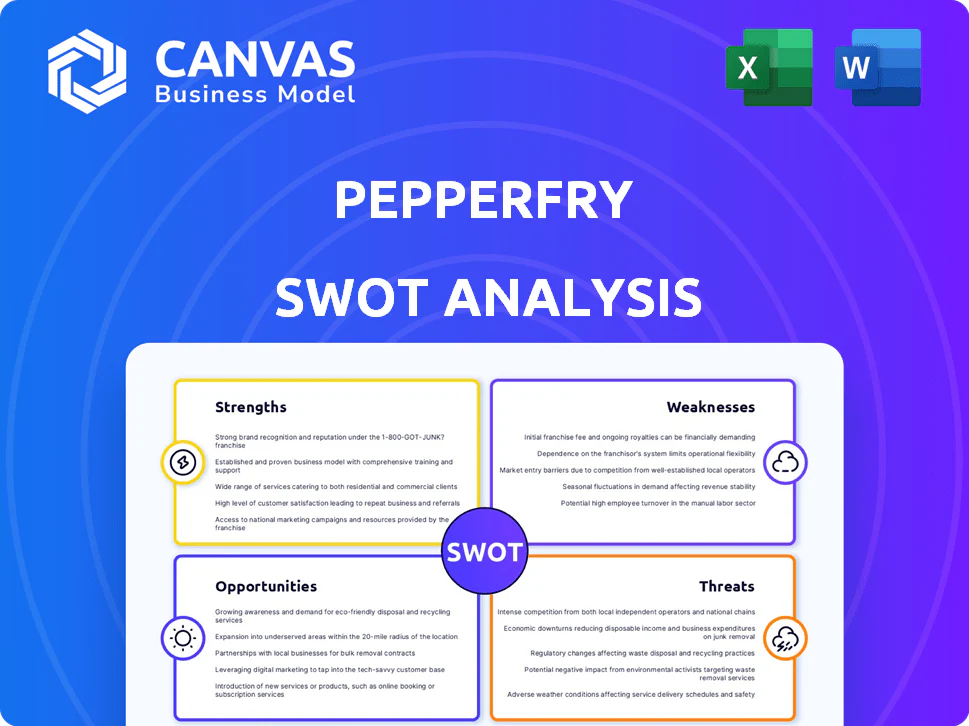
PEPPERFRY SWOT ANALYSIS TEMPLATE RESEARCH

Make Insightful Decisions Backed by Expert Research
Pepperfry's strong omni-channel presence and brand recognition position it well in India's booming home-furnishings market, yet inventory complexity and competitive pressure from global and local players pose clear risks; our full SWOT unpacks these dynamics with revenue impacts and strategic options. Purchase the complete SWOT analysis for a professionally formatted Word report and editable Excel matrix to inform investment, strategy, or pitch materials.
Strengths

Omnichannel footprint with over 200 Studio Pepperfry locations across 100 cities
Pepperfry's omnichannel network-200+ Studio Pepperfry stores in 100 cities as of FY2025-lets customers handle high-ticket furniture pre-purchase, boosting trust; stores report conversion rates up to 3-4x higher than pure web traffic and contributed ~18% of FY2025 gross merchandise value (GMV), narrowing the online-to-offline purchase gap.
In-house logistics network PepPost covering 500 plus cities with specialized handling
Pepperfry's in-house PepPost covers 500+ cities and records a damage rate below 2% for bulky goods, outperforming typical third-party rates of 4-6%, supporting higher margin retention in FY2025 where gross margin for furniture rose to ~28.5%.

Private label portfolio contributing more than 45 percent of total annual revenue
Pepperfry's private-label brands Woodsworth and Mintwud drive over 45% of FY2025 revenue, delivering gross margins near 42% versus ~20-25% on third-party listings, by owning design and specs to pivot fast to trends like mid-century modern and industrial. This cuts vendor dependence and sustains uniform quality across the platform.

High Average Order Value exceeding 18,000 Indian Rupees per transaction
Pepperfry's average order value (AOV) exceeded 18,000 INR in FY2025, crucial in furniture where heavy-goods shipping and high customer-acquisition costs demand large ticket sizes to protect margins.
This AOV signals loyal customers treating Pepperfry as a destination for major home investments, not just decor, supporting repeat purchases and higher lifetime value.
Maintaining >18,000 INR AOV improves unit economics as Pepperfry scales, aiding the path to EBITDA breakeven by spreading fixed logistics and marketing costs across larger transactions.
- FY2025 AOV: >18,000 INR
- Reduces per-order shipping cost impact
- Raises customer lifetime value via big-ticket purchases
Robust data ecosystem with 1.2 million active registered users and first-party insights
Pepperfry uses first-party data from 1.2 million active registered users to tailor marketing and forecast regional demand, cutting unsold stock costs by an estimated 12% vs. industry peers.
This precise retargeting raises conversion rates-reported up to 4.8% on personalized campaigns-and creates a customer-style moat hard for new entrants to match.
- 1.2M active users
- ~12% lower unsold-stock cost
- 4.8% personalized-campaign conversion
Pepperfry FY25: 200+ studios, 45% private-label rev, AOV >₹18K, 1.2M users
Pepperfry's omnichannel reach (200+ studios, 100 cities), PepPost coverage (500+ cities, <2% damage), strong private labels (Woodsworth/Mintwud = 45% revenue, ~42% gross margin), AOV >18,000 INR, 1.2M active users and personalized campaign conversion 4.8% drove FY2025 GMV mix and improved unit economics.
| Metric | FY2025 |
|---|---|
| Studios | 200+ |
| Cities | 100 |
| PepPost cities | 500+ |
| Damage rate | <2% |
| Private-label rev | 45% |
| Private-label GM | ~42% |
| AOV | >18,000 INR |
| Active users | 1.2M |
| Personalized CVR | 4.8% |
What is included in the product
 Detailed Word Document
Provides a concise SWOT analysis of Pepperfry, outlining its core strengths, operational weaknesses, market opportunities, and external threats to clarify strategic positioning and growth risks.

 Customizable Excel Spreadsheet
Provides a concise Pepperfry SWOT snapshot for quick strategic alignment, highlighting furniture-market strengths, online-channel weaknesses, growth opportunities, and competitive threats for fast executive decision-making.
Weaknesses

Reported consolidated net loss of 1.2 billion Indian Rupees in the 2025 fiscal year
Pepperfry reported a consolidated net loss of 1.2 billion INR in FY2025 despite revenue rising 18% to 14.6 billion INR, signaling margins squeezed by high operations and marketing spend.
Investors now favor cash flow over growth; persistent losses threaten future funding and valuation, with free cash flow negative 820 million INR in FY2025.
Break-even looks distant-management must cut costs further, but tighter spending could slow expansion and market share gains.
Marketing expenses accounting for nearly 25 percent of total operating costs
Pepperfry's marketing expenses stood at about 24.8% of FY2025 operating costs, forcing high customer-acquisition costs (CAC) that erode margins in India's crowded e‑commerce market; FY2025 CAC averaged ₹3,200 per new customer versus ₹2,400 in FY2023.
Heavy reliance on paid search and social ads-~68% of digital spend in FY2025-signals weak organic brand pull, so growth leans on bought traffic rather than loyalty.
Quarterly spend cuts in 2025 showed an immediate ~18% drop in order volume, underlining revenue sensitivity to marketing reductions.

Product return and replacement rates hovering around 10 percent for bulky items
High return/replacement rates (~10% for bulky items in FY2025) raise reverse-logistics costs; Pepperfry reported higher delivery-related expense pressure, cutting gross margins by an estimated 120-150 bps in FY2025.
Transit damage from handling bulky furniture drives these returns, and customers report frequent visual/finish mismatches versus online listings, boosting return incidence.
Marketplace scale-over 5,000 third-party sellers in 2025-makes uniform quality control hard, amplifying warranty and replacement costs.

Revenue concentration with 60 percent of sales coming from the top 8 metro areas
Pepperfry derives ~60% of FY2025 net sales from its top 8 metro areas, leaving it exposed to localized downturns or shifts in housing and interior spending in those cities.
Efforts to expand into Tier‑2/3 towns face higher per‑order logistics costs and about 20-40% lower average order value, pressuring margins.
Diversifying geographically is crucial to reduce risk from metro saturation and stabilize growth.
- 60% FY2025 sales from top 8 metros
- Tier‑2/3 AOV 20-40% lower
- Higher logistics cost per order outside metros
- Geographic diversification lowers concentration risk
Recent executive leadership turnover impacting long-term strategic continuity
Frequent C‑suite changes in the past 18 months have shifted Pepperfry's strategy, creating mixed signals for employees and investors during the FY2025 IPO push; leadership churn coincided with a 12% QoQ slowdown in FY2025 gross merchandise value (GMV) growth, per company filings.
This instability risks delaying projects-international expansion and a planned platform AI integration-after management noted a 6‑9 month execution lag in FY2025 roadmaps.
- 18 months: multiple C‑suite changes
- FY2025: 12% QoQ GMV growth slowdown
- Execution lag: 6-9 months on major projects
- IPO timing: leadership turnover raises investor uncertainty
FY25 Red Flags: ₹1.2bn Loss, -₹820m FCF, High CAC & 12% QoQ GMV Slowdown
Weaknesses: FY2025 net loss ₹1.2bn, negative FCF ₹820m; high CAC ₹3,200 (FY2025) and marketing 24.8% of ops; return rate ~10% raises logistics costs; 60% sales from top‑8 metros; Tier‑2/3 AOV 20-40% lower; C‑suite churn with 12% QoQ GMV slowdown.
| Metric | FY2025 |
|---|---|
| Net loss | ₹1.2bn |
| Free cash flow | -₹820m |
| CAC | ₹3,200 |
| Marketing % of ops | 24.8% |
| Return rate | ~10% |
| Metro sales concentration | 60% |
| Tier‑2/3 AOV | -20-40% |
| QoQ GMV slowdown | 12% |
Preview Before You Purchase
Pepperfry SWOT Analysis
This is the actual SWOT analysis document you'll receive upon purchase-no surprises, just professional quality.

Original: $10.00
-65%$10.00
$3.50PEPPERFRY SWOT ANALYSIS TEMPLATE RESEARCH
Make Insightful Decisions Backed by Expert Research
Pepperfry's strong omni-channel presence and brand recognition position it well in India's booming home-furnishings market, yet inventory complexity and competitive pressure from global and local players pose clear risks; our full SWOT unpacks these dynamics with revenue impacts and strategic options. Purchase the complete SWOT analysis for a professionally formatted Word report and editable Excel matrix to inform investment, strategy, or pitch materials.
Strengths
Omnichannel footprint with over 200 Studio Pepperfry locations across 100 cities
Pepperfry's omnichannel network-200+ Studio Pepperfry stores in 100 cities as of FY2025-lets customers handle high-ticket furniture pre-purchase, boosting trust; stores report conversion rates up to 3-4x higher than pure web traffic and contributed ~18% of FY2025 gross merchandise value (GMV), narrowing the online-to-offline purchase gap.
In-house logistics network PepPost covering 500 plus cities with specialized handling
Pepperfry's in-house PepPost covers 500+ cities and records a damage rate below 2% for bulky goods, outperforming typical third-party rates of 4-6%, supporting higher margin retention in FY2025 where gross margin for furniture rose to ~28.5%.
Private label portfolio contributing more than 45 percent of total annual revenue
Pepperfry's private-label brands Woodsworth and Mintwud drive over 45% of FY2025 revenue, delivering gross margins near 42% versus ~20-25% on third-party listings, by owning design and specs to pivot fast to trends like mid-century modern and industrial. This cuts vendor dependence and sustains uniform quality across the platform.
High Average Order Value exceeding 18,000 Indian Rupees per transaction
Pepperfry's average order value (AOV) exceeded 18,000 INR in FY2025, crucial in furniture where heavy-goods shipping and high customer-acquisition costs demand large ticket sizes to protect margins.
This AOV signals loyal customers treating Pepperfry as a destination for major home investments, not just decor, supporting repeat purchases and higher lifetime value.
Maintaining >18,000 INR AOV improves unit economics as Pepperfry scales, aiding the path to EBITDA breakeven by spreading fixed logistics and marketing costs across larger transactions.
- FY2025 AOV: >18,000 INR
- Reduces per-order shipping cost impact
- Raises customer lifetime value via big-ticket purchases
Robust data ecosystem with 1.2 million active registered users and first-party insights
Pepperfry uses first-party data from 1.2 million active registered users to tailor marketing and forecast regional demand, cutting unsold stock costs by an estimated 12% vs. industry peers.
This precise retargeting raises conversion rates-reported up to 4.8% on personalized campaigns-and creates a customer-style moat hard for new entrants to match.
- 1.2M active users
- ~12% lower unsold-stock cost
- 4.8% personalized-campaign conversion
Pepperfry FY25: 200+ studios, 45% private-label rev, AOV >₹18K, 1.2M users
Pepperfry's omnichannel reach (200+ studios, 100 cities), PepPost coverage (500+ cities, <2% damage), strong private labels (Woodsworth/Mintwud = 45% revenue, ~42% gross margin), AOV >18,000 INR, 1.2M active users and personalized campaign conversion 4.8% drove FY2025 GMV mix and improved unit economics.
| Metric | FY2025 |
|---|---|
| Studios | 200+ |
| Cities | 100 |
| PepPost cities | 500+ |
| Damage rate | <2% |
| Private-label rev | 45% |
| Private-label GM | ~42% |
| AOV | >18,000 INR |
| Active users | 1.2M |
| Personalized CVR | 4.8% |
What is included in the product
Detailed Word Document
Provides a concise SWOT analysis of Pepperfry, outlining its core strengths, operational weaknesses, market opportunities, and external threats to clarify strategic positioning and growth risks.
Customizable Excel Spreadsheet
Provides a concise Pepperfry SWOT snapshot for quick strategic alignment, highlighting furniture-market strengths, online-channel weaknesses, growth opportunities, and competitive threats for fast executive decision-making.
Weaknesses
Reported consolidated net loss of 1.2 billion Indian Rupees in the 2025 fiscal year
Pepperfry reported a consolidated net loss of 1.2 billion INR in FY2025 despite revenue rising 18% to 14.6 billion INR, signaling margins squeezed by high operations and marketing spend.
Investors now favor cash flow over growth; persistent losses threaten future funding and valuation, with free cash flow negative 820 million INR in FY2025.
Break-even looks distant-management must cut costs further, but tighter spending could slow expansion and market share gains.
Marketing expenses accounting for nearly 25 percent of total operating costs
Pepperfry's marketing expenses stood at about 24.8% of FY2025 operating costs, forcing high customer-acquisition costs (CAC) that erode margins in India's crowded e‑commerce market; FY2025 CAC averaged ₹3,200 per new customer versus ₹2,400 in FY2023.
Heavy reliance on paid search and social ads-~68% of digital spend in FY2025-signals weak organic brand pull, so growth leans on bought traffic rather than loyalty.
Quarterly spend cuts in 2025 showed an immediate ~18% drop in order volume, underlining revenue sensitivity to marketing reductions.
Product return and replacement rates hovering around 10 percent for bulky items
High return/replacement rates (~10% for bulky items in FY2025) raise reverse-logistics costs; Pepperfry reported higher delivery-related expense pressure, cutting gross margins by an estimated 120-150 bps in FY2025.
Transit damage from handling bulky furniture drives these returns, and customers report frequent visual/finish mismatches versus online listings, boosting return incidence.
Marketplace scale-over 5,000 third-party sellers in 2025-makes uniform quality control hard, amplifying warranty and replacement costs.
Revenue concentration with 60 percent of sales coming from the top 8 metro areas
Pepperfry derives ~60% of FY2025 net sales from its top 8 metro areas, leaving it exposed to localized downturns or shifts in housing and interior spending in those cities.
Efforts to expand into Tier‑2/3 towns face higher per‑order logistics costs and about 20-40% lower average order value, pressuring margins.
Diversifying geographically is crucial to reduce risk from metro saturation and stabilize growth.
- 60% FY2025 sales from top 8 metros
- Tier‑2/3 AOV 20-40% lower
- Higher logistics cost per order outside metros
- Geographic diversification lowers concentration risk
Recent executive leadership turnover impacting long-term strategic continuity
Frequent C‑suite changes in the past 18 months have shifted Pepperfry's strategy, creating mixed signals for employees and investors during the FY2025 IPO push; leadership churn coincided with a 12% QoQ slowdown in FY2025 gross merchandise value (GMV) growth, per company filings.
This instability risks delaying projects-international expansion and a planned platform AI integration-after management noted a 6‑9 month execution lag in FY2025 roadmaps.
- 18 months: multiple C‑suite changes
- FY2025: 12% QoQ GMV growth slowdown
- Execution lag: 6-9 months on major projects
- IPO timing: leadership turnover raises investor uncertainty
FY25 Red Flags: ₹1.2bn Loss, -₹820m FCF, High CAC & 12% QoQ GMV Slowdown
Weaknesses: FY2025 net loss ₹1.2bn, negative FCF ₹820m; high CAC ₹3,200 (FY2025) and marketing 24.8% of ops; return rate ~10% raises logistics costs; 60% sales from top‑8 metros; Tier‑2/3 AOV 20-40% lower; C‑suite churn with 12% QoQ GMV slowdown.
| Metric | FY2025 |
|---|---|
| Net loss | ₹1.2bn |
| Free cash flow | -₹820m |
| CAC | ₹3,200 |
| Marketing % of ops | 24.8% |
| Return rate | ~10% |
| Metro sales concentration | 60% |
| Tier‑2/3 AOV | -20-40% |
| QoQ GMV slowdown | 12% |
Preview Before You Purchase
Pepperfry SWOT Analysis
This is the actual SWOT analysis document you'll receive upon purchase-no surprises, just professional quality.
Product Information
Product Information
Shipping & Returns
Shipping & Returns
Description
Make Insightful Decisions Backed by Expert Research
Pepperfry's strong omni-channel presence and brand recognition position it well in India's booming home-furnishings market, yet inventory complexity and competitive pressure from global and local players pose clear risks; our full SWOT unpacks these dynamics with revenue impacts and strategic options. Purchase the complete SWOT analysis for a professionally formatted Word report and editable Excel matrix to inform investment, strategy, or pitch materials.
Strengths
Omnichannel footprint with over 200 Studio Pepperfry locations across 100 cities
Pepperfry's omnichannel network-200+ Studio Pepperfry stores in 100 cities as of FY2025-lets customers handle high-ticket furniture pre-purchase, boosting trust; stores report conversion rates up to 3-4x higher than pure web traffic and contributed ~18% of FY2025 gross merchandise value (GMV), narrowing the online-to-offline purchase gap.
In-house logistics network PepPost covering 500 plus cities with specialized handling
Pepperfry's in-house PepPost covers 500+ cities and records a damage rate below 2% for bulky goods, outperforming typical third-party rates of 4-6%, supporting higher margin retention in FY2025 where gross margin for furniture rose to ~28.5%.
Private label portfolio contributing more than 45 percent of total annual revenue
Pepperfry's private-label brands Woodsworth and Mintwud drive over 45% of FY2025 revenue, delivering gross margins near 42% versus ~20-25% on third-party listings, by owning design and specs to pivot fast to trends like mid-century modern and industrial. This cuts vendor dependence and sustains uniform quality across the platform.
High Average Order Value exceeding 18,000 Indian Rupees per transaction
Pepperfry's average order value (AOV) exceeded 18,000 INR in FY2025, crucial in furniture where heavy-goods shipping and high customer-acquisition costs demand large ticket sizes to protect margins.
This AOV signals loyal customers treating Pepperfry as a destination for major home investments, not just decor, supporting repeat purchases and higher lifetime value.
Maintaining >18,000 INR AOV improves unit economics as Pepperfry scales, aiding the path to EBITDA breakeven by spreading fixed logistics and marketing costs across larger transactions.
- FY2025 AOV: >18,000 INR
- Reduces per-order shipping cost impact
- Raises customer lifetime value via big-ticket purchases
Robust data ecosystem with 1.2 million active registered users and first-party insights
Pepperfry uses first-party data from 1.2 million active registered users to tailor marketing and forecast regional demand, cutting unsold stock costs by an estimated 12% vs. industry peers.
This precise retargeting raises conversion rates-reported up to 4.8% on personalized campaigns-and creates a customer-style moat hard for new entrants to match.
- 1.2M active users
- ~12% lower unsold-stock cost
- 4.8% personalized-campaign conversion
Pepperfry FY25: 200+ studios, 45% private-label rev, AOV >₹18K, 1.2M users
Pepperfry's omnichannel reach (200+ studios, 100 cities), PepPost coverage (500+ cities, <2% damage), strong private labels (Woodsworth/Mintwud = 45% revenue, ~42% gross margin), AOV >18,000 INR, 1.2M active users and personalized campaign conversion 4.8% drove FY2025 GMV mix and improved unit economics.
| Metric | FY2025 |
|---|---|
| Studios | 200+ |
| Cities | 100 |
| PepPost cities | 500+ |
| Damage rate | <2% |
| Private-label rev | 45% |
| Private-label GM | ~42% |
| AOV | >18,000 INR |
| Active users | 1.2M |
| Personalized CVR | 4.8% |
What is included in the product
Detailed Word Document
Provides a concise SWOT analysis of Pepperfry, outlining its core strengths, operational weaknesses, market opportunities, and external threats to clarify strategic positioning and growth risks.
Customizable Excel Spreadsheet
Provides a concise Pepperfry SWOT snapshot for quick strategic alignment, highlighting furniture-market strengths, online-channel weaknesses, growth opportunities, and competitive threats for fast executive decision-making.
Weaknesses
Reported consolidated net loss of 1.2 billion Indian Rupees in the 2025 fiscal year
Pepperfry reported a consolidated net loss of 1.2 billion INR in FY2025 despite revenue rising 18% to 14.6 billion INR, signaling margins squeezed by high operations and marketing spend.
Investors now favor cash flow over growth; persistent losses threaten future funding and valuation, with free cash flow negative 820 million INR in FY2025.
Break-even looks distant-management must cut costs further, but tighter spending could slow expansion and market share gains.
Marketing expenses accounting for nearly 25 percent of total operating costs
Pepperfry's marketing expenses stood at about 24.8% of FY2025 operating costs, forcing high customer-acquisition costs (CAC) that erode margins in India's crowded e‑commerce market; FY2025 CAC averaged ₹3,200 per new customer versus ₹2,400 in FY2023.
Heavy reliance on paid search and social ads-~68% of digital spend in FY2025-signals weak organic brand pull, so growth leans on bought traffic rather than loyalty.
Quarterly spend cuts in 2025 showed an immediate ~18% drop in order volume, underlining revenue sensitivity to marketing reductions.
Product return and replacement rates hovering around 10 percent for bulky items
High return/replacement rates (~10% for bulky items in FY2025) raise reverse-logistics costs; Pepperfry reported higher delivery-related expense pressure, cutting gross margins by an estimated 120-150 bps in FY2025.
Transit damage from handling bulky furniture drives these returns, and customers report frequent visual/finish mismatches versus online listings, boosting return incidence.
Marketplace scale-over 5,000 third-party sellers in 2025-makes uniform quality control hard, amplifying warranty and replacement costs.
Revenue concentration with 60 percent of sales coming from the top 8 metro areas
Pepperfry derives ~60% of FY2025 net sales from its top 8 metro areas, leaving it exposed to localized downturns or shifts in housing and interior spending in those cities.
Efforts to expand into Tier‑2/3 towns face higher per‑order logistics costs and about 20-40% lower average order value, pressuring margins.
Diversifying geographically is crucial to reduce risk from metro saturation and stabilize growth.
- 60% FY2025 sales from top 8 metros
- Tier‑2/3 AOV 20-40% lower
- Higher logistics cost per order outside metros
- Geographic diversification lowers concentration risk
Recent executive leadership turnover impacting long-term strategic continuity
Frequent C‑suite changes in the past 18 months have shifted Pepperfry's strategy, creating mixed signals for employees and investors during the FY2025 IPO push; leadership churn coincided with a 12% QoQ slowdown in FY2025 gross merchandise value (GMV) growth, per company filings.
This instability risks delaying projects-international expansion and a planned platform AI integration-after management noted a 6‑9 month execution lag in FY2025 roadmaps.
- 18 months: multiple C‑suite changes
- FY2025: 12% QoQ GMV growth slowdown
- Execution lag: 6-9 months on major projects
- IPO timing: leadership turnover raises investor uncertainty
FY25 Red Flags: ₹1.2bn Loss, -₹820m FCF, High CAC & 12% QoQ GMV Slowdown
Weaknesses: FY2025 net loss ₹1.2bn, negative FCF ₹820m; high CAC ₹3,200 (FY2025) and marketing 24.8% of ops; return rate ~10% raises logistics costs; 60% sales from top‑8 metros; Tier‑2/3 AOV 20-40% lower; C‑suite churn with 12% QoQ GMV slowdown.
| Metric | FY2025 |
|---|---|
| Net loss | ₹1.2bn |
| Free cash flow | -₹820m |
| CAC | ₹3,200 |
| Marketing % of ops | 24.8% |
| Return rate | ~10% |
| Metro sales concentration | 60% |
| Tier‑2/3 AOV | -20-40% |
| QoQ GMV slowdown | 12% |
Preview Before You Purchase
Pepperfry SWOT Analysis
This is the actual SWOT analysis document you'll receive upon purchase-no surprises, just professional quality.











