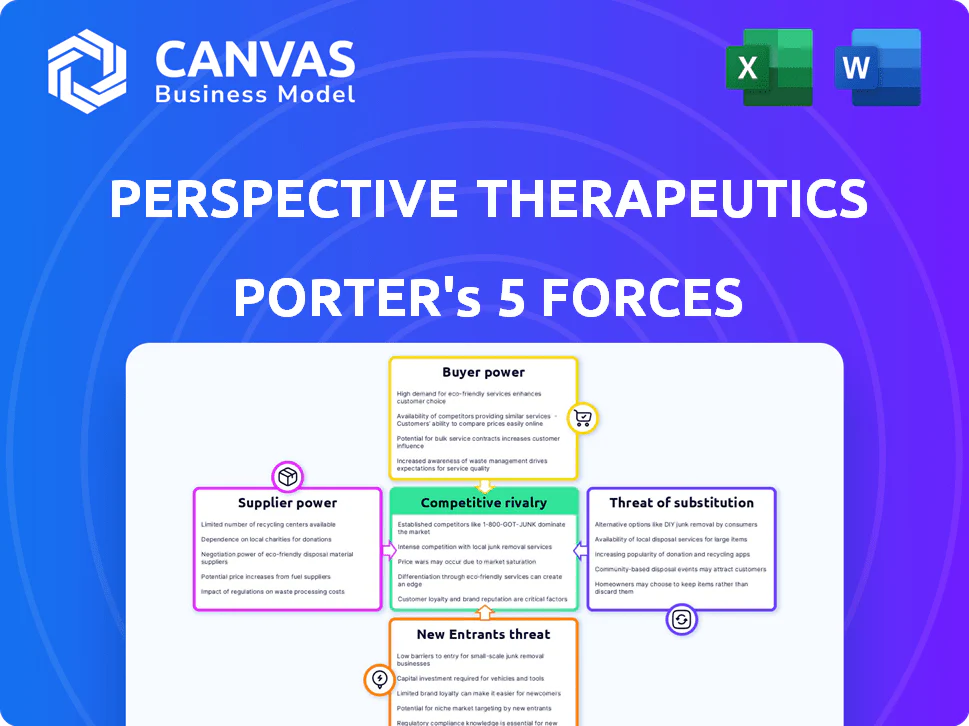
PERSPECTIVE THERAPEUTICS PORTER'S FIVE FORCES TEMPLATE RESEARCH
What is included in the product
 Detailed Word Document
Analyzes Perspective Therapeutics' competitive landscape, detailing threats, rivals, and market dynamics.

 Customizable Excel Spreadsheet
Quickly identify threats and opportunities to support strategic decisions.
Preview the Actual Deliverable
Perspective Therapeutics Porter's Five Forces Analysis
This preview shows the complete Porter's Five Forces analysis for Perspective Therapeutics. You'll receive this same comprehensive, ready-to-use document instantly upon purchase.

Porter's Five Forces Analysis Template

Go Beyond the Preview—Access the Full Strategic Report
Perspective Therapeutics operates in a complex market influenced by numerous competitive forces. Examining supplier power reveals the impact of specialized medical component providers. Buyer power is shaped by the influence of healthcare providers and regulatory bodies. The threat of new entrants is moderate, with high barriers due to R&D costs. The threat of substitutes is limited by the novel nature of their therapy. Competitive rivalry is fierce, influenced by other radiopharmaceutical companies.
This brief snapshot only scratches the surface. Unlock the full Porter's Five Forces Analysis to explore Perspective Therapeutics’s competitive dynamics, market pressures, and strategic advantages in detail.
Suppliers Bargaining Power

Limited number of radioisotope producers
The supply chain for medical radioisotopes, including alpha-emitters like Lead-212 (212Pb), involves a limited number of specialized producers. This concentration gives suppliers considerable pricing power. Perspective Therapeutics sources 228Th, a 212Pb precursor, from the U.S. DOE. In 2024, the global radioisotope market was valued at approximately $5.5 billion, highlighting the stakes.
Regulatory hurdles and production complexities
Perspective Therapeutics operates within a highly regulated environment. The production of radiotherapeutics involves handling radioactive materials, requiring adherence to strict safety and environmental regulations. This complexity and the need for specialized facilities significantly reduce the number of potential suppliers. In 2024, regulatory compliance costs for pharmaceutical companies increased by an estimated 12%.

Short half-life of isotopes
Perspective Therapeutics' suppliers face bargaining power challenges due to the short half-lives of radioisotopes. These isotopes, crucial for radiopharmaceuticals, decay quickly, demanding immediate production and delivery. This reliance can amplify suppliers' leverage, especially those with efficient networks. For example, in 2024, the market for radiopharmaceuticals was valued at $7.2 billion, showing the importance of timely supply.

Dependency on specialized equipment and expertise
Perspective Therapeutics' reliance on specialized equipment and expertise significantly influences its supplier bargaining power. The manufacturing of radiopharmaceuticals demands niche infrastructure and skilled personnel, which may increase supplier leverage. This dependency could lead to higher costs or supply chain disruptions. For instance, the cost of specialized equipment can range from $500,000 to over $2 million.
- Specialized equipment costs vary widely, affecting production expenses.
- Expertise in handling radioactive materials is a critical dependency.
- Supply chain disruptions pose a risk to production timelines.
- Supplier leverage impacts pricing and negotiation dynamics.
Potential for supply chain disruptions
Perspective Therapeutics faces supply chain vulnerabilities due to the intricate nature of radioisotope production and distribution. Disruptions, stemming from production issues, transportation challenges, or regulatory changes, can severely impact manufacturing and delivery capabilities. This increases the bargaining power of reliable suppliers, especially in a market where alternatives may be scarce.
- Radioisotope supply chain disruptions can significantly impact pharmaceutical companies.
- Production challenges, such as equipment failures or material shortages, are common.
- Transportation delays or restrictions can also create supply chain bottlenecks.
- Regulatory changes can impact production and distribution.
Radioisotope Scarcity: A $7.2B Market Challenge
Perspective Therapeutics contends with supplier bargaining power influenced by radioisotope scarcity and regulatory demands. The specialized nature of production and the short half-lives of isotopes enhance supplier leverage. Disruptions in supply chains, as seen in 2024's $7.2B radiopharmaceutical market, further amplify these dynamics.
| Factor | Impact | 2024 Data |
|---|---|---|
| Supplier Concentration | High bargaining power | Global radioisotope market: $5.5B |
| Regulatory Compliance | Increases costs | Pharma compliance costs up 12% |
| Supply Chain Disruptions | Heightens vulnerability | Radiopharmaceutical market: $7.2B |
Customers Bargaining Power

Diverse customer base
Perspective Therapeutics' customer base, primarily healthcare providers, exhibits moderate bargaining power. The customer base includes diverse entities, from large hospital networks to smaller clinics, preventing any single entity from dominating. In 2024, the radiopharmaceutical market is valued at approximately $6 billion, and competition keeps prices in check. This diversity helps Perspective Therapeutics maintain pricing control.
Influence of reimbursement and payors
Healthcare decisions are heavily influenced by reimbursement policies. Government payors and private insurers influence demand and pricing. In 2024, the US healthcare spending reached $4.8 trillion, with significant influence from payors. Reimbursement rates impact Perspective Therapeutics' products. This gives payors considerable bargaining power.

Clinical trial results and physician adoption
Physician adoption of Perspective Therapeutics' radiopharmaceuticals hinges on clinical trial outcomes. Strong data and guideline inclusion boost demand. Conversely, poor results can limit alternatives. In 2024, successful trials could significantly increase customer bargaining power. Conversely, weak data might constrain it.

Availability of alternative treatments
Customers, including patients and healthcare providers, wield significant bargaining power due to the availability of alternative cancer treatments. These options include surgery, chemotherapy, and radiation, alongside newer immunotherapies and targeted therapies. This wide array of choices allows customers to select treatments based on factors like efficacy, cost, and side effects, potentially diminishing Perspective Therapeutics' influence.
- In 2024, the global oncology market is projected to reach $280 billion.
- Immunotherapies have shown significant growth, with Keytruda and Opdivo generating billions in annual revenue.
- The competitive landscape features established players like Roche and Bristol Myers Squibb.
Patient advocacy groups and awareness
Patient advocacy groups and heightened patient awareness significantly shape customer power. Informed patients may push for specific treatments, potentially boosting demand for a company's products if they are perceived as beneficial. Conversely, they can pressure for alternatives if concerns exist. In 2024, patient advocacy spending reached $2.5 billion in the U.S., demonstrating their influence.
- Patient advocacy groups' influence on treatment choices.
- Increased awareness drives demand or pressure for alternatives.
- 2024 U.S. patient advocacy spending: $2.5 billion.
- Patient-driven demand can impact company product success.
Customer Power Dynamics: A Look at the Healthcare Landscape
Perspective Therapeutics faces moderate customer bargaining power. Healthcare providers, including hospitals and clinics, have varied influence, preventing single entity dominance. Reimbursement policies impact demand and pricing, with U.S. healthcare spending reaching $4.8 trillion in 2024. Patient advocacy and alternative treatments further shape customer power.
| Factor | Impact | 2024 Data |
|---|---|---|
| Market Competition | Moderate | Radiopharmaceutical market: $6B |
| Reimbursement | Significant | US healthcare spending: $4.8T |
| Alternatives | High | Oncology market: $280B |
Rivalry Among Competitors

Presence of established pharmaceutical companies
Established pharmaceutical giants are formidable competitors in the radiopharmaceutical market. These firms, such as Novartis and Bayer, boast substantial R&D budgets; for instance, Novartis invested $5.1 billion in R&D in 2023. Their extensive infrastructure enables them to quickly commercialize new products. This gives them a significant edge over smaller companies like Perspective Therapeutics.
Emerging radiopharmaceutical companies
Emerging radiopharmaceutical companies intensify competition. Numerous firms develop novel radiopharmaceuticals, vying for market share. For instance, in 2024, several startups secured funding rounds. These companies focus on innovative therapies, increasing rivalry. This drives differentiation in technologies and product candidates.

Ongoing clinical trials and pipeline development
Competitive rivalry is significantly influenced by active clinical trials and pipeline advancements. Companies are constantly racing to develop and launch new treatments. For example, in 2024, several firms are in Phase 3 trials, indicating strong competition. Successful trial results can drastically alter market share.

Focus on specific cancer types and targets
In the radiopharmaceutical sector, competitive rivalry is intensifying due to a focus on specific cancer types and targets. This specialization creates direct competition as multiple companies develop therapies for similar indications. For example, in 2024, several firms are targeting prostate cancer with various radioligand therapies, leading to a competitive landscape. This includes companies like Novartis, with their radioligand therapies like Pluvicto.
- Novartis's Pluvicto generated sales of $980 million in 2023, showing the market potential.
- Competition is fierce in prostate cancer, with multiple clinical trials underway.
- Companies are also targeting other cancers, like breast and lung, increasing competition.
- The success of these therapies depends on clinical trial results, regulatory approvals, and market access.
Technological advancements and innovation
Technological advancements and innovation are crucial in the radiopharmaceutical field, driving competitive rivalry. Companies must innovate in isotope production, targeting, and imaging to stay ahead. Those adopting new technologies gain an edge, while laggards risk losing ground. The radiopharmaceutical market, valued at $7.8 billion in 2023, is expected to reach $12.7 billion by 2028, intensifying the competition for market share.
- Innovation in radiopharmaceuticals includes advancements in alpha emitters, with therapies like Pluvicto gaining traction.
- Companies like Novartis and Bayer are investing heavily in R&D to develop novel radioligand therapies, enhancing competition.
- The adoption of AI and machine learning in imaging and drug development is accelerating, creating new competitive dynamics.
- Patent expirations and the entry of biosimilars are increasing the need for continuous innovation to maintain a competitive advantage.
Intense Competition in Radiopharmaceutical Market
Competitive rivalry in Perspective Therapeutics' market is intense. Established firms like Novartis, with $980 million in Pluvicto sales in 2023, pose a significant challenge. Emerging companies and technological advancements further fuel competition, especially in prostate cancer treatments.
| Factor | Impact | Example |
|---|---|---|
| Established Competitors | High R&D budgets, strong infrastructure | Novartis ($5.1B R&D in 2023) |
| Emerging Companies | Innovation, increased competition | Startups securing funding in 2024 |
| Technological Advancements | Drives differentiation | AI, machine learning in imaging |
Original: $10.00
-65%$10.00
$3.50PERSPECTIVE THERAPEUTICS PORTER'S FIVE FORCES TEMPLATE RESEARCH
What is included in the product
Detailed Word Document
Analyzes Perspective Therapeutics' competitive landscape, detailing threats, rivals, and market dynamics.
Customizable Excel Spreadsheet
Quickly identify threats and opportunities to support strategic decisions.
Preview the Actual Deliverable
Perspective Therapeutics Porter's Five Forces Analysis
This preview shows the complete Porter's Five Forces analysis for Perspective Therapeutics. You'll receive this same comprehensive, ready-to-use document instantly upon purchase.
Porter's Five Forces Analysis Template
Go Beyond the Preview—Access the Full Strategic Report
Perspective Therapeutics operates in a complex market influenced by numerous competitive forces. Examining supplier power reveals the impact of specialized medical component providers. Buyer power is shaped by the influence of healthcare providers and regulatory bodies. The threat of new entrants is moderate, with high barriers due to R&D costs. The threat of substitutes is limited by the novel nature of their therapy. Competitive rivalry is fierce, influenced by other radiopharmaceutical companies.
This brief snapshot only scratches the surface. Unlock the full Porter's Five Forces Analysis to explore Perspective Therapeutics’s competitive dynamics, market pressures, and strategic advantages in detail.
Suppliers Bargaining Power
Limited number of radioisotope producers
The supply chain for medical radioisotopes, including alpha-emitters like Lead-212 (212Pb), involves a limited number of specialized producers. This concentration gives suppliers considerable pricing power. Perspective Therapeutics sources 228Th, a 212Pb precursor, from the U.S. DOE. In 2024, the global radioisotope market was valued at approximately $5.5 billion, highlighting the stakes.
Regulatory hurdles and production complexities
Perspective Therapeutics operates within a highly regulated environment. The production of radiotherapeutics involves handling radioactive materials, requiring adherence to strict safety and environmental regulations. This complexity and the need for specialized facilities significantly reduce the number of potential suppliers. In 2024, regulatory compliance costs for pharmaceutical companies increased by an estimated 12%.
Short half-life of isotopes
Perspective Therapeutics' suppliers face bargaining power challenges due to the short half-lives of radioisotopes. These isotopes, crucial for radiopharmaceuticals, decay quickly, demanding immediate production and delivery. This reliance can amplify suppliers' leverage, especially those with efficient networks. For example, in 2024, the market for radiopharmaceuticals was valued at $7.2 billion, showing the importance of timely supply.
Dependency on specialized equipment and expertise
Perspective Therapeutics' reliance on specialized equipment and expertise significantly influences its supplier bargaining power. The manufacturing of radiopharmaceuticals demands niche infrastructure and skilled personnel, which may increase supplier leverage. This dependency could lead to higher costs or supply chain disruptions. For instance, the cost of specialized equipment can range from $500,000 to over $2 million.
- Specialized equipment costs vary widely, affecting production expenses.
- Expertise in handling radioactive materials is a critical dependency.
- Supply chain disruptions pose a risk to production timelines.
- Supplier leverage impacts pricing and negotiation dynamics.
Potential for supply chain disruptions
Perspective Therapeutics faces supply chain vulnerabilities due to the intricate nature of radioisotope production and distribution. Disruptions, stemming from production issues, transportation challenges, or regulatory changes, can severely impact manufacturing and delivery capabilities. This increases the bargaining power of reliable suppliers, especially in a market where alternatives may be scarce.
- Radioisotope supply chain disruptions can significantly impact pharmaceutical companies.
- Production challenges, such as equipment failures or material shortages, are common.
- Transportation delays or restrictions can also create supply chain bottlenecks.
- Regulatory changes can impact production and distribution.
Radioisotope Scarcity: A $7.2B Market Challenge
Perspective Therapeutics contends with supplier bargaining power influenced by radioisotope scarcity and regulatory demands. The specialized nature of production and the short half-lives of isotopes enhance supplier leverage. Disruptions in supply chains, as seen in 2024's $7.2B radiopharmaceutical market, further amplify these dynamics.
| Factor | Impact | 2024 Data |
|---|---|---|
| Supplier Concentration | High bargaining power | Global radioisotope market: $5.5B |
| Regulatory Compliance | Increases costs | Pharma compliance costs up 12% |
| Supply Chain Disruptions | Heightens vulnerability | Radiopharmaceutical market: $7.2B |
Customers Bargaining Power
Diverse customer base
Perspective Therapeutics' customer base, primarily healthcare providers, exhibits moderate bargaining power. The customer base includes diverse entities, from large hospital networks to smaller clinics, preventing any single entity from dominating. In 2024, the radiopharmaceutical market is valued at approximately $6 billion, and competition keeps prices in check. This diversity helps Perspective Therapeutics maintain pricing control.
Influence of reimbursement and payors
Healthcare decisions are heavily influenced by reimbursement policies. Government payors and private insurers influence demand and pricing. In 2024, the US healthcare spending reached $4.8 trillion, with significant influence from payors. Reimbursement rates impact Perspective Therapeutics' products. This gives payors considerable bargaining power.
Clinical trial results and physician adoption
Physician adoption of Perspective Therapeutics' radiopharmaceuticals hinges on clinical trial outcomes. Strong data and guideline inclusion boost demand. Conversely, poor results can limit alternatives. In 2024, successful trials could significantly increase customer bargaining power. Conversely, weak data might constrain it.
Availability of alternative treatments
Customers, including patients and healthcare providers, wield significant bargaining power due to the availability of alternative cancer treatments. These options include surgery, chemotherapy, and radiation, alongside newer immunotherapies and targeted therapies. This wide array of choices allows customers to select treatments based on factors like efficacy, cost, and side effects, potentially diminishing Perspective Therapeutics' influence.
- In 2024, the global oncology market is projected to reach $280 billion.
- Immunotherapies have shown significant growth, with Keytruda and Opdivo generating billions in annual revenue.
- The competitive landscape features established players like Roche and Bristol Myers Squibb.
Patient advocacy groups and awareness
Patient advocacy groups and heightened patient awareness significantly shape customer power. Informed patients may push for specific treatments, potentially boosting demand for a company's products if they are perceived as beneficial. Conversely, they can pressure for alternatives if concerns exist. In 2024, patient advocacy spending reached $2.5 billion in the U.S., demonstrating their influence.
- Patient advocacy groups' influence on treatment choices.
- Increased awareness drives demand or pressure for alternatives.
- 2024 U.S. patient advocacy spending: $2.5 billion.
- Patient-driven demand can impact company product success.
Customer Power Dynamics: A Look at the Healthcare Landscape
Perspective Therapeutics faces moderate customer bargaining power. Healthcare providers, including hospitals and clinics, have varied influence, preventing single entity dominance. Reimbursement policies impact demand and pricing, with U.S. healthcare spending reaching $4.8 trillion in 2024. Patient advocacy and alternative treatments further shape customer power.
| Factor | Impact | 2024 Data |
|---|---|---|
| Market Competition | Moderate | Radiopharmaceutical market: $6B |
| Reimbursement | Significant | US healthcare spending: $4.8T |
| Alternatives | High | Oncology market: $280B |
Rivalry Among Competitors
Presence of established pharmaceutical companies
Established pharmaceutical giants are formidable competitors in the radiopharmaceutical market. These firms, such as Novartis and Bayer, boast substantial R&D budgets; for instance, Novartis invested $5.1 billion in R&D in 2023. Their extensive infrastructure enables them to quickly commercialize new products. This gives them a significant edge over smaller companies like Perspective Therapeutics.
Emerging radiopharmaceutical companies
Emerging radiopharmaceutical companies intensify competition. Numerous firms develop novel radiopharmaceuticals, vying for market share. For instance, in 2024, several startups secured funding rounds. These companies focus on innovative therapies, increasing rivalry. This drives differentiation in technologies and product candidates.
Ongoing clinical trials and pipeline development
Competitive rivalry is significantly influenced by active clinical trials and pipeline advancements. Companies are constantly racing to develop and launch new treatments. For example, in 2024, several firms are in Phase 3 trials, indicating strong competition. Successful trial results can drastically alter market share.
Focus on specific cancer types and targets
In the radiopharmaceutical sector, competitive rivalry is intensifying due to a focus on specific cancer types and targets. This specialization creates direct competition as multiple companies develop therapies for similar indications. For example, in 2024, several firms are targeting prostate cancer with various radioligand therapies, leading to a competitive landscape. This includes companies like Novartis, with their radioligand therapies like Pluvicto.
- Novartis's Pluvicto generated sales of $980 million in 2023, showing the market potential.
- Competition is fierce in prostate cancer, with multiple clinical trials underway.
- Companies are also targeting other cancers, like breast and lung, increasing competition.
- The success of these therapies depends on clinical trial results, regulatory approvals, and market access.
Technological advancements and innovation
Technological advancements and innovation are crucial in the radiopharmaceutical field, driving competitive rivalry. Companies must innovate in isotope production, targeting, and imaging to stay ahead. Those adopting new technologies gain an edge, while laggards risk losing ground. The radiopharmaceutical market, valued at $7.8 billion in 2023, is expected to reach $12.7 billion by 2028, intensifying the competition for market share.
- Innovation in radiopharmaceuticals includes advancements in alpha emitters, with therapies like Pluvicto gaining traction.
- Companies like Novartis and Bayer are investing heavily in R&D to develop novel radioligand therapies, enhancing competition.
- The adoption of AI and machine learning in imaging and drug development is accelerating, creating new competitive dynamics.
- Patent expirations and the entry of biosimilars are increasing the need for continuous innovation to maintain a competitive advantage.
Intense Competition in Radiopharmaceutical Market
Competitive rivalry in Perspective Therapeutics' market is intense. Established firms like Novartis, with $980 million in Pluvicto sales in 2023, pose a significant challenge. Emerging companies and technological advancements further fuel competition, especially in prostate cancer treatments.
| Factor | Impact | Example |
|---|---|---|
| Established Competitors | High R&D budgets, strong infrastructure | Novartis ($5.1B R&D in 2023) |
| Emerging Companies | Innovation, increased competition | Startups securing funding in 2024 |
| Technological Advancements | Drives differentiation | AI, machine learning in imaging |
Product Information
Product Information
Shipping & Returns
Shipping & Returns
Description
What is included in the product
Detailed Word Document
Analyzes Perspective Therapeutics' competitive landscape, detailing threats, rivals, and market dynamics.
Customizable Excel Spreadsheet
Quickly identify threats and opportunities to support strategic decisions.
Preview the Actual Deliverable
Perspective Therapeutics Porter's Five Forces Analysis
This preview shows the complete Porter's Five Forces analysis for Perspective Therapeutics. You'll receive this same comprehensive, ready-to-use document instantly upon purchase.
Porter's Five Forces Analysis Template
Go Beyond the Preview—Access the Full Strategic Report
Perspective Therapeutics operates in a complex market influenced by numerous competitive forces. Examining supplier power reveals the impact of specialized medical component providers. Buyer power is shaped by the influence of healthcare providers and regulatory bodies. The threat of new entrants is moderate, with high barriers due to R&D costs. The threat of substitutes is limited by the novel nature of their therapy. Competitive rivalry is fierce, influenced by other radiopharmaceutical companies.
This brief snapshot only scratches the surface. Unlock the full Porter's Five Forces Analysis to explore Perspective Therapeutics’s competitive dynamics, market pressures, and strategic advantages in detail.
Suppliers Bargaining Power
Limited number of radioisotope producers
The supply chain for medical radioisotopes, including alpha-emitters like Lead-212 (212Pb), involves a limited number of specialized producers. This concentration gives suppliers considerable pricing power. Perspective Therapeutics sources 228Th, a 212Pb precursor, from the U.S. DOE. In 2024, the global radioisotope market was valued at approximately $5.5 billion, highlighting the stakes.
Regulatory hurdles and production complexities
Perspective Therapeutics operates within a highly regulated environment. The production of radiotherapeutics involves handling radioactive materials, requiring adherence to strict safety and environmental regulations. This complexity and the need for specialized facilities significantly reduce the number of potential suppliers. In 2024, regulatory compliance costs for pharmaceutical companies increased by an estimated 12%.
Short half-life of isotopes
Perspective Therapeutics' suppliers face bargaining power challenges due to the short half-lives of radioisotopes. These isotopes, crucial for radiopharmaceuticals, decay quickly, demanding immediate production and delivery. This reliance can amplify suppliers' leverage, especially those with efficient networks. For example, in 2024, the market for radiopharmaceuticals was valued at $7.2 billion, showing the importance of timely supply.
Dependency on specialized equipment and expertise
Perspective Therapeutics' reliance on specialized equipment and expertise significantly influences its supplier bargaining power. The manufacturing of radiopharmaceuticals demands niche infrastructure and skilled personnel, which may increase supplier leverage. This dependency could lead to higher costs or supply chain disruptions. For instance, the cost of specialized equipment can range from $500,000 to over $2 million.
- Specialized equipment costs vary widely, affecting production expenses.
- Expertise in handling radioactive materials is a critical dependency.
- Supply chain disruptions pose a risk to production timelines.
- Supplier leverage impacts pricing and negotiation dynamics.
Potential for supply chain disruptions
Perspective Therapeutics faces supply chain vulnerabilities due to the intricate nature of radioisotope production and distribution. Disruptions, stemming from production issues, transportation challenges, or regulatory changes, can severely impact manufacturing and delivery capabilities. This increases the bargaining power of reliable suppliers, especially in a market where alternatives may be scarce.
- Radioisotope supply chain disruptions can significantly impact pharmaceutical companies.
- Production challenges, such as equipment failures or material shortages, are common.
- Transportation delays or restrictions can also create supply chain bottlenecks.
- Regulatory changes can impact production and distribution.
Radioisotope Scarcity: A $7.2B Market Challenge
Perspective Therapeutics contends with supplier bargaining power influenced by radioisotope scarcity and regulatory demands. The specialized nature of production and the short half-lives of isotopes enhance supplier leverage. Disruptions in supply chains, as seen in 2024's $7.2B radiopharmaceutical market, further amplify these dynamics.
| Factor | Impact | 2024 Data |
|---|---|---|
| Supplier Concentration | High bargaining power | Global radioisotope market: $5.5B |
| Regulatory Compliance | Increases costs | Pharma compliance costs up 12% |
| Supply Chain Disruptions | Heightens vulnerability | Radiopharmaceutical market: $7.2B |
Customers Bargaining Power
Diverse customer base
Perspective Therapeutics' customer base, primarily healthcare providers, exhibits moderate bargaining power. The customer base includes diverse entities, from large hospital networks to smaller clinics, preventing any single entity from dominating. In 2024, the radiopharmaceutical market is valued at approximately $6 billion, and competition keeps prices in check. This diversity helps Perspective Therapeutics maintain pricing control.
Influence of reimbursement and payors
Healthcare decisions are heavily influenced by reimbursement policies. Government payors and private insurers influence demand and pricing. In 2024, the US healthcare spending reached $4.8 trillion, with significant influence from payors. Reimbursement rates impact Perspective Therapeutics' products. This gives payors considerable bargaining power.
Clinical trial results and physician adoption
Physician adoption of Perspective Therapeutics' radiopharmaceuticals hinges on clinical trial outcomes. Strong data and guideline inclusion boost demand. Conversely, poor results can limit alternatives. In 2024, successful trials could significantly increase customer bargaining power. Conversely, weak data might constrain it.
Availability of alternative treatments
Customers, including patients and healthcare providers, wield significant bargaining power due to the availability of alternative cancer treatments. These options include surgery, chemotherapy, and radiation, alongside newer immunotherapies and targeted therapies. This wide array of choices allows customers to select treatments based on factors like efficacy, cost, and side effects, potentially diminishing Perspective Therapeutics' influence.
- In 2024, the global oncology market is projected to reach $280 billion.
- Immunotherapies have shown significant growth, with Keytruda and Opdivo generating billions in annual revenue.
- The competitive landscape features established players like Roche and Bristol Myers Squibb.
Patient advocacy groups and awareness
Patient advocacy groups and heightened patient awareness significantly shape customer power. Informed patients may push for specific treatments, potentially boosting demand for a company's products if they are perceived as beneficial. Conversely, they can pressure for alternatives if concerns exist. In 2024, patient advocacy spending reached $2.5 billion in the U.S., demonstrating their influence.
- Patient advocacy groups' influence on treatment choices.
- Increased awareness drives demand or pressure for alternatives.
- 2024 U.S. patient advocacy spending: $2.5 billion.
- Patient-driven demand can impact company product success.
Customer Power Dynamics: A Look at the Healthcare Landscape
Perspective Therapeutics faces moderate customer bargaining power. Healthcare providers, including hospitals and clinics, have varied influence, preventing single entity dominance. Reimbursement policies impact demand and pricing, with U.S. healthcare spending reaching $4.8 trillion in 2024. Patient advocacy and alternative treatments further shape customer power.
| Factor | Impact | 2024 Data |
|---|---|---|
| Market Competition | Moderate | Radiopharmaceutical market: $6B |
| Reimbursement | Significant | US healthcare spending: $4.8T |
| Alternatives | High | Oncology market: $280B |
Rivalry Among Competitors
Presence of established pharmaceutical companies
Established pharmaceutical giants are formidable competitors in the radiopharmaceutical market. These firms, such as Novartis and Bayer, boast substantial R&D budgets; for instance, Novartis invested $5.1 billion in R&D in 2023. Their extensive infrastructure enables them to quickly commercialize new products. This gives them a significant edge over smaller companies like Perspective Therapeutics.
Emerging radiopharmaceutical companies
Emerging radiopharmaceutical companies intensify competition. Numerous firms develop novel radiopharmaceuticals, vying for market share. For instance, in 2024, several startups secured funding rounds. These companies focus on innovative therapies, increasing rivalry. This drives differentiation in technologies and product candidates.
Ongoing clinical trials and pipeline development
Competitive rivalry is significantly influenced by active clinical trials and pipeline advancements. Companies are constantly racing to develop and launch new treatments. For example, in 2024, several firms are in Phase 3 trials, indicating strong competition. Successful trial results can drastically alter market share.
Focus on specific cancer types and targets
In the radiopharmaceutical sector, competitive rivalry is intensifying due to a focus on specific cancer types and targets. This specialization creates direct competition as multiple companies develop therapies for similar indications. For example, in 2024, several firms are targeting prostate cancer with various radioligand therapies, leading to a competitive landscape. This includes companies like Novartis, with their radioligand therapies like Pluvicto.
- Novartis's Pluvicto generated sales of $980 million in 2023, showing the market potential.
- Competition is fierce in prostate cancer, with multiple clinical trials underway.
- Companies are also targeting other cancers, like breast and lung, increasing competition.
- The success of these therapies depends on clinical trial results, regulatory approvals, and market access.
Technological advancements and innovation
Technological advancements and innovation are crucial in the radiopharmaceutical field, driving competitive rivalry. Companies must innovate in isotope production, targeting, and imaging to stay ahead. Those adopting new technologies gain an edge, while laggards risk losing ground. The radiopharmaceutical market, valued at $7.8 billion in 2023, is expected to reach $12.7 billion by 2028, intensifying the competition for market share.
- Innovation in radiopharmaceuticals includes advancements in alpha emitters, with therapies like Pluvicto gaining traction.
- Companies like Novartis and Bayer are investing heavily in R&D to develop novel radioligand therapies, enhancing competition.
- The adoption of AI and machine learning in imaging and drug development is accelerating, creating new competitive dynamics.
- Patent expirations and the entry of biosimilars are increasing the need for continuous innovation to maintain a competitive advantage.
Intense Competition in Radiopharmaceutical Market
Competitive rivalry in Perspective Therapeutics' market is intense. Established firms like Novartis, with $980 million in Pluvicto sales in 2023, pose a significant challenge. Emerging companies and technological advancements further fuel competition, especially in prostate cancer treatments.
| Factor | Impact | Example |
|---|---|---|
| Established Competitors | High R&D budgets, strong infrastructure | Novartis ($5.1B R&D in 2023) |
| Emerging Companies | Innovation, increased competition | Startups securing funding in 2024 |
| Technological Advancements | Drives differentiation | AI, machine learning in imaging |











