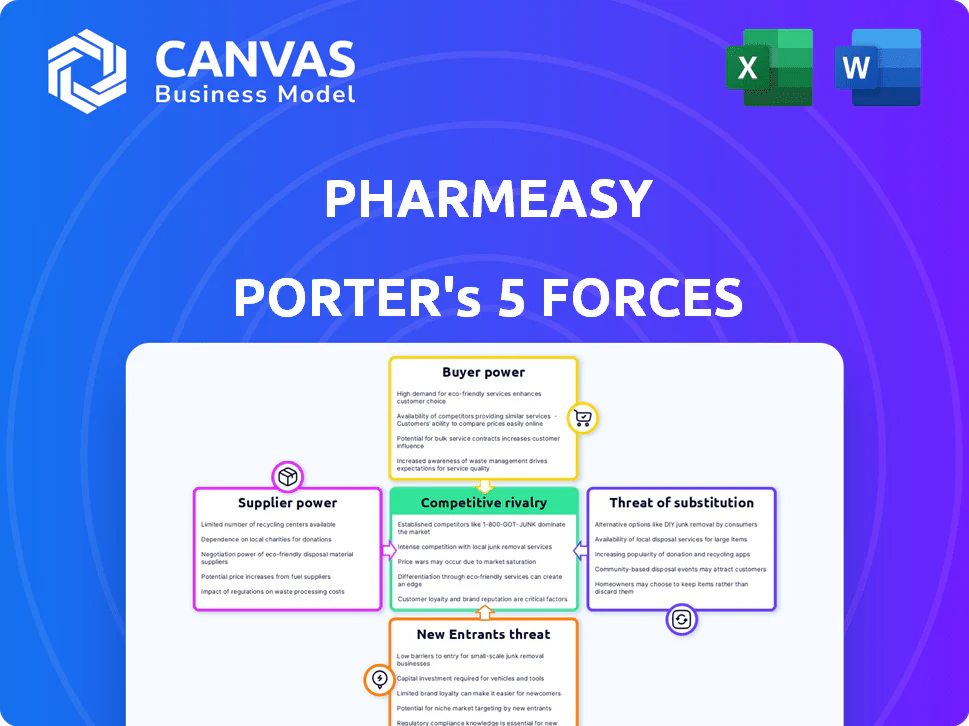
PHARMEASY PORTER'S FIVE FORCES TEMPLATE RESEARCH

A Must-Have Tool for Decision-Makers
PharmEasy faces intense buyer pressure, margin-squeezing competition, and regulatory headwinds that shape its growth trajectory; this snapshot highlights key tensions but omits force-by-force scoring and scenario analysis.
Suppliers Bargaining Power

Pharmaceutical Manufacturer Dominance
Large pharma firms like Sun Pharma and Cipla wield high supplier power because branded drugs-responsible for ~45% of Indian prescription sales in 2025-are often non-substitutable, forcing PharmEasy to prioritize supply continuity over price.
Dependency on Logistics and Delivery Partners
PharmEasy depends on third-party fleets and local partners for ~70% of deliveries; in FY2025 logistics costs rose 18% as fuel prices climbed and gig-worker wage demands pushed partner margin requests up 12 percentage points.

Technology and Cloud Infrastructure Costs
PharmEasy relies on AWS and Google Cloud for 2025-scale operations, with estimated cloud spend around $45-60M annually (2025 fiscal), making provider switching costly and slow.
High-end cybersecurity and uptime SLAs push fixed tech costs up; global cloud price inflation of ~8-12% in 2024-25 strengthens vendor leverage.
These entrenched costs reduce PharmEasy's negotiation room, as migration risks and data gravity raise effective supplier power.

Diagnostic Lab Accreditation and Quality
PharmEasy's 2025 Thyrocare integration leaves it reliant on certified labs and 12,000+ phlebotomists who can command higher revenue shares-industry reports show lab partners take 18-28% of test revenues for specialized services.
Because consumer trust links to speed and accuracy, top-tier labs hold negotiating leverage; turnaround times under 24 hours and accuracy >99% raise switching costs and margin pressure for PharmEasy.
For niche tests (genetic/oncology), the supplier pool is <500 accredited providers in India (2025), so specialists extract premiums, raising procurement risk and cost volatility for PharmEasy.
- Phlebotomist network: 12,000+ (2025)
- Lab revenue share: 18-28% on specialized tests
- Turnaround benchmark: <24 hours; accuracy >99%
- Accredited niche providers: <500 in India (2025)
Financial Creditors and Capital Providers
Post-2024 debt restructurings left PharmEasy's financial creditors controlling cash allocation; lenders insist on EBITDA-positive targets and quarterly deleveraging metrics tied to ₹1,200-1,500 crore facility covenants.
Capital supply tightened in 2025-26, with creditors limiting growth spend and forcing a shift from market-share chase to margin recovery; customer-acquisition burn was capped below FY2025 levels.
By Q4 2025 creditors required a clear path to profitability, curbing early-2026 marketing and promo outlays and reducing net cash burn guidance by ~35% versus 2024.
- Creditors set EBITDA breakeven deadlines and covenant limits on ₹1,200-1,500 crore facilities
- Funding terms shift: stricter covenants, lower growth capital
- Early-2026 CAC spend capped; net cash burn guidance cut ~35% vs 2024
High supplier power: branded Rx, costly logistics & cloud squeeze margins
Supplier power is high: branded pharma non-substitutability drives pricing pressure; logistics partners cover ~70% deliveries and raised margins 12ppt in FY2025; cloud spend ~$50M (2025) and lab/phlebotomist reliance (12,000+; lab revenue share 18-28%) raise switching costs and squeeze margins.
| Metric | 2025 |
|---|---|
| Branded Rx share | ~45% |
| Logistics coverage | ~70% |
| Logistics margin rise | +12 ppt |
| Cloud spend | ~$50M |
| Phlebotomists | 12,000+ |
| Lab revenue share | 18-28% |
What is included in the product
 Detailed Word Document
Tailored exclusively for PharmEasy, this Porter's Five Forces overview uncovers key drivers of competition, buyer and supplier bargaining power, entry barriers, substitutes, and disruptive threats shaping its pricing, margins, and market positioning.

 Customizable Excel Spreadsheet
A concise Porter's Five Forces snapshot tailored to PharmEasy-quickly identify competitive pressures, supplier leverage, and bargaining threats to guide tactical moves.
Customers Bargaining Power

Low Switching Costs in a Digital Ecosystem
Consumers can switch between PharmEasy, Tata 1mg, and Apollo 24/7 with a single click; 2025 surveys show 68% of Indian digital-health users cite ease of switching as top reason for changing platforms.
Digital prescription portability and interoperable EHRs in 2025 cut customer stickiness; 54% of patients moved providers last year due to better app features.
This forces PharmEasy to reinvest: management disclosed INR 420 crore spent on marketing and loyalty in FY2025 to curb churn and improve user experience.
High Price Sensitivity and Discount Hunting
Indian consumers are highly price-sensitive: 72% compare final checkout prices across apps, per a 2025 RedSeer survey, so even ₹10-₹20 gaps trigger cart abandonment for PharmEasy.
Discount hunting and promo-driven buying make medicines feel commoditized, forcing PharmEasy to match offers and eroding gross margins, which stood at ~18% in FY2025.
This relentless price competition caps PharmEasy's pricing power and constrains its ability to increase average selling price without risking share loss.

Demand for Hyper-Local Delivery Speeds
Customers now expect 30-60 minute delivery for acute meds; quick-commerce growth (India Q4 2025: 40% YoY for instant grocery) lets them ditch platforms with next-day slots, raising PharmEasy churn risk.
Building hyper-local hubs and courier networks adds capital and opex-est. incremental cost ~INR 150-300 per order-yet <1% of users pay extra, squeezing margins.

Information Transparency and Generic Alternatives
Customers use price-comparison apps and PharmEasy's transparency tools to spot generics; in 2025, generic penetration in India reached ~68%, pressuring branded margins and cutting PharmEasy's average order value (AOV) by an estimated 6-9% versus 2023 levels.
PharmEasy must display generic options and price breakdowns, or risk losing orders to low-margin alternatives and shrinking gross margins, with pharmacy-margin compression visible in 2025 GP% trends.
- High info access: ~70% shoppers use price tools
- Generics share: ~68% of prescriptions (2025)
- AOV impact: -6-9% vs 2023
- Margin pressure: lower gross profit % in 2025
Leverage of Corporate and Insurance Clients
PharmEasy's 2025 B2B mix: ~28% of GMV comes from insurance and corporate wellness, letting buyers demand bulk discounts and 60-90-day payment terms that retail users can't.
Those contracts lift order volume but cut net take rate by an estimated 4-7 percentage points versus retail, pressuring gross margin (FY2025 gross margin 18.2%).
Institutional buyers also push data, SLAs, and returns policies, raising fulfilment cost and working-capital needs.
- ~28% GMV from B2B (FY2025)
- Net take rate hit: -4-7 pp vs retail
- FY2025 gross margin: 18.2%
- Payment terms: 60-90 days
Customer leverage forces PharmEasy into INR420cr marketing push and margin squeeze
High switching (68% cite ease), price sensitivity (72% compare prices), and generic penetration (~68%) gave customers strong leverage in 2025, forcing PharmEasy to spend INR 420 crore on marketing and accept FY2025 gross margin ~18.2%; B2B mix (~28% GMV) further pressured take-rates (-4-7 pp) and increased working-capital needs.
| Metric | 2025 |
|---|---|
| Switching intent | 68% |
| Price-check users | 72% |
| Generics share | 68% |
| Marketing & loyalty spend | INR 420 crore |
| FY2025 gross margin | 18.2% |
| B2B GMV | 28% |
| Net take rate hit (B2B) | -4-7 pp |
Preview Before You Purchase
PharmEasy Porter's Five Forces Analysis
This preview shows the exact PharmEasy Porter's Five Forces analysis you'll receive immediately after purchase-no placeholders, no mockups, fully formatted and ready for download.

PHARMEASY PORTER'S FIVE FORCES TEMPLATE RESEARCH
A Must-Have Tool for Decision-Makers
PharmEasy faces intense buyer pressure, margin-squeezing competition, and regulatory headwinds that shape its growth trajectory; this snapshot highlights key tensions but omits force-by-force scoring and scenario analysis.
Suppliers Bargaining Power
Pharmaceutical Manufacturer Dominance
Large pharma firms like Sun Pharma and Cipla wield high supplier power because branded drugs-responsible for ~45% of Indian prescription sales in 2025-are often non-substitutable, forcing PharmEasy to prioritize supply continuity over price.
Dependency on Logistics and Delivery Partners
PharmEasy depends on third-party fleets and local partners for ~70% of deliveries; in FY2025 logistics costs rose 18% as fuel prices climbed and gig-worker wage demands pushed partner margin requests up 12 percentage points.
Technology and Cloud Infrastructure Costs
PharmEasy relies on AWS and Google Cloud for 2025-scale operations, with estimated cloud spend around $45-60M annually (2025 fiscal), making provider switching costly and slow.
High-end cybersecurity and uptime SLAs push fixed tech costs up; global cloud price inflation of ~8-12% in 2024-25 strengthens vendor leverage.
These entrenched costs reduce PharmEasy's negotiation room, as migration risks and data gravity raise effective supplier power.
Diagnostic Lab Accreditation and Quality
PharmEasy's 2025 Thyrocare integration leaves it reliant on certified labs and 12,000+ phlebotomists who can command higher revenue shares-industry reports show lab partners take 18-28% of test revenues for specialized services.
Because consumer trust links to speed and accuracy, top-tier labs hold negotiating leverage; turnaround times under 24 hours and accuracy >99% raise switching costs and margin pressure for PharmEasy.
For niche tests (genetic/oncology), the supplier pool is <500 accredited providers in India (2025), so specialists extract premiums, raising procurement risk and cost volatility for PharmEasy.
- Phlebotomist network: 12,000+ (2025)
- Lab revenue share: 18-28% on specialized tests
- Turnaround benchmark: <24 hours; accuracy >99%
- Accredited niche providers: <500 in India (2025)
Financial Creditors and Capital Providers
Post-2024 debt restructurings left PharmEasy's financial creditors controlling cash allocation; lenders insist on EBITDA-positive targets and quarterly deleveraging metrics tied to ₹1,200-1,500 crore facility covenants.
Capital supply tightened in 2025-26, with creditors limiting growth spend and forcing a shift from market-share chase to margin recovery; customer-acquisition burn was capped below FY2025 levels.
By Q4 2025 creditors required a clear path to profitability, curbing early-2026 marketing and promo outlays and reducing net cash burn guidance by ~35% versus 2024.
- Creditors set EBITDA breakeven deadlines and covenant limits on ₹1,200-1,500 crore facilities
- Funding terms shift: stricter covenants, lower growth capital
- Early-2026 CAC spend capped; net cash burn guidance cut ~35% vs 2024
High supplier power: branded Rx, costly logistics & cloud squeeze margins
Supplier power is high: branded pharma non-substitutability drives pricing pressure; logistics partners cover ~70% deliveries and raised margins 12ppt in FY2025; cloud spend ~$50M (2025) and lab/phlebotomist reliance (12,000+; lab revenue share 18-28%) raise switching costs and squeeze margins.
| Metric | 2025 |
|---|---|
| Branded Rx share | ~45% |
| Logistics coverage | ~70% |
| Logistics margin rise | +12 ppt |
| Cloud spend | ~$50M |
| Phlebotomists | 12,000+ |
| Lab revenue share | 18-28% |
What is included in the product
Detailed Word Document
Tailored exclusively for PharmEasy, this Porter's Five Forces overview uncovers key drivers of competition, buyer and supplier bargaining power, entry barriers, substitutes, and disruptive threats shaping its pricing, margins, and market positioning.
Customizable Excel Spreadsheet
A concise Porter's Five Forces snapshot tailored to PharmEasy-quickly identify competitive pressures, supplier leverage, and bargaining threats to guide tactical moves.
Customers Bargaining Power
Low Switching Costs in a Digital Ecosystem
Consumers can switch between PharmEasy, Tata 1mg, and Apollo 24/7 with a single click; 2025 surveys show 68% of Indian digital-health users cite ease of switching as top reason for changing platforms.
Digital prescription portability and interoperable EHRs in 2025 cut customer stickiness; 54% of patients moved providers last year due to better app features.
This forces PharmEasy to reinvest: management disclosed INR 420 crore spent on marketing and loyalty in FY2025 to curb churn and improve user experience.
High Price Sensitivity and Discount Hunting
Indian consumers are highly price-sensitive: 72% compare final checkout prices across apps, per a 2025 RedSeer survey, so even ₹10-₹20 gaps trigger cart abandonment for PharmEasy.
Discount hunting and promo-driven buying make medicines feel commoditized, forcing PharmEasy to match offers and eroding gross margins, which stood at ~18% in FY2025.
This relentless price competition caps PharmEasy's pricing power and constrains its ability to increase average selling price without risking share loss.
Demand for Hyper-Local Delivery Speeds
Customers now expect 30-60 minute delivery for acute meds; quick-commerce growth (India Q4 2025: 40% YoY for instant grocery) lets them ditch platforms with next-day slots, raising PharmEasy churn risk.
Building hyper-local hubs and courier networks adds capital and opex-est. incremental cost ~INR 150-300 per order-yet <1% of users pay extra, squeezing margins.
Information Transparency and Generic Alternatives
Customers use price-comparison apps and PharmEasy's transparency tools to spot generics; in 2025, generic penetration in India reached ~68%, pressuring branded margins and cutting PharmEasy's average order value (AOV) by an estimated 6-9% versus 2023 levels.
PharmEasy must display generic options and price breakdowns, or risk losing orders to low-margin alternatives and shrinking gross margins, with pharmacy-margin compression visible in 2025 GP% trends.
- High info access: ~70% shoppers use price tools
- Generics share: ~68% of prescriptions (2025)
- AOV impact: -6-9% vs 2023
- Margin pressure: lower gross profit % in 2025
Leverage of Corporate and Insurance Clients
PharmEasy's 2025 B2B mix: ~28% of GMV comes from insurance and corporate wellness, letting buyers demand bulk discounts and 60-90-day payment terms that retail users can't.
Those contracts lift order volume but cut net take rate by an estimated 4-7 percentage points versus retail, pressuring gross margin (FY2025 gross margin 18.2%).
Institutional buyers also push data, SLAs, and returns policies, raising fulfilment cost and working-capital needs.
- ~28% GMV from B2B (FY2025)
- Net take rate hit: -4-7 pp vs retail
- FY2025 gross margin: 18.2%
- Payment terms: 60-90 days
Customer leverage forces PharmEasy into INR420cr marketing push and margin squeeze
High switching (68% cite ease), price sensitivity (72% compare prices), and generic penetration (~68%) gave customers strong leverage in 2025, forcing PharmEasy to spend INR 420 crore on marketing and accept FY2025 gross margin ~18.2%; B2B mix (~28% GMV) further pressured take-rates (-4-7 pp) and increased working-capital needs.
| Metric | 2025 |
|---|---|
| Switching intent | 68% |
| Price-check users | 72% |
| Generics share | 68% |
| Marketing & loyalty spend | INR 420 crore |
| FY2025 gross margin | 18.2% |
| B2B GMV | 28% |
| Net take rate hit (B2B) | -4-7 pp |
Preview Before You Purchase
PharmEasy Porter's Five Forces Analysis
This preview shows the exact PharmEasy Porter's Five Forces analysis you'll receive immediately after purchase-no placeholders, no mockups, fully formatted and ready for download.
Product Information
Product Information
Shipping & Returns
Shipping & Returns
Description
A Must-Have Tool for Decision-Makers
PharmEasy faces intense buyer pressure, margin-squeezing competition, and regulatory headwinds that shape its growth trajectory; this snapshot highlights key tensions but omits force-by-force scoring and scenario analysis.
Suppliers Bargaining Power
Pharmaceutical Manufacturer Dominance
Large pharma firms like Sun Pharma and Cipla wield high supplier power because branded drugs-responsible for ~45% of Indian prescription sales in 2025-are often non-substitutable, forcing PharmEasy to prioritize supply continuity over price.
Dependency on Logistics and Delivery Partners
PharmEasy depends on third-party fleets and local partners for ~70% of deliveries; in FY2025 logistics costs rose 18% as fuel prices climbed and gig-worker wage demands pushed partner margin requests up 12 percentage points.
Technology and Cloud Infrastructure Costs
PharmEasy relies on AWS and Google Cloud for 2025-scale operations, with estimated cloud spend around $45-60M annually (2025 fiscal), making provider switching costly and slow.
High-end cybersecurity and uptime SLAs push fixed tech costs up; global cloud price inflation of ~8-12% in 2024-25 strengthens vendor leverage.
These entrenched costs reduce PharmEasy's negotiation room, as migration risks and data gravity raise effective supplier power.
Diagnostic Lab Accreditation and Quality
PharmEasy's 2025 Thyrocare integration leaves it reliant on certified labs and 12,000+ phlebotomists who can command higher revenue shares-industry reports show lab partners take 18-28% of test revenues for specialized services.
Because consumer trust links to speed and accuracy, top-tier labs hold negotiating leverage; turnaround times under 24 hours and accuracy >99% raise switching costs and margin pressure for PharmEasy.
For niche tests (genetic/oncology), the supplier pool is <500 accredited providers in India (2025), so specialists extract premiums, raising procurement risk and cost volatility for PharmEasy.
- Phlebotomist network: 12,000+ (2025)
- Lab revenue share: 18-28% on specialized tests
- Turnaround benchmark: <24 hours; accuracy >99%
- Accredited niche providers: <500 in India (2025)
Financial Creditors and Capital Providers
Post-2024 debt restructurings left PharmEasy's financial creditors controlling cash allocation; lenders insist on EBITDA-positive targets and quarterly deleveraging metrics tied to ₹1,200-1,500 crore facility covenants.
Capital supply tightened in 2025-26, with creditors limiting growth spend and forcing a shift from market-share chase to margin recovery; customer-acquisition burn was capped below FY2025 levels.
By Q4 2025 creditors required a clear path to profitability, curbing early-2026 marketing and promo outlays and reducing net cash burn guidance by ~35% versus 2024.
- Creditors set EBITDA breakeven deadlines and covenant limits on ₹1,200-1,500 crore facilities
- Funding terms shift: stricter covenants, lower growth capital
- Early-2026 CAC spend capped; net cash burn guidance cut ~35% vs 2024
High supplier power: branded Rx, costly logistics & cloud squeeze margins
Supplier power is high: branded pharma non-substitutability drives pricing pressure; logistics partners cover ~70% deliveries and raised margins 12ppt in FY2025; cloud spend ~$50M (2025) and lab/phlebotomist reliance (12,000+; lab revenue share 18-28%) raise switching costs and squeeze margins.
| Metric | 2025 |
|---|---|
| Branded Rx share | ~45% |
| Logistics coverage | ~70% |
| Logistics margin rise | +12 ppt |
| Cloud spend | ~$50M |
| Phlebotomists | 12,000+ |
| Lab revenue share | 18-28% |
What is included in the product
Detailed Word Document
Tailored exclusively for PharmEasy, this Porter's Five Forces overview uncovers key drivers of competition, buyer and supplier bargaining power, entry barriers, substitutes, and disruptive threats shaping its pricing, margins, and market positioning.
Customizable Excel Spreadsheet
A concise Porter's Five Forces snapshot tailored to PharmEasy-quickly identify competitive pressures, supplier leverage, and bargaining threats to guide tactical moves.
Customers Bargaining Power
Low Switching Costs in a Digital Ecosystem
Consumers can switch between PharmEasy, Tata 1mg, and Apollo 24/7 with a single click; 2025 surveys show 68% of Indian digital-health users cite ease of switching as top reason for changing platforms.
Digital prescription portability and interoperable EHRs in 2025 cut customer stickiness; 54% of patients moved providers last year due to better app features.
This forces PharmEasy to reinvest: management disclosed INR 420 crore spent on marketing and loyalty in FY2025 to curb churn and improve user experience.
High Price Sensitivity and Discount Hunting
Indian consumers are highly price-sensitive: 72% compare final checkout prices across apps, per a 2025 RedSeer survey, so even ₹10-₹20 gaps trigger cart abandonment for PharmEasy.
Discount hunting and promo-driven buying make medicines feel commoditized, forcing PharmEasy to match offers and eroding gross margins, which stood at ~18% in FY2025.
This relentless price competition caps PharmEasy's pricing power and constrains its ability to increase average selling price without risking share loss.
Demand for Hyper-Local Delivery Speeds
Customers now expect 30-60 minute delivery for acute meds; quick-commerce growth (India Q4 2025: 40% YoY for instant grocery) lets them ditch platforms with next-day slots, raising PharmEasy churn risk.
Building hyper-local hubs and courier networks adds capital and opex-est. incremental cost ~INR 150-300 per order-yet <1% of users pay extra, squeezing margins.
Information Transparency and Generic Alternatives
Customers use price-comparison apps and PharmEasy's transparency tools to spot generics; in 2025, generic penetration in India reached ~68%, pressuring branded margins and cutting PharmEasy's average order value (AOV) by an estimated 6-9% versus 2023 levels.
PharmEasy must display generic options and price breakdowns, or risk losing orders to low-margin alternatives and shrinking gross margins, with pharmacy-margin compression visible in 2025 GP% trends.
- High info access: ~70% shoppers use price tools
- Generics share: ~68% of prescriptions (2025)
- AOV impact: -6-9% vs 2023
- Margin pressure: lower gross profit % in 2025
Leverage of Corporate and Insurance Clients
PharmEasy's 2025 B2B mix: ~28% of GMV comes from insurance and corporate wellness, letting buyers demand bulk discounts and 60-90-day payment terms that retail users can't.
Those contracts lift order volume but cut net take rate by an estimated 4-7 percentage points versus retail, pressuring gross margin (FY2025 gross margin 18.2%).
Institutional buyers also push data, SLAs, and returns policies, raising fulfilment cost and working-capital needs.
- ~28% GMV from B2B (FY2025)
- Net take rate hit: -4-7 pp vs retail
- FY2025 gross margin: 18.2%
- Payment terms: 60-90 days
Customer leverage forces PharmEasy into INR420cr marketing push and margin squeeze
High switching (68% cite ease), price sensitivity (72% compare prices), and generic penetration (~68%) gave customers strong leverage in 2025, forcing PharmEasy to spend INR 420 crore on marketing and accept FY2025 gross margin ~18.2%; B2B mix (~28% GMV) further pressured take-rates (-4-7 pp) and increased working-capital needs.
| Metric | 2025 |
|---|---|
| Switching intent | 68% |
| Price-check users | 72% |
| Generics share | 68% |
| Marketing & loyalty spend | INR 420 crore |
| FY2025 gross margin | 18.2% |
| B2B GMV | 28% |
| Net take rate hit (B2B) | -4-7 pp |
Preview Before You Purchase
PharmEasy Porter's Five Forces Analysis
This preview shows the exact PharmEasy Porter's Five Forces analysis you'll receive immediately after purchase-no placeholders, no mockups, fully formatted and ready for download.











