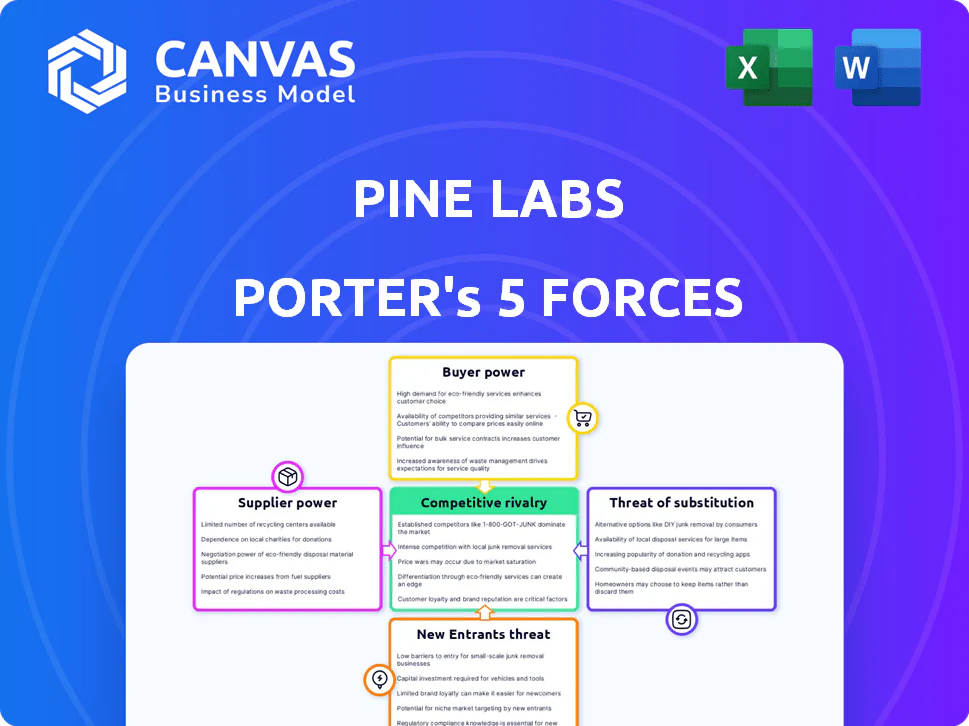
PINE LABS PORTER'S FIVE FORCES TEMPLATE RESEARCH

Go Beyond the Preview-Access the Full Strategic Report
Pine Labs faces strong buyer pressure, moderate supplier influence, intense fintech rivalry, manageable new-entrant barriers, and rising substitute threats from digital payments-this snapshot highlights key dynamics but only scratches the surface. Unlock the full Porter's Five Forces Analysis to explore Pine Labs's competitive position, force-by-force ratings, visuals, and actionable strategy insights.
Suppliers Bargaining Power

Concentration of Payment Networks
Global payment networks Visa, Mastercard, and RuPay set protocols and fee schedules that strongly constrain Pine Labs; these networks process the rails for card interchange and rule pricing. Pine Labs channels about 30% of 2025 revenue via its issuing and processing business, so a 10-20 bps rise in interchange could cut EBITDA materially. Despite Pine Labs' scale, the oligopoly lets networks impose largely non‑negotiable fee changes, raising supplier leverage.
Dependence on Cloud Infrastructure Providers
Pine Labs depends on hyperscalers-Amazon Web Services, Google Cloud, and Microsoft Azure-to sustain 99.9% uptime and process 5.6 billion transactions yearly, giving these suppliers leverage.
From its 2025 IPO, Pine Labs allocated about $27 million (₹2,300 million) for cloud infrastructure, underscoring supplier importance.
High data migration costs create lock-in, so cloud providers hold moderate to high bargaining power over Pine Labs.

Specialized Hardware Component Manufacturers
Specialized hardware suppliers hold high bargaining power because DCPs and Android POS need specific semiconductors and secure modules, and global chip shortages raised component lead times by ~20% in 2024-25. Pine Labs allocated $51 million (₹4,300 million) for device procurement in FY2025-26 to serve ~1 million merchants, and PCI-DSS recertification makes supplier switches slow and costly.

Regulatory and Compliance Service Providers
Regulatory and compliance service providers wield high supplier power for Pine Labs because RBI and regional regulators in 2025 increased audits; Pine Labs uses niche cybersecurity and audit firms to keep licenses across India, Southeast Asia, and the Middle East.
These firms offer crucial regulatory air cover; scarcity of cross-border fintech auditors raises switching costs and negotiating leverage-noncompliance with 2025 data-localization laws (e.g., India's stricter rules) could cost licenses and revenue streams.
- RBI/region tightened audits in 2025
- Few firms audit cross-border fintech stacks
- Data-localization breaches risk license loss
- Compliance partners thus indispensable
Financial Institution Partnerships
Pine Labs bridges merchants and 177 financial institutions, including HDFC Bank, Axis Bank, and ICICI Bank, which supply settlement accounts and credit lines crucial for merchant lending-a high-margin growth area that drove Pine Labs' BNPL and EMI volume to about INR 6,200 crore in FY2025.
Though Pine Labs supplies POS and software, banks control capital; loss of a major partner would sharply impair Pay Later and EMI offerings to 716 enterprise brands and could cut receivables funding by a large share.
- 177 banking partners
- Includes HDFC, Axis, ICICI
- 716 enterprise brands served
- BNPL/EMI volume ~INR 6,200 crore (FY2025)
Supplier power threatens Pine Labs: card fees, banks, cloud and hardware risk EBITDA
Suppliers-card networks, hyperscalers, chip vendors, compliance auditors, and banks-hold significant bargaining power over Pine Labs in 2025; card-network fee shifts (10-20 bps) or loss of bank partners could materially cut EBITDA and receivables funding. Cloud and hardware lock‑in plus tightened RBI audits raise switching costs and supplier leverage.
| Supplier | 2025 Key metric |
|---|---|
| Card networks | 30% rev via issuing/processing; 10-20 bps impact |
| Hyperscalers | $27m (₹2,300m) infra spend (IPO allocation) |
| Hardware vendors | $51m (₹4,300m) device procurement |
| Banks | 177 partners; BNPL/EMI ₹6,200cr volume |
What is included in the product
 Detailed Word Document
Tailored Porter's Five Forces analysis for Pine Labs that uncovers competitive drivers, buyer/supplier power, entry barriers, substitutes, and disruptive threats to assess pricing power and strategic vulnerabilities.

 Customizable Excel Spreadsheet
A concise Porter's Five Forces one-pager for Pine Labs-quickly spot competitive threats and bargaining pressures to guide decisive action.
Customers Bargaining Power

High Concentration Among Enterprise Clients
High concentration: 716 anchor enterprise clients-including McDonald's, Starbucks, and major e-commerce players-drive a large share of Pine Labs' volume and wield strong bargaining power to demand lower fees or bespoke integrations.
Losing one top-tier client would dent Pine Labs' $137 billion 2025 Gross Transaction Value (GTV), showing material revenue and fee-pressure risk.
Low Switching Costs for Small Merchants
While Pine Labs' enterprise clients are deeply integrated, nearly 1 million SMBs in its 2025 network face low switching costs; competitors Razorpay, PhonePe, and Square increased SMB share gains by offering plug‑and‑play terminals and incentives, helping Square onboard ~150k POS users in 2024-25 alone.

Price Sensitivity in Low-Margin Markets
Pine Labs operates in a thin‑margin acquiring market, with a revenue‑to‑volume ratio near 0.2% as of late 2025, so small fee hikes cut into merchant economics quickly.
Merchants react strongly to MDR or POS rental rises; studies show >30% of SMEs consider switching for even 10-20 bps savings, constraining Pine Labs' pricing power.
Higher fees risk churn to UPI QR solutions that avoid card‑swipe fees; UPI accounted for ~60% of retail digital transactions in India by value in 2025, raising substitution threat.

Increased Information Symmetry
In 2026 merchants use marketplaces showing transparent pricing and reviews-searches show average gateway fee spreads fell to 0.4 percentage points, cutting legacy providers' information edge and letting SMBs pick the lowest-cost option.
Thus Pine Labs must defend premium pricing by delivering measurable value: faster settlements (targeting 24‑48h vs industry 72h) and analytics that lift merchant GMV by >5% annually.
- Fee spread: 0.4 pp (2026)
- Settlement target: 24‑48h vs 72h
- Analytics uplift: >5% merchant GMV
Demand for Unified Omnichannel Solutions
Modern merchants seek a single Merchant OS combining POS and online gateways; Pine Labs now bundles its Plural gateway with terminals to capture this shift-failure risks churn to digital-first rivals. In FY2025 Pine Labs reported ~₹13,200 crore TPV and grew merchant count 18% YoY, so omnichannel gaps would jeopardize this scale versus Stripe/Adyen global growth.
- Pine Labs FY2025 TPV ~₹13,200 crore
- Merchant base +18% YoY in 2025
- Risk: consolidation to Stripe/Adyen with stronger online stacks
Pine Labs risk concentrated: 716 anchors, $137B GTV, 60% UPI cap on pricing
High buyer power: 716 anchor clients drive volumes; Pine Labs' 2025 GTV $137B and FY2025 TPV ₹13,200cr concentrate risk. SMBs (~1M) face low switching costs; UPI ~60% value share (2025) and 0.4pp fee spreads cap pricing. Pine Labs must protect margins via 24-48h settlements and >5% analytics uplift.
| Metric | 2025 |
|---|---|
| GTV | $137B |
| TPV | ₹13,200cr |
| Major clients | 716 |
| SMBs | ~1,000,000 |
| UPI share | ~60% |
Preview Before You Purchase
Pine Labs Porter's Five Forces Analysis
This preview shows the exact Pine Labs Porter's Five Forces analysis you'll receive-fully written, professionally formatted, and ready to download immediately after purchase; no placeholders, no mockups, and no surprise edits required.

PINE LABS PORTER'S FIVE FORCES TEMPLATE RESEARCH
Go Beyond the Preview-Access the Full Strategic Report
Pine Labs faces strong buyer pressure, moderate supplier influence, intense fintech rivalry, manageable new-entrant barriers, and rising substitute threats from digital payments-this snapshot highlights key dynamics but only scratches the surface. Unlock the full Porter's Five Forces Analysis to explore Pine Labs's competitive position, force-by-force ratings, visuals, and actionable strategy insights.
Suppliers Bargaining Power
Concentration of Payment Networks
Global payment networks Visa, Mastercard, and RuPay set protocols and fee schedules that strongly constrain Pine Labs; these networks process the rails for card interchange and rule pricing. Pine Labs channels about 30% of 2025 revenue via its issuing and processing business, so a 10-20 bps rise in interchange could cut EBITDA materially. Despite Pine Labs' scale, the oligopoly lets networks impose largely non‑negotiable fee changes, raising supplier leverage.
Dependence on Cloud Infrastructure Providers
Pine Labs depends on hyperscalers-Amazon Web Services, Google Cloud, and Microsoft Azure-to sustain 99.9% uptime and process 5.6 billion transactions yearly, giving these suppliers leverage.
From its 2025 IPO, Pine Labs allocated about $27 million (₹2,300 million) for cloud infrastructure, underscoring supplier importance.
High data migration costs create lock-in, so cloud providers hold moderate to high bargaining power over Pine Labs.
Specialized Hardware Component Manufacturers
Specialized hardware suppliers hold high bargaining power because DCPs and Android POS need specific semiconductors and secure modules, and global chip shortages raised component lead times by ~20% in 2024-25. Pine Labs allocated $51 million (₹4,300 million) for device procurement in FY2025-26 to serve ~1 million merchants, and PCI-DSS recertification makes supplier switches slow and costly.
Regulatory and Compliance Service Providers
Regulatory and compliance service providers wield high supplier power for Pine Labs because RBI and regional regulators in 2025 increased audits; Pine Labs uses niche cybersecurity and audit firms to keep licenses across India, Southeast Asia, and the Middle East.
These firms offer crucial regulatory air cover; scarcity of cross-border fintech auditors raises switching costs and negotiating leverage-noncompliance with 2025 data-localization laws (e.g., India's stricter rules) could cost licenses and revenue streams.
- RBI/region tightened audits in 2025
- Few firms audit cross-border fintech stacks
- Data-localization breaches risk license loss
- Compliance partners thus indispensable
Financial Institution Partnerships
Pine Labs bridges merchants and 177 financial institutions, including HDFC Bank, Axis Bank, and ICICI Bank, which supply settlement accounts and credit lines crucial for merchant lending-a high-margin growth area that drove Pine Labs' BNPL and EMI volume to about INR 6,200 crore in FY2025.
Though Pine Labs supplies POS and software, banks control capital; loss of a major partner would sharply impair Pay Later and EMI offerings to 716 enterprise brands and could cut receivables funding by a large share.
- 177 banking partners
- Includes HDFC, Axis, ICICI
- 716 enterprise brands served
- BNPL/EMI volume ~INR 6,200 crore (FY2025)
Supplier power threatens Pine Labs: card fees, banks, cloud and hardware risk EBITDA
Suppliers-card networks, hyperscalers, chip vendors, compliance auditors, and banks-hold significant bargaining power over Pine Labs in 2025; card-network fee shifts (10-20 bps) or loss of bank partners could materially cut EBITDA and receivables funding. Cloud and hardware lock‑in plus tightened RBI audits raise switching costs and supplier leverage.
| Supplier | 2025 Key metric |
|---|---|
| Card networks | 30% rev via issuing/processing; 10-20 bps impact |
| Hyperscalers | $27m (₹2,300m) infra spend (IPO allocation) |
| Hardware vendors | $51m (₹4,300m) device procurement |
| Banks | 177 partners; BNPL/EMI ₹6,200cr volume |
What is included in the product
Detailed Word Document
Tailored Porter's Five Forces analysis for Pine Labs that uncovers competitive drivers, buyer/supplier power, entry barriers, substitutes, and disruptive threats to assess pricing power and strategic vulnerabilities.
Customizable Excel Spreadsheet
A concise Porter's Five Forces one-pager for Pine Labs-quickly spot competitive threats and bargaining pressures to guide decisive action.
Customers Bargaining Power
High Concentration Among Enterprise Clients
High concentration: 716 anchor enterprise clients-including McDonald's, Starbucks, and major e-commerce players-drive a large share of Pine Labs' volume and wield strong bargaining power to demand lower fees or bespoke integrations.
Losing one top-tier client would dent Pine Labs' $137 billion 2025 Gross Transaction Value (GTV), showing material revenue and fee-pressure risk.
Low Switching Costs for Small Merchants
While Pine Labs' enterprise clients are deeply integrated, nearly 1 million SMBs in its 2025 network face low switching costs; competitors Razorpay, PhonePe, and Square increased SMB share gains by offering plug‑and‑play terminals and incentives, helping Square onboard ~150k POS users in 2024-25 alone.
Price Sensitivity in Low-Margin Markets
Pine Labs operates in a thin‑margin acquiring market, with a revenue‑to‑volume ratio near 0.2% as of late 2025, so small fee hikes cut into merchant economics quickly.
Merchants react strongly to MDR or POS rental rises; studies show >30% of SMEs consider switching for even 10-20 bps savings, constraining Pine Labs' pricing power.
Higher fees risk churn to UPI QR solutions that avoid card‑swipe fees; UPI accounted for ~60% of retail digital transactions in India by value in 2025, raising substitution threat.
Increased Information Symmetry
In 2026 merchants use marketplaces showing transparent pricing and reviews-searches show average gateway fee spreads fell to 0.4 percentage points, cutting legacy providers' information edge and letting SMBs pick the lowest-cost option.
Thus Pine Labs must defend premium pricing by delivering measurable value: faster settlements (targeting 24‑48h vs industry 72h) and analytics that lift merchant GMV by >5% annually.
- Fee spread: 0.4 pp (2026)
- Settlement target: 24‑48h vs 72h
- Analytics uplift: >5% merchant GMV
Demand for Unified Omnichannel Solutions
Modern merchants seek a single Merchant OS combining POS and online gateways; Pine Labs now bundles its Plural gateway with terminals to capture this shift-failure risks churn to digital-first rivals. In FY2025 Pine Labs reported ~₹13,200 crore TPV and grew merchant count 18% YoY, so omnichannel gaps would jeopardize this scale versus Stripe/Adyen global growth.
- Pine Labs FY2025 TPV ~₹13,200 crore
- Merchant base +18% YoY in 2025
- Risk: consolidation to Stripe/Adyen with stronger online stacks
Pine Labs risk concentrated: 716 anchors, $137B GTV, 60% UPI cap on pricing
High buyer power: 716 anchor clients drive volumes; Pine Labs' 2025 GTV $137B and FY2025 TPV ₹13,200cr concentrate risk. SMBs (~1M) face low switching costs; UPI ~60% value share (2025) and 0.4pp fee spreads cap pricing. Pine Labs must protect margins via 24-48h settlements and >5% analytics uplift.
| Metric | 2025 |
|---|---|
| GTV | $137B |
| TPV | ₹13,200cr |
| Major clients | 716 |
| SMBs | ~1,000,000 |
| UPI share | ~60% |
Preview Before You Purchase
Pine Labs Porter's Five Forces Analysis
This preview shows the exact Pine Labs Porter's Five Forces analysis you'll receive-fully written, professionally formatted, and ready to download immediately after purchase; no placeholders, no mockups, and no surprise edits required.
Product Information
Product Information
Shipping & Returns
Shipping & Returns
Description
Go Beyond the Preview-Access the Full Strategic Report
Pine Labs faces strong buyer pressure, moderate supplier influence, intense fintech rivalry, manageable new-entrant barriers, and rising substitute threats from digital payments-this snapshot highlights key dynamics but only scratches the surface. Unlock the full Porter's Five Forces Analysis to explore Pine Labs's competitive position, force-by-force ratings, visuals, and actionable strategy insights.
Suppliers Bargaining Power
Concentration of Payment Networks
Global payment networks Visa, Mastercard, and RuPay set protocols and fee schedules that strongly constrain Pine Labs; these networks process the rails for card interchange and rule pricing. Pine Labs channels about 30% of 2025 revenue via its issuing and processing business, so a 10-20 bps rise in interchange could cut EBITDA materially. Despite Pine Labs' scale, the oligopoly lets networks impose largely non‑negotiable fee changes, raising supplier leverage.
Dependence on Cloud Infrastructure Providers
Pine Labs depends on hyperscalers-Amazon Web Services, Google Cloud, and Microsoft Azure-to sustain 99.9% uptime and process 5.6 billion transactions yearly, giving these suppliers leverage.
From its 2025 IPO, Pine Labs allocated about $27 million (₹2,300 million) for cloud infrastructure, underscoring supplier importance.
High data migration costs create lock-in, so cloud providers hold moderate to high bargaining power over Pine Labs.
Specialized Hardware Component Manufacturers
Specialized hardware suppliers hold high bargaining power because DCPs and Android POS need specific semiconductors and secure modules, and global chip shortages raised component lead times by ~20% in 2024-25. Pine Labs allocated $51 million (₹4,300 million) for device procurement in FY2025-26 to serve ~1 million merchants, and PCI-DSS recertification makes supplier switches slow and costly.
Regulatory and Compliance Service Providers
Regulatory and compliance service providers wield high supplier power for Pine Labs because RBI and regional regulators in 2025 increased audits; Pine Labs uses niche cybersecurity and audit firms to keep licenses across India, Southeast Asia, and the Middle East.
These firms offer crucial regulatory air cover; scarcity of cross-border fintech auditors raises switching costs and negotiating leverage-noncompliance with 2025 data-localization laws (e.g., India's stricter rules) could cost licenses and revenue streams.
- RBI/region tightened audits in 2025
- Few firms audit cross-border fintech stacks
- Data-localization breaches risk license loss
- Compliance partners thus indispensable
Financial Institution Partnerships
Pine Labs bridges merchants and 177 financial institutions, including HDFC Bank, Axis Bank, and ICICI Bank, which supply settlement accounts and credit lines crucial for merchant lending-a high-margin growth area that drove Pine Labs' BNPL and EMI volume to about INR 6,200 crore in FY2025.
Though Pine Labs supplies POS and software, banks control capital; loss of a major partner would sharply impair Pay Later and EMI offerings to 716 enterprise brands and could cut receivables funding by a large share.
- 177 banking partners
- Includes HDFC, Axis, ICICI
- 716 enterprise brands served
- BNPL/EMI volume ~INR 6,200 crore (FY2025)
Supplier power threatens Pine Labs: card fees, banks, cloud and hardware risk EBITDA
Suppliers-card networks, hyperscalers, chip vendors, compliance auditors, and banks-hold significant bargaining power over Pine Labs in 2025; card-network fee shifts (10-20 bps) or loss of bank partners could materially cut EBITDA and receivables funding. Cloud and hardware lock‑in plus tightened RBI audits raise switching costs and supplier leverage.
| Supplier | 2025 Key metric |
|---|---|
| Card networks | 30% rev via issuing/processing; 10-20 bps impact |
| Hyperscalers | $27m (₹2,300m) infra spend (IPO allocation) |
| Hardware vendors | $51m (₹4,300m) device procurement |
| Banks | 177 partners; BNPL/EMI ₹6,200cr volume |
What is included in the product
Detailed Word Document
Tailored Porter's Five Forces analysis for Pine Labs that uncovers competitive drivers, buyer/supplier power, entry barriers, substitutes, and disruptive threats to assess pricing power and strategic vulnerabilities.
Customizable Excel Spreadsheet
A concise Porter's Five Forces one-pager for Pine Labs-quickly spot competitive threats and bargaining pressures to guide decisive action.
Customers Bargaining Power
High Concentration Among Enterprise Clients
High concentration: 716 anchor enterprise clients-including McDonald's, Starbucks, and major e-commerce players-drive a large share of Pine Labs' volume and wield strong bargaining power to demand lower fees or bespoke integrations.
Losing one top-tier client would dent Pine Labs' $137 billion 2025 Gross Transaction Value (GTV), showing material revenue and fee-pressure risk.
Low Switching Costs for Small Merchants
While Pine Labs' enterprise clients are deeply integrated, nearly 1 million SMBs in its 2025 network face low switching costs; competitors Razorpay, PhonePe, and Square increased SMB share gains by offering plug‑and‑play terminals and incentives, helping Square onboard ~150k POS users in 2024-25 alone.
Price Sensitivity in Low-Margin Markets
Pine Labs operates in a thin‑margin acquiring market, with a revenue‑to‑volume ratio near 0.2% as of late 2025, so small fee hikes cut into merchant economics quickly.
Merchants react strongly to MDR or POS rental rises; studies show >30% of SMEs consider switching for even 10-20 bps savings, constraining Pine Labs' pricing power.
Higher fees risk churn to UPI QR solutions that avoid card‑swipe fees; UPI accounted for ~60% of retail digital transactions in India by value in 2025, raising substitution threat.
Increased Information Symmetry
In 2026 merchants use marketplaces showing transparent pricing and reviews-searches show average gateway fee spreads fell to 0.4 percentage points, cutting legacy providers' information edge and letting SMBs pick the lowest-cost option.
Thus Pine Labs must defend premium pricing by delivering measurable value: faster settlements (targeting 24‑48h vs industry 72h) and analytics that lift merchant GMV by >5% annually.
- Fee spread: 0.4 pp (2026)
- Settlement target: 24‑48h vs 72h
- Analytics uplift: >5% merchant GMV
Demand for Unified Omnichannel Solutions
Modern merchants seek a single Merchant OS combining POS and online gateways; Pine Labs now bundles its Plural gateway with terminals to capture this shift-failure risks churn to digital-first rivals. In FY2025 Pine Labs reported ~₹13,200 crore TPV and grew merchant count 18% YoY, so omnichannel gaps would jeopardize this scale versus Stripe/Adyen global growth.
- Pine Labs FY2025 TPV ~₹13,200 crore
- Merchant base +18% YoY in 2025
- Risk: consolidation to Stripe/Adyen with stronger online stacks
Pine Labs risk concentrated: 716 anchors, $137B GTV, 60% UPI cap on pricing
High buyer power: 716 anchor clients drive volumes; Pine Labs' 2025 GTV $137B and FY2025 TPV ₹13,200cr concentrate risk. SMBs (~1M) face low switching costs; UPI ~60% value share (2025) and 0.4pp fee spreads cap pricing. Pine Labs must protect margins via 24-48h settlements and >5% analytics uplift.
| Metric | 2025 |
|---|---|
| GTV | $137B |
| TPV | ₹13,200cr |
| Major clients | 716 |
| SMBs | ~1,000,000 |
| UPI share | ~60% |
Preview Before You Purchase
Pine Labs Porter's Five Forces Analysis
This preview shows the exact Pine Labs Porter's Five Forces analysis you'll receive-fully written, professionally formatted, and ready to download immediately after purchase; no placeholders, no mockups, and no surprise edits required.











