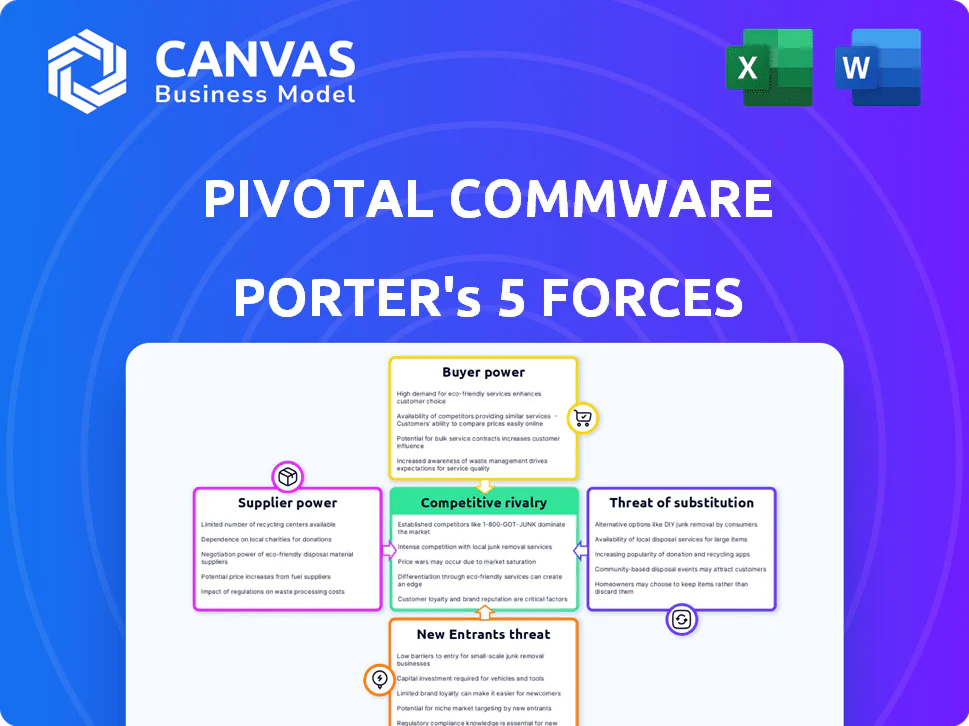
PIVOTAL COMMWARE PORTER'S FIVE FORCES TEMPLATE RESEARCH
What is included in the product
 Detailed Word Document
Analyzes competitive forces, supplier/buyer power, threats, and entry barriers for Pivotal Commware.

 Customizable Excel Spreadsheet
Quickly identify threats with a concise summary of all five forces.
Full Version Awaits
Pivotal Commware Porter's Five Forces Analysis
This preview showcases Pivotal Commware's Porter's Five Forces analysis in its entirety. It examines competitive rivalry, threat of new entrants, supplier power, buyer power, and threat of substitutes. You'll see the detailed breakdown of each force impacting the company's position in the market. The document is fully formatted with professional analysis. This analysis is the same document you'll receive immediately after purchase.

Porter's Five Forces Analysis Template

Don't Miss the Bigger Picture
Pivotal Commware faces complex industry pressures. Its competitive landscape includes established players and disruptive technologies. Supplier power, especially for critical components, is a key factor. Buyer power varies with the deployment scale and customer type. The threat of new entrants and substitute solutions constantly looms. Understanding these forces is vital for strategic planning.
The complete report reveals the real forces shaping Pivotal Commware’s industry—from supplier influence to threat of new entrants. Gain actionable insights to drive smarter decision-making.
Suppliers Bargaining Power

Component Manufacturers
Component manufacturers' bargaining power impacts Pivotal Commware. Concentrated suppliers of unique parts, like metamaterials, hold leverage. Limited suppliers for specialized components allow for higher prices. Pivotal Commware uses MACOM's mmWave, showing supplier reliance. In 2024, MACOM's revenue was $679.9 million, reflecting its market presence.
Technology Licensors
Pivotal Commware's holographic beamforming tech, rooted in metamaterials, involves licensed intellectual property, potentially increasing licensors' bargaining power. Exclusive, essential patents give licensors leverage. In 2024, the licensing market for advanced tech saw significant deal values, suggesting strong licensor influence.

Software and Design Tool Providers
Pivotal Commware relies on software and design tools, like Ansys HFSS. Suppliers of these tools possess bargaining power, especially if their offerings are industry standards or offer unique capabilities. Ansys reported a 16% revenue increase in Q3 2024, indicating strong market position. This suggests that Pivotal Commware's reliance on such tools gives suppliers some leverage.

Manufacturing Partners
Pivotal Commware's reliance on manufacturing partners introduces supplier bargaining power dynamics. These partners, crucial for hardware production, can exert influence. Their power hinges on production volume, process complexity, and alternative manufacturing availability. In 2024, global manufacturing costs saw fluctuations, impacting supplier negotiations.
- Production volume significantly impacts pricing, with larger orders potentially securing better terms.
- Complex manufacturing processes may limit supplier options, increasing their leverage.
- The availability of alternative manufacturers reduces supplier bargaining power.
- Geopolitical factors and supply chain disruptions in 2024 have added complexity.
Talent Pool
Pivotal Commware's access to specialized talent significantly impacts its supplier power. The company needs skilled engineers and researchers in metamaterials and RF engineering. Demand for this talent influences labor costs and innovation capabilities. High demand can increase costs and limit growth potential. In 2024, the median salary for RF engineers was around $120,000 per year.
- Specialized Skills: Metamaterials, RF engineering, software-defined antennas.
- Impact: Influences labor costs and innovation.
- Talent Demand: High demand can increase costs.
- 2024 Data: Median RF engineer salary approximately $120,000.
Supplier Power Dynamics: A Deep Dive
Pivotal Commware faces supplier bargaining power across several fronts. Component suppliers, especially those with unique parts, hold leverage. Licensing of intellectual property and reliance on software tools also give suppliers power. Manufacturing partners and the need for specialized talent further shape supplier dynamics.
| Supplier Type | Bargaining Power Impact | 2024 Data/Examples |
|---|---|---|
| Component Manufacturers | Concentrated suppliers of unique parts hold leverage, allowing for higher prices. | MACOM's 2024 revenue: $679.9M. |
| Licensors | Exclusive patents give licensors leverage. | Licensing market showed strong influence in 2024. |
| Software/Design Tool Providers | Industry standards or unique offerings increase power. | Ansys Q3 2024 revenue increase: 16%. |
| Manufacturing Partners | Power hinges on production volume and complexity. | 2024 manufacturing costs saw fluctuations. |
| Specialized Talent | High demand influences labor costs and innovation. | 2024 median RF engineer salary: ~$120,000. |
Customers Bargaining Power

Mobile Network Operators (MNOs)
Pivotal Commware's main clients are mobile network operators (MNOs) that use its tech to improve 5G networks, especially for mmWave coverage. MNOs like Verizon, an investor in Pivotal, have strong buying power. Verizon spent approximately $1.7 billion on capital expenditures in Q3 2024. Their influence shapes tech standards. Their large-scale deployments give them leverage.
Enterprises and Businesses
Pivotal Commware's FWA solutions serve enterprise clients. Bargaining power varies with deployment size and alternative broadband availability. Larger deployments might lead to greater negotiation leverage. In 2024, the enterprise FWA market saw significant growth, increasing by 20% year-over-year, influenced by demand for high-speed connectivity. This market trend affects customer bargaining power.

End Users (Indirect)
End users, like individuals and businesses, indirectly affect customer bargaining power by demanding fast, reliable wireless services. This demand pushes Mobile Network Operators (MNOs) to invest in technologies, such as holographic beamforming. In 2024, the global mobile data traffic reached 150 exabytes per month, highlighting the immense user demand. Customer satisfaction and churn rates significantly influence MNOs' purchasing choices. A 2024 study showed that a 1% increase in customer satisfaction can lead to a 0.5% rise in revenue for telecom companies.

Government and Regulatory Bodies
Government and regulatory bodies significantly affect customer bargaining power in the wireless infrastructure sector. Spectrum allocation policies, like those from the FCC, dictate available frequencies, impacting the services and technologies, such as Pivotal Commware's, can offer. Network deployment mandates, such as those requiring specific coverage levels, influence infrastructure investments and customer choices. Consumer protection regulations further shape service offerings and pricing structures.
- The FCC's 2024 spectrum auctions generated billions in revenue, influencing network deployment strategies.
- Regulations on network coverage, like those in the US, can mandate service in specific areas, impacting customer access and provider strategies.
- Consumer protection laws in the EU impact pricing and service transparency, affecting customer bargaining power.
Competition Among Customers
The bargaining power of customers, particularly mobile network operators (MNOs), significantly influences Pivotal Commware's market position. Competition among MNOs impacts their price sensitivity and demand for favorable terms. In 2024, the global mobile data traffic increased, intensifying competition among MNOs to attract and retain subscribers. This pressure can lead to MNOs seeking lower prices or better service terms from suppliers like Pivotal Commware.
- Intense competition compels MNOs to seek cost-effective solutions.
- Market dynamics in 2024 show a drive for improved network efficiency.
- MNOs may leverage their scale to negotiate better deals.
- Pivotal Commware must offer competitive pricing.
MNOs' Power Play: Data, Dollars, and Dynamics
Mobile network operators (MNOs) heavily influence Pivotal Commware. Their purchasing power is amplified by market competition and the need for cost-effective solutions. In 2024, global mobile data traffic surged, intensifying MNOs' pressure to optimize costs.
| Factor | Impact | Data (2024) |
|---|---|---|
| MNO Competition | Price Sensitivity | Data traffic increased by 25% |
| Market Dynamics | Efficiency Drive | 5G infrastructure spending: $30B |
| MNO Scale | Negotiating Power | Verizon's CapEx: $1.7B (Q3) |
Rivalry Among Competitors

Direct Competitors in Holographic Beamforming
Pivotal Commware faces competition from companies developing holographic beamforming and alternative wireless communication technologies. Identifying direct rivals is crucial for understanding market dynamics. The market is competitive, with companies like Kymeta also vying for market share. For example, in 2024, the global beamforming market was valued at over $2 billion, indicating significant rivalry.
Companies Offering Alternative Beamforming Technologies
The competitive landscape includes firms like Metawave, ConcealFab, and BeammWave, offering alternative beamforming technologies. These competitors, using phased arrays and massive MIMO, also strive to enhance network capacity and coverage. In 2024, the global 5G infrastructure market, which includes these technologies, is projected to reach $30.9 billion.

Established Telecommunications Equipment Providers
Established players like NEC, Mavenir, and CommScope compete in the telecom equipment market. These firms boast extensive product lines and customer networks. CommScope's 2023 revenue was $4.4 billion, showcasing their market presence. Their resources and reach present a significant challenge to Pivotal Commware.

In-House Development by MNOs
Mobile Network Operators (MNOs) sometimes develop beamforming tech internally. This can lessen their need for external vendors like Pivotal Commware. For example, in 2024, major MNOs spent billions on R&D. This includes exploring in-house 5G and 6G solutions. This in-house focus could intensify competition.
- 2024 R&D spending by top MNOs exceeded $50 billion globally.
- Internal development may lead to proprietary solutions, increasing market competition.
- This trend reduces dependency on external suppliers such as Pivotal Commware.
Price and Performance Competition
Pivotal Commware faces intense rivalry, primarily through price and performance. Competition hinges on technology performance, evaluating speed and coverage. Cost-effectiveness, deployment ease, and integration are also key. Meeting network operators' and enterprises' needs is crucial.
- 5G infrastructure market projected to reach $47.9 billion by 2024.
- Wireless backhaul equipment market expected to hit $6.8 billion in 2024.
- Companies compete on price to gain market share.
- Advancements in mmWave technology are critical.
5G Market Heats Up: $47.9B in 2024!
Competitive rivalry for Pivotal Commware is fierce, driven by both established and emerging players. In 2024, the 5G infrastructure market is projected to reach $47.9 billion, intensifying competition. Companies compete on price, performance, and ease of integration to gain market share. This includes advancements in mmWave tech.
| Aspect | Details | Data (2024) |
|---|---|---|
| Market Size | 5G Infrastructure | $47.9 Billion |
| R&D Spending (MNOs) | Global Investment | >$50 Billion |
| Backhaul Market | Wireless Equipment | $6.8 Billion |
Original: $10.00
-65%$10.00
$3.50PIVOTAL COMMWARE PORTER'S FIVE FORCES TEMPLATE RESEARCH
What is included in the product
Detailed Word Document
Analyzes competitive forces, supplier/buyer power, threats, and entry barriers for Pivotal Commware.
Customizable Excel Spreadsheet
Quickly identify threats with a concise summary of all five forces.
Full Version Awaits
Pivotal Commware Porter's Five Forces Analysis
This preview showcases Pivotal Commware's Porter's Five Forces analysis in its entirety. It examines competitive rivalry, threat of new entrants, supplier power, buyer power, and threat of substitutes. You'll see the detailed breakdown of each force impacting the company's position in the market. The document is fully formatted with professional analysis. This analysis is the same document you'll receive immediately after purchase.
Porter's Five Forces Analysis Template
Don't Miss the Bigger Picture
Pivotal Commware faces complex industry pressures. Its competitive landscape includes established players and disruptive technologies. Supplier power, especially for critical components, is a key factor. Buyer power varies with the deployment scale and customer type. The threat of new entrants and substitute solutions constantly looms. Understanding these forces is vital for strategic planning.
The complete report reveals the real forces shaping Pivotal Commware’s industry—from supplier influence to threat of new entrants. Gain actionable insights to drive smarter decision-making.
Suppliers Bargaining Power
Component Manufacturers
Component manufacturers' bargaining power impacts Pivotal Commware. Concentrated suppliers of unique parts, like metamaterials, hold leverage. Limited suppliers for specialized components allow for higher prices. Pivotal Commware uses MACOM's mmWave, showing supplier reliance. In 2024, MACOM's revenue was $679.9 million, reflecting its market presence.
Technology Licensors
Pivotal Commware's holographic beamforming tech, rooted in metamaterials, involves licensed intellectual property, potentially increasing licensors' bargaining power. Exclusive, essential patents give licensors leverage. In 2024, the licensing market for advanced tech saw significant deal values, suggesting strong licensor influence.
Software and Design Tool Providers
Pivotal Commware relies on software and design tools, like Ansys HFSS. Suppliers of these tools possess bargaining power, especially if their offerings are industry standards or offer unique capabilities. Ansys reported a 16% revenue increase in Q3 2024, indicating strong market position. This suggests that Pivotal Commware's reliance on such tools gives suppliers some leverage.
Manufacturing Partners
Pivotal Commware's reliance on manufacturing partners introduces supplier bargaining power dynamics. These partners, crucial for hardware production, can exert influence. Their power hinges on production volume, process complexity, and alternative manufacturing availability. In 2024, global manufacturing costs saw fluctuations, impacting supplier negotiations.
- Production volume significantly impacts pricing, with larger orders potentially securing better terms.
- Complex manufacturing processes may limit supplier options, increasing their leverage.
- The availability of alternative manufacturers reduces supplier bargaining power.
- Geopolitical factors and supply chain disruptions in 2024 have added complexity.
Talent Pool
Pivotal Commware's access to specialized talent significantly impacts its supplier power. The company needs skilled engineers and researchers in metamaterials and RF engineering. Demand for this talent influences labor costs and innovation capabilities. High demand can increase costs and limit growth potential. In 2024, the median salary for RF engineers was around $120,000 per year.
- Specialized Skills: Metamaterials, RF engineering, software-defined antennas.
- Impact: Influences labor costs and innovation.
- Talent Demand: High demand can increase costs.
- 2024 Data: Median RF engineer salary approximately $120,000.
Supplier Power Dynamics: A Deep Dive
Pivotal Commware faces supplier bargaining power across several fronts. Component suppliers, especially those with unique parts, hold leverage. Licensing of intellectual property and reliance on software tools also give suppliers power. Manufacturing partners and the need for specialized talent further shape supplier dynamics.
| Supplier Type | Bargaining Power Impact | 2024 Data/Examples |
|---|---|---|
| Component Manufacturers | Concentrated suppliers of unique parts hold leverage, allowing for higher prices. | MACOM's 2024 revenue: $679.9M. |
| Licensors | Exclusive patents give licensors leverage. | Licensing market showed strong influence in 2024. |
| Software/Design Tool Providers | Industry standards or unique offerings increase power. | Ansys Q3 2024 revenue increase: 16%. |
| Manufacturing Partners | Power hinges on production volume and complexity. | 2024 manufacturing costs saw fluctuations. |
| Specialized Talent | High demand influences labor costs and innovation. | 2024 median RF engineer salary: ~$120,000. |
Customers Bargaining Power
Mobile Network Operators (MNOs)
Pivotal Commware's main clients are mobile network operators (MNOs) that use its tech to improve 5G networks, especially for mmWave coverage. MNOs like Verizon, an investor in Pivotal, have strong buying power. Verizon spent approximately $1.7 billion on capital expenditures in Q3 2024. Their influence shapes tech standards. Their large-scale deployments give them leverage.
Enterprises and Businesses
Pivotal Commware's FWA solutions serve enterprise clients. Bargaining power varies with deployment size and alternative broadband availability. Larger deployments might lead to greater negotiation leverage. In 2024, the enterprise FWA market saw significant growth, increasing by 20% year-over-year, influenced by demand for high-speed connectivity. This market trend affects customer bargaining power.
End Users (Indirect)
End users, like individuals and businesses, indirectly affect customer bargaining power by demanding fast, reliable wireless services. This demand pushes Mobile Network Operators (MNOs) to invest in technologies, such as holographic beamforming. In 2024, the global mobile data traffic reached 150 exabytes per month, highlighting the immense user demand. Customer satisfaction and churn rates significantly influence MNOs' purchasing choices. A 2024 study showed that a 1% increase in customer satisfaction can lead to a 0.5% rise in revenue for telecom companies.
Government and Regulatory Bodies
Government and regulatory bodies significantly affect customer bargaining power in the wireless infrastructure sector. Spectrum allocation policies, like those from the FCC, dictate available frequencies, impacting the services and technologies, such as Pivotal Commware's, can offer. Network deployment mandates, such as those requiring specific coverage levels, influence infrastructure investments and customer choices. Consumer protection regulations further shape service offerings and pricing structures.
- The FCC's 2024 spectrum auctions generated billions in revenue, influencing network deployment strategies.
- Regulations on network coverage, like those in the US, can mandate service in specific areas, impacting customer access and provider strategies.
- Consumer protection laws in the EU impact pricing and service transparency, affecting customer bargaining power.
Competition Among Customers
The bargaining power of customers, particularly mobile network operators (MNOs), significantly influences Pivotal Commware's market position. Competition among MNOs impacts their price sensitivity and demand for favorable terms. In 2024, the global mobile data traffic increased, intensifying competition among MNOs to attract and retain subscribers. This pressure can lead to MNOs seeking lower prices or better service terms from suppliers like Pivotal Commware.
- Intense competition compels MNOs to seek cost-effective solutions.
- Market dynamics in 2024 show a drive for improved network efficiency.
- MNOs may leverage their scale to negotiate better deals.
- Pivotal Commware must offer competitive pricing.
MNOs' Power Play: Data, Dollars, and Dynamics
Mobile network operators (MNOs) heavily influence Pivotal Commware. Their purchasing power is amplified by market competition and the need for cost-effective solutions. In 2024, global mobile data traffic surged, intensifying MNOs' pressure to optimize costs.
| Factor | Impact | Data (2024) |
|---|---|---|
| MNO Competition | Price Sensitivity | Data traffic increased by 25% |
| Market Dynamics | Efficiency Drive | 5G infrastructure spending: $30B |
| MNO Scale | Negotiating Power | Verizon's CapEx: $1.7B (Q3) |
Rivalry Among Competitors
Direct Competitors in Holographic Beamforming
Pivotal Commware faces competition from companies developing holographic beamforming and alternative wireless communication technologies. Identifying direct rivals is crucial for understanding market dynamics. The market is competitive, with companies like Kymeta also vying for market share. For example, in 2024, the global beamforming market was valued at over $2 billion, indicating significant rivalry.
Companies Offering Alternative Beamforming Technologies
The competitive landscape includes firms like Metawave, ConcealFab, and BeammWave, offering alternative beamforming technologies. These competitors, using phased arrays and massive MIMO, also strive to enhance network capacity and coverage. In 2024, the global 5G infrastructure market, which includes these technologies, is projected to reach $30.9 billion.
Established Telecommunications Equipment Providers
Established players like NEC, Mavenir, and CommScope compete in the telecom equipment market. These firms boast extensive product lines and customer networks. CommScope's 2023 revenue was $4.4 billion, showcasing their market presence. Their resources and reach present a significant challenge to Pivotal Commware.
In-House Development by MNOs
Mobile Network Operators (MNOs) sometimes develop beamforming tech internally. This can lessen their need for external vendors like Pivotal Commware. For example, in 2024, major MNOs spent billions on R&D. This includes exploring in-house 5G and 6G solutions. This in-house focus could intensify competition.
- 2024 R&D spending by top MNOs exceeded $50 billion globally.
- Internal development may lead to proprietary solutions, increasing market competition.
- This trend reduces dependency on external suppliers such as Pivotal Commware.
Price and Performance Competition
Pivotal Commware faces intense rivalry, primarily through price and performance. Competition hinges on technology performance, evaluating speed and coverage. Cost-effectiveness, deployment ease, and integration are also key. Meeting network operators' and enterprises' needs is crucial.
- 5G infrastructure market projected to reach $47.9 billion by 2024.
- Wireless backhaul equipment market expected to hit $6.8 billion in 2024.
- Companies compete on price to gain market share.
- Advancements in mmWave technology are critical.
5G Market Heats Up: $47.9B in 2024!
Competitive rivalry for Pivotal Commware is fierce, driven by both established and emerging players. In 2024, the 5G infrastructure market is projected to reach $47.9 billion, intensifying competition. Companies compete on price, performance, and ease of integration to gain market share. This includes advancements in mmWave tech.
| Aspect | Details | Data (2024) |
|---|---|---|
| Market Size | 5G Infrastructure | $47.9 Billion |
| R&D Spending (MNOs) | Global Investment | >$50 Billion |
| Backhaul Market | Wireless Equipment | $6.8 Billion |
Product Information
Product Information
Shipping & Returns
Shipping & Returns
Description
What is included in the product
Detailed Word Document
Analyzes competitive forces, supplier/buyer power, threats, and entry barriers for Pivotal Commware.
Customizable Excel Spreadsheet
Quickly identify threats with a concise summary of all five forces.
Full Version Awaits
Pivotal Commware Porter's Five Forces Analysis
This preview showcases Pivotal Commware's Porter's Five Forces analysis in its entirety. It examines competitive rivalry, threat of new entrants, supplier power, buyer power, and threat of substitutes. You'll see the detailed breakdown of each force impacting the company's position in the market. The document is fully formatted with professional analysis. This analysis is the same document you'll receive immediately after purchase.
Porter's Five Forces Analysis Template
Don't Miss the Bigger Picture
Pivotal Commware faces complex industry pressures. Its competitive landscape includes established players and disruptive technologies. Supplier power, especially for critical components, is a key factor. Buyer power varies with the deployment scale and customer type. The threat of new entrants and substitute solutions constantly looms. Understanding these forces is vital for strategic planning.
The complete report reveals the real forces shaping Pivotal Commware’s industry—from supplier influence to threat of new entrants. Gain actionable insights to drive smarter decision-making.
Suppliers Bargaining Power
Component Manufacturers
Component manufacturers' bargaining power impacts Pivotal Commware. Concentrated suppliers of unique parts, like metamaterials, hold leverage. Limited suppliers for specialized components allow for higher prices. Pivotal Commware uses MACOM's mmWave, showing supplier reliance. In 2024, MACOM's revenue was $679.9 million, reflecting its market presence.
Technology Licensors
Pivotal Commware's holographic beamforming tech, rooted in metamaterials, involves licensed intellectual property, potentially increasing licensors' bargaining power. Exclusive, essential patents give licensors leverage. In 2024, the licensing market for advanced tech saw significant deal values, suggesting strong licensor influence.
Software and Design Tool Providers
Pivotal Commware relies on software and design tools, like Ansys HFSS. Suppliers of these tools possess bargaining power, especially if their offerings are industry standards or offer unique capabilities. Ansys reported a 16% revenue increase in Q3 2024, indicating strong market position. This suggests that Pivotal Commware's reliance on such tools gives suppliers some leverage.
Manufacturing Partners
Pivotal Commware's reliance on manufacturing partners introduces supplier bargaining power dynamics. These partners, crucial for hardware production, can exert influence. Their power hinges on production volume, process complexity, and alternative manufacturing availability. In 2024, global manufacturing costs saw fluctuations, impacting supplier negotiations.
- Production volume significantly impacts pricing, with larger orders potentially securing better terms.
- Complex manufacturing processes may limit supplier options, increasing their leverage.
- The availability of alternative manufacturers reduces supplier bargaining power.
- Geopolitical factors and supply chain disruptions in 2024 have added complexity.
Talent Pool
Pivotal Commware's access to specialized talent significantly impacts its supplier power. The company needs skilled engineers and researchers in metamaterials and RF engineering. Demand for this talent influences labor costs and innovation capabilities. High demand can increase costs and limit growth potential. In 2024, the median salary for RF engineers was around $120,000 per year.
- Specialized Skills: Metamaterials, RF engineering, software-defined antennas.
- Impact: Influences labor costs and innovation.
- Talent Demand: High demand can increase costs.
- 2024 Data: Median RF engineer salary approximately $120,000.
Supplier Power Dynamics: A Deep Dive
Pivotal Commware faces supplier bargaining power across several fronts. Component suppliers, especially those with unique parts, hold leverage. Licensing of intellectual property and reliance on software tools also give suppliers power. Manufacturing partners and the need for specialized talent further shape supplier dynamics.
| Supplier Type | Bargaining Power Impact | 2024 Data/Examples |
|---|---|---|
| Component Manufacturers | Concentrated suppliers of unique parts hold leverage, allowing for higher prices. | MACOM's 2024 revenue: $679.9M. |
| Licensors | Exclusive patents give licensors leverage. | Licensing market showed strong influence in 2024. |
| Software/Design Tool Providers | Industry standards or unique offerings increase power. | Ansys Q3 2024 revenue increase: 16%. |
| Manufacturing Partners | Power hinges on production volume and complexity. | 2024 manufacturing costs saw fluctuations. |
| Specialized Talent | High demand influences labor costs and innovation. | 2024 median RF engineer salary: ~$120,000. |
Customers Bargaining Power
Mobile Network Operators (MNOs)
Pivotal Commware's main clients are mobile network operators (MNOs) that use its tech to improve 5G networks, especially for mmWave coverage. MNOs like Verizon, an investor in Pivotal, have strong buying power. Verizon spent approximately $1.7 billion on capital expenditures in Q3 2024. Their influence shapes tech standards. Their large-scale deployments give them leverage.
Enterprises and Businesses
Pivotal Commware's FWA solutions serve enterprise clients. Bargaining power varies with deployment size and alternative broadband availability. Larger deployments might lead to greater negotiation leverage. In 2024, the enterprise FWA market saw significant growth, increasing by 20% year-over-year, influenced by demand for high-speed connectivity. This market trend affects customer bargaining power.
End Users (Indirect)
End users, like individuals and businesses, indirectly affect customer bargaining power by demanding fast, reliable wireless services. This demand pushes Mobile Network Operators (MNOs) to invest in technologies, such as holographic beamforming. In 2024, the global mobile data traffic reached 150 exabytes per month, highlighting the immense user demand. Customer satisfaction and churn rates significantly influence MNOs' purchasing choices. A 2024 study showed that a 1% increase in customer satisfaction can lead to a 0.5% rise in revenue for telecom companies.
Government and Regulatory Bodies
Government and regulatory bodies significantly affect customer bargaining power in the wireless infrastructure sector. Spectrum allocation policies, like those from the FCC, dictate available frequencies, impacting the services and technologies, such as Pivotal Commware's, can offer. Network deployment mandates, such as those requiring specific coverage levels, influence infrastructure investments and customer choices. Consumer protection regulations further shape service offerings and pricing structures.
- The FCC's 2024 spectrum auctions generated billions in revenue, influencing network deployment strategies.
- Regulations on network coverage, like those in the US, can mandate service in specific areas, impacting customer access and provider strategies.
- Consumer protection laws in the EU impact pricing and service transparency, affecting customer bargaining power.
Competition Among Customers
The bargaining power of customers, particularly mobile network operators (MNOs), significantly influences Pivotal Commware's market position. Competition among MNOs impacts their price sensitivity and demand for favorable terms. In 2024, the global mobile data traffic increased, intensifying competition among MNOs to attract and retain subscribers. This pressure can lead to MNOs seeking lower prices or better service terms from suppliers like Pivotal Commware.
- Intense competition compels MNOs to seek cost-effective solutions.
- Market dynamics in 2024 show a drive for improved network efficiency.
- MNOs may leverage their scale to negotiate better deals.
- Pivotal Commware must offer competitive pricing.
MNOs' Power Play: Data, Dollars, and Dynamics
Mobile network operators (MNOs) heavily influence Pivotal Commware. Their purchasing power is amplified by market competition and the need for cost-effective solutions. In 2024, global mobile data traffic surged, intensifying MNOs' pressure to optimize costs.
| Factor | Impact | Data (2024) |
|---|---|---|
| MNO Competition | Price Sensitivity | Data traffic increased by 25% |
| Market Dynamics | Efficiency Drive | 5G infrastructure spending: $30B |
| MNO Scale | Negotiating Power | Verizon's CapEx: $1.7B (Q3) |
Rivalry Among Competitors
Direct Competitors in Holographic Beamforming
Pivotal Commware faces competition from companies developing holographic beamforming and alternative wireless communication technologies. Identifying direct rivals is crucial for understanding market dynamics. The market is competitive, with companies like Kymeta also vying for market share. For example, in 2024, the global beamforming market was valued at over $2 billion, indicating significant rivalry.
Companies Offering Alternative Beamforming Technologies
The competitive landscape includes firms like Metawave, ConcealFab, and BeammWave, offering alternative beamforming technologies. These competitors, using phased arrays and massive MIMO, also strive to enhance network capacity and coverage. In 2024, the global 5G infrastructure market, which includes these technologies, is projected to reach $30.9 billion.
Established Telecommunications Equipment Providers
Established players like NEC, Mavenir, and CommScope compete in the telecom equipment market. These firms boast extensive product lines and customer networks. CommScope's 2023 revenue was $4.4 billion, showcasing their market presence. Their resources and reach present a significant challenge to Pivotal Commware.
In-House Development by MNOs
Mobile Network Operators (MNOs) sometimes develop beamforming tech internally. This can lessen their need for external vendors like Pivotal Commware. For example, in 2024, major MNOs spent billions on R&D. This includes exploring in-house 5G and 6G solutions. This in-house focus could intensify competition.
- 2024 R&D spending by top MNOs exceeded $50 billion globally.
- Internal development may lead to proprietary solutions, increasing market competition.
- This trend reduces dependency on external suppliers such as Pivotal Commware.
Price and Performance Competition
Pivotal Commware faces intense rivalry, primarily through price and performance. Competition hinges on technology performance, evaluating speed and coverage. Cost-effectiveness, deployment ease, and integration are also key. Meeting network operators' and enterprises' needs is crucial.
- 5G infrastructure market projected to reach $47.9 billion by 2024.
- Wireless backhaul equipment market expected to hit $6.8 billion in 2024.
- Companies compete on price to gain market share.
- Advancements in mmWave technology are critical.
5G Market Heats Up: $47.9B in 2024!
Competitive rivalry for Pivotal Commware is fierce, driven by both established and emerging players. In 2024, the 5G infrastructure market is projected to reach $47.9 billion, intensifying competition. Companies compete on price, performance, and ease of integration to gain market share. This includes advancements in mmWave tech.
| Aspect | Details | Data (2024) |
|---|---|---|
| Market Size | 5G Infrastructure | $47.9 Billion |
| R&D Spending (MNOs) | Global Investment | >$50 Billion |
| Backhaul Market | Wireless Equipment | $6.8 Billion |











