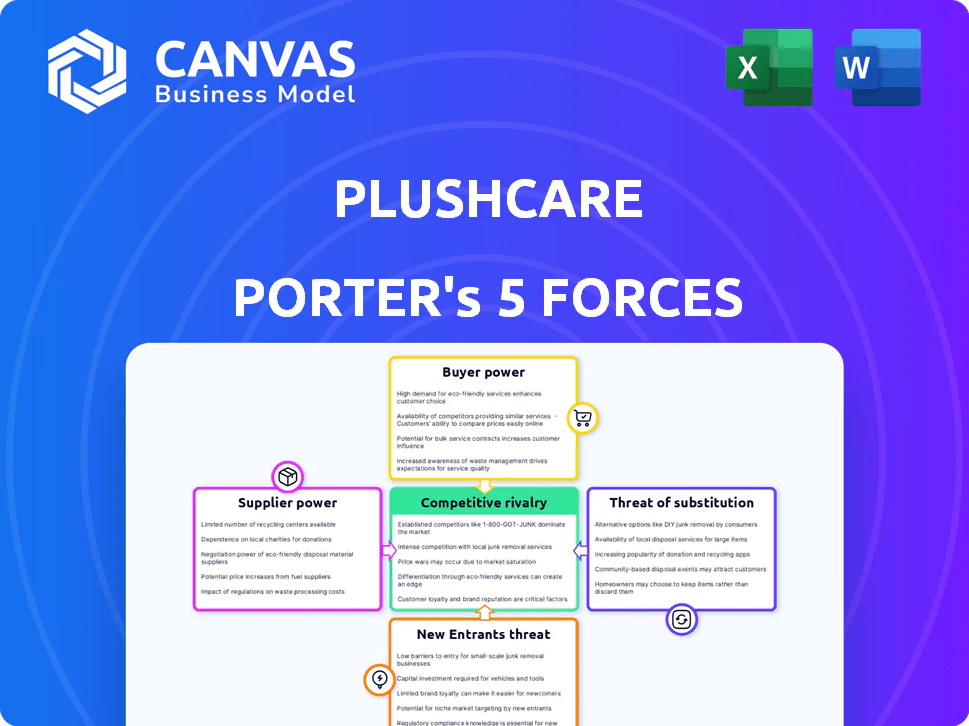
PLUSHCARE PORTER'S FIVE FORCES TEMPLATE RESEARCH
What is included in the product
 Detailed Word Document
Analyzes PlushCare's competitive landscape, including threats from new entrants and substitutes.

 Customizable Excel Spreadsheet
A dynamic, real-time update of market forces, instantly revealing areas of vulnerability.
What You See Is What You Get
PlushCare Porter's Five Forces Analysis
This preview showcases the complete Porter's Five Forces analysis of PlushCare. It's the identical document you'll receive immediately upon purchase, fully formatted and ready. The analysis explores competitive rivalry, supplier power, and more. Understand the industry dynamics influencing PlushCare's market position. No alterations or additional steps are required.

Porter's Five Forces Analysis Template

From Overview to Strategy Blueprint
PlushCare faces moderate rivalry, with established telehealth providers and new entrants vying for market share. Buyer power is relatively high, as patients have various choices. Supplier power is limited, primarily tied to healthcare professionals. Substitutes, like in-person visits, pose a threat. The threat of new entrants is moderate, influenced by regulatory hurdles and capital needs.
This brief snapshot only scratches the surface. Unlock the full Porter's Five Forces Analysis to explore PlushCare’s competitive dynamics, market pressures, and strategic advantages in detail.
Suppliers Bargaining Power

Limited Number of Healthcare Technology Providers
In telehealth, specialized tech suppliers hold some sway. Their limited numbers allow for significant pricing power. This can lead to increased operational costs. For instance, in 2024, the average cost for telehealth software was $25,000-$75,000 annually. This affects profitability.
High Demand for Specialized Healthcare Professionals
PlushCare relies on licensed physicians, and the demand for specialized healthcare professionals, including doctors and mental health experts, is rising in telehealth. This increasing demand gives these professionals greater bargaining power. In 2024, the telehealth market is projected to reach $65.7 billion, which may lead to higher compensation demands. This can affect PlushCare's operational costs.

Potential for Vertical Integration by Suppliers
Technology or software suppliers possess the capacity for vertical integration, potentially launching their own telehealth services. This strategic move could enhance their leverage over companies such as PlushCare. For example, the telehealth market was valued at $62.5 billion in 2023, and is projected to reach $175.5 billion by 2030. Suppliers might merge with or acquire entities like PlushCare, thereby increasing their control over pricing strategies and service distribution. This shift could substantially influence PlushCare's operational dynamics and market competitiveness.

Dependence on Pharmacies and Laboratories
PlushCare's business model depends on external pharmacies and laboratories. They handle prescriptions and lab test orders, creating a dependence on these providers. This reliance gives pharmacies and labs some bargaining power over PlushCare. For example, in 2024, the US pharmacy market reached $490 billion. This highlights the significant financial influence of these suppliers.
- Reliance on external providers for key services.
- Pharmacies and labs have bargaining power.
- Large pharmacy market size in the US.
- Impact on PlushCare's operational costs.
Influence of Electronic Health Record (EHR) Systems
Electronic Health Record (EHR) systems are crucial for telehealth platforms like PlushCare, ensuring smooth healthcare delivery. Major EHR providers wield significant bargaining power, given the critical nature of their systems. Switching costs can be high, impacting telehealth platforms financially and operationally. In 2024, the EHR market was valued at $33.2 billion, reflecting its importance.
- EHR integration is vital for telehealth operations.
- Major EHR providers hold considerable bargaining power.
- Switching EHR systems involves high costs.
- The EHR market was worth $33.2B in 2024.
Supplier Power Dynamics: A Healthcare Startup's Challenge
PlushCare faces supplier bargaining power from tech, healthcare professionals, pharmacies, labs, and EHR providers. Limited tech suppliers and rising demand for healthcare professionals enable pricing power. External providers like pharmacies and labs also wield influence. The EHR market's $33.2B value in 2024 highlights this.
| Supplier Type | Bargaining Power | Impact on PlushCare |
|---|---|---|
| Tech Suppliers | High due to limited numbers | Increased operational costs ($25,000-$75,000/yr software) |
| Healthcare Professionals | Increasing due to rising demand | Higher compensation demands |
| Pharmacies/Labs | Moderate, reliant on external providers | Impact on operational costs |
| EHR Providers | High, critical for operations | High switching costs, market worth $33.2B in 2024 |
Customers Bargaining Power

Availability of Multiple Telehealth Platforms
Patients today have numerous telehealth choices, from startups to established healthcare systems. This abundance boosts customer bargaining power, allowing them to compare and contrast services. In 2024, the telehealth market saw over 1000 platforms. Patients can easily switch providers. The availability of options forces companies like PlushCare to compete on price and quality.
Price Sensitivity of Consumers
Telehealth costs significantly influence patient choices, particularly given diverse insurance plans and budget options. Price sensitivity enables customers to pressure pricing. In 2024, the average cost of a virtual doctor's visit without insurance can range from $75 to $200, reflecting consumer price sensitivity. This financial factor empowers patients to seek more cost-effective services.

Access to Information and Reviews
Patients now wield significant power due to readily available information. They can effortlessly compare telehealth services like PlushCare based on online reviews and pricing. This ease of access, amplified by platforms like Healthgrades, which saw over 1.1 billion visits in 2024, strengthens customer bargaining power. This allows them to negotiate or choose providers that best meet their needs. The rise of consumer-driven healthcare further underscores this shift.

Ability to Switch Providers Easily
Patients can easily switch telehealth providers, which boosts their bargaining power. This flexibility means customers aren't stuck with one platform, giving them more leverage. The low switching costs encourage competition among telehealth services. In 2024, the average telehealth visit cost about $79, but prices vary. This ease of comparison and switching keeps providers competitive.
- Switching between telehealth platforms is typically straightforward.
- This ease of switching enhances customer power significantly.
- The low costs associated with changing providers empower patients.
- Telehealth services compete to attract and retain customers.
Growing Trend of Consumer-Driven Healthcare
Patients are increasingly active in healthcare choices, favoring convenience and accessibility. This shift empowers consumers to select providers, including telehealth services like PlushCare. The rise of informed consumers influences service quality and cost. Consumer-driven healthcare is evident in the growing telehealth market. The telehealth market was valued at USD 62.4 billion in 2023.
- Telehealth adoption rates increased significantly in 2024 due to consumer demand.
- Consumers now prioritize factors like cost, convenience, and reviews when choosing healthcare.
- This trend forces providers to compete on service quality and patient experience.
- PlushCare and similar platforms benefit from this consumer-centric approach.
Telehealth: Customer Power in a Competitive Market
Customers of telehealth platforms have strong bargaining power due to abundant choices. The market, with over 1000 platforms in 2024, fosters competition. Patients' price sensitivity, with virtual visits costing $75-$200 without insurance in 2024, drives cost-consciousness.
| Factor | Impact | 2024 Data |
|---|---|---|
| Provider Choices | High | 1000+ platforms |
| Price Sensitivity | Significant | $75-$200 visit cost |
| Switching Costs | Low | Easy provider change |
Rivalry Among Competitors

Numerous Players in the Telehealth Market
The telehealth market is a battleground, featuring many competitors providing virtual care. Established companies, new startups, and even traditional healthcare providers are all vying for market share. In 2024, the telehealth market was valued at approximately $62 billion, showcasing its significant size and the intensity of competition. This intense rivalry can lead to price wars and service innovation.
Rapid Technological Advancements
Rapid technological advancements in telehealth, like AI and data analytics, fuel fierce competition. Companies must continuously invest in tech to stay ahead. For example, in 2024, telehealth spending reached $6.5 billion, indicating a high-stakes environment.

Differentiation of Services
Telehealth companies compete by specializing in areas like mental health or offering unique features. PlushCare focuses on virtual primary care and mental health services. In 2024, the telehealth market is projected to reach $60 billion, with mental health services growing significantly. Companies like PlushCare differentiate by integrating these services, aiming for a larger market share.

Marketing and Brand Building
PlushCare's rivals vigorously market their services, vying for customer attention in the competitive telehealth arena. Establishing a solid brand image and gaining customer trust is vital for differentiation. Marketing spending in the telehealth sector surged in 2024, with some companies allocating over 30% of their revenue to advertising. This intense focus on brand building reflects the high stakes involved in attracting and retaining patients.
- Telehealth advertising spending increased by 25% in 2024.
- Customer acquisition costs in telehealth are up 15% year-over-year.
- Brand recognition is a key factor in driving patient choice.
Pricing Strategies
PlushCare faces competitive rivalry through pricing strategies. Some telehealth providers offer lower-cost options, like Teladoc, which has a subscription model. PlushCare uses a consultation fee model and accepts insurance, potentially making it more accessible. In 2024, the telehealth market continues to grow, intensifying price competition among providers.
- Teladoc's market cap in early 2024: Approximately $2.5 billion.
- Average cost of a virtual doctor visit (without insurance): $75-$100.
- Telehealth market growth rate (2024): Estimated at 15-20%.
Telehealth's $62B Battleground: Competition Heats Up!
Competitive rivalry in telehealth is fierce, with numerous companies vying for market share, reflected in the $62 billion market valuation in 2024. This competition drives innovation and price adjustments, as telehealth ad spending increased by 25% in 2024. Companies like PlushCare differentiate via specialization and marketing, despite rising customer acquisition costs.
| Aspect | Details | 2024 Data |
|---|---|---|
| Market Value | Total market size | $62 billion |
| Advertising Spend | Increase in telehealth advertising | 25% |
| Customer Acquisition Cost | Year-over-year increase | 15% |
PLUSHCARE PORTER'S FIVE FORCES TEMPLATE RESEARCH
What is included in the product
Detailed Word Document
Analyzes PlushCare's competitive landscape, including threats from new entrants and substitutes.
Customizable Excel Spreadsheet
A dynamic, real-time update of market forces, instantly revealing areas of vulnerability.
What You See Is What You Get
PlushCare Porter's Five Forces Analysis
This preview showcases the complete Porter's Five Forces analysis of PlushCare. It's the identical document you'll receive immediately upon purchase, fully formatted and ready. The analysis explores competitive rivalry, supplier power, and more. Understand the industry dynamics influencing PlushCare's market position. No alterations or additional steps are required.
Porter's Five Forces Analysis Template
From Overview to Strategy Blueprint
PlushCare faces moderate rivalry, with established telehealth providers and new entrants vying for market share. Buyer power is relatively high, as patients have various choices. Supplier power is limited, primarily tied to healthcare professionals. Substitutes, like in-person visits, pose a threat. The threat of new entrants is moderate, influenced by regulatory hurdles and capital needs.
This brief snapshot only scratches the surface. Unlock the full Porter's Five Forces Analysis to explore PlushCare’s competitive dynamics, market pressures, and strategic advantages in detail.
Suppliers Bargaining Power
Limited Number of Healthcare Technology Providers
In telehealth, specialized tech suppliers hold some sway. Their limited numbers allow for significant pricing power. This can lead to increased operational costs. For instance, in 2024, the average cost for telehealth software was $25,000-$75,000 annually. This affects profitability.
High Demand for Specialized Healthcare Professionals
PlushCare relies on licensed physicians, and the demand for specialized healthcare professionals, including doctors and mental health experts, is rising in telehealth. This increasing demand gives these professionals greater bargaining power. In 2024, the telehealth market is projected to reach $65.7 billion, which may lead to higher compensation demands. This can affect PlushCare's operational costs.
Potential for Vertical Integration by Suppliers
Technology or software suppliers possess the capacity for vertical integration, potentially launching their own telehealth services. This strategic move could enhance their leverage over companies such as PlushCare. For example, the telehealth market was valued at $62.5 billion in 2023, and is projected to reach $175.5 billion by 2030. Suppliers might merge with or acquire entities like PlushCare, thereby increasing their control over pricing strategies and service distribution. This shift could substantially influence PlushCare's operational dynamics and market competitiveness.
Dependence on Pharmacies and Laboratories
PlushCare's business model depends on external pharmacies and laboratories. They handle prescriptions and lab test orders, creating a dependence on these providers. This reliance gives pharmacies and labs some bargaining power over PlushCare. For example, in 2024, the US pharmacy market reached $490 billion. This highlights the significant financial influence of these suppliers.
- Reliance on external providers for key services.
- Pharmacies and labs have bargaining power.
- Large pharmacy market size in the US.
- Impact on PlushCare's operational costs.
Influence of Electronic Health Record (EHR) Systems
Electronic Health Record (EHR) systems are crucial for telehealth platforms like PlushCare, ensuring smooth healthcare delivery. Major EHR providers wield significant bargaining power, given the critical nature of their systems. Switching costs can be high, impacting telehealth platforms financially and operationally. In 2024, the EHR market was valued at $33.2 billion, reflecting its importance.
- EHR integration is vital for telehealth operations.
- Major EHR providers hold considerable bargaining power.
- Switching EHR systems involves high costs.
- The EHR market was worth $33.2B in 2024.
Supplier Power Dynamics: A Healthcare Startup's Challenge
PlushCare faces supplier bargaining power from tech, healthcare professionals, pharmacies, labs, and EHR providers. Limited tech suppliers and rising demand for healthcare professionals enable pricing power. External providers like pharmacies and labs also wield influence. The EHR market's $33.2B value in 2024 highlights this.
| Supplier Type | Bargaining Power | Impact on PlushCare |
|---|---|---|
| Tech Suppliers | High due to limited numbers | Increased operational costs ($25,000-$75,000/yr software) |
| Healthcare Professionals | Increasing due to rising demand | Higher compensation demands |
| Pharmacies/Labs | Moderate, reliant on external providers | Impact on operational costs |
| EHR Providers | High, critical for operations | High switching costs, market worth $33.2B in 2024 |
Customers Bargaining Power
Availability of Multiple Telehealth Platforms
Patients today have numerous telehealth choices, from startups to established healthcare systems. This abundance boosts customer bargaining power, allowing them to compare and contrast services. In 2024, the telehealth market saw over 1000 platforms. Patients can easily switch providers. The availability of options forces companies like PlushCare to compete on price and quality.
Price Sensitivity of Consumers
Telehealth costs significantly influence patient choices, particularly given diverse insurance plans and budget options. Price sensitivity enables customers to pressure pricing. In 2024, the average cost of a virtual doctor's visit without insurance can range from $75 to $200, reflecting consumer price sensitivity. This financial factor empowers patients to seek more cost-effective services.
Access to Information and Reviews
Patients now wield significant power due to readily available information. They can effortlessly compare telehealth services like PlushCare based on online reviews and pricing. This ease of access, amplified by platforms like Healthgrades, which saw over 1.1 billion visits in 2024, strengthens customer bargaining power. This allows them to negotiate or choose providers that best meet their needs. The rise of consumer-driven healthcare further underscores this shift.
Ability to Switch Providers Easily
Patients can easily switch telehealth providers, which boosts their bargaining power. This flexibility means customers aren't stuck with one platform, giving them more leverage. The low switching costs encourage competition among telehealth services. In 2024, the average telehealth visit cost about $79, but prices vary. This ease of comparison and switching keeps providers competitive.
- Switching between telehealth platforms is typically straightforward.
- This ease of switching enhances customer power significantly.
- The low costs associated with changing providers empower patients.
- Telehealth services compete to attract and retain customers.
Growing Trend of Consumer-Driven Healthcare
Patients are increasingly active in healthcare choices, favoring convenience and accessibility. This shift empowers consumers to select providers, including telehealth services like PlushCare. The rise of informed consumers influences service quality and cost. Consumer-driven healthcare is evident in the growing telehealth market. The telehealth market was valued at USD 62.4 billion in 2023.
- Telehealth adoption rates increased significantly in 2024 due to consumer demand.
- Consumers now prioritize factors like cost, convenience, and reviews when choosing healthcare.
- This trend forces providers to compete on service quality and patient experience.
- PlushCare and similar platforms benefit from this consumer-centric approach.
Telehealth: Customer Power in a Competitive Market
Customers of telehealth platforms have strong bargaining power due to abundant choices. The market, with over 1000 platforms in 2024, fosters competition. Patients' price sensitivity, with virtual visits costing $75-$200 without insurance in 2024, drives cost-consciousness.
| Factor | Impact | 2024 Data |
|---|---|---|
| Provider Choices | High | 1000+ platforms |
| Price Sensitivity | Significant | $75-$200 visit cost |
| Switching Costs | Low | Easy provider change |
Rivalry Among Competitors
Numerous Players in the Telehealth Market
The telehealth market is a battleground, featuring many competitors providing virtual care. Established companies, new startups, and even traditional healthcare providers are all vying for market share. In 2024, the telehealth market was valued at approximately $62 billion, showcasing its significant size and the intensity of competition. This intense rivalry can lead to price wars and service innovation.
Rapid Technological Advancements
Rapid technological advancements in telehealth, like AI and data analytics, fuel fierce competition. Companies must continuously invest in tech to stay ahead. For example, in 2024, telehealth spending reached $6.5 billion, indicating a high-stakes environment.
Differentiation of Services
Telehealth companies compete by specializing in areas like mental health or offering unique features. PlushCare focuses on virtual primary care and mental health services. In 2024, the telehealth market is projected to reach $60 billion, with mental health services growing significantly. Companies like PlushCare differentiate by integrating these services, aiming for a larger market share.
Marketing and Brand Building
PlushCare's rivals vigorously market their services, vying for customer attention in the competitive telehealth arena. Establishing a solid brand image and gaining customer trust is vital for differentiation. Marketing spending in the telehealth sector surged in 2024, with some companies allocating over 30% of their revenue to advertising. This intense focus on brand building reflects the high stakes involved in attracting and retaining patients.
- Telehealth advertising spending increased by 25% in 2024.
- Customer acquisition costs in telehealth are up 15% year-over-year.
- Brand recognition is a key factor in driving patient choice.
Pricing Strategies
PlushCare faces competitive rivalry through pricing strategies. Some telehealth providers offer lower-cost options, like Teladoc, which has a subscription model. PlushCare uses a consultation fee model and accepts insurance, potentially making it more accessible. In 2024, the telehealth market continues to grow, intensifying price competition among providers.
- Teladoc's market cap in early 2024: Approximately $2.5 billion.
- Average cost of a virtual doctor visit (without insurance): $75-$100.
- Telehealth market growth rate (2024): Estimated at 15-20%.
Telehealth's $62B Battleground: Competition Heats Up!
Competitive rivalry in telehealth is fierce, with numerous companies vying for market share, reflected in the $62 billion market valuation in 2024. This competition drives innovation and price adjustments, as telehealth ad spending increased by 25% in 2024. Companies like PlushCare differentiate via specialization and marketing, despite rising customer acquisition costs.
| Aspect | Details | 2024 Data |
|---|---|---|
| Market Value | Total market size | $62 billion |
| Advertising Spend | Increase in telehealth advertising | 25% |
| Customer Acquisition Cost | Year-over-year increase | 15% |
Product Information
Product Information
Shipping & Returns
Shipping & Returns
Description
What is included in the product
Detailed Word Document
Analyzes PlushCare's competitive landscape, including threats from new entrants and substitutes.
Customizable Excel Spreadsheet
A dynamic, real-time update of market forces, instantly revealing areas of vulnerability.
What You See Is What You Get
PlushCare Porter's Five Forces Analysis
This preview showcases the complete Porter's Five Forces analysis of PlushCare. It's the identical document you'll receive immediately upon purchase, fully formatted and ready. The analysis explores competitive rivalry, supplier power, and more. Understand the industry dynamics influencing PlushCare's market position. No alterations or additional steps are required.
Porter's Five Forces Analysis Template
From Overview to Strategy Blueprint
PlushCare faces moderate rivalry, with established telehealth providers and new entrants vying for market share. Buyer power is relatively high, as patients have various choices. Supplier power is limited, primarily tied to healthcare professionals. Substitutes, like in-person visits, pose a threat. The threat of new entrants is moderate, influenced by regulatory hurdles and capital needs.
This brief snapshot only scratches the surface. Unlock the full Porter's Five Forces Analysis to explore PlushCare’s competitive dynamics, market pressures, and strategic advantages in detail.
Suppliers Bargaining Power
Limited Number of Healthcare Technology Providers
In telehealth, specialized tech suppliers hold some sway. Their limited numbers allow for significant pricing power. This can lead to increased operational costs. For instance, in 2024, the average cost for telehealth software was $25,000-$75,000 annually. This affects profitability.
High Demand for Specialized Healthcare Professionals
PlushCare relies on licensed physicians, and the demand for specialized healthcare professionals, including doctors and mental health experts, is rising in telehealth. This increasing demand gives these professionals greater bargaining power. In 2024, the telehealth market is projected to reach $65.7 billion, which may lead to higher compensation demands. This can affect PlushCare's operational costs.
Potential for Vertical Integration by Suppliers
Technology or software suppliers possess the capacity for vertical integration, potentially launching their own telehealth services. This strategic move could enhance their leverage over companies such as PlushCare. For example, the telehealth market was valued at $62.5 billion in 2023, and is projected to reach $175.5 billion by 2030. Suppliers might merge with or acquire entities like PlushCare, thereby increasing their control over pricing strategies and service distribution. This shift could substantially influence PlushCare's operational dynamics and market competitiveness.
Dependence on Pharmacies and Laboratories
PlushCare's business model depends on external pharmacies and laboratories. They handle prescriptions and lab test orders, creating a dependence on these providers. This reliance gives pharmacies and labs some bargaining power over PlushCare. For example, in 2024, the US pharmacy market reached $490 billion. This highlights the significant financial influence of these suppliers.
- Reliance on external providers for key services.
- Pharmacies and labs have bargaining power.
- Large pharmacy market size in the US.
- Impact on PlushCare's operational costs.
Influence of Electronic Health Record (EHR) Systems
Electronic Health Record (EHR) systems are crucial for telehealth platforms like PlushCare, ensuring smooth healthcare delivery. Major EHR providers wield significant bargaining power, given the critical nature of their systems. Switching costs can be high, impacting telehealth platforms financially and operationally. In 2024, the EHR market was valued at $33.2 billion, reflecting its importance.
- EHR integration is vital for telehealth operations.
- Major EHR providers hold considerable bargaining power.
- Switching EHR systems involves high costs.
- The EHR market was worth $33.2B in 2024.
Supplier Power Dynamics: A Healthcare Startup's Challenge
PlushCare faces supplier bargaining power from tech, healthcare professionals, pharmacies, labs, and EHR providers. Limited tech suppliers and rising demand for healthcare professionals enable pricing power. External providers like pharmacies and labs also wield influence. The EHR market's $33.2B value in 2024 highlights this.
| Supplier Type | Bargaining Power | Impact on PlushCare |
|---|---|---|
| Tech Suppliers | High due to limited numbers | Increased operational costs ($25,000-$75,000/yr software) |
| Healthcare Professionals | Increasing due to rising demand | Higher compensation demands |
| Pharmacies/Labs | Moderate, reliant on external providers | Impact on operational costs |
| EHR Providers | High, critical for operations | High switching costs, market worth $33.2B in 2024 |
Customers Bargaining Power
Availability of Multiple Telehealth Platforms
Patients today have numerous telehealth choices, from startups to established healthcare systems. This abundance boosts customer bargaining power, allowing them to compare and contrast services. In 2024, the telehealth market saw over 1000 platforms. Patients can easily switch providers. The availability of options forces companies like PlushCare to compete on price and quality.
Price Sensitivity of Consumers
Telehealth costs significantly influence patient choices, particularly given diverse insurance plans and budget options. Price sensitivity enables customers to pressure pricing. In 2024, the average cost of a virtual doctor's visit without insurance can range from $75 to $200, reflecting consumer price sensitivity. This financial factor empowers patients to seek more cost-effective services.
Access to Information and Reviews
Patients now wield significant power due to readily available information. They can effortlessly compare telehealth services like PlushCare based on online reviews and pricing. This ease of access, amplified by platforms like Healthgrades, which saw over 1.1 billion visits in 2024, strengthens customer bargaining power. This allows them to negotiate or choose providers that best meet their needs. The rise of consumer-driven healthcare further underscores this shift.
Ability to Switch Providers Easily
Patients can easily switch telehealth providers, which boosts their bargaining power. This flexibility means customers aren't stuck with one platform, giving them more leverage. The low switching costs encourage competition among telehealth services. In 2024, the average telehealth visit cost about $79, but prices vary. This ease of comparison and switching keeps providers competitive.
- Switching between telehealth platforms is typically straightforward.
- This ease of switching enhances customer power significantly.
- The low costs associated with changing providers empower patients.
- Telehealth services compete to attract and retain customers.
Growing Trend of Consumer-Driven Healthcare
Patients are increasingly active in healthcare choices, favoring convenience and accessibility. This shift empowers consumers to select providers, including telehealth services like PlushCare. The rise of informed consumers influences service quality and cost. Consumer-driven healthcare is evident in the growing telehealth market. The telehealth market was valued at USD 62.4 billion in 2023.
- Telehealth adoption rates increased significantly in 2024 due to consumer demand.
- Consumers now prioritize factors like cost, convenience, and reviews when choosing healthcare.
- This trend forces providers to compete on service quality and patient experience.
- PlushCare and similar platforms benefit from this consumer-centric approach.
Telehealth: Customer Power in a Competitive Market
Customers of telehealth platforms have strong bargaining power due to abundant choices. The market, with over 1000 platforms in 2024, fosters competition. Patients' price sensitivity, with virtual visits costing $75-$200 without insurance in 2024, drives cost-consciousness.
| Factor | Impact | 2024 Data |
|---|---|---|
| Provider Choices | High | 1000+ platforms |
| Price Sensitivity | Significant | $75-$200 visit cost |
| Switching Costs | Low | Easy provider change |
Rivalry Among Competitors
Numerous Players in the Telehealth Market
The telehealth market is a battleground, featuring many competitors providing virtual care. Established companies, new startups, and even traditional healthcare providers are all vying for market share. In 2024, the telehealth market was valued at approximately $62 billion, showcasing its significant size and the intensity of competition. This intense rivalry can lead to price wars and service innovation.
Rapid Technological Advancements
Rapid technological advancements in telehealth, like AI and data analytics, fuel fierce competition. Companies must continuously invest in tech to stay ahead. For example, in 2024, telehealth spending reached $6.5 billion, indicating a high-stakes environment.
Differentiation of Services
Telehealth companies compete by specializing in areas like mental health or offering unique features. PlushCare focuses on virtual primary care and mental health services. In 2024, the telehealth market is projected to reach $60 billion, with mental health services growing significantly. Companies like PlushCare differentiate by integrating these services, aiming for a larger market share.
Marketing and Brand Building
PlushCare's rivals vigorously market their services, vying for customer attention in the competitive telehealth arena. Establishing a solid brand image and gaining customer trust is vital for differentiation. Marketing spending in the telehealth sector surged in 2024, with some companies allocating over 30% of their revenue to advertising. This intense focus on brand building reflects the high stakes involved in attracting and retaining patients.
- Telehealth advertising spending increased by 25% in 2024.
- Customer acquisition costs in telehealth are up 15% year-over-year.
- Brand recognition is a key factor in driving patient choice.
Pricing Strategies
PlushCare faces competitive rivalry through pricing strategies. Some telehealth providers offer lower-cost options, like Teladoc, which has a subscription model. PlushCare uses a consultation fee model and accepts insurance, potentially making it more accessible. In 2024, the telehealth market continues to grow, intensifying price competition among providers.
- Teladoc's market cap in early 2024: Approximately $2.5 billion.
- Average cost of a virtual doctor visit (without insurance): $75-$100.
- Telehealth market growth rate (2024): Estimated at 15-20%.
Telehealth's $62B Battleground: Competition Heats Up!
Competitive rivalry in telehealth is fierce, with numerous companies vying for market share, reflected in the $62 billion market valuation in 2024. This competition drives innovation and price adjustments, as telehealth ad spending increased by 25% in 2024. Companies like PlushCare differentiate via specialization and marketing, despite rising customer acquisition costs.
| Aspect | Details | 2024 Data |
|---|---|---|
| Market Value | Total market size | $62 billion |
| Advertising Spend | Increase in telehealth advertising | 25% |
| Customer Acquisition Cost | Year-over-year increase | 15% |











