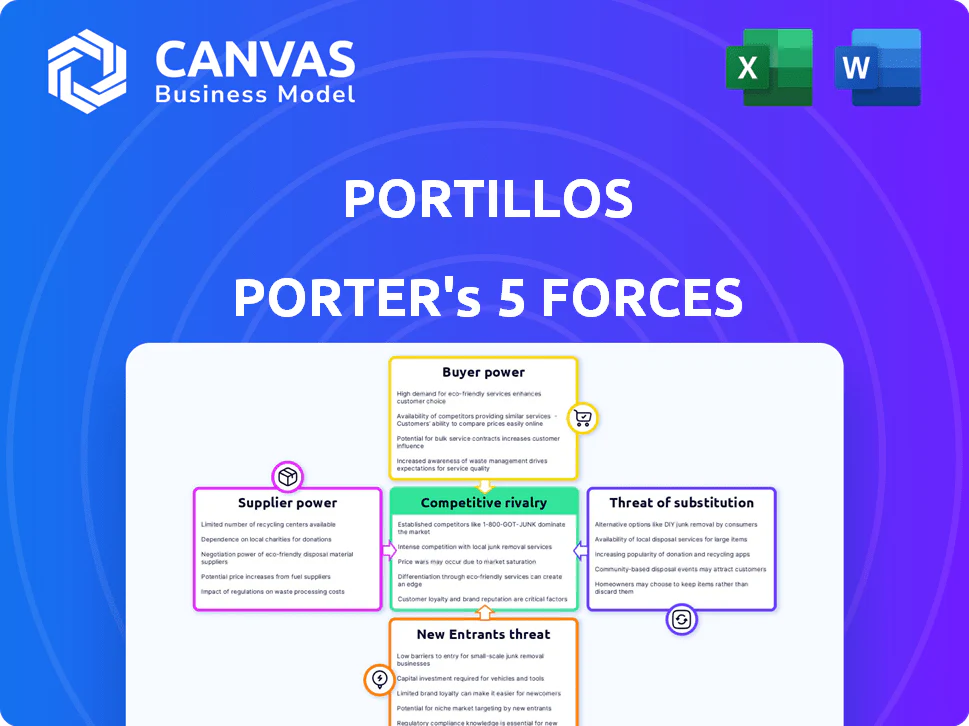
PORTILLOS PORTER'S FIVE FORCES TEMPLATE RESEARCH

Don't Miss the Bigger Picture
Portillo's benefits from strong local brand loyalty and scale in fast-casual dining, but faces intense supplier scrutiny, growing substitute threats, and regional competitive pressure that squeeze margins and growth flexibility.
This brief snapshot only scratches the surface. Unlock the full Porter's Five Forces Analysis to explore Portillos's competitive dynamics, market pressures, and strategic advantages in detail.
Suppliers Bargaining Power

Concentrated reliance on core beef and pork proteins
As of March 2026, Portillo's faces elevated supplier power from concentrated reliance on Chicago-style Italian beef and hot dogs; beef cost inflation of mid-single-digits (management cited ~5% for FY2026) is a primary margin headwind after FY2025 COGS rose to 32.8% of sales.
Impact of regional supply chain concentration
With 66 of Portillo's 102 restaurants in the Midwest as of FY2025, Portillo's relies on regional suppliers and commissaries to ensure Chicago-style consistency.
Sunbelt expansion reduced geographic risk but poppy-seed buns and giardiniera still need specialist vendors, limiting sourcing options.
Supplier concentration gives these partners pricing and contract leverage, potentially pressuring margins.

Inflationary pressure on labor and operating inputs
Portillo's faces 3-3.5% projected labor inflation for 2026 after 2025 wage-driven labor costs rose ~4.1%, squeezing EBITDA margin which was 14.2% in FY2025; packaging and utility costs climbed ~6% YoY in 2025. Non-food suppliers-especially eco-friendly packaging-have stronger leverage as sustainable demand keeps prices elevated. The Restaurant of the Future rollout targets 150 bp margin recovery over 3 years, but near-term labor and utility contracts remain a persistent drag on EBITDA.

Limited vertical integration for specialized ingredients
Portillo's relies on third-party partners for core items and runs limited commissaries, so it is a price-taker for commodities like wheat; in FY2025 Portillo's reported cost of goods sold at $372.4M, making it sensitive to input shocks when wheat futures rose ~28% year-over-year in 2024-25.
- Third-party sourcing for core menu items
- Limited vertical integration; some commissaries only
- FY2025 COGS $372.4M; exposed to commodity swings
- Wheat futures +28% YoY (2024-25) → squeeze margins
High switching costs for brand-defining products
High switching costs stem from Portillo's reliance on brand-name ingredients and long-term bakery and meat processors; deviating risks a perceptible quality drop that would hurt its authentic Chicago street-food image and same-store sales.
Suppliers gain leverage at annual price reviews-Portillo's paid ~$1.2B COGS in FY2025, so even 2% supplier price hikes would add ~$24M to costs and pressure margins.
- Brand-tied suppliers raise negotiation power
- Perceptible quality shifts risk revenue and reputation
- $1.2B FY2025 COGS → 2% hike = $24M hit
Rising input costs-2% supplier hike could shave ~$24M and squeeze Portillo's FY2026 margins
Supplier power is high: FY2025 COGS $372.4M (company-wide COGS ~$1.2B), beef/wheat exposure (wheat futures +28% YoY 2024-25), specialist vendors for buns/giardiniera, limited vertical integration, and a 2% supplier price rise would add ~$24M to costs, pressuring Portillo's FY2026 margins.
| Metric | Value |
|---|---|
| FY2025 COGS (core) | $372.4M |
| Total FY2025 COGS | $1.2B |
| Wheat futures 2024-25 | +28% |
| Potential 2% cost hit | $24M |
What is included in the product
 Detailed Word Document
Tailored Portillo's Porter's Five Forces analysis that pinpoints competitive intensity, buyer and supplier power, substitution risks, and entry barriers-highlighting near-term disruptors and strategic levers for pricing and margin protection.

 Customizable Excel Spreadsheet
One-sheet Portillo's Five Forces snapshot-instantly shows competitive pressure, supplier/buyer leverage, and entrant/rival threats so executives can prioritize tactics without digging through pages.
Customers Bargaining Power

Low switching costs in a saturated fast-casual market
Customers face near-zero switching costs in fast-casual, so Portillo's risks churn to Shake Shack or Chipotle if perceived value slips; industry traffic growth is <1% for 2026 per NPD Group, boosting consumer leverage.
With ~$40 average check sensitivity and dense competitors, consumers force Portillo's to fight on experience and price; same-store sales pressure means tighter margins and higher marketing spend.
Heightened price sensitivity amid economic cooling
Market data from early 2026 shows middle-income consumers-Portillos Restaurants LLC's core demographic-questioning $15-$20 meals; CPI-adjusted disposable income for the 35-54 cohort fell 1.8% YoY in Q4 2025, raising price sensitivity.
Same-restaurant sales declined 3.3% in late 2025, signaling buyers cut visit frequency and traded down to lower-priced QSRs, eroding Portillo's traffic and AUV.
This buyer power constrains Portillo's ability to pass rising commodity costs (beef and dairy input inflation ~6-8% in 2025) through menu price increases without further sales declines.

Influence of digital loyalty and the Perks program
Portillo's Perks scaled to over 2 million members by early 2026, and in FY2025 loyalty-driven spend accounted for an estimated 28% of restaurant revenue, boosting transparency and reward power for customers.
Members now delay visits awaiting surprise offers, raising deal-sensitivity; Portillo's reports a 12% higher redemption rate during targeted promotions in 2025.
The program fuels data-driven marketing-Portillo's cited a 15% lift in visit frequency among Perks users in FY2025-but it also creates an expectation for continuous value that, if unmet, risks increased churn and lower lifetime value.

Demand for multi-channel convenience and speed
Buyers push Portillo's to deliver seamless drive-thru, pickup, and delivery; digital channels now generate about 28% of Portillo's 2025 revenue ($~300M of $1.08B FY2025 revenue).
Customers pick the fastest, most accurate brands; Portillo's cut drive-thru time by 40 seconds in 2025, reducing order errors and protecting traffic.
Missed convenience leads to immediate churn to digitally integrated rivals like Chick-fil-A and Raising Cane's.
- Digital sales ~28% of FY2025 revenue (~$300M)
- Drive-thru speed improved by 40 seconds in 2025
- High churn risk if service speed/accuracy lags competitors
Information transparency and social proof
In 2026, real-time reviews and social media mean one bad visit can reach millions; Portillo's must protect reputation across 102 U.S. locations to avoid revenue hits-same-store sales fell 1.2% after a viral complaint in 2025 at one franchise.
Customers vet restaurants pre-visit, giving consumers collective leverage that forces Portillo's to spend more on brand and QC, notably in expansion states Texas and Georgia where 2025 openings cost $18.4M.
- 102 locations (2026)
- 2025 viral incident: -1.2% same-store sales
- $18.4M spent on 2025 market entry (TX, GA)
- High review transparency raises QA and marketing spend
Price‑squeezed customers force Portillo's into promotions, faster service, and loyalty
Customers hold strong bargaining power: near-zero switching costs, high price sensitivity after a 1.8% CPI-adjusted income drop for ages 35-54 (Q4 2025), and digital choices-digital sales ~28% of FY2025 revenue (~$300M of $1.08B)-force Portillo's to protect traffic via promotions, faster service, and loyalty offers.
| Metric | 2025/2026 Value |
|---|---|
| FY2025 Revenue | $1.08B |
| Digital Sales | $~300M (28%) |
| Perks Members | 2M+ |
| Same-restaurant SSS decline | -3.3% (late 2025) |
| 35-54 income change | -1.8% YoY Q4 2025 |
Preview Before You Purchase
Portillos Porter's Five Forces Analysis
This preview shows the exact Portillo's Porter's Five Forces analysis you'll receive immediately after purchase-no placeholders or mockups, fully formatted and ready to use.

Original: $10.00
-65%$10.00
$3.50PORTILLOS PORTER'S FIVE FORCES TEMPLATE RESEARCH
Don't Miss the Bigger Picture
Portillo's benefits from strong local brand loyalty and scale in fast-casual dining, but faces intense supplier scrutiny, growing substitute threats, and regional competitive pressure that squeeze margins and growth flexibility.
This brief snapshot only scratches the surface. Unlock the full Porter's Five Forces Analysis to explore Portillos's competitive dynamics, market pressures, and strategic advantages in detail.
Suppliers Bargaining Power
Concentrated reliance on core beef and pork proteins
As of March 2026, Portillo's faces elevated supplier power from concentrated reliance on Chicago-style Italian beef and hot dogs; beef cost inflation of mid-single-digits (management cited ~5% for FY2026) is a primary margin headwind after FY2025 COGS rose to 32.8% of sales.
Impact of regional supply chain concentration
With 66 of Portillo's 102 restaurants in the Midwest as of FY2025, Portillo's relies on regional suppliers and commissaries to ensure Chicago-style consistency.
Sunbelt expansion reduced geographic risk but poppy-seed buns and giardiniera still need specialist vendors, limiting sourcing options.
Supplier concentration gives these partners pricing and contract leverage, potentially pressuring margins.
Inflationary pressure on labor and operating inputs
Portillo's faces 3-3.5% projected labor inflation for 2026 after 2025 wage-driven labor costs rose ~4.1%, squeezing EBITDA margin which was 14.2% in FY2025; packaging and utility costs climbed ~6% YoY in 2025. Non-food suppliers-especially eco-friendly packaging-have stronger leverage as sustainable demand keeps prices elevated. The Restaurant of the Future rollout targets 150 bp margin recovery over 3 years, but near-term labor and utility contracts remain a persistent drag on EBITDA.
Limited vertical integration for specialized ingredients
Portillo's relies on third-party partners for core items and runs limited commissaries, so it is a price-taker for commodities like wheat; in FY2025 Portillo's reported cost of goods sold at $372.4M, making it sensitive to input shocks when wheat futures rose ~28% year-over-year in 2024-25.
- Third-party sourcing for core menu items
- Limited vertical integration; some commissaries only
- FY2025 COGS $372.4M; exposed to commodity swings
- Wheat futures +28% YoY (2024-25) → squeeze margins
High switching costs for brand-defining products
High switching costs stem from Portillo's reliance on brand-name ingredients and long-term bakery and meat processors; deviating risks a perceptible quality drop that would hurt its authentic Chicago street-food image and same-store sales.
Suppliers gain leverage at annual price reviews-Portillo's paid ~$1.2B COGS in FY2025, so even 2% supplier price hikes would add ~$24M to costs and pressure margins.
- Brand-tied suppliers raise negotiation power
- Perceptible quality shifts risk revenue and reputation
- $1.2B FY2025 COGS → 2% hike = $24M hit
Rising input costs-2% supplier hike could shave ~$24M and squeeze Portillo's FY2026 margins
Supplier power is high: FY2025 COGS $372.4M (company-wide COGS ~$1.2B), beef/wheat exposure (wheat futures +28% YoY 2024-25), specialist vendors for buns/giardiniera, limited vertical integration, and a 2% supplier price rise would add ~$24M to costs, pressuring Portillo's FY2026 margins.
| Metric | Value |
|---|---|
| FY2025 COGS (core) | $372.4M |
| Total FY2025 COGS | $1.2B |
| Wheat futures 2024-25 | +28% |
| Potential 2% cost hit | $24M |
What is included in the product
Detailed Word Document
Tailored Portillo's Porter's Five Forces analysis that pinpoints competitive intensity, buyer and supplier power, substitution risks, and entry barriers-highlighting near-term disruptors and strategic levers for pricing and margin protection.
Customizable Excel Spreadsheet
One-sheet Portillo's Five Forces snapshot-instantly shows competitive pressure, supplier/buyer leverage, and entrant/rival threats so executives can prioritize tactics without digging through pages.
Customers Bargaining Power
Low switching costs in a saturated fast-casual market
Customers face near-zero switching costs in fast-casual, so Portillo's risks churn to Shake Shack or Chipotle if perceived value slips; industry traffic growth is <1% for 2026 per NPD Group, boosting consumer leverage.
With ~$40 average check sensitivity and dense competitors, consumers force Portillo's to fight on experience and price; same-store sales pressure means tighter margins and higher marketing spend.
Heightened price sensitivity amid economic cooling
Market data from early 2026 shows middle-income consumers-Portillos Restaurants LLC's core demographic-questioning $15-$20 meals; CPI-adjusted disposable income for the 35-54 cohort fell 1.8% YoY in Q4 2025, raising price sensitivity.
Same-restaurant sales declined 3.3% in late 2025, signaling buyers cut visit frequency and traded down to lower-priced QSRs, eroding Portillo's traffic and AUV.
This buyer power constrains Portillo's ability to pass rising commodity costs (beef and dairy input inflation ~6-8% in 2025) through menu price increases without further sales declines.
Influence of digital loyalty and the Perks program
Portillo's Perks scaled to over 2 million members by early 2026, and in FY2025 loyalty-driven spend accounted for an estimated 28% of restaurant revenue, boosting transparency and reward power for customers.
Members now delay visits awaiting surprise offers, raising deal-sensitivity; Portillo's reports a 12% higher redemption rate during targeted promotions in 2025.
The program fuels data-driven marketing-Portillo's cited a 15% lift in visit frequency among Perks users in FY2025-but it also creates an expectation for continuous value that, if unmet, risks increased churn and lower lifetime value.
Demand for multi-channel convenience and speed
Buyers push Portillo's to deliver seamless drive-thru, pickup, and delivery; digital channels now generate about 28% of Portillo's 2025 revenue ($~300M of $1.08B FY2025 revenue).
Customers pick the fastest, most accurate brands; Portillo's cut drive-thru time by 40 seconds in 2025, reducing order errors and protecting traffic.
Missed convenience leads to immediate churn to digitally integrated rivals like Chick-fil-A and Raising Cane's.
- Digital sales ~28% of FY2025 revenue (~$300M)
- Drive-thru speed improved by 40 seconds in 2025
- High churn risk if service speed/accuracy lags competitors
Information transparency and social proof
In 2026, real-time reviews and social media mean one bad visit can reach millions; Portillo's must protect reputation across 102 U.S. locations to avoid revenue hits-same-store sales fell 1.2% after a viral complaint in 2025 at one franchise.
Customers vet restaurants pre-visit, giving consumers collective leverage that forces Portillo's to spend more on brand and QC, notably in expansion states Texas and Georgia where 2025 openings cost $18.4M.
- 102 locations (2026)
- 2025 viral incident: -1.2% same-store sales
- $18.4M spent on 2025 market entry (TX, GA)
- High review transparency raises QA and marketing spend
Price‑squeezed customers force Portillo's into promotions, faster service, and loyalty
Customers hold strong bargaining power: near-zero switching costs, high price sensitivity after a 1.8% CPI-adjusted income drop for ages 35-54 (Q4 2025), and digital choices-digital sales ~28% of FY2025 revenue (~$300M of $1.08B)-force Portillo's to protect traffic via promotions, faster service, and loyalty offers.
| Metric | 2025/2026 Value |
|---|---|
| FY2025 Revenue | $1.08B |
| Digital Sales | $~300M (28%) |
| Perks Members | 2M+ |
| Same-restaurant SSS decline | -3.3% (late 2025) |
| 35-54 income change | -1.8% YoY Q4 2025 |
Preview Before You Purchase
Portillos Porter's Five Forces Analysis
This preview shows the exact Portillo's Porter's Five Forces analysis you'll receive immediately after purchase-no placeholders or mockups, fully formatted and ready to use.
Product Information
Product Information
Shipping & Returns
Shipping & Returns
Description
Don't Miss the Bigger Picture
Portillo's benefits from strong local brand loyalty and scale in fast-casual dining, but faces intense supplier scrutiny, growing substitute threats, and regional competitive pressure that squeeze margins and growth flexibility.
This brief snapshot only scratches the surface. Unlock the full Porter's Five Forces Analysis to explore Portillos's competitive dynamics, market pressures, and strategic advantages in detail.
Suppliers Bargaining Power
Concentrated reliance on core beef and pork proteins
As of March 2026, Portillo's faces elevated supplier power from concentrated reliance on Chicago-style Italian beef and hot dogs; beef cost inflation of mid-single-digits (management cited ~5% for FY2026) is a primary margin headwind after FY2025 COGS rose to 32.8% of sales.
Impact of regional supply chain concentration
With 66 of Portillo's 102 restaurants in the Midwest as of FY2025, Portillo's relies on regional suppliers and commissaries to ensure Chicago-style consistency.
Sunbelt expansion reduced geographic risk but poppy-seed buns and giardiniera still need specialist vendors, limiting sourcing options.
Supplier concentration gives these partners pricing and contract leverage, potentially pressuring margins.
Inflationary pressure on labor and operating inputs
Portillo's faces 3-3.5% projected labor inflation for 2026 after 2025 wage-driven labor costs rose ~4.1%, squeezing EBITDA margin which was 14.2% in FY2025; packaging and utility costs climbed ~6% YoY in 2025. Non-food suppliers-especially eco-friendly packaging-have stronger leverage as sustainable demand keeps prices elevated. The Restaurant of the Future rollout targets 150 bp margin recovery over 3 years, but near-term labor and utility contracts remain a persistent drag on EBITDA.
Limited vertical integration for specialized ingredients
Portillo's relies on third-party partners for core items and runs limited commissaries, so it is a price-taker for commodities like wheat; in FY2025 Portillo's reported cost of goods sold at $372.4M, making it sensitive to input shocks when wheat futures rose ~28% year-over-year in 2024-25.
- Third-party sourcing for core menu items
- Limited vertical integration; some commissaries only
- FY2025 COGS $372.4M; exposed to commodity swings
- Wheat futures +28% YoY (2024-25) → squeeze margins
High switching costs for brand-defining products
High switching costs stem from Portillo's reliance on brand-name ingredients and long-term bakery and meat processors; deviating risks a perceptible quality drop that would hurt its authentic Chicago street-food image and same-store sales.
Suppliers gain leverage at annual price reviews-Portillo's paid ~$1.2B COGS in FY2025, so even 2% supplier price hikes would add ~$24M to costs and pressure margins.
- Brand-tied suppliers raise negotiation power
- Perceptible quality shifts risk revenue and reputation
- $1.2B FY2025 COGS → 2% hike = $24M hit
Rising input costs-2% supplier hike could shave ~$24M and squeeze Portillo's FY2026 margins
Supplier power is high: FY2025 COGS $372.4M (company-wide COGS ~$1.2B), beef/wheat exposure (wheat futures +28% YoY 2024-25), specialist vendors for buns/giardiniera, limited vertical integration, and a 2% supplier price rise would add ~$24M to costs, pressuring Portillo's FY2026 margins.
| Metric | Value |
|---|---|
| FY2025 COGS (core) | $372.4M |
| Total FY2025 COGS | $1.2B |
| Wheat futures 2024-25 | +28% |
| Potential 2% cost hit | $24M |
What is included in the product
Detailed Word Document
Tailored Portillo's Porter's Five Forces analysis that pinpoints competitive intensity, buyer and supplier power, substitution risks, and entry barriers-highlighting near-term disruptors and strategic levers for pricing and margin protection.
Customizable Excel Spreadsheet
One-sheet Portillo's Five Forces snapshot-instantly shows competitive pressure, supplier/buyer leverage, and entrant/rival threats so executives can prioritize tactics without digging through pages.
Customers Bargaining Power
Low switching costs in a saturated fast-casual market
Customers face near-zero switching costs in fast-casual, so Portillo's risks churn to Shake Shack or Chipotle if perceived value slips; industry traffic growth is <1% for 2026 per NPD Group, boosting consumer leverage.
With ~$40 average check sensitivity and dense competitors, consumers force Portillo's to fight on experience and price; same-store sales pressure means tighter margins and higher marketing spend.
Heightened price sensitivity amid economic cooling
Market data from early 2026 shows middle-income consumers-Portillos Restaurants LLC's core demographic-questioning $15-$20 meals; CPI-adjusted disposable income for the 35-54 cohort fell 1.8% YoY in Q4 2025, raising price sensitivity.
Same-restaurant sales declined 3.3% in late 2025, signaling buyers cut visit frequency and traded down to lower-priced QSRs, eroding Portillo's traffic and AUV.
This buyer power constrains Portillo's ability to pass rising commodity costs (beef and dairy input inflation ~6-8% in 2025) through menu price increases without further sales declines.
Influence of digital loyalty and the Perks program
Portillo's Perks scaled to over 2 million members by early 2026, and in FY2025 loyalty-driven spend accounted for an estimated 28% of restaurant revenue, boosting transparency and reward power for customers.
Members now delay visits awaiting surprise offers, raising deal-sensitivity; Portillo's reports a 12% higher redemption rate during targeted promotions in 2025.
The program fuels data-driven marketing-Portillo's cited a 15% lift in visit frequency among Perks users in FY2025-but it also creates an expectation for continuous value that, if unmet, risks increased churn and lower lifetime value.
Demand for multi-channel convenience and speed
Buyers push Portillo's to deliver seamless drive-thru, pickup, and delivery; digital channels now generate about 28% of Portillo's 2025 revenue ($~300M of $1.08B FY2025 revenue).
Customers pick the fastest, most accurate brands; Portillo's cut drive-thru time by 40 seconds in 2025, reducing order errors and protecting traffic.
Missed convenience leads to immediate churn to digitally integrated rivals like Chick-fil-A and Raising Cane's.
- Digital sales ~28% of FY2025 revenue (~$300M)
- Drive-thru speed improved by 40 seconds in 2025
- High churn risk if service speed/accuracy lags competitors
Information transparency and social proof
In 2026, real-time reviews and social media mean one bad visit can reach millions; Portillo's must protect reputation across 102 U.S. locations to avoid revenue hits-same-store sales fell 1.2% after a viral complaint in 2025 at one franchise.
Customers vet restaurants pre-visit, giving consumers collective leverage that forces Portillo's to spend more on brand and QC, notably in expansion states Texas and Georgia where 2025 openings cost $18.4M.
- 102 locations (2026)
- 2025 viral incident: -1.2% same-store sales
- $18.4M spent on 2025 market entry (TX, GA)
- High review transparency raises QA and marketing spend
Price‑squeezed customers force Portillo's into promotions, faster service, and loyalty
Customers hold strong bargaining power: near-zero switching costs, high price sensitivity after a 1.8% CPI-adjusted income drop for ages 35-54 (Q4 2025), and digital choices-digital sales ~28% of FY2025 revenue (~$300M of $1.08B)-force Portillo's to protect traffic via promotions, faster service, and loyalty offers.
| Metric | 2025/2026 Value |
|---|---|
| FY2025 Revenue | $1.08B |
| Digital Sales | $~300M (28%) |
| Perks Members | 2M+ |
| Same-restaurant SSS decline | -3.3% (late 2025) |
| 35-54 income change | -1.8% YoY Q4 2025 |
Preview Before You Purchase
Portillos Porter's Five Forces Analysis
This preview shows the exact Portillo's Porter's Five Forces analysis you'll receive immediately after purchase-no placeholders or mockups, fully formatted and ready to use.











