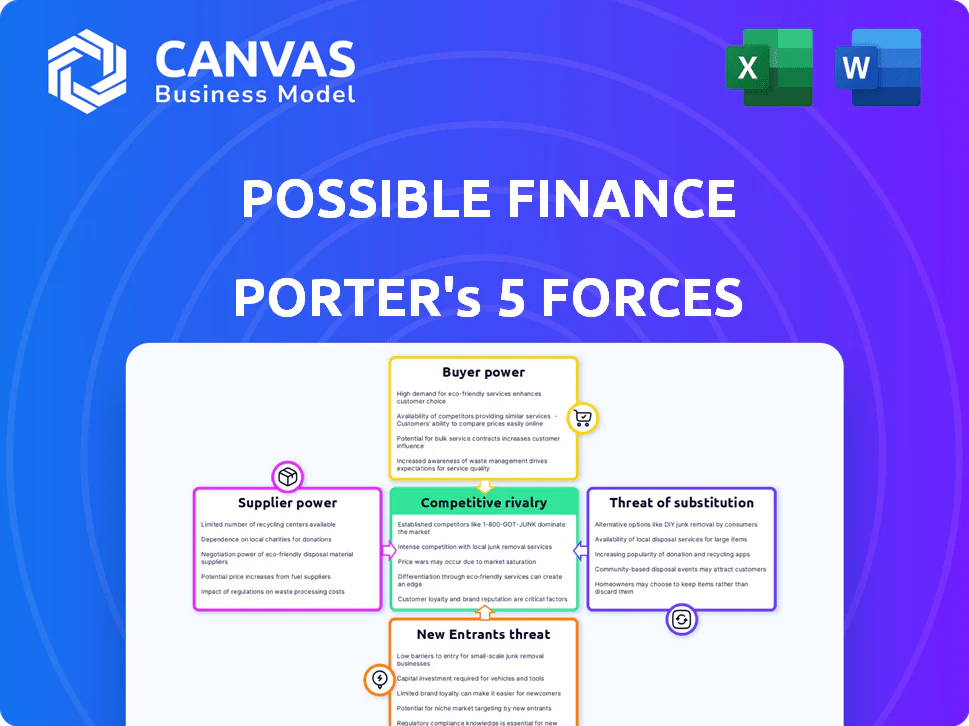
POSSIBLE FINANCE PORTER'S FIVE FORCES TEMPLATE RESEARCH
What is included in the product
 Detailed Word Document
Assesses competitive forces shaping Possible Finance, revealing threats, opportunities, and market positioning.

 Customizable Excel Spreadsheet
Customize threat levels with new data or evolving market trends.
Preview the Actual Deliverable
Possible Finance Porter's Five Forces Analysis
This preview details the complete Possible Finance Porter's Five Forces Analysis. It's the exact document you'll instantly receive upon purchase—no edits needed.

Porter's Five Forces Analysis Template

A Must-Have Tool for Decision-Makers
Possible Finance's industry is shaped by forces like competition and the threat of new entrants. Understanding buyer power and supplier dynamics is crucial. These elements significantly influence profitability and strategy. Analyzing substitutes reveals alternative options impacting market share. This preliminary view offers a glimpse of competitive intensity.
Unlock the full Porter's Five Forces Analysis to explore Possible Finance’s competitive dynamics, market pressures, and strategic advantages in detail.
Suppliers Bargaining Power

Access to Capital
Possible Finance's ability to provide loans hinges on its access to capital. In 2024, rising interest rates increased the cost of capital for many lenders. If capital sources like investors or banks have limited availability or charge high rates, they gain more bargaining power. For example, the average interest rate on a 24-month personal loan was around 13.2% in late 2024, up from 11.5% in early 2023, impacting lending profitability.
Technology Providers
Possible Finance relies heavily on tech for its operations, including its platform and credit assessments. Tech suppliers, like software providers and cloud hosting services, can wield power. If these services are unique or vital, suppliers gain leverage. In 2024, cloud services spending rose, reflecting this power. Global cloud spending hit $671 billion, showing supplier influence.

Credit Bureaus
Possible Finance relies on credit bureaus like Equifax, Experian, and TransUnion. These bureaus are crucial suppliers of credit data. In 2024, Equifax's revenue was around $4.9 billion. Their data access terms and pricing directly affect Possible's operations.

Data Providers
Possible Finance relies on alternative data providers to assess risk, especially for those lacking traditional credit scores. These suppliers, offering unique data like banking transactions, wield significant bargaining power. Their pricing and terms can impact Possible Finance's operational costs and profitability. The reliability and breadth of this data are crucial for accurate risk assessment.
- In 2024, the alternative credit data market was valued at approximately $2.5 billion, projected to reach $6 billion by 2029.
- Data breaches and privacy concerns can significantly impact the bargaining power, with fines reaching millions.
- The cost of data acquisition varies, with premium data sources charging up to $10 per individual data point.
- The switching cost for Possible Finance depends on the integration complexity, potentially costing several million dollars.
Payment Processors
Possible Finance relies on payment processors to handle loan disbursements and payment collections. These processors, like Stripe and PayPal, charge fees that directly impact Possible's profitability. In 2024, the average transaction fee for payment processors ranged from 2.9% to 3.5% plus a small fixed fee. The bargaining power of these suppliers hinges on competition and switching costs.
- Payment processors set fees affecting operational costs.
- Average transaction fees in 2024 were between 2.9% and 3.5%.
- Supplier power depends on competition and switching ease.
Finance's Supplier Power: Costs & Risks
Possible Finance faces supplier bargaining power from capital providers, tech firms, credit bureaus, and alternative data sources. The cost of capital, influenced by interest rates, impacts lending profitability. Tech and data suppliers, offering essential services, hold significant leverage. Payment processors' fees also affect operational costs.
| Supplier Type | Impact on Possible Finance | 2024 Data |
|---|---|---|
| Capital Providers | Cost of capital; Lending profitability | Avg. 24-mo personal loan rate ~13.2% |
| Tech Suppliers | Operational efficiency; Platform costs | Global cloud spending: $671B |
| Credit Bureaus | Credit data access & costs | Equifax revenue: ~$4.9B |
| Alt. Data Providers | Risk assessment costs | Market value: ~$2.5B (2024) |
| Payment Processors | Transaction fees | Avg. transaction fees: 2.9%-3.5% |
Customers Bargaining Power

Availability of Alternatives
Possible Finance's customers, frequently those with limited credit, face alternative lenders like payday loans. These options boost customer bargaining power. In 2024, the payday loan industry saw $30 billion in loans. Customers can select the most suitable short-term funding.
Low Switching Costs
Switching costs for short-term loan customers are often low, especially online. This enables easy comparison of offers. In 2024, the average APR for personal loans was around 12-15%, encouraging consumers to shop around. This bargaining power impacts lenders' pricing strategies.

Price Sensitivity
Customers of small-dollar installment loans, like those offered by Possible Finance, are often highly price-sensitive. Their financial constraints make interest rates and fees critical. In 2024, the average APR for a two-year personal loan was around 12.49%, highlighting the impact of pricing. This sensitivity enables customers to select lenders offering better terms, influencing Possible Finance's strategies.

Information Availability
Customers today wield significant bargaining power due to readily available information. Online reviews and comparison sites enable easy research across various lending options. This transparency pushes lenders to offer competitive terms to attract borrowers. For example, in 2024, the use of online comparison tools increased by 15% for personal loans, and 12% for mortgages.
- Increased Transparency: Online platforms provide clear insights into rates and terms.
- Competitive Pressure: Lenders must offer attractive deals to stay competitive.
- Informed Decisions: Customers can compare and choose the best options.
- Market Impact: This forces lenders to improve customer service.
Lack of Strong Brand Loyalty
In the short-term lending market, customers often show less brand loyalty than in traditional banking. They may focus on immediate needs like accessing funds quickly and getting good terms. This customer behavior boosts their ability to negotiate better deals. In 2024, data showed that 35% of borrowers switched lenders for better rates.
- Switching lenders is common to find better rates, which is approximately 35% in 2024.
- Speed and terms are often prioritized over brand names in short-term lending.
- Increased customer bargaining power affects the market dynamics.
Borrowers' Leverage: Navigating Loan Choices
Possible Finance customers have strong bargaining power, with many alternative lenders available. The payday loan industry issued $30 billion in loans in 2024, giving customers choices. Low switching costs and price sensitivity in this market enhance customer influence.
| Factor | Impact | 2024 Data |
|---|---|---|
| Alternative Lenders | Increased Competition | $30B in payday loans |
| Switching Costs | Easy Comparison | Avg. APR 12-15% |
| Price Sensitivity | Negotiating Power | 2-yr loan APR 12.49% |
Rivalry Among Competitors

Number of Competitors
The alternative lending sector, where Possible Finance competes, is highly competitive due to the presence of numerous participants. This includes fintech lenders, traditional banks, and cash advance apps, all vying for market share. In 2024, the US fintech lending market was estimated to have hundreds of active companies. The increased competition puts pressure on pricing and customer acquisition.
Market Growth Rate
The alternative lending market's growth, attracting entrants, intensifies competition. Increased rivalry can pressure margins, as seen in 2024's alternative lending, where many companies competed for a slice of the $1.5 trillion market. Rapid expansion, while promising, boosts the battle for market share among players. This dynamic necessitates astute strategies to maintain a competitive edge.

Diversity of Competitors
Possible Finance faces diverse competitors. These include established giants and agile fintech startups. The varied landscape complicates strategic planning. For instance, in 2024, the fintech sector saw over $100 billion in global investment, highlighting intense competition. This competition stems from differences in size, resources and business models.

Product Differentiation
Product differentiation is a key aspect of competitive rivalry in the short-term loan market. Companies strive to stand out by offering unique features. The intensity of rivalry is directly affected by the ability to differentiate. For example, some offer rapid funding, while others focus on flexible repayment plans.
- Faster funding options are a key differentiator, with some lenders offering funds within minutes.
- Flexible repayment terms, including options to reschedule payments, can attract borrowers.
- Credit-building features, such as reporting payments to credit bureaus, are becoming more common.
- Fee structures and interest rates remain a significant differentiator.
Exit Barriers
Exit barriers significantly influence competitive rivalry. If exiting the market is easy, competition might decrease. However, in the financial services sector, these barriers often exist. Regulatory hurdles and extensive infrastructure can make it difficult for companies to leave, thus sustaining rivalry.
- Regulatory burdens can involve substantial costs for financial institutions.
- Established infrastructure such as IT systems, and customer relationships can be difficult to dismantle.
- In 2024, the average cost to comply with financial regulations increased by 7% year-over-year for large financial institutions.
Alternative Lending: A Competitive Landscape
Competitive rivalry in alternative lending is fierce, driven by numerous players. The market's growth attracts new entrants, intensifying competition for market share. Differentiating products through features like rapid funding and flexible terms is crucial.
| Aspect | Impact | Data (2024) |
|---|---|---|
| Market Entrants | Increase Competition | US Fintech market: Hundreds of companies |
| Product Differentiation | Key for standing out | Rapid funding, flexible terms |
| Exit Barriers | Sustains Rivalry | Avg. compliance cost up 7% YoY |
Original: $10.00
-65%$10.00
$3.50POSSIBLE FINANCE PORTER'S FIVE FORCES TEMPLATE RESEARCH
What is included in the product
Detailed Word Document
Assesses competitive forces shaping Possible Finance, revealing threats, opportunities, and market positioning.
Customizable Excel Spreadsheet
Customize threat levels with new data or evolving market trends.
Preview the Actual Deliverable
Possible Finance Porter's Five Forces Analysis
This preview details the complete Possible Finance Porter's Five Forces Analysis. It's the exact document you'll instantly receive upon purchase—no edits needed.
Porter's Five Forces Analysis Template
A Must-Have Tool for Decision-Makers
Possible Finance's industry is shaped by forces like competition and the threat of new entrants. Understanding buyer power and supplier dynamics is crucial. These elements significantly influence profitability and strategy. Analyzing substitutes reveals alternative options impacting market share. This preliminary view offers a glimpse of competitive intensity.
Unlock the full Porter's Five Forces Analysis to explore Possible Finance’s competitive dynamics, market pressures, and strategic advantages in detail.
Suppliers Bargaining Power
Access to Capital
Possible Finance's ability to provide loans hinges on its access to capital. In 2024, rising interest rates increased the cost of capital for many lenders. If capital sources like investors or banks have limited availability or charge high rates, they gain more bargaining power. For example, the average interest rate on a 24-month personal loan was around 13.2% in late 2024, up from 11.5% in early 2023, impacting lending profitability.
Technology Providers
Possible Finance relies heavily on tech for its operations, including its platform and credit assessments. Tech suppliers, like software providers and cloud hosting services, can wield power. If these services are unique or vital, suppliers gain leverage. In 2024, cloud services spending rose, reflecting this power. Global cloud spending hit $671 billion, showing supplier influence.
Credit Bureaus
Possible Finance relies on credit bureaus like Equifax, Experian, and TransUnion. These bureaus are crucial suppliers of credit data. In 2024, Equifax's revenue was around $4.9 billion. Their data access terms and pricing directly affect Possible's operations.
Data Providers
Possible Finance relies on alternative data providers to assess risk, especially for those lacking traditional credit scores. These suppliers, offering unique data like banking transactions, wield significant bargaining power. Their pricing and terms can impact Possible Finance's operational costs and profitability. The reliability and breadth of this data are crucial for accurate risk assessment.
- In 2024, the alternative credit data market was valued at approximately $2.5 billion, projected to reach $6 billion by 2029.
- Data breaches and privacy concerns can significantly impact the bargaining power, with fines reaching millions.
- The cost of data acquisition varies, with premium data sources charging up to $10 per individual data point.
- The switching cost for Possible Finance depends on the integration complexity, potentially costing several million dollars.
Payment Processors
Possible Finance relies on payment processors to handle loan disbursements and payment collections. These processors, like Stripe and PayPal, charge fees that directly impact Possible's profitability. In 2024, the average transaction fee for payment processors ranged from 2.9% to 3.5% plus a small fixed fee. The bargaining power of these suppliers hinges on competition and switching costs.
- Payment processors set fees affecting operational costs.
- Average transaction fees in 2024 were between 2.9% and 3.5%.
- Supplier power depends on competition and switching ease.
Finance's Supplier Power: Costs & Risks
Possible Finance faces supplier bargaining power from capital providers, tech firms, credit bureaus, and alternative data sources. The cost of capital, influenced by interest rates, impacts lending profitability. Tech and data suppliers, offering essential services, hold significant leverage. Payment processors' fees also affect operational costs.
| Supplier Type | Impact on Possible Finance | 2024 Data |
|---|---|---|
| Capital Providers | Cost of capital; Lending profitability | Avg. 24-mo personal loan rate ~13.2% |
| Tech Suppliers | Operational efficiency; Platform costs | Global cloud spending: $671B |
| Credit Bureaus | Credit data access & costs | Equifax revenue: ~$4.9B |
| Alt. Data Providers | Risk assessment costs | Market value: ~$2.5B (2024) |
| Payment Processors | Transaction fees | Avg. transaction fees: 2.9%-3.5% |
Customers Bargaining Power
Availability of Alternatives
Possible Finance's customers, frequently those with limited credit, face alternative lenders like payday loans. These options boost customer bargaining power. In 2024, the payday loan industry saw $30 billion in loans. Customers can select the most suitable short-term funding.
Low Switching Costs
Switching costs for short-term loan customers are often low, especially online. This enables easy comparison of offers. In 2024, the average APR for personal loans was around 12-15%, encouraging consumers to shop around. This bargaining power impacts lenders' pricing strategies.
Price Sensitivity
Customers of small-dollar installment loans, like those offered by Possible Finance, are often highly price-sensitive. Their financial constraints make interest rates and fees critical. In 2024, the average APR for a two-year personal loan was around 12.49%, highlighting the impact of pricing. This sensitivity enables customers to select lenders offering better terms, influencing Possible Finance's strategies.
Information Availability
Customers today wield significant bargaining power due to readily available information. Online reviews and comparison sites enable easy research across various lending options. This transparency pushes lenders to offer competitive terms to attract borrowers. For example, in 2024, the use of online comparison tools increased by 15% for personal loans, and 12% for mortgages.
- Increased Transparency: Online platforms provide clear insights into rates and terms.
- Competitive Pressure: Lenders must offer attractive deals to stay competitive.
- Informed Decisions: Customers can compare and choose the best options.
- Market Impact: This forces lenders to improve customer service.
Lack of Strong Brand Loyalty
In the short-term lending market, customers often show less brand loyalty than in traditional banking. They may focus on immediate needs like accessing funds quickly and getting good terms. This customer behavior boosts their ability to negotiate better deals. In 2024, data showed that 35% of borrowers switched lenders for better rates.
- Switching lenders is common to find better rates, which is approximately 35% in 2024.
- Speed and terms are often prioritized over brand names in short-term lending.
- Increased customer bargaining power affects the market dynamics.
Borrowers' Leverage: Navigating Loan Choices
Possible Finance customers have strong bargaining power, with many alternative lenders available. The payday loan industry issued $30 billion in loans in 2024, giving customers choices. Low switching costs and price sensitivity in this market enhance customer influence.
| Factor | Impact | 2024 Data |
|---|---|---|
| Alternative Lenders | Increased Competition | $30B in payday loans |
| Switching Costs | Easy Comparison | Avg. APR 12-15% |
| Price Sensitivity | Negotiating Power | 2-yr loan APR 12.49% |
Rivalry Among Competitors
Number of Competitors
The alternative lending sector, where Possible Finance competes, is highly competitive due to the presence of numerous participants. This includes fintech lenders, traditional banks, and cash advance apps, all vying for market share. In 2024, the US fintech lending market was estimated to have hundreds of active companies. The increased competition puts pressure on pricing and customer acquisition.
Market Growth Rate
The alternative lending market's growth, attracting entrants, intensifies competition. Increased rivalry can pressure margins, as seen in 2024's alternative lending, where many companies competed for a slice of the $1.5 trillion market. Rapid expansion, while promising, boosts the battle for market share among players. This dynamic necessitates astute strategies to maintain a competitive edge.
Diversity of Competitors
Possible Finance faces diverse competitors. These include established giants and agile fintech startups. The varied landscape complicates strategic planning. For instance, in 2024, the fintech sector saw over $100 billion in global investment, highlighting intense competition. This competition stems from differences in size, resources and business models.
Product Differentiation
Product differentiation is a key aspect of competitive rivalry in the short-term loan market. Companies strive to stand out by offering unique features. The intensity of rivalry is directly affected by the ability to differentiate. For example, some offer rapid funding, while others focus on flexible repayment plans.
- Faster funding options are a key differentiator, with some lenders offering funds within minutes.
- Flexible repayment terms, including options to reschedule payments, can attract borrowers.
- Credit-building features, such as reporting payments to credit bureaus, are becoming more common.
- Fee structures and interest rates remain a significant differentiator.
Exit Barriers
Exit barriers significantly influence competitive rivalry. If exiting the market is easy, competition might decrease. However, in the financial services sector, these barriers often exist. Regulatory hurdles and extensive infrastructure can make it difficult for companies to leave, thus sustaining rivalry.
- Regulatory burdens can involve substantial costs for financial institutions.
- Established infrastructure such as IT systems, and customer relationships can be difficult to dismantle.
- In 2024, the average cost to comply with financial regulations increased by 7% year-over-year for large financial institutions.
Alternative Lending: A Competitive Landscape
Competitive rivalry in alternative lending is fierce, driven by numerous players. The market's growth attracts new entrants, intensifying competition for market share. Differentiating products through features like rapid funding and flexible terms is crucial.
| Aspect | Impact | Data (2024) |
|---|---|---|
| Market Entrants | Increase Competition | US Fintech market: Hundreds of companies |
| Product Differentiation | Key for standing out | Rapid funding, flexible terms |
| Exit Barriers | Sustains Rivalry | Avg. compliance cost up 7% YoY |
Product Information
Product Information
Shipping & Returns
Shipping & Returns
Description
What is included in the product
Detailed Word Document
Assesses competitive forces shaping Possible Finance, revealing threats, opportunities, and market positioning.
Customizable Excel Spreadsheet
Customize threat levels with new data or evolving market trends.
Preview the Actual Deliverable
Possible Finance Porter's Five Forces Analysis
This preview details the complete Possible Finance Porter's Five Forces Analysis. It's the exact document you'll instantly receive upon purchase—no edits needed.
Porter's Five Forces Analysis Template
A Must-Have Tool for Decision-Makers
Possible Finance's industry is shaped by forces like competition and the threat of new entrants. Understanding buyer power and supplier dynamics is crucial. These elements significantly influence profitability and strategy. Analyzing substitutes reveals alternative options impacting market share. This preliminary view offers a glimpse of competitive intensity.
Unlock the full Porter's Five Forces Analysis to explore Possible Finance’s competitive dynamics, market pressures, and strategic advantages in detail.
Suppliers Bargaining Power
Access to Capital
Possible Finance's ability to provide loans hinges on its access to capital. In 2024, rising interest rates increased the cost of capital for many lenders. If capital sources like investors or banks have limited availability or charge high rates, they gain more bargaining power. For example, the average interest rate on a 24-month personal loan was around 13.2% in late 2024, up from 11.5% in early 2023, impacting lending profitability.
Technology Providers
Possible Finance relies heavily on tech for its operations, including its platform and credit assessments. Tech suppliers, like software providers and cloud hosting services, can wield power. If these services are unique or vital, suppliers gain leverage. In 2024, cloud services spending rose, reflecting this power. Global cloud spending hit $671 billion, showing supplier influence.
Credit Bureaus
Possible Finance relies on credit bureaus like Equifax, Experian, and TransUnion. These bureaus are crucial suppliers of credit data. In 2024, Equifax's revenue was around $4.9 billion. Their data access terms and pricing directly affect Possible's operations.
Data Providers
Possible Finance relies on alternative data providers to assess risk, especially for those lacking traditional credit scores. These suppliers, offering unique data like banking transactions, wield significant bargaining power. Their pricing and terms can impact Possible Finance's operational costs and profitability. The reliability and breadth of this data are crucial for accurate risk assessment.
- In 2024, the alternative credit data market was valued at approximately $2.5 billion, projected to reach $6 billion by 2029.
- Data breaches and privacy concerns can significantly impact the bargaining power, with fines reaching millions.
- The cost of data acquisition varies, with premium data sources charging up to $10 per individual data point.
- The switching cost for Possible Finance depends on the integration complexity, potentially costing several million dollars.
Payment Processors
Possible Finance relies on payment processors to handle loan disbursements and payment collections. These processors, like Stripe and PayPal, charge fees that directly impact Possible's profitability. In 2024, the average transaction fee for payment processors ranged from 2.9% to 3.5% plus a small fixed fee. The bargaining power of these suppliers hinges on competition and switching costs.
- Payment processors set fees affecting operational costs.
- Average transaction fees in 2024 were between 2.9% and 3.5%.
- Supplier power depends on competition and switching ease.
Finance's Supplier Power: Costs & Risks
Possible Finance faces supplier bargaining power from capital providers, tech firms, credit bureaus, and alternative data sources. The cost of capital, influenced by interest rates, impacts lending profitability. Tech and data suppliers, offering essential services, hold significant leverage. Payment processors' fees also affect operational costs.
| Supplier Type | Impact on Possible Finance | 2024 Data |
|---|---|---|
| Capital Providers | Cost of capital; Lending profitability | Avg. 24-mo personal loan rate ~13.2% |
| Tech Suppliers | Operational efficiency; Platform costs | Global cloud spending: $671B |
| Credit Bureaus | Credit data access & costs | Equifax revenue: ~$4.9B |
| Alt. Data Providers | Risk assessment costs | Market value: ~$2.5B (2024) |
| Payment Processors | Transaction fees | Avg. transaction fees: 2.9%-3.5% |
Customers Bargaining Power
Availability of Alternatives
Possible Finance's customers, frequently those with limited credit, face alternative lenders like payday loans. These options boost customer bargaining power. In 2024, the payday loan industry saw $30 billion in loans. Customers can select the most suitable short-term funding.
Low Switching Costs
Switching costs for short-term loan customers are often low, especially online. This enables easy comparison of offers. In 2024, the average APR for personal loans was around 12-15%, encouraging consumers to shop around. This bargaining power impacts lenders' pricing strategies.
Price Sensitivity
Customers of small-dollar installment loans, like those offered by Possible Finance, are often highly price-sensitive. Their financial constraints make interest rates and fees critical. In 2024, the average APR for a two-year personal loan was around 12.49%, highlighting the impact of pricing. This sensitivity enables customers to select lenders offering better terms, influencing Possible Finance's strategies.
Information Availability
Customers today wield significant bargaining power due to readily available information. Online reviews and comparison sites enable easy research across various lending options. This transparency pushes lenders to offer competitive terms to attract borrowers. For example, in 2024, the use of online comparison tools increased by 15% for personal loans, and 12% for mortgages.
- Increased Transparency: Online platforms provide clear insights into rates and terms.
- Competitive Pressure: Lenders must offer attractive deals to stay competitive.
- Informed Decisions: Customers can compare and choose the best options.
- Market Impact: This forces lenders to improve customer service.
Lack of Strong Brand Loyalty
In the short-term lending market, customers often show less brand loyalty than in traditional banking. They may focus on immediate needs like accessing funds quickly and getting good terms. This customer behavior boosts their ability to negotiate better deals. In 2024, data showed that 35% of borrowers switched lenders for better rates.
- Switching lenders is common to find better rates, which is approximately 35% in 2024.
- Speed and terms are often prioritized over brand names in short-term lending.
- Increased customer bargaining power affects the market dynamics.
Borrowers' Leverage: Navigating Loan Choices
Possible Finance customers have strong bargaining power, with many alternative lenders available. The payday loan industry issued $30 billion in loans in 2024, giving customers choices. Low switching costs and price sensitivity in this market enhance customer influence.
| Factor | Impact | 2024 Data |
|---|---|---|
| Alternative Lenders | Increased Competition | $30B in payday loans |
| Switching Costs | Easy Comparison | Avg. APR 12-15% |
| Price Sensitivity | Negotiating Power | 2-yr loan APR 12.49% |
Rivalry Among Competitors
Number of Competitors
The alternative lending sector, where Possible Finance competes, is highly competitive due to the presence of numerous participants. This includes fintech lenders, traditional banks, and cash advance apps, all vying for market share. In 2024, the US fintech lending market was estimated to have hundreds of active companies. The increased competition puts pressure on pricing and customer acquisition.
Market Growth Rate
The alternative lending market's growth, attracting entrants, intensifies competition. Increased rivalry can pressure margins, as seen in 2024's alternative lending, where many companies competed for a slice of the $1.5 trillion market. Rapid expansion, while promising, boosts the battle for market share among players. This dynamic necessitates astute strategies to maintain a competitive edge.
Diversity of Competitors
Possible Finance faces diverse competitors. These include established giants and agile fintech startups. The varied landscape complicates strategic planning. For instance, in 2024, the fintech sector saw over $100 billion in global investment, highlighting intense competition. This competition stems from differences in size, resources and business models.
Product Differentiation
Product differentiation is a key aspect of competitive rivalry in the short-term loan market. Companies strive to stand out by offering unique features. The intensity of rivalry is directly affected by the ability to differentiate. For example, some offer rapid funding, while others focus on flexible repayment plans.
- Faster funding options are a key differentiator, with some lenders offering funds within minutes.
- Flexible repayment terms, including options to reschedule payments, can attract borrowers.
- Credit-building features, such as reporting payments to credit bureaus, are becoming more common.
- Fee structures and interest rates remain a significant differentiator.
Exit Barriers
Exit barriers significantly influence competitive rivalry. If exiting the market is easy, competition might decrease. However, in the financial services sector, these barriers often exist. Regulatory hurdles and extensive infrastructure can make it difficult for companies to leave, thus sustaining rivalry.
- Regulatory burdens can involve substantial costs for financial institutions.
- Established infrastructure such as IT systems, and customer relationships can be difficult to dismantle.
- In 2024, the average cost to comply with financial regulations increased by 7% year-over-year for large financial institutions.
Alternative Lending: A Competitive Landscape
Competitive rivalry in alternative lending is fierce, driven by numerous players. The market's growth attracts new entrants, intensifying competition for market share. Differentiating products through features like rapid funding and flexible terms is crucial.
| Aspect | Impact | Data (2024) |
|---|---|---|
| Market Entrants | Increase Competition | US Fintech market: Hundreds of companies |
| Product Differentiation | Key for standing out | Rapid funding, flexible terms |
| Exit Barriers | Sustains Rivalry | Avg. compliance cost up 7% YoY |











