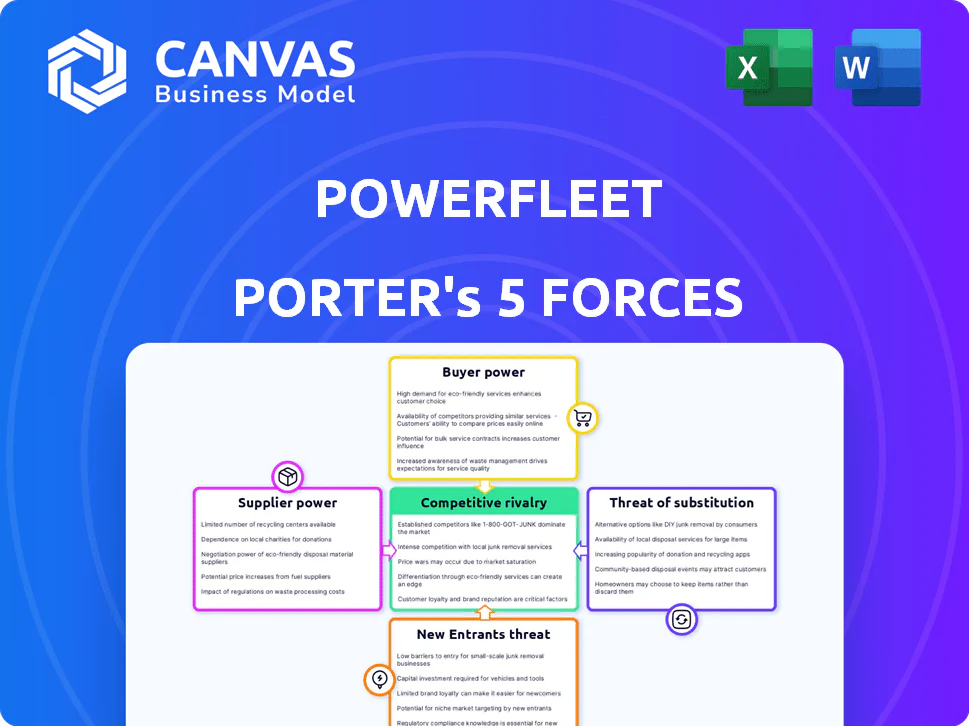
POWERFLEET PORTER'S FIVE FORCES TEMPLATE RESEARCH
What is included in the product
 Detailed Word Document
Analyzes PowerFleet's competitive position, identifying industry pressures, and market share threats.

 Customizable Excel Spreadsheet
Instantly assess competitive intensity with color-coded ratings and weighted scores.
Same Document Delivered
PowerFleet Porter's Five Forces Analysis
This is the complete PowerFleet Porter's Five Forces analysis you'll receive. The preview you're seeing is the exact, ready-to-download document. It covers competitive rivalry, supplier power, buyer power, threat of substitution, and threat of new entrants. This is a professionally crafted analysis, fully formatted and ready for your immediate use. No changes are required.

Porter's Five Forces Analysis Template

From Overview to Strategy Blueprint
PowerFleet operates within a complex telematics market, facing diverse competitive pressures. Its profitability is influenced by the bargaining power of both suppliers and buyers, particularly impacting pricing. The threat of new entrants, fueled by technological advancements, is a constant consideration. Substitute products, such as alternative tracking solutions, also pose a challenge. Moreover, the intensity of rivalry among existing competitors shapes PowerFleet's strategic choices.
The full analysis reveals the strength and intensity of each market force affecting PowerFleet, complete with visuals and summaries for fast, clear interpretation.
Suppliers Bargaining Power

Limited Number of Component Suppliers
In the IoT and M2M sectors, supplier power depends on concentration. Specialized components like RFID or GPS often come from a few suppliers, boosting their leverage. For example, in 2024, the global RFID market was valued at $13.5 billion. Vehicle telematics integration gives automakers some supplier negotiation power. This dynamic is crucial for PowerFleet.
Proprietary Technology and Intellectual Property
Suppliers with proprietary tech, like specialized chips vital for PowerFleet's products, wield considerable influence. High switching costs arise if PowerFleet seeks alternative suppliers. In 2024, companies with unique tech saw a 15% rise in contract values. This impacts PowerFleet's costs and flexibility.

Integration Complexity
PowerFleet's integration complexity, combining hardware and software, bolsters supplier power. Dependence on specialized software significantly impacts costs. In 2024, companies spent an average of 30% of their IT budget on software, increasing supplier leverage. Well-integrated systems are crucial for operational efficiency.

Potential for Forward Integration
Suppliers' bargaining power increases if they can integrate forward, potentially competing with PowerFleet. This means suppliers, like those providing hardware, could develop their own software or services. Such moves could erode PowerFleet's market share and profitability. For example, if a key hardware provider started offering its own tracking software, PowerFleet's customer base could shrink.
- PowerFleet's revenue in 2023 was approximately $117.7 million, showing its reliance on its supplier network.
- The cost of goods sold (COGS) for PowerFleet in 2023 was about $78.7 million, highlighting the impact of supplier pricing.
- Forward integration could lead to a price war, impacting PowerFleet's gross margins, which were around 33% in 2023.
Cost of Components
PowerFleet faces supplier bargaining power, especially with fluctuating component costs like semiconductors and sensors. These costs directly affect PowerFleet's cost of goods sold, influencing profitability. Suppliers' control over these costs is a key factor. For instance, the semiconductor shortage in 2021-2022 significantly impacted many companies.
- PowerFleet's gross profit margin was 33.4% in Q3 2023, reflecting cost pressures.
- Semiconductor prices and availability continue to be volatile in 2024.
- PowerFleet's ability to manage supply chain risks is crucial.
Supplier Dynamics: Costs & Control
PowerFleet's suppliers, especially those with specialized tech, hold significant bargaining power, impacting costs and flexibility. High switching costs and integration complexity further enhance supplier influence, as seen in the $78.7 million COGS in 2023. Forward integration by suppliers poses a competitive threat, potentially eroding market share and margins.
| Aspect | Impact on PowerFleet | 2024 Data |
|---|---|---|
| Supplier Concentration | Higher supplier leverage | RFID market: $13.5B |
| Proprietary Tech | Increased costs, reduced flexibility | Unique tech contract rise: 15% |
| Integration Complexity | Dependence on specialized software | IT budget on software: 30% |
Customers Bargaining Power

Fragmented Customer Base vs. Large Enterprise Clients
PowerFleet's customer base includes both small businesses and major players like Walmart, reflecting a mix of buyer power dynamics. A fragmented customer base typically means lower buyer power overall. However, large enterprise clients, due to their substantial purchasing volume, have significant leverage. In 2024, Walmart's revenue was approximately $648 billion, illustrating the scale of such clients.
Availability of Alternatives and Switching Costs
Customers of PowerFleet, like those in the telematics sector, have choices. Alternatives range from competitors to in-house tracking. Switching costs significantly affect customer power. For instance, integrating with existing systems can make switching costly. In 2024, the telematics market saw a 15% churn rate, highlighting the impact of switching dynamics.

Price Sensitivity
In competitive markets, customers are price-sensitive. This is especially true for commoditized tracking and management aspects. This sensitivity gives buyers power to negotiate lower prices. For instance, in 2024, the average price of fleet management software saw a 5% decrease due to market competition. This shows the impact of customer price sensitivity.

Customer Knowledge and Access to Information
Customer knowledge significantly impacts PowerFleet's bargaining power dynamics. Informed customers, familiar with telematics and asset tracking, can negotiate better terms. The ease of accessing pricing and feature comparisons across providers boosts buyer power. This is especially true in competitive markets, where options abound. For instance, the global telematics market was valued at $76.9 billion in 2023.
- Increased customer knowledge leads to stronger negotiation positions.
- Availability of comparative data empowers buyers.
- Competitive markets intensify buyer power.
- The telematics market's size underscores its importance ($76.9B in 2023).
Impact of the Solution on Customer Operations
The significance of PowerFleet's solutions to a customer's fundamental operations impacts their negotiating strength. If PowerFleet's offerings are vital for a client's efficiency and profitability, the customer's ability to demand big discounts decreases. For instance, in 2024, the logistics sector saw a 7% increase in demand for real-time tracking solutions, highlighting the essential role of PowerFleet's technology. This dependence limits customers' options.
- Critical solutions decrease customer power.
- Essential for efficiency and profitability.
- Logistics sector demand rose 7% in 2024.
- Dependence limits customer options.
Customer Bargaining Power: Size Matters
PowerFleet faces varied customer bargaining power based on size and market dynamics. Large clients like Walmart, with its $648 billion revenue in 2024, wield substantial influence. Customer choices in the telematics sector, such as in-house tracking, also affect this power.
Price sensitivity in competitive markets, where prices dropped 5% in 2024, gives buyers leverage. Informed customers, leveraging comparative data, further strengthen their negotiation positions. PowerFleet's value to essential operations also impacts customer power.
| Aspect | Impact | 2024 Data |
|---|---|---|
| Customer Size | Large clients have more power | Walmart's revenue: $648B |
| Market Competition | Increased buyer power | Fleet software price decrease: 5% |
| Customer Knowledge | Enhanced negotiation | Telematics market value (2023): $76.9B |
Rivalry Among Competitors

Number and Diversity of Competitors
The IoT and telematics market is fiercely competitive, populated by giants and niche players alike. PowerFleet faces significant competition, contributing to intense rivalry. In 2024, the global telematics market was valued at $82.3 billion, with numerous companies vying for market share. This crowded landscape drives price wars and innovation.
Market Growth Rate
The telematics and IoT sectors are booming. The market's expansion can lessen rivalry initially. However, it also draws in new participants. This intensifies the fight for market share. The global telematics market was valued at $74.7 billion in 2023.

Industry Concentration
The telematics market features numerous competitors, yet key players like PowerFleet, Geotab, and Samsara hold significant market shares. Market concentration impacts rivalry; high concentration might curb price wars but intensify strategic moves. PowerFleet's 2023 revenue was $136.2 million. Strategic shifts and tech advancements are key.

Product Differentiation and Switching Costs
PowerFleet's ability to distinguish its offerings through features, tech, and service affects rivalry. Differentiation, like advanced telematics, reduces competition's impact. High switching costs, such as integrating complex systems, also lessen rivalry intensity. For instance, in 2024, PowerFleet's focus on proprietary technology aimed to boost differentiation.
- PowerFleet's 2024 focus on proprietary tech aimed to boost differentiation.
- High switching costs, like complex system integration, lessen rivalry.
- Differentiation reduces the impact of competition.
- Advanced telematics is an example of differentiation.
Exit Barriers
High exit barriers in the market, like substantial investments in specialized assets or enduring contracts, intensify competition. These barriers keep struggling firms operational, increasing rivalry as they strive for survival. For example, the telematics industry saw mergers and acquisitions in 2024, showing how exit costs influence market dynamics. Companies like PowerFleet may face intense competition if competitors are unwilling to exit. This can lead to price wars or aggressive marketing.
- Specialized Assets: Investments in proprietary tracking technology.
- Long-Term Contracts: Contracts with fleet management companies.
- Mergers and Acquisitions: Industry consolidation in 2024.
- Market Dynamics: How exit costs influence market competition.
Telematics Market: Intense Competition Ahead
Competitive rivalry in the telematics market is high, with many companies competing for market share, driving innovation and price wars. In 2024, the global telematics market was valued at $82.3 billion. PowerFleet faces intense competition due to the crowded landscape.
| Aspect | Impact on Rivalry | Example (2024) |
|---|---|---|
| Market Growth | Can initially lessen, then intensify | Telematics market value at $82.3B |
| Market Concentration | High concentration may curb price wars. | PowerFleet's 2023 Revenue: $136.2M |
| Differentiation | Reduces competition's impact | PowerFleet's focus on proprietary tech. |
Original: $10.00
-65%$10.00
$3.50POWERFLEET PORTER'S FIVE FORCES TEMPLATE RESEARCH
What is included in the product
Detailed Word Document
Analyzes PowerFleet's competitive position, identifying industry pressures, and market share threats.
Customizable Excel Spreadsheet
Instantly assess competitive intensity with color-coded ratings and weighted scores.
Same Document Delivered
PowerFleet Porter's Five Forces Analysis
This is the complete PowerFleet Porter's Five Forces analysis you'll receive. The preview you're seeing is the exact, ready-to-download document. It covers competitive rivalry, supplier power, buyer power, threat of substitution, and threat of new entrants. This is a professionally crafted analysis, fully formatted and ready for your immediate use. No changes are required.
Porter's Five Forces Analysis Template
From Overview to Strategy Blueprint
PowerFleet operates within a complex telematics market, facing diverse competitive pressures. Its profitability is influenced by the bargaining power of both suppliers and buyers, particularly impacting pricing. The threat of new entrants, fueled by technological advancements, is a constant consideration. Substitute products, such as alternative tracking solutions, also pose a challenge. Moreover, the intensity of rivalry among existing competitors shapes PowerFleet's strategic choices.
The full analysis reveals the strength and intensity of each market force affecting PowerFleet, complete with visuals and summaries for fast, clear interpretation.
Suppliers Bargaining Power
Limited Number of Component Suppliers
In the IoT and M2M sectors, supplier power depends on concentration. Specialized components like RFID or GPS often come from a few suppliers, boosting their leverage. For example, in 2024, the global RFID market was valued at $13.5 billion. Vehicle telematics integration gives automakers some supplier negotiation power. This dynamic is crucial for PowerFleet.
Proprietary Technology and Intellectual Property
Suppliers with proprietary tech, like specialized chips vital for PowerFleet's products, wield considerable influence. High switching costs arise if PowerFleet seeks alternative suppliers. In 2024, companies with unique tech saw a 15% rise in contract values. This impacts PowerFleet's costs and flexibility.
Integration Complexity
PowerFleet's integration complexity, combining hardware and software, bolsters supplier power. Dependence on specialized software significantly impacts costs. In 2024, companies spent an average of 30% of their IT budget on software, increasing supplier leverage. Well-integrated systems are crucial for operational efficiency.
Potential for Forward Integration
Suppliers' bargaining power increases if they can integrate forward, potentially competing with PowerFleet. This means suppliers, like those providing hardware, could develop their own software or services. Such moves could erode PowerFleet's market share and profitability. For example, if a key hardware provider started offering its own tracking software, PowerFleet's customer base could shrink.
- PowerFleet's revenue in 2023 was approximately $117.7 million, showing its reliance on its supplier network.
- The cost of goods sold (COGS) for PowerFleet in 2023 was about $78.7 million, highlighting the impact of supplier pricing.
- Forward integration could lead to a price war, impacting PowerFleet's gross margins, which were around 33% in 2023.
Cost of Components
PowerFleet faces supplier bargaining power, especially with fluctuating component costs like semiconductors and sensors. These costs directly affect PowerFleet's cost of goods sold, influencing profitability. Suppliers' control over these costs is a key factor. For instance, the semiconductor shortage in 2021-2022 significantly impacted many companies.
- PowerFleet's gross profit margin was 33.4% in Q3 2023, reflecting cost pressures.
- Semiconductor prices and availability continue to be volatile in 2024.
- PowerFleet's ability to manage supply chain risks is crucial.
Supplier Dynamics: Costs & Control
PowerFleet's suppliers, especially those with specialized tech, hold significant bargaining power, impacting costs and flexibility. High switching costs and integration complexity further enhance supplier influence, as seen in the $78.7 million COGS in 2023. Forward integration by suppliers poses a competitive threat, potentially eroding market share and margins.
| Aspect | Impact on PowerFleet | 2024 Data |
|---|---|---|
| Supplier Concentration | Higher supplier leverage | RFID market: $13.5B |
| Proprietary Tech | Increased costs, reduced flexibility | Unique tech contract rise: 15% |
| Integration Complexity | Dependence on specialized software | IT budget on software: 30% |
Customers Bargaining Power
Fragmented Customer Base vs. Large Enterprise Clients
PowerFleet's customer base includes both small businesses and major players like Walmart, reflecting a mix of buyer power dynamics. A fragmented customer base typically means lower buyer power overall. However, large enterprise clients, due to their substantial purchasing volume, have significant leverage. In 2024, Walmart's revenue was approximately $648 billion, illustrating the scale of such clients.
Availability of Alternatives and Switching Costs
Customers of PowerFleet, like those in the telematics sector, have choices. Alternatives range from competitors to in-house tracking. Switching costs significantly affect customer power. For instance, integrating with existing systems can make switching costly. In 2024, the telematics market saw a 15% churn rate, highlighting the impact of switching dynamics.
Price Sensitivity
In competitive markets, customers are price-sensitive. This is especially true for commoditized tracking and management aspects. This sensitivity gives buyers power to negotiate lower prices. For instance, in 2024, the average price of fleet management software saw a 5% decrease due to market competition. This shows the impact of customer price sensitivity.
Customer Knowledge and Access to Information
Customer knowledge significantly impacts PowerFleet's bargaining power dynamics. Informed customers, familiar with telematics and asset tracking, can negotiate better terms. The ease of accessing pricing and feature comparisons across providers boosts buyer power. This is especially true in competitive markets, where options abound. For instance, the global telematics market was valued at $76.9 billion in 2023.
- Increased customer knowledge leads to stronger negotiation positions.
- Availability of comparative data empowers buyers.
- Competitive markets intensify buyer power.
- The telematics market's size underscores its importance ($76.9B in 2023).
Impact of the Solution on Customer Operations
The significance of PowerFleet's solutions to a customer's fundamental operations impacts their negotiating strength. If PowerFleet's offerings are vital for a client's efficiency and profitability, the customer's ability to demand big discounts decreases. For instance, in 2024, the logistics sector saw a 7% increase in demand for real-time tracking solutions, highlighting the essential role of PowerFleet's technology. This dependence limits customers' options.
- Critical solutions decrease customer power.
- Essential for efficiency and profitability.
- Logistics sector demand rose 7% in 2024.
- Dependence limits customer options.
Customer Bargaining Power: Size Matters
PowerFleet faces varied customer bargaining power based on size and market dynamics. Large clients like Walmart, with its $648 billion revenue in 2024, wield substantial influence. Customer choices in the telematics sector, such as in-house tracking, also affect this power.
Price sensitivity in competitive markets, where prices dropped 5% in 2024, gives buyers leverage. Informed customers, leveraging comparative data, further strengthen their negotiation positions. PowerFleet's value to essential operations also impacts customer power.
| Aspect | Impact | 2024 Data |
|---|---|---|
| Customer Size | Large clients have more power | Walmart's revenue: $648B |
| Market Competition | Increased buyer power | Fleet software price decrease: 5% |
| Customer Knowledge | Enhanced negotiation | Telematics market value (2023): $76.9B |
Rivalry Among Competitors
Number and Diversity of Competitors
The IoT and telematics market is fiercely competitive, populated by giants and niche players alike. PowerFleet faces significant competition, contributing to intense rivalry. In 2024, the global telematics market was valued at $82.3 billion, with numerous companies vying for market share. This crowded landscape drives price wars and innovation.
Market Growth Rate
The telematics and IoT sectors are booming. The market's expansion can lessen rivalry initially. However, it also draws in new participants. This intensifies the fight for market share. The global telematics market was valued at $74.7 billion in 2023.
Industry Concentration
The telematics market features numerous competitors, yet key players like PowerFleet, Geotab, and Samsara hold significant market shares. Market concentration impacts rivalry; high concentration might curb price wars but intensify strategic moves. PowerFleet's 2023 revenue was $136.2 million. Strategic shifts and tech advancements are key.
Product Differentiation and Switching Costs
PowerFleet's ability to distinguish its offerings through features, tech, and service affects rivalry. Differentiation, like advanced telematics, reduces competition's impact. High switching costs, such as integrating complex systems, also lessen rivalry intensity. For instance, in 2024, PowerFleet's focus on proprietary technology aimed to boost differentiation.
- PowerFleet's 2024 focus on proprietary tech aimed to boost differentiation.
- High switching costs, like complex system integration, lessen rivalry.
- Differentiation reduces the impact of competition.
- Advanced telematics is an example of differentiation.
Exit Barriers
High exit barriers in the market, like substantial investments in specialized assets or enduring contracts, intensify competition. These barriers keep struggling firms operational, increasing rivalry as they strive for survival. For example, the telematics industry saw mergers and acquisitions in 2024, showing how exit costs influence market dynamics. Companies like PowerFleet may face intense competition if competitors are unwilling to exit. This can lead to price wars or aggressive marketing.
- Specialized Assets: Investments in proprietary tracking technology.
- Long-Term Contracts: Contracts with fleet management companies.
- Mergers and Acquisitions: Industry consolidation in 2024.
- Market Dynamics: How exit costs influence market competition.
Telematics Market: Intense Competition Ahead
Competitive rivalry in the telematics market is high, with many companies competing for market share, driving innovation and price wars. In 2024, the global telematics market was valued at $82.3 billion. PowerFleet faces intense competition due to the crowded landscape.
| Aspect | Impact on Rivalry | Example (2024) |
|---|---|---|
| Market Growth | Can initially lessen, then intensify | Telematics market value at $82.3B |
| Market Concentration | High concentration may curb price wars. | PowerFleet's 2023 Revenue: $136.2M |
| Differentiation | Reduces competition's impact | PowerFleet's focus on proprietary tech. |
Product Information
Product Information
Shipping & Returns
Shipping & Returns
Description
What is included in the product
Detailed Word Document
Analyzes PowerFleet's competitive position, identifying industry pressures, and market share threats.
Customizable Excel Spreadsheet
Instantly assess competitive intensity with color-coded ratings and weighted scores.
Same Document Delivered
PowerFleet Porter's Five Forces Analysis
This is the complete PowerFleet Porter's Five Forces analysis you'll receive. The preview you're seeing is the exact, ready-to-download document. It covers competitive rivalry, supplier power, buyer power, threat of substitution, and threat of new entrants. This is a professionally crafted analysis, fully formatted and ready for your immediate use. No changes are required.
Porter's Five Forces Analysis Template
From Overview to Strategy Blueprint
PowerFleet operates within a complex telematics market, facing diverse competitive pressures. Its profitability is influenced by the bargaining power of both suppliers and buyers, particularly impacting pricing. The threat of new entrants, fueled by technological advancements, is a constant consideration. Substitute products, such as alternative tracking solutions, also pose a challenge. Moreover, the intensity of rivalry among existing competitors shapes PowerFleet's strategic choices.
The full analysis reveals the strength and intensity of each market force affecting PowerFleet, complete with visuals and summaries for fast, clear interpretation.
Suppliers Bargaining Power
Limited Number of Component Suppliers
In the IoT and M2M sectors, supplier power depends on concentration. Specialized components like RFID or GPS often come from a few suppliers, boosting their leverage. For example, in 2024, the global RFID market was valued at $13.5 billion. Vehicle telematics integration gives automakers some supplier negotiation power. This dynamic is crucial for PowerFleet.
Proprietary Technology and Intellectual Property
Suppliers with proprietary tech, like specialized chips vital for PowerFleet's products, wield considerable influence. High switching costs arise if PowerFleet seeks alternative suppliers. In 2024, companies with unique tech saw a 15% rise in contract values. This impacts PowerFleet's costs and flexibility.
Integration Complexity
PowerFleet's integration complexity, combining hardware and software, bolsters supplier power. Dependence on specialized software significantly impacts costs. In 2024, companies spent an average of 30% of their IT budget on software, increasing supplier leverage. Well-integrated systems are crucial for operational efficiency.
Potential for Forward Integration
Suppliers' bargaining power increases if they can integrate forward, potentially competing with PowerFleet. This means suppliers, like those providing hardware, could develop their own software or services. Such moves could erode PowerFleet's market share and profitability. For example, if a key hardware provider started offering its own tracking software, PowerFleet's customer base could shrink.
- PowerFleet's revenue in 2023 was approximately $117.7 million, showing its reliance on its supplier network.
- The cost of goods sold (COGS) for PowerFleet in 2023 was about $78.7 million, highlighting the impact of supplier pricing.
- Forward integration could lead to a price war, impacting PowerFleet's gross margins, which were around 33% in 2023.
Cost of Components
PowerFleet faces supplier bargaining power, especially with fluctuating component costs like semiconductors and sensors. These costs directly affect PowerFleet's cost of goods sold, influencing profitability. Suppliers' control over these costs is a key factor. For instance, the semiconductor shortage in 2021-2022 significantly impacted many companies.
- PowerFleet's gross profit margin was 33.4% in Q3 2023, reflecting cost pressures.
- Semiconductor prices and availability continue to be volatile in 2024.
- PowerFleet's ability to manage supply chain risks is crucial.
Supplier Dynamics: Costs & Control
PowerFleet's suppliers, especially those with specialized tech, hold significant bargaining power, impacting costs and flexibility. High switching costs and integration complexity further enhance supplier influence, as seen in the $78.7 million COGS in 2023. Forward integration by suppliers poses a competitive threat, potentially eroding market share and margins.
| Aspect | Impact on PowerFleet | 2024 Data |
|---|---|---|
| Supplier Concentration | Higher supplier leverage | RFID market: $13.5B |
| Proprietary Tech | Increased costs, reduced flexibility | Unique tech contract rise: 15% |
| Integration Complexity | Dependence on specialized software | IT budget on software: 30% |
Customers Bargaining Power
Fragmented Customer Base vs. Large Enterprise Clients
PowerFleet's customer base includes both small businesses and major players like Walmart, reflecting a mix of buyer power dynamics. A fragmented customer base typically means lower buyer power overall. However, large enterprise clients, due to their substantial purchasing volume, have significant leverage. In 2024, Walmart's revenue was approximately $648 billion, illustrating the scale of such clients.
Availability of Alternatives and Switching Costs
Customers of PowerFleet, like those in the telematics sector, have choices. Alternatives range from competitors to in-house tracking. Switching costs significantly affect customer power. For instance, integrating with existing systems can make switching costly. In 2024, the telematics market saw a 15% churn rate, highlighting the impact of switching dynamics.
Price Sensitivity
In competitive markets, customers are price-sensitive. This is especially true for commoditized tracking and management aspects. This sensitivity gives buyers power to negotiate lower prices. For instance, in 2024, the average price of fleet management software saw a 5% decrease due to market competition. This shows the impact of customer price sensitivity.
Customer Knowledge and Access to Information
Customer knowledge significantly impacts PowerFleet's bargaining power dynamics. Informed customers, familiar with telematics and asset tracking, can negotiate better terms. The ease of accessing pricing and feature comparisons across providers boosts buyer power. This is especially true in competitive markets, where options abound. For instance, the global telematics market was valued at $76.9 billion in 2023.
- Increased customer knowledge leads to stronger negotiation positions.
- Availability of comparative data empowers buyers.
- Competitive markets intensify buyer power.
- The telematics market's size underscores its importance ($76.9B in 2023).
Impact of the Solution on Customer Operations
The significance of PowerFleet's solutions to a customer's fundamental operations impacts their negotiating strength. If PowerFleet's offerings are vital for a client's efficiency and profitability, the customer's ability to demand big discounts decreases. For instance, in 2024, the logistics sector saw a 7% increase in demand for real-time tracking solutions, highlighting the essential role of PowerFleet's technology. This dependence limits customers' options.
- Critical solutions decrease customer power.
- Essential for efficiency and profitability.
- Logistics sector demand rose 7% in 2024.
- Dependence limits customer options.
Customer Bargaining Power: Size Matters
PowerFleet faces varied customer bargaining power based on size and market dynamics. Large clients like Walmart, with its $648 billion revenue in 2024, wield substantial influence. Customer choices in the telematics sector, such as in-house tracking, also affect this power.
Price sensitivity in competitive markets, where prices dropped 5% in 2024, gives buyers leverage. Informed customers, leveraging comparative data, further strengthen their negotiation positions. PowerFleet's value to essential operations also impacts customer power.
| Aspect | Impact | 2024 Data |
|---|---|---|
| Customer Size | Large clients have more power | Walmart's revenue: $648B |
| Market Competition | Increased buyer power | Fleet software price decrease: 5% |
| Customer Knowledge | Enhanced negotiation | Telematics market value (2023): $76.9B |
Rivalry Among Competitors
Number and Diversity of Competitors
The IoT and telematics market is fiercely competitive, populated by giants and niche players alike. PowerFleet faces significant competition, contributing to intense rivalry. In 2024, the global telematics market was valued at $82.3 billion, with numerous companies vying for market share. This crowded landscape drives price wars and innovation.
Market Growth Rate
The telematics and IoT sectors are booming. The market's expansion can lessen rivalry initially. However, it also draws in new participants. This intensifies the fight for market share. The global telematics market was valued at $74.7 billion in 2023.
Industry Concentration
The telematics market features numerous competitors, yet key players like PowerFleet, Geotab, and Samsara hold significant market shares. Market concentration impacts rivalry; high concentration might curb price wars but intensify strategic moves. PowerFleet's 2023 revenue was $136.2 million. Strategic shifts and tech advancements are key.
Product Differentiation and Switching Costs
PowerFleet's ability to distinguish its offerings through features, tech, and service affects rivalry. Differentiation, like advanced telematics, reduces competition's impact. High switching costs, such as integrating complex systems, also lessen rivalry intensity. For instance, in 2024, PowerFleet's focus on proprietary technology aimed to boost differentiation.
- PowerFleet's 2024 focus on proprietary tech aimed to boost differentiation.
- High switching costs, like complex system integration, lessen rivalry.
- Differentiation reduces the impact of competition.
- Advanced telematics is an example of differentiation.
Exit Barriers
High exit barriers in the market, like substantial investments in specialized assets or enduring contracts, intensify competition. These barriers keep struggling firms operational, increasing rivalry as they strive for survival. For example, the telematics industry saw mergers and acquisitions in 2024, showing how exit costs influence market dynamics. Companies like PowerFleet may face intense competition if competitors are unwilling to exit. This can lead to price wars or aggressive marketing.
- Specialized Assets: Investments in proprietary tracking technology.
- Long-Term Contracts: Contracts with fleet management companies.
- Mergers and Acquisitions: Industry consolidation in 2024.
- Market Dynamics: How exit costs influence market competition.
Telematics Market: Intense Competition Ahead
Competitive rivalry in the telematics market is high, with many companies competing for market share, driving innovation and price wars. In 2024, the global telematics market was valued at $82.3 billion. PowerFleet faces intense competition due to the crowded landscape.
| Aspect | Impact on Rivalry | Example (2024) |
|---|---|---|
| Market Growth | Can initially lessen, then intensify | Telematics market value at $82.3B |
| Market Concentration | High concentration may curb price wars. | PowerFleet's 2023 Revenue: $136.2M |
| Differentiation | Reduces competition's impact | PowerFleet's focus on proprietary tech. |











