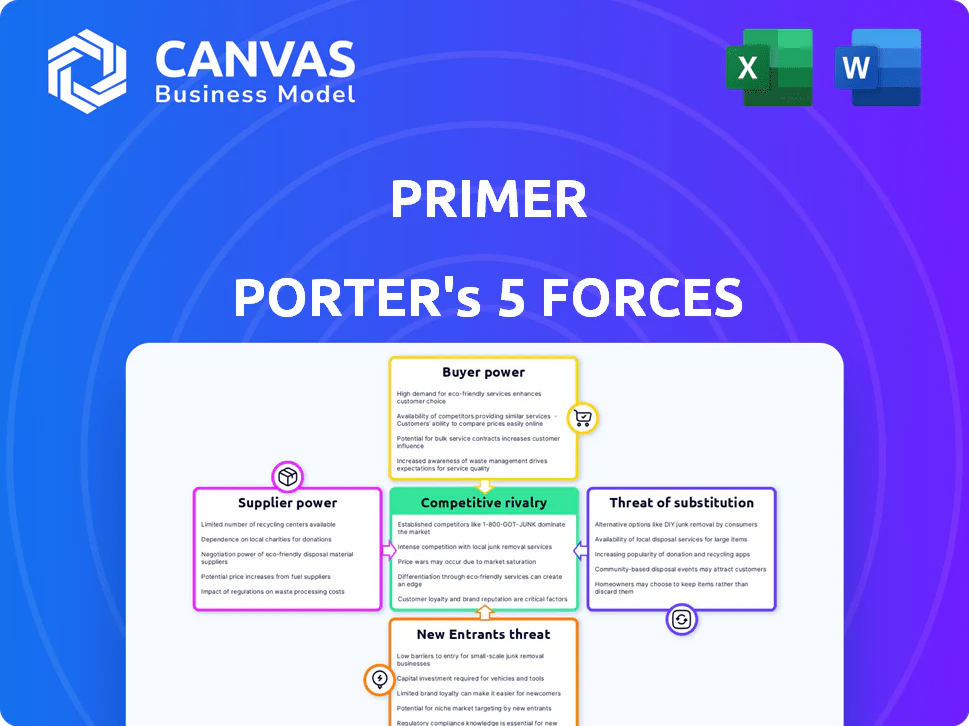
PRIMER PORTER'S FIVE FORCES TEMPLATE RESEARCH
What is included in the product
 Detailed Word Document
Primer's competitive environment is analyzed via the Five Forces framework, revealing threats and opportunities.

 Customizable Excel Spreadsheet
Uncover the key market forces with a dynamic visualization, making strategic planning a breeze.
Same Document Delivered
Primer Porter's Five Forces Analysis
This Porter's Five Forces analysis preview showcases the complete, ready-to-use document you'll instantly receive after purchasing. It's the final, fully formatted version, not a sample or mockup. This ensures you get the same quality content immediately. No surprises, just immediate access to the exact analysis.

Porter's Five Forces Analysis Template

A Must-Have Tool for Decision-Makers
Porter's Five Forces analyzes Primer's competitive landscape by assessing industry rivalry, supplier power, buyer power, threat of substitutes, and threat of new entrants. This framework helps understand the intensity of competition and profitability. Analyzing these forces enables strategic decision-making. Understanding these dynamics reveals how Primer can sustain its competitive advantage. This overview is just a glimpse into the factors impacting Primer's market position.
Unlock key insights into Primer’s industry forces—from buyer power to substitute threats—and use this knowledge to inform strategy or investment decisions.
Suppliers Bargaining Power

Reliance on Payment Gateways and Processors
Primer, as a payment infrastructure, relies on payment gateways. The power of these suppliers is key, with major players holding influence. Primer integrates widely, mitigating single-supplier power. In 2024, the global payment processing market is valued at over $100 billion. Diversification is crucial for Primer.
Technology and Infrastructure Providers
Primer relies on technology and infrastructure providers for its platform, including cloud services and security. These suppliers' bargaining power hinges on alternative availability and switching costs. In 2024, cloud computing spending is projected to reach $678.8 billion, with significant provider concentration. Leveraging cloud services can reduce reliance on traditional IT suppliers.

Financial Institutions and Banks
Financial institutions and banks are key suppliers in the payment ecosystem, offering services like transaction processing. Their bargaining power is significant due to their role in fund movement and compliance. In 2024, the average transaction processing fee was between 1.5% to 3.5% of the transaction value, impacting profitability. Diversifying banking relationships can help mitigate the impact of supplier bargaining power.

Regulatory Bodies
Regulatory bodies, though not suppliers, significantly influence payment companies. Compliance with regulations, such as those from the CFPB in the US or GDPR in Europe, adds substantial costs. These bodies wield considerable power through their ability to enforce strict standards. Staying ahead of these changes is vital for companies. For example, the average cost of compliance for financial institutions rose by 10% in 2024.
- Compliance Costs: The average cost of compliance for financial institutions rose by 10% in 2024.
- Regulatory Scrutiny: Increased scrutiny from regulatory bodies, like the CFPB, is ongoing.
- Impact on Innovation: Regulations can slow down innovation, affecting market dynamics.
- Market Impact: The impact of regulatory changes is felt across the entire financial market.
Specialized Technology Components
Suppliers of specialized tech components, like security protocols, wield significant power, especially with proprietary or scarce offerings. Companies often use multi-sourcing to lessen reliance on one supplier for crucial parts. For example, in 2024, the cybersecurity market reached $202 billion, highlighting supplier importance. This gives specialized tech suppliers leverage in negotiations.
- Market size: The cybersecurity market reached $202 billion in 2024.
- Multi-sourcing: Many businesses use multiple suppliers for critical components.
- Proprietary technology: Suppliers with unique tech have more influence.
- Negotiating power: Specialized suppliers often have strong bargaining power.
Supplier Power: Shaping Costs and Strategies
The bargaining power of suppliers significantly shapes Primer's operational costs and market dynamics. Key suppliers include payment gateways, tech providers, and financial institutions. In 2024, the payment processing market exceeded $100 billion, underscoring supplier importance.
Cloud services and security tech suppliers also hold sway. The cloud computing market was projected to hit $678.8 billion in 2024, impacting pricing. Diversification and negotiation are key strategies to manage supplier influence effectively.
Financial institutions, crucial for transaction processing, wield substantial power. Average transaction fees ranged from 1.5% to 3.5% in 2024, affecting profitability. Building diverse banking relationships helps mitigate this impact.
| Supplier Type | Impact on Primer | 2024 Market Data |
|---|---|---|
| Payment Gateways | Transaction Costs | Market over $100B |
| Tech Providers | Infrastructure Costs | Cloud spending $678.8B |
| Financial Institutions | Processing Fees | Fees 1.5%-3.5% |
Customers Bargaining Power

Large Enterprise Clients
Primer targets enterprises with complex payment needs, a market segment that accounted for 65% of payment processing revenue in 2024. These large clients wield considerable bargaining power. Their volume, like the $100 million in annual transactions some process, influences pricing. They can negotiate favorable terms.
Availability of Alternatives
Customers in payment processing have many choices. They can use different platforms, integrate directly with payment service providers (PSPs), or create their own solutions. This variety increases their power. For example, in 2024, the market saw over 20 payment orchestration platforms, offering diverse features and pricing. Switching is also easy; a 2024 study showed 60% of businesses considered switching payment providers annually.

Importance of Payment Infrastructure to Business Operations
For digital businesses, payment infrastructure is vital. Their demands for tailored solutions and top-tier service increase customer power. In-house payment expertise strengthens their position. E-commerce sales in the U.S. reached $1.1 trillion in 2023, highlighting this reliance.

Access to Information
Customers, particularly larger ones, wield significant bargaining power due to their access to pricing and service level data. This transparency enables them to negotiate effectively, putting pressure on pricing strategies. For example, in 2024, online retail giants like Amazon have consistently driven down prices. Full information provides buyers with leverage and helps them to compare offers.
- Price Comparison: Customers readily compare prices online.
- Market Research: They can easily research product alternatives.
- Negotiation: Informed buyers can often negotiate better deals.
- Switching Costs: Low switching costs also make buyers more powerful.
Potential for Backward Integration
The bargaining power of customers can be amplified by the potential for backward integration, a strategy where customers develop their own payment infrastructure. While less common for smaller merchants, large enterprises like Amazon or Walmart have the resources to internalize payment processing. This capability gives these customers more leverage in negotiations. For example, in 2024, Amazon processed approximately $600 billion in sales through its internal payment systems, showcasing the scale and impact of backward integration. This reduces their reliance on external payment processors.
- Backward integration allows large customers to bypass external payment processors.
- This increases their bargaining power through the ability to self-serve.
- Amazon's $600 billion in sales processed internally in 2024 is a key example.
- The threat of this capability can be a significant negotiating tool.
Customer Power Drives Pricing in Payment Orchestration
Customers, especially enterprises, have significant bargaining power. They influence pricing due to high transaction volumes, like the $100 million annual transactions. Customers can easily compare prices online and switch providers, increasing their negotiation leverage.
| Aspect | Impact | 2024 Data |
|---|---|---|
| Market Choice | Many options | 20+ payment orchestration platforms |
| Switching | Easy to switch | 60% of businesses considered switching |
| Backward Integration | Customer control | Amazon processed $600B internally |
Rivalry Among Competitors

Presence of Numerous Competitors
The payment processing sector is highly competitive, with many companies fighting for dominance. In 2024, the market saw over 500 payment service providers. This intense rivalry pushes firms to innovate and offer better services to attract customers. Competition drives down profit margins.
Differentiation of Services
Rivalry is influenced by service differentiation. Primer's unified infrastructure and automation aim to set it apart. Yet, rivals like Stripe and Adyen have similar features. In 2024, the payment processing market is highly competitive, with companies constantly innovating. This intensifies rivalry.

Price Competition
Intense price competition can trigger price wars and squeeze profit margins. The payment processing sector often experiences this, where firms lower fees to gain or keep clients. For instance, in 2024, Visa and Mastercard faced pressure to lower interchange fees. This impacted their profitability, a key factor in competitive rivalry.

Innovation and Technological Advancements
The payments industry sees relentless innovation, with tech advancements driving competition. Firms must continuously update platforms to stay ahead, fostering intense rivalry. This dynamic environment pushes companies to invest heavily in R&D, as seen with Square's $338 million R&D spend in Q3 2023. The need for constant iteration fuels the competitive landscape.
- R&D spending is critical.
- Innovation cycles are fast-paced.
- Competition is very dynamic.
- Companies constantly evolve.
Global Reach and Expansion
The payment processing and orchestration market sees intense rivalry fueled by global expansion. Companies are aggressively entering new regions to capture international clients, intensifying competition. This worldwide push is evident in the increasing number of cross-border transactions handled. Expansion strategies involve mergers and acquisitions, and partnerships, to boost market share. This dynamic environment challenges companies to innovate and differentiate themselves.
- Global payment volume is projected to reach $3.5 trillion by the end of 2024.
- Cross-border e-commerce sales are expected to account for 22% of total e-commerce sales in 2024.
- Strategic partnerships are up 15% in 2024.
- M&A activity in the payments sector has increased by 10% in the first half of 2024.
Payment Processing: A Battleground of Billions
Competitive rivalry in payment processing is fierce, with hundreds of providers vying for market share. Intense competition drives innovation and often leads to price wars, squeezing profit margins. The need for constant technological upgrades and global expansion further intensifies this rivalry.
| Metric | 2024 Data | Impact |
|---|---|---|
| Number of Payment Service Providers | Over 500 | High competition |
| Global Payment Volume (Projected) | $3.5 Trillion | Expansion focus |
| R&D Spending (Square Q3 2023) | $338 Million | Continuous innovation |
PRIMER PORTER'S FIVE FORCES TEMPLATE RESEARCH
What is included in the product
Detailed Word Document
Primer's competitive environment is analyzed via the Five Forces framework, revealing threats and opportunities.
Customizable Excel Spreadsheet
Uncover the key market forces with a dynamic visualization, making strategic planning a breeze.
Same Document Delivered
Primer Porter's Five Forces Analysis
This Porter's Five Forces analysis preview showcases the complete, ready-to-use document you'll instantly receive after purchasing. It's the final, fully formatted version, not a sample or mockup. This ensures you get the same quality content immediately. No surprises, just immediate access to the exact analysis.
Porter's Five Forces Analysis Template
A Must-Have Tool for Decision-Makers
Porter's Five Forces analyzes Primer's competitive landscape by assessing industry rivalry, supplier power, buyer power, threat of substitutes, and threat of new entrants. This framework helps understand the intensity of competition and profitability. Analyzing these forces enables strategic decision-making. Understanding these dynamics reveals how Primer can sustain its competitive advantage. This overview is just a glimpse into the factors impacting Primer's market position.
Unlock key insights into Primer’s industry forces—from buyer power to substitute threats—and use this knowledge to inform strategy or investment decisions.
Suppliers Bargaining Power
Reliance on Payment Gateways and Processors
Primer, as a payment infrastructure, relies on payment gateways. The power of these suppliers is key, with major players holding influence. Primer integrates widely, mitigating single-supplier power. In 2024, the global payment processing market is valued at over $100 billion. Diversification is crucial for Primer.
Technology and Infrastructure Providers
Primer relies on technology and infrastructure providers for its platform, including cloud services and security. These suppliers' bargaining power hinges on alternative availability and switching costs. In 2024, cloud computing spending is projected to reach $678.8 billion, with significant provider concentration. Leveraging cloud services can reduce reliance on traditional IT suppliers.
Financial Institutions and Banks
Financial institutions and banks are key suppliers in the payment ecosystem, offering services like transaction processing. Their bargaining power is significant due to their role in fund movement and compliance. In 2024, the average transaction processing fee was between 1.5% to 3.5% of the transaction value, impacting profitability. Diversifying banking relationships can help mitigate the impact of supplier bargaining power.
Regulatory Bodies
Regulatory bodies, though not suppliers, significantly influence payment companies. Compliance with regulations, such as those from the CFPB in the US or GDPR in Europe, adds substantial costs. These bodies wield considerable power through their ability to enforce strict standards. Staying ahead of these changes is vital for companies. For example, the average cost of compliance for financial institutions rose by 10% in 2024.
- Compliance Costs: The average cost of compliance for financial institutions rose by 10% in 2024.
- Regulatory Scrutiny: Increased scrutiny from regulatory bodies, like the CFPB, is ongoing.
- Impact on Innovation: Regulations can slow down innovation, affecting market dynamics.
- Market Impact: The impact of regulatory changes is felt across the entire financial market.
Specialized Technology Components
Suppliers of specialized tech components, like security protocols, wield significant power, especially with proprietary or scarce offerings. Companies often use multi-sourcing to lessen reliance on one supplier for crucial parts. For example, in 2024, the cybersecurity market reached $202 billion, highlighting supplier importance. This gives specialized tech suppliers leverage in negotiations.
- Market size: The cybersecurity market reached $202 billion in 2024.
- Multi-sourcing: Many businesses use multiple suppliers for critical components.
- Proprietary technology: Suppliers with unique tech have more influence.
- Negotiating power: Specialized suppliers often have strong bargaining power.
Supplier Power: Shaping Costs and Strategies
The bargaining power of suppliers significantly shapes Primer's operational costs and market dynamics. Key suppliers include payment gateways, tech providers, and financial institutions. In 2024, the payment processing market exceeded $100 billion, underscoring supplier importance.
Cloud services and security tech suppliers also hold sway. The cloud computing market was projected to hit $678.8 billion in 2024, impacting pricing. Diversification and negotiation are key strategies to manage supplier influence effectively.
Financial institutions, crucial for transaction processing, wield substantial power. Average transaction fees ranged from 1.5% to 3.5% in 2024, affecting profitability. Building diverse banking relationships helps mitigate this impact.
| Supplier Type | Impact on Primer | 2024 Market Data |
|---|---|---|
| Payment Gateways | Transaction Costs | Market over $100B |
| Tech Providers | Infrastructure Costs | Cloud spending $678.8B |
| Financial Institutions | Processing Fees | Fees 1.5%-3.5% |
Customers Bargaining Power
Large Enterprise Clients
Primer targets enterprises with complex payment needs, a market segment that accounted for 65% of payment processing revenue in 2024. These large clients wield considerable bargaining power. Their volume, like the $100 million in annual transactions some process, influences pricing. They can negotiate favorable terms.
Availability of Alternatives
Customers in payment processing have many choices. They can use different platforms, integrate directly with payment service providers (PSPs), or create their own solutions. This variety increases their power. For example, in 2024, the market saw over 20 payment orchestration platforms, offering diverse features and pricing. Switching is also easy; a 2024 study showed 60% of businesses considered switching payment providers annually.
Importance of Payment Infrastructure to Business Operations
For digital businesses, payment infrastructure is vital. Their demands for tailored solutions and top-tier service increase customer power. In-house payment expertise strengthens their position. E-commerce sales in the U.S. reached $1.1 trillion in 2023, highlighting this reliance.
Access to Information
Customers, particularly larger ones, wield significant bargaining power due to their access to pricing and service level data. This transparency enables them to negotiate effectively, putting pressure on pricing strategies. For example, in 2024, online retail giants like Amazon have consistently driven down prices. Full information provides buyers with leverage and helps them to compare offers.
- Price Comparison: Customers readily compare prices online.
- Market Research: They can easily research product alternatives.
- Negotiation: Informed buyers can often negotiate better deals.
- Switching Costs: Low switching costs also make buyers more powerful.
Potential for Backward Integration
The bargaining power of customers can be amplified by the potential for backward integration, a strategy where customers develop their own payment infrastructure. While less common for smaller merchants, large enterprises like Amazon or Walmart have the resources to internalize payment processing. This capability gives these customers more leverage in negotiations. For example, in 2024, Amazon processed approximately $600 billion in sales through its internal payment systems, showcasing the scale and impact of backward integration. This reduces their reliance on external payment processors.
- Backward integration allows large customers to bypass external payment processors.
- This increases their bargaining power through the ability to self-serve.
- Amazon's $600 billion in sales processed internally in 2024 is a key example.
- The threat of this capability can be a significant negotiating tool.
Customer Power Drives Pricing in Payment Orchestration
Customers, especially enterprises, have significant bargaining power. They influence pricing due to high transaction volumes, like the $100 million annual transactions. Customers can easily compare prices online and switch providers, increasing their negotiation leverage.
| Aspect | Impact | 2024 Data |
|---|---|---|
| Market Choice | Many options | 20+ payment orchestration platforms |
| Switching | Easy to switch | 60% of businesses considered switching |
| Backward Integration | Customer control | Amazon processed $600B internally |
Rivalry Among Competitors
Presence of Numerous Competitors
The payment processing sector is highly competitive, with many companies fighting for dominance. In 2024, the market saw over 500 payment service providers. This intense rivalry pushes firms to innovate and offer better services to attract customers. Competition drives down profit margins.
Differentiation of Services
Rivalry is influenced by service differentiation. Primer's unified infrastructure and automation aim to set it apart. Yet, rivals like Stripe and Adyen have similar features. In 2024, the payment processing market is highly competitive, with companies constantly innovating. This intensifies rivalry.
Price Competition
Intense price competition can trigger price wars and squeeze profit margins. The payment processing sector often experiences this, where firms lower fees to gain or keep clients. For instance, in 2024, Visa and Mastercard faced pressure to lower interchange fees. This impacted their profitability, a key factor in competitive rivalry.
Innovation and Technological Advancements
The payments industry sees relentless innovation, with tech advancements driving competition. Firms must continuously update platforms to stay ahead, fostering intense rivalry. This dynamic environment pushes companies to invest heavily in R&D, as seen with Square's $338 million R&D spend in Q3 2023. The need for constant iteration fuels the competitive landscape.
- R&D spending is critical.
- Innovation cycles are fast-paced.
- Competition is very dynamic.
- Companies constantly evolve.
Global Reach and Expansion
The payment processing and orchestration market sees intense rivalry fueled by global expansion. Companies are aggressively entering new regions to capture international clients, intensifying competition. This worldwide push is evident in the increasing number of cross-border transactions handled. Expansion strategies involve mergers and acquisitions, and partnerships, to boost market share. This dynamic environment challenges companies to innovate and differentiate themselves.
- Global payment volume is projected to reach $3.5 trillion by the end of 2024.
- Cross-border e-commerce sales are expected to account for 22% of total e-commerce sales in 2024.
- Strategic partnerships are up 15% in 2024.
- M&A activity in the payments sector has increased by 10% in the first half of 2024.
Payment Processing: A Battleground of Billions
Competitive rivalry in payment processing is fierce, with hundreds of providers vying for market share. Intense competition drives innovation and often leads to price wars, squeezing profit margins. The need for constant technological upgrades and global expansion further intensifies this rivalry.
| Metric | 2024 Data | Impact |
|---|---|---|
| Number of Payment Service Providers | Over 500 | High competition |
| Global Payment Volume (Projected) | $3.5 Trillion | Expansion focus |
| R&D Spending (Square Q3 2023) | $338 Million | Continuous innovation |
Product Information
Product Information
Shipping & Returns
Shipping & Returns
Description
What is included in the product
Detailed Word Document
Primer's competitive environment is analyzed via the Five Forces framework, revealing threats and opportunities.
Customizable Excel Spreadsheet
Uncover the key market forces with a dynamic visualization, making strategic planning a breeze.
Same Document Delivered
Primer Porter's Five Forces Analysis
This Porter's Five Forces analysis preview showcases the complete, ready-to-use document you'll instantly receive after purchasing. It's the final, fully formatted version, not a sample or mockup. This ensures you get the same quality content immediately. No surprises, just immediate access to the exact analysis.
Porter's Five Forces Analysis Template
A Must-Have Tool for Decision-Makers
Porter's Five Forces analyzes Primer's competitive landscape by assessing industry rivalry, supplier power, buyer power, threat of substitutes, and threat of new entrants. This framework helps understand the intensity of competition and profitability. Analyzing these forces enables strategic decision-making. Understanding these dynamics reveals how Primer can sustain its competitive advantage. This overview is just a glimpse into the factors impacting Primer's market position.
Unlock key insights into Primer’s industry forces—from buyer power to substitute threats—and use this knowledge to inform strategy or investment decisions.
Suppliers Bargaining Power
Reliance on Payment Gateways and Processors
Primer, as a payment infrastructure, relies on payment gateways. The power of these suppliers is key, with major players holding influence. Primer integrates widely, mitigating single-supplier power. In 2024, the global payment processing market is valued at over $100 billion. Diversification is crucial for Primer.
Technology and Infrastructure Providers
Primer relies on technology and infrastructure providers for its platform, including cloud services and security. These suppliers' bargaining power hinges on alternative availability and switching costs. In 2024, cloud computing spending is projected to reach $678.8 billion, with significant provider concentration. Leveraging cloud services can reduce reliance on traditional IT suppliers.
Financial Institutions and Banks
Financial institutions and banks are key suppliers in the payment ecosystem, offering services like transaction processing. Their bargaining power is significant due to their role in fund movement and compliance. In 2024, the average transaction processing fee was between 1.5% to 3.5% of the transaction value, impacting profitability. Diversifying banking relationships can help mitigate the impact of supplier bargaining power.
Regulatory Bodies
Regulatory bodies, though not suppliers, significantly influence payment companies. Compliance with regulations, such as those from the CFPB in the US or GDPR in Europe, adds substantial costs. These bodies wield considerable power through their ability to enforce strict standards. Staying ahead of these changes is vital for companies. For example, the average cost of compliance for financial institutions rose by 10% in 2024.
- Compliance Costs: The average cost of compliance for financial institutions rose by 10% in 2024.
- Regulatory Scrutiny: Increased scrutiny from regulatory bodies, like the CFPB, is ongoing.
- Impact on Innovation: Regulations can slow down innovation, affecting market dynamics.
- Market Impact: The impact of regulatory changes is felt across the entire financial market.
Specialized Technology Components
Suppliers of specialized tech components, like security protocols, wield significant power, especially with proprietary or scarce offerings. Companies often use multi-sourcing to lessen reliance on one supplier for crucial parts. For example, in 2024, the cybersecurity market reached $202 billion, highlighting supplier importance. This gives specialized tech suppliers leverage in negotiations.
- Market size: The cybersecurity market reached $202 billion in 2024.
- Multi-sourcing: Many businesses use multiple suppliers for critical components.
- Proprietary technology: Suppliers with unique tech have more influence.
- Negotiating power: Specialized suppliers often have strong bargaining power.
Supplier Power: Shaping Costs and Strategies
The bargaining power of suppliers significantly shapes Primer's operational costs and market dynamics. Key suppliers include payment gateways, tech providers, and financial institutions. In 2024, the payment processing market exceeded $100 billion, underscoring supplier importance.
Cloud services and security tech suppliers also hold sway. The cloud computing market was projected to hit $678.8 billion in 2024, impacting pricing. Diversification and negotiation are key strategies to manage supplier influence effectively.
Financial institutions, crucial for transaction processing, wield substantial power. Average transaction fees ranged from 1.5% to 3.5% in 2024, affecting profitability. Building diverse banking relationships helps mitigate this impact.
| Supplier Type | Impact on Primer | 2024 Market Data |
|---|---|---|
| Payment Gateways | Transaction Costs | Market over $100B |
| Tech Providers | Infrastructure Costs | Cloud spending $678.8B |
| Financial Institutions | Processing Fees | Fees 1.5%-3.5% |
Customers Bargaining Power
Large Enterprise Clients
Primer targets enterprises with complex payment needs, a market segment that accounted for 65% of payment processing revenue in 2024. These large clients wield considerable bargaining power. Their volume, like the $100 million in annual transactions some process, influences pricing. They can negotiate favorable terms.
Availability of Alternatives
Customers in payment processing have many choices. They can use different platforms, integrate directly with payment service providers (PSPs), or create their own solutions. This variety increases their power. For example, in 2024, the market saw over 20 payment orchestration platforms, offering diverse features and pricing. Switching is also easy; a 2024 study showed 60% of businesses considered switching payment providers annually.
Importance of Payment Infrastructure to Business Operations
For digital businesses, payment infrastructure is vital. Their demands for tailored solutions and top-tier service increase customer power. In-house payment expertise strengthens their position. E-commerce sales in the U.S. reached $1.1 trillion in 2023, highlighting this reliance.
Access to Information
Customers, particularly larger ones, wield significant bargaining power due to their access to pricing and service level data. This transparency enables them to negotiate effectively, putting pressure on pricing strategies. For example, in 2024, online retail giants like Amazon have consistently driven down prices. Full information provides buyers with leverage and helps them to compare offers.
- Price Comparison: Customers readily compare prices online.
- Market Research: They can easily research product alternatives.
- Negotiation: Informed buyers can often negotiate better deals.
- Switching Costs: Low switching costs also make buyers more powerful.
Potential for Backward Integration
The bargaining power of customers can be amplified by the potential for backward integration, a strategy where customers develop their own payment infrastructure. While less common for smaller merchants, large enterprises like Amazon or Walmart have the resources to internalize payment processing. This capability gives these customers more leverage in negotiations. For example, in 2024, Amazon processed approximately $600 billion in sales through its internal payment systems, showcasing the scale and impact of backward integration. This reduces their reliance on external payment processors.
- Backward integration allows large customers to bypass external payment processors.
- This increases their bargaining power through the ability to self-serve.
- Amazon's $600 billion in sales processed internally in 2024 is a key example.
- The threat of this capability can be a significant negotiating tool.
Customer Power Drives Pricing in Payment Orchestration
Customers, especially enterprises, have significant bargaining power. They influence pricing due to high transaction volumes, like the $100 million annual transactions. Customers can easily compare prices online and switch providers, increasing their negotiation leverage.
| Aspect | Impact | 2024 Data |
|---|---|---|
| Market Choice | Many options | 20+ payment orchestration platforms |
| Switching | Easy to switch | 60% of businesses considered switching |
| Backward Integration | Customer control | Amazon processed $600B internally |
Rivalry Among Competitors
Presence of Numerous Competitors
The payment processing sector is highly competitive, with many companies fighting for dominance. In 2024, the market saw over 500 payment service providers. This intense rivalry pushes firms to innovate and offer better services to attract customers. Competition drives down profit margins.
Differentiation of Services
Rivalry is influenced by service differentiation. Primer's unified infrastructure and automation aim to set it apart. Yet, rivals like Stripe and Adyen have similar features. In 2024, the payment processing market is highly competitive, with companies constantly innovating. This intensifies rivalry.
Price Competition
Intense price competition can trigger price wars and squeeze profit margins. The payment processing sector often experiences this, where firms lower fees to gain or keep clients. For instance, in 2024, Visa and Mastercard faced pressure to lower interchange fees. This impacted their profitability, a key factor in competitive rivalry.
Innovation and Technological Advancements
The payments industry sees relentless innovation, with tech advancements driving competition. Firms must continuously update platforms to stay ahead, fostering intense rivalry. This dynamic environment pushes companies to invest heavily in R&D, as seen with Square's $338 million R&D spend in Q3 2023. The need for constant iteration fuels the competitive landscape.
- R&D spending is critical.
- Innovation cycles are fast-paced.
- Competition is very dynamic.
- Companies constantly evolve.
Global Reach and Expansion
The payment processing and orchestration market sees intense rivalry fueled by global expansion. Companies are aggressively entering new regions to capture international clients, intensifying competition. This worldwide push is evident in the increasing number of cross-border transactions handled. Expansion strategies involve mergers and acquisitions, and partnerships, to boost market share. This dynamic environment challenges companies to innovate and differentiate themselves.
- Global payment volume is projected to reach $3.5 trillion by the end of 2024.
- Cross-border e-commerce sales are expected to account for 22% of total e-commerce sales in 2024.
- Strategic partnerships are up 15% in 2024.
- M&A activity in the payments sector has increased by 10% in the first half of 2024.
Payment Processing: A Battleground of Billions
Competitive rivalry in payment processing is fierce, with hundreds of providers vying for market share. Intense competition drives innovation and often leads to price wars, squeezing profit margins. The need for constant technological upgrades and global expansion further intensifies this rivalry.
| Metric | 2024 Data | Impact |
|---|---|---|
| Number of Payment Service Providers | Over 500 | High competition |
| Global Payment Volume (Projected) | $3.5 Trillion | Expansion focus |
| R&D Spending (Square Q3 2023) | $338 Million | Continuous innovation |











