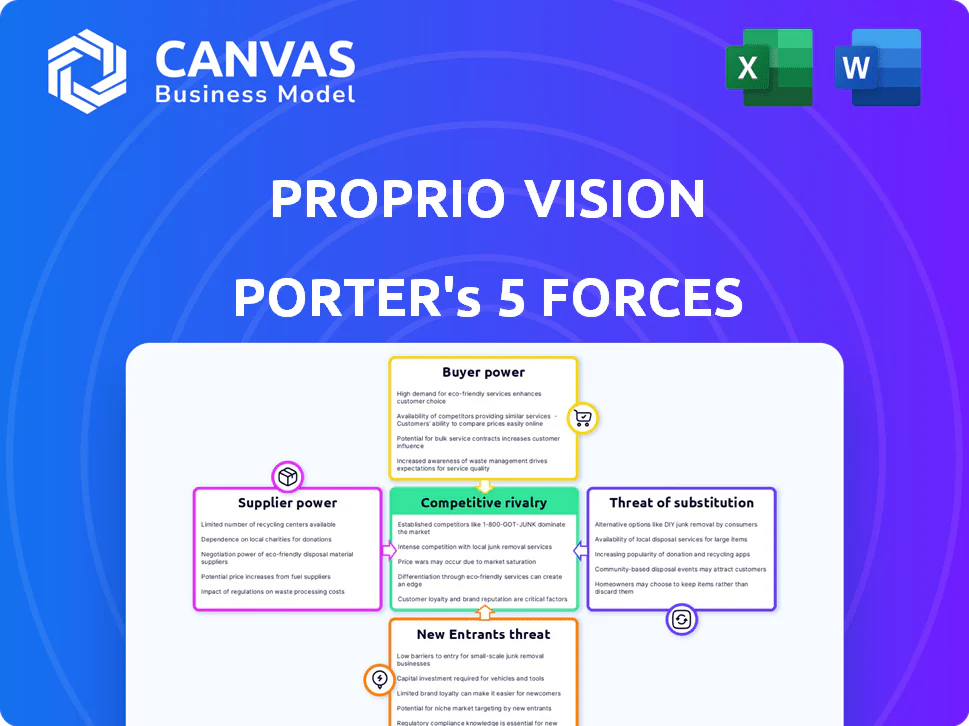
PROPRIO VISION PORTER'S FIVE FORCES TEMPLATE RESEARCH
What is included in the product
 Detailed Word Document
Tailored exclusively for Proprio Vision, analyzing its position within its competitive landscape.

 Customizable Excel Spreadsheet
Instantly visualize complex forces with an intuitive visual dashboard.
Preview the Actual Deliverable
Proprio Vision Porter's Five Forces Analysis
This preview presents Proprio Vision's Porter's Five Forces analysis, showing exactly what you'll receive instantly upon purchase.

Porter's Five Forces Analysis Template

From Overview to Strategy Blueprint
Proprio Vision operates within a dynamic market shaped by diverse competitive forces. Examining these forces reveals critical insights for strategic planning. Buyer power, driven by market alternatives, impacts Proprio Vision's pricing strategy. Supplier influence, especially for specialized components, poses potential challenges. The threat of new entrants, fueled by technological advancements, requires constant innovation. Competitive rivalry within the medical technology space demands robust differentiation. Finally, substitute products represent an ongoing challenge to market share.
The full analysis reveals the strength and intensity of each market force affecting Proprio Vision, complete with visuals and summaries for fast, clear interpretation.
Suppliers Bargaining Power

Reliance on Specialized Components
Proprio Vision's tech, using specialized components for imaging and AR, faces supplier bargaining power. Limited suppliers for cutting-edge tech can drive up costs and affect part availability. In 2024, the global market for AR/VR components was valued at $28 billion, with a few key suppliers dominating. This concentration gives suppliers leverage.
Importance of Software and Algorithms
Proprio Vision's reliance on advanced machine learning and computer vision algorithms is key. Although software development is in-house, the firm depends on external resources. If these frameworks or datasets are scarce or expensive to switch, suppliers gain power. For example, the global AI market was valued at $196.63 billion in 2023.

Talent Pool for Niche Expertise
Proprio Vision's reliance on specialized talent, like computer vision engineers, gives suppliers (the talent pool) some power. The competition for these experts could drive up salary expenses. In 2024, the average salary for a computer vision engineer was approximately $150,000 annually in the US. Finding and keeping these people is critical for innovation.

Access to Medical Data
Proprio Vision's reliance on medical data introduces supplier bargaining power. Access to large, quality datasets is crucial for its AI algorithms. Hospitals and data services could exert influence, especially with unique data. The cost of medical data has been rising, with some datasets costing over $1 million. Securing data agreements at favorable terms is vital for Proprio.
- Data Acquisition Costs: The cost of acquiring medical datasets can be substantial, potentially impacting Proprio's profitability.
- Data Uniqueness: The value of the data increases if it is exclusive or hard to replicate, giving suppliers more leverage.
- Contractual Agreements: Negotiation of favorable terms and conditions is critical to manage supplier power.
- Data Availability: Limited availability of specific datasets can increase the bargaining power of suppliers.
Regulatory Compliance Requirements
Suppliers in the medical device sector face intense regulatory scrutiny, such as those from the FDA in the U.S. or the EMA in Europe. These regulations can restrict the number of qualified suppliers, boosting their bargaining power. The costs for suppliers to comply with these standards, including audits and certifications, can be substantial. This situation gives compliant suppliers an advantage.
- FDA inspections increased by 15% in 2024.
- Compliance costs can add up to 10-20% of a product's manufacturing cost.
- Approximately 30% of medical device suppliers fail initial regulatory audits.
- The global medical device market was valued at $495 billion in 2023.
Proprio Vision's Cost Challenges: Suppliers & Talent
Proprio Vision faces supplier power due to limited tech component suppliers, potentially increasing costs. Dependence on specialized software and data also gives suppliers leverage. Competition for talent, like computer vision engineers, affects salary expenses.
| Factor | Impact | Data Point (2024) |
|---|---|---|
| AR/VR Component Suppliers | High concentration | Market valued at $28B |
| AI Frameworks | Scarcity/Cost | AI market valued at $200B (est.) |
| Computer Vision Engineers | Salary Pressure | Avg. salary: $150K (US) |
Customers Bargaining Power

Demand for Improved Surgical Outcomes
Hospitals and surgical centers, as major customers, hold substantial bargaining power because they prioritize enhanced patient outcomes, reduced complications, and operational efficiency. Proprio's value proposition hinges on showcasing measurable improvements in these areas. In 2024, the average cost of a surgical site infection was around $15,270, which hospitals are eager to mitigate. Their negotiation strength is tied to how effectively Proprio can address these financial and clinical concerns.
Budgetary Constraints in Healthcare
Healthcare providers face significant budgetary constraints, impacting their purchasing decisions. Hospitals and clinics, often under pressure from insurers, seek cost-effective solutions. This financial strain gives customers like hospitals leverage to negotiate prices. In 2024, healthcare spending in the U.S. reached nearly $4.8 trillion, highlighting the financial pressures.

Availability of Alternative Solutions
Customers of Proprio Vision have alternative solutions such as traditional imaging. These alternatives, like conventional X-rays, offer baseline capabilities. In 2024, the global market for surgical navigation systems was valued at around $1.2 billion. This gives customers leverage.

Influence of Surgeons and Medical Staff
Surgeons and operating room staff are the primary users of Proprio Vision's system. Their acceptance and training needs directly impact purchasing decisions by hospitals. Hospitals prioritize technologies favored by their medical professionals, influencing adoption rates. The perceived value of the system by these users is crucial for market success. In 2024, approximately 80% of hospitals consider surgeon preferences when adopting new surgical technologies.
- Surgeon preference is a key driver in hospital tech adoption.
- Training and ease of use are critical for acceptance.
- Feedback from medical staff shapes purchasing decisions.
- The value proposition must align with user needs.
Implementation and Integration Costs
Implementing a new surgical navigation system like Proprio Vision's entails substantial upfront costs. These include the system's purchase price, which can range from $100,000 to $500,000. Integration with existing hospital IT infrastructure adds further expenses. Hospitals also face staff training expenses, potentially costing between $5,000 and $20,000 per surgeon and surgical team.
- Initial investment: $100,000 - $500,000 for the system.
- Integration costs: IT infrastructure adjustments.
- Training expenses: $5,000 - $20,000 per surgical team.
- Switching costs: Leverage during negotiations.
Surgical Navigation Market Dynamics: Key Factors
Hospitals, as major customers, negotiate based on improved patient outcomes and cost savings. Healthcare providers face significant budgetary constraints, increasing their bargaining power. Alternative solutions like traditional imaging and surgical navigation systems also provide leverage.
Surgeon preferences and staff acceptance significantly influence purchasing decisions. High upfront implementation costs, including system purchase and integration, impact negotiation dynamics. In 2024, the global surgical navigation market was about $1.2 billion.
| Factor | Impact | 2024 Data |
|---|---|---|
| Cost Pressure | High | U.S. healthcare spending: $4.8T |
| Alternative Solutions | Moderate | Surgical navigation market: $1.2B |
| Implementation Costs | High | System cost: $100K-$500K |
Rivalry Among Competitors

Presence of Established Medical Device Companies
The surgical technology market is dominated by giants like Medtronic and Stryker, possessing extensive product lines and deep hospital connections. These established firms, including Brainlab, fiercely compete in surgical navigation and robotics. In 2024, Medtronic's revenue hit $32 billion, highlighting the scale of competition. Their market presence significantly impacts Proprio Vision's ability to gain market share.
Rapid Technological Advancement
The surgical tech field, especially with AI, computer vision, and AR, moves fast. Competitors constantly fund R&D, pushing innovation. For example, in 2024, AI in healthcare saw over $10 billion in investment. Proprio needs to innovate to keep up.

Differentiation Based on Technology and Data
Competitive rivalry in the surgical vision market, like Proprio Vision's, hinges on technological differentiation. Companies with superior tech and unique data analytics gain an edge. For instance, the global surgical robotics market was valued at $6.1 billion in 2023, showing strong growth. Seamless integration into surgical workflows is crucial for adoption. This drives competition among players.

Pricing Pressures
Pricing pressures are significant in healthcare, driven by cost management demands. Proprio Vision must prove its value to justify its advanced system's cost. Competitors may offer similar services at lower prices. This requires a compelling value proposition.
- Hospital operating margins were tight in 2024, averaging around 2-3%.
- The market for surgical robotics is projected to reach $12.9 billion by 2028.
- Average hospital spending on capital equipment increased by 4.5% in 2024.
- Price competition among surgical robotics vendors is increasing.
Global Market Competition
The surgical navigation and visualization market is intensely competitive worldwide. Proprio Vision will contend with both local and international companies. This global scope means they must consider diverse market strategies and regulatory environments. Competition drives innovation but also demands a strong market presence.
- Market size: The global surgical navigation market was valued at USD 2.5 billion in 2024.
- Key competitors: Medtronic, Brainlab, and Stryker are significant players.
- Geographic expansion: Companies are actively expanding into Asia-Pacific and Europe.
- Technological advancements: Focus on AI and robotics intensifies competition.
Surgical Tech: Navigating a Competitive Landscape
Competitive rivalry in surgical tech is fierce, with giants like Medtronic and Stryker dominating. Innovation, fueled by R&D, is constant, as seen with the $10B+ invested in AI in healthcare in 2024. Proprio Vision faces pricing pressure, and tight hospital margins (2-3% in 2024) demand a strong value proposition.
| Aspect | Details |
|---|---|
| Market Size (Surgical Navigation, 2024) | USD 2.5 Billion |
| Surgical Robotics Market Projection (2028) | $12.9 Billion |
| Hospital Capital Equipment Spending Increase (2024) | 4.5% |
Original: $10.00
-65%$10.00
$3.50PROPRIO VISION PORTER'S FIVE FORCES TEMPLATE RESEARCH
What is included in the product
Detailed Word Document
Tailored exclusively for Proprio Vision, analyzing its position within its competitive landscape.
Customizable Excel Spreadsheet
Instantly visualize complex forces with an intuitive visual dashboard.
Preview the Actual Deliverable
Proprio Vision Porter's Five Forces Analysis
This preview presents Proprio Vision's Porter's Five Forces analysis, showing exactly what you'll receive instantly upon purchase.
Porter's Five Forces Analysis Template
From Overview to Strategy Blueprint
Proprio Vision operates within a dynamic market shaped by diverse competitive forces. Examining these forces reveals critical insights for strategic planning. Buyer power, driven by market alternatives, impacts Proprio Vision's pricing strategy. Supplier influence, especially for specialized components, poses potential challenges. The threat of new entrants, fueled by technological advancements, requires constant innovation. Competitive rivalry within the medical technology space demands robust differentiation. Finally, substitute products represent an ongoing challenge to market share.
The full analysis reveals the strength and intensity of each market force affecting Proprio Vision, complete with visuals and summaries for fast, clear interpretation.
Suppliers Bargaining Power
Reliance on Specialized Components
Proprio Vision's tech, using specialized components for imaging and AR, faces supplier bargaining power. Limited suppliers for cutting-edge tech can drive up costs and affect part availability. In 2024, the global market for AR/VR components was valued at $28 billion, with a few key suppliers dominating. This concentration gives suppliers leverage.
Importance of Software and Algorithms
Proprio Vision's reliance on advanced machine learning and computer vision algorithms is key. Although software development is in-house, the firm depends on external resources. If these frameworks or datasets are scarce or expensive to switch, suppliers gain power. For example, the global AI market was valued at $196.63 billion in 2023.
Talent Pool for Niche Expertise
Proprio Vision's reliance on specialized talent, like computer vision engineers, gives suppliers (the talent pool) some power. The competition for these experts could drive up salary expenses. In 2024, the average salary for a computer vision engineer was approximately $150,000 annually in the US. Finding and keeping these people is critical for innovation.
Access to Medical Data
Proprio Vision's reliance on medical data introduces supplier bargaining power. Access to large, quality datasets is crucial for its AI algorithms. Hospitals and data services could exert influence, especially with unique data. The cost of medical data has been rising, with some datasets costing over $1 million. Securing data agreements at favorable terms is vital for Proprio.
- Data Acquisition Costs: The cost of acquiring medical datasets can be substantial, potentially impacting Proprio's profitability.
- Data Uniqueness: The value of the data increases if it is exclusive or hard to replicate, giving suppliers more leverage.
- Contractual Agreements: Negotiation of favorable terms and conditions is critical to manage supplier power.
- Data Availability: Limited availability of specific datasets can increase the bargaining power of suppliers.
Regulatory Compliance Requirements
Suppliers in the medical device sector face intense regulatory scrutiny, such as those from the FDA in the U.S. or the EMA in Europe. These regulations can restrict the number of qualified suppliers, boosting their bargaining power. The costs for suppliers to comply with these standards, including audits and certifications, can be substantial. This situation gives compliant suppliers an advantage.
- FDA inspections increased by 15% in 2024.
- Compliance costs can add up to 10-20% of a product's manufacturing cost.
- Approximately 30% of medical device suppliers fail initial regulatory audits.
- The global medical device market was valued at $495 billion in 2023.
Proprio Vision's Cost Challenges: Suppliers & Talent
Proprio Vision faces supplier power due to limited tech component suppliers, potentially increasing costs. Dependence on specialized software and data also gives suppliers leverage. Competition for talent, like computer vision engineers, affects salary expenses.
| Factor | Impact | Data Point (2024) |
|---|---|---|
| AR/VR Component Suppliers | High concentration | Market valued at $28B |
| AI Frameworks | Scarcity/Cost | AI market valued at $200B (est.) |
| Computer Vision Engineers | Salary Pressure | Avg. salary: $150K (US) |
Customers Bargaining Power
Demand for Improved Surgical Outcomes
Hospitals and surgical centers, as major customers, hold substantial bargaining power because they prioritize enhanced patient outcomes, reduced complications, and operational efficiency. Proprio's value proposition hinges on showcasing measurable improvements in these areas. In 2024, the average cost of a surgical site infection was around $15,270, which hospitals are eager to mitigate. Their negotiation strength is tied to how effectively Proprio can address these financial and clinical concerns.
Budgetary Constraints in Healthcare
Healthcare providers face significant budgetary constraints, impacting their purchasing decisions. Hospitals and clinics, often under pressure from insurers, seek cost-effective solutions. This financial strain gives customers like hospitals leverage to negotiate prices. In 2024, healthcare spending in the U.S. reached nearly $4.8 trillion, highlighting the financial pressures.
Availability of Alternative Solutions
Customers of Proprio Vision have alternative solutions such as traditional imaging. These alternatives, like conventional X-rays, offer baseline capabilities. In 2024, the global market for surgical navigation systems was valued at around $1.2 billion. This gives customers leverage.
Influence of Surgeons and Medical Staff
Surgeons and operating room staff are the primary users of Proprio Vision's system. Their acceptance and training needs directly impact purchasing decisions by hospitals. Hospitals prioritize technologies favored by their medical professionals, influencing adoption rates. The perceived value of the system by these users is crucial for market success. In 2024, approximately 80% of hospitals consider surgeon preferences when adopting new surgical technologies.
- Surgeon preference is a key driver in hospital tech adoption.
- Training and ease of use are critical for acceptance.
- Feedback from medical staff shapes purchasing decisions.
- The value proposition must align with user needs.
Implementation and Integration Costs
Implementing a new surgical navigation system like Proprio Vision's entails substantial upfront costs. These include the system's purchase price, which can range from $100,000 to $500,000. Integration with existing hospital IT infrastructure adds further expenses. Hospitals also face staff training expenses, potentially costing between $5,000 and $20,000 per surgeon and surgical team.
- Initial investment: $100,000 - $500,000 for the system.
- Integration costs: IT infrastructure adjustments.
- Training expenses: $5,000 - $20,000 per surgical team.
- Switching costs: Leverage during negotiations.
Surgical Navigation Market Dynamics: Key Factors
Hospitals, as major customers, negotiate based on improved patient outcomes and cost savings. Healthcare providers face significant budgetary constraints, increasing their bargaining power. Alternative solutions like traditional imaging and surgical navigation systems also provide leverage.
Surgeon preferences and staff acceptance significantly influence purchasing decisions. High upfront implementation costs, including system purchase and integration, impact negotiation dynamics. In 2024, the global surgical navigation market was about $1.2 billion.
| Factor | Impact | 2024 Data |
|---|---|---|
| Cost Pressure | High | U.S. healthcare spending: $4.8T |
| Alternative Solutions | Moderate | Surgical navigation market: $1.2B |
| Implementation Costs | High | System cost: $100K-$500K |
Rivalry Among Competitors
Presence of Established Medical Device Companies
The surgical technology market is dominated by giants like Medtronic and Stryker, possessing extensive product lines and deep hospital connections. These established firms, including Brainlab, fiercely compete in surgical navigation and robotics. In 2024, Medtronic's revenue hit $32 billion, highlighting the scale of competition. Their market presence significantly impacts Proprio Vision's ability to gain market share.
Rapid Technological Advancement
The surgical tech field, especially with AI, computer vision, and AR, moves fast. Competitors constantly fund R&D, pushing innovation. For example, in 2024, AI in healthcare saw over $10 billion in investment. Proprio needs to innovate to keep up.
Differentiation Based on Technology and Data
Competitive rivalry in the surgical vision market, like Proprio Vision's, hinges on technological differentiation. Companies with superior tech and unique data analytics gain an edge. For instance, the global surgical robotics market was valued at $6.1 billion in 2023, showing strong growth. Seamless integration into surgical workflows is crucial for adoption. This drives competition among players.
Pricing Pressures
Pricing pressures are significant in healthcare, driven by cost management demands. Proprio Vision must prove its value to justify its advanced system's cost. Competitors may offer similar services at lower prices. This requires a compelling value proposition.
- Hospital operating margins were tight in 2024, averaging around 2-3%.
- The market for surgical robotics is projected to reach $12.9 billion by 2028.
- Average hospital spending on capital equipment increased by 4.5% in 2024.
- Price competition among surgical robotics vendors is increasing.
Global Market Competition
The surgical navigation and visualization market is intensely competitive worldwide. Proprio Vision will contend with both local and international companies. This global scope means they must consider diverse market strategies and regulatory environments. Competition drives innovation but also demands a strong market presence.
- Market size: The global surgical navigation market was valued at USD 2.5 billion in 2024.
- Key competitors: Medtronic, Brainlab, and Stryker are significant players.
- Geographic expansion: Companies are actively expanding into Asia-Pacific and Europe.
- Technological advancements: Focus on AI and robotics intensifies competition.
Surgical Tech: Navigating a Competitive Landscape
Competitive rivalry in surgical tech is fierce, with giants like Medtronic and Stryker dominating. Innovation, fueled by R&D, is constant, as seen with the $10B+ invested in AI in healthcare in 2024. Proprio Vision faces pricing pressure, and tight hospital margins (2-3% in 2024) demand a strong value proposition.
| Aspect | Details |
|---|---|
| Market Size (Surgical Navigation, 2024) | USD 2.5 Billion |
| Surgical Robotics Market Projection (2028) | $12.9 Billion |
| Hospital Capital Equipment Spending Increase (2024) | 4.5% |
Product Information
Product Information
Shipping & Returns
Shipping & Returns
Description
What is included in the product
Detailed Word Document
Tailored exclusively for Proprio Vision, analyzing its position within its competitive landscape.
Customizable Excel Spreadsheet
Instantly visualize complex forces with an intuitive visual dashboard.
Preview the Actual Deliverable
Proprio Vision Porter's Five Forces Analysis
This preview presents Proprio Vision's Porter's Five Forces analysis, showing exactly what you'll receive instantly upon purchase.
Porter's Five Forces Analysis Template
From Overview to Strategy Blueprint
Proprio Vision operates within a dynamic market shaped by diverse competitive forces. Examining these forces reveals critical insights for strategic planning. Buyer power, driven by market alternatives, impacts Proprio Vision's pricing strategy. Supplier influence, especially for specialized components, poses potential challenges. The threat of new entrants, fueled by technological advancements, requires constant innovation. Competitive rivalry within the medical technology space demands robust differentiation. Finally, substitute products represent an ongoing challenge to market share.
The full analysis reveals the strength and intensity of each market force affecting Proprio Vision, complete with visuals and summaries for fast, clear interpretation.
Suppliers Bargaining Power
Reliance on Specialized Components
Proprio Vision's tech, using specialized components for imaging and AR, faces supplier bargaining power. Limited suppliers for cutting-edge tech can drive up costs and affect part availability. In 2024, the global market for AR/VR components was valued at $28 billion, with a few key suppliers dominating. This concentration gives suppliers leverage.
Importance of Software and Algorithms
Proprio Vision's reliance on advanced machine learning and computer vision algorithms is key. Although software development is in-house, the firm depends on external resources. If these frameworks or datasets are scarce or expensive to switch, suppliers gain power. For example, the global AI market was valued at $196.63 billion in 2023.
Talent Pool for Niche Expertise
Proprio Vision's reliance on specialized talent, like computer vision engineers, gives suppliers (the talent pool) some power. The competition for these experts could drive up salary expenses. In 2024, the average salary for a computer vision engineer was approximately $150,000 annually in the US. Finding and keeping these people is critical for innovation.
Access to Medical Data
Proprio Vision's reliance on medical data introduces supplier bargaining power. Access to large, quality datasets is crucial for its AI algorithms. Hospitals and data services could exert influence, especially with unique data. The cost of medical data has been rising, with some datasets costing over $1 million. Securing data agreements at favorable terms is vital for Proprio.
- Data Acquisition Costs: The cost of acquiring medical datasets can be substantial, potentially impacting Proprio's profitability.
- Data Uniqueness: The value of the data increases if it is exclusive or hard to replicate, giving suppliers more leverage.
- Contractual Agreements: Negotiation of favorable terms and conditions is critical to manage supplier power.
- Data Availability: Limited availability of specific datasets can increase the bargaining power of suppliers.
Regulatory Compliance Requirements
Suppliers in the medical device sector face intense regulatory scrutiny, such as those from the FDA in the U.S. or the EMA in Europe. These regulations can restrict the number of qualified suppliers, boosting their bargaining power. The costs for suppliers to comply with these standards, including audits and certifications, can be substantial. This situation gives compliant suppliers an advantage.
- FDA inspections increased by 15% in 2024.
- Compliance costs can add up to 10-20% of a product's manufacturing cost.
- Approximately 30% of medical device suppliers fail initial regulatory audits.
- The global medical device market was valued at $495 billion in 2023.
Proprio Vision's Cost Challenges: Suppliers & Talent
Proprio Vision faces supplier power due to limited tech component suppliers, potentially increasing costs. Dependence on specialized software and data also gives suppliers leverage. Competition for talent, like computer vision engineers, affects salary expenses.
| Factor | Impact | Data Point (2024) |
|---|---|---|
| AR/VR Component Suppliers | High concentration | Market valued at $28B |
| AI Frameworks | Scarcity/Cost | AI market valued at $200B (est.) |
| Computer Vision Engineers | Salary Pressure | Avg. salary: $150K (US) |
Customers Bargaining Power
Demand for Improved Surgical Outcomes
Hospitals and surgical centers, as major customers, hold substantial bargaining power because they prioritize enhanced patient outcomes, reduced complications, and operational efficiency. Proprio's value proposition hinges on showcasing measurable improvements in these areas. In 2024, the average cost of a surgical site infection was around $15,270, which hospitals are eager to mitigate. Their negotiation strength is tied to how effectively Proprio can address these financial and clinical concerns.
Budgetary Constraints in Healthcare
Healthcare providers face significant budgetary constraints, impacting their purchasing decisions. Hospitals and clinics, often under pressure from insurers, seek cost-effective solutions. This financial strain gives customers like hospitals leverage to negotiate prices. In 2024, healthcare spending in the U.S. reached nearly $4.8 trillion, highlighting the financial pressures.
Availability of Alternative Solutions
Customers of Proprio Vision have alternative solutions such as traditional imaging. These alternatives, like conventional X-rays, offer baseline capabilities. In 2024, the global market for surgical navigation systems was valued at around $1.2 billion. This gives customers leverage.
Influence of Surgeons and Medical Staff
Surgeons and operating room staff are the primary users of Proprio Vision's system. Their acceptance and training needs directly impact purchasing decisions by hospitals. Hospitals prioritize technologies favored by their medical professionals, influencing adoption rates. The perceived value of the system by these users is crucial for market success. In 2024, approximately 80% of hospitals consider surgeon preferences when adopting new surgical technologies.
- Surgeon preference is a key driver in hospital tech adoption.
- Training and ease of use are critical for acceptance.
- Feedback from medical staff shapes purchasing decisions.
- The value proposition must align with user needs.
Implementation and Integration Costs
Implementing a new surgical navigation system like Proprio Vision's entails substantial upfront costs. These include the system's purchase price, which can range from $100,000 to $500,000. Integration with existing hospital IT infrastructure adds further expenses. Hospitals also face staff training expenses, potentially costing between $5,000 and $20,000 per surgeon and surgical team.
- Initial investment: $100,000 - $500,000 for the system.
- Integration costs: IT infrastructure adjustments.
- Training expenses: $5,000 - $20,000 per surgical team.
- Switching costs: Leverage during negotiations.
Surgical Navigation Market Dynamics: Key Factors
Hospitals, as major customers, negotiate based on improved patient outcomes and cost savings. Healthcare providers face significant budgetary constraints, increasing their bargaining power. Alternative solutions like traditional imaging and surgical navigation systems also provide leverage.
Surgeon preferences and staff acceptance significantly influence purchasing decisions. High upfront implementation costs, including system purchase and integration, impact negotiation dynamics. In 2024, the global surgical navigation market was about $1.2 billion.
| Factor | Impact | 2024 Data |
|---|---|---|
| Cost Pressure | High | U.S. healthcare spending: $4.8T |
| Alternative Solutions | Moderate | Surgical navigation market: $1.2B |
| Implementation Costs | High | System cost: $100K-$500K |
Rivalry Among Competitors
Presence of Established Medical Device Companies
The surgical technology market is dominated by giants like Medtronic and Stryker, possessing extensive product lines and deep hospital connections. These established firms, including Brainlab, fiercely compete in surgical navigation and robotics. In 2024, Medtronic's revenue hit $32 billion, highlighting the scale of competition. Their market presence significantly impacts Proprio Vision's ability to gain market share.
Rapid Technological Advancement
The surgical tech field, especially with AI, computer vision, and AR, moves fast. Competitors constantly fund R&D, pushing innovation. For example, in 2024, AI in healthcare saw over $10 billion in investment. Proprio needs to innovate to keep up.
Differentiation Based on Technology and Data
Competitive rivalry in the surgical vision market, like Proprio Vision's, hinges on technological differentiation. Companies with superior tech and unique data analytics gain an edge. For instance, the global surgical robotics market was valued at $6.1 billion in 2023, showing strong growth. Seamless integration into surgical workflows is crucial for adoption. This drives competition among players.
Pricing Pressures
Pricing pressures are significant in healthcare, driven by cost management demands. Proprio Vision must prove its value to justify its advanced system's cost. Competitors may offer similar services at lower prices. This requires a compelling value proposition.
- Hospital operating margins were tight in 2024, averaging around 2-3%.
- The market for surgical robotics is projected to reach $12.9 billion by 2028.
- Average hospital spending on capital equipment increased by 4.5% in 2024.
- Price competition among surgical robotics vendors is increasing.
Global Market Competition
The surgical navigation and visualization market is intensely competitive worldwide. Proprio Vision will contend with both local and international companies. This global scope means they must consider diverse market strategies and regulatory environments. Competition drives innovation but also demands a strong market presence.
- Market size: The global surgical navigation market was valued at USD 2.5 billion in 2024.
- Key competitors: Medtronic, Brainlab, and Stryker are significant players.
- Geographic expansion: Companies are actively expanding into Asia-Pacific and Europe.
- Technological advancements: Focus on AI and robotics intensifies competition.
Surgical Tech: Navigating a Competitive Landscape
Competitive rivalry in surgical tech is fierce, with giants like Medtronic and Stryker dominating. Innovation, fueled by R&D, is constant, as seen with the $10B+ invested in AI in healthcare in 2024. Proprio Vision faces pricing pressure, and tight hospital margins (2-3% in 2024) demand a strong value proposition.
| Aspect | Details |
|---|---|
| Market Size (Surgical Navigation, 2024) | USD 2.5 Billion |
| Surgical Robotics Market Projection (2028) | $12.9 Billion |
| Hospital Capital Equipment Spending Increase (2024) | 4.5% |











