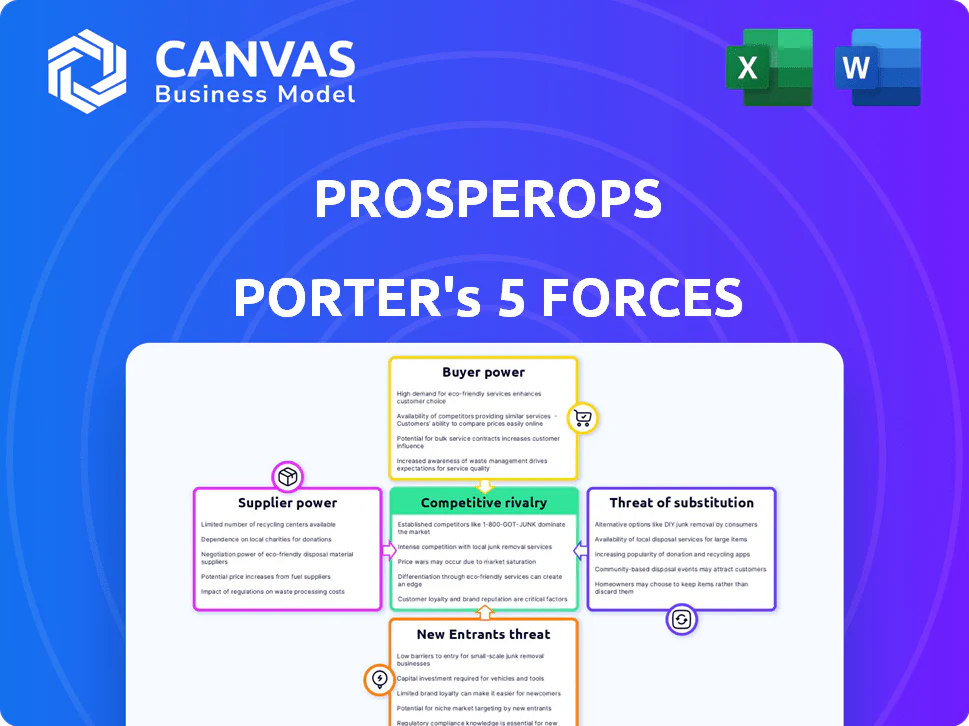
PROSPEROPS PORTER'S FIVE FORCES TEMPLATE RESEARCH
What is included in the product
 Detailed Word Document
Tailored exclusively for ProsperOps, analyzing its position within its competitive landscape.

 Customizable Excel Spreadsheet
Instantly grasp strategic pressure with a powerful spider/radar chart, no more guesswork.
What You See Is What You Get
ProsperOps Porter's Five Forces Analysis
This preview outlines the complete Porter's Five Forces analysis for ProsperOps, mirroring the final deliverable.
You’re seeing the exact analysis you'll download immediately post-purchase: comprehensive and insightful.
The document is fully formatted and professionally written, ready for your direct application.
There are no substitutions. What you're viewing is what you’ll receive, fully ready.
Purchase now for instant access to this ready-to-use analysis.

Porter's Five Forces Analysis Template

Elevate Your Analysis with the Complete Porter's Five Forces Analysis
ProsperOps operates within a dynamic cloud cost optimization market, facing intense competition and evolving buyer demands. Its success hinges on navigating the complex interplay of industry forces: the threat of substitutes, bargaining power of buyers and suppliers, competitive rivalry, and the threat of new entrants. Understanding these forces is vital for strategic positioning and sustained growth.
This brief snapshot only scratches the surface. Unlock the full Porter's Five Forces Analysis to explore ProsperOps’s competitive dynamics, market pressures, and strategic advantages in detail.
Suppliers Bargaining Power

Reliance on Cloud Providers
ProsperOps heavily depends on cloud providers like AWS, Google Cloud, and Azure. These providers, controlling a large market share, wield considerable power. In 2024, AWS held around 32% of the cloud market, followed by Microsoft Azure at 25% and Google Cloud at 11%. This concentration influences ProsperOps' operational costs and customer savings.
Specialized Technology and Expertise
Specialized tech expertise for cloud cost optimization, like that used by ProsperOps, gives suppliers leverage. The need for accurate, timely data from cloud providers further boosts their power. In 2024, cloud spending is projected to reach $678.8 billion globally, highlighting the importance of cost optimization. This dependency can increase supplier bargaining power.

Potential for Vendor Lock-in
ProsperOps' multi-cloud optimization, while beneficial, could lead to vendor lock-in through deep integration with a primary cloud provider. This dependency might empower the cloud provider, potentially increasing their bargaining power. For instance, in 2024, Amazon Web Services (AWS) accounted for roughly 32% of the cloud infrastructure services market. Switching providers could become complex and costly, affecting ProsperOps’ flexibility.

Data Access and APIs
ProsperOps depends on cloud providers' APIs for usage and billing data. Supplier control over this data affects ProsperOps' service. Restrictions could harm delivery and boost supplier power. Cloud spending grew, with AWS, Azure, and Google Cloud dominating.
- AWS held 31% market share in Q3 2024.
- Azure's revenue grew 29% YoY in Q3 2024.
- Google Cloud's revenue increased by 22% YoY in Q3 2024.
- Data access changes can significantly impact cost optimization services.
Competition Among Cloud Providers
Intense competition among cloud providers like AWS, Azure, and Google Cloud weakens supplier power. This competition drives them to offer competitive pricing and incentives. In 2024, AWS held about 32% of the cloud market, Azure 25%, and Google Cloud 11%. ProsperOps can capitalize on this rivalry.
- Competitive pricing and programs emerge from cloud provider competition.
- AWS held a 32% market share in 2024.
- Azure held a 25% market share in 2024.
- Google Cloud had an 11% market share in 2024.
Cloud Market Dynamics Impacting Costs
ProsperOps faces supplier power from cloud providers, like AWS, Azure, and Google Cloud, which control large market shares. In Q3 2024, AWS held 31% of the market. This influences ProsperOps' costs. Cloud providers' control over data also affects ProsperOps.
| Cloud Provider | Q3 2024 Market Share | Revenue Growth (YoY) |
|---|---|---|
| AWS | 31% | N/A |
| Azure | N/A | 29% |
| Google Cloud | N/A | 22% |
Customers Bargaining Power

Availability of Alternatives
Customers now have many choices for cloud cost management, including tools from cloud providers and third-party options. This abundance of alternatives strengthens customer bargaining power. For instance, in 2024, the cloud cost management market was estimated at $4.8 billion. If ProsperOps doesn't offer competitive pricing or services, customers can easily switch to a rival.
Significant Cloud Spend
Businesses, especially large enterprises, have significant cloud expenditures, motivating cost reduction. Their spending empowers them to negotiate favorable terms with cloud optimization providers. For instance, in 2024, the cloud services market reached $670 billion. This massive spending gives them leverage in negotiations.

Understanding of Cloud Economics
As cloud adoption matures, organizations become more savvy about cloud economics. This increased understanding allows them to critically assess options and negotiate better terms. In 2024, companies saved an average of 20% on cloud spending through optimization efforts. This knowledge gives them leverage to demand more from providers. This shift is evident in the growing demand for cost-effective solutions.

Impact on Profitability
Cloud costs often represent a substantial part of operational expenses. ProsperOps' ability to reduce these costs directly boosts a customer's profitability. This cost-saving service potentially gives ProsperOps some bargaining power. However, customers retain significant power due to their direct financial benefit focus.
- Cloud spending surged, with global spending reaching $67.2 billion in Q4 2023.
- Cost optimization tools can cut cloud bills by up to 30%.
- Businesses prioritize cost savings, making customers price-sensitive.
- Customer demand for lower cloud costs is constantly increasing.
Switching Costs
Switching costs significantly impact customer bargaining power in the cloud cost optimization market. The effort and potential disruption tied to moving from one platform to another pose a barrier. These costs encompass the time, resources, and expertise required for migration and integration. However, platforms like ProsperOps focus on ease of integration to reduce these burdens.
- Complexity: Migrating cloud resources and configurations can be time-consuming.
- Integration Challenges: Integrating a new platform with existing cloud infrastructure might need specific expertise.
- Data Migration: Transferring historical data for performance analysis adds to the complexity.
- Provider Solutions: Providers are improving ease of integration to retain customers.
Cloud Cost Control: Customers Rule!
Customers' bargaining power in cloud cost management is substantial, fueled by many choices and high cloud spending. The cloud cost management market was valued at $4.8 billion in 2024, with the cloud services market reaching $670 billion. Businesses' focus on cost savings and savvy cloud economics further enhance their negotiating strength, even with integration challenges.
| Factor | Impact | Data |
|---|---|---|
| Market Options | High Choice | $4.8B Cloud Cost Mgmt. Market (2024) |
| Spending | Negotiating Power | $670B Cloud Services Market (2024) |
| Cost Focus | Price Sensitivity | Up to 30% Savings with Optimization |
Rivalry Among Competitors

Numerous Competitors
The cloud cost optimization market is highly competitive, featuring many rivals. Native cloud tools from providers like AWS, Azure, and GCP compete with third-party vendors. This crowded space increases rivalry. In 2024, the market saw over 100 players, heightening the battle for customer acquisition and market share.
Diverse Offerings
Competitors provide varied services. Some offer basic cost monitoring, while others provide comprehensive FinOps platforms. This variety means ProsperOps faces companies with different service levels. In 2024, the FinOps market grew, with diverse solutions addressing varied needs. The market's value was estimated at $2.7 billion, reflecting the competitive landscape.

Native Cloud Provider Tools
AWS, Azure, and Google Cloud provide built-in cost management tools, posing direct competition. These native tools offer basic functionalities that can meet some customer needs. For example, AWS Cost Explorer saw a 20% increase in user adoption in 2024. This impacts the market.

Focus on Automation and AI
The competitive landscape in cloud cost management is intensifying, with a major focus on automation and AI. Firms are racing to integrate advanced AI and automation into their cloud cost optimization tools. This trend directly impacts ProsperOps, as automated optimization is central to its value proposition.
- The global cloud automation market is projected to reach $18.2 billion by 2024.
- AI adoption in cloud management is expected to grow by 30% in 2024.
- Companies are investing heavily in AI-driven cost optimization, with investments up 25% in 2024.
- The rise of serverless computing is driving demand for automated cost management.
Pricing Models
Competitors in the cloud cost optimization space utilize diverse pricing models, such as a percentage of savings, subscription fees, or feature-based pricing. This variety intensifies competition. ProsperOps' savings-based model offers a competitive edge. The differing pricing strategies increase the overall competitive rivalry.
- Percentage of savings models can range from 10-20% of cost savings achieved.
- Subscription fees vary, with basic plans starting around $500/month and enterprise plans exceeding $5,000/month.
- Feature-based pricing is common for tools offering specific functionalities, with prices varying depending on the features included.
- In 2024, the cloud cost optimization market is estimated at $4.8 billion, showing substantial growth.
Cloud Cost Wars: $4.8B Market, 100+ Players!
The cloud cost optimization market is fiercely competitive. Over 100 players battled for market share in 2024. Native cloud tools and varied pricing models intensify rivalry.
| Aspect | Details | 2024 Data |
|---|---|---|
| Market Size | Estimated market value | $4.8 billion |
| AI Adoption | Expected growth | 30% |
| Automation Market | Projected value | $18.2 billion |
Original: $10.00
-65%$10.00
$3.50PROSPEROPS PORTER'S FIVE FORCES TEMPLATE RESEARCH
What is included in the product
Detailed Word Document
Tailored exclusively for ProsperOps, analyzing its position within its competitive landscape.
Customizable Excel Spreadsheet
Instantly grasp strategic pressure with a powerful spider/radar chart, no more guesswork.
What You See Is What You Get
ProsperOps Porter's Five Forces Analysis
This preview outlines the complete Porter's Five Forces analysis for ProsperOps, mirroring the final deliverable.
You’re seeing the exact analysis you'll download immediately post-purchase: comprehensive and insightful.
The document is fully formatted and professionally written, ready for your direct application.
There are no substitutions. What you're viewing is what you’ll receive, fully ready.
Purchase now for instant access to this ready-to-use analysis.
Porter's Five Forces Analysis Template
Elevate Your Analysis with the Complete Porter's Five Forces Analysis
ProsperOps operates within a dynamic cloud cost optimization market, facing intense competition and evolving buyer demands. Its success hinges on navigating the complex interplay of industry forces: the threat of substitutes, bargaining power of buyers and suppliers, competitive rivalry, and the threat of new entrants. Understanding these forces is vital for strategic positioning and sustained growth.
This brief snapshot only scratches the surface. Unlock the full Porter's Five Forces Analysis to explore ProsperOps’s competitive dynamics, market pressures, and strategic advantages in detail.
Suppliers Bargaining Power
Reliance on Cloud Providers
ProsperOps heavily depends on cloud providers like AWS, Google Cloud, and Azure. These providers, controlling a large market share, wield considerable power. In 2024, AWS held around 32% of the cloud market, followed by Microsoft Azure at 25% and Google Cloud at 11%. This concentration influences ProsperOps' operational costs and customer savings.
Specialized Technology and Expertise
Specialized tech expertise for cloud cost optimization, like that used by ProsperOps, gives suppliers leverage. The need for accurate, timely data from cloud providers further boosts their power. In 2024, cloud spending is projected to reach $678.8 billion globally, highlighting the importance of cost optimization. This dependency can increase supplier bargaining power.
Potential for Vendor Lock-in
ProsperOps' multi-cloud optimization, while beneficial, could lead to vendor lock-in through deep integration with a primary cloud provider. This dependency might empower the cloud provider, potentially increasing their bargaining power. For instance, in 2024, Amazon Web Services (AWS) accounted for roughly 32% of the cloud infrastructure services market. Switching providers could become complex and costly, affecting ProsperOps’ flexibility.
Data Access and APIs
ProsperOps depends on cloud providers' APIs for usage and billing data. Supplier control over this data affects ProsperOps' service. Restrictions could harm delivery and boost supplier power. Cloud spending grew, with AWS, Azure, and Google Cloud dominating.
- AWS held 31% market share in Q3 2024.
- Azure's revenue grew 29% YoY in Q3 2024.
- Google Cloud's revenue increased by 22% YoY in Q3 2024.
- Data access changes can significantly impact cost optimization services.
Competition Among Cloud Providers
Intense competition among cloud providers like AWS, Azure, and Google Cloud weakens supplier power. This competition drives them to offer competitive pricing and incentives. In 2024, AWS held about 32% of the cloud market, Azure 25%, and Google Cloud 11%. ProsperOps can capitalize on this rivalry.
- Competitive pricing and programs emerge from cloud provider competition.
- AWS held a 32% market share in 2024.
- Azure held a 25% market share in 2024.
- Google Cloud had an 11% market share in 2024.
Cloud Market Dynamics Impacting Costs
ProsperOps faces supplier power from cloud providers, like AWS, Azure, and Google Cloud, which control large market shares. In Q3 2024, AWS held 31% of the market. This influences ProsperOps' costs. Cloud providers' control over data also affects ProsperOps.
| Cloud Provider | Q3 2024 Market Share | Revenue Growth (YoY) |
|---|---|---|
| AWS | 31% | N/A |
| Azure | N/A | 29% |
| Google Cloud | N/A | 22% |
Customers Bargaining Power
Availability of Alternatives
Customers now have many choices for cloud cost management, including tools from cloud providers and third-party options. This abundance of alternatives strengthens customer bargaining power. For instance, in 2024, the cloud cost management market was estimated at $4.8 billion. If ProsperOps doesn't offer competitive pricing or services, customers can easily switch to a rival.
Significant Cloud Spend
Businesses, especially large enterprises, have significant cloud expenditures, motivating cost reduction. Their spending empowers them to negotiate favorable terms with cloud optimization providers. For instance, in 2024, the cloud services market reached $670 billion. This massive spending gives them leverage in negotiations.
Understanding of Cloud Economics
As cloud adoption matures, organizations become more savvy about cloud economics. This increased understanding allows them to critically assess options and negotiate better terms. In 2024, companies saved an average of 20% on cloud spending through optimization efforts. This knowledge gives them leverage to demand more from providers. This shift is evident in the growing demand for cost-effective solutions.
Impact on Profitability
Cloud costs often represent a substantial part of operational expenses. ProsperOps' ability to reduce these costs directly boosts a customer's profitability. This cost-saving service potentially gives ProsperOps some bargaining power. However, customers retain significant power due to their direct financial benefit focus.
- Cloud spending surged, with global spending reaching $67.2 billion in Q4 2023.
- Cost optimization tools can cut cloud bills by up to 30%.
- Businesses prioritize cost savings, making customers price-sensitive.
- Customer demand for lower cloud costs is constantly increasing.
Switching Costs
Switching costs significantly impact customer bargaining power in the cloud cost optimization market. The effort and potential disruption tied to moving from one platform to another pose a barrier. These costs encompass the time, resources, and expertise required for migration and integration. However, platforms like ProsperOps focus on ease of integration to reduce these burdens.
- Complexity: Migrating cloud resources and configurations can be time-consuming.
- Integration Challenges: Integrating a new platform with existing cloud infrastructure might need specific expertise.
- Data Migration: Transferring historical data for performance analysis adds to the complexity.
- Provider Solutions: Providers are improving ease of integration to retain customers.
Cloud Cost Control: Customers Rule!
Customers' bargaining power in cloud cost management is substantial, fueled by many choices and high cloud spending. The cloud cost management market was valued at $4.8 billion in 2024, with the cloud services market reaching $670 billion. Businesses' focus on cost savings and savvy cloud economics further enhance their negotiating strength, even with integration challenges.
| Factor | Impact | Data |
|---|---|---|
| Market Options | High Choice | $4.8B Cloud Cost Mgmt. Market (2024) |
| Spending | Negotiating Power | $670B Cloud Services Market (2024) |
| Cost Focus | Price Sensitivity | Up to 30% Savings with Optimization |
Rivalry Among Competitors
Numerous Competitors
The cloud cost optimization market is highly competitive, featuring many rivals. Native cloud tools from providers like AWS, Azure, and GCP compete with third-party vendors. This crowded space increases rivalry. In 2024, the market saw over 100 players, heightening the battle for customer acquisition and market share.
Diverse Offerings
Competitors provide varied services. Some offer basic cost monitoring, while others provide comprehensive FinOps platforms. This variety means ProsperOps faces companies with different service levels. In 2024, the FinOps market grew, with diverse solutions addressing varied needs. The market's value was estimated at $2.7 billion, reflecting the competitive landscape.
Native Cloud Provider Tools
AWS, Azure, and Google Cloud provide built-in cost management tools, posing direct competition. These native tools offer basic functionalities that can meet some customer needs. For example, AWS Cost Explorer saw a 20% increase in user adoption in 2024. This impacts the market.
Focus on Automation and AI
The competitive landscape in cloud cost management is intensifying, with a major focus on automation and AI. Firms are racing to integrate advanced AI and automation into their cloud cost optimization tools. This trend directly impacts ProsperOps, as automated optimization is central to its value proposition.
- The global cloud automation market is projected to reach $18.2 billion by 2024.
- AI adoption in cloud management is expected to grow by 30% in 2024.
- Companies are investing heavily in AI-driven cost optimization, with investments up 25% in 2024.
- The rise of serverless computing is driving demand for automated cost management.
Pricing Models
Competitors in the cloud cost optimization space utilize diverse pricing models, such as a percentage of savings, subscription fees, or feature-based pricing. This variety intensifies competition. ProsperOps' savings-based model offers a competitive edge. The differing pricing strategies increase the overall competitive rivalry.
- Percentage of savings models can range from 10-20% of cost savings achieved.
- Subscription fees vary, with basic plans starting around $500/month and enterprise plans exceeding $5,000/month.
- Feature-based pricing is common for tools offering specific functionalities, with prices varying depending on the features included.
- In 2024, the cloud cost optimization market is estimated at $4.8 billion, showing substantial growth.
Cloud Cost Wars: $4.8B Market, 100+ Players!
The cloud cost optimization market is fiercely competitive. Over 100 players battled for market share in 2024. Native cloud tools and varied pricing models intensify rivalry.
| Aspect | Details | 2024 Data |
|---|---|---|
| Market Size | Estimated market value | $4.8 billion |
| AI Adoption | Expected growth | 30% |
| Automation Market | Projected value | $18.2 billion |
Product Information
Product Information
Shipping & Returns
Shipping & Returns
Description
What is included in the product
Detailed Word Document
Tailored exclusively for ProsperOps, analyzing its position within its competitive landscape.
Customizable Excel Spreadsheet
Instantly grasp strategic pressure with a powerful spider/radar chart, no more guesswork.
What You See Is What You Get
ProsperOps Porter's Five Forces Analysis
This preview outlines the complete Porter's Five Forces analysis for ProsperOps, mirroring the final deliverable.
You’re seeing the exact analysis you'll download immediately post-purchase: comprehensive and insightful.
The document is fully formatted and professionally written, ready for your direct application.
There are no substitutions. What you're viewing is what you’ll receive, fully ready.
Purchase now for instant access to this ready-to-use analysis.
Porter's Five Forces Analysis Template
Elevate Your Analysis with the Complete Porter's Five Forces Analysis
ProsperOps operates within a dynamic cloud cost optimization market, facing intense competition and evolving buyer demands. Its success hinges on navigating the complex interplay of industry forces: the threat of substitutes, bargaining power of buyers and suppliers, competitive rivalry, and the threat of new entrants. Understanding these forces is vital for strategic positioning and sustained growth.
This brief snapshot only scratches the surface. Unlock the full Porter's Five Forces Analysis to explore ProsperOps’s competitive dynamics, market pressures, and strategic advantages in detail.
Suppliers Bargaining Power
Reliance on Cloud Providers
ProsperOps heavily depends on cloud providers like AWS, Google Cloud, and Azure. These providers, controlling a large market share, wield considerable power. In 2024, AWS held around 32% of the cloud market, followed by Microsoft Azure at 25% and Google Cloud at 11%. This concentration influences ProsperOps' operational costs and customer savings.
Specialized Technology and Expertise
Specialized tech expertise for cloud cost optimization, like that used by ProsperOps, gives suppliers leverage. The need for accurate, timely data from cloud providers further boosts their power. In 2024, cloud spending is projected to reach $678.8 billion globally, highlighting the importance of cost optimization. This dependency can increase supplier bargaining power.
Potential for Vendor Lock-in
ProsperOps' multi-cloud optimization, while beneficial, could lead to vendor lock-in through deep integration with a primary cloud provider. This dependency might empower the cloud provider, potentially increasing their bargaining power. For instance, in 2024, Amazon Web Services (AWS) accounted for roughly 32% of the cloud infrastructure services market. Switching providers could become complex and costly, affecting ProsperOps’ flexibility.
Data Access and APIs
ProsperOps depends on cloud providers' APIs for usage and billing data. Supplier control over this data affects ProsperOps' service. Restrictions could harm delivery and boost supplier power. Cloud spending grew, with AWS, Azure, and Google Cloud dominating.
- AWS held 31% market share in Q3 2024.
- Azure's revenue grew 29% YoY in Q3 2024.
- Google Cloud's revenue increased by 22% YoY in Q3 2024.
- Data access changes can significantly impact cost optimization services.
Competition Among Cloud Providers
Intense competition among cloud providers like AWS, Azure, and Google Cloud weakens supplier power. This competition drives them to offer competitive pricing and incentives. In 2024, AWS held about 32% of the cloud market, Azure 25%, and Google Cloud 11%. ProsperOps can capitalize on this rivalry.
- Competitive pricing and programs emerge from cloud provider competition.
- AWS held a 32% market share in 2024.
- Azure held a 25% market share in 2024.
- Google Cloud had an 11% market share in 2024.
Cloud Market Dynamics Impacting Costs
ProsperOps faces supplier power from cloud providers, like AWS, Azure, and Google Cloud, which control large market shares. In Q3 2024, AWS held 31% of the market. This influences ProsperOps' costs. Cloud providers' control over data also affects ProsperOps.
| Cloud Provider | Q3 2024 Market Share | Revenue Growth (YoY) |
|---|---|---|
| AWS | 31% | N/A |
| Azure | N/A | 29% |
| Google Cloud | N/A | 22% |
Customers Bargaining Power
Availability of Alternatives
Customers now have many choices for cloud cost management, including tools from cloud providers and third-party options. This abundance of alternatives strengthens customer bargaining power. For instance, in 2024, the cloud cost management market was estimated at $4.8 billion. If ProsperOps doesn't offer competitive pricing or services, customers can easily switch to a rival.
Significant Cloud Spend
Businesses, especially large enterprises, have significant cloud expenditures, motivating cost reduction. Their spending empowers them to negotiate favorable terms with cloud optimization providers. For instance, in 2024, the cloud services market reached $670 billion. This massive spending gives them leverage in negotiations.
Understanding of Cloud Economics
As cloud adoption matures, organizations become more savvy about cloud economics. This increased understanding allows them to critically assess options and negotiate better terms. In 2024, companies saved an average of 20% on cloud spending through optimization efforts. This knowledge gives them leverage to demand more from providers. This shift is evident in the growing demand for cost-effective solutions.
Impact on Profitability
Cloud costs often represent a substantial part of operational expenses. ProsperOps' ability to reduce these costs directly boosts a customer's profitability. This cost-saving service potentially gives ProsperOps some bargaining power. However, customers retain significant power due to their direct financial benefit focus.
- Cloud spending surged, with global spending reaching $67.2 billion in Q4 2023.
- Cost optimization tools can cut cloud bills by up to 30%.
- Businesses prioritize cost savings, making customers price-sensitive.
- Customer demand for lower cloud costs is constantly increasing.
Switching Costs
Switching costs significantly impact customer bargaining power in the cloud cost optimization market. The effort and potential disruption tied to moving from one platform to another pose a barrier. These costs encompass the time, resources, and expertise required for migration and integration. However, platforms like ProsperOps focus on ease of integration to reduce these burdens.
- Complexity: Migrating cloud resources and configurations can be time-consuming.
- Integration Challenges: Integrating a new platform with existing cloud infrastructure might need specific expertise.
- Data Migration: Transferring historical data for performance analysis adds to the complexity.
- Provider Solutions: Providers are improving ease of integration to retain customers.
Cloud Cost Control: Customers Rule!
Customers' bargaining power in cloud cost management is substantial, fueled by many choices and high cloud spending. The cloud cost management market was valued at $4.8 billion in 2024, with the cloud services market reaching $670 billion. Businesses' focus on cost savings and savvy cloud economics further enhance their negotiating strength, even with integration challenges.
| Factor | Impact | Data |
|---|---|---|
| Market Options | High Choice | $4.8B Cloud Cost Mgmt. Market (2024) |
| Spending | Negotiating Power | $670B Cloud Services Market (2024) |
| Cost Focus | Price Sensitivity | Up to 30% Savings with Optimization |
Rivalry Among Competitors
Numerous Competitors
The cloud cost optimization market is highly competitive, featuring many rivals. Native cloud tools from providers like AWS, Azure, and GCP compete with third-party vendors. This crowded space increases rivalry. In 2024, the market saw over 100 players, heightening the battle for customer acquisition and market share.
Diverse Offerings
Competitors provide varied services. Some offer basic cost monitoring, while others provide comprehensive FinOps platforms. This variety means ProsperOps faces companies with different service levels. In 2024, the FinOps market grew, with diverse solutions addressing varied needs. The market's value was estimated at $2.7 billion, reflecting the competitive landscape.
Native Cloud Provider Tools
AWS, Azure, and Google Cloud provide built-in cost management tools, posing direct competition. These native tools offer basic functionalities that can meet some customer needs. For example, AWS Cost Explorer saw a 20% increase in user adoption in 2024. This impacts the market.
Focus on Automation and AI
The competitive landscape in cloud cost management is intensifying, with a major focus on automation and AI. Firms are racing to integrate advanced AI and automation into their cloud cost optimization tools. This trend directly impacts ProsperOps, as automated optimization is central to its value proposition.
- The global cloud automation market is projected to reach $18.2 billion by 2024.
- AI adoption in cloud management is expected to grow by 30% in 2024.
- Companies are investing heavily in AI-driven cost optimization, with investments up 25% in 2024.
- The rise of serverless computing is driving demand for automated cost management.
Pricing Models
Competitors in the cloud cost optimization space utilize diverse pricing models, such as a percentage of savings, subscription fees, or feature-based pricing. This variety intensifies competition. ProsperOps' savings-based model offers a competitive edge. The differing pricing strategies increase the overall competitive rivalry.
- Percentage of savings models can range from 10-20% of cost savings achieved.
- Subscription fees vary, with basic plans starting around $500/month and enterprise plans exceeding $5,000/month.
- Feature-based pricing is common for tools offering specific functionalities, with prices varying depending on the features included.
- In 2024, the cloud cost optimization market is estimated at $4.8 billion, showing substantial growth.
Cloud Cost Wars: $4.8B Market, 100+ Players!
The cloud cost optimization market is fiercely competitive. Over 100 players battled for market share in 2024. Native cloud tools and varied pricing models intensify rivalry.
| Aspect | Details | 2024 Data |
|---|---|---|
| Market Size | Estimated market value | $4.8 billion |
| AI Adoption | Expected growth | 30% |
| Automation Market | Projected value | $18.2 billion |











