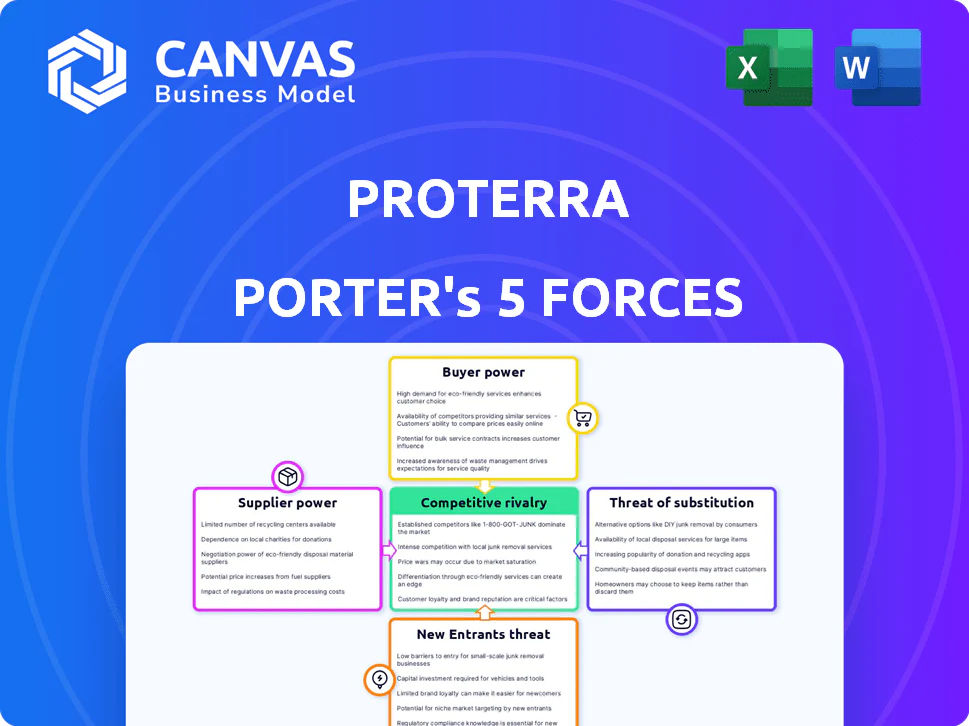
PROTERRA PORTER'S FIVE FORCES TEMPLATE RESEARCH
What is included in the product
 Detailed Word Document
Identifies disruptive forces, emerging threats, and substitutes that challenge market share.

 Customizable Excel Spreadsheet
Swap in your own data, labels, and notes to reflect current business conditions.
Same Document Delivered
Proterra Porter's Five Forces Analysis
This is the complete Proterra Porter's Five Forces analysis. The document you see here is exactly what you’ll download after purchase—fully formatted and ready. We examine competitive rivalry within the EV industry. It analyzes supplier power regarding battery component availability. Buyer power through fleet purchasing decisions is also assessed. Threat of new entrants, plus the threat of substitutes like gasoline vehicles are considered.

Porter's Five Forces Analysis Template

Go Beyond the Preview—Access the Full Strategic Report
Proterra faces intense competition from established automakers and emerging EV startups, significantly impacting pricing and market share. Supplier power is moderate, with access to battery technology a key differentiator. The threat of new entrants is high, fueled by government incentives and technological advancements. Buyer power is considerable, as customers have numerous EV options. Substitute products (ICE vehicles) remain a challenge but are declining.
This brief snapshot only scratches the surface. Unlock the full Porter's Five Forces Analysis to explore Proterra’s competitive dynamics, market pressures, and strategic advantages in detail.
Suppliers Bargaining Power

Battery Technology Providers
Proterra heavily depends on battery suppliers for its electric buses and systems. These suppliers hold considerable power because batteries are crucial for product performance and cost. The battery market's dynamics, including technological advancements and supply chain issues, directly affect Proterra. In 2024, battery costs remained a key factor, influencing profitability.
Specialized Component Manufacturers
Specialized component manufacturers, like those producing electric drivetrains, hold significant bargaining power. These suppliers, offering unique parts, limit readily available alternatives. For instance, in 2024, companies like BorgWarner and Dana Inc. saw strong demand for EV components. The specialized nature of these components gives suppliers leverage.

Raw Material Providers
Proterra's reliance on raw materials like lithium, cobalt, and nickel gives suppliers significant bargaining power. In 2024, lithium prices fluctuated, affecting battery production costs. Cobalt prices also saw shifts, impacting Proterra's margins. Nickel's availability further influences Proterra's ability to meet production targets.

Software and Technology Providers
Software and technology suppliers wield considerable influence over Proterra Porter. Their proprietary or deeply integrated technologies, essential for fleet management, charging infrastructure, and vehicle control, give them leverage. If Proterra depends heavily on a single supplier, the supplier can dictate terms, impacting costs and operational efficiency. This is especially true for specialized software in the electric vehicle (EV) sector.
- Proterra's 2023 financial reports show significant expenses related to software and technology integration.
- The company's dependence on specific charging infrastructure software solutions can create vulnerabilities.
- Negotiating power is crucial; competition among suppliers can mitigate risks.
- Strategic partnerships and in-house development can reduce reliance on external software.
Labor Force
Proterra's labor force significantly impacts its supplier bargaining power. A skilled workforce is crucial for EV and battery production. The availability of engineers and technicians affects production costs and capabilities. Labor costs are a key factor, with wage rates varying by location and skill level. These dynamics influence Proterra's ability to negotiate with suppliers.
- In 2024, the average hourly wage for manufacturing workers in the U.S. was around $26.
- The demand for skilled EV technicians is projected to increase by 15% by 2025.
- Unionization rates in the automotive sector can affect labor costs and bargaining power.
Supplier Power Dynamics: A Deep Dive
Proterra's supplier power is high due to reliance on key components and materials. Battery suppliers, holding critical technology, influence costs significantly. Specialized component manufacturers and raw material providers like lithium and cobalt also exert strong leverage. Software and labor dynamics further impact Proterra's bargaining position.
| Supplier Type | Impact | 2024 Data |
|---|---|---|
| Battery Suppliers | High, due to tech & cost | Battery costs: ~30-40% of EV cost |
| Component Manufacturers | Moderate, due to specialization | EV component market growth: 15% |
| Raw Material Providers | High, due to price volatility | Lithium price fluctuation: +/- 20% |
| Software Suppliers | Significant, integration | Software costs: up to 10% of revenue |
Customers Bargaining Power

Transit Agencies and Fleet Operators
Transit agencies and fleet operators wield considerable bargaining power as Proterra's main clients. These customers, responsible for large-scale vehicle purchases, can dictate pricing and service terms. The transit market's size and the volume of Proterra buses sold in 2024, totaling over 600 units, amplify this influence. Their power is further strengthened by the availability of alternative electric bus suppliers.
Government Funding and Incentives
Government incentives significantly impact customer power. In 2024, the US government offered substantial grants and tax credits to promote zero-emission vehicles. These incentives reduce the upfront cost of electric buses, increasing customer demand. Regulations mandating cleaner transportation also boost customer purchasing power by creating a market for Proterra's products.

Demand for Customization
Proterra's customers, including transit agencies and commercial fleet operators, often demand vehicle customizations. This demand for tailored solutions, like specific range or charging infrastructure, heightens customer bargaining power. Meeting these diverse needs can increase costs and potentially reduce profit margins. For instance, in 2024, customization requests drove up production costs for some electric bus models by up to 15%.

Availability of Alternatives
Customers can choose electric buses and infrastructure from various manufacturers, boosting their bargaining power. This competitive environment gives buyers options. For example, in 2024, the electric bus market saw a growth, with multiple players offering diverse products. This rivalry limits Proterra's ability to set prices or terms. Buyers can easily switch providers if they find better deals or features elsewhere.
- Market competition intensifies customer choice.
- Switching costs impact customer decisions.
- Price sensitivity influences purchasing behavior.
- Product differentiation affects bargaining power.
Long-term Service and Support Needs
Customers' bargaining power increases with long-term service needs. Proterra's clients depend on the company for maintenance, parts, and technical support. The availability and quality of these services affect satisfaction and future purchases. This reliance gives customers leverage in negotiations.
- Proterra's service revenue in 2023 was a key factor in customer relationships.
- High-quality support can lead to repeat business, while poor service reduces this.
- Customer satisfaction directly impacts future sales and brand reputation.
- Reliable service is crucial for electric vehicle fleet operations.
How Customer Power Shapes Electric Bus Deals
Proterra's customers, mainly transit agencies, have strong bargaining power, influencing prices and terms. Government incentives, such as those in 2024, affect demand and customer decisions. Customization requests, increasing costs by up to 15% in 2024, also boost customer leverage.
| Factor | Impact | Example (2024) |
|---|---|---|
| Market Competition | Increases customer choice. | Multiple electric bus suppliers. |
| Incentives | Boosts demand and purchasing power. | US grants and tax credits. |
| Customization | Raises costs, enhances power. | Up to 15% cost increase. |
Rivalry Among Competitors

Presence of Established Bus Manufacturers
Established bus manufacturers present intense competition in the electric bus market. Companies like Daimler and Volvo have substantial infrastructure, customer networks, and manufacturing expertise. In 2024, Daimler's bus division generated roughly $4.5 billion in revenue, showing its market strength. These firms' resources allow them to compete aggressively. Their experience provides a competitive advantage.
Emergence of New Electric Vehicle Companies
The electric vehicle (EV) market is attracting numerous new entrants, significantly heightening competitive rivalry. Companies like Arrival and Lion Electric are specifically targeting the commercial EV segment. This surge in competitors forces established players to innovate and compete aggressively. In 2024, the global electric bus market was valued at $16.8 billion, showing the potential for new entrants.

International Competitors
International competitors significantly shape the electric bus market. Global manufacturers, especially from China and Europe, present strong competition to Proterra Porter. These competitors offer diverse products and often leverage different cost structures and market sizes. For example, BYD, a major Chinese player, delivered over 19,000 electric buses in 2023, highlighting the intensity of international rivalry.

Technological Advancements and Innovation Speed
Technological advancements are rapidly changing the competitive landscape. The race to improve battery technology, charging infrastructure, and vehicle performance is fierce. Companies are investing heavily to stay ahead. This intense competition pushes for constant innovation. For example, Proterra’s battery systems have a high energy density.
- Battery technology is advancing rapidly, with energy density increasing by 5-10% annually.
- Charging infrastructure investments are projected to reach $20 billion by 2024.
- Vehicle performance improvements are critical for market share.
Pricing Pressure and Market Share Competition
Competitive rivalry among electric bus manufacturers, like Proterra Porter, often results in pricing pressure, squeezing profit margins. The competition for market share is intense, as companies bid for contracts with transit agencies. Securing large contracts is crucial, but it intensifies rivalry. This competitive landscape demands efficient cost management and strategic pricing.
- Proterra filed for bankruptcy in 2023, highlighting the financial pressures.
- Competition includes established players like BYD and new entrants.
- Transit agencies have price-sensitive bidding processes.
- Market share battles impact profitability.
Electric Bus Market: A Competitive Landscape
Competitive rivalry in the electric bus market is fierce due to established players, new entrants, and international competitors. Rapid technological advancements, like enhanced battery tech, add to the competition. This intense environment leads to pricing pressure and impacts profit margins, as seen with Proterra's bankruptcy.
| Aspect | Details |
|---|---|
| Market Value (2024) | $16.8 billion |
| BYD Electric Bus Deliveries (2023) | Over 19,000 |
| Daimler Bus Revenue (2024) | $4.5 billion |
Original: $10.00
-65%$10.00
$3.50PROTERRA PORTER'S FIVE FORCES TEMPLATE RESEARCH
What is included in the product
Detailed Word Document
Identifies disruptive forces, emerging threats, and substitutes that challenge market share.
Customizable Excel Spreadsheet
Swap in your own data, labels, and notes to reflect current business conditions.
Same Document Delivered
Proterra Porter's Five Forces Analysis
This is the complete Proterra Porter's Five Forces analysis. The document you see here is exactly what you’ll download after purchase—fully formatted and ready. We examine competitive rivalry within the EV industry. It analyzes supplier power regarding battery component availability. Buyer power through fleet purchasing decisions is also assessed. Threat of new entrants, plus the threat of substitutes like gasoline vehicles are considered.
Porter's Five Forces Analysis Template
Go Beyond the Preview—Access the Full Strategic Report
Proterra faces intense competition from established automakers and emerging EV startups, significantly impacting pricing and market share. Supplier power is moderate, with access to battery technology a key differentiator. The threat of new entrants is high, fueled by government incentives and technological advancements. Buyer power is considerable, as customers have numerous EV options. Substitute products (ICE vehicles) remain a challenge but are declining.
This brief snapshot only scratches the surface. Unlock the full Porter's Five Forces Analysis to explore Proterra’s competitive dynamics, market pressures, and strategic advantages in detail.
Suppliers Bargaining Power
Battery Technology Providers
Proterra heavily depends on battery suppliers for its electric buses and systems. These suppliers hold considerable power because batteries are crucial for product performance and cost. The battery market's dynamics, including technological advancements and supply chain issues, directly affect Proterra. In 2024, battery costs remained a key factor, influencing profitability.
Specialized Component Manufacturers
Specialized component manufacturers, like those producing electric drivetrains, hold significant bargaining power. These suppliers, offering unique parts, limit readily available alternatives. For instance, in 2024, companies like BorgWarner and Dana Inc. saw strong demand for EV components. The specialized nature of these components gives suppliers leverage.
Raw Material Providers
Proterra's reliance on raw materials like lithium, cobalt, and nickel gives suppliers significant bargaining power. In 2024, lithium prices fluctuated, affecting battery production costs. Cobalt prices also saw shifts, impacting Proterra's margins. Nickel's availability further influences Proterra's ability to meet production targets.
Software and Technology Providers
Software and technology suppliers wield considerable influence over Proterra Porter. Their proprietary or deeply integrated technologies, essential for fleet management, charging infrastructure, and vehicle control, give them leverage. If Proterra depends heavily on a single supplier, the supplier can dictate terms, impacting costs and operational efficiency. This is especially true for specialized software in the electric vehicle (EV) sector.
- Proterra's 2023 financial reports show significant expenses related to software and technology integration.
- The company's dependence on specific charging infrastructure software solutions can create vulnerabilities.
- Negotiating power is crucial; competition among suppliers can mitigate risks.
- Strategic partnerships and in-house development can reduce reliance on external software.
Labor Force
Proterra's labor force significantly impacts its supplier bargaining power. A skilled workforce is crucial for EV and battery production. The availability of engineers and technicians affects production costs and capabilities. Labor costs are a key factor, with wage rates varying by location and skill level. These dynamics influence Proterra's ability to negotiate with suppliers.
- In 2024, the average hourly wage for manufacturing workers in the U.S. was around $26.
- The demand for skilled EV technicians is projected to increase by 15% by 2025.
- Unionization rates in the automotive sector can affect labor costs and bargaining power.
Supplier Power Dynamics: A Deep Dive
Proterra's supplier power is high due to reliance on key components and materials. Battery suppliers, holding critical technology, influence costs significantly. Specialized component manufacturers and raw material providers like lithium and cobalt also exert strong leverage. Software and labor dynamics further impact Proterra's bargaining position.
| Supplier Type | Impact | 2024 Data |
|---|---|---|
| Battery Suppliers | High, due to tech & cost | Battery costs: ~30-40% of EV cost |
| Component Manufacturers | Moderate, due to specialization | EV component market growth: 15% |
| Raw Material Providers | High, due to price volatility | Lithium price fluctuation: +/- 20% |
| Software Suppliers | Significant, integration | Software costs: up to 10% of revenue |
Customers Bargaining Power
Transit Agencies and Fleet Operators
Transit agencies and fleet operators wield considerable bargaining power as Proterra's main clients. These customers, responsible for large-scale vehicle purchases, can dictate pricing and service terms. The transit market's size and the volume of Proterra buses sold in 2024, totaling over 600 units, amplify this influence. Their power is further strengthened by the availability of alternative electric bus suppliers.
Government Funding and Incentives
Government incentives significantly impact customer power. In 2024, the US government offered substantial grants and tax credits to promote zero-emission vehicles. These incentives reduce the upfront cost of electric buses, increasing customer demand. Regulations mandating cleaner transportation also boost customer purchasing power by creating a market for Proterra's products.
Demand for Customization
Proterra's customers, including transit agencies and commercial fleet operators, often demand vehicle customizations. This demand for tailored solutions, like specific range or charging infrastructure, heightens customer bargaining power. Meeting these diverse needs can increase costs and potentially reduce profit margins. For instance, in 2024, customization requests drove up production costs for some electric bus models by up to 15%.
Availability of Alternatives
Customers can choose electric buses and infrastructure from various manufacturers, boosting their bargaining power. This competitive environment gives buyers options. For example, in 2024, the electric bus market saw a growth, with multiple players offering diverse products. This rivalry limits Proterra's ability to set prices or terms. Buyers can easily switch providers if they find better deals or features elsewhere.
- Market competition intensifies customer choice.
- Switching costs impact customer decisions.
- Price sensitivity influences purchasing behavior.
- Product differentiation affects bargaining power.
Long-term Service and Support Needs
Customers' bargaining power increases with long-term service needs. Proterra's clients depend on the company for maintenance, parts, and technical support. The availability and quality of these services affect satisfaction and future purchases. This reliance gives customers leverage in negotiations.
- Proterra's service revenue in 2023 was a key factor in customer relationships.
- High-quality support can lead to repeat business, while poor service reduces this.
- Customer satisfaction directly impacts future sales and brand reputation.
- Reliable service is crucial for electric vehicle fleet operations.
How Customer Power Shapes Electric Bus Deals
Proterra's customers, mainly transit agencies, have strong bargaining power, influencing prices and terms. Government incentives, such as those in 2024, affect demand and customer decisions. Customization requests, increasing costs by up to 15% in 2024, also boost customer leverage.
| Factor | Impact | Example (2024) |
|---|---|---|
| Market Competition | Increases customer choice. | Multiple electric bus suppliers. |
| Incentives | Boosts demand and purchasing power. | US grants and tax credits. |
| Customization | Raises costs, enhances power. | Up to 15% cost increase. |
Rivalry Among Competitors
Presence of Established Bus Manufacturers
Established bus manufacturers present intense competition in the electric bus market. Companies like Daimler and Volvo have substantial infrastructure, customer networks, and manufacturing expertise. In 2024, Daimler's bus division generated roughly $4.5 billion in revenue, showing its market strength. These firms' resources allow them to compete aggressively. Their experience provides a competitive advantage.
Emergence of New Electric Vehicle Companies
The electric vehicle (EV) market is attracting numerous new entrants, significantly heightening competitive rivalry. Companies like Arrival and Lion Electric are specifically targeting the commercial EV segment. This surge in competitors forces established players to innovate and compete aggressively. In 2024, the global electric bus market was valued at $16.8 billion, showing the potential for new entrants.
International Competitors
International competitors significantly shape the electric bus market. Global manufacturers, especially from China and Europe, present strong competition to Proterra Porter. These competitors offer diverse products and often leverage different cost structures and market sizes. For example, BYD, a major Chinese player, delivered over 19,000 electric buses in 2023, highlighting the intensity of international rivalry.
Technological Advancements and Innovation Speed
Technological advancements are rapidly changing the competitive landscape. The race to improve battery technology, charging infrastructure, and vehicle performance is fierce. Companies are investing heavily to stay ahead. This intense competition pushes for constant innovation. For example, Proterra’s battery systems have a high energy density.
- Battery technology is advancing rapidly, with energy density increasing by 5-10% annually.
- Charging infrastructure investments are projected to reach $20 billion by 2024.
- Vehicle performance improvements are critical for market share.
Pricing Pressure and Market Share Competition
Competitive rivalry among electric bus manufacturers, like Proterra Porter, often results in pricing pressure, squeezing profit margins. The competition for market share is intense, as companies bid for contracts with transit agencies. Securing large contracts is crucial, but it intensifies rivalry. This competitive landscape demands efficient cost management and strategic pricing.
- Proterra filed for bankruptcy in 2023, highlighting the financial pressures.
- Competition includes established players like BYD and new entrants.
- Transit agencies have price-sensitive bidding processes.
- Market share battles impact profitability.
Electric Bus Market: A Competitive Landscape
Competitive rivalry in the electric bus market is fierce due to established players, new entrants, and international competitors. Rapid technological advancements, like enhanced battery tech, add to the competition. This intense environment leads to pricing pressure and impacts profit margins, as seen with Proterra's bankruptcy.
| Aspect | Details |
|---|---|
| Market Value (2024) | $16.8 billion |
| BYD Electric Bus Deliveries (2023) | Over 19,000 |
| Daimler Bus Revenue (2024) | $4.5 billion |
Product Information
Product Information
Shipping & Returns
Shipping & Returns
Description
What is included in the product
Detailed Word Document
Identifies disruptive forces, emerging threats, and substitutes that challenge market share.
Customizable Excel Spreadsheet
Swap in your own data, labels, and notes to reflect current business conditions.
Same Document Delivered
Proterra Porter's Five Forces Analysis
This is the complete Proterra Porter's Five Forces analysis. The document you see here is exactly what you’ll download after purchase—fully formatted and ready. We examine competitive rivalry within the EV industry. It analyzes supplier power regarding battery component availability. Buyer power through fleet purchasing decisions is also assessed. Threat of new entrants, plus the threat of substitutes like gasoline vehicles are considered.
Porter's Five Forces Analysis Template
Go Beyond the Preview—Access the Full Strategic Report
Proterra faces intense competition from established automakers and emerging EV startups, significantly impacting pricing and market share. Supplier power is moderate, with access to battery technology a key differentiator. The threat of new entrants is high, fueled by government incentives and technological advancements. Buyer power is considerable, as customers have numerous EV options. Substitute products (ICE vehicles) remain a challenge but are declining.
This brief snapshot only scratches the surface. Unlock the full Porter's Five Forces Analysis to explore Proterra’s competitive dynamics, market pressures, and strategic advantages in detail.
Suppliers Bargaining Power
Battery Technology Providers
Proterra heavily depends on battery suppliers for its electric buses and systems. These suppliers hold considerable power because batteries are crucial for product performance and cost. The battery market's dynamics, including technological advancements and supply chain issues, directly affect Proterra. In 2024, battery costs remained a key factor, influencing profitability.
Specialized Component Manufacturers
Specialized component manufacturers, like those producing electric drivetrains, hold significant bargaining power. These suppliers, offering unique parts, limit readily available alternatives. For instance, in 2024, companies like BorgWarner and Dana Inc. saw strong demand for EV components. The specialized nature of these components gives suppliers leverage.
Raw Material Providers
Proterra's reliance on raw materials like lithium, cobalt, and nickel gives suppliers significant bargaining power. In 2024, lithium prices fluctuated, affecting battery production costs. Cobalt prices also saw shifts, impacting Proterra's margins. Nickel's availability further influences Proterra's ability to meet production targets.
Software and Technology Providers
Software and technology suppliers wield considerable influence over Proterra Porter. Their proprietary or deeply integrated technologies, essential for fleet management, charging infrastructure, and vehicle control, give them leverage. If Proterra depends heavily on a single supplier, the supplier can dictate terms, impacting costs and operational efficiency. This is especially true for specialized software in the electric vehicle (EV) sector.
- Proterra's 2023 financial reports show significant expenses related to software and technology integration.
- The company's dependence on specific charging infrastructure software solutions can create vulnerabilities.
- Negotiating power is crucial; competition among suppliers can mitigate risks.
- Strategic partnerships and in-house development can reduce reliance on external software.
Labor Force
Proterra's labor force significantly impacts its supplier bargaining power. A skilled workforce is crucial for EV and battery production. The availability of engineers and technicians affects production costs and capabilities. Labor costs are a key factor, with wage rates varying by location and skill level. These dynamics influence Proterra's ability to negotiate with suppliers.
- In 2024, the average hourly wage for manufacturing workers in the U.S. was around $26.
- The demand for skilled EV technicians is projected to increase by 15% by 2025.
- Unionization rates in the automotive sector can affect labor costs and bargaining power.
Supplier Power Dynamics: A Deep Dive
Proterra's supplier power is high due to reliance on key components and materials. Battery suppliers, holding critical technology, influence costs significantly. Specialized component manufacturers and raw material providers like lithium and cobalt also exert strong leverage. Software and labor dynamics further impact Proterra's bargaining position.
| Supplier Type | Impact | 2024 Data |
|---|---|---|
| Battery Suppliers | High, due to tech & cost | Battery costs: ~30-40% of EV cost |
| Component Manufacturers | Moderate, due to specialization | EV component market growth: 15% |
| Raw Material Providers | High, due to price volatility | Lithium price fluctuation: +/- 20% |
| Software Suppliers | Significant, integration | Software costs: up to 10% of revenue |
Customers Bargaining Power
Transit Agencies and Fleet Operators
Transit agencies and fleet operators wield considerable bargaining power as Proterra's main clients. These customers, responsible for large-scale vehicle purchases, can dictate pricing and service terms. The transit market's size and the volume of Proterra buses sold in 2024, totaling over 600 units, amplify this influence. Their power is further strengthened by the availability of alternative electric bus suppliers.
Government Funding and Incentives
Government incentives significantly impact customer power. In 2024, the US government offered substantial grants and tax credits to promote zero-emission vehicles. These incentives reduce the upfront cost of electric buses, increasing customer demand. Regulations mandating cleaner transportation also boost customer purchasing power by creating a market for Proterra's products.
Demand for Customization
Proterra's customers, including transit agencies and commercial fleet operators, often demand vehicle customizations. This demand for tailored solutions, like specific range or charging infrastructure, heightens customer bargaining power. Meeting these diverse needs can increase costs and potentially reduce profit margins. For instance, in 2024, customization requests drove up production costs for some electric bus models by up to 15%.
Availability of Alternatives
Customers can choose electric buses and infrastructure from various manufacturers, boosting their bargaining power. This competitive environment gives buyers options. For example, in 2024, the electric bus market saw a growth, with multiple players offering diverse products. This rivalry limits Proterra's ability to set prices or terms. Buyers can easily switch providers if they find better deals or features elsewhere.
- Market competition intensifies customer choice.
- Switching costs impact customer decisions.
- Price sensitivity influences purchasing behavior.
- Product differentiation affects bargaining power.
Long-term Service and Support Needs
Customers' bargaining power increases with long-term service needs. Proterra's clients depend on the company for maintenance, parts, and technical support. The availability and quality of these services affect satisfaction and future purchases. This reliance gives customers leverage in negotiations.
- Proterra's service revenue in 2023 was a key factor in customer relationships.
- High-quality support can lead to repeat business, while poor service reduces this.
- Customer satisfaction directly impacts future sales and brand reputation.
- Reliable service is crucial for electric vehicle fleet operations.
How Customer Power Shapes Electric Bus Deals
Proterra's customers, mainly transit agencies, have strong bargaining power, influencing prices and terms. Government incentives, such as those in 2024, affect demand and customer decisions. Customization requests, increasing costs by up to 15% in 2024, also boost customer leverage.
| Factor | Impact | Example (2024) |
|---|---|---|
| Market Competition | Increases customer choice. | Multiple electric bus suppliers. |
| Incentives | Boosts demand and purchasing power. | US grants and tax credits. |
| Customization | Raises costs, enhances power. | Up to 15% cost increase. |
Rivalry Among Competitors
Presence of Established Bus Manufacturers
Established bus manufacturers present intense competition in the electric bus market. Companies like Daimler and Volvo have substantial infrastructure, customer networks, and manufacturing expertise. In 2024, Daimler's bus division generated roughly $4.5 billion in revenue, showing its market strength. These firms' resources allow them to compete aggressively. Their experience provides a competitive advantage.
Emergence of New Electric Vehicle Companies
The electric vehicle (EV) market is attracting numerous new entrants, significantly heightening competitive rivalry. Companies like Arrival and Lion Electric are specifically targeting the commercial EV segment. This surge in competitors forces established players to innovate and compete aggressively. In 2024, the global electric bus market was valued at $16.8 billion, showing the potential for new entrants.
International Competitors
International competitors significantly shape the electric bus market. Global manufacturers, especially from China and Europe, present strong competition to Proterra Porter. These competitors offer diverse products and often leverage different cost structures and market sizes. For example, BYD, a major Chinese player, delivered over 19,000 electric buses in 2023, highlighting the intensity of international rivalry.
Technological Advancements and Innovation Speed
Technological advancements are rapidly changing the competitive landscape. The race to improve battery technology, charging infrastructure, and vehicle performance is fierce. Companies are investing heavily to stay ahead. This intense competition pushes for constant innovation. For example, Proterra’s battery systems have a high energy density.
- Battery technology is advancing rapidly, with energy density increasing by 5-10% annually.
- Charging infrastructure investments are projected to reach $20 billion by 2024.
- Vehicle performance improvements are critical for market share.
Pricing Pressure and Market Share Competition
Competitive rivalry among electric bus manufacturers, like Proterra Porter, often results in pricing pressure, squeezing profit margins. The competition for market share is intense, as companies bid for contracts with transit agencies. Securing large contracts is crucial, but it intensifies rivalry. This competitive landscape demands efficient cost management and strategic pricing.
- Proterra filed for bankruptcy in 2023, highlighting the financial pressures.
- Competition includes established players like BYD and new entrants.
- Transit agencies have price-sensitive bidding processes.
- Market share battles impact profitability.
Electric Bus Market: A Competitive Landscape
Competitive rivalry in the electric bus market is fierce due to established players, new entrants, and international competitors. Rapid technological advancements, like enhanced battery tech, add to the competition. This intense environment leads to pricing pressure and impacts profit margins, as seen with Proterra's bankruptcy.
| Aspect | Details |
|---|---|
| Market Value (2024) | $16.8 billion |
| BYD Electric Bus Deliveries (2023) | Over 19,000 |
| Daimler Bus Revenue (2024) | $4.5 billion |











