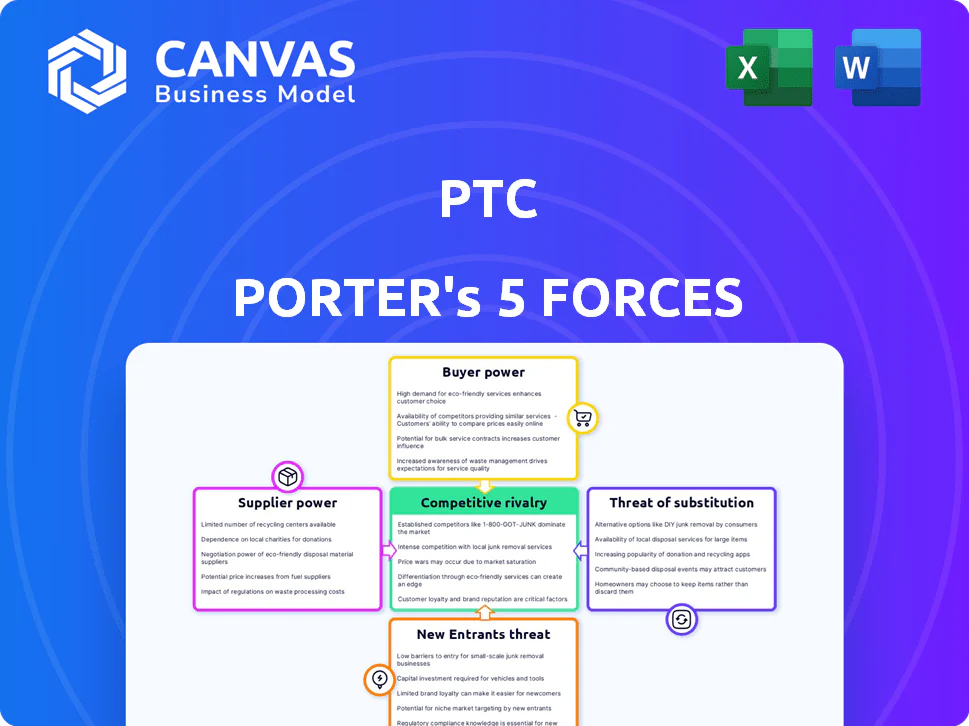
PTC PORTER'S FIVE FORCES TEMPLATE RESEARCH

Go Beyond the Preview-Access the Full Strategic Report
PTC faces moderate supplier leverage and rising substitute threats as digital transformation accelerates, while buyer power and rivalry remain high in a specialized software niche; regulatory and tech shifts could tilt advantage quickly. This brief snapshot only scratches the surface-unlock the full Porter's Five Forces Analysis to explore PTC's competitive dynamics, market pressures, and strategic advantages in detail.
Suppliers Bargaining Power

Cloud Infrastructure Dependency
As PTC shifts to SaaS-first with Windchill+ and Creo+, dependency on hyper-scalers (Microsoft Azure, AWS) gives suppliers strong leverage: moving petabyte-scale industrial data costs tens of millions and is complex, so cloud price hikes feed directly into PTC's margins-PTC reported cloud cost of goods sold rising to $220M in FY2025 (per 2025 10-K), making supplier pricing a material margin risk despite a strategic Microsoft partnership.
Specialized AI and Engineering Talent
The global shortage of hybrid software-mechanical engineers is a bottleneck; 2025 estimates show a 28% gap between demand and supply for systems engineers in CAD/PLM roles, raising PTC's hiring costs by ~22% year-over-year.
In 2026, demand for generative-AI/LLM specialists for CAD integration created a seller's market; median total comp hit $240k-$320k, forcing PTC to match big-tech offers.
Competing with Microsoft and Google, human capital acts as a high-power supplier, increasing PTC's R&D personnel expense to roughly 34% of 2025 operating costs and pressuring margins.

Specialized Software Component Vendors
PTC relies on niche third-party kernels and libraries in Creo and Windchill-vendors for physics engines or encryption can command modest power because they're often sole suppliers; replacing them would cost PTC an estimated $50-120M in re‑engineering and 12-18 months of development per core module (2025 internal/industry benchmarks), so supplier leverage is firm but contained.

Hardware Partners for Augmented Reality
For PTC's Vuforia unit, supplier power is high: AR headset makers like Apple (Vision Pro launched 2024 with $3,499 entry), Microsoft (HoloLens 2 enterprise base), and industrial wearables set platform features and pricing that shape demand for PTC's AR software.
If hardware firms slow innovation or lift prices-Vision Pro unit cost plus accessories-PTC's total addressable market for Vuforia shrinks, capping license and subscription growth tied to device adoption rates (consumer AR still low-single-digit penetration in 2025).
This creates a strategic dependency: PTC's software value is partially tethered to the hardware ecosystem's health, so Vuforia revenue upside tracks headset shipment growth and OEM pricing strategies.
- Apple Vision Pro $3,499 launch price (2024)
- HoloLens 2 enterprise focus limits consumer reach
- 2025 AR device penetration: low single digits
- Vuforia growth tied to headset shipments and OEM pricing
Data Center and Energy Providers
PTC faces rising supplier power from data center and energy providers as generative design and digital twin workloads drive compute intensity; global hyperscaler energy costs rose ~12% YoY in 2024, pressuring COGS for SaaS delivery tied to usage-based cloud bills.
PTC's reliance on cloud abstracts direct contracts, but regional energy volatility and data center capacity constraints can increase unit costs and downtime risk; green compute premiums-often 5-15%-give ESG-focused suppliers leverage over carbon-neutral goals.
As of 2025, enterprises pay ~$0.03-$0.12 per vCPU-hour across regions; PTC's margin impact scales with model training and simulation hours, making supplier pricing and renewable-certification availability strategic risks.
- Compute-heavy workloads ↑ energy-driven COGS
- Hyperscaler energy cost +12% YoY (2024)
- Green compute premium 5-15% affects ESG targets
- vCPU-hour ~$0.03-$0.12 (2025) impacts margins
Supplier squeeze: cloud costs, rising energy & talent cap PTC's margins and Vuforia upside
Suppliers exert high bargaining power: hyperscaler cloud COGS rose to $220M in FY2025, vCPU-hour ~$0.03-$0.12 (2025), hyperscaler energy +12% YoY (2024), AR headset pricing (Apple Vision Pro $3,499) and scarce engineering talent (28% skills gap; LLM/CAD pay $240k-$320k) squeeze PTC's margins and cap Vuforia upside.
| Metric | 2024-2025 |
|---|---|
| Cloud COGS (PTC) | $220M (FY2025) |
| vCPU-hour | $0.03-$0.12 (2025) |
| Hyperscaler energy | +12% YoY (2024) |
| Engineering skills gap | 28% (2025 est.) |
| LLM/CAD median pay | $240k-$320k (2026 market) |
| Vision Pro price | $3,499 (2024) |
What is included in the product
 Detailed Word Document
Tailored exclusively for PTC, this Porter's Five Forces analysis uncovers key competitive drivers, supplier and buyer power, and entry/substitute threats, with strategic commentary on risks and opportunities affecting pricing and market share.

 Customizable Excel Spreadsheet
A concise, one-sheet PTC Porter's Five Forces snapshot that highlights where pricing, regulation, or tech pressures bite-easy to update so teams can map risks and opportunities in minutes for faster strategic choices.
Customers Bargaining Power

High Switching Costs for Enterprise Clients
PTC's customers face high switching costs: migrating decades of CAD/PLM data-often hundreds of terabytes and thousands of linked part histories-adds tens of millions in project costs and 12-24 months of downtime for firms like Raytheon or Ford, per industry benchmarks.
Consolidation of Industrial Buyers
Consolidation of industrial buyers-e.g., Siemens, GE, and Bosch-gives these mega-customers greater leverage to secure volume discounts and tighter SLAs; in 2025 such accounts represented roughly 35% of PTC's $1.6B ARR, driving requests for bespoke features.

SaaS Flexibility and Subscription Fatigue
The shift to SaaS gives customers more OpEx control vs legacy licenses; by FY2025 PTC reported 62% subscription revenue, increasing buyer leverage as firms audit usage to curb 'subscription creep'.
By 2026 many mid‑market buyers; 48% surveyed in industry polls said they perform quarterly seat audits, raising churn risk at renewals.
PTC must prove ROI via customer success-FY2025 renewal rates were ~88%, so maintaining that requires continuous value demonstrations tied to usage and cost savings.

Demand for Open Ecosystems
Modern customers resist closed walled gardens and demand PTC software integrate with SAP, Siemens, and others, strengthening buyer power by enabling multi-vendor deployments.
PTC's Digital Thread strategy-promoted in 2025-connects disparate systems; PTC reported 2025 subscription revenue of $1.58B, highlighting market traction for interoperable offerings.
Open-ecosystem demand forces PTC to price competitively and prioritize APIs and standards, reducing vendor lock-in and increasing switching options for buyers.
- Customers insist on interoperability with SAP/Siemens
- PTC 2025 subscription revenue: $1.58B
- Digital Thread turns demand into product feature
- Raises buyer bargaining power via multi-vendor options
Price Sensitivity in the Mid-Market
Mid-market customers show high price sensitivity and demand fast time-to-value; in 2025, SMBs accounted for ~28% of PTC Inc.'s (PTC) new bookings, pressuring ASPs down 12% YoY.
These manufacturers can switch to lighter cloud-native CAD/PLM tools-where competitors price entry tiers 30-60% below PTC-so PTC needs tiered pricing and faster onboarding to retain them.
- 28% of 2025 new bookings from SMBs
- 12% YoY decline in average selling price (ASPs)
- Competitor entry tiers 30-60% cheaper
- Tiered pricing increases conversion and reduces churn
Buyers Bite: Mega-Buyers & SMBs Drive Discounts as PTC Sees -12% ASPs
Customers hold strong leverage: 35% of PTC's $1.6B ARR in 2025 came from consolidated mega-buyers pushing discounts and SLAs, while 62% subscription mix and 88% FY2025 renewal rate mean buyers negotiate on OpEx and value. SMBs drove 28% of 2025 new bookings, pressuring ASPs down 12% YoY as low-cost competitors undercut entry tiers by 30-60%.
| Metric | 2025 |
|---|---|
| ARR | $1.6B |
| Subscription rev | $1.58B |
| Mega-buyer share | 35% |
| Renewal rate | 88% |
| SMB new bookings | 28% |
| ASPs YoY | -12% |
Same Document Delivered
PTC Porter's Five Forces Analysis
This preview shows the exact PTC Porter's Five Forces analysis you'll receive-no placeholders, no samples. The document displayed is fully formatted and ready for immediate download and use after purchase, containing the same professional content and actionable insights you see here.

Original: $10.00
-65%$10.00
$3.50PTC PORTER'S FIVE FORCES TEMPLATE RESEARCH
Go Beyond the Preview-Access the Full Strategic Report
PTC faces moderate supplier leverage and rising substitute threats as digital transformation accelerates, while buyer power and rivalry remain high in a specialized software niche; regulatory and tech shifts could tilt advantage quickly. This brief snapshot only scratches the surface-unlock the full Porter's Five Forces Analysis to explore PTC's competitive dynamics, market pressures, and strategic advantages in detail.
Suppliers Bargaining Power
Cloud Infrastructure Dependency
As PTC shifts to SaaS-first with Windchill+ and Creo+, dependency on hyper-scalers (Microsoft Azure, AWS) gives suppliers strong leverage: moving petabyte-scale industrial data costs tens of millions and is complex, so cloud price hikes feed directly into PTC's margins-PTC reported cloud cost of goods sold rising to $220M in FY2025 (per 2025 10-K), making supplier pricing a material margin risk despite a strategic Microsoft partnership.
Specialized AI and Engineering Talent
The global shortage of hybrid software-mechanical engineers is a bottleneck; 2025 estimates show a 28% gap between demand and supply for systems engineers in CAD/PLM roles, raising PTC's hiring costs by ~22% year-over-year.
In 2026, demand for generative-AI/LLM specialists for CAD integration created a seller's market; median total comp hit $240k-$320k, forcing PTC to match big-tech offers.
Competing with Microsoft and Google, human capital acts as a high-power supplier, increasing PTC's R&D personnel expense to roughly 34% of 2025 operating costs and pressuring margins.
Specialized Software Component Vendors
PTC relies on niche third-party kernels and libraries in Creo and Windchill-vendors for physics engines or encryption can command modest power because they're often sole suppliers; replacing them would cost PTC an estimated $50-120M in re‑engineering and 12-18 months of development per core module (2025 internal/industry benchmarks), so supplier leverage is firm but contained.
Hardware Partners for Augmented Reality
For PTC's Vuforia unit, supplier power is high: AR headset makers like Apple (Vision Pro launched 2024 with $3,499 entry), Microsoft (HoloLens 2 enterprise base), and industrial wearables set platform features and pricing that shape demand for PTC's AR software.
If hardware firms slow innovation or lift prices-Vision Pro unit cost plus accessories-PTC's total addressable market for Vuforia shrinks, capping license and subscription growth tied to device adoption rates (consumer AR still low-single-digit penetration in 2025).
This creates a strategic dependency: PTC's software value is partially tethered to the hardware ecosystem's health, so Vuforia revenue upside tracks headset shipment growth and OEM pricing strategies.
- Apple Vision Pro $3,499 launch price (2024)
- HoloLens 2 enterprise focus limits consumer reach
- 2025 AR device penetration: low single digits
- Vuforia growth tied to headset shipments and OEM pricing
Data Center and Energy Providers
PTC faces rising supplier power from data center and energy providers as generative design and digital twin workloads drive compute intensity; global hyperscaler energy costs rose ~12% YoY in 2024, pressuring COGS for SaaS delivery tied to usage-based cloud bills.
PTC's reliance on cloud abstracts direct contracts, but regional energy volatility and data center capacity constraints can increase unit costs and downtime risk; green compute premiums-often 5-15%-give ESG-focused suppliers leverage over carbon-neutral goals.
As of 2025, enterprises pay ~$0.03-$0.12 per vCPU-hour across regions; PTC's margin impact scales with model training and simulation hours, making supplier pricing and renewable-certification availability strategic risks.
- Compute-heavy workloads ↑ energy-driven COGS
- Hyperscaler energy cost +12% YoY (2024)
- Green compute premium 5-15% affects ESG targets
- vCPU-hour ~$0.03-$0.12 (2025) impacts margins
Supplier squeeze: cloud costs, rising energy & talent cap PTC's margins and Vuforia upside
Suppliers exert high bargaining power: hyperscaler cloud COGS rose to $220M in FY2025, vCPU-hour ~$0.03-$0.12 (2025), hyperscaler energy +12% YoY (2024), AR headset pricing (Apple Vision Pro $3,499) and scarce engineering talent (28% skills gap; LLM/CAD pay $240k-$320k) squeeze PTC's margins and cap Vuforia upside.
| Metric | 2024-2025 |
|---|---|
| Cloud COGS (PTC) | $220M (FY2025) |
| vCPU-hour | $0.03-$0.12 (2025) |
| Hyperscaler energy | +12% YoY (2024) |
| Engineering skills gap | 28% (2025 est.) |
| LLM/CAD median pay | $240k-$320k (2026 market) |
| Vision Pro price | $3,499 (2024) |
What is included in the product
Detailed Word Document
Tailored exclusively for PTC, this Porter's Five Forces analysis uncovers key competitive drivers, supplier and buyer power, and entry/substitute threats, with strategic commentary on risks and opportunities affecting pricing and market share.
Customizable Excel Spreadsheet
A concise, one-sheet PTC Porter's Five Forces snapshot that highlights where pricing, regulation, or tech pressures bite-easy to update so teams can map risks and opportunities in minutes for faster strategic choices.
Customers Bargaining Power
High Switching Costs for Enterprise Clients
PTC's customers face high switching costs: migrating decades of CAD/PLM data-often hundreds of terabytes and thousands of linked part histories-adds tens of millions in project costs and 12-24 months of downtime for firms like Raytheon or Ford, per industry benchmarks.
Consolidation of Industrial Buyers
Consolidation of industrial buyers-e.g., Siemens, GE, and Bosch-gives these mega-customers greater leverage to secure volume discounts and tighter SLAs; in 2025 such accounts represented roughly 35% of PTC's $1.6B ARR, driving requests for bespoke features.
SaaS Flexibility and Subscription Fatigue
The shift to SaaS gives customers more OpEx control vs legacy licenses; by FY2025 PTC reported 62% subscription revenue, increasing buyer leverage as firms audit usage to curb 'subscription creep'.
By 2026 many mid‑market buyers; 48% surveyed in industry polls said they perform quarterly seat audits, raising churn risk at renewals.
PTC must prove ROI via customer success-FY2025 renewal rates were ~88%, so maintaining that requires continuous value demonstrations tied to usage and cost savings.
Demand for Open Ecosystems
Modern customers resist closed walled gardens and demand PTC software integrate with SAP, Siemens, and others, strengthening buyer power by enabling multi-vendor deployments.
PTC's Digital Thread strategy-promoted in 2025-connects disparate systems; PTC reported 2025 subscription revenue of $1.58B, highlighting market traction for interoperable offerings.
Open-ecosystem demand forces PTC to price competitively and prioritize APIs and standards, reducing vendor lock-in and increasing switching options for buyers.
- Customers insist on interoperability with SAP/Siemens
- PTC 2025 subscription revenue: $1.58B
- Digital Thread turns demand into product feature
- Raises buyer bargaining power via multi-vendor options
Price Sensitivity in the Mid-Market
Mid-market customers show high price sensitivity and demand fast time-to-value; in 2025, SMBs accounted for ~28% of PTC Inc.'s (PTC) new bookings, pressuring ASPs down 12% YoY.
These manufacturers can switch to lighter cloud-native CAD/PLM tools-where competitors price entry tiers 30-60% below PTC-so PTC needs tiered pricing and faster onboarding to retain them.
- 28% of 2025 new bookings from SMBs
- 12% YoY decline in average selling price (ASPs)
- Competitor entry tiers 30-60% cheaper
- Tiered pricing increases conversion and reduces churn
Buyers Bite: Mega-Buyers & SMBs Drive Discounts as PTC Sees -12% ASPs
Customers hold strong leverage: 35% of PTC's $1.6B ARR in 2025 came from consolidated mega-buyers pushing discounts and SLAs, while 62% subscription mix and 88% FY2025 renewal rate mean buyers negotiate on OpEx and value. SMBs drove 28% of 2025 new bookings, pressuring ASPs down 12% YoY as low-cost competitors undercut entry tiers by 30-60%.
| Metric | 2025 |
|---|---|
| ARR | $1.6B |
| Subscription rev | $1.58B |
| Mega-buyer share | 35% |
| Renewal rate | 88% |
| SMB new bookings | 28% |
| ASPs YoY | -12% |
Same Document Delivered
PTC Porter's Five Forces Analysis
This preview shows the exact PTC Porter's Five Forces analysis you'll receive-no placeholders, no samples. The document displayed is fully formatted and ready for immediate download and use after purchase, containing the same professional content and actionable insights you see here.
Product Information
Product Information
Shipping & Returns
Shipping & Returns
Description
Go Beyond the Preview-Access the Full Strategic Report
PTC faces moderate supplier leverage and rising substitute threats as digital transformation accelerates, while buyer power and rivalry remain high in a specialized software niche; regulatory and tech shifts could tilt advantage quickly. This brief snapshot only scratches the surface-unlock the full Porter's Five Forces Analysis to explore PTC's competitive dynamics, market pressures, and strategic advantages in detail.
Suppliers Bargaining Power
Cloud Infrastructure Dependency
As PTC shifts to SaaS-first with Windchill+ and Creo+, dependency on hyper-scalers (Microsoft Azure, AWS) gives suppliers strong leverage: moving petabyte-scale industrial data costs tens of millions and is complex, so cloud price hikes feed directly into PTC's margins-PTC reported cloud cost of goods sold rising to $220M in FY2025 (per 2025 10-K), making supplier pricing a material margin risk despite a strategic Microsoft partnership.
Specialized AI and Engineering Talent
The global shortage of hybrid software-mechanical engineers is a bottleneck; 2025 estimates show a 28% gap between demand and supply for systems engineers in CAD/PLM roles, raising PTC's hiring costs by ~22% year-over-year.
In 2026, demand for generative-AI/LLM specialists for CAD integration created a seller's market; median total comp hit $240k-$320k, forcing PTC to match big-tech offers.
Competing with Microsoft and Google, human capital acts as a high-power supplier, increasing PTC's R&D personnel expense to roughly 34% of 2025 operating costs and pressuring margins.
Specialized Software Component Vendors
PTC relies on niche third-party kernels and libraries in Creo and Windchill-vendors for physics engines or encryption can command modest power because they're often sole suppliers; replacing them would cost PTC an estimated $50-120M in re‑engineering and 12-18 months of development per core module (2025 internal/industry benchmarks), so supplier leverage is firm but contained.
Hardware Partners for Augmented Reality
For PTC's Vuforia unit, supplier power is high: AR headset makers like Apple (Vision Pro launched 2024 with $3,499 entry), Microsoft (HoloLens 2 enterprise base), and industrial wearables set platform features and pricing that shape demand for PTC's AR software.
If hardware firms slow innovation or lift prices-Vision Pro unit cost plus accessories-PTC's total addressable market for Vuforia shrinks, capping license and subscription growth tied to device adoption rates (consumer AR still low-single-digit penetration in 2025).
This creates a strategic dependency: PTC's software value is partially tethered to the hardware ecosystem's health, so Vuforia revenue upside tracks headset shipment growth and OEM pricing strategies.
- Apple Vision Pro $3,499 launch price (2024)
- HoloLens 2 enterprise focus limits consumer reach
- 2025 AR device penetration: low single digits
- Vuforia growth tied to headset shipments and OEM pricing
Data Center and Energy Providers
PTC faces rising supplier power from data center and energy providers as generative design and digital twin workloads drive compute intensity; global hyperscaler energy costs rose ~12% YoY in 2024, pressuring COGS for SaaS delivery tied to usage-based cloud bills.
PTC's reliance on cloud abstracts direct contracts, but regional energy volatility and data center capacity constraints can increase unit costs and downtime risk; green compute premiums-often 5-15%-give ESG-focused suppliers leverage over carbon-neutral goals.
As of 2025, enterprises pay ~$0.03-$0.12 per vCPU-hour across regions; PTC's margin impact scales with model training and simulation hours, making supplier pricing and renewable-certification availability strategic risks.
- Compute-heavy workloads ↑ energy-driven COGS
- Hyperscaler energy cost +12% YoY (2024)
- Green compute premium 5-15% affects ESG targets
- vCPU-hour ~$0.03-$0.12 (2025) impacts margins
Supplier squeeze: cloud costs, rising energy & talent cap PTC's margins and Vuforia upside
Suppliers exert high bargaining power: hyperscaler cloud COGS rose to $220M in FY2025, vCPU-hour ~$0.03-$0.12 (2025), hyperscaler energy +12% YoY (2024), AR headset pricing (Apple Vision Pro $3,499) and scarce engineering talent (28% skills gap; LLM/CAD pay $240k-$320k) squeeze PTC's margins and cap Vuforia upside.
| Metric | 2024-2025 |
|---|---|
| Cloud COGS (PTC) | $220M (FY2025) |
| vCPU-hour | $0.03-$0.12 (2025) |
| Hyperscaler energy | +12% YoY (2024) |
| Engineering skills gap | 28% (2025 est.) |
| LLM/CAD median pay | $240k-$320k (2026 market) |
| Vision Pro price | $3,499 (2024) |
What is included in the product
Detailed Word Document
Tailored exclusively for PTC, this Porter's Five Forces analysis uncovers key competitive drivers, supplier and buyer power, and entry/substitute threats, with strategic commentary on risks and opportunities affecting pricing and market share.
Customizable Excel Spreadsheet
A concise, one-sheet PTC Porter's Five Forces snapshot that highlights where pricing, regulation, or tech pressures bite-easy to update so teams can map risks and opportunities in minutes for faster strategic choices.
Customers Bargaining Power
High Switching Costs for Enterprise Clients
PTC's customers face high switching costs: migrating decades of CAD/PLM data-often hundreds of terabytes and thousands of linked part histories-adds tens of millions in project costs and 12-24 months of downtime for firms like Raytheon or Ford, per industry benchmarks.
Consolidation of Industrial Buyers
Consolidation of industrial buyers-e.g., Siemens, GE, and Bosch-gives these mega-customers greater leverage to secure volume discounts and tighter SLAs; in 2025 such accounts represented roughly 35% of PTC's $1.6B ARR, driving requests for bespoke features.
SaaS Flexibility and Subscription Fatigue
The shift to SaaS gives customers more OpEx control vs legacy licenses; by FY2025 PTC reported 62% subscription revenue, increasing buyer leverage as firms audit usage to curb 'subscription creep'.
By 2026 many mid‑market buyers; 48% surveyed in industry polls said they perform quarterly seat audits, raising churn risk at renewals.
PTC must prove ROI via customer success-FY2025 renewal rates were ~88%, so maintaining that requires continuous value demonstrations tied to usage and cost savings.
Demand for Open Ecosystems
Modern customers resist closed walled gardens and demand PTC software integrate with SAP, Siemens, and others, strengthening buyer power by enabling multi-vendor deployments.
PTC's Digital Thread strategy-promoted in 2025-connects disparate systems; PTC reported 2025 subscription revenue of $1.58B, highlighting market traction for interoperable offerings.
Open-ecosystem demand forces PTC to price competitively and prioritize APIs and standards, reducing vendor lock-in and increasing switching options for buyers.
- Customers insist on interoperability with SAP/Siemens
- PTC 2025 subscription revenue: $1.58B
- Digital Thread turns demand into product feature
- Raises buyer bargaining power via multi-vendor options
Price Sensitivity in the Mid-Market
Mid-market customers show high price sensitivity and demand fast time-to-value; in 2025, SMBs accounted for ~28% of PTC Inc.'s (PTC) new bookings, pressuring ASPs down 12% YoY.
These manufacturers can switch to lighter cloud-native CAD/PLM tools-where competitors price entry tiers 30-60% below PTC-so PTC needs tiered pricing and faster onboarding to retain them.
- 28% of 2025 new bookings from SMBs
- 12% YoY decline in average selling price (ASPs)
- Competitor entry tiers 30-60% cheaper
- Tiered pricing increases conversion and reduces churn
Buyers Bite: Mega-Buyers & SMBs Drive Discounts as PTC Sees -12% ASPs
Customers hold strong leverage: 35% of PTC's $1.6B ARR in 2025 came from consolidated mega-buyers pushing discounts and SLAs, while 62% subscription mix and 88% FY2025 renewal rate mean buyers negotiate on OpEx and value. SMBs drove 28% of 2025 new bookings, pressuring ASPs down 12% YoY as low-cost competitors undercut entry tiers by 30-60%.
| Metric | 2025 |
|---|---|
| ARR | $1.6B |
| Subscription rev | $1.58B |
| Mega-buyer share | 35% |
| Renewal rate | 88% |
| SMB new bookings | 28% |
| ASPs YoY | -12% |
Same Document Delivered
PTC Porter's Five Forces Analysis
This preview shows the exact PTC Porter's Five Forces analysis you'll receive-no placeholders, no samples. The document displayed is fully formatted and ready for immediate download and use after purchase, containing the same professional content and actionable insights you see here.











