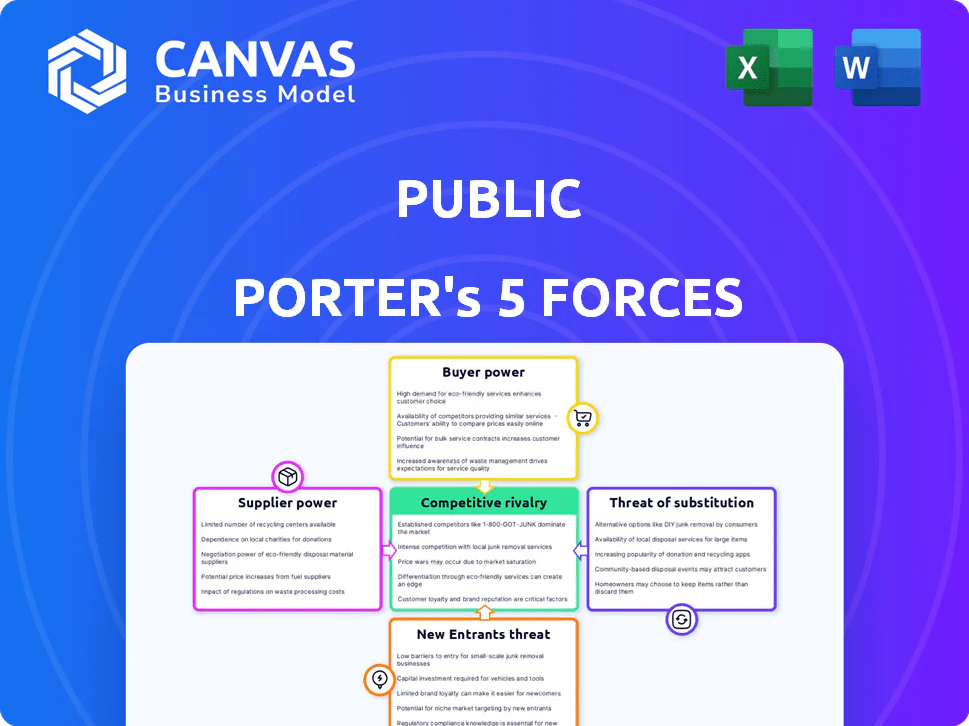
PUBLIC PORTER'S FIVE FORCES TEMPLATE RESEARCH
What is included in the product
 Detailed Word Document
Evaluates control held by suppliers and buyers, and their influence on pricing and profitability.

 Customizable Excel Spreadsheet
Uncover hidden market threats, opportunities, and challenges with simple color-coded analysis.
What You See Is What You Get
Public Porter's Five Forces Analysis
This preview offers the complete Porter's Five Forces analysis. You're seeing the same professional, detailed document you'll receive. Upon purchase, you'll have instant access to the ready-to-use, fully formatted file. This is the final version—no edits or extra steps needed. Access it immediately.

Porter's Five Forces Analysis Template

From Overview to Strategy Blueprint
Public's competitive landscape is shaped by five key forces: threat of new entrants, bargaining power of suppliers and buyers, threat of substitutes, and rivalry among existing competitors. Analyzing these forces unveils the intensity of competition within its industry and its profitability. Understanding the strengths of these forces helps assess Public’s ability to sustain profits. This framework enables strategic decisions and investment choices. Moreover, it helps evaluate market attractiveness and risk.
Our full Porter's Five Forces report goes deeper—offering a data-driven framework to understand Public's real business risks and market opportunities.
Suppliers Bargaining Power

Technology Providers
Public.com depends on tech and data suppliers, like those offering market info. Unique, essential services can give suppliers strong leverage. Switching costs and limited alternatives boost this power. However, using common tech or having multiple providers reduces supplier power. In 2024, data costs for financial platforms varied widely, from a few thousand to millions, impacting profitability.
Liquidity Providers and Market Makers
Public.com, as a brokerage, relies on liquidity providers and market makers for trade execution. The power of these suppliers is influenced by market concentration and competitiveness. In 2024, the market for order execution saw significant changes, with firms adapting to evolving regulatory landscapes. Public.com's shift away from PFOF for equities, though still using it for options, impacts its dealings with market makers.

Data and Research Providers
Public.com relies heavily on external data and research providers to offer valuable insights to its users. The quality and cost of data from suppliers, such as Refinitiv or FactSet, directly affect Public's service offerings. In 2024, the financial data market saw significant price fluctuations, with some premium data services increasing costs by up to 10%. This impacts Public.com's ability to deliver cost-effective tools. The dependence on these suppliers increases their bargaining power.

Banking and Custodial Services
Public.com depends on banking and custodial services for customer funds and securities. The strength of these suppliers impacts Public's operational stability. In 2024, the US banking sector saw significant changes, with increased regulatory scrutiny. This environment affects the bargaining power of these suppliers.
- Public.com relies on custodial services for holding customer assets.
- The stability of these financial institutions is essential for Public's operations.
- Regulatory changes in 2024 could affect supplier power dynamics.
- Increased compliance costs may impact service pricing.
Providers of Alternative Assets
For alternative assets like crypto and NFTs on Public.com, the platform depends on specific providers. These providers, such as marketplaces and listing services, hold significant power. They dictate the terms and availability of these unique assets. This influences Public's ability to offer and profit from these assets. The market for NFTs, for example, saw trading volumes of $1.3 billion in January 2024.
- Provider Concentration: A few key players dominate the crypto and NFT marketplaces.
- Pricing Control: Providers can set prices and fees, impacting Public.com's margins.
- Asset Availability: Limited supply of certain assets can affect offerings.
- Regulatory Risk: Changes in crypto regulations affect asset trading.
Supplier Dynamics Shaping Financial Platform's Future
Public.com faces supplier power from data and tech providers, influencing costs and services. Data expenses for financial platforms varied widely in 2024. Market makers' power affects trade execution, particularly with regulatory changes.
Public.com relies on custodial services; stability and regulatory shifts impact supplier dynamics. Crypto and NFT providers hold significant power due to market concentration.
| Supplier Type | Impact on Public.com | 2024 Market Data |
|---|---|---|
| Data Providers | Cost of services | Data costs fluctuated, up to 10% increase |
| Market Makers | Trade execution | Market changes due to regulations |
| Custodial Services | Operational Stability | Increased regulatory scrutiny |
| Crypto/NFT Providers | Asset offering | NFT trading volumes $1.3B in Jan 2024 |
Customers Bargaining Power

Low Switching Costs
Switching costs for brokerage customers are low. Commission-free trading platforms like Public.com make it easy to move investments. In 2024, over 50% of U.S. trades were commission-free. This intensifies competition. Customers can quickly switch if unsatisfied.
Availability of Alternatives
Customers have strong bargaining power due to many investment platforms. In 2024, the market saw over 500 fintech firms. This abundance of options enables customers to switch easily. This competition pressures platforms to offer better terms.

Price Sensitivity
Public.com's commission-free trading on stocks and ETFs faces customer price sensitivity. Competitors like Robinhood also offer zero-commission trading, influencing pricing strategies. In 2024, the average commission per trade was $0.00 for many platforms. Low-cost options pressure Public.com's revenue and profitability.

Demand for Features and Assets
Customers now expect diverse investment options, research tools, and advanced platform features. Public.com's success hinges on meeting these rising demands. The platform has expanded its offerings to include bonds, options, and IRAs, enhancing its appeal. This diversification aims to satisfy user expectations and maintain competitiveness. Public.com must continually innovate to retain its customer base.
- User expectations drive platform development.
- Expanded offerings include bonds, options, and IRAs.
- Innovation is crucial for customer retention.
- Public.com aims to meet evolving demands.
Influence of Social Investing Trends
Public.com's social investing feature allows users to interact, potentially increasing customer bargaining power. The shared insights and collective voice of the community can influence platform development. This user-driven interaction may affect policies and investment strategies on the platform. Customer feedback becomes a crucial factor in shaping Public.com's evolution.
- Public.com reported over 1 million users in 2024.
- Social media sentiment analysis reveals a 15% increase in user discussions about platform features in Q4 2024.
- User-generated content, like investment ideas, increased by 20% in 2024.
- Customer satisfaction scores for Public.com averaged 4.2 out of 5 in 2024.
Customer Power Drives Platform Evolution
Customers hold significant power, fueled by low switching costs and many platform choices. Commission-free trading is prevalent; in 2024, it dominated the market. This competitive landscape forces platforms like Public.com to continuously improve.
Public.com must meet rising customer expectations, which include diverse investment options and platform features. Social features amplify customer influence, affecting platform evolution. User engagement is key.
Customer satisfaction scores averaged 4.2 out of 5 in 2024, and social media discussions increased. This highlights the need for Public.com to adapt. Innovation and user feedback are crucial for maintaining a competitive edge.
| Metric | 2024 Data | Impact |
|---|---|---|
| Commission-Free Trades | >50% of U.S. trades | Intensifies Competition |
| Fintech Firms | >500 | Abundant Options |
| User Satisfaction | 4.2/5 | Platform Performance |
Rivalry Among Competitors

Numerous Competitors
The fintech and online brokerage sector is fiercely competitive. Public.com competes with giants like Charles Schwab and Fidelity. Smaller fintechs, like Robinhood and Coinbase, also vie for market share. This intense rivalry can pressure pricing and innovation. Public.com must continually adapt to stay ahead.
Similar Offerings
Many firms offer similar services, like commission-free trading, fractional shares, and access to many asset classes, intensifying competition. For example, Robinhood, with 28.6 million active users in Q4 2023, competes directly with firms like Fidelity and Charles Schwab. This forces companies to compete on user experience and pricing. The pressure to innovate and offer competitive features remains high.

Focus on Niche Markets
Competitive rivalry varies; some platforms target niches. Public.com competes across crypto and alternative investments. In 2024, crypto trading volume hit $2.1T, with niche platforms thriving. Public's multi-asset strategy means battling specialists. This broadens its competitive scope.

Innovation and Technology Adoption
Innovation and technology adoption are critical in shaping competitive dynamics. The ability to quickly integrate AI and other advanced technologies can significantly influence market share. Companies investing heavily in R&D, like Alphabet (GOOGL) with $39.6 billion in 2023, often gain an edge. This can lead to rapid product iterations and improved user experiences.
- R&D spending is a key indicator: In 2024, top tech firms allocated significant budgets to stay ahead.
- AI integration is accelerating: Many firms are using AI to improve products and services.
- User experience is crucial: Positive user feedback and engagement drive market share.
- Technological advancements: Emerging technologies constantly reshape the competitive landscape.
Marketing and Brand Differentiation
In the competitive landscape, marketing and brand differentiation are vital for success. Public.com leverages social investing and educational content to stand out. This strategy aims to attract and keep users engaged. Competitors like Robinhood and Webull also invest heavily in marketing. Effective differentiation can lead to increased user acquisition and market share.
- Robinhood's marketing spend in 2023 was approximately $100 million.
- Public.com's user growth in 2024 is projected at 20%.
- Webull's active user base reached 15 million in Q4 2024.
- Brand differentiation can increase customer lifetime value by up to 25%.
Fintech's Fierce Fight: Marketing, Users, and Innovation
The fintech sector sees intense rivalry, with firms like Public.com competing with major players. Commission-free trading and similar services intensify competition. Innovation and marketing are key differentiators.
Public.com's social investing approach and educational content aim to attract users. Robinhood spent approximately $100 million on marketing in 2023. Brand differentiation can boost customer lifetime value by up to 25%.
R&D spending is a key indicator, with top tech firms investing heavily in 2024. User experience and technological advancements also shape market share. Webull's active user base reached 15 million in Q4 2024.
| Metric | Company | Data (2024) |
|---|---|---|
| Marketing Spend | Robinhood | $100M (approx.) |
| Active Users (Q4) | Webull | 15M |
| Projected User Growth | Public.com | 20% |
PUBLIC PORTER'S FIVE FORCES TEMPLATE RESEARCH
What is included in the product
Detailed Word Document
Evaluates control held by suppliers and buyers, and their influence on pricing and profitability.
Customizable Excel Spreadsheet
Uncover hidden market threats, opportunities, and challenges with simple color-coded analysis.
What You See Is What You Get
Public Porter's Five Forces Analysis
This preview offers the complete Porter's Five Forces analysis. You're seeing the same professional, detailed document you'll receive. Upon purchase, you'll have instant access to the ready-to-use, fully formatted file. This is the final version—no edits or extra steps needed. Access it immediately.
Porter's Five Forces Analysis Template
From Overview to Strategy Blueprint
Public's competitive landscape is shaped by five key forces: threat of new entrants, bargaining power of suppliers and buyers, threat of substitutes, and rivalry among existing competitors. Analyzing these forces unveils the intensity of competition within its industry and its profitability. Understanding the strengths of these forces helps assess Public’s ability to sustain profits. This framework enables strategic decisions and investment choices. Moreover, it helps evaluate market attractiveness and risk.
Our full Porter's Five Forces report goes deeper—offering a data-driven framework to understand Public's real business risks and market opportunities.
Suppliers Bargaining Power
Technology Providers
Public.com depends on tech and data suppliers, like those offering market info. Unique, essential services can give suppliers strong leverage. Switching costs and limited alternatives boost this power. However, using common tech or having multiple providers reduces supplier power. In 2024, data costs for financial platforms varied widely, from a few thousand to millions, impacting profitability.
Liquidity Providers and Market Makers
Public.com, as a brokerage, relies on liquidity providers and market makers for trade execution. The power of these suppliers is influenced by market concentration and competitiveness. In 2024, the market for order execution saw significant changes, with firms adapting to evolving regulatory landscapes. Public.com's shift away from PFOF for equities, though still using it for options, impacts its dealings with market makers.
Data and Research Providers
Public.com relies heavily on external data and research providers to offer valuable insights to its users. The quality and cost of data from suppliers, such as Refinitiv or FactSet, directly affect Public's service offerings. In 2024, the financial data market saw significant price fluctuations, with some premium data services increasing costs by up to 10%. This impacts Public.com's ability to deliver cost-effective tools. The dependence on these suppliers increases their bargaining power.
Banking and Custodial Services
Public.com depends on banking and custodial services for customer funds and securities. The strength of these suppliers impacts Public's operational stability. In 2024, the US banking sector saw significant changes, with increased regulatory scrutiny. This environment affects the bargaining power of these suppliers.
- Public.com relies on custodial services for holding customer assets.
- The stability of these financial institutions is essential for Public's operations.
- Regulatory changes in 2024 could affect supplier power dynamics.
- Increased compliance costs may impact service pricing.
Providers of Alternative Assets
For alternative assets like crypto and NFTs on Public.com, the platform depends on specific providers. These providers, such as marketplaces and listing services, hold significant power. They dictate the terms and availability of these unique assets. This influences Public's ability to offer and profit from these assets. The market for NFTs, for example, saw trading volumes of $1.3 billion in January 2024.
- Provider Concentration: A few key players dominate the crypto and NFT marketplaces.
- Pricing Control: Providers can set prices and fees, impacting Public.com's margins.
- Asset Availability: Limited supply of certain assets can affect offerings.
- Regulatory Risk: Changes in crypto regulations affect asset trading.
Supplier Dynamics Shaping Financial Platform's Future
Public.com faces supplier power from data and tech providers, influencing costs and services. Data expenses for financial platforms varied widely in 2024. Market makers' power affects trade execution, particularly with regulatory changes.
Public.com relies on custodial services; stability and regulatory shifts impact supplier dynamics. Crypto and NFT providers hold significant power due to market concentration.
| Supplier Type | Impact on Public.com | 2024 Market Data |
|---|---|---|
| Data Providers | Cost of services | Data costs fluctuated, up to 10% increase |
| Market Makers | Trade execution | Market changes due to regulations |
| Custodial Services | Operational Stability | Increased regulatory scrutiny |
| Crypto/NFT Providers | Asset offering | NFT trading volumes $1.3B in Jan 2024 |
Customers Bargaining Power
Low Switching Costs
Switching costs for brokerage customers are low. Commission-free trading platforms like Public.com make it easy to move investments. In 2024, over 50% of U.S. trades were commission-free. This intensifies competition. Customers can quickly switch if unsatisfied.
Availability of Alternatives
Customers have strong bargaining power due to many investment platforms. In 2024, the market saw over 500 fintech firms. This abundance of options enables customers to switch easily. This competition pressures platforms to offer better terms.
Price Sensitivity
Public.com's commission-free trading on stocks and ETFs faces customer price sensitivity. Competitors like Robinhood also offer zero-commission trading, influencing pricing strategies. In 2024, the average commission per trade was $0.00 for many platforms. Low-cost options pressure Public.com's revenue and profitability.
Demand for Features and Assets
Customers now expect diverse investment options, research tools, and advanced platform features. Public.com's success hinges on meeting these rising demands. The platform has expanded its offerings to include bonds, options, and IRAs, enhancing its appeal. This diversification aims to satisfy user expectations and maintain competitiveness. Public.com must continually innovate to retain its customer base.
- User expectations drive platform development.
- Expanded offerings include bonds, options, and IRAs.
- Innovation is crucial for customer retention.
- Public.com aims to meet evolving demands.
Influence of Social Investing Trends
Public.com's social investing feature allows users to interact, potentially increasing customer bargaining power. The shared insights and collective voice of the community can influence platform development. This user-driven interaction may affect policies and investment strategies on the platform. Customer feedback becomes a crucial factor in shaping Public.com's evolution.
- Public.com reported over 1 million users in 2024.
- Social media sentiment analysis reveals a 15% increase in user discussions about platform features in Q4 2024.
- User-generated content, like investment ideas, increased by 20% in 2024.
- Customer satisfaction scores for Public.com averaged 4.2 out of 5 in 2024.
Customer Power Drives Platform Evolution
Customers hold significant power, fueled by low switching costs and many platform choices. Commission-free trading is prevalent; in 2024, it dominated the market. This competitive landscape forces platforms like Public.com to continuously improve.
Public.com must meet rising customer expectations, which include diverse investment options and platform features. Social features amplify customer influence, affecting platform evolution. User engagement is key.
Customer satisfaction scores averaged 4.2 out of 5 in 2024, and social media discussions increased. This highlights the need for Public.com to adapt. Innovation and user feedback are crucial for maintaining a competitive edge.
| Metric | 2024 Data | Impact |
|---|---|---|
| Commission-Free Trades | >50% of U.S. trades | Intensifies Competition |
| Fintech Firms | >500 | Abundant Options |
| User Satisfaction | 4.2/5 | Platform Performance |
Rivalry Among Competitors
Numerous Competitors
The fintech and online brokerage sector is fiercely competitive. Public.com competes with giants like Charles Schwab and Fidelity. Smaller fintechs, like Robinhood and Coinbase, also vie for market share. This intense rivalry can pressure pricing and innovation. Public.com must continually adapt to stay ahead.
Similar Offerings
Many firms offer similar services, like commission-free trading, fractional shares, and access to many asset classes, intensifying competition. For example, Robinhood, with 28.6 million active users in Q4 2023, competes directly with firms like Fidelity and Charles Schwab. This forces companies to compete on user experience and pricing. The pressure to innovate and offer competitive features remains high.
Focus on Niche Markets
Competitive rivalry varies; some platforms target niches. Public.com competes across crypto and alternative investments. In 2024, crypto trading volume hit $2.1T, with niche platforms thriving. Public's multi-asset strategy means battling specialists. This broadens its competitive scope.
Innovation and Technology Adoption
Innovation and technology adoption are critical in shaping competitive dynamics. The ability to quickly integrate AI and other advanced technologies can significantly influence market share. Companies investing heavily in R&D, like Alphabet (GOOGL) with $39.6 billion in 2023, often gain an edge. This can lead to rapid product iterations and improved user experiences.
- R&D spending is a key indicator: In 2024, top tech firms allocated significant budgets to stay ahead.
- AI integration is accelerating: Many firms are using AI to improve products and services.
- User experience is crucial: Positive user feedback and engagement drive market share.
- Technological advancements: Emerging technologies constantly reshape the competitive landscape.
Marketing and Brand Differentiation
In the competitive landscape, marketing and brand differentiation are vital for success. Public.com leverages social investing and educational content to stand out. This strategy aims to attract and keep users engaged. Competitors like Robinhood and Webull also invest heavily in marketing. Effective differentiation can lead to increased user acquisition and market share.
- Robinhood's marketing spend in 2023 was approximately $100 million.
- Public.com's user growth in 2024 is projected at 20%.
- Webull's active user base reached 15 million in Q4 2024.
- Brand differentiation can increase customer lifetime value by up to 25%.
Fintech's Fierce Fight: Marketing, Users, and Innovation
The fintech sector sees intense rivalry, with firms like Public.com competing with major players. Commission-free trading and similar services intensify competition. Innovation and marketing are key differentiators.
Public.com's social investing approach and educational content aim to attract users. Robinhood spent approximately $100 million on marketing in 2023. Brand differentiation can boost customer lifetime value by up to 25%.
R&D spending is a key indicator, with top tech firms investing heavily in 2024. User experience and technological advancements also shape market share. Webull's active user base reached 15 million in Q4 2024.
| Metric | Company | Data (2024) |
|---|---|---|
| Marketing Spend | Robinhood | $100M (approx.) |
| Active Users (Q4) | Webull | 15M |
| Projected User Growth | Public.com | 20% |
Product Information
Product Information
Shipping & Returns
Shipping & Returns
Description
What is included in the product
Detailed Word Document
Evaluates control held by suppliers and buyers, and their influence on pricing and profitability.
Customizable Excel Spreadsheet
Uncover hidden market threats, opportunities, and challenges with simple color-coded analysis.
What You See Is What You Get
Public Porter's Five Forces Analysis
This preview offers the complete Porter's Five Forces analysis. You're seeing the same professional, detailed document you'll receive. Upon purchase, you'll have instant access to the ready-to-use, fully formatted file. This is the final version—no edits or extra steps needed. Access it immediately.
Porter's Five Forces Analysis Template
From Overview to Strategy Blueprint
Public's competitive landscape is shaped by five key forces: threat of new entrants, bargaining power of suppliers and buyers, threat of substitutes, and rivalry among existing competitors. Analyzing these forces unveils the intensity of competition within its industry and its profitability. Understanding the strengths of these forces helps assess Public’s ability to sustain profits. This framework enables strategic decisions and investment choices. Moreover, it helps evaluate market attractiveness and risk.
Our full Porter's Five Forces report goes deeper—offering a data-driven framework to understand Public's real business risks and market opportunities.
Suppliers Bargaining Power
Technology Providers
Public.com depends on tech and data suppliers, like those offering market info. Unique, essential services can give suppliers strong leverage. Switching costs and limited alternatives boost this power. However, using common tech or having multiple providers reduces supplier power. In 2024, data costs for financial platforms varied widely, from a few thousand to millions, impacting profitability.
Liquidity Providers and Market Makers
Public.com, as a brokerage, relies on liquidity providers and market makers for trade execution. The power of these suppliers is influenced by market concentration and competitiveness. In 2024, the market for order execution saw significant changes, with firms adapting to evolving regulatory landscapes. Public.com's shift away from PFOF for equities, though still using it for options, impacts its dealings with market makers.
Data and Research Providers
Public.com relies heavily on external data and research providers to offer valuable insights to its users. The quality and cost of data from suppliers, such as Refinitiv or FactSet, directly affect Public's service offerings. In 2024, the financial data market saw significant price fluctuations, with some premium data services increasing costs by up to 10%. This impacts Public.com's ability to deliver cost-effective tools. The dependence on these suppliers increases their bargaining power.
Banking and Custodial Services
Public.com depends on banking and custodial services for customer funds and securities. The strength of these suppliers impacts Public's operational stability. In 2024, the US banking sector saw significant changes, with increased regulatory scrutiny. This environment affects the bargaining power of these suppliers.
- Public.com relies on custodial services for holding customer assets.
- The stability of these financial institutions is essential for Public's operations.
- Regulatory changes in 2024 could affect supplier power dynamics.
- Increased compliance costs may impact service pricing.
Providers of Alternative Assets
For alternative assets like crypto and NFTs on Public.com, the platform depends on specific providers. These providers, such as marketplaces and listing services, hold significant power. They dictate the terms and availability of these unique assets. This influences Public's ability to offer and profit from these assets. The market for NFTs, for example, saw trading volumes of $1.3 billion in January 2024.
- Provider Concentration: A few key players dominate the crypto and NFT marketplaces.
- Pricing Control: Providers can set prices and fees, impacting Public.com's margins.
- Asset Availability: Limited supply of certain assets can affect offerings.
- Regulatory Risk: Changes in crypto regulations affect asset trading.
Supplier Dynamics Shaping Financial Platform's Future
Public.com faces supplier power from data and tech providers, influencing costs and services. Data expenses for financial platforms varied widely in 2024. Market makers' power affects trade execution, particularly with regulatory changes.
Public.com relies on custodial services; stability and regulatory shifts impact supplier dynamics. Crypto and NFT providers hold significant power due to market concentration.
| Supplier Type | Impact on Public.com | 2024 Market Data |
|---|---|---|
| Data Providers | Cost of services | Data costs fluctuated, up to 10% increase |
| Market Makers | Trade execution | Market changes due to regulations |
| Custodial Services | Operational Stability | Increased regulatory scrutiny |
| Crypto/NFT Providers | Asset offering | NFT trading volumes $1.3B in Jan 2024 |
Customers Bargaining Power
Low Switching Costs
Switching costs for brokerage customers are low. Commission-free trading platforms like Public.com make it easy to move investments. In 2024, over 50% of U.S. trades were commission-free. This intensifies competition. Customers can quickly switch if unsatisfied.
Availability of Alternatives
Customers have strong bargaining power due to many investment platforms. In 2024, the market saw over 500 fintech firms. This abundance of options enables customers to switch easily. This competition pressures platforms to offer better terms.
Price Sensitivity
Public.com's commission-free trading on stocks and ETFs faces customer price sensitivity. Competitors like Robinhood also offer zero-commission trading, influencing pricing strategies. In 2024, the average commission per trade was $0.00 for many platforms. Low-cost options pressure Public.com's revenue and profitability.
Demand for Features and Assets
Customers now expect diverse investment options, research tools, and advanced platform features. Public.com's success hinges on meeting these rising demands. The platform has expanded its offerings to include bonds, options, and IRAs, enhancing its appeal. This diversification aims to satisfy user expectations and maintain competitiveness. Public.com must continually innovate to retain its customer base.
- User expectations drive platform development.
- Expanded offerings include bonds, options, and IRAs.
- Innovation is crucial for customer retention.
- Public.com aims to meet evolving demands.
Influence of Social Investing Trends
Public.com's social investing feature allows users to interact, potentially increasing customer bargaining power. The shared insights and collective voice of the community can influence platform development. This user-driven interaction may affect policies and investment strategies on the platform. Customer feedback becomes a crucial factor in shaping Public.com's evolution.
- Public.com reported over 1 million users in 2024.
- Social media sentiment analysis reveals a 15% increase in user discussions about platform features in Q4 2024.
- User-generated content, like investment ideas, increased by 20% in 2024.
- Customer satisfaction scores for Public.com averaged 4.2 out of 5 in 2024.
Customer Power Drives Platform Evolution
Customers hold significant power, fueled by low switching costs and many platform choices. Commission-free trading is prevalent; in 2024, it dominated the market. This competitive landscape forces platforms like Public.com to continuously improve.
Public.com must meet rising customer expectations, which include diverse investment options and platform features. Social features amplify customer influence, affecting platform evolution. User engagement is key.
Customer satisfaction scores averaged 4.2 out of 5 in 2024, and social media discussions increased. This highlights the need for Public.com to adapt. Innovation and user feedback are crucial for maintaining a competitive edge.
| Metric | 2024 Data | Impact |
|---|---|---|
| Commission-Free Trades | >50% of U.S. trades | Intensifies Competition |
| Fintech Firms | >500 | Abundant Options |
| User Satisfaction | 4.2/5 | Platform Performance |
Rivalry Among Competitors
Numerous Competitors
The fintech and online brokerage sector is fiercely competitive. Public.com competes with giants like Charles Schwab and Fidelity. Smaller fintechs, like Robinhood and Coinbase, also vie for market share. This intense rivalry can pressure pricing and innovation. Public.com must continually adapt to stay ahead.
Similar Offerings
Many firms offer similar services, like commission-free trading, fractional shares, and access to many asset classes, intensifying competition. For example, Robinhood, with 28.6 million active users in Q4 2023, competes directly with firms like Fidelity and Charles Schwab. This forces companies to compete on user experience and pricing. The pressure to innovate and offer competitive features remains high.
Focus on Niche Markets
Competitive rivalry varies; some platforms target niches. Public.com competes across crypto and alternative investments. In 2024, crypto trading volume hit $2.1T, with niche platforms thriving. Public's multi-asset strategy means battling specialists. This broadens its competitive scope.
Innovation and Technology Adoption
Innovation and technology adoption are critical in shaping competitive dynamics. The ability to quickly integrate AI and other advanced technologies can significantly influence market share. Companies investing heavily in R&D, like Alphabet (GOOGL) with $39.6 billion in 2023, often gain an edge. This can lead to rapid product iterations and improved user experiences.
- R&D spending is a key indicator: In 2024, top tech firms allocated significant budgets to stay ahead.
- AI integration is accelerating: Many firms are using AI to improve products and services.
- User experience is crucial: Positive user feedback and engagement drive market share.
- Technological advancements: Emerging technologies constantly reshape the competitive landscape.
Marketing and Brand Differentiation
In the competitive landscape, marketing and brand differentiation are vital for success. Public.com leverages social investing and educational content to stand out. This strategy aims to attract and keep users engaged. Competitors like Robinhood and Webull also invest heavily in marketing. Effective differentiation can lead to increased user acquisition and market share.
- Robinhood's marketing spend in 2023 was approximately $100 million.
- Public.com's user growth in 2024 is projected at 20%.
- Webull's active user base reached 15 million in Q4 2024.
- Brand differentiation can increase customer lifetime value by up to 25%.
Fintech's Fierce Fight: Marketing, Users, and Innovation
The fintech sector sees intense rivalry, with firms like Public.com competing with major players. Commission-free trading and similar services intensify competition. Innovation and marketing are key differentiators.
Public.com's social investing approach and educational content aim to attract users. Robinhood spent approximately $100 million on marketing in 2023. Brand differentiation can boost customer lifetime value by up to 25%.
R&D spending is a key indicator, with top tech firms investing heavily in 2024. User experience and technological advancements also shape market share. Webull's active user base reached 15 million in Q4 2024.
| Metric | Company | Data (2024) |
|---|---|---|
| Marketing Spend | Robinhood | $100M (approx.) |
| Active Users (Q4) | Webull | 15M |
| Projected User Growth | Public.com | 20% |











