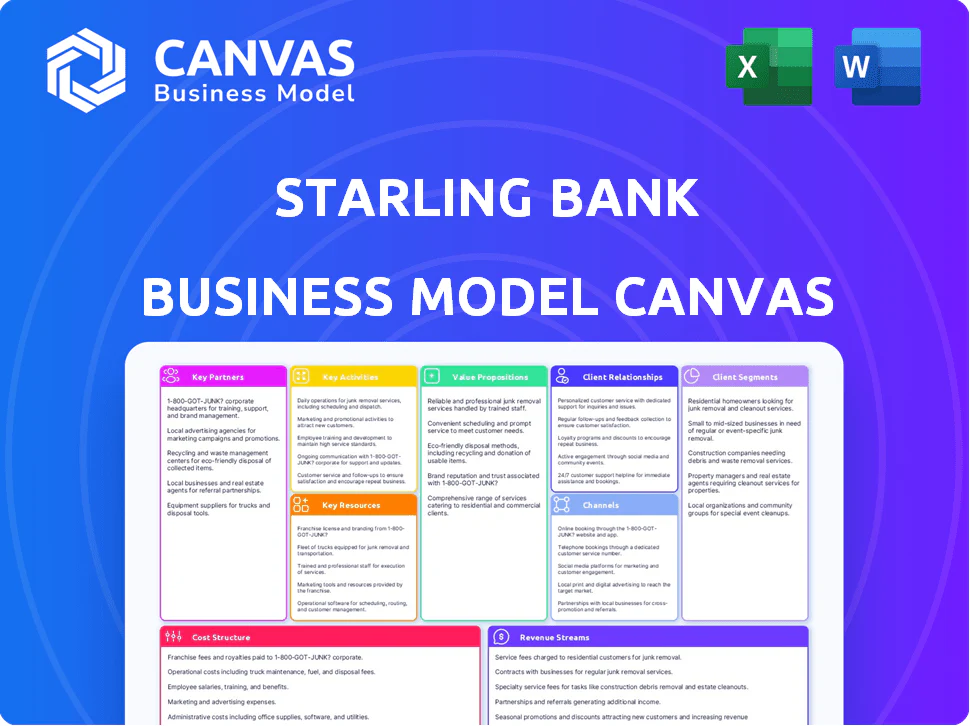
STARLING BANK BUSINESS MODEL CANVAS TEMPLATE RESEARCH

Starling Bank BMC: Customer-led, modular, margin-focused blueprint for investors & founders
Unlock the full Business Model Canvas for Starling Bank-discover how its customer-focused UX, modular partnerships, and lean cost base drive growth and margins; ideal for investors, founders, and strategists seeking a ready-to-use, editable blueprint to benchmark, adapt, and scale.
Partnerships

Engine by Starling Global SaaS Clients
Engine by Starling Global SaaS Clients: Starling Bank pivots to a high-margin tech provider, licensing its cloud-native platform to international banks like Salt Bank and AMP, driving recurring revenue-Engine contracts contributed an estimated £42m revenue in FY2025, boosting SaaS gross margins above 70%.
UK Post Office Branch Network
Despite being digital-first, Starling Bank leverages the UK Post Office's 11,500 branches to enable cash and cheque deposits for personal and business accounts; in FY2025 this partnership handled an estimated 120k SME cash transactions monthly, extending nationwide coverage without branch capex.

Mastercard Global Payment Network
As Starling Bank's primary card issuer and payment processor, Mastercard supplies the global rails that let Starling cards be used at over 90 million merchant locations across 210 countries, enabling cross-border payments that contributed to Starling's £1.1bn payment volume growth in FY2025.
The Mastercard integration delivers real-time transaction data powering instant spending notifications and has reduced card-fraud loss rates for Starling to below 0.03% of transaction volume in 2025 through advanced tokenization and network-level fraud detection.

Financial Services Marketplace Partners
Starling integrates third-party providers like Wealthify, PensionBee, and Churchill Insurance into its app; in FY2025 Starling reported marketplace revenue of £46m, with partner commissions driving ~12% of non-interest income.
This embedded marketplace lets customers manage banking, investing, pensions, and insurance in one interface, boosting retention and average revenue per user (ARPU) to an estimated £78 annually in 2025.
- Marketplace revenue FY2025: £46m
- Partner commissions ≈12% of non-interest income
- ARPU FY2025 ≈ £78/year
- Key partners: Wealthify, PensionBee, Churchill Insurance
British Business Bank and Government Entities
Starling partners with the British Business Bank and HM Treasury-backed schemes, continuing successor programs to the Recovery Loan Scheme, letting Starling lend to SMEs with partial state risk coverage; this support helped Starling reach about 10% of the UK SME banking market by early 2026 and originate roughly £3.2bn in government-backed SME loans in FY2025.
- ~10% UK SME market share (early 2026)
- ~£3.2bn government-backed SME loans (FY2025)
- State risk mitigation lowers loss exposure
Starling partners fuel £4.5bn ecosystem: Engine SaaS, Post Office SME flows, Mastercard scale
Starling's key partners-Engine clients (licenses £42m FY2025), UK Post Office (120k SME cash transactions/month), Mastercard (supporting £1.1bn payment-volume growth FY2025; fraud loss <0.03%), marketplace partners (Wealthify, PensionBee, Churchill; £46m marketplace revenue FY2025; ARPU £78), British Business Bank (≈£3.2bn gov-backed SME loans FY2025).
| Partner | Metric FY2025 |
|---|---|
| Engine (SaaS) | £42m revenue |
| UK Post Office | 120k SME cash tx/month |
| Mastercard | £1.1bn payment growth; fraud <0.03% |
| Marketplace partners | £46m revenue; ARPU £78 |
| British Business Bank | £3.2bn gov-backed SME loans |
What is included in the product
 Detailed Word Document
A focused Business Model Canvas for Starling Bank detailing its digital-first value propositions, customer segments (retail, SMEs, marketplace partners), omni-digital channels, revenue streams (interchange, lending, BaaS), cost structure, key partners and activities, plus SWOT-linked insights for investor presentations and strategic planning.

 Customizable Excel Spreadsheet
High-level, editable Business Model Canvas that distills Starling Bank's digital banking strategy into a one-page tool-ideal for quickly identifying customer pain relievers, revenue streams, and operational efficiencies for team alignment and fast decision-making.
Activities

Proprietary Cloud Platform Development
Starling Bank's proprietary Engine cloud platform, developed in-house, powers rapid feature releases and 99.99% uptime, letting Starling deploy updates weeks faster than legacy banks and achieve a cost-to-serve ~30-40% lower than traditional high-street peers as of FY2025.
Automated Credit Decisioning and Risk Management
Starling Bank uses real-time transaction analytics to automate lending for personal loans and SME lines, approving many applications in minutes versus weeks; in FY2025 this helped grow lending balances to £3.2bn and cut decision times to under 10 minutes on average. This automation supports a FY2025 net interest margin near 2.1% while keeping 90+ DPD (days past due) default rates around 0.6%, sustaining profitability.

Regulatory Compliance and Financial Crime Prevention
As a fully licensed bank, Starling Bank spends heavily on automated AML (anti-money laundering) and KYC (know-your-customer) systems to meet FCA and PRA rules; in FY2025 Starling reported £48m in compliance and technology costs tied to these controls, embedding them in onboarding to keep drop rates under 6%.

Targeted Customer Acquisition and Digital Marketing
Starling Bank grows via high-efficiency digital channels and word-of-mouth, reaching over 4.5 million accounts by 2026 while keeping customer acquisition costs materially below Big Four levels.
Marketing leans on organic growth and data-driven social campaigns-reducing paid media spend; FY2025 metrics show lower CAC versus incumbents and rising share of digitally acquired deposits.
- 4.5M+ accounts by 2026
- Primary channels: app store, referrals, social ads
- Low CAC vs Big Four (FY2025)
- Data-driven targeting increases conversion
- Minimal TV/print spend
SaaS Product Engineering for Engine
Starling Bank now dedicates ~30% of R&D to modularizing its Engine into sellable SaaS, building customizable APIs and country-localized cores to target SME and challenger banks internationally; Engine licenses contributed an estimated £55m revenue in FY2025, signaling a shift toward a hybrid bank-software model.
- ~30% R&D to Engine SaaS
- £55m Engine license revenue (FY2025)
- Custom APIs + localized cores for intl markets
- Targets SMEs, challengers, embedded finance
Starling Engine: 99.99% uptime, £3.2bn loans, £55m SaaS & 4.5M+ accounts by 2026
Starling's Engine drives 99.99% uptime and faster releases; FY2025 lending balances £3.2bn, NIM ~2.1%, defaults 0.6%; compliance/tech costs £48m; Engine SaaS revenue £55m; >4.5M accounts by 2026; ~30% R&D to Engine.
| Metric | FY2025 |
|---|---|
| Uptime | 99.99% |
| Lending balances | £3.2bn |
| NIM | 2.1% |
| Defaults (90+ DPD) | 0.6% |
| Compliance/tech costs | £48m |
| Engine SaaS revenue | £55m |
| Accounts (by 2026) | 4.5M+ |
| R&D to Engine | ~30% |
What You See Is What You Get
Business Model Canvas
The document you're previewing is the exact Starling Bank Business Model Canvas you'll receive-no mockups or samples-so when you purchase, you'll instantly get the same fully formatted, editable file ready for use in presentations and planning.

Original: $10.00
-65%$10.00
$3.50STARLING BANK BUSINESS MODEL CANVAS TEMPLATE RESEARCH
Starling Bank BMC: Customer-led, modular, margin-focused blueprint for investors & founders
Unlock the full Business Model Canvas for Starling Bank-discover how its customer-focused UX, modular partnerships, and lean cost base drive growth and margins; ideal for investors, founders, and strategists seeking a ready-to-use, editable blueprint to benchmark, adapt, and scale.
Partnerships
Engine by Starling Global SaaS Clients
Engine by Starling Global SaaS Clients: Starling Bank pivots to a high-margin tech provider, licensing its cloud-native platform to international banks like Salt Bank and AMP, driving recurring revenue-Engine contracts contributed an estimated £42m revenue in FY2025, boosting SaaS gross margins above 70%.
UK Post Office Branch Network
Despite being digital-first, Starling Bank leverages the UK Post Office's 11,500 branches to enable cash and cheque deposits for personal and business accounts; in FY2025 this partnership handled an estimated 120k SME cash transactions monthly, extending nationwide coverage without branch capex.
Mastercard Global Payment Network
As Starling Bank's primary card issuer and payment processor, Mastercard supplies the global rails that let Starling cards be used at over 90 million merchant locations across 210 countries, enabling cross-border payments that contributed to Starling's £1.1bn payment volume growth in FY2025.
The Mastercard integration delivers real-time transaction data powering instant spending notifications and has reduced card-fraud loss rates for Starling to below 0.03% of transaction volume in 2025 through advanced tokenization and network-level fraud detection.
Financial Services Marketplace Partners
Starling integrates third-party providers like Wealthify, PensionBee, and Churchill Insurance into its app; in FY2025 Starling reported marketplace revenue of £46m, with partner commissions driving ~12% of non-interest income.
This embedded marketplace lets customers manage banking, investing, pensions, and insurance in one interface, boosting retention and average revenue per user (ARPU) to an estimated £78 annually in 2025.
- Marketplace revenue FY2025: £46m
- Partner commissions ≈12% of non-interest income
- ARPU FY2025 ≈ £78/year
- Key partners: Wealthify, PensionBee, Churchill Insurance
British Business Bank and Government Entities
Starling partners with the British Business Bank and HM Treasury-backed schemes, continuing successor programs to the Recovery Loan Scheme, letting Starling lend to SMEs with partial state risk coverage; this support helped Starling reach about 10% of the UK SME banking market by early 2026 and originate roughly £3.2bn in government-backed SME loans in FY2025.
- ~10% UK SME market share (early 2026)
- ~£3.2bn government-backed SME loans (FY2025)
- State risk mitigation lowers loss exposure
Starling partners fuel £4.5bn ecosystem: Engine SaaS, Post Office SME flows, Mastercard scale
Starling's key partners-Engine clients (licenses £42m FY2025), UK Post Office (120k SME cash transactions/month), Mastercard (supporting £1.1bn payment-volume growth FY2025; fraud loss <0.03%), marketplace partners (Wealthify, PensionBee, Churchill; £46m marketplace revenue FY2025; ARPU £78), British Business Bank (≈£3.2bn gov-backed SME loans FY2025).
| Partner | Metric FY2025 |
|---|---|
| Engine (SaaS) | £42m revenue |
| UK Post Office | 120k SME cash tx/month |
| Mastercard | £1.1bn payment growth; fraud <0.03% |
| Marketplace partners | £46m revenue; ARPU £78 |
| British Business Bank | £3.2bn gov-backed SME loans |
What is included in the product
Detailed Word Document
A focused Business Model Canvas for Starling Bank detailing its digital-first value propositions, customer segments (retail, SMEs, marketplace partners), omni-digital channels, revenue streams (interchange, lending, BaaS), cost structure, key partners and activities, plus SWOT-linked insights for investor presentations and strategic planning.
Customizable Excel Spreadsheet
High-level, editable Business Model Canvas that distills Starling Bank's digital banking strategy into a one-page tool-ideal for quickly identifying customer pain relievers, revenue streams, and operational efficiencies for team alignment and fast decision-making.
Activities
Proprietary Cloud Platform Development
Starling Bank's proprietary Engine cloud platform, developed in-house, powers rapid feature releases and 99.99% uptime, letting Starling deploy updates weeks faster than legacy banks and achieve a cost-to-serve ~30-40% lower than traditional high-street peers as of FY2025.
Automated Credit Decisioning and Risk Management
Starling Bank uses real-time transaction analytics to automate lending for personal loans and SME lines, approving many applications in minutes versus weeks; in FY2025 this helped grow lending balances to £3.2bn and cut decision times to under 10 minutes on average. This automation supports a FY2025 net interest margin near 2.1% while keeping 90+ DPD (days past due) default rates around 0.6%, sustaining profitability.
Regulatory Compliance and Financial Crime Prevention
As a fully licensed bank, Starling Bank spends heavily on automated AML (anti-money laundering) and KYC (know-your-customer) systems to meet FCA and PRA rules; in FY2025 Starling reported £48m in compliance and technology costs tied to these controls, embedding them in onboarding to keep drop rates under 6%.
Targeted Customer Acquisition and Digital Marketing
Starling Bank grows via high-efficiency digital channels and word-of-mouth, reaching over 4.5 million accounts by 2026 while keeping customer acquisition costs materially below Big Four levels.
Marketing leans on organic growth and data-driven social campaigns-reducing paid media spend; FY2025 metrics show lower CAC versus incumbents and rising share of digitally acquired deposits.
- 4.5M+ accounts by 2026
- Primary channels: app store, referrals, social ads
- Low CAC vs Big Four (FY2025)
- Data-driven targeting increases conversion
- Minimal TV/print spend
SaaS Product Engineering for Engine
Starling Bank now dedicates ~30% of R&D to modularizing its Engine into sellable SaaS, building customizable APIs and country-localized cores to target SME and challenger banks internationally; Engine licenses contributed an estimated £55m revenue in FY2025, signaling a shift toward a hybrid bank-software model.
- ~30% R&D to Engine SaaS
- £55m Engine license revenue (FY2025)
- Custom APIs + localized cores for intl markets
- Targets SMEs, challengers, embedded finance
Starling Engine: 99.99% uptime, £3.2bn loans, £55m SaaS & 4.5M+ accounts by 2026
Starling's Engine drives 99.99% uptime and faster releases; FY2025 lending balances £3.2bn, NIM ~2.1%, defaults 0.6%; compliance/tech costs £48m; Engine SaaS revenue £55m; >4.5M accounts by 2026; ~30% R&D to Engine.
| Metric | FY2025 |
|---|---|
| Uptime | 99.99% |
| Lending balances | £3.2bn |
| NIM | 2.1% |
| Defaults (90+ DPD) | 0.6% |
| Compliance/tech costs | £48m |
| Engine SaaS revenue | £55m |
| Accounts (by 2026) | 4.5M+ |
| R&D to Engine | ~30% |
What You See Is What You Get
Business Model Canvas
The document you're previewing is the exact Starling Bank Business Model Canvas you'll receive-no mockups or samples-so when you purchase, you'll instantly get the same fully formatted, editable file ready for use in presentations and planning.
Product Information
Product Information
Shipping & Returns
Shipping & Returns
Description
Starling Bank BMC: Customer-led, modular, margin-focused blueprint for investors & founders
Unlock the full Business Model Canvas for Starling Bank-discover how its customer-focused UX, modular partnerships, and lean cost base drive growth and margins; ideal for investors, founders, and strategists seeking a ready-to-use, editable blueprint to benchmark, adapt, and scale.
Partnerships
Engine by Starling Global SaaS Clients
Engine by Starling Global SaaS Clients: Starling Bank pivots to a high-margin tech provider, licensing its cloud-native platform to international banks like Salt Bank and AMP, driving recurring revenue-Engine contracts contributed an estimated £42m revenue in FY2025, boosting SaaS gross margins above 70%.
UK Post Office Branch Network
Despite being digital-first, Starling Bank leverages the UK Post Office's 11,500 branches to enable cash and cheque deposits for personal and business accounts; in FY2025 this partnership handled an estimated 120k SME cash transactions monthly, extending nationwide coverage without branch capex.
Mastercard Global Payment Network
As Starling Bank's primary card issuer and payment processor, Mastercard supplies the global rails that let Starling cards be used at over 90 million merchant locations across 210 countries, enabling cross-border payments that contributed to Starling's £1.1bn payment volume growth in FY2025.
The Mastercard integration delivers real-time transaction data powering instant spending notifications and has reduced card-fraud loss rates for Starling to below 0.03% of transaction volume in 2025 through advanced tokenization and network-level fraud detection.
Financial Services Marketplace Partners
Starling integrates third-party providers like Wealthify, PensionBee, and Churchill Insurance into its app; in FY2025 Starling reported marketplace revenue of £46m, with partner commissions driving ~12% of non-interest income.
This embedded marketplace lets customers manage banking, investing, pensions, and insurance in one interface, boosting retention and average revenue per user (ARPU) to an estimated £78 annually in 2025.
- Marketplace revenue FY2025: £46m
- Partner commissions ≈12% of non-interest income
- ARPU FY2025 ≈ £78/year
- Key partners: Wealthify, PensionBee, Churchill Insurance
British Business Bank and Government Entities
Starling partners with the British Business Bank and HM Treasury-backed schemes, continuing successor programs to the Recovery Loan Scheme, letting Starling lend to SMEs with partial state risk coverage; this support helped Starling reach about 10% of the UK SME banking market by early 2026 and originate roughly £3.2bn in government-backed SME loans in FY2025.
- ~10% UK SME market share (early 2026)
- ~£3.2bn government-backed SME loans (FY2025)
- State risk mitigation lowers loss exposure
Starling partners fuel £4.5bn ecosystem: Engine SaaS, Post Office SME flows, Mastercard scale
Starling's key partners-Engine clients (licenses £42m FY2025), UK Post Office (120k SME cash transactions/month), Mastercard (supporting £1.1bn payment-volume growth FY2025; fraud loss <0.03%), marketplace partners (Wealthify, PensionBee, Churchill; £46m marketplace revenue FY2025; ARPU £78), British Business Bank (≈£3.2bn gov-backed SME loans FY2025).
| Partner | Metric FY2025 |
|---|---|
| Engine (SaaS) | £42m revenue |
| UK Post Office | 120k SME cash tx/month |
| Mastercard | £1.1bn payment growth; fraud <0.03% |
| Marketplace partners | £46m revenue; ARPU £78 |
| British Business Bank | £3.2bn gov-backed SME loans |
What is included in the product
Detailed Word Document
A focused Business Model Canvas for Starling Bank detailing its digital-first value propositions, customer segments (retail, SMEs, marketplace partners), omni-digital channels, revenue streams (interchange, lending, BaaS), cost structure, key partners and activities, plus SWOT-linked insights for investor presentations and strategic planning.
Customizable Excel Spreadsheet
High-level, editable Business Model Canvas that distills Starling Bank's digital banking strategy into a one-page tool-ideal for quickly identifying customer pain relievers, revenue streams, and operational efficiencies for team alignment and fast decision-making.
Activities
Proprietary Cloud Platform Development
Starling Bank's proprietary Engine cloud platform, developed in-house, powers rapid feature releases and 99.99% uptime, letting Starling deploy updates weeks faster than legacy banks and achieve a cost-to-serve ~30-40% lower than traditional high-street peers as of FY2025.
Automated Credit Decisioning and Risk Management
Starling Bank uses real-time transaction analytics to automate lending for personal loans and SME lines, approving many applications in minutes versus weeks; in FY2025 this helped grow lending balances to £3.2bn and cut decision times to under 10 minutes on average. This automation supports a FY2025 net interest margin near 2.1% while keeping 90+ DPD (days past due) default rates around 0.6%, sustaining profitability.
Regulatory Compliance and Financial Crime Prevention
As a fully licensed bank, Starling Bank spends heavily on automated AML (anti-money laundering) and KYC (know-your-customer) systems to meet FCA and PRA rules; in FY2025 Starling reported £48m in compliance and technology costs tied to these controls, embedding them in onboarding to keep drop rates under 6%.
Targeted Customer Acquisition and Digital Marketing
Starling Bank grows via high-efficiency digital channels and word-of-mouth, reaching over 4.5 million accounts by 2026 while keeping customer acquisition costs materially below Big Four levels.
Marketing leans on organic growth and data-driven social campaigns-reducing paid media spend; FY2025 metrics show lower CAC versus incumbents and rising share of digitally acquired deposits.
- 4.5M+ accounts by 2026
- Primary channels: app store, referrals, social ads
- Low CAC vs Big Four (FY2025)
- Data-driven targeting increases conversion
- Minimal TV/print spend
SaaS Product Engineering for Engine
Starling Bank now dedicates ~30% of R&D to modularizing its Engine into sellable SaaS, building customizable APIs and country-localized cores to target SME and challenger banks internationally; Engine licenses contributed an estimated £55m revenue in FY2025, signaling a shift toward a hybrid bank-software model.
- ~30% R&D to Engine SaaS
- £55m Engine license revenue (FY2025)
- Custom APIs + localized cores for intl markets
- Targets SMEs, challengers, embedded finance
Starling Engine: 99.99% uptime, £3.2bn loans, £55m SaaS & 4.5M+ accounts by 2026
Starling's Engine drives 99.99% uptime and faster releases; FY2025 lending balances £3.2bn, NIM ~2.1%, defaults 0.6%; compliance/tech costs £48m; Engine SaaS revenue £55m; >4.5M accounts by 2026; ~30% R&D to Engine.
| Metric | FY2025 |
|---|---|
| Uptime | 99.99% |
| Lending balances | £3.2bn |
| NIM | 2.1% |
| Defaults (90+ DPD) | 0.6% |
| Compliance/tech costs | £48m |
| Engine SaaS revenue | £55m |
| Accounts (by 2026) | 4.5M+ |
| R&D to Engine | ~30% |
What You See Is What You Get
Business Model Canvas
The document you're previewing is the exact Starling Bank Business Model Canvas you'll receive-no mockups or samples-so when you purchase, you'll instantly get the same fully formatted, editable file ready for use in presentations and planning.











