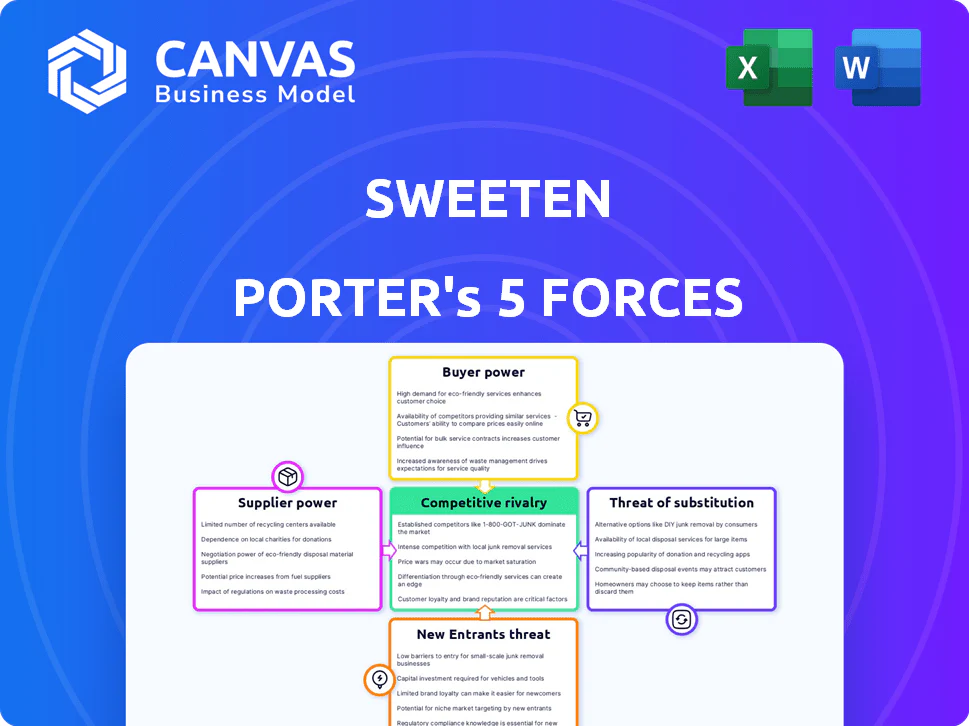
SWEETEN PORTER'S FIVE FORCES TEMPLATE RESEARCH
What is included in the product
 Detailed Word Document
Analyzes Sweeten's position by examining competition, buyer/supplier power, threats, and entry barriers.

 Customizable Excel Spreadsheet
Analyze industry forces faster with automated formulas and color-coded risk levels.
Preview the Actual Deliverable
Sweeten Porter's Five Forces Analysis
You are previewing the full Sweeten Porter's Five Forces analysis. The content shown reflects the same professional document you'll receive after purchase, fully prepared. It includes detailed explanations of each force, industry specific insights. This ready-to-use file is the exact deliverable. Get it instantly!

Porter's Five Forces Analysis Template

Don't Miss the Bigger Picture
Sweeten's industry faces evolving dynamics, assessed through Porter's Five Forces. Buyer power, supplier influence, and competitive rivalry all impact profitability. The threat of substitutes and new entrants also shape the competitive landscape. Understanding these forces is key to strategy and investment. This brief snapshot only scratches the surface. Unlock the full Porter's Five Forces Analysis to explore Sweeten’s competitive dynamics, market pressures, and strategic advantages in detail.
Suppliers Bargaining Power

Dependence on quality contractors
Sweeten's platform is built on a foundation of dependable contractors. The caliber of these contractors is crucial for the services provided to homeowners. A scarcity of top-tier contractors in specific regions or specialties could strengthen their negotiating position. This might translate to higher expenses or more stringent partnership conditions for Sweeten. For instance, in 2024, areas with high construction demand saw contractor rates increase by up to 10%.
Availability of skilled labor
The construction industry, and Sweeten by extension, faces supplier power due to skilled labor availability. Labor shortages, especially in specialized trades, enhance contractors' leverage. In 2024, construction labor costs rose, impacting project pricing. This can lead to contractors dictating terms, reducing Sweeten's control.

Contractor acquisition and retention costs
Sweeten's ability to attract and keep skilled contractors impacts its value. Marketing, vetting, and project flow expenses affect Sweeten's costs. High contractor acquisition costs boost the bargaining power of sought-after contractors. Consider that construction labor costs rose in 2024. According to the Associated General Contractors of America, these costs are up by 6.3% year-over-year.

Differentiation of contractors
Sweeten faces supplier power from contractors, despite vetting. Contractor expertise, reputation, and pricing vary, influencing bargaining power. Specialized contractors, like those for high-end renovations, may command better terms. Sweeten mitigates this by offering diverse, vetted contractor options. For example, the average cost for a kitchen remodel in 2024 was around $25,000, highlighting the impact of specialized skills.
- Contractor Specialization: Drives bargaining power.
- Pricing Variance: Impacts project costs.
- Sweeten's Role: Provides contractor diversity.
- Market Dynamics: Influences contractor demand.
Sweeten's vetting process and standards
Sweeten's vetting process is crucial. It sets standards for contractors joining the platform, influencing supplier selection. This process gives Sweeten leverage by ensuring quality and professionalism, impacting project outcomes. This control is vital in managing supplier relationships effectively. For 2024, the home renovation market in the U.S. is estimated at $450 billion.
- Vetting Process: Ensures contractor quality and professionalism.
- Supplier Selection: Influences which contractors can join Sweeten.
- Market Impact: Leverages in the home renovation market.
- 2024 Market: US home renovation market estimated at $450 billion.
Contractor Dynamics: Costs & Market Trends
Sweeten's contractor relationships are key to its business, with supplier power influenced by contractor specialization and market demand. Skilled contractors can command better terms, affecting project costs. Sweeten's vetting process and diverse contractor options help manage these dynamics.
| Factor | Impact | 2024 Data |
|---|---|---|
| Contractor Specialization | Increases bargaining power | Specialized labor costs up 6.3% YoY |
| Market Demand | Influences project pricing | US home renovation market: $450B |
| Sweeten's Vetting | Ensures quality | Average kitchen remodel cost: $25,000 |
Customers Bargaining Power

Availability of alternative platforms and methods
Homeowners can find contractors via multiple platforms, like Angi or Thumbtack, or through referrals. The availability of these alternatives directly affects their bargaining power. If Sweeten doesn't offer a superior experience, customers can easily switch. In 2024, the home renovation market was estimated at $500 billion. Homeowners' leverage is high if Sweeten's value proposition is weak.
Information asymmetry and transparency
Sweeten boosts homeowner power by reducing information gaps. Its tools offer transparency, like contractor reviews. This builds customer bargaining power, giving them more leverage. In 2024, the construction industry faced $1.9 trillion in spending, highlighting the stakes. Sweeten's approach helps homeowners navigate this market with greater control.

Project size and complexity
The scale and intricacy of a renovation project influence customer bargaining power. Larger, complex projects grant homeowners more leverage due to their revenue potential. Sweeten's platform manages diverse project sizes, potentially varying customer power. In 2024, the average renovation cost was $20,000-$75,000, influencing negotiation dynamics.

Economic conditions affecting homeowner spending
Economic conditions significantly influence homeowner spending, thereby affecting the bargaining power of customers. High interest rates and inflation, as seen in 2024, can make homeowners more cautious about renovation spending. This economic pressure increases their bargaining power, leading them to seek lower prices or delay projects.
- Interest rates in 2024 averaged around 7% for a 30-year fixed mortgage, impacting homeowner affordability.
- Inflation rates, though moderating, remained above the Federal Reserve's 2% target, influencing spending decisions.
- Homeowners might delay projects, leading to a potential decrease in the renovation market size.
Sweeten's ability to provide value-added services
Sweeten's value-added services, like bid leveling and project management, impact customer bargaining power. These services enhance the overall value proposition. Homeowners who highly value these extras are less inclined to aggressively negotiate prices. This reduces their bargaining strength, as the comprehensive service package justifies the cost.
- Sweeten provides project management assistance, which can increase project success rates by up to 15%.
- Bid leveling services can save homeowners an average of 8% on project costs by ensuring fair comparisons.
- Customer satisfaction scores for projects using Sweeten's services are typically 20% higher.
- In 2024, the home renovation market in the US is estimated at $450 billion.
Homeowners' Renovation Power: Navigating the Market
Homeowners have strong bargaining power, influenced by market options and economic factors. Platforms like Angi and Thumbtack offer alternatives, impacting Sweeten's competitive edge. In 2024, the home renovation market faced economic pressures, increasing homeowner caution.
Sweeten's value-added services, such as bid leveling, impact customer negotiation dynamics. These services reduce homeowner bargaining power by justifying costs. Project management assistance from Sweeten can boost project success by up to 15%.
Customer bargaining power varies with project scale and complexity. Larger projects give homeowners more leverage. The average renovation cost in 2024 ranged from $20,000 to $75,000.
| Factor | Impact on Bargaining Power | 2024 Data |
|---|---|---|
| Market Alternatives | High if many options | $500B home renovation market |
| Economic Conditions | High during economic downturns | 7% average mortgage rates |
| Sweeten's Services | Reduced with added value | 8% average savings on bid leveling |
Rivalry Among Competitors

Number and size of competitors
The online home improvement market features several competitors, including startups and established firms. This crowded field, with players like HomeAdvisor and Houzz, intensifies competition. In 2024, HomeAdvisor's revenue was around $600 million, reflecting the market's size. The presence of well-funded companies suggests strong rivalry.
Differentiation of services
Sweeten faces rivalry from competitors offering similar services, like contractor matching and project management tools. The intensity of competition hinges on how well services are differentiated. Sweeten distinguishes itself through vetted contractors. In 2024, the home renovation market hit $500 billion, intensifying the rivalry.

Market growth rate
The home renovation market is currently experiencing consistent growth, with a projected value of $500 billion in 2024. Initially, a growing market can ease rivalry. However, this attracts new entrants, potentially intensifying competition. For example, the number of renovation-related businesses increased by 8% in the last year.

Switching costs for customers and contractors
Switching costs within the home renovation market are relatively low. Homeowners can easily explore different platforms or methods to find contractors. Contractors often join multiple platforms to secure more projects. This ease of switching intensifies competition among platforms like Sweeten and their rivals.
- HomeAdvisor saw 28.1 million average monthly unique users in Q4 2023.
- Angi had 15.2 million average monthly unique users in Q4 2023.
- The market size of the U.S. home services industry was $600 billion in 2023.
Brand reputation and trust
In the home renovation industry, where projects are high-stakes, brand reputation and trust form the backbone of competitive advantage. Sweeten's focus on vetting contractors directly addresses this, aiming to build homeowner confidence. Competitors with established reputations, like larger national firms, present a considerable challenge to Sweeten's growth. Maintaining a trusted brand is vital in this market, where word-of-mouth and online reviews significantly influence consumer choices.
- HomeAdvisor reported over 70% of homeowners start their renovation search online.
- Angie's List, another competitor, has millions of user reviews.
- Sweeten's growth relies heavily on positive customer experiences.
- Building trust often involves ensuring project transparency and contractor reliability.
Home Renovation: $500B Market, Fierce Competition!
Competitive rivalry in the home renovation market is intense due to numerous players and low switching costs. The market's $500 billion value in 2024 attracts new entrants, increasing competition. Brand reputation and trust are crucial, as seen with HomeAdvisor's 28.1 million users in Q4 2023.
| Aspect | Details | Impact |
|---|---|---|
| Market Size (2024) | $500 billion | Attracts Competitors |
| Switching Costs | Relatively Low | Intensifies Rivalry |
| HomeAdvisor Users (Q4 2023) | 28.1 million | Highlights Brand Importance |
SWEETEN PORTER'S FIVE FORCES TEMPLATE RESEARCH
What is included in the product
Detailed Word Document
Analyzes Sweeten's position by examining competition, buyer/supplier power, threats, and entry barriers.
Customizable Excel Spreadsheet
Analyze industry forces faster with automated formulas and color-coded risk levels.
Preview the Actual Deliverable
Sweeten Porter's Five Forces Analysis
You are previewing the full Sweeten Porter's Five Forces analysis. The content shown reflects the same professional document you'll receive after purchase, fully prepared. It includes detailed explanations of each force, industry specific insights. This ready-to-use file is the exact deliverable. Get it instantly!
Porter's Five Forces Analysis Template
Don't Miss the Bigger Picture
Sweeten's industry faces evolving dynamics, assessed through Porter's Five Forces. Buyer power, supplier influence, and competitive rivalry all impact profitability. The threat of substitutes and new entrants also shape the competitive landscape. Understanding these forces is key to strategy and investment. This brief snapshot only scratches the surface. Unlock the full Porter's Five Forces Analysis to explore Sweeten’s competitive dynamics, market pressures, and strategic advantages in detail.
Suppliers Bargaining Power
Dependence on quality contractors
Sweeten's platform is built on a foundation of dependable contractors. The caliber of these contractors is crucial for the services provided to homeowners. A scarcity of top-tier contractors in specific regions or specialties could strengthen their negotiating position. This might translate to higher expenses or more stringent partnership conditions for Sweeten. For instance, in 2024, areas with high construction demand saw contractor rates increase by up to 10%.
Availability of skilled labor
The construction industry, and Sweeten by extension, faces supplier power due to skilled labor availability. Labor shortages, especially in specialized trades, enhance contractors' leverage. In 2024, construction labor costs rose, impacting project pricing. This can lead to contractors dictating terms, reducing Sweeten's control.
Contractor acquisition and retention costs
Sweeten's ability to attract and keep skilled contractors impacts its value. Marketing, vetting, and project flow expenses affect Sweeten's costs. High contractor acquisition costs boost the bargaining power of sought-after contractors. Consider that construction labor costs rose in 2024. According to the Associated General Contractors of America, these costs are up by 6.3% year-over-year.
Differentiation of contractors
Sweeten faces supplier power from contractors, despite vetting. Contractor expertise, reputation, and pricing vary, influencing bargaining power. Specialized contractors, like those for high-end renovations, may command better terms. Sweeten mitigates this by offering diverse, vetted contractor options. For example, the average cost for a kitchen remodel in 2024 was around $25,000, highlighting the impact of specialized skills.
- Contractor Specialization: Drives bargaining power.
- Pricing Variance: Impacts project costs.
- Sweeten's Role: Provides contractor diversity.
- Market Dynamics: Influences contractor demand.
Sweeten's vetting process and standards
Sweeten's vetting process is crucial. It sets standards for contractors joining the platform, influencing supplier selection. This process gives Sweeten leverage by ensuring quality and professionalism, impacting project outcomes. This control is vital in managing supplier relationships effectively. For 2024, the home renovation market in the U.S. is estimated at $450 billion.
- Vetting Process: Ensures contractor quality and professionalism.
- Supplier Selection: Influences which contractors can join Sweeten.
- Market Impact: Leverages in the home renovation market.
- 2024 Market: US home renovation market estimated at $450 billion.
Contractor Dynamics: Costs & Market Trends
Sweeten's contractor relationships are key to its business, with supplier power influenced by contractor specialization and market demand. Skilled contractors can command better terms, affecting project costs. Sweeten's vetting process and diverse contractor options help manage these dynamics.
| Factor | Impact | 2024 Data |
|---|---|---|
| Contractor Specialization | Increases bargaining power | Specialized labor costs up 6.3% YoY |
| Market Demand | Influences project pricing | US home renovation market: $450B |
| Sweeten's Vetting | Ensures quality | Average kitchen remodel cost: $25,000 |
Customers Bargaining Power
Availability of alternative platforms and methods
Homeowners can find contractors via multiple platforms, like Angi or Thumbtack, or through referrals. The availability of these alternatives directly affects their bargaining power. If Sweeten doesn't offer a superior experience, customers can easily switch. In 2024, the home renovation market was estimated at $500 billion. Homeowners' leverage is high if Sweeten's value proposition is weak.
Information asymmetry and transparency
Sweeten boosts homeowner power by reducing information gaps. Its tools offer transparency, like contractor reviews. This builds customer bargaining power, giving them more leverage. In 2024, the construction industry faced $1.9 trillion in spending, highlighting the stakes. Sweeten's approach helps homeowners navigate this market with greater control.
Project size and complexity
The scale and intricacy of a renovation project influence customer bargaining power. Larger, complex projects grant homeowners more leverage due to their revenue potential. Sweeten's platform manages diverse project sizes, potentially varying customer power. In 2024, the average renovation cost was $20,000-$75,000, influencing negotiation dynamics.
Economic conditions affecting homeowner spending
Economic conditions significantly influence homeowner spending, thereby affecting the bargaining power of customers. High interest rates and inflation, as seen in 2024, can make homeowners more cautious about renovation spending. This economic pressure increases their bargaining power, leading them to seek lower prices or delay projects.
- Interest rates in 2024 averaged around 7% for a 30-year fixed mortgage, impacting homeowner affordability.
- Inflation rates, though moderating, remained above the Federal Reserve's 2% target, influencing spending decisions.
- Homeowners might delay projects, leading to a potential decrease in the renovation market size.
Sweeten's ability to provide value-added services
Sweeten's value-added services, like bid leveling and project management, impact customer bargaining power. These services enhance the overall value proposition. Homeowners who highly value these extras are less inclined to aggressively negotiate prices. This reduces their bargaining strength, as the comprehensive service package justifies the cost.
- Sweeten provides project management assistance, which can increase project success rates by up to 15%.
- Bid leveling services can save homeowners an average of 8% on project costs by ensuring fair comparisons.
- Customer satisfaction scores for projects using Sweeten's services are typically 20% higher.
- In 2024, the home renovation market in the US is estimated at $450 billion.
Homeowners' Renovation Power: Navigating the Market
Homeowners have strong bargaining power, influenced by market options and economic factors. Platforms like Angi and Thumbtack offer alternatives, impacting Sweeten's competitive edge. In 2024, the home renovation market faced economic pressures, increasing homeowner caution.
Sweeten's value-added services, such as bid leveling, impact customer negotiation dynamics. These services reduce homeowner bargaining power by justifying costs. Project management assistance from Sweeten can boost project success by up to 15%.
Customer bargaining power varies with project scale and complexity. Larger projects give homeowners more leverage. The average renovation cost in 2024 ranged from $20,000 to $75,000.
| Factor | Impact on Bargaining Power | 2024 Data |
|---|---|---|
| Market Alternatives | High if many options | $500B home renovation market |
| Economic Conditions | High during economic downturns | 7% average mortgage rates |
| Sweeten's Services | Reduced with added value | 8% average savings on bid leveling |
Rivalry Among Competitors
Number and size of competitors
The online home improvement market features several competitors, including startups and established firms. This crowded field, with players like HomeAdvisor and Houzz, intensifies competition. In 2024, HomeAdvisor's revenue was around $600 million, reflecting the market's size. The presence of well-funded companies suggests strong rivalry.
Differentiation of services
Sweeten faces rivalry from competitors offering similar services, like contractor matching and project management tools. The intensity of competition hinges on how well services are differentiated. Sweeten distinguishes itself through vetted contractors. In 2024, the home renovation market hit $500 billion, intensifying the rivalry.
Market growth rate
The home renovation market is currently experiencing consistent growth, with a projected value of $500 billion in 2024. Initially, a growing market can ease rivalry. However, this attracts new entrants, potentially intensifying competition. For example, the number of renovation-related businesses increased by 8% in the last year.
Switching costs for customers and contractors
Switching costs within the home renovation market are relatively low. Homeowners can easily explore different platforms or methods to find contractors. Contractors often join multiple platforms to secure more projects. This ease of switching intensifies competition among platforms like Sweeten and their rivals.
- HomeAdvisor saw 28.1 million average monthly unique users in Q4 2023.
- Angi had 15.2 million average monthly unique users in Q4 2023.
- The market size of the U.S. home services industry was $600 billion in 2023.
Brand reputation and trust
In the home renovation industry, where projects are high-stakes, brand reputation and trust form the backbone of competitive advantage. Sweeten's focus on vetting contractors directly addresses this, aiming to build homeowner confidence. Competitors with established reputations, like larger national firms, present a considerable challenge to Sweeten's growth. Maintaining a trusted brand is vital in this market, where word-of-mouth and online reviews significantly influence consumer choices.
- HomeAdvisor reported over 70% of homeowners start their renovation search online.
- Angie's List, another competitor, has millions of user reviews.
- Sweeten's growth relies heavily on positive customer experiences.
- Building trust often involves ensuring project transparency and contractor reliability.
Home Renovation: $500B Market, Fierce Competition!
Competitive rivalry in the home renovation market is intense due to numerous players and low switching costs. The market's $500 billion value in 2024 attracts new entrants, increasing competition. Brand reputation and trust are crucial, as seen with HomeAdvisor's 28.1 million users in Q4 2023.
| Aspect | Details | Impact |
|---|---|---|
| Market Size (2024) | $500 billion | Attracts Competitors |
| Switching Costs | Relatively Low | Intensifies Rivalry |
| HomeAdvisor Users (Q4 2023) | 28.1 million | Highlights Brand Importance |
Product Information
Product Information
Shipping & Returns
Shipping & Returns
Description
What is included in the product
Detailed Word Document
Analyzes Sweeten's position by examining competition, buyer/supplier power, threats, and entry barriers.
Customizable Excel Spreadsheet
Analyze industry forces faster with automated formulas and color-coded risk levels.
Preview the Actual Deliverable
Sweeten Porter's Five Forces Analysis
You are previewing the full Sweeten Porter's Five Forces analysis. The content shown reflects the same professional document you'll receive after purchase, fully prepared. It includes detailed explanations of each force, industry specific insights. This ready-to-use file is the exact deliverable. Get it instantly!
Porter's Five Forces Analysis Template
Don't Miss the Bigger Picture
Sweeten's industry faces evolving dynamics, assessed through Porter's Five Forces. Buyer power, supplier influence, and competitive rivalry all impact profitability. The threat of substitutes and new entrants also shape the competitive landscape. Understanding these forces is key to strategy and investment. This brief snapshot only scratches the surface. Unlock the full Porter's Five Forces Analysis to explore Sweeten’s competitive dynamics, market pressures, and strategic advantages in detail.
Suppliers Bargaining Power
Dependence on quality contractors
Sweeten's platform is built on a foundation of dependable contractors. The caliber of these contractors is crucial for the services provided to homeowners. A scarcity of top-tier contractors in specific regions or specialties could strengthen their negotiating position. This might translate to higher expenses or more stringent partnership conditions for Sweeten. For instance, in 2024, areas with high construction demand saw contractor rates increase by up to 10%.
Availability of skilled labor
The construction industry, and Sweeten by extension, faces supplier power due to skilled labor availability. Labor shortages, especially in specialized trades, enhance contractors' leverage. In 2024, construction labor costs rose, impacting project pricing. This can lead to contractors dictating terms, reducing Sweeten's control.
Contractor acquisition and retention costs
Sweeten's ability to attract and keep skilled contractors impacts its value. Marketing, vetting, and project flow expenses affect Sweeten's costs. High contractor acquisition costs boost the bargaining power of sought-after contractors. Consider that construction labor costs rose in 2024. According to the Associated General Contractors of America, these costs are up by 6.3% year-over-year.
Differentiation of contractors
Sweeten faces supplier power from contractors, despite vetting. Contractor expertise, reputation, and pricing vary, influencing bargaining power. Specialized contractors, like those for high-end renovations, may command better terms. Sweeten mitigates this by offering diverse, vetted contractor options. For example, the average cost for a kitchen remodel in 2024 was around $25,000, highlighting the impact of specialized skills.
- Contractor Specialization: Drives bargaining power.
- Pricing Variance: Impacts project costs.
- Sweeten's Role: Provides contractor diversity.
- Market Dynamics: Influences contractor demand.
Sweeten's vetting process and standards
Sweeten's vetting process is crucial. It sets standards for contractors joining the platform, influencing supplier selection. This process gives Sweeten leverage by ensuring quality and professionalism, impacting project outcomes. This control is vital in managing supplier relationships effectively. For 2024, the home renovation market in the U.S. is estimated at $450 billion.
- Vetting Process: Ensures contractor quality and professionalism.
- Supplier Selection: Influences which contractors can join Sweeten.
- Market Impact: Leverages in the home renovation market.
- 2024 Market: US home renovation market estimated at $450 billion.
Contractor Dynamics: Costs & Market Trends
Sweeten's contractor relationships are key to its business, with supplier power influenced by contractor specialization and market demand. Skilled contractors can command better terms, affecting project costs. Sweeten's vetting process and diverse contractor options help manage these dynamics.
| Factor | Impact | 2024 Data |
|---|---|---|
| Contractor Specialization | Increases bargaining power | Specialized labor costs up 6.3% YoY |
| Market Demand | Influences project pricing | US home renovation market: $450B |
| Sweeten's Vetting | Ensures quality | Average kitchen remodel cost: $25,000 |
Customers Bargaining Power
Availability of alternative platforms and methods
Homeowners can find contractors via multiple platforms, like Angi or Thumbtack, or through referrals. The availability of these alternatives directly affects their bargaining power. If Sweeten doesn't offer a superior experience, customers can easily switch. In 2024, the home renovation market was estimated at $500 billion. Homeowners' leverage is high if Sweeten's value proposition is weak.
Information asymmetry and transparency
Sweeten boosts homeowner power by reducing information gaps. Its tools offer transparency, like contractor reviews. This builds customer bargaining power, giving them more leverage. In 2024, the construction industry faced $1.9 trillion in spending, highlighting the stakes. Sweeten's approach helps homeowners navigate this market with greater control.
Project size and complexity
The scale and intricacy of a renovation project influence customer bargaining power. Larger, complex projects grant homeowners more leverage due to their revenue potential. Sweeten's platform manages diverse project sizes, potentially varying customer power. In 2024, the average renovation cost was $20,000-$75,000, influencing negotiation dynamics.
Economic conditions affecting homeowner spending
Economic conditions significantly influence homeowner spending, thereby affecting the bargaining power of customers. High interest rates and inflation, as seen in 2024, can make homeowners more cautious about renovation spending. This economic pressure increases their bargaining power, leading them to seek lower prices or delay projects.
- Interest rates in 2024 averaged around 7% for a 30-year fixed mortgage, impacting homeowner affordability.
- Inflation rates, though moderating, remained above the Federal Reserve's 2% target, influencing spending decisions.
- Homeowners might delay projects, leading to a potential decrease in the renovation market size.
Sweeten's ability to provide value-added services
Sweeten's value-added services, like bid leveling and project management, impact customer bargaining power. These services enhance the overall value proposition. Homeowners who highly value these extras are less inclined to aggressively negotiate prices. This reduces their bargaining strength, as the comprehensive service package justifies the cost.
- Sweeten provides project management assistance, which can increase project success rates by up to 15%.
- Bid leveling services can save homeowners an average of 8% on project costs by ensuring fair comparisons.
- Customer satisfaction scores for projects using Sweeten's services are typically 20% higher.
- In 2024, the home renovation market in the US is estimated at $450 billion.
Homeowners' Renovation Power: Navigating the Market
Homeowners have strong bargaining power, influenced by market options and economic factors. Platforms like Angi and Thumbtack offer alternatives, impacting Sweeten's competitive edge. In 2024, the home renovation market faced economic pressures, increasing homeowner caution.
Sweeten's value-added services, such as bid leveling, impact customer negotiation dynamics. These services reduce homeowner bargaining power by justifying costs. Project management assistance from Sweeten can boost project success by up to 15%.
Customer bargaining power varies with project scale and complexity. Larger projects give homeowners more leverage. The average renovation cost in 2024 ranged from $20,000 to $75,000.
| Factor | Impact on Bargaining Power | 2024 Data |
|---|---|---|
| Market Alternatives | High if many options | $500B home renovation market |
| Economic Conditions | High during economic downturns | 7% average mortgage rates |
| Sweeten's Services | Reduced with added value | 8% average savings on bid leveling |
Rivalry Among Competitors
Number and size of competitors
The online home improvement market features several competitors, including startups and established firms. This crowded field, with players like HomeAdvisor and Houzz, intensifies competition. In 2024, HomeAdvisor's revenue was around $600 million, reflecting the market's size. The presence of well-funded companies suggests strong rivalry.
Differentiation of services
Sweeten faces rivalry from competitors offering similar services, like contractor matching and project management tools. The intensity of competition hinges on how well services are differentiated. Sweeten distinguishes itself through vetted contractors. In 2024, the home renovation market hit $500 billion, intensifying the rivalry.
Market growth rate
The home renovation market is currently experiencing consistent growth, with a projected value of $500 billion in 2024. Initially, a growing market can ease rivalry. However, this attracts new entrants, potentially intensifying competition. For example, the number of renovation-related businesses increased by 8% in the last year.
Switching costs for customers and contractors
Switching costs within the home renovation market are relatively low. Homeowners can easily explore different platforms or methods to find contractors. Contractors often join multiple platforms to secure more projects. This ease of switching intensifies competition among platforms like Sweeten and their rivals.
- HomeAdvisor saw 28.1 million average monthly unique users in Q4 2023.
- Angi had 15.2 million average monthly unique users in Q4 2023.
- The market size of the U.S. home services industry was $600 billion in 2023.
Brand reputation and trust
In the home renovation industry, where projects are high-stakes, brand reputation and trust form the backbone of competitive advantage. Sweeten's focus on vetting contractors directly addresses this, aiming to build homeowner confidence. Competitors with established reputations, like larger national firms, present a considerable challenge to Sweeten's growth. Maintaining a trusted brand is vital in this market, where word-of-mouth and online reviews significantly influence consumer choices.
- HomeAdvisor reported over 70% of homeowners start their renovation search online.
- Angie's List, another competitor, has millions of user reviews.
- Sweeten's growth relies heavily on positive customer experiences.
- Building trust often involves ensuring project transparency and contractor reliability.
Home Renovation: $500B Market, Fierce Competition!
Competitive rivalry in the home renovation market is intense due to numerous players and low switching costs. The market's $500 billion value in 2024 attracts new entrants, increasing competition. Brand reputation and trust are crucial, as seen with HomeAdvisor's 28.1 million users in Q4 2023.
| Aspect | Details | Impact |
|---|---|---|
| Market Size (2024) | $500 billion | Attracts Competitors |
| Switching Costs | Relatively Low | Intensifies Rivalry |
| HomeAdvisor Users (Q4 2023) | 28.1 million | Highlights Brand Importance |











